Introduction
Juvenile nasopharyngeal angiofibroma (JNA) is a histopathologically benign and highly vascular tumour of the nasopharynx that develops primarily in adolescent males. Although it is a relatively rare neoplasm, accounting for only 0.05–1 per cent of all head and neck tumours, its locally aggressive behaviour and the associated risk of intra-operative profuse bleeding during surgical treatment render its treatment challenging.Reference Midilli, Karci and Akyildiz1, Reference Nicolai, Schreiber and Bolzoni Villaret2
The aetiology of JNA is not fully understood. Some researchers consider it a true neoplasm, and believe that hormonal and genetic effects are involved in its aetiology; others theorise that it is the result of vascular malformation due to non-resorption of an arterial remnant of the first branchial arch.Reference Farag, Ghanimah, Ragaie and Saleem3–Reference Beham, Beham-Schmid, Regauer, Aubock and Stammberger6
The cardinal symptoms of JNA include progressive unilateral or bilateral nasal obstruction, recurrent epistaxis and chronic rhinorrhoea. Proptosis, vision impairment, cranial nerve palsy and neurological deficits are indicative of an advanced-stage tumour. Diagnosis is based on thorough anamnesis, otolaryngological examination (including nasal endoscopy), and pre-operative contrast-enhanced computed tomography (CT) and magnetic resonance imaging (MRI). Biopsy should be avoided because of the risk of massive epistaxis.
Accurate pre-operative staging is crucial for predicting tumour prognosis, but there is a lack of consensus concerning the best classification system. With the introduction of the endoscope in the early 1990s, surgical treatment of JNA began to evolve from external to endoscopic procedures, and new classification systems in accordance with the advantages of endoscopy were proposed.Reference Onerci, Ogretmenoglu and Yucel7
Despite ongoing debate concerning the aetiology and classification of JNA, the accepted treatment is surgery. Pre-operative embolisation can reduce intra-operative blood loss, and facilitate surgical exposure and dissection. Palliative radiotherapy can be a treatment option only in unresectable cases with advanced intracranial extension, or in patients in whom surgery could be life-threatening. Herein, we report the features and surgical outcomes of 48 JNA patients who were surgically treated in our clinic between 2005 and 2016.
Materials and methods
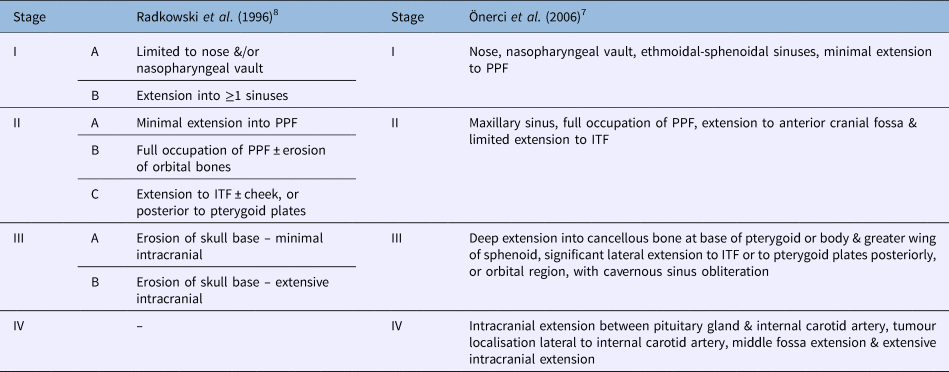
The medical records of 48 male patients histologically confirmed as having JNA, who underwent surgery at the Department of Otolaryngology, Hacettepe University, Ankara, Turkey, between January 2005 and May 2016, were retrospectively reviewed. Routine ENT examination and diagnostic fibre-optic nasopharyngoscopy were performed in each case. Nasal biopsy was not performed in any of the patients because of the risk of massive bleeding. Data from the patients’ medical files, including patient demographics, date of diagnosis, tumour stage, surgical reports, pre-operative and post-operative imaging findings, follow-up duration, and recurrence, were analysed. Tumour stage was determined via pre-operative diagnostic CT and MRI, according to the Radkowski and Önerci classification systems (Table 1).Reference Onerci, Ogretmenoglu and Yucel7, Reference Radkowski, McGill, Healy, Ohlms and Jones8
Staging according to Radkowski and Önerci

PPF = pterygopalatine fossa; ± = with or without; ITF = infratemporal fossa
All of the patients underwent surgery at our hospital, but 10 (20.9 per cent) had undergone primary surgery at other institutions before they were referred to our hospital because of recurrence. Patients who underwent revision surgery after initial surgery at our hospital were classified as recurrent cases. Patients with stable residual tumour tissue during follow up were considered not to have had recurrence.
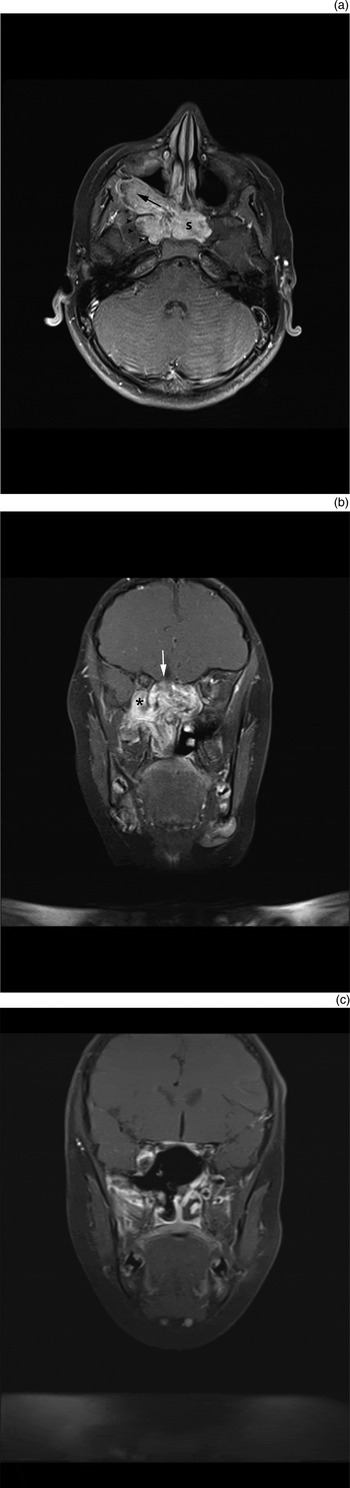
The primary surgical technique was endoscopic in all of the primary cases. The Caldwell–Luc technique was used in eight cases to improve endoscope access to the maxillary sinus. External procedures (Le Fort I and craniotomy) were performed in three of the recurrent cases. All patients underwent post-operative follow-up MRI within 24 hours of surgery to ensure accurate detection of residual tumour tissue (Figure 1). The study protocol was approved by the Hacettepe University School of Medicine Ethics Committee (approval number: GO 16/72-24).
Pre-operative (a) axial and (b) coronal magnetic resonance imaging (MRI) sections of a nine-year-old patient. The mass originates from the sphenopalatine foramen, fills the retroantral space and extends to the infratemporal fossa laterally (black arrow). Pterygoid base (black arrowheads) and sphenoid sinus (S) are invaded by the tumour. Note the minimal skull base erosion (white arrow) and inferior orbital fissure invasion (asterisk) (in part b). (c) Post-operative coronal MRI scan showing total resection of the mass.

Statistical analysis was performed using IBM SPSS Statistics for Windows software, version 23.0 (Armonk, New York, USA), and Microsoft Excel spreadsheet software (Redmond, Washington, USA). Descriptive analysis was performed, and categorical variables were compared using Pearson's chi-square test and Fisher's exact test for small-sample data (n < 5). The normality of the distribution of data was determined using the Shapiro–Wilk test and normal distribution parameters. The student's t-test and Mann–Whitney U test were used to compare two independent samples. The level of statistical significance was set at p < 0.05.
Results
Patients’ characteristics
The mean age (± standard deviation (SD)) of the 48 male patients was 15.1 ± 4.12 years. The mean duration of follow up was 23.2 months (range, 6–120 months). The most common presenting symptom was nasal obstruction (91.6 per cent), followed by recurrent epistaxis (83.3 per cent). A female patient who was initially diagnosed with JNA via histopathological evaluation was excluded from the study after additional detailed histopathological examination showed negative β-catenin expression and unusual localisation at the inferior turbinate.
Staging
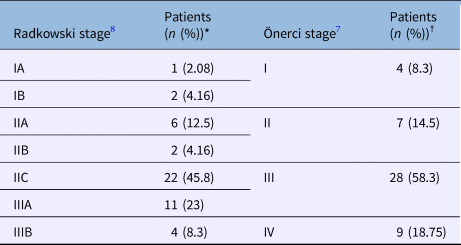
Tumours were staged according to the Radkowski and Önerci staging systems (Table 1).Reference Onerci, Ogretmenoglu and Yucel7, Reference Radkowski, McGill, Healy, Ohlms and Jones8 Based on the Radkowski classification, 1 patient was stage IA (2.08 per cent), 2 were IB (4.16 per cent), 6 were IIA (12.5 per cent), 2 were IIB (4.16 per cent), 22 were IIC (45.8 per cent), 11 were IIIA (23 per cent) and 4 were IIIB (8.3 per cent). According to the Önerci classification, 4 patients were stage I (8.3 per cent), 7 were II (14.5 per cent), 28 were III (58.3 per cent) and 9 were IV (18.75 per cent) (Table 2).
Numbers of patients according to Radkowski and Önerci classification systems

* n = 48;
† n = 48
Embolisation, blood loss and hospitalisation
In all, 30 patients (62 per cent) underwent pre-operative embolisation, and their recurrence rate was 20 per cent. Of the 18 patients who did not undergo pre-operative embolisation, the recurrence rate was 22 per cent. The difference was not significant (p = 0.99). In total, three patients had complications associated with embolisation, as follows: femoral artery thrombosis (n = 1); central retinal artery occlusion due to the embolic agent, followed by partial recovery with medical treatment (n = 1); and transient blindness caused by embolic agent toxicity to the visual cortex (n = 1).
The mean (± SD) hospitalisation duration in all 48 patients was 5.8 ± 1.7 days. The mean (± SD) hospitalisation duration was 6.6 ± 1.5 days in the embolised patients and 4.6 ± 1.3 days in the non-embolised patients (p < 0.001).
Overall, the mean intra-operative blood loss was 574 ml (range, 75–1700 ml). Among the patients with early-stage tumours (Radkowski stage of less than IIC, and Önerci stage of II or less), mean intra-operative blood loss was 108 ml among the embolised patients, versus 256 ml among the non-embolised patients (p < 0.05). In contrast, there was no significant difference in mean blood loss between the embolised (644 ml) and non-embolised (780 ml) patients with advanced-stage tumours (Radkowski stage of IIC or more, and Önerci stage of III or more) (p = 0.09).
Surgical technique
All 48 patients underwent surgery at our hospital, although 10 (20.8 per cent) had undergone primary surgery at other hospitals and were then referred to us because of recurrence. The transnasal endoscopic technique was the initial surgical method in all patients. In eight patients (16.7 per cent), the Caldwell–Luc procedure was additionally performed to provide improved endoscopic visualisation of the maxillary sinus. None of the patients underwent an initial external procedure at our hospital, but three patients required external procedures (Le Fort I osteotomy (n = 2) and craniotomy (n = 1) within the neurosurgery department) for revision surgery. There was no significant difference in the recurrence rate between the patients who underwent initial transnasal endoscopic surgery versus those who underwent the Caldwell–Luc procedure plus transnasal endoscopic surgery (p = 0.66).
Analysis of recurrence
The overall recurrence rate among the 48 patients was 20.8 per cent. In the 10 patients with recurrence, the Radkowski stage was IIC in 3 patients (30 per cent), IIIA in 3 patients (30 per cent) and IIIB in 4 patients (40 per cent). The Önerci stage in these patients was III in four patients (40 per cent) and IV in six patients (60 per cent). Advanced-stage tumours (Radkowski stage of IIC or more, and Önerci stage of III or more) were significantly more aggressive than earlier stage tumours (p < 0.05 and p < 0.01, respectively). In addition, there was a significant difference in the recurrence rate between patients diagnosed aged less than 14 years (34.7 per cent; 8 of 23 patients) and those aged more than 14 years (8 per cent; 2 of 25 patients) (p < 0.05).
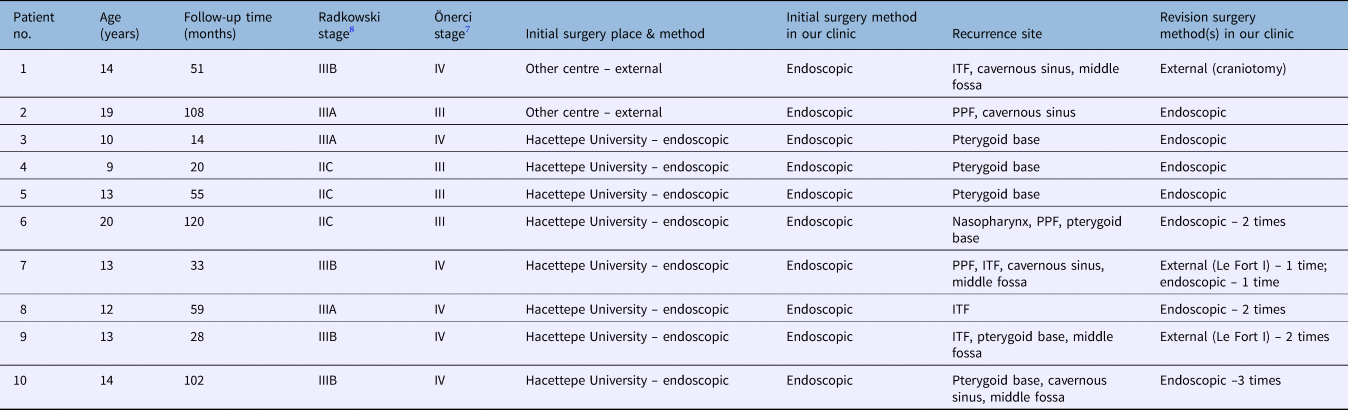
Among the 10 patients with recurrence, 6 (60 per cent) had recurrence at the pterygoid base and Vidian canal. Retrospective analysis of these six patients showed that inadequate drilling of the Vidian canal was performed because of uncontrolled intra-operative bleeding. In contrast, eight non-recurrent cases initially had pterygoid base invasion and underwent Vidian canal drilling during surgery. Vidian canal drilling was associated with a significantly lower risk of recurrence (p < 0.001). Patient number one required external radiotherapy following craniotomy because of intracranial tumour residue. Table 3 summarises the features of the patients with recurrence.
Features of recurrent cases

No. = number; ITF = infratemporal fossa; PPF = pterygopalatine fossa
Discussion
The cardinal symptoms of JNA are recurrent epistaxis, nasal obstruction and nasal discharge. Imaging methods, such as CT and MRI, as well as observation of clinical symptoms and physical examination, are important for the diagnosis and follow up of JNA. Magnetic resonance imaging performed within 24 hours of surgery can be used to accurately detect residual tumour, as granulation tissues have not yet formed and non-tumoural tissues are non-enhancing. We therefore recommend MRI in all patients within 24 hours of surgery. In the present study, 77 per cent of the tumours (37 patients) were of an advanced stage at the time of diagnosis. Misdiagnosing the chronic nasal obstruction patients as having adenoid hypertrophy or rhinosinusitis, and not performing nasal endoscopy in those with recurrent epistaxis, might explain the high number of patients presenting with advanced-stage tumours.
Almost all JNA patients have varying degrees of pterygopalatine fossa invasion, irrespective of the point of origin.Reference Onerci, Ogretmenoglu and Yucel7 While it is easier to control this site endoscopically, endoscopic or midline treatment methods can be ineffective in patients with tumours that extend to the posterior wall of the maxillary sinus, or in those who exhibit noticeable infratemporal fossa invasion with extension to the buccal fat pad.Reference Herman, Lot, Chapot, Salvan and Huy9 These problems have been overcome with the advent of angled endoscopes, but significant extension to the lateral infratemporal fossa should be assessed with critical care, as it is associated with the risk of spread to the middle fossa through the foramen ovale and rotundum. In concordance with these earlier reports, four patients in the present study who underwent revision surgery had recurrent tumour tissue in the infratemporal fossa, of which three had intracranial extension at the time of recurrence, and one had tumour progression and extension to the fossa following revision surgery.
Since the introduction of the endoscope to JNA surgery in the mid-1990s, it has been used for complete resection of tumours and for controlling the surgical cavity after surgery. Although endoscope use is associated with a shallow learning curve, it is also associated with such advantages as enhanced tumour visualisation, prevention of scar formation and no impairment of facial development. Moreover, it has proven useful in such deep structures as the clivus and foramen lacerum, and for localisation of the infratemporal fossa. Despite reports of the limited utility of the endoscope in patients with lesions that extend to the lateral infratemporal fossa fat pad, intracranial extension and extension to the lateral aspect of the cavernous sinus,Reference Nicolai, Villaret, Farina, Nadeau, Yakirevitch and Berlucchi10 we have not encountered any significant limitations of the endoscope that would compel us to intra-operatively switch to an open procedure.
The wide variety of recurrence sites in the present study, including the pterygoid base and pterygopalatine fossa, which are easily accessible via endoscope, indicates that factors other than surgical technique may have played a role in the observed cases of recurrence. Excessive bleeding leading to incomplete tumour resection, inadequate drilling of the Vidian canal, and tumour invasion of such sites as the pterygoid base and cavernous sinus, which are difficult to manipulate, might also have been associated with the diversity of recurrence locations in the present study. Retrospective evaluation of three patients who had recurrence in the pterygopalatine fossa and of six patients with recurrence in the pterygoid base showed that all had uncontrolled intra-operative bleeding and inadequate Vidian canal drilling, which is in accordance with our postulation.
In the present study, there were three extreme recurrent cases with tumours that were too large to allow a cleavage for endoscopic dissection, or with massive intracranial extension; regardless of this, all patients were surgically treated endoscopically without any serious complications. Hence, we suggest that endoscopic surgery be considered the first-line treatment for JNA.
It is thought that recurrence occurs because of regrowth of residual tumour tissue following incomplete resection.Reference Enepekides11 Glad et al.,Reference Glad, Vainer, Buchwald, Petersen, Theilgaard and Bonvin12 Herman et al.Reference Herman, Lot, Chapot, Salvan and Huy9 and Huang et al.Reference Huang, Liu, Wang, Sun, Yang and Wang13 reported overall recurrence rates of 23 per cent, 27 per cent and 31 per cent, respectively, which is similar to the present study's rate of 20.8 per cent. In the present study, the highest recurrence rate was observed in patients with Radkowski stage IIIB tumours (100 per cent) and Önerci stage IV tumours (66.6 per cent). In contrast, none of the patients with Radkowski stage I–IIB or Önerci stage I–II tumours had recurrence. It was reported that 75–93 per cent of recurrent cases had pterygoid base invasion.Reference Onerci, Ogretmenoglu and Yucel7 Howard et al. recommends careful exploration of the Vidian canal to reduce the risk of residual tumour.Reference Howard, Lloyd and Lund14 Among the patients in the present study who developed recurrence, six (60 per cent) had a tumour of pterygoid base origin, and intra-operative exploration of the Vidian canal significantly reduced the risk of recurrence.
Patients in the present study who were diagnosed aged less than 14 years had a higher recurrence rate (34.7 per cent) than those diagnosed aged more than 14 years (8 per cent). Sun et al. reported that age 18 years was the threshold for a significantly increased risk of recurrence.Reference Sun, Wang, Yu, Wang, Wang and Jiang15 In contrast, Liu et al. reported no connection between the age at JNA diagnosis and recurrence.Reference Liu, Wang, Huang, Han, Ferguson and Shi16 We think that the high tumour growth rate due to growth factors that affect the general growth of the body and increased exposure to hormonal effects might explain why the risk of recurrence is higher in patients diagnosed with JNA when aged less than 14 years; however, a definitive answer to this question will require additional research.
• Transnasal endoscopic surgery remains the treatment of choice for juvenile nasopharyngeal angiofibroma
• Pre-operative embolisation is not always necessary; the potential risks and benefits should be carefully considered
• Patients aged less than 14 years and patients with advanced-stage tumours are at greater risk of recurrence
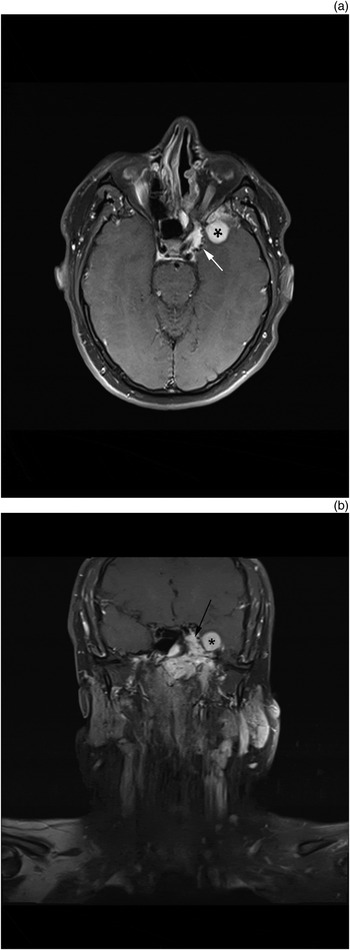
Endovascular methods of treating JNA have improved since the 1970s. Various materials and methods, including particulate agents (polyvinyl alcohol), glue embolisation, onyx and coil embolisation, are used for embolisation. Some studies report that pre-operative embolisation reduces intra-operative bleeding and the need for blood transfusion, eases dissection, decreases the duration of surgery, and reduces the cost of treatment.Reference Li, Qian, Shan and Wang17, Reference Lutz, Holtmannspötter, Flatz, Meier-Bender, Berghaus and Brückmann18 In contrast, others report that embolisation has no effect on the volume of blood loss and that it prolongs hospitalisation duration because it is a form of in-patient treatment.Reference Mohammadi, Saedi and Basam19 Serious complications associated with embolisation, such as stroke and vision loss, have also been reported.Reference Onerci, Gumus, Cil and Eldem20 In the present study, embolisation was observed to prolong hospitalisation duration, particularly by prolonging the pre-operative hospitalisation period. Moreover, three patients in the present study had complications due to embolisation. Interestingly, there was a significant difference in the volume of blood loss between the embolised and non-embolised patients with early-stage tumours, but not between the embolised and non-embolised patients with advanced-stage tumours. This might have been due to the ineffective embolisation of advanced-stage tumours, because such tumours usually derive their nutrient vessels from the internal carotid system (Figure 2).
Pre-operative (a) axial and (b) coronal magnetic resonance imaging sections of recurrent case number 10 (Radkowski stage IIIB, Önerci stage IV). The tumour invades the cavernous sinus (black arrow in part b) and extends to the middle fossa (asterisk). Note the tortuous nutrient vessel from the internal carotid artery (white arrow in part a).

We think it is important to treat residual disease as distinct from recurrence, because residual disease can sometimes exhibit a benign clinical behaviour. Critical attention is necessary when identifying indications for revision surgery in patients with residual tumours, because changes in anatomical landmarks and synechia increase the difficulty and risks of surgery. Some studies advise a wait-and-see approach in cases of residual disease, especially when the tumour is located in the intracranial compartment.Reference Onerci, Ogretmenoglu and Yucel7 In the present study, apart from the recurrent cases presented in Table 3, there were three patients (6.25 per cent) who had radiologically proven residual disease during the post-operative period. These patients were clinically and radiologically followed up for a mean of 37 months. Tumour stage was Önerci stage IV in all cases, and the residual tumours persisted in the intracranial compartment. However, revision surgery was not performed because of the stable condition of the lesions and the risk of complications. We recommend follow up of residual tumours and surgical intervention only in cases of tumour growth.
Conclusion
The present findings show that transnasal endoscopic surgery could be considered the treatment of choice for JNA, based on the high success rate achieved in the present study. Pre-operative embolisation reduces intra-operative bleeding in patients with early-stage tumours, but has no appreciable effect in those with advanced-stage tumours. Patients aged less than 14 years at the time of diagnosis and patients with advanced-stage tumours (Radkowski stage of IIC or more, and Önerci stage of III or more) are at greater risk of recurrence and should be monitored with extreme care.
Competing interests
None declared