Introduction
Intergeneric hybridization is an attempt to cross-species spanning wide taxonomic boundaries for various purposes, including obtaining haploids. Interspecific crosses, intergeneric crosses and intergeneric somatic hybridization have been carried out in rice (Oryza sativa L.) by various researchers (Nezu et al., Reference Nezu, Katayama and Kihara1960; Deming et al., Reference Deming, Shanbao, Xiaolan, Junhua, Xianbin, Yonghui, Liancheng and Bensong1985; Sitch and Romero, Reference Sitch and Romero1990; Jelodar et al., Reference Jelodar, Blackhall, Hartman, Brar, Khush, Davey, Cocking and Power1999) but haploid production through these methods has not been reported. The diploid hybrids (2n = 24) originating from rice × Sorghum (Sorghum bicolor (L.) Moench.) crosses reported by Deming and co-workers (1985) turned out to be sterile and had a delayed developmental timeline. In case of the rice × Porteresia coarctata (Roxb.) Tateoka. crosses, the growth of the pollen tube was inhibited in the stigma style (Sitch et al., Reference Sitch, Romero and Dalmacior1989). Later on, Jena (Reference Jena1994) employed in vitro embryo manipulation to generate hybrids of rice and P. coarctata, though the crossability rate was very low (0.09–0.13%) and the hybrids were completely male sterile. On similar lines, rice yielded hybrids upon pollinating with Leersia perrieri (Camus) Launert. but the crossability rate (0.07%) was reported to be even lower than with P. coarctata (Ballesfin et al., Reference Ballesfin, Vinarao, Sapin, Kim and Jena2018). Intergeneric crosses of rice have also been reported with Rhynchoryza subulata (Nees) Baill (Sitch, Reference Sitch1990; Sitch and Romero, Reference Sitch and Romero1990). Though in this case, the fertilization was incomplete with the pollen tube failing to reach the micropylar end. Contrastingly, in wheat × maize crosses (Triticum aestivum L. × Zea mays L.), the pollen tubes have been reported to reach the micropyle, especially when supplemented by 2, 4-D (Wedzony and van Lammeren, Reference Wedzony and van Lammeren1996). The successful fertilization of wheat with maize pollen followed by the elimination of maize chromosomes leads to haploid induction (Laurie and Bennett, Reference Laurie and Bennett1986; Laurie and Snape, Reference Laurie and Snape1990; Suenaga, Reference Suenaga1994; Inagaki, Reference Inagaki1997; Mujeeb-Kazi and Riera-Lizarazu, Reference Mujeeb-Kazi, Riera-Lizarazu, Mohan Jain, Spory and Veilleux1997) and is used routinely in wheat breeding programmes (Niroula and Bimb, Reference Niroula and Bimb2009; Srivastava and Bains, Reference Srivastava and Bains2018). Similar outcomes have been obtained from wheat × pearl millet (Pennisetum glaucum (L.) R. Br.) crosses (Ahmad and Comeau, Reference Ahmad and Comeau1990; Suenaga, Reference Suenaga1994; Inagaki and Mujeeb-Kazi, Reference Inagaki and Mujeeb-Kazi1995; Inagaki and Hash, Reference Inagaki and Hash1998; Garcia-Llamas et al., Reference García-Llamas, Ramirez and Ballesteros2004; Gernand et al., Reference Gernand, Rutten, Varshney, Rubtsova, Prodanovic, Brüß, Kumlehn, Matzk and Houben2005).
Contrastingly, in the present study, the intergeneric crosses of rice with maize and pearl millet did not yield any practical dividends. Various crossability barriers that either prevent fertilization or lead to early embryo abortion, might be at play. Fertilization may be inhibited due to failure of either pollen germination on stigma or pollen tube growth and penetration (Stebbins, Reference Stebbins1958). As apparent from the previous reports, the intergeneric crosses of rice with various species of family Poaceae are marred by the inhibition of pollen tube growth (Sitch et al., Reference Sitch, Romero and Dalmacior1989, Sitch, Reference Sitch1990; Sitch and Romero, Reference Sitch and Romero1990). Interestingly, the factors affecting incompatibility reaction in hybridizations of rice with either maize or pearl millet have not been reported to date.
The present investigation was undertaken to elucidate the crossability barriers underlying rice × maize and rice × pearl millet crosses. This information could be useful towards adapting the rice wide crosses to emulate the wheat × maize system.
Materials and methods
Plant material, pollination and Auxin treatment
Rice cultivar Punjab Rice 121 (PR 121) was grown during the Kharif season (field season spanning May to November, coinciding with the monsoons/rains in India) in a field set-up. The individual plants were uprooted and transplanted into buckets (along with rhizosphere soil) 2 days prior to pollination. Emasculated spikelets were pollinated with pollen from maize inbred lines LM 13 and LM 14 or hybrids PMH1 and PMH3 or a mixture of maize pollen and pollen from pearl millet inbred lines PIB 626 and PIB 686. In total, seven pollen samples were used for pollination. Twenty-four hours after pollination (24 HAP), the pollinated panicles were supplemented with either 100 ppm or 150 ppm of different auxins (either 2, 4-D or DICAMBA). The auxin supplementation was done by injection into the culm. Eight days after pollination, panicles were checked for embryo formation. Any caryopses formed were analysed for the presence of embryos by dissecting them under the stereo-microscope. A few caryopses and any embryos that could be rescued were cultured for regeneration on half-strength Murashige−Skoog (MS) media (Murashige and Skoog, Reference Murashige and Skoog1962).
Examination of pollen tube growth in whole-mount preparations
For studying the pollen tube penetration, pistils were collected from the pollinated spikelets at 6 HAP and 24 HAP into Carnoy's Solution II and subsequently rehydrated through a decreasing ethanol series. They were cleared in 0.05 M disodium phosphate (Na2HPO4) at 50°C for 2 h and then left overnight at room temperature. The pistils were subsequently rinsed in double distilled water three times and transferred into a decolourized aniline blue solution (DABS). They were left to stain overnight. The pistils were then mounted in 50% glycerol and covered with a coverslip; gentle pressure was applied to spread the tissue. The pistil was then observed under UV light excitation in Zeiss Axio Imager Z.2.
Results
The crosses of PR 121 with maize inbreds, hybrids and pearl millet inbreds (Table 1) did not yield healthy caryopses, even upon supplementation with auxins. Of 23,343 spikelets pollinated with maize, and 14,014 spikelets pollinated with pearl millet, 308 and 186 gave rise to caryopses, respectively. Of 308 caryopses resulting from rice × maize crosses, 269 were flaccid and weak, as were 140 of the caryopses originating from rice × pearl millet crosses. Upon dissection, the flaccid caryopses were revealed to have ‘watery’ endosperm and did not carry any embryo. A few flaccid caryopses cultured directly on MS media without dissection, did not regenerate. The remaining 85 caryopses yielded a semi-solid white endosperm upon dissection, which indicated that these had resulted from emasculation escapes. The embryos from these caryopses gave rise to healthy plantlets under tissue culture conditions and upon transplanting developed into healthy plants of PR121 type. Further pollen fertility studies showed close to 100% fertile pollen establishing these had indeed originated from selfing. The low incidence of caryopsis formation even upon supplementation indicated that both the maize pollen and the pearl millet pollen did not elicit a compatible reaction from the rice female gametophyte. No significant difference in fertilization capability of maize and pearl millet pollen was observed (unpaired t-test df = 6, t = 0.426, P = 0.68). Application of DICAMBA in place of 2,4-D also did not yield any significant improvement (unpaired t-test, df = 6, t = −1.26, P = 0.25).
Details of intergeneric crosses were carried out to study fertilization efficiency of rice × maize and rice × pearl millet crosses under supplementation with different auxins. (R × M = rice × maize, R × B = rice × pearl millet)

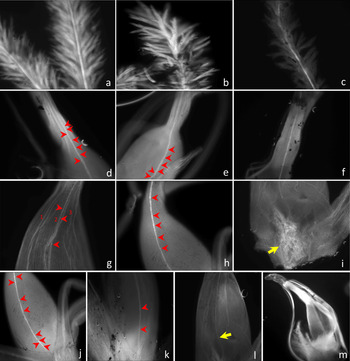
Imaging of DABS-stained pistils confirmed the incompatibility of rice pistils with the maize pollen as well as the pearl millet pollen. The papillae fostered intensive callose depositions indicating that the incompatibility started at the stigmatic surfaces (Fig. 1a, 1b). At both 6 HAP and 24 HAP (Fig. 1d, 1e, 1g and 1h) multiple pollen tubes were seen obstructed with intense callose depositions in the style. Callose depositions were visible in the zone of tube transmission, which is a known indicator of incompatible reaction (Fig. 1d). Pollen tubes could be seen reaching the ovary, highly occluded by callose plugs till the tip (Fig. 1j and 1k).
Features observed in pistils under fluorescent microscope upon DABS staining (Callose depositions are marked by red arrowheads, yellow arrows indicate markers of compatible rection). (a) Rice pistil treated with maize pollen exhibit callose depositions on papillar surfaces. (b) Rice pistil treated with pearl millet pollen exhibit callose depositions on papillar surfaces. (c) Rice pistil treated with rice pollen − callose depositions not seen on papillar surfaces. (d) Callose plugs fostered in pollen tube growing through the style in pistil pollinated with maize at 6HAP. Callose deposits are also seen in zone of tube transmission. (e) Callose plugs seen in pollen tube growing through the style in pistil pollinated with pearl millet at 6HAP. (f) Pistil in R × R cross does not foster callose depositions as it grows through the style, 6HAP. (g) Callose depositions and multiple pollen tubes (marked as 1, 2,3) seen in pistil from R × M cross at 24HAP. (h) Callose plugs seen in pistil from R × B cross at 24HAP. (i) Visible reaction at micropylar end in pistil treated with rice pollen marked by arrow. (j) Rice pistil treated with maize pollen shows callose depositions in the ovary. (k) Rice pistil treated with pearl millet pollen shows callose depositions in the ovary. (l) Rice pistil treated with rice pollen shows a pollen tube unhindered by callose plugs, the tip does not show occlusion (marked by arrow), thus making way for the release of pollen. (m) Caryopses with internal structured beginning to form at 24 HAP from rice pistil treated with rice pollen.

In the case of the rice × rice cis-generic crosses simulating self-pollination, stigmatic surfaces did not show intense fluorescence indicating low callose deposition (Fig. 1c). A single pollen tube was observed penetrating the style (Fig. 1f). The indicators of normal reaction became visible at the micropylar end at 6 HAP (Fig. 1i). The tube was not obstructed at the tip in this case (Fig. 1l). Callose depositions, though not as intense, were seen in the growing pollen tube. We observed true caryopses with internal structures beginning to form, at 24 HAP in the case of cis-generic crosses (Fig. 1m).
Discussion
In the current study, we endeavoured to investigate pollen pistil interaction at the level of pollen tube germination in wide crosses of rice. The rice stigma is a papillate structure and forms the first base for the interaction with the incoming pollen. The stigma/pollen interaction is a highly specialized system that favours certain genotype combinations (Heslop-Harrison, Reference Heslop-Harrison1975). Pollen adhesion to the stigma, its germination, and pollen tube growth through stigma and style are achieved if a compatible combination is established. In the case of an incompatible reaction, the pollen tube can be arrested by callose depositions as it grows through the transmitting tract of the style. Callose (β-1,3-glucan) is then often accumulated in the pollen tube tip (Baum et al., Reference Baum, Lagudah and Appels1992). Callose deposition has been associated with a variety of functions including plant defence responses where it is useful for sequestering anti-bacterial compounds (Luna et al., Reference Luna, Pastor, Robert, Flors, Mauch-Mani and Ton2011). Callose is also deposited at the primary cell wall of meiocytes, tetrads and microspores, and is essential for exine formation in the pollen wall (Dong et al., Reference Dong, Hong, Sivaramakrishnan, Mahfouz and Verma2005). Thus, callose acts as both a molecular filter and a physical barrier. The pollen tubes contain callose both in their walls as well as in the plugs that segment the growing tubes. During pollen tube penetration, callose can serve as a leak sealant and a physical barrier depending upon whether the reaction is compatible or incompatible.
Our study demonstrated that rice × rice crosses have lower callose accumulation as compared to rice × maize and rice × pearl millet crosses, underlining the difference between compatible and incompatible fertilization reactions. A compatible pollen tube exhibits small, intermittent, widely spaced callose plugs as opposed to heavy callose accumulation in incompatible wide crosses. Stott (Reference Stott1972) observed that the incompatible pollen tubes are slower growing, marked by heavy callose depositions along and at the end of the tube. In avocado (Persea americana Mill.) as well as Brassica species, self-incompatibility is explained by callose occlusion of pollen tubes (Sedgley, Reference Sedgley1977; Sulaman et al., Reference Sulaman, Arnoldo, Yu, Tulsieram, Rothstein and Goring1997). In grasses, callose is formed within the incompatible tubes; as a wall lining, plugs and occluding the tip (Shivanna et al., Reference Shivanna, Heslop-Harrison and Heslop-Harrison1978). As early as Reference Heslop-Harrison1982, Heslop-Harrison described the callose plugs as an important part of pre-zygotic fertilization barriers in grasses. Callose plugs blocking incompatible pollen tubes are also observed in interspecific crosses as exemplified by Populus spp. (Gaget et al., Reference Gaget, Said, Dumas and Knox1984). Callose depositions along the walls and blocking the tip, as reported in Petunia hybrida Vilm. characterize gametophytic incompatibility (Unal, Reference Unal1986). The number of callose particles deposited into the pollen tube surges during an incompatible reaction due to premature degeneration of pollen tube cytoplasm (Cresti and van Went, Reference Cresti and Van Went1976). As reviewed by Dumas and Knox (Reference Dumas and Knox1983), callose depositions along the stylar regions are indicative of mutual rejection. Our imaging of rice pistils pollinated with maize and pearl millet pollen showed these standard markers of incompatible reaction.
Low crossability rates and high levels of incompatibility are common in rice wide crosses outside genus Oryza (Deming et al., Reference Deming, Shanbao, Xiaolan, Junhua, Xianbin, Yonghui, Liancheng and Bensong1985; Sitch and Romero, Reference Sitch and Romero1990; Jena, Reference Jena1994; Ballesfin et al., Reference Ballesfin, Vinarao, Sapin, Kim and Jena2018), a trend reinforced by the present study. Inhibition/arrest of pollen tube growth as seen in the present study has been observed earlier in rice and Portresia coarctata crosses (Sarker et al., Reference Sarker, Samad, Seraj, Hoque and Islam1993). The same study also reported that for compatible reactions in rice, pollen tube reached ovary between 75 and 150 min and the reaction is complete within 6 h. In Pennisetum species, delayed ovary penetration over 10–15 HAP has been observed in interspecific wide crosses due to slow pollen tube growth (Kaushal and Sidhu, Reference Kaushal and Sidhu2000). In the current study, rice × maize and rice × pearl millet crosses did not show any signs of compatibility even at 24HAP, whereas the self-pollinated pistils showed caryopsis formation by this point. The formation of false caryopses upon auxin treatment can be due to histological changes and ovary enlargement elicited by supplementation (Wedzony and van Lammeren Reference Wedzony and van Lammeren1996; Kapoor and Singh, Reference Kapoor and Singh2017). The absence of embryo-formation, as observed in the present investigation, is a common occurrence during wide hybridization in cereals (Zenkteler and Nitzsche, Reference Zenkteler and Nitzsche1984). No significant differences in embryo formation were seen upon supplementing with different auxins. In contrast, Kapoor and Singh (Reference Kapoor and Singh2017) found that the DICAMBA treatment-induced enlarged ovaries and embryo development in oat (Avena sativa L.) × maize crosses; the auxin treatment was most efficient when administered at 48 HAP. Additionally, genotype specificity influences the success of wide crosses (Jamwal et al., Reference Jamwal, Chaudhary, Badiyal and Hussain2016).
Conclusion
The current study underlines the inability of rice × maize and rice × pearl millet crosses to serve as a haploid induction system for rice without intervention. Pollination techniques including mentor pollen, delayed pollination, gibberellic acid treatment and preliminary auxin treatment might be tested to overcome incompatibility. In future, different rice genotypes along with different concentrations and combinations of auxins as suggested by Mahato and Chaudhary (Reference Mahato and Chaudhary2019) can be evaluated for successful wide hybridization. Further ultrastructural studies might be needed to study associated pre-fertilization reactions that hinder compatibility.
Acknowledgements
The authors are grateful to Bayer's Beachell Borlaug International Scholars Program (earlier Monsanto's Beachell Borlaug International Scholars Program) and Council of Scientific and Industrial Research and University Grants Commission administered joint Junior Research Fellowship for financial support. The authors also express their gratitude to the Maize section and the Millet section, Department of Plant Breeding and Genetics, PAU for providing seeds of maize and pearl millet cultivars used in this study. The authors acknowledge the Centre of Excellence on Brassicas, Department of Plant Breeding and Genetics, PAU where the work described in this study was carried out in part. The authors are grateful to Dr S.S. Banga, Dr Parveen Chhuneja and Dr Palvi Malik for their feedback.