





Peripartum depression (PPD), conceptualised in DSM-5-TR as major depressive disorder with peripartum onset, is a common complication of pregnancy and the postnatal period that can substantially impair maternal functioning, infant caregiving and family well-being. 1,Reference Slomian, Honvo, Emonts, Reginster and Bruyère2 Although the DSM-5-TR specifier emphasises onset during pregnancy or within 4 weeks postpartum, clinical and public health literature increasingly recognises that depressive episodes often extend across the first postpartum year. Reference Slomian, Honvo, Emonts, Reginster and Bruyère2,Reference Robbins, Ko, D’Angelo, Salvesen von Essen, Bish and Kroelinger3
PPD is associated with poorer maternal health and adverse outcomes in bonding and child development, making prevention and early identification a priority. Reference Slomian, Honvo, Emonts, Reginster and Bruyère2,Reference Bluett-Duncan, Kishore, Patil, Satyanarayana and Sharp4 Routine perinatal contact with health services offers repeated opportunities for detection, yet systematic screening and referral pathways remain inconsistent in many settings. Reference Webb, Uddin, Ford, Easter, Shakespeare and Roberts5,Reference Yang, Wang, Wang, Liu, Lun and Ma6
In South Africa, perinatal depressive symptoms are reported at particularly high levels, with studies in low-resource contexts describing the proportion screening positive for PPD at around 30–37% and antenatal symptoms affecting a third or more of pregnant women. Reference Nweke, Ukwuoma, Adiuku-Brown, Okemuo, Ugwu and Nseka7–Reference Ramohlola, Maimela and Ntuli9 This burden is shaped by structural and interpersonal stressors, including poverty, gender-based violence and living with HIV, alongside limited access to routine mental healthcare. Reference Peltzer, Rodriguez, Lee and Jones10,Reference Honikman, Sigwebela, Schneider, Field, Kathard, Padarath, Galvaan and Lorenzo11
The aetiology of PPD is multifactorial, with biological vulnerability interacting dynamically with psychological and social stressors. Reference Yim, Tanner Stapleton, Guardino, Hahn-Holbrook and Dunkel Schetter12 Interpersonal adversity may mediate risk, helping to explain why some women develop depression during the peripartum period whereas others do not. Reference Beydoun, Beydoun, Kaufman, Lo and Zonderman13 Within this framework, modifiable social conditions – particularly the availability of supportive relationships – represent clinically actionable targets. Reference Dennis and Dowswell14
Social support refers to the emotional and practical resources available through one’s social network. Reference Acoba15 It is commonly operationalised as perceived support, which shows consistent positive associations with mental health outcomes and resilience. Reference Gariépy, Honkaniemi and Quesnel-Vallée16 In South African settings, emerging evidence suggests that perceived social support may buffer pathways to postnatal depressive symptoms, even amid chronic socioeconomic adversity. Reference Mathew, Lund and Seward17,Reference Peltzer and Shikwane18
Given the high local burden and the feasibility of assessing support needs during routine care, this study aimed to determine the relationship between perceived social support and peripartum depressive symptoms in a South African cohort.
Method
Study design and setting
This cross-sectional, analytical quantitative study was conducted at the antenatal clinic and postnatal ward of Tshwane District Hospital (TDH), an urban district-level public hospital providing routine care to lower-risk peripartum women in Pretoria, Gauteng province, South Africa.
Participants
Eligible participants were women aged ≥18 years who were in the peripartum period (from the beginning of pregnancy to 4 weeks postpartum), able to provide informed consent and willing to participate. Women who were medically unwell (e.g. postpartum haemorrhage, sepsis or peripartum cardiomyopathy) or unable to complete the study procedures were excluded.
Sampling and recruitment
A convenience sampling strategy was used. Although the convenience, single-site design limits statistical generalisability, the setting offers a relevant public sector clinical context and may be informative for similar district-hospital populations. The primary investigator approached potential participants, explained the study, obtained written informed consent and then provided a self-administered questionnaire. The final sample size of n = 200 was determined to be sufficient for the planned analyses.
Data collection
Social determinants of health questionnaire
A specially designed questionnaire assessed the social determinants of health as defined by the World Health Organization and operationalised using the Healthy People 2030 five-domain framework, drawing items from the following domains: economic stability, access to quality education, access to quality healthcare, neighbourhood and built environment and social and community context. 19 Items included age; education; employment; receipt of a social grant; food security; chronic medical illness; urbanicity; housing characteristics (fixed home, access to running water, sanitation, electricity); relationship status; religious affiliation; prior diagnosis of a depressive disorder (timing and treatment received); and experiences of discrimination.
Social support
Social support was assessed using the Oslo Social Support Scale (OSSS-3), a validated, three-item, self-report instrument. Reference Kocalevent, Berg, Beutel, Hinz, Zenger and Härter20 Total scores were categorised as either poor (3–8), moderate (9–11) or strong (12–14) social support.
Depressive symptoms
Depressive symptoms were assessed using the Edinburgh Postnatal Depression Scale (EPDS), a validated, ten-item, self-report screening measure designed for use during pregnancy and the postpartum period. Reference Levis, Negeri, Sun, Benedetti and Thombs21,Reference Lawrie, Hofmeyr, de Jager and Berk22 EPDS is a screening tool and not a diagnostic instrument. The primary outcome was screening positive for clinically significant depressive symptoms, defined as EPDS ≥13 (higher specificity for probable depression). A sensitivity analysis additionally used EPDS ≥11 to assess whether observed associations were consistent at a lower threshold. For methodological robustness, EPDS cut-offs of 11 and 13 were both examined to capture the trade-off between broader case detection at the threshold that maximises combined sensitivity and specificity (≥11), and greater specificity for more severe depressive symptoms at a higher threshold (≥13). Reference Levis, Negeri, Sun, Benedetti and Thombs21,Reference Kendall-Tackett23 Outcomes are therefore reported as the proportion of participants screening positive in this sample rather than a population prevalence estimate.
Ethical standards
All procedures contributing to this work comply with the ethical standards of the relevant national and institutional committees on human experimentation, and with the Helsinki Declaration of 1975 as revised in 2013. Approval was obtained from the University of Pretoria Faculty of Health Sciences Research Ethics Committee (approval no. 724/2022, 14 April 2023), the Master of Medicine Committee and the National Health Research Database. Strengthening the Reporting of Observational Studies in Epidemiology reporting guidelines for cross-sectional observational studies were followed. Permission to conduct the study was obtained from the Chief Executive Officer of TDH.
Participation was voluntary, and participants could withdraw at any time without penalty or adverse effects. Confidentiality was maintained, and hospital numbers were recorded solely to prevent duplicate participation. Data were stored securely by the principal investigator.
If a participant screened positive with suicidality, appeared to be at risk of harm to self or others or required treatment for a mental illness, an appropriate referral was initiated according to local pathways. For peripartum in-patients, the treating clinical team was advised to refer to the relevant in-patient psychiatric or psychological services; for antenatal clinic participants, referral recommendations were made via the clinic’s established referral processes.
Results
Sociodemographic factors
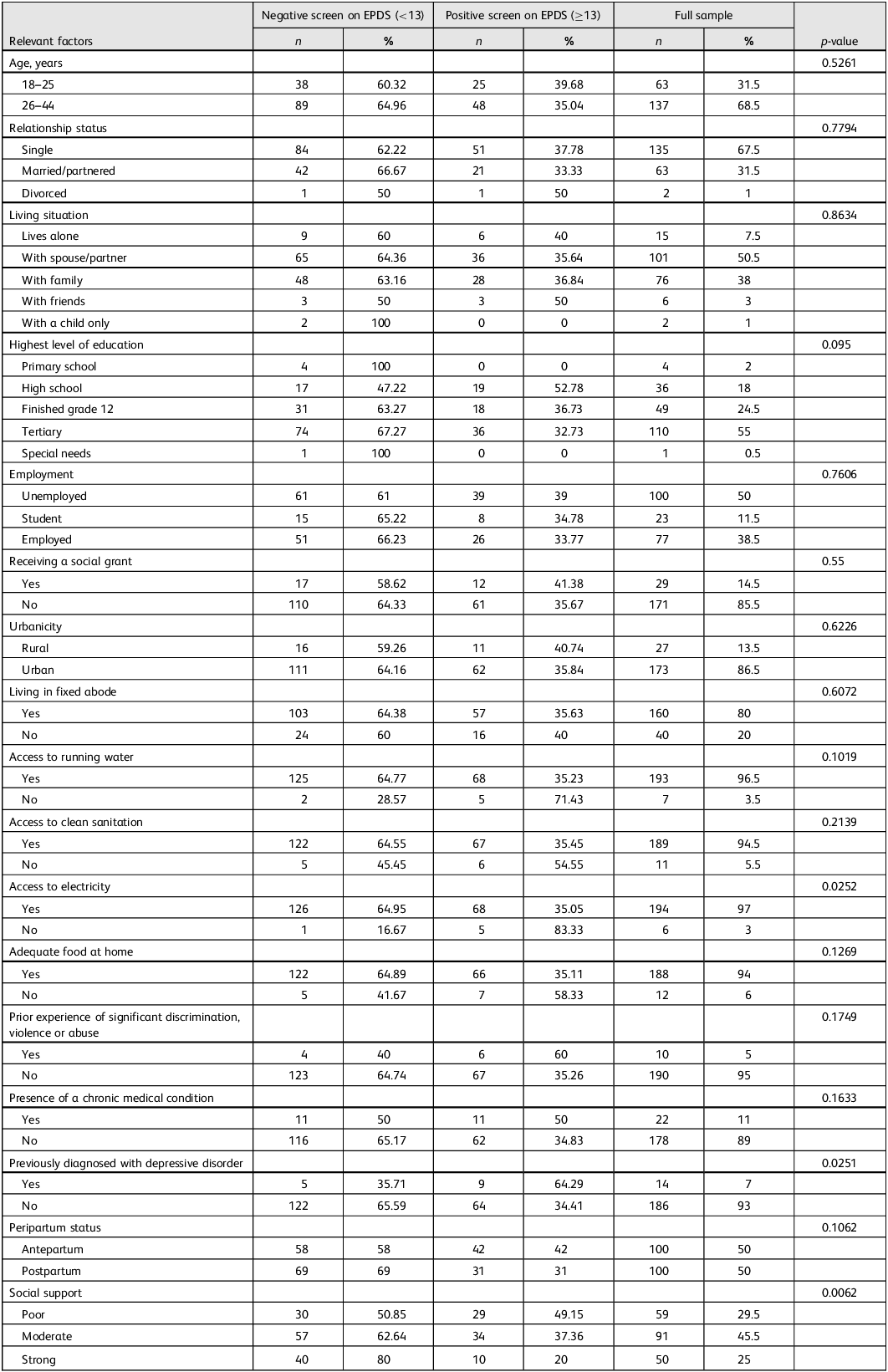
Data were collected from 200 participants, including 100 from the antenatal clinic and 100 from the postnatal ward. Participant characteristics are shown in Table 1. Two-thirds of participants were aged between 26 and 44 years (68.5%, n = 137), with the remainder aged between 18 and 25 years (31.5%, n = 63). Most participants were single (67.5%, n = 135). Half of the participants lived with their partner (50.5%, n = 101), and most of the remainder lived with their family (38.0%, n = 76). A minority of participants received social grants (14.5%, n = 29). Approximately half of the participants had tertiary education (55.0%, n = 110) and half were unemployed (50.0%, n = 100). Almost all participants lived in an urban environment (86.5%, n = 173) and in a fixed abode (80.0%, n = 160). Most participants had access to running water (96.5%, n = 193), clean sanitation (94.5%, n = 189), electricity (97.0%, n = 194) and adequate food (94.0%, n = 188). A small proportion of participants experienced significant discrimination, violence or abuse (5.0%, n = 10). Most participants did not have a chronic medical condition (89.0%, n = 178). A previous diagnosis of depressive disorder was present in 7% (n = 14) of participants, most of whom were diagnosed more than 12 months before their current pregnancy (64.29%, n = 9) and were mainly treated with psychosocial therapy (64.29%, n = 9).
Relevant factors and their association with screening positive for clinically significant depressive symptoms on the Edinburgh Postnatal Depression Scale (EPDS)

Table 1 Long description
The table presents data on various factors and their association with screening positive for clinically significant depressive symptoms on the Edinburgh Postnatal Depression Scale (EPDS). It includes 13 rows and 10 columns, with column headers: Negative screen on EPDS (<13), Positive screen on EPDS (<13), and Full sample. Each row represents a different factor, such as age, relationship status, living situation, education level, employment status, social support, urban/rural living, access to water, clean sanitation, electricity, adequate food, experience of significant discrimination, violence or abuse, chronic medical condition, previous diagnosis with depressive disorder, peri/partum status, and social support. Each row provides the count and percentage of participants for each factor under the three screening categories. Notable trends include the majority of participants being aged between 26 and 44 years, single, living with their partner or family, having tertiary education, being unemployed, living in an urban environment, having access to running water, clean sanitation, electricity, and adequate food. A small proportion experienced significant discrimination, violence or abuse, and most did not have a chronic medical condition. A previous diagnosis of depressive disorder was present in 7% of participants.
Social support
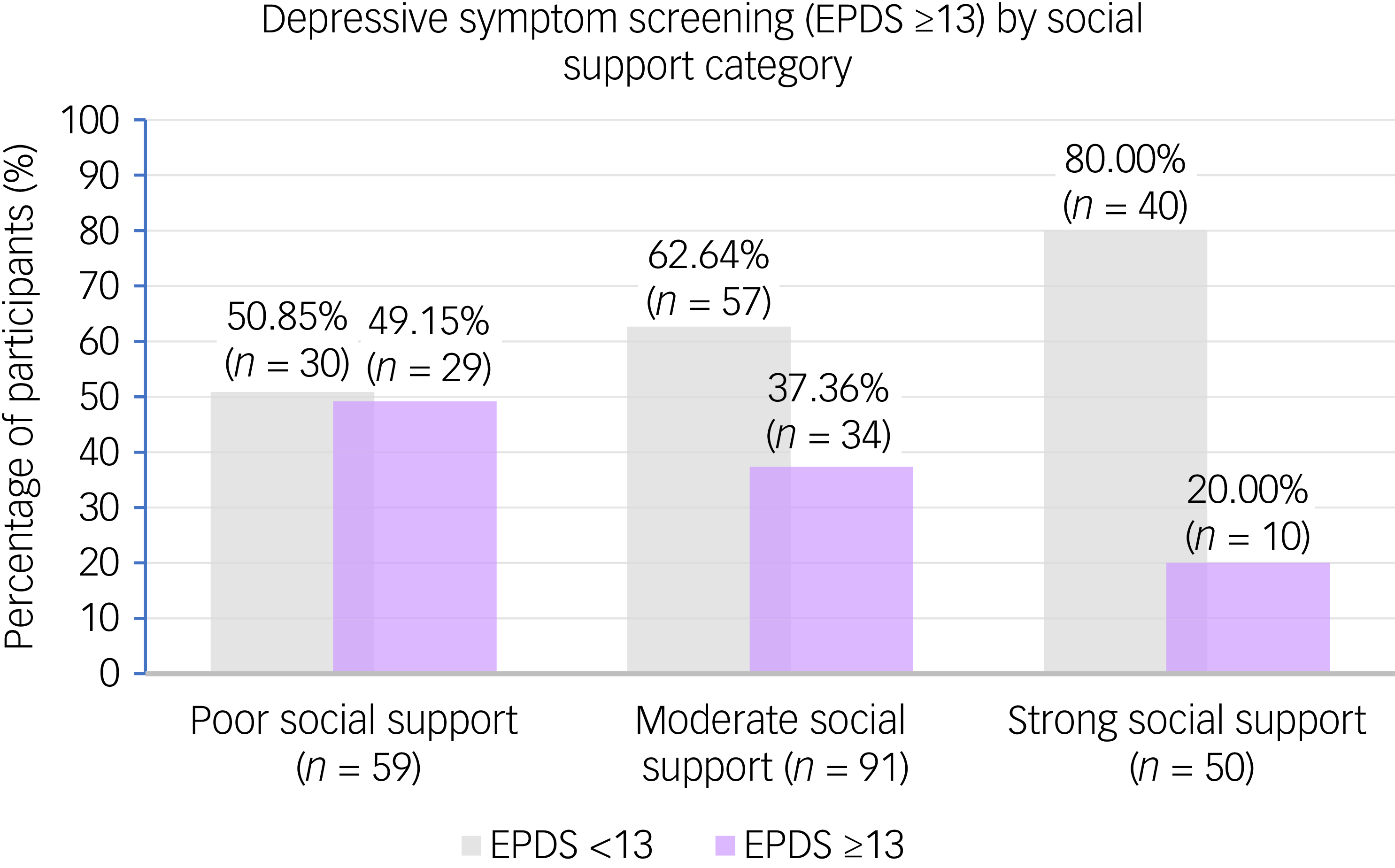
Poor social support (OSSS-3 score 3–8) was reported by 29.5% (n = 59) of participants, moderate social support (9–11) by 45.5% (n = 91) and strong social support (12–14) by 25.0% (n = 50). The distribution of OSSS-3 categories is shown in Fig. 1.
Distribution of EPDS screening outcome (<13 and ≥13) across Oslo Social Support Scale categories (poor 3–8, moderate 9–11, strong 12–14). Bars show proportions, labels show numbers (n) and percentages (%). EPDS, Edinburgh Postnatal Depression Scale.

Depressive symptoms
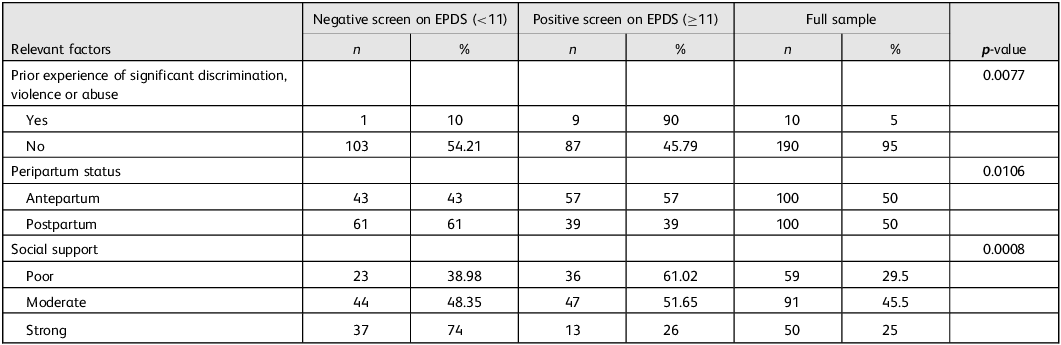
Using the primary EPDS cut-off of ≥13, 36.5% (n = 73) of participants screened positive for clinically significant depressive symptoms and 63.5% (n = 127) screened negative (Table 1). As a sensitivity analysis, applying the alternative EPDS cut-off of ≥11, 48.0% (n = 96) screened positive and 52.0% (n = 104) screened negative (Table 2).
Significant factors and their association with screening positive for clinically significant depressive symptoms on the Edinburgh Postnatal Depression Scale (EPDS) with a lower cut-off for sensitivity

Table 2 Long description
The table presents data on factors associated with screening positive for clinically significant depressive symptoms on the Edinburgh Postnatal Depression Scale (EPDS) using a cut-off of 11. It has four rows and seven columns. The columns are labeled as follows: Relevant factors, Negative screen on EPDS (<11) n, Negative screen on EPDS (<11) %, Positive screen on EPDS (≥11) n, Positive screen on EPDS (≥11) %, Full sample n, Full sample %, and P-value. The row labels include Prior experience of significant discrimination, violence or abuse, Peripartum status, and Social support. Each row provides data for the relevant factors, with subcategories such as Yes and No for Prior experience, Antepartum and Postpartum for Peripartum status, and Poor, Moderate, and Strong for Social support. The table includes values for each subcategory under the respective columns, showing the count and percentage of participants who screened negative or positive on the EPDS. Notable trends include the P-values indicating statistical significance for certain factors.
Associations with screening outcome
Using the primary cut-off (EPDS ≥13), three factors were significantly associated with screening positive: lack of access to electricity at home (p = 0.0252), a previous diagnosis of depressive disorder (p = 0.0251) and lower perceived social support (p = 0.0062) (Table 1). The proportion screening positive decreased across OSSS-3 categories, from 49.15% in the poor social support group to 37.36% in the moderate group and 20.0% in the strong support group (Table 1 and Fig. 1).
In the sensitivity analysis (EPDS ≥11), prior experience of significant discrimination, violence or abuse (p = 0.0077) and antepartum status (p = 0.0106) were additionally associated with screening positive (Table 2). The association between social support and screening outcome remained significant and was stronger at the lower cut-off (p = 0.0008), with 61.02% screening positive in the poor support group, 51.65% in the moderate group and 26.0% in the strong support group (Table 2).
Discussion
Few studies in South Africa have examined how social determinants of health and social support relate to perinatal depressive symptoms, and our findings add to this underdeveloped evidence base. Reference Ng’oma, Bitew, Kaiyo-Utete, Hanlon, Honikman and Stewart24 In our sample, a high proportion of participants screened positive for clinically significant perinatal depressive symptoms, consistent with prior South African studies reporting rates from 22 to 57%, noting that instruments and thresholds vary. Reference Ng’oma, Bitew, Kaiyo-Utete, Hanlon, Honikman and Stewart24–Reference Mokwena and Masike27 These elevated rates may reflect structural pressures in many urban low- and middle-income settings, including socioeconomic deprivation, housing insecurity and barriers to timely, high-quality healthcare. Reference Ng’oma, Bitew, Kaiyo-Utete, Hanlon, Honikman and Stewart24,Reference Mokwena and Masike27,Reference van Heyningen, Myer, Onah, Tomlinson, Field and Honikman28
Perceived social support has shown a protective association with depressive symptoms. Reference Cho, Lee and Choi29 Women reporting lower perceived support were more likely to screen positive, suggesting that limited or unreliable support networks may increase vulnerability during pregnancy and early motherhood. Reference Tomlinson, Swartz, Cooper and Molteno30 This pattern closely mirrors South African findings across several contexts. Among HIV-infected pregnant women initiating antiretroviral therapy in the Western Cape, perceived social support and HIV-related stigma were strongly interrelated and both were associated with higher EPDS symptom scores, with stigma shaping the apparent protective association of support. Reference Brittain, Mellins and Phillips31 In the postnatal period, a study of HIV-positive women in Mpumalanga found that depressed mood was independently associated with both lower social support and discrimination experiences. Reference Peltzer and Shikwane18 Similarly, peripartum research in Nkangala district reported that the probability of postnatal depression was associated with partner support and receipt of social support, alongside partner violence and economic stressors. Reference Modjadji and Mokwena32
South African cohort work also highlights the centrality of close relationships as a core component of support. In Soweto, antenatal longitudinal data identified partner and family stressors as key drivers of persistent depression and anxiety across pregnancy, and that study measured several practical and relational dimensions of social support, including access to help, a confidante and ability to speak to a partner. Reference Redinger, Pearson, Houle, Norris and Rochat33 Earlier cohort evidence from the same setting found that reported difficulties with a partner predicted postnatal depression, reinforcing partner relationship quality as a locally salient support pathway. Reference Ramchandani, Richter, Stein and Norris34
At the cut-off score of 13 or above, in addition to lower perceived support, lack of access to electricity and a history of depression were associated with screening positive. Electricity access is a marker of material disadvantage that affects daily functioning through lighting, heating and food storage, and its absence can increase the time and stress required for routine tasks. Reference Hernández35,Reference Li, Xie and Wei36 It may also reduce digital connectivity, limiting contact with supportive others and access to health information. Reference Houngbonon, Le Quentrec and Rubrichi37 A prior diagnosis of depression remained a strong predictor of perinatal symptoms, consistent with vulnerability to recurrence during periods of heightened biological and psychosocial stress. Reference Biaggi, Conroy, Pawlby and Pariante38
Using the lower cut-off score of 11 or above, additional adversities were associated with screening positive, particularly experiences of discrimination and exposure to violence or abuse. This aligns with South African evidence linking discrimination and stigma to perinatal depressive symptoms, and reinforces the importance of routinely assessing these exposures when interpreting symptom presentations. Reference Peltzer and Shikwane18,Reference Brittain, Mellins and Phillips31,Reference Tsai, Tomlinson, Comulada and Rotheram-Borus39,Reference Govender, Naidoo and Taylor40 At this threshold, antenatal participants screened positive more frequently than postpartum participants. This may reflect antenatal stressors such as fear of childbirth, financial insecurity and role transition, alongside stigma and self-criticism about low mood during a period that is socially framed as joyful. Reference Peltzer, Rodriguez, Lee and Jones10,Reference Govender, Naidoo and Taylor40–Reference Hildingsson, Nilsson, Merio and Larsson42
Although antenatal services often focus on obstetric risk and severe mental illness, integrated screening for depressive symptoms alongside key social risks is not yet routine. Clear referral pathways and stepped-care options, including peer support and family-focused components, may improve identification and linkage to care in resource-constrained settings. Reference Honikman, Field, Sigwebela, April, James and Hermanus43
It is crucial to acknowledge the limitations of this work. First, the cross-sectional design allows for the identification of associations only, not causal relationships. Second, the single-site, convenience sampling at an urban hospital means the findings cannot be generalised to rural areas or high-risk obstetric populations, such as those with pre-eclampsia or fetal complications. Third, the study was conducted exclusively in English, potentially excluding women more comfortable with indigenous languages. Fourth, EPDS remains a screening tool and not a diagnostic one. Finally, the omission of obstetric history, specifically parity, is a significant limitation. Parity was not assessed, although it may influence both depressive symptoms and the availability, type and adequacy of social support during the peripartum period.
Conclusion
In this sample of peripartum women attending a South African district hospital, a substantial proportion screened positive for clinically significant depressive symptoms and lower perceived social support was strongly associated with screening positivity. These findings support the value of integrating brief screening for depressive symptoms and social support into routine perinatal care, alongside clear referral pathways and accessible psychosocial support options. Future research should expand to include more diverse, rural and high-risk obstetric populations, with a specific focus on the role of parity and the mechanisms through which different types of support confer resilience. Prioritising maternal mental health screening and fostering supportive social networks are essential steps towards improving outcomes for mothers and children in South Africa.
Data availability
Anonymised data supporting the findings of this study are available from the first and corresponding author, M.B.-K., upon reasonable request, subject to the terms of the ethics approval granted by the University of Pretoria Faculty of Health Sciences Research Ethics Committee (approval no. 724/2022).
Acknowledgements
The authors thank Dr Cheryl Tosh from the University of Pretoria for providing language writing support. The authors also thank Maryn Viljoen for providing statistical support.
Author contributions
M.B.-K. contributed to the conceptualisation of the study, conducted the literature review, obtained ethical approval, conducted the data collection and wrote the final manuscript. H.S.B. provided supervision, assisted in writing the manuscript and critically reviewed the final draft. T.D.M. provided supervision, assisted in writing the manuscript and critically reviewed the final draft.
Funding
This research received no specific grant from any funding agency in the public, commercial or not-for-profit sectors.
Declaration of interest
None.
Consent to participate
Written informed consent was obtained from all participants.
Transparency declaration
The lead author affirms that the manuscript is an honest, accurate and transparent account of the study being reported; that no important aspects of the study have been omitted; and that any discrepancies from the study as planned have been explained.
Thesis citing
This work is part of a dissertation for partial fulfilment of the requirements for the degree of Master of Medicine (Psychiatry).

 Open access


eLetters
No eLetters have been published for this article.