INTRODUCTION
Confabulations are false memories, which may be either entirely or partially incorrect, and which sometimes consist of real memories jumbled up and retrieved out of temporal context (Kopelman, Reference Kopelman2010). The content of confabulations is often autobiographical, and themes range from plausible/everyday events to grandiose/fantastic ideas. Confabulations may arise either in response to direct questioning (provoked or momentary) or in the absence of this (spontaneous confabulation), and patients may act on their confabulations (Kopelman, Reference Kopelman1999; Schnider, Reference Schnider2003). Spontaneous confabulation arises as a consequence of an underlying neurological condition, and patients typically have limited awareness of their errors.
The classification of confabulation has prompted much debate. Some authors have argued that only spontaneous confabulations constitute a specific neurological syndrome, as opposed to provoked confabulations, which can occur in the general population (Kopelman, Reference Kopelman1987, Reference Kopelman1999; Schnider, Reference Schnider2008; Schnider, von Damiken, & Gutbrod, Reference Schnider, von Daniken and Gutbrod1996). By contrast, Coltheart and Turner (Reference Coltheart, Turner and Hirstein2009) have argued that only provoked false memories should be regarded as confabulations because spontaneous confabulations are best viewed as delusions. A third group of authors have argued that there is no clear-cut distinction between spontaneous and provoked confabulations (Gilboa, Alain, Stuss, Melo, Miller, & Moscovitch, Reference Gilboa, Alain, Stuss, Melo, Miller and Moscovitch2006; Gilboa & Moscovitch, Reference Gilboa, Moscovitch, Baddeley, Kopelman and Wilson2002). Moreover, these different types of confabulation can occur together in the same patient (DeLuca, Reference DeLuca and Hirstein2009).
Confabulations are still poorly understood, but several models have attempted to explain the cognitive mechanisms underlying confabulations, and the brain areas that are critically damaged in confabulation. Several reviews of research on confabulation have recently been published (DeLuca, Reference DeLuca and Hirstein2009; Fotopoulou, Reference Fotopoulou2010; Kopelman, Reference Kopelman2010; Schnider, Reference Schnider2008). Of particular relevance to the present investigation are models which place an emphasis on the contributions of personal identity and personal biases in the formation of confabulations.
Although there is evidence linking confabulations to pathology in specific regions of the brain (namely, the ventro-medial and orbito-frontal cortex) and to particular memory and executive deficits (e.g., Gilboa et al., Reference Gilboa, Alain, Stuss, Melo, Miller and Moscovitch2006; Schnider, Reference Schnider2003; Toosy et al., Reference Toosy, Burbridge, Pitkanen, Loyal, Akanuma and Laing2008; Turner, Cipolotti, Yousry & Shallice, Reference Turner, Cipolotti, Yousry and Shallice2008), it remains unclear how the contents of confabulations are generated. Several authors have pointed to the role of self-identity and emotion in the formation of confabulations (Burgess & McNeil, Reference Burgess and McNeil1999; Conway & Pleydell-Pearce, Reference Conway and Pleydell-Pearce2000; Johnson & Raye, Reference Johnson, Raye, Schacter and Scarry2000; Kopelman, Reference Kopelman1999). Autobiographical memories have been described as a relatively faithful reconstruction of the past in the light of present goals and self-images; memories are not generated in a vacuum (Conway & Pleydell-Pearce, Reference Conway and Pleydell-Pearce2000; Fotopoulou, Reference Fotopoulou2008). The sense of personal identity relies on autobiographical memories, and these memories are constructed to reflect not only our past experiences, but also our notion of “self” and any particular goals and emotions prevailing at the time of reconstruction (Conway & Pleydell-Pearce, Reference Conway and Pleydell-Pearce2000; Conway & Tacchi, Reference Conway and Tacchi1996; Fotopoulou, Conway, Griffiths, Birchall, & Tyrer, Reference Fotopoulou, Conway, Griffiths, Birchall and Tyrer2007).
One hypothesis is that confabulations arise as an exaggeration of the personal biases that affect healthy memory processes (Conway & Tacchi, Reference Conway and Tacchi1996; Fotopoulou, Solms, & Turnbull, Reference Fotopoulou, Solms and Turnbull2004; Fotopoulou, Conway, et al., Reference Fotopoulou, Conway, Griffiths, Birchall and Tyrer2007; Turnbull, Jenkins, & Rowley, Reference Turnbull, Jenkins and Rowley2004). In the absence of specific retrieval cues, “generic representations” consistent with personal wishes and goals are created (Burgess & McNeil, Reference Burgess and McNeil1999; Metcalf, Langdon, & Coltheart, Reference Metcalf, Langdon and Coltheart2010). Faulty monitoring mechanisms may lead to the confident acceptance of such biased memories as correct (Burgess & Shallice, Reference Burgess and Shallice1996; Gilboa et al., Reference Gilboa, Alain, Stuss, Melo, Miller and Moscovitch2006). Gilboa et al. (Reference Gilboa, Alain, Stuss, Melo, Miller and Moscovitch2006) have argued the “feeling of rightness” about our recollections is biased by the strength of the schema underpinning retrieved memories (compare Dalla Barba, Cappelletti, Signorini, & Denes, Reference Dalla Barba, Cappelletti, Signorini and Denes1997). Our concept of “self” is one of the most salient and robust schema we hold; therefore, false autobiographical memories are likely to command an exaggerated sense of confidence in their veracity (Gilboa et al., Reference Gilboa, Alain, Stuss, Melo, Miller and Moscovitch2006).
Some authors have argued that personal biases in confabulation are not only self-referent but also self-serving (Fotopoulou, Conway, & Solms, Reference Fotopoulou, Conway and Solms2007). Human beings have a natural tendency to present themselves in a pleasant light and, in the context of deficits in memory retrieval, motivational aspects play an increased role in determining memory recollection (Turnbull et al., Reference Turnbull, Jenkins and Rowley2004; Walker, Skowronski, & Thompson, Reference Walker, Skowronski and Thompson2003). The role of such motivational forces is two-fold: (i) they provide a sense of self-coherence (i.e., consistency with the pre-injury self-image and reality); and (ii) they facilitate a feeling of self-enhancement (i.e., presenting oneself in a more pleasant light) (Fotopoulou, Reference Fotopoulou2008, Reference Fotopoulou2010).
In a series of well-controlled experiments, Fotopoulou (Reference Fotopoulou2010) has found that independent raters consistently judged confabulations to be more pleasant than the “real” facts the confabulations had replaced (see Fotopoulou, Reference Fotopoulou2010, for a review). Confabulating patients produced significantly more pleasant false memories than did healthy controls (Fotopoulou et al., Reference Fotopoulou, Solms and Turnbull2004; Fotopoulou, Conway, Tyrer, Birchall, Griffiths, & Solms, Reference Fotopoulou, Conway, Tyrer, Birchall, Griffiths and Solms2008); and the patients’ false memories were judged significantly more pleasant than were their true memories (Fotopoulou, Conway, et al., Reference Fotopoulou, Conway, Griffiths, Birchall and Tyrer2007; Fotopoulou, Conway, Tyrer, et al., Reference Fotopoulou, Conway, Tyrer, Birchall, Griffiths and Solms2008). On the basis of such evidence, Turnbull et al. (Reference Turnbull, Jenkins and Rowley2004) and Fotopoulou, Conway, Tyrer, et al. (Reference Fotopoulou, Conway, Tyrer, Birchall, Griffiths and Solms2008) have all argued that confabulations may provide a self-preserving function against a patient’s awareness of his/her adverse circumstances (Fotopoulou, Reference Fotopoulou2008; Turnbull et al., Reference Turnbull, Jenkins and Rowley2004; see also Conway and Tacchi, Reference Conway and Tacchi1996). Consistent with this, some studies have found that (pleasant) confabulations are associated with low mood, a topic which requires further study (Fotopoulou, Reference Fotopoulou2008; Fotopoulou, Conway, Tyrer, et al., Reference Fotopoulou, Conway, Tyrer, Birchall, Griffiths and Solms2008; Turnbull et al., Reference Turnbull, Jenkins and Rowley2004).
More recently Metcalf et al. (Reference Metcalf, Langdon and Coltheart2010) reported that this self-enhancing bias is not universal, because they found that it was present only in some confabulations; these were mainly confabulations relating to the most recent (postmorbid) time-period, rather than earlier (premorbid) time-periods. Korsakoff (Reference Korsakoff1891) himself had reported unpleasant confabulations, noting that funerals and deaths were common themes in his patients’ confabulations (Schnider, Reference Schnider2008). Moreover, Metcalf et al. (Reference Metcalf, Langdon and Coltheart2010) raised the possibility of a mood-congruent bias in the emotional content of confabulations; they found evidence of depression in those patients with the least positive bias in their confabulations. Several authors have found a high percentage of neutral (or “realistic”) confabulations in their patients (Dalla Barba & Boissé, Reference Dalla Barba and Boissé2010; Metcalf et al., Reference Metcalf, Langdon and Coltheart2010). Metcalf et al. (Reference Metcalf, Langdon and Coltheart2010) argued that the content of confabulations primarily reflects the tendency to retrieve generic memories when memory retrieval is faulty (compare Dalla Barba et al., Reference Dalla Barba, Cappelletti, Signorini and Denes1997; Gilboa et al., Reference Gilboa, Alain, Stuss, Melo, Miller and Moscovitch2006). However, Metcalf et al. (Reference Metcalf, Langdon and Coltheart2010) also acknowledged that there can be a personal bias toward those memories (pleasant or unpleasant) which are consistent with the patient’s premorbid self-image in an attempt to preserve a coherent self-identity in the face of changing reality.
In summary, there is disagreement regarding the underlying basis of confabulation and, in particular, whether and to what extent emotional mechanisms determine the content of confabulations. However, many of the theoretical arguments have been postulated on the basis of well-controlled single case-studies or from small case-series, and there have been relatively few large group studies of confabulation to date (Fotopoulou, Conway, Solms, Tyrer, & Kopelman, Reference Fotopoulou, Conway, Solms, Tyrer and Kopelman2008; Turner, Cipolotti, et al., Reference Turner, Cipolotti, Yousry and Shallice2008). In the present investigation, we have examined a relatively large group of confabulating patients to look for emotional bias in confabulations. Our aims were as follows: (1) To determine whether patients’ confabulations are rated as having higher levels of affective content, rather than neutral content, compared with their “true” memories; (2) To investigate whether those confabulations containing affective content/material show an enhanced proportion of pleasant content, as opposed to unpleasant content, compared with their true memories; (3) To examine whether there is a correlation between each participant’s current mood-state and the mean valence score of his/her confabulations and/or true memories; and (4) To investigate whether there was any difference in the pattern of performance between those patients who had focal pathology in the ventro-medial or orbito-frontal cortex and those who did not.
METHOD
Participants
This study was formally approved by the London Multi-centre Ethics Committee (Reference number: MREC/03/2/093). Confabulating patients were recruited from the Brain Injury Rehabilitation Unit, Edgware, and from neuropsychiatric services in the South London and Maudsley NHS Foundation Trust. Forty-six patients from these sources were originally referred on the grounds that the patients were said to be confabulating in the absence of severe psychiatric or behavioral disturbance. Five refused to take part in the study. One patient was excluded when we found evidence of severe current psychiatric and behavioral disturbance in his or her medical records at the time of referral. Another patient was too confused to take part in the initial interview and was also excluded from the study. For inclusion in this investigation, participants had to have well-documented evidence of confabulation in the medical records, and a score above 8 on the episodic section of Dalla Barba’s (Reference Dalla Barba1993) Confabulation Battery. We excluded 10 of the remaining patients on the grounds of poor documentation of their confabulation in the medical records, and/or weak or minimal evidence of confabulation at interview or on being administered the confabulation battery (Dalla Barba, Reference Dalla Barba1993). Five patients did not have an informant who could verify their memories, and they were also excluded from the study. This left 24 patients who were included in the investigation: all 24 manifested confabulation according to their medical records, at an initial assessment interview with A.B., and on Dalla Barba’s (Reference Dalla Barba1993) Confabulation Battery.
Cases were recruited because of the presence of “spontaneous” confabulation, rather than on the basis of a particular underlying etiology (compare Dalla Barba & Boissé, Reference Dalla Barba and Boissé2010; Metcalf et al., Reference Metcalf, Langdon and Coltheart2010). There were several underlying pathologies in our sample, including hypoxia (9 patients), traumatic brain injury (6), subarachnoid hemorrhage (4), cardiovascular (1), tumor (1), encephalitis (1), and alcohol related brain damage (2). Of the 24 patients, 20 (83.3%) had been recorded as having acted upon their confabulations. For example, one patient (a school teacher) patrolled the corridors of the hospital at night believing he was inspecting the dormitories at a boarding school. Another patient, believing that he was still living at home rather than in hospital, traveled 30 miles to his home on public transport (hitching a lift, and then taking two trains) despite not having any money.
Confabulating participants’ brain injury had been diagnosed a mean of 6.11 (±3.72) months before recruitment to the study. The mean age of the sample was 51.53 (±10.24), and 83% of the group was male. Clinical MRI or CT scans were obtained for 21 of our 24 participants. The scans showed that 10 participants had sustained focal lesions that involved the orbito-frontal and/or ventro-medial prefrontal cortex (VMFC); 3 had focal pathology that did not involve the VMFC; and 8 had suffered some degree of generalized atrophy.
Background Assessments
All the participants were administered the following background neuropsychological tests: the revised National Adult Reading Test (NART-R) as a measure of premorbid IQ (Nelson & Willison, Reference Nelson and Willison1991); the Wechsler Abbreviated Scale of Intelligence (WASI) as a brief measure of current IQ (Wechsler, Reference Wechsler1999); the Wechsler Memory Scale –III as a measure of anterograde memory (Wechsler, Wycherley, Benjamin, Crawford, & Mockler, Reference Wechsler, Wycherley, Benjamin, Crawford and Mockler1997); and the Trail Making Test (TMT) (Reitan, Reference Reitan1958), the Cognitive Estimates Test (CET) (Shallice & Evans, Reference Shallice and Evans1978), and the Hayling & Brixton Tests as measures of executive function (Burgess & Shallice, Reference Burgess and Shallice1997). As a measure of current mood-state, the Hospital Anxiety and Depression Scale (HADS) (Zigmond & Snaith, Reference Zigmond and Snaith1983) was administered.
Experimental Procedures
Patients were administered the personal semantic and the episodic memory sections of the Dalla Barba (Reference Dalla Barba1993) confabulation interview, modified for use in the United Kingdom (Kopelman, Ng, & Van Den Brouke, Reference Kopelman, Ng and Van Den Brouke1997). They were also administered the childhood, young adult, and recent items from the autobiographical incidents (“episodic”) schedule of the Autobiographical Memory Interview (Kopelman, Wilson, & Baddeley, Reference Kopelman, Wilson and Baddeley1990).
Patients’ responses on both these tasks were transcribed verbatim. We then interviewed their relatives (usually the wife, husband, or partner), and examined their medical records to determine the accuracy of their responses and to identify which responses had been confabulated.
Two methods have been used to judge emotional valence of memories: the “comparison” method and the “face value” method. In the “comparison” method, pleasantness/unpleasantness ratings are made relative to the “reality” of an event, where a memory has been confabulated (Fotopoulou et al., Reference Fotopoulou, Solms and Turnbull2004; Fotopoulou, Conway, Tyrer, et al., Reference Turner, Cipolotti, Yousry and Shallice2008). The “comparison” method has been used to investigate whether the confabulations obtained represented a specific improvement on the patient’s current or “real” situation (Fotopoulou et al., Reference Fotopoulou, Solms and Turnbull2004; Fotopoulou, Conway, Tyrer, et al., Reference Fotopoulou, Conway, Tyrer, Birchall, Griffiths and Solms2008). An advantage of this method is in evaluating the affective load of memories against their actual reality. A putative drawback of this method is that this “comparison” evaluation can be applied only to confabulations. Consequently, in the current study, we have used the “face value” method, which allows for direct comparisons between confabulations and “true memories”. In this method, raters are asked to evaluate memories on a 1 to 7 point scale for their (face value) pleasantness/unpleasantness (Metcalf, Reference Metcalf2006).
Two naive raters (two female psychology undergraduates) were presented with transcripts of participants’ responses to the Dalla Barba and AMI interviews, containing (a) items to which the participant had responded with a true memory and (b) confabulated responses (according to the interview with the wife, husband or partner). The raters were not told whether a response was true or false; they were given the following instructions: “Please rate the response to each of the enclosed interview questions according to how pleasant or unpleasant you think the answer is. Please use the scale 1 –7, where 1 is very unpleasant (or negative) and 7 is very pleasant (or positive).” (Metcalf, Reference Metcalf2006).
The raters were given example ratings, taken from Metcalf (Reference Metcalf2006):
i) “very pleasant (i.e., rating 7) “The day my daughter was born was the happiest day of my life. Just looking at her face for the first time brought tears of happiness to my eyes”;
ii) neutral (i.e., rating 4) “My daughter is 6 years old”;
iii) very unpleasant (i.e., rating 1) “I backed out of my driveway and I ran over my cat in front of my wife. We were both very upset and I was so angry at myself for not looking where I was going”.
We calculated the mean of the two judges’ ratings for each item, and coded the scores. For this purpose, ratings above 4 were categorized as “pleasant”; ratings of 4 were considered neutral; and ratings below 4 were classified as “unpleasant”. For example the following statement received a mean score of 7 (i.e., pleasant): asked to report an incident during a recent holiday, one of our participants replied: “I’ve been on lots of holidays to Spain with friends and work colleagues. We traveled around. We had a good time. We went to good housing estates”. The following statement received a mean rating of 1.5 (i.e., unpleasant): asked if he remembered the day he was admitted to hospital, a participant replied: “Everything was in chaos because a patient had “A.W.O.L.”, and most things weren’t working”.
Our first aim was to examine whether patients showed a bias to report confabulations with affective (rather than neutral) content, compared with their true memories. For this, we first calculated the percentage of confabulations with affective content using the formula: [100*(pleasant + unpleasant confabulations)/number of confabulations], and we did the same for true memories [100*(pleasant + unpleasant true memories) /number of true memories]. To test the significance of differences, we used a paired t test.
Our second aim was to investigate whether patients showed an enhanced percentage of pleasant content within their “affective” confabulations (i.e., confabulations with a score > or < than 4), compared with the percentage of pleasant memories among their “affective” true memories. For this analysis we included only memories that had an emotional load, either pleasant or unpleasant. We calculated the percentage of confabulations with pleasant content using the formula [100*pleasant confabulations/pleasant + unpleasant confabulations], and we did the same for true memories [100*pleasant true memories/pleasant + unpleasant true memories]. We then compared these using a paired t test.
Our third aim was to examine whether there is a correlation between each participant’s current mood-state and the mean valence score of his/her confabulations and/or true memories. To investigate this, we examined for any correlation between the mean pleasantness ratings and self-ratings on a mood (depression) scale.
Finally we investigated whether patients with pathology involving the ventro-medial or orbito-frontal cortex (collectively labeled VMFC) differed from patients without obvious VMFC pathology in terms of affective content in confabulations. MRI or CT scan films and reports were available for 21 patients, which we examined and classified in terms of: (i) focal damage affecting the VMFC (10 patients); (ii) focal damage not extending to the VMFC (3); or (iii) some degree of generalized atrophy only (8). Because the second group consisted of only 3 patients, and we were mainly interested in the effects of the VMFC on affective ratings, we merged the last two groups into one. We then compared two groups: those with focal VMFC (n = 10) and those without focal VMFC pathology (n = 11), looking at the percentage of affective memories among the confabulations and true memories in each lesion group. For this analysis, we calculated each participant’s percentage of affective memories among his/her confabulations and true memories (we used the same formulae as in our first analysis), that is, the percentage of affective memories in each patient’s confabulations, and the percentage of affective memories among each person’s true memories. We then carried out a repeated measures analysis of variance (ANOVA) with lesion site (focal VMFC, other pathology) as the independent (between) factor, memory type (confabulation or true memory) as the within factor, and percentage of affective memories as the dependent variable.
RESULTS
Background Cognitive Testing
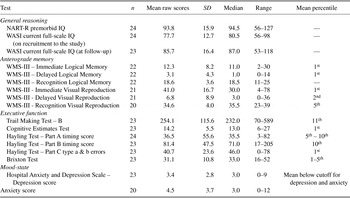
Table 1 shows background neuropsychological test scores. Mean estimated premorbid IQ on the basis of a reading test (NART-R) fell within the “normal” range. WASI Full-scale IQ on recruitment to the study was approximately 16 points below the participants’ predicted premorbid IQ, because they were confused and confabulating. However, at 9 months’ follow-up, their mean WASI Full-scale IQ fell only 8 points below their predicted premorbid IQ. On the WMS-III measures of verbal and visual recall and recognition memory, the participants’ mean scores were impaired across all measures (5th percentile or lower). On measures of executive function, mean scores were “impaired” (below the 5th percentile) for the Brixton, Hayling Part C errors, and Cognitive Estimates tests, and “borderline” (5th to 11th percentile) for the Trail Making test, Part B, and the Hayling test, parts A and B. The participants did not report abnormal levels of depression or anxiety on the HADS.
Background neuropsychological test and mood-state scores

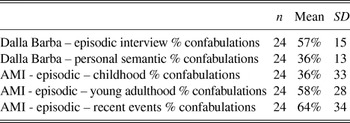
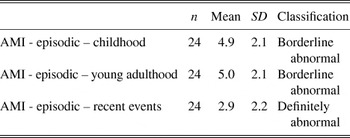
Table 2a shows the mean percentage of items to which participants gave confabulatory responses on the episodic and personal semantic sections of the Dalla Barba confabulation battery. On this scale, the patients gave confabulatory answers to a mean of 57% (±15%) of items from the episodic section and 36% (±13) from the personal semantic section. On the AMI, the patients gave confabulations to between 36% and 64% of the items across the different time-periods (overall mean 52.7%) with more confabulations on the “recent” than the “childhood” items. Table 2b shows the accuracy and quality of the memories produced on the AMI, scored as in the original Manual (Kopelman et al., Reference Kopelman, Wilson and Baddeley1990). The patients’ means scores on the “childhood” and on the “young adulthood” items from the AMI fell within the “borderline abnormal” level of recall. The patients’ mean scores on the “recent” items fell within the “definitely abnormal” range. This pattern is consistent with a temporal (or Ribot) gradient (Kopelman et al., Reference Kopelman, Wilson and Baddeley1990). Dalla BarbaFootnote 1 and AMIFootnote 2 mean percentage of confabulations, as verified from informants and the medical records 1 (Dalla Barba, Reference Dalla Barba1993) adapted for UK (Kopelman et al., Reference Kopelman, Ng and Van Den Brouke1997) 2 (Kopelman et al., Reference Kopelman, Wilson and Baddeley1990) ‘Accuracy’ scores on the AMI

Confabulations
Across the Dalla Barba battery and the AMI, our 24 participants gave a total of 1056 responses. Of these, 481 were “true” memories, 83 were “don’t know” or “can’t remember” responses, and 492 were confabulations. We eliminated the “don’t know” and “can’t remember” responses from any further analysis. This left 973 “memories” for analysis.
Inter-rater Reliability
The inter-rater reliability between the two judges’ ratings for pleasant/neutral/unpleasant content across the 973 “memories” was kappa = 0.61 (p < .01). This is classified as “substantial” according to Landis and Koch (Reference Landis and Koch1977).
Emotional Content of Confabulations Versus True Memories
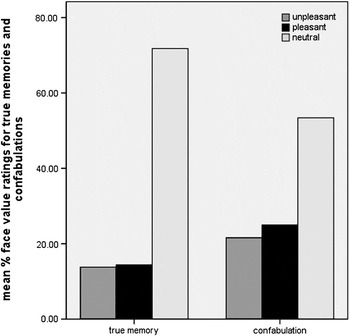
Figure 1 shows the mean percent of memories evaluated as “pleasant” (>4), “neutral” (=4) or “unpleasant” (<4) separately for the “true” memories and the confabulations. Figure 1 shows that overall the majority of our participants’ memories attracted a neutral rating, followed by pleasant and lastly unpleasant ratings, irrespective of whether the memories were true or false
The mean percent of memories rated at “face value” as “unpleasant”, “pleasant”, or “neutral” among the “true” and confabulated memories by two judges on data from 24 confabulating memory-disordered patients.

Our first aim was to investigate whether patients showed a bias to report affective (rather than neutral) content in confabulations, but not in true memories. For this analysis, we compared the percentage of affective confabulations (pleasant or unpleasant) with that of true memories. The mean percent of confabulations with emotional content was 46.6 (14.8) and the mean percent of true memories with affective content was 28.2 (13.4). A paired t test analysis indicated confabulations contained a significantly higher percentage of statements with affective content than true memories (t(23) = 5.20; p < .001, two-tailed).
Our second aim was to investigate whether patients show an enhanced percentage of pleasant content in their confabulations, compared with their true memories. For this analysis, we selected only confabulations with affective content and we calculated the percentage of these which had pleasant content [mean = 54.1 (22.5)]; we did the same for true memories [mean = 47.7 (26.9)]. On this analysis, a paired t test analysis indicated there was no significant difference between the percentage of pleasant content among the “affective” confabulations compared with the percentage of pleasant content among the “affective” true memories [t(23) = 0. 90, N.S., two-tailed].
Correlations Between Valence of Memories and Participants’ Mood-state
Our third aim was to see whether there was a correlation between each participant’s current mood-state (as self-reported on the HADS scale for depression) and the mean valence score of his/her confabulations. For this analysis, we calculated the mean valence of confabulations and the mean valence of true memories, respectively, for each patient. This was then correlated with each patient’s HADS-depression score. As the variables were not normally distributed, we calculated non-parametric correlations using Kendall’s tau. There was a near-significant negative correlation between the valences of both types of memories and depression scores (Kendall = −0.27, and Kendall = −0.28; p < .10, two-tailed, respectively), that is, unpleasant content was weakly associated with depressed mood in both confabulated and true memories.
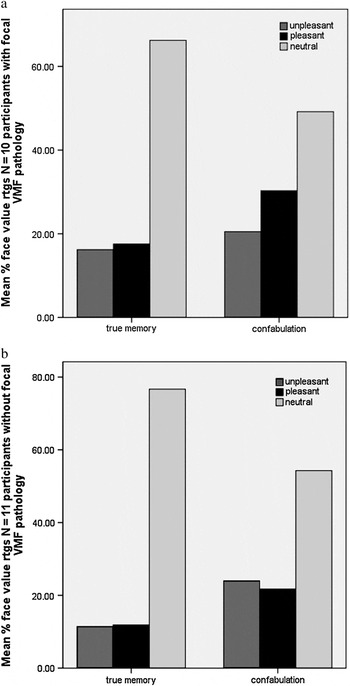
Comparison between lesion groups
Figure 2 (a and b) shows the percent of confabulations and “true” memories evaluated as “pleasant” (>4), “neutral” (=4) or “unpleasant” (<4) for patients with focal VMFC involvement (Figure 2a) and for patients with either generalized atrophy or focal lesions not involving the VMFC (Figure 2b). We carried out repeated measures ANOVA with, lesion site as the independent (between) factor (VMF, other pathology), one within factor which was memory type (confabulations or true memories), and the percentage of affective memories as the dependent variable. The effect of lesion was not statistically significant [F(1,19) = 2.53, N.S.], and, more particularly, there was no significant interaction between lesion site and memory type [F(1,19) = 0.45, N.S.]. In brief, there was no evidence of lesion type affecting the percentage of emotionally charged memories between confabulations and true memories.
Panels a and b show the mean percent of memories rated at “face value” as “unpleasant”, “pleasant”, or “neutral” among the “true” and confabulated memories by two judges on data from 21 confabulating memory-disordered patients: (a) those whose focal pathology involved the ventro-medial prefrontal cortex (VMFC; N = 10); and (b) those with different pathologies: either generalized atrophy or focal lesions not involving the VMFC (N = 11).

DISCUSSION
The nature of confabulation remains a matter of much debate. In particular, the question of whether there is a motivational bias in confabulation, such that confabulations tend to be pleasant and self-enhancing (relative to “real” or “true” memories), remains controversial. In this investigation, we studied 24 patients who had been spontaneously confabulating, 20 of whom had acted upon their confabulations. We examined their responses to the “episodic” and personal semantic sections of the Dalla Barba Confabulation Battery, and to the incidents/episodic schedule of the Autobiographical Memory Interview (AMI). We used the “face value” method to evaluate the affective content of confabulations compared with “true” memories.
Overall, we found an enhanced frequency of “memories” with affective content among confabulations in our patients, relative to their “true” memories (Figure 1). This was the case whether the patients’ underlying pathology included focal involvement of the VMFC or not (Figure 2a&b). Within memories with an affective load, confabulations and genuinely remembered memories contained similar proportions of pleasant ratings. In other words, some confabulations were evaluated as “unpleasant” (compare Korsakoff, Reference Korsakoff1891; Metcalf et al., Reference Metcalf, Langdon and Coltheart2010), and a high proportion of confabulations were of “neutral” valence. In summary we found: (i) an affective (but not necessarily positive) bias, which was significantly more pronounced among the confabulations; (ii) the same affective bias on memories irrespective of whether or not the participants’ MRI or CT brain scans revealed focal pathology involving the VMFC; and (iii) a high proportion of neutral or “generic” memories.
It has been suggested that confabulations preserve a positive self-image in the context of the patients’ unpleasant reality, which may include a depressed mood-state (Fotopoulou, Conway, Tyrer, et al., Reference Fotopoulou, Conway, Tyrer, Birchall, Griffiths and Solms2008; Turnbull et al., Reference Turnbull, Jenkins and Rowley2004). Our participants reported a significantly higher proportion of affective confabulations, relative to true memories but these affective confabulations were not necessarily pleasant. Similarly, Metcalf et al. (Reference Metcalf, Langdon and Coltheart2010) have recently reported that the personal biases in confabulation are not universally pleasant. Instead, they suggested these biases were specific to the individual and served the function of preserving adherence with past and present perceptions of self-identity in the context of change (Conway & Pleydell-Pearce, Reference Conway and Pleydell-Pearce2000; Fotopoulou, Conway, Solms, et al., Reference Fotopoulou, Conway, Solms, Tyrer and Kopelman2008; Metcalf et al., Reference Metcalf, Langdon and Coltheart2010). Moreover, whereas Fotopoulou, Conway, Tyrer et al. (Reference Fotopoulou, Conway, Tyrer, Birchall, Griffiths and Solms2008) found a significant correlation between the pleasantness of the content of confabulations and the severity of depression, we obtained a near-significant correlation in the opposite direction both for confabulated and true memories. If this finding were to be replicated, it would suggest that the presence of unpleasant content in confabulations tends to be associated with more severe depression, consistent with the possibility that memories may be mood-congruent. However, our findings suggest that the contribution of current mood-state to confabulation is likely to be only subtle and not necessarily specific to confabulations (compare Metcalf et al., Reference Metcalf, Langdon and Coltheart2010).
Turner, Simons, Gilbert, Frith, and Burgess (Reference Turner, Simons, Gilbert, Frith and Burgess2008) have acknowledged that the precise relationship between dysfunction in the VMFC and confabulation remains unclear, but they suggested a couple of possibilities. One was that the VMFC is responsible for integrating cognitive processes with emotional markers that bias decision-making at a pre-conscious level, and in particular the “feeling of rightness” (Gilboa et al., Reference Gilboa, Alain, Stuss, Melo, Miller and Moscovitch2006). The other was that this region is involved in matching events to internal predictions (Turner, Simons, Gilbert, et al., Reference Turner, Simons, Gilbert, Frith and Burgess2008). Similarly Schnider hypothesized that the orbitofrontal cortex (OFC) may function as a “generic outcome monitoring system” in the production of memories (Schnider, Reference Schnider2008). In the present investigation, our patients showed spontaneous confabulations, and 83.3% of the sample had acted upon their confabulations. However, of those with MRI or CT scans available, only 47.6% showed focal pathology within the VMFC, suggesting that this may not be necessary for the appearance of spontaneous confabulation. Moreover, there was no significant difference between the VMFC and non-VMFC subgroups in terms of the affective bias among the confabulations.
Consistent with other studies, we found a high proportion of neutral confabulations (Dalla Barba & Boissé, Reference Dalla Barba and Boissé2010; Metcalf et al., Reference Metcalf, Langdon and Coltheart2010). Burgess and McNeil (Reference Burgess and McNeil1999) and Metcalf et al. (Reference Metcalf, Langdon and Coltheart2010) argued that faulty memory specification mechanisms result in “generic” confabulations being produced. These represent the most salient elements from the person’s past experiences, emotions and goals. Dalla Barba and Boissé (Reference Dalla Barba and Boissé2010) and Dalla Barba et al. (Reference Dalla Barba, Cappelletti, Signorini and Denes1997) have argued confabulators draw on the most stable elements of their memories, which refer primarily to general habits or patterns of behavior, rather than the less stable memories of specific events (Dalla Barba & Boissé, Reference Dalla Barba and Boissé2010; Kopelman, Reference Kopelman2010). Gilboa et al. (Reference Gilboa, Alain, Stuss, Melo, Miller and Moscovitch2006) also proposed that schema about the self (or self-identity) are the most stable elements of autobiographical memory. Memories consistent with these are likely to be accepted as true with excessive confidence, and these generic memories can be nuanced by personal biases. In the present investigation, our findings are consistent with an interpretation of confabulations as preserving adherence with past and present perceptions of self-identity in the context of change (Conway & Pleydell-Pearce, Reference Conway and Pleydell-Pearce2000; Fotopoulou et al., Reference Fotopoulou, Conway, Tyrer, Birchall, Griffiths and Solms2008a; Metcalf et al., Reference Metcalf, Langdon and Coltheart2010).
In conclusion, we obtained an enhanced proportion of “memories” with affective content amongst confabulations, relative to “true” memories. This affective bias occurred in patients irrespective of whether there was focal pathology within the VMFC. We did not find an enhanced effect of pleasant confabulations when they were rated at “face value” and compared with genuinely remembered memories. Many confabulations had either neutral or unpleasant content and, in this respect, it was interesting that there was some evidence of mood congruency within the confabulations. Although there may be a fundamental deficit in trace specification or verification (Kopelman, Reference Kopelman1999, Reference Kopelman2010) which underlies confabulation, our results indicate an affective influence on the content of confabulation, possibly nuanced by the person’s concept of self and his/her mood-state at the time of the confabulation. Some, but not all, confabulations contain pleasant content.
ACKNOWLEDGMENTS
The authors thank Dr. Chris Metcalfe, University of Bristol, and Dr. Katerina Fotopoulou for their inspirational comments and invaluable help with this study. No conflicts of interest and no sources of financial support exist.