Spelling and word recognition are the lower level processes underpinning literacy development. Both skills require the acquisition of phonological and subsequent orthographic representations that make up words. Word recognition requires identifying specific orthographic details, whereas word spelling requires accurate recall and production of exact orthographic representations when there may be numerous possibilities for any given phoneme. The challenge of spelling is less demanding in a more transparent orthography such as Turkish in which spelling requires only translation of phonemes to graphemes (Spencer, Reference Spencer2000). In an opaque orthography such as English, however, acquiring accurate spelling is a life-long process that involves the gradual acquisition of phonological, orthographic, and morphological components of the language, all of which culminate in word-specific orthographic information (Frost, Reference Frost, Snowling and Hulme2005; Perfetti, Reference Perfetti, Perfetti, Rieben and Fayol1997; Share, Reference Share2008; Spencer, Reference Spencer2000). The development of spelling entails acquiring knowledge of orthographic specific conventions as well as word-specific knowledge (Ehri, Reference Ehri2000). Every new spelling rule that is learned must be integrated into the speller's general orthographic convention knowledge in order to be retained.
This study longitudinally examined first language (L1) Hebrew students from a middle socioeconomic background who were acquiring spelling in English as a foreign language (EFL) at three points during their EFL studies. This process is expected to be a complex one with L1 literacy experience together with the gradual acquisition of the linguistic components of English jointly impacting spelling development.
UNDERLYING CONNECTIONS BETWEEN LINGUISTIC ABILITIES MEASURED IN L1 AND EFL SPELLING DEVELOPMENT
Various theories have accounted for the connection between literacy acquisition in L1 and additional languages. The linguistic coding differences hypothesis (LCDH; Sparks, Reference Sparks1995; Sparks & Ganschow, Reference Sparks and Ganschow1993a, Reference Sparks and Ganschow1993b) claims that L1 skills serve as the foundation for second language (L2) and foreign language learning and that skills in L1 components, that is, phonological, orthographic, syntactic, semantic, and morphological, will be expressed in additional languages the student acquires (Kahn-Horwitz, Shimron, & Sparks, Reference Kahn-Horwitz, Shimron and Sparks2005). The LCDH is compatible with Cummins' (Reference Cummins1979) interdependence hypothesis, which claims that common underlying language proficiencies will impact on L1 and L2 academic proficiency despite differences between the languages, and also with Geva's central processing theory in which linguistic abilities are expressed in first and additional language literacy development (Geva & Siegel, Reference Geva and Siegel2000; Gholamain & Geva, Reference Gholamain and Geva1999).
In two recent studies, the LCDH has been shown to be relevant longitudinally regarding the impact of L1 literacy skills in explaining L2 word decoding and spelling ability (Sparks, Patton, Ganschow, & Humbach, Reference Sparks, Patton, Ganschow and Humbach2009; Sparks, Patton, Ganschow, Humbach, & Javorsky, Reference Sparks, Patton, Ganschow, Humbach and Javorsky2008). Sparks and colleagues (Reference Sparks, Patton, Ganschow, Humbach and Javorsky2008) found 47% of the variance in L2 spelling measured in tenth grade was accounted for by English L1 spelling measured in elementary school. Phonological awareness measured in English added to the explained variance of L2 spelling. Sparks and colleagues (Reference Sparks, Patton, Ganschow and Humbach2009) found a strong correlation of .68 between L1 (English) spelling measured in fifth grade and L2 (Spanish, German, and French) spelling achievement measured in tenth grade. A review of EFL spelling studies (Figueredo, Reference Figueredo2006) reported on cross-linguistic transfer from numerous L1 backgrounds including Dutch, French, German, Persian, Portuguese, and Welsh. Research from various L1 speakers acquiring English L2 spelling has shown that L1 skills impact on English L2 spelling among Arabic (Fender, Reference Fender2008), Welsh (James, Sholfield, Garrett, & Griffiths, Reference James, Scholfield, Garrett and Griffiths1993), Spanish (Sun-Alperin & Wang, Reference Sun-Alperin and Wang2005), Chinese (Wang & Geva, Reference Wang and Geva2003), and Hebrew (Tal, Reference Tal2005) L1 speakers.
The present study sought to add to the aforementioned body of research on L1–L2 spelling by examining the connection between Hebrew L1 linguistic ability and EFL spelling development at three points over 9 years of EFL study. Despite the small sample size, the study nonetheless provided a unique opportunity to examine L1–L2 linguistically related spelling connections longitudinally.
SPECIFIC L1 AND L2 PREDICTORS OF L1 AND L2 SPELLING
Research that has been conducted showing the connection between L1 predictors of L1 spelling, L1 predictors of L2 spelling, and L2 predictors of L2 spelling provides a relevant background for the current longitudinal study of the connection between L1 Hebrew literacy predictors, EFL literacy predictors, and EFL spelling over 9 years. L1 literacy research has shown that acquisition of the alphabetic principle is crucial for spelling development. Learning to spell entails both the ability to manipulate the phonemes of the language and the knowledge that graphemes represent phonemes. Phonemic awareness facilitates the analysis of words into individual phonemes and their subsequent representation by graphemes in order for successful spelling to take place (Caravolas, Hulme & Snowling, Reference Caravolas, Hulme and Snowling2001; Leong, Tan, Cheng, & Hau, Reference Leong, Tan, Cheng and Hau2005; Leppanen, Niemi, Aunola, & Nurmi, Reference Leppanen, Niemi, Aunola and Nurmi2006; Verhoeven, Reference Verhoeven2000). The above findings have been supported cross-linguistically whereby phonemic awareness measured in L1 has predicted L2 reading skill (Carlisle, Beeman, Hull-Davis, & Sphraim, Reference Carlisle, Beeman, Hull Davis and Sphraim1999; Cisero & Royer, Reference Cisero and Royer1995; Comeau, Cormier, Grandmaison, & Lacroix, Reference Comeau, Cormier, Grandmaison and Lacroix1999; Dufva & Voeten, Reference Dufva and Voeten1999; Durgunoglu, Nagy, & Hancin-Bhatt, Reference Durgunoglu, Nagy and Hancin-Bhatt1993; Kahn-Horwitz et al., Reference Kahn-Horwitz, Shimron and Sparks2005; Nakamato, Lindsey, & Manis, Reference Nakamato, Lindsey and Manis2007) as well as L2 spelling, specifically between English and French in the spelling of L1 and L2 plural morphemes (Cormier & Kelson, Reference Cormier and Kelson2000). Phonemic awareness measured in English has also been found to predict English spelling for the first four elementary grades for EFL learners (Jongejan, Verhoeven, & Siegel, Reference Jongejan, Verhoeven and Siegel2007).
L1 literacy research has shown that successful representation of phonemes by graphemes requires letter knowledge (Caravolas, Hulme, & Snowling, Reference Caravolas, Hulme and Snowling2001). Knowledge of letter names and sounds has been found to predict spelling for L1 English kindergarteners (Ritchey, Reference Ritchey2008) and for L1 Finnish first graders (Leppanen et al., Reference Leppanen, Niemi, Aunola and Nurmi2006). Verhoeven (Reference Verhoeven2000) found a strong relationship between phonemic segmentation measured in Dutch phoneme–grapheme representations and Dutch word spelling for both young elementary school minority students and L1 Dutch students with a reciprocal relationship appearing between phoneme–grapheme representations and word spelling. As opposed to word recognition ability, minority Dutch children were significantly poorer spellers when compared to their L1 Dutch counterparts. Verhoeven speculated that poorer Dutch phoneme awareness and a weaker ability to map graphemes to phonemes led to poorer recognition of orthographic patterns.
L1 literacy research has shown that phonological processing skill is also considered critical for L1 spelling development. Phonological processing includes phonological recoding, or word attack skills, which act as an independent self-teaching mechanism (Share, Reference Share1995). This self-teaching mechanism enables the reader, and to an even greater extent the speller, to develop orthographic knowledge based on a few trials of grapheme–phoneme or phoneme–grapheme mapping (Shahar-Yames & Share, Reference Shahar-Yames and Share2008). Within the process of self-teaching, the reader or speller blends the phonemes enabling word identification, and in the case of the speller, confirmation that a particular word has been written correctly. The orthographic knowledge acquired after exposure to and representation of print results in memorizing word specific orthographic sequences.
Specific phonological characteristics of different L1s have been found to be connected to different literacy skills. For example, Saiegh-Haddad (Reference Saiegh-Haddad2010) has described how the linguistic distance between Spoken Vernacular Arabic (which children speak as an L1 at home) and literary Arabic known as Modern Standard Arabic (which is the literary language taught from first grade) impacts on reading acquisition. Another example is provided by Ben-Dror, Frost, and Bentin (Reference Ben-Dror, Frost and Bentin1995) whereby adult Hebrew L1 readers experienced greater difficulty (expressed in accuracy and latency scores) as opposed to English readers on a phoneme isolation task. They explain this finding as a result of the basic subsyllabic consonant–vowel (CV) unit that Hebrew speakers are accustomed to in their L1 as opposed to English speakers, who are accustomed to the basic C or V phoneme that are the basic units of words. From a cross-linguistic perspective, in the case of biliterates or students studying EFL, phonological processing may develop as a result of experience with a more transparent orthography.
Evidence from L1 literacy research has also shown that reading and spelling skills are strongly connected to one another. Strong correlations of over .70 have been reported between these two abilities for opaque orthographies such as English L1 (Ehri, Reference Ehri2000) as well as for more transparent orthographies such as Finnish (Leppanen et al., Reference Leppanen, Niemi, Aunola and Nurmi2006). In the case of an orthography such as Hebrew, which is opaque for spelling and completely transparent for voweled reading, a weaker connection has been found between reading and spelling. For example, Kahn-Horwitz, Shimron, and Sparks (Reference Kahn-Horwitz, Shimron and Sparks2005) reported on a correlation of .46 for fourth grade L1 Hebrew-speaking children, and Geva, Wade-Woolley, and Shany (Reference Geva, Wade-Woolley and Shany1993) found that the strong correlation of .82 among first-grade Hebrew L2 children dropped to a correlation of .57 in second grade as spelling complexity increased. In the case of orthographies sharing orthographic depth characteristics for reading and spelling, an underlying orthographic basis for both spelling and reading that is based on prior developed phonological awareness would account for spelling and reading having an effect on one another (Ritchey, Reference Ritchey2008; Seymour, Reference Seymour, Perfetti, Rieben and Fayol1997). Orthographic representations thus learned while spelling or reading should benefit the other. In English L1, early spelling has been found to strongly predict later reading, but early reading has a weaker effect on later spelling (Conrad, Reference Conrad2008; Ellis & Cataldo, Reference Ellis and Cataldo1990). In most cases spelling necessarily involves reading because after encoding a word, the speller reads it (Ehri, Reference Ehri2000). Correct spelling requires complete orthographic representations in contrast to correct word reading, where incomplete orthographic representations may suffice. In addition, the process of spelling creates a motoric memory trace, which can further bootstrap orthographic specific knowledge of a word in a multisensory manner (Shahar-Yames & Share, Reference Shahar-Yames and Share2008). The reading–spelling relationship was represented both in a longitudinal L1 study spanning the first 3 years of spelling development (Caravolas et al., Reference Caravolas, Hulme and Snowling2001) and in a study related to the current study in English L2 (Kahn-Horwitz, Sparks, & Goldstein, Reference Kahn-Horwitz, Sparks and Goldstein2011) in which EFL spelling measured in fourth and ninth grades was strongly associated with EFL word reading in ninth grade.
EFL SPELLING DEVELOPMENT
Various developmental stage theories have been proposed over the past decades to explain English spelling development (Ehri, Reference Ehri, Snowling and Thomson1991; Gentry, Reference Gentry1981; Henderson & Templeton, Reference Henderson and Templeton1986; Young, Reference Young2007). Stage theory contributes by highlighting the use of different evolving psycholinguistic features in children's spelling. This theory implies that children in any particular stage will illustrate errors that mainly reflect that particular stage and that there will be a gradual movement from stage to stage in their spelling development. However, research amongst English L1 spellers has shown this to be only part of the entire story (Varnhagen, Mccallum, & Burstow, Reference Varnhagen, McCallum and Burstow1997). Treiman and Cassar (Reference Treiman, Cassar, Perfetti, Rieben and Fayol1997) have suggested that young spellers may rely specifically on phonology and letter names while spelling; however, in parallel, they may also implement their gradually developing orthographic and morphemic knowledge. They observed integration of both orthographic as well as morphological knowledge in kindergarten and first grade spellers. For example, children in first grade wrote ck, but not at the beginning of a word. This finding is an indication of adherence to English orthographic conventions. The results of the current study may provide some evidence as to whether different L1 and EFL variables associated with EFL spelling at the three different points of measurement reflect specific developmental stages or an integration of various language components in their spelling.
RATIONALE AND RESEARCH QUESTIONS
This study aimed to examine the extent to which language components were associated with EFL spelling longitudinally during school spelling acquisition, looking specifically at the extent to which letter–sound and letter name knowledge, phonemic awareness, phonological processing measures (word attack), and L1 spelling predicted EFL spelling at the beginning, middle, and end of formal school English instruction.
First-grade Hebrew-speaking students in Israel acquire L1 Hebrew reading and spelling using the fully vowelized orthography with diacritical marks appearing above or below the letters. This presentation of the Hebrew orthography is completely transparent for reading. After acquiring grapheme–phoneme correspondence for the 22 consonants and respective diacritical marks, any word can be successfully decoded independent of lexical, morphological, or contextual information. In contrast, the Hebrew orthography is less transparent for spelling due to the existence of 12 graphemes that represent five phonemes including phonemes that are represented with an alternate grapheme in a word final position, phonemes with alternate graphemes in the initial or middle of the word, and various silent graphemes that are morphologically instructive. Elementary school children read vowelized Hebrew texts for the first 2 years of school but during the third grade and onward, they are gradually exposed to the opaque unvowelized form of Hebrew, which requires phonological, orthographic, lexical, morphological, and contextual processing for successful decoding as well as spelling.
Hebrew is the official first language in Israel, and it is the mother tongue for the majority Hebrew-speaking population. Arabic is the mother tongue of the largest minority group and the official second language of Israel (Spolsky & Shohamy, Reference Spolsky and Shohamy1996). English is a foreign language that is taught in the formal framework of school. English instruction is optional between 1st and 3rd grade, and age of onset of instruction depends on individual school policy. From 4th grade until the end of 12th grade, English is a compulsory subject that includes both oral and literacy instruction. The term EFL is used for the purpose of this study because English is mainly acquired in the framework of formal school studies (Baker & Prys Jones, Reference Baker and Prys Jones1998). In addition, students from medium to high socioeconomic status (SES) backgrounds are often exposed to English through the media, Internet, and traveling abroad. School children in these populations are aware of the importance of English for later success in completing tertiary education and for international business.
Despite the opaqueness of the English orthography, English instruction in most Israeli schools includes relatively little explicit spelling instruction. For the participants in this study, a mainly whole language approach to spelling instruction was used between fourth and sixth grade. Students were given regular spelling dictations based on subject themes they were studying (for details of this approach, see Schlagal, Reference Schlagal2001). In keeping with this approach, the words in the dictations were not purposefully included to reflect common orthographic or morphological connections. Instead, vocabulary related to a particular theme was studied, for example, in initial instruction, family, animals, or colors, and students were expected to demonstrate knowledge of meanings and spellings of this group of words within the framework of a spelling dictation. From seventh grade, students were no longer given spelling dictations. However, a part of their grade in school given for English written expression included an evaluation of their spelling.
The present study examined the development of EFL spelling longitudinally and the connection between Hebrew L1 and EFL literacy related abilities and EFL spelling. A longitudinal study has numerous advantages. First, at each time point, the independent variables are measured before the dependent variable. Second, the same participants are observed at linguistic developmentally different stages, which allows for examining whether and to what extent L1 and EFL literacy related measures predict EFL spelling. In this study, L1 measures and rudimentary knowledge of English letter names and sounds were administered to Hebrew L1 students at the beginning of 4th grade (their first year of EFL study). The same L1 measures and EFL word reading and spelling measures were administered to Hebrew L1 students at the end of 4th grade and again at the end of 9th grade (after 6 years of EFL study). Finally, the students were tested on EFL spelling at the end of 12th grade before they completed their matriculation examinations and graduated from school at the end of 9 years of EFL study.
Our research questions examined the connections between L1 componential linguistic abilities together with EFL decoding components and EFL spelling during the three points that spelling was examined in this longitudinal study. Specifically, we asked the following questions:
1. Did L1 and EFL variables at the beginning of fourth grade predict EFL spelling at the end of fourth grade?
2. Did L1 and EFL variables measured at the end of fourth grade predict EFL spelling at the end of ninth grade?
3. Did L1 and EFL variables measured at the end of ninth grade predict EFL spelling at the end of 12th grade?
METHOD
Participants
Participants were 33 Hebrew-speaking students who were tested at the beginning and end of 4th grade, end of 9th grade, and end of 12th grade, their final year of school. They were part of an original study consisting of 145 children (Kahn-Horwitz et al., Reference Kahn-Horwitz, Shimron and Sparks2005, Reference Kahn-Horwitz, Shimron and Sparks2006) who participated in the study 8 years earlier at the beginning and end of fourth grade. When signing consent forms, parents acknowledged that participants had not lived in English speaking countries for any extended period of time, did not have English speaking parents and had not been exposed to English in the framework of private lessons prior to starting formal English study.
Seventy-seven participants of the original group were tested again, 5 years later at the end of ninth grade (Kahn-Horwitz et al., Reference Kahn-Horwitz, Sparks and Goldstein2011). The original participants in the study came from schools in three different areas, representing two different (SES) backgrounds (Kahn-Horwitz et al., Reference Kahn-Horwitz, Shimron and Sparks2006). At the beginning of seventh grade in the transition to junior high school, participants in the original study from two of the schools in two towns were dispersed, making it difficult to locate them at the end of ninth grade. Most of the participants from one of the three original schools in a middle SES rural area continued studying at the one junior high school in that area. Of the original 96 participants in this aforementioned junior high school, 77 agreed to take part in this follow-up study at the end of ninth grade (mean age = 14 years, 7 months, SD = 0.45; 36 males, 41 females).
Of the 77 participants who participated in the 9th-grade follow-up, 33 students agreed to participate in a spelling dictation at the end of 12th grade. There were 14 males and 19 females in the 12th grade study. Their mean age was 17 years, 7 months (SD = 0.45). All participants had been formally studying EFL for 4 weekly hours over a period of 9 years. The data of these 33 students from the middle SES school was analyzed for the purpose of this study. This high attrition rate resulting in only 33 students remaining a part of the study for 9 years is a major limitation regarding the ability to generalize the results of this study as this sample may not be similar to the original 145. However, this study provided an opportunity to observe 33 EFL students over 9 years, which is rare and of interest in its own right.
Instruments
L1 (Hebrew) measures: Phoneme awareness (beginning and end of fourth grade, end of ninth grade)
PHONEME DELETION. This task (Shany, Zieger, & Ravid, Reference Shany, Zieger and Ravid2001) is a Hebrew version of the Rosner phoneme deletion task. Participants were required to repeat a word that the tester pronounced and then delete an initial, medial or final phoneme from that word, e.g., ʃelet (Hebrew for “sign”) and then delete the phoneme ʃ. The correct resulting pseudoword was elet. The maximum score for this task was 20.
SPELLING (BEGINNING AND END OF FOURTH GRADE, END OF NINTH GRADE). A spelling dictation consisting of single Hebrew words (which were pronounced as single words and then in the context of a sentence) and two sentences were dictated to the fourth graders (see Kahn-Horwitz et al., Reference Kahn-Horwitz, Shimron and Sparks2005). The maximum score for this task was 25. At the end of ninth grade, a spelling dictation (Shany et al., Reference Shany, Zieger and Ravid2001) consisting of 43 words was dictated to participants. Each word was pronounced, followed by a contextual sentence and again the key word. Participants thereafter wrote the word, for example, nikneta (Hebrew for “was bought”). The maximum score for this task was 43.
WORD ATTACK (BEGINNING AND END OF FOURTH GRADE, END OF NINTH GRADE). The Greenbaum and Lichter (Reference Greenbaum, Lichter, Greenbaum and Lichter1996) Hebrew Word Attack task measuring phonological recoding, which consists of 25 nonwords (e.g., vasug) was administered. The maximum score for this task was 25.
EFL (English) measures
EFL LETTER NAME AND SOUND KNOWLEDGE (BEGINNING AND END OF FOURTH GRADE). Participants were required to name and pronounce the sound of each of the 26 English letters presented in lowercase manuscript on cards in a random manner. Because of extremely high correlations between knowledge of sounds and names of English letters (for beginning of fourth grade r = .96, p < .01; for end of fourth grade r = .95, p < .01) and in order to prevent multicolinearity, the two measures were combined into an English letter knowledge cluster. The maximum score for the combined task was 52.
EFL WORD RECOGNITION (END OF FOURTH GRADE AND END OF NINTH GRADE). At the end of fourth grade, students read an informal measure consisting of words to which the fourth graders had been exposed during their first year of EFL studies (e.g., stop, farm, number; see Kahn-Horwitz et al., Reference Kahn-Horwitz, Shimron and Sparks2005). Each student was requested to read all 20 words aloud. The maximum score for this task was 20. At the end of ninth grade, a single word recognition task (Stanovich & Siegel, Reference Stanovich and Siegel1994) consisting of 40 frequent one-syllable words was presented to students, who read the words aloud. The maximum score for accuracy was 40.
EFL SPELLING (END OF 4TH, 9TH, AND 12TH GRADE). At the end of 4th grade, the students who had received elementary writing instruction wrote a short sentence consisting of six frequent words to which they had been exposed during their first year of EFL instruction. The sentence was Look at the cat in the tree (the word the appeared twice and due to it being spelled the same by all participants, it was not counted twice). A score of one point was given for each word spelled correctly. The maximum score for this task was six. The Cronbach alpha coefficient for these items was 0.78.
Toward the end of ninth grade, three English sentences were dictated to the participants. The sentences consisted of words taken from ninth grade textbooks (e.g., Last year he taught computer technology; Assis, Reference Assis2002; Ezra & Kerman, Reference Ezra and Kerman1998). Participants first heard the entire sentence read twice, then the tester dictated chunks of two to three words at a time. Participants were required to write the sentences. The maximum score for this subtest was 25, with one point given for every correctly spelled word. The Cronbach alpha coefficient for these items was 0.90.
At the end of 12th grade, three English sentences were dictated to the participants. The sentences consisted of words that were either a part of the second thousand frequency word list or the academic word list with considerably more orthographic and morphological demands (e.g., It is fascinating to examine the geography of different countries; see, Nation, Reference Nation2001). Participants first heard the entire sentence read twice and then the tester dictated chunks of two to three words at a time. Participants were required to write the sentences. The maximum score for this subtest was 28, with one point given for each correctly spelled word. The Cronbach alpha coefficient for these items was 0.83.
Procedure
At the beginning and end of 4th grade, the first author conducted group as well as individual testing with the original participants, which lasted a little over 1 hr in a quiet room at the elementary school. The first author together with research assistants (who were all qualified English teachers studying didactic assessment and who received special training for using the above measures) tested each of the participants individually during the last 2 months of 9th grade. Testing took place in a quiet room in the school and lasted approximately 1 hr. At the end of 12th grade, EFL teachers conducted a spelling dictation to the 33 students who agreed to participate in the last stage of testing.
RESULTS
Results for this study were obtained by conducting multiple regressions, which enabled examination of the connection between L1 and EFL predictive measures and EFL spelling. In addition, examining spelling related predictors longitudinally at the beginning, middle, and end of EFL school studies enabled us to observe various developmental predictors over time in EFL spelling in similar patterns observed in English L1 spelling research, taking into account the orthographic depth of printed English.
Descriptive statistics and correlations
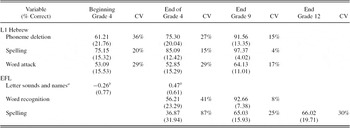
Preliminary analyses included calculating means, standard deviations, and coefficient of variations for the testing measures (see Table 1). Most of the means (when the same measures were repeated) improved from the beginning of 4th grade to the end of 4th grade and from the end of 4th grade to the end of 9th grade and standard deviations decreased. Coefficient of variations showed that the younger the students (both in L1 Hebrew and in English L2), the greater the heterogeneity of the distribution. This heterogeneity was quite extreme regarding English L2 measures, which could be explained by very large individual differences between students in the group regarding English literacy measures measured at the beginning and end of 4th grade (knowledge of English letter sounds and names, word recognition, and spelling). The English word recognition task measured at the end of 9th grade showed a relatively high mean score as opposed to the mean scores of the English spelling tasks measured at the end of 9th and 12th grades, which were still far from reaching ceiling effects. The coefficients of variation for the English spelling tasks were very large as opposed to the coefficient of variation for the English word recognition task.
Means (standard deviations) and coefficient of variation at beginning and end of 4th, 9th, and 12th Grade

Note: CV, coefficient of variation measuring relative heterogeneity of the distribution; L1, first language; EFL, English as a foreign language.
a z score.
bThe coefficient of variation has no value in the case of z scores.
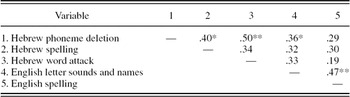
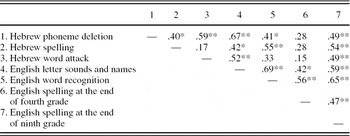
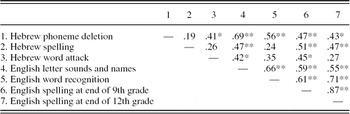
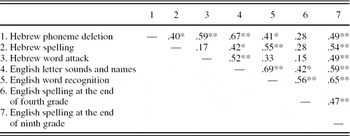
Strength of connections between linguistic abilities measured in Hebrew L1 and EFL measured at the beginning and end of 4th grade and at the end of the 9th grade and English spelling measured at the end of 4th, 9th, and 12th grade was measured by calculating Pearson correlation coefficients (see Table 2, Table 3, and Table 4). English spelling at the end of 4th grade correlated moderately with English spelling at the end of 9th grade as well as with English spelling at the end of 12th grade r = .46. However, English spelling at the end of the 9th grade correlated strongly with English spelling at the end of 12th grade r = .87.
Intercorrelations between measures at the beginning of fourth grade and English spelling at the end of fourth grade

*p < .05. **p < .01.
Intercorrelations between measures at the end of fourth grade and English spelling at the end of ninth grade
*p < .05. **p < .01.
Intercorrelations between measures at the end of 9th grade and English spelling at the end of 12th grade

*p < .05. **p < .01.
Predictors of EFL spelling
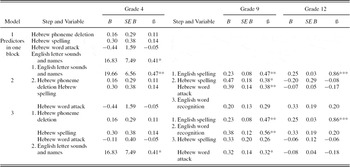
Beginning of fourth grade L1 and EFL variables predicting end of fourth grade EFL spelling. The Hebrew L1 and EFL predictors of EFL spelling at the end of fourth grade were examined by entering Hebrew variables and English letter sound knowledge together into a multiple linear regression analysis (Table 5). These variables together explained 26% of the variance; however, the results were not significant F (4, 28) = 2.42, p = .07. When the Hebrew L1 variable block (phonological awareness, spelling, and word attack) was entered as a first step to the model, it contributed 12% to the explained variance of the model F (3, 29) = 1.36, p = .28. The English letter sound knowledge variable was entered as a second step and contributed an additional 13% F (1, 28) = 5.05, p = .03. The English addition contributed significantly to the model. When the order was changed and the English letter sound knowledge was entered as a first step it contributed 23% F (1, 31) = 8.98, p = .01. The addition of the Hebrew L1 block as the second step explained a further 3% F (3, 28) = .41, p = .75. In both orders English letter sound knowledge was more influential in explaining end of fourth grade English spelling.
Multiple linear regressions for variables predicting EFL spelling in different models at the end of 4th, 9th, and 12th grades

Note: EFL, English as a foreign language.
*p < .05. **p < .01. ***p < .001.
The following multiple regression analyses were conducted in order to better understand the connection between English spelling measured at an earlier point, Hebrew L1 and EFL literacy-related predictors, and EFL spelling at the end of 9th and 12th grades. In each case English spelling measured at an earlier point was entered first, and subsequently the entry order of the Hebrew L1 variable block versus the English word recognition measure was alternated.
End of fourth grade L1 and EFL variables predicting end of ninth grade EFL spelling. For both regressions, English spelling measured at the end of fourth grade served as an autoregressor and was entered as a first step. In the first model, the two Hebrew linguistic variables (spelling and word attack) measured at the end of fourth grade that were considered to be influential for end of ninth grade English spelling, were entered as a block in the second step. English word recognition measured at the end of fourth grade was the last block to enter. These variables together explained 57% of the variance in ninth grade English spelling, F (4, 26) = 8.53, p = .001. The autoregressor, end of fourth grade spelling, contributed 22% to the explained variance of the first model, F (1, 29) = 8.04, p = .008. When the Hebrew L1 variable block (spelling and word attack) was entered as a second step to the model, it contributed an additional 31% to the explained variance of the model, F (2, 27) = 8.82, p = .001. The English word recognition variable was entered as a third step and contributed an additional 4% to ninth grade English spelling, F (1, 26) = 2.48, p = .13. When the order was changed and the English word recognition variable was entered as a second step (following the autoregressor variable), it contributed an additional 22% to ninth grade English spelling, F (1, 28) = 10.63, p = .003. The addition of the Hebrew L1 block as the third step contributed an additional 14%, F (2, 26) = 4.07, p = .03. In both orders after the important contribution of English spelling at the end of fourth grade, the Hebrew variable block was influential in explaining end of ninth grade English spelling more than English word recognition.
End of 9th grade L1 and EFL variables predicting end of 12th grade EFL spelling. For both regressions, English spelling measured at the end of ninth grade served as an autoregressor and was entered as a first step. In the first model the two Hebrew linguistic variables (spelling and word attack) measured at the end of 9th grade that were considered to be influential on end of 12th grade English spelling were entered as a block in the second step. Finally, English word recognition measured at the end of ninth grade was entered in the third step. These variables altogether explained 78% of the variance in 12th grade English spelling, F (4, 26) = 23.66, p = .0001. The autoregressor, end of 9th grade spelling, contributed 73% to the explained variance of the model, F (1, 29) = 78.75, p = .0001. When the Hebrew L1 variable block (spelling and word attack) was entered as a second step to the model it contributed an additional 3% to the explained variance of the model, F (2, 27) = 1.56, p = .23. The English word recognition variable was entered as a third step and contributed an additional 3% to 12th grade English spelling, F (1, 26) = 3.11, p = .09. When the order was changed and the English word recognition variable was entered as a second step (after end of 9th grade spelling), it contributed an additional 3% variance, F (1, 28) = 3.01, p = .09. The addition of the Hebrew L1 block as the third step contributed an additional 3% variance, F (2, 26) = 1.66, p = .03. Regardless of order, after the major and unique contribution of English spelling at the end of 9th grade, neither the Hebrew variable block nor the English word recognition variable were particularly influential in explaining end of 12th grade English spelling.
DISCUSSION
This study sought to longitudinally examine the connection between L1 literacy-related linguistic abilities together with EFL decoding abilities and EFL spelling at the end of 4th, 9th, and 12th grade among Hebrew L1 students. During the course of their English school studies, these students received partial explicit instruction of the English orthography. Results supported the linguistic coding differences hypothesis, which is compatible with the interdependence hypothesis and central processing theory in that Hebrew literacy measures at the end of 4th grade predicted EFL spelling at the end of 9th grade even after accounting for the variance explained by EFL spelling and word recognition. In addition to the contribution of underlying L1 predictors to EFL spelling, EFL literacy components were found to account for EFL spelling at the three measurement points: English letter sounds and names at the beginning of 4th grade initially predicting EFL spelling at the end of 4th grade. Ninth grade EFL spelling was predicted by end of 4th grade English spelling in which children spelled simple, one syllable words with mainly VC, CVC, CCVV, and CVVC structure. Twelfth grade EFL spelling was predicted by end of 9th grade English spelling. In the next two sections, we discuss the connections between students' L1 and EFL spelling skills and EFL literacy and EFL spelling.
Connection between L1 measures and EFL spelling development
Support for the linguistic coding differences hypothesis was found at one measuring point, the end of ninth grade. In this case, the combination of Hebrew L1 spelling and word attack measured at the end of fourth grade explained EFL spelling at the end of ninth grade. This supports findings by Sparks and colleagues (Reference Sparks, Patton, Ganschow, Humbach and Javorsky2008) in their longitudinal study where English L1 spelling measured in elementary school accounted for L2 spelling in 10th grade. Grapheme–phoneme mapping is required for the word attack task in Hebrew. For Hebrew spelling, by the end of fourth grade children will have internalized many word specific orthographic representations. A combination of the aforementioned decoding and orthographic processes in Hebrew L1 cross-linguistically contributed significantly to end of ninth grade English spelling.
Most previous studies that showed a connection between L1 abilities and second language spelling used a cross-sectional design (e.g., see Cormier & Kelson, Reference Cormier and Kelson2000; Fender, Reference Fender2008; James et al., Reference James, Scholfield, Garrett and Griffiths1993; Tal, Reference Tal2005). However, in contrast to Sparks et al.'s longitudinal studies (Sparks et al., Reference Sparks, Patton, Ganschow, Humbach and Javorsky2008, Reference Sparks, Patton, Ganschow and Humbach2009) in which English L1 variables were longitudinally connected to L2 spelling, the present study shows that EFL literacy variables were significantly associated with EFL spelling at the three points of data collection with the Hebrew L1 variables contributing to EFL spelling at one measuring point only. This finding may be the result of different orthographic characteristics of the respective orthographies being studied. Sparks et al. (Reference Sparks, Patton, Ganschow, Humbach and Javorsky2008) examined English L1 predicting Spanish, French, and German spelling, whereas the current study examined Hebrew L1 and EFL literacy variables predicting EFL spelling. More specifically, it is interesting to note that phonemic awareness measured in L1 Hebrew before the onset of formal English instruction (beginning of fourth grade) did not significantly contribute to end of fourth grade English spelling. Considering previous cross-linguistic findings whereby L1 phonemic awareness predicted L2 spelling (Cormier & Kelson, Reference Cormier and Kelson2000; Sparks et al., Reference Sparks, Patton, Ganschow, Humbach and Javorsky2008), these findings should be possibly be considered in the light of fundamental differences between Hebrew and English. The basic unit of instruction in the Hebrew orthography is based on two phonemes (CV) comprising a subsyllabic unit (Ben-Dror et al., Reference Ben-Dror, Frost and Bentin1995). Phonological awareness of subsyllabic units may have predominated among Hebrew L1 readers who had not yet started English literacy acquisition. With the onset of English literacy acquisition, phonemic awareness may have sharpened and then subsequently been tapped by the phoneme deletion task (measured in Hebrew). Another explanation for L1 phonemic awareness not emerging as a predictor of EFL spelling at the end of fourth grade may have been the small sample size. A larger sample may have resulted in L1 linguistic abilities contributing significantly to end of fourth grade English spelling.
EFL literacy predictors of EFL spelling
This study found that knowledge of English letter sounds and names measured at the beginning of 4th grade was influential in explaining end of 4th grade English spelling. The English spelling autoregressor measured at the end of 4th grade was influential in explaining end of 9th grade English spelling (together with the Hebrew L1 measures). The end of 9th grade English spelling autoregressor contributed significantly to English spelling measured at the end of 12th grade. The association between EFL literacy measures and EFL spelling became stronger toward the third measuring point, that is, 12th grade. At the end of 12th grade orthographic specific measures in EFL surpassed orthographic measures in L1 for predicting EFL spelling.
EFL spelling development as measured in this study showed similarities as well as differences with findings reported from L1 English spelling development research. Similarities include the results that although EFL students in this study only started studying English (oral skills and literacy) in fourth grade, the finding that beginning of fourth grade rudimentary knowledge of English letter sounds and names significantly accounted for a portion of the end of fourth grade English spelling mirrors L1 spelling development (Ehri, Reference Ehri2000; Treiman & Cassar, Reference Treiman, Cassar, Perfetti, Rieben and Fayol1997) and points to the importance of English letter knowledge for beginning spelling development to the extent that it outweighs the L1 linguistic abilities connection.
A second similarity between L1 and EFL spelling development is the moderate correlation between end of 4th grade spelling and end of 9th grade spelling as well as between end of 4th grade spelling and end of 12th grade spelling. This finding is in contrast to the strong correlation found between 9th and 12th grade spelling. These results may support evidence that initial and more advanced English spelling tap different linguistic components (Treiman & Cassar, Reference Treiman, Cassar, Perfetti, Rieben and Fayol1997). Whereas initial English rudimentary spelling demands phoneme–grapheme mapping including some orthographic conventions, 9th and 12th grade spelling tap a similar level of English spelling, which includes phonological, orthographic, and morphological dimensions.
A third similarity between findings from L1 spelling development and the current EFL longitudinal study was that at the second measuring of English spelling after 6 years of English study in ninth grade, results showed that EFL spelling (measured at the end of fourth grade) explained 22% of the variance in EFL spelling of the end of ninth grade. Findings suggest that Hebrew L1 speakers at the end of ninth grade are still heavily dependent on phoneme–grapheme correspondences together with the analysis of the phonemic components of words in order to represent them graphemically as is illustrated in the spelling of simple VC, CVC, CVVC, and CCVV words. A similar result was found cross-linguistically for Spanish-speaking children learning to read and spell in English (Sun-Alperin & Wang, Reference Sun-Alperin and Wang2005). For older elementary school students, orthographic measures have been found to mainly account for EFL word reading and spelling ability (Leong et al., Reference Leong, Tan, Cheng and Hau2005). The spelling of the EFL students in this study at the end of ninth grade was explained by phonological–orthographic strategies represented cross-linguistically and by simple English orthographic structures.
A fourth similarity between L1 spelling research and the present study was that at the third measuring point at the end of 12th grade, evidence of an orthographic and morphological strategy underlying EFL spelling was observed for the students in the study, whereby EFL spelling measured in 9th grade explained 73% of the variance of end of 12th grade EFL spelling. This measure can be said to primarily tap orthographic and morphological knowledge because it consists of words with both regular and irregular orthographic conventions, that is, the EFL 9th grade spelling task consists of derived and inflected morphemes with complex syllabic structures. These orthographic and morphological strategies are the underlying strategies that have been observed in English L1 spelling (Treiman & Cassar, Reference Treiman, Cassar, Perfetti, Rieben and Fayol1997).
A difference between L1 spelling development and the results of the current study relates to the strength of connection between English spelling and reading. Ehri (Reference Ehri2000) reported strong correlations between L1 English spelling and reading, signifying a common underlying basis for both abilities. In the present study, these correlations were found to be weaker for EFL reading and spelling. Although English word recognition measured at the end of 4th grade contributed to end of 9th grade spelling, this connection was overshadowed by Hebrew L1 word attack and spelling. English spelling measured at the end of 9th grade subsumed English word recognition in predicting end of 12th grade EFL spelling. These results are supported to some extent by both Conrad (Reference Conrad2008) and Ellis and Cataldo (Reference Ellis and Cataldo1990), who found that although early L1 spelling had a stronger effect on later reading, early L1 reading had a weaker effect on later spelling. It could be that the gap between EFL spelling and EFL reading is much larger than in English L1 because English spelling is emphasized to a lesser extent in the EFL class and instruction emphasizes reading rather than spelling. It seems that in the case of this EFL longitudinal study, supporting reports from L1 word reading contributes less to word spelling than word spelling measured at an earlier point contributed to word spelling measured later, thereby illustrating that incomplete word specific orthographic knowledge may suffice for English word reading but that complete word-specific orthographic knowledge is necessary for English word spelling (Conrad, Reference Conrad2008; Ellis & Cataldo, Reference Ellis and Cataldo1990).
In sum, the results showed that linguistic characteristics of the various stages of English L1 spellers were found to longitudinally characterize EFL spellers to a certain extent cross-linguistically (at the end of 9th grade) as well as within English, mainly with early EFL spelling predicting later spelling. Initial EFL spelling at the end of 4th grade was explained by rudimentary English letter knowledge, which primarily taps orthographic knowledge but cannot be separated from phonological ability. EFL spelling measured in 9th grade after 6 years of English instruction was jointly explained by end of 4th grade English spelling and Hebrew spelling and word attack with a small contribution made by English word recognition. EFL spelling measured at the end of 12th grade was explained by end of 9th grade EFL spelling.
Present limitations and future directions
Although this longitudinal design provided insight into the association between L1 linguistic abilities and EFL spelling development as well as to the developmental processes in EFL spelling that resemble L1 English spelling development, the small sample size and the finding that the 33 students in the final longitudinal sample were not found to be similar to the original 145 is a factor that limits the possibility of making broad generalizations. Further longitudinal studies of this nature with larger populations and without a significant attrition rate would clarify the developmental nature of EFL spelling. In addition a measure consisting of a larger number of words capturing English orthographic conventions would provide a more valid measure of initial English spelling ability. Designing a uniform EFL spelling measure with the same basic items and increasingly difficult items to measure spelling in high school would provide an improved measure for comparison across grades. One additional possibility would be to create a measure that could tease out the difference between L1 Hebrew transfer and developmental type errors, for example, whether spelling the word deep as “dp” is a result of using a letter name developmental strategy or a reflection of the L1 Hebrew orthographic convention of spelling words without vowels.
The weaker correlations revealed in this study between EFL word reading and spelling longitudinally as well as the finding that English word recognition was overshadowed by L1 word attack and spelling and autoregressor EFL spelling as predictors of EFL spelling may suggest that policies regarding English spelling instruction in Israel should be examined. Spelling can significantly contribute to literacy acquisition in that the spelling of a word (as opposed to reading it) involves a motoric memory trace, which assists the acquisition of word specific orthographic knowledge in a multisensory manner. Presently in Israel during elementary school studies, EFL spellings are memorized and are intentionally content related but only incidentally (if at all) orthographically or morphologically related. In order for EFL reading and spelling to support one another, it may be worthwhile for EFL teachers to consider using direct instruction targeting English orthographic conventions in order to benefit English language learners in acquiring word specific knowledge as well as broadening their knowledge about conventions pertaining to the English orthography as a whole. Knowledge of the English orthography is at the basis of both spelling and reading development. It follows that direct instruction in the English orthography may have positive ramifications for both EFL reading and spelling development.