Introduction
In 2014, 14.9% of the world's adult population of women were obese [body mass index (BMI) ⩾ 30 kg/m2], including women of reproductive age (NCD-RisC, 2016). The global prevalence of obesity is expected to increase to 21% by 2025 (NCD-RisC, 2016). Convincing evidence shows that maternal pre-pregnancy/early pregnancy obesity poses multiple health risks during pregnancy and at delivery, including hypertension-spectrum pregnancy disorders (O'Brien et al. Reference O'Brien, Ray and Chan2003; Rahman et al. Reference Rahman, Abe, Kanda, Narita, Rahman and Bilano2015), and gestational diabetes (Torloni et al. Reference Torloni, Betran, Horta, Nakamura, Atallah and Moron2009).
Growing evidence suggests that maternal obesity not only increases the risk for physical health hazards, but is also associated with poorer mental health during and after pregnancy. According to one meta-analysis, obese women had a 43% and 21% higher odds for reporting clinically relevant symptoms of depression during pregnancy than normal weight (BMI 18.5–24.99 kg/m2) or overweight (25–29.99 kg/m2) women, respectively (Molyneaux et al. Reference Molyneaux, Poston, Ashurst-Williams and Howard2014). The meta-analysis also showed that obese women had a 30% and 20% higher odds of reporting clinically relevant symptoms of depression after pregnancy than normal and overweight women, respectively (Molyneaux et al. Reference Molyneaux, Poston, Ashurst-Williams and Howard2014).
In agreement with this meta-analysis, findings from a more recent study of over 7000 US women reported that in comparison to normal weight women overweight women had 31% and obese women had 65% higher odds for reporting clinically relevant depressive symptoms during pregnancy (Venkatesh et al. Reference Venkatesh, Riley, Castro, Perlis and Kaimal2016). In another study of over 13 000 UK women, obese, but not overweight women, had 39% higher odds than had normal weight women for reporting clinically relevant depressive symptoms during pregnancy (Molyneaux et al. Reference Molyneaux, Poston, Khondoker and Howard2016b). Yet, another study of over 5000 women from Australia, Ireland, New Zealand, and UK reported that only in women with high socio-economic status (SES), obese, but not overweight women, had 116% higher odds than had than normal weight women for reporting clinically relevant depressive symptoms during pregnancy (Molyneaux et al. Reference Molyneaux, Pasupathy, Kenny, McCowan, North and Dekker2016a). This study did not find significant differences in depressive symptoms between obese, overweight, and normal weight women in the low SES group or when high and low SES groups were combined (Molyneaux et al. Reference Molyneaux, Pasupathy, Kenny, McCowan, North and Dekker2016a). In a series of smaller scale studies from different countries and ethnic groups, the pattern of findings is more mixed with some reporting associations between overweight and/or obesity and depressive symptoms (Bogaerts et al. Reference Bogaerts, Devlieger, Nuyts, Witters, Gyselaers and Guelinckx2013; Dotlic et al. Reference Dotlic, Terzic, Babic, Vasiljevic, Janosevic and Janosevic2014; Mina et al. Reference Mina, Denison, Forbes, Stirrat, Norman and Reynolds2015; Nagl et al. Reference Nagl, Steinig, Klinitzke, Stepan and Kersting2016; Ruhstaller et al. Reference Ruhstaller, Elovitz, Stringer, Epperson and Durnwald2017; Salehi-Pourmehr et al. Reference Salehi-Pourmehr, Mohammad-Alizadeh, Jafarilar-Agdam, Rafiee and Farshbaf-Khalili2017), others reporting null associations (Ertel et al. Reference Ertel, Silveira, Pekow, Dole, Markenson and Chasan-Taber2015; Sahrakorpi et al. Reference Sahrakorpi, Koivusalo, Stach-Lempinen, Eriksson, Kautiainen and Roine2017) or associations with even lower levels of depressive symptoms during pregnancy (Ertel et al. Reference Ertel, Silveira, Pekow, Dole, Markenson and Chasan-Taber2015). In the more recent studies that have focused on depressive symptoms after pregnancy, the pattern of findings is also mixed with other studies reporting associations between overweight and/or obesity and depressive symptoms (Mina et al. Reference Mina, Denison, Forbes, Stirrat, Norman and Reynolds2015; Salehi-Pourmehr et al. Reference Salehi-Pourmehr, Mohammad-Alizadeh, Jafarilar-Agdam, Rafiee and Farshbaf-Khalili2017), while other studies report that they are unrelated (Ruyak et al. Reference Ruyak, Lowe, Corwin, Neu and Boursaw2016; Sahrakorpi et al. Reference Sahrakorpi, Koivusalo, Stach-Lempinen, Eriksson, Kautiainen and Roine2017).
However, significant caveats in the previous studies hinder conclusions about validity of the findings. None of the studies measured depressive symptoms on multiple occasions throughout pregnancy. In only seven (Rallis et al. Reference Rallis, Pgd, Skouteris, Wertheim and Paxton2007; Ban et al. Reference Ban, Gibson, West, Fiaschi, Oates and Tata2012; Christian et al. Reference Christian, Iams, Porter and Glaser2012; Ertel et al. Reference Ertel, Kleinman, Van Rossem, Sagiv, Tiemeier and Hofman2012; Van Poppel et al. Reference Van Poppel, Hartman, Hosper and Van Eijsden2012; Mina et al. Reference Mina, Denison, Forbes, Stirrat, Norman and Reynolds2015; Ruyak et al. Reference Ruyak, Lowe, Corwin, Neu and Boursaw2016) of the studies on postpartum depressive symptoms, were depressive symptoms during pregnancy taken into account. As over 40% of women with clinically relevant depressive symptoms during pregnancy continue to suffer from these symptoms after pregnancy (Evans et al. Reference Evans, Melotti, Heron, Ramchandani, Wiles and Murray2012), it remains unclear if the effects of obesity on postpartum depressive symptoms reflect continuity of symptoms during pregnancy or if obesity is predictive of the onset of symptomatology after pregnancy. Further, the often co-morbid hypertension-spectrum pregnancy disorders and/or gestational diabetes were taken into account in only one (Mina et al. Reference Mina, Denison, Forbes, Stirrat, Norman and Reynolds2015) of the studies on symptoms during pregnancy and in two of the studies on postpartum symptoms (Sundaram et al. Reference Sundaram, Harman, Peoples-Sheps, Hall and Simpson2012; Mina et al. Reference Mina, Denison, Forbes, Stirrat, Norman and Reynolds2015). Hence, it remains unknown if the associations between pre-pregnancy/early pregnancy obesity and depressive symptoms are explained by these hypertensive and diabetic disorders. Finally, in only four (Fowles et al. Reference Fowles, Timmerman, Bryant and Kim2011; Lukose et al. Reference Lukose, Ramthal, Thomas, Bosch, Kurpad and Duggan2014; Mina et al. Reference Mina, Denison, Forbes, Stirrat, Norman and Reynolds2015; Molyneaux et al. Reference Molyneaux, Pasupathy, Kenny, McCowan, North and Dekker2016a) studies out of the 40 focusing on depressive symptoms during pregnancy, and in only one (Mina et al. Reference Mina, Denison, Forbes, Stirrat, Norman and Reynolds2015) of the studies out of the 20 focusing on postpartum depressive symptoms was weight measured [in two studies weight was measured in a subsample (Xuto et al. Reference Xuto, Sinsuksai, Piaseu, Nityasuddhi and Phupong2012; Salehi-Pourmehr et al. Reference Salehi-Pourmehr, Mohammad-Alizadeh, Jafarilar-Agdam, Rafiee and Farshbaf-Khalili2017)]; in the other studies, it was self-reported, even years after delivery, which carries bias (Stommel & Schoenborn, Reference Stommel and Schoenborn2009) and may result in misclassification of women into different BMI categories.
To address these critical knowledge gaps in the literature, we tested in a large sample of pregnant Finnish women if early pregnancy BMI derived from the Finnish Medical Birth Register (MBR) (Gissler & Haukka, Reference Gissler and Haukka2004) was associated with depressive symptoms reported by the mother biweekly during pregnancy from the 12th until the 39th gestational week or delivery, and twice at 2.4 and 28.2 weeks after delivery. We also tested if maternal early pregnancy BMI predicted clinically relevant postpartum-onset depressive symptoms. Finally, we tested if any of these associations were driven by maternal hypertensive or diabetic pre-pregnancy or pregnancy disorders, or if these disorders added to the effects of maternal early pregnancy BMI.
Methods
Participants
The participants were from the Prediction and Prevention of Preeclampsia and Intrauterine Growth Restriction (PREDO) study (Girchenko et al. Reference Girchenko, Lahti, Tuovinen, Savolainen, Lahti and Binder2017). Figure 1 presents a flow chart of the current study participants and sample attrition. The PREDO study enrolled 4785 pregnant women, of whom 4777 (eight miscarriages or stillbirths according to child birth date data from hospital records or MBR) gave birth to a singleton live child between 2006 and 2010. Of note, of the total number of 5332 enrolled participants who consented to participate, the 537 who withdrew participation or could not be traced, and hence were not included in the PREDO study sample, may include miscarriages or stillbirths not identified via hospital records or the MBR owing to missing child birth date data.
Flow chart of the participants and sample attrition of the PREDO study.

The women were recruited to the study when they visited antenatal clinics at one of the 10 study hospitals in Southern and Eastern Finland for their first ultrasound screen between 12 + 0 and 13 + 6 weeks + days of gestation. The PREDO study comprises two subsamples. First, a community-based subsample who were enrolled regardless of their risk factor status for pre-eclampsia and intrauterine growth restriction. They comprise 3698 women who gave birth to a live child (among the 3702 women in this subsample, there were four miscarriages or stillbirths). Second, to increase the number of women with pre-eclampsia and intrauterine growth restriction in our sample, we recruited a subsample with a known risk factor status for pre-eclampsia and intrauterine growth restriction, including obesity; they comprised 1079 women who gave birth to a live child (among the 1083 women in this subsample, there were four miscarriages or stillbirths). As shown in Fig. 1, of the 4745 women who gave birth to a live-born infant and had data on early pregnancy BMI and pre-pregnancy and pregnancy disorders, data on depressive symptoms during pregnancy were available in 3372 (71.1%). Of them, 3234 (95.9%) had data on depressive symptoms both during pregnancy and at an average of 2.4 (s.d. = 1.2) and/or 28.2 (s.d. = 4.2) weeks after pregnancy. This sample of 3234 women formed the analytic sample of the current study.
The women in the analytic sample were older than the participating women with a live-born infant who did not have data on depressive symptoms both during and after pregnancy (p < 0.001), were more often primiparous (p < 0.001) and had less often pre-eclampsia (p < 0.05). The groups did not differ in the other maternal, obstetric or perinatal characteristics (all p values > 0.11).
The study protocol was approved by the Ethics Committee of Obstetrics and Gynaecology and Children and Psychiatry of the Helsinki and Uusimaa Hospital District and by the participating hospitals. All participants provided written informed consent.
Measures
Maternal early pregnancy BMI and hypertensive and diabetic pre-pregnancy and pregnancy disorders
Data were extracted from the Finnish MBR (Gissler & Haukka, Reference Gissler and Haukka2004) and/or the maternity care cards and hospital records. Each individual diagnosis was further verified by a clinical jury for the subsample recruited based on their known risk factor status of pre-eclampsia and intrauterine growth restriction (Fig. 1).
Early pregnancy BMI was calculated from weight and height measured by a nurse at the first visit to the antenatal clinic, in our sample on average 8 + 4 (s.d. = 1 + 3) weeks + days of gestation when pregnancy weight gain is still minimal, and categorized into underweight (<18.5 kg/m2), normal weight (18.5–24.99 kg/m2), overweight (25–29.99 kg/m2), and obese (⩾30 kg/m2) groups according to the World Health Organization criteria (World Health Organization, 2000).
Gestational diabetes was defined as fasting, 1 or 2 h plasma glucose during a 75 g oral glucose tolerance test ⩾5.1, 10.0, or 8.5 mmol/l, respectively; pre-eclampsia as blood pressure ⩾140 mmHg systolic and/or ⩾90 mmHg diastolic in two consecutive measurements and proteinuria ⩾0.3 g/24 h; gestational hypertension as blood pressure ⩾hypertension 140 mmHg systolic and/or ⩾90 mmHg diastolic in a women who was normotensive before 20 weeks of gestation.
We also identified women with type 1 diabetes (none of the women had type 2 diabetes) and with chronic hypertension defined as blood pressure ⩾140 mmHg systolic and/or ⩾90 mmHg diastolic or medication for hypertension before 20 weeks of gestation.
Depressive symptoms during and after pregnancy
The Center for Epidemiological Studies Depression Scale (CES-D) (Radloff, Reference Radloff1977) was completed by the women biweekly up to 14 times throughout pregnancy starting from 12 + 0 to 13 + 6 gestation weeks + days until 38 + 0 to 39 + 6 gestation weeks + days or delivery, and at 2.4 (s.d. = 1.2) and/or 28.2 (s.d. = 4.2) weeks after pregnancy. The 20 CES-D questions were rated on a scale from none (0) to all the time (3). Higher scores indicate more depressive symptoms during the past week and a sumscore of ⩾16 indicates clinically relevant depressive symptoms (Radloff, Reference Radloff1977; Vilagut et al. Reference Vilagut, Forero, Barbaglia and Alonso2016). The CES-D has been used extensively and validated in pregnant populations (Maloni et al. Reference Maloni, Park, Anthony and Musil2005; Nast et al. Reference Nast, Bolten, Meinlschmidt and Hellhammer2013). In our sample, the CES-D (Cronbach's α = 0.88–0.92 in the 14 biweekly measurement points during pregnancy and the two measurement points after pregnancy) showed high internal consistency (Lahti et al. Reference Lahti, Savolainen, Tuovinen, Pesonen, Lahti and Heinonen2017).
Covariates and confounders
These included maternal age at delivery (years), smoking during pregnancy (did not smoke/quit during first trimester/smoked throughout pregnancy), parity (primiparous/multiparous), child's gestational age (weeks), birth weight (g), and sex (girls/boy) with data extracted from medical records and/or MBR; maternal alcohol use during pregnancy (yes/no), maternal leisure-time physical activity (PA) during pregnancy (categorized into three groups: not at all/less than once a month/1–2 times per month; approximately once a week/2–3 times per week; 4–5 times per week/approximately every day), and education level (basic/secondary v. tertiary) were self-reported in early pregnancy.
Statistical analysis
First, by using linear mixed and generalized mixed model regression analyses, we tested if depressive symptoms levels across the biweekly measurements from 12 + 0 to 39 + 6 weeks + days of gestation/delivery varied between overweight, obese, and underweight women in comparison to normal weight women. We also tested if changes in depressive symptoms levels across the biweekly measurements during pregnancy varied between these groups. Associations with depressive symptoms were tested in two separate models with depressive symptoms treated both as continuous (biweekly scores were square root transformed to improve linear model fitting and then transformed to s.d. units using the mean of the biweekly CES-D scores across 12–39 gestational weeks to facilitate interpretation but still retaining the within-time variation), and as dichotomized at the clinical cut-off ⩾16. Early pregnancy BMI groups (using normal weight as the comparison group) and gestational week (values compressed to even weeks) main effects were entered first into the regression equation as between-person time invariant and within-person time-varying predictors, respectively. We thereafter added BMI group x gestation week interaction terms into the model. Random effects were allowed in the model to account for individual differences in the intercept and in the gestational week-related slopes (this model provided the best model fit based on Akaike information criterion in comparison to models defining random intercept or random slope only). We specified unstructured covariance and autoregressive error covariance matrices for the linear mixed models with the continuous depressive symptoms as the outcome, and unstructured covariance matrix and binomial reference distribution for the generalized linear mixed models with clinically relevant depressive symptoms dichotomized variables as the outcome. We repeated the analyses by replacing depressive symptoms during pregnancy and gestational week with depressive symptoms after pregnancy and the time point (expressed in a number of weeks after pregnancy), when reporting these symptoms postpartum, respectively. We carried out the analyses on depressive symptoms after pregnancy in all women in the analytic sample, and then we excluded women who reported clinically relevant depressive symptoms during pregnancy (mean of CES-D scores across 12–39 gestational weeks ⩾16) to study postpartum-onset clinically relevant symptomatology.
We then tested if maternal hypertensive and diabetic pre-pregnancy and pregnancy disorders were associated with maternal depressive symptoms during and after pregnancy in models where early pregnancy BMI variables were replaced by disorders (no disorders was used as the referent). To study if any BMI effects were confounded by maternal hypertensive and diabetic pre-pregnancy and pregnancy disorders, we re-ran the early pregnancy BMI models by adjusting for having any v. no disorders. Finally, we tested if the effects of hypertensive and diabetic pre-pregnancy and pregnancy disorders added to the effects of maternal early pregnancy BMI, by testing the effects of having any v. no hypertensive and diabetic pre-pregnancy and pregnancy disorders on depressive symptoms during and after pregnancy in the different BMI groups.
We present all findings as adjusted for the covariates and show unstandardized estimates representing mean differences in depressive symptoms in s.d. units and odds ratios for having depressive symptoms scores above the clinical cut-off and their 95% confidence intervals (CIs). All p values are two-tailed.
Results
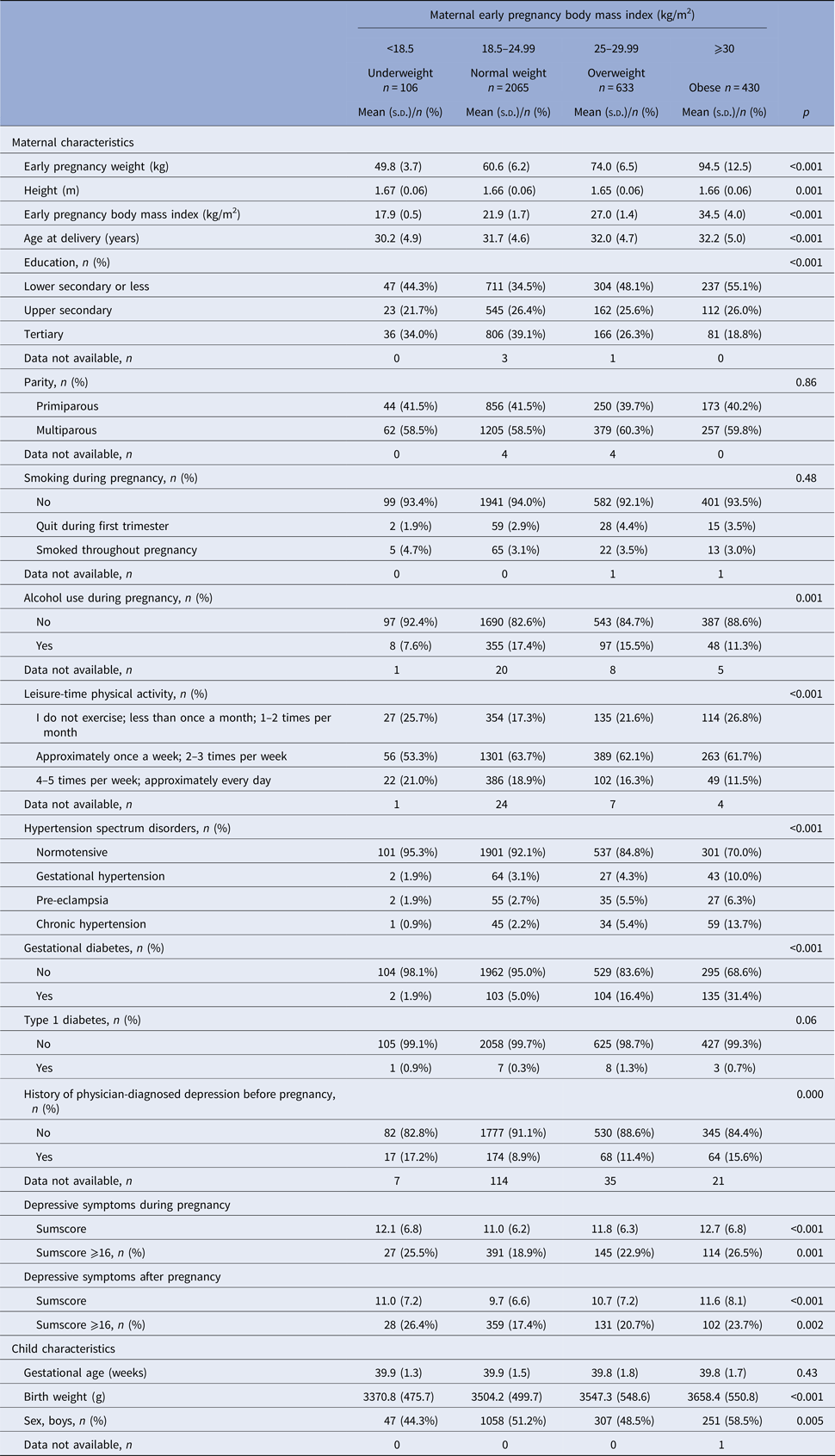
Table 1 shows sample characteristics according to maternal BMI groups for the analytic sample of 3234 women. The median number of depressive symptoms ratings during pregnancy was 13 (interquartile range 12–14); 79.6% of the women had two or less missing depressive symptoms ratings during pregnancy. Of the 3234 women, 2382 (73.7%) had depressive symptoms data at both follow-ups at 2.4 and 28.2 weeks after pregnancy, and 852 (22.3%) had depressive symptoms data at either follow-up. Online Supplementary Fig. S1 shows the number of women with missing data on depressive symptoms during and after pregnancy.
Characteristics of the sample according to maternal early pregnancy weight groups (N = 3234)

Note: Frequencies and percentages refer to valid N of variable.
Maternal depressive symptoms during pregnancy (intraclass correlations 0.46–0.80, all p values<0.0001) and after pregnancy (intraclass correlation 0.53, p < 0.0001) were significantly correlated. The mean of the depressive symptoms sumscores across 12–39 gestational weeks was significantly correlated with the mean of the two or the only sumscore after pregnancy (intraclass correlation 0.66, p < 0.0001). Of the 3234 women with depressive symptoms data both during and after pregnancy, 677 (20.9%) had clinically relevant symptoms during pregnancy and 620 (19.2%) had clinically relevant symptoms after pregnancy. Of the 677 women with clinically relevant symptoms during pregnancy, 361 (53.3% of 677) continued to have clinically relevant symptoms after pregnancy. Of the 2557 (79.1%) women who did not have clinically relevant depression symptoms during pregnancy, 259 (10.1% of 2557) had clinically relevant symptoms after pregnancy.
Maternal early pregnancy BMI groups and depressive symptoms during pregnancy
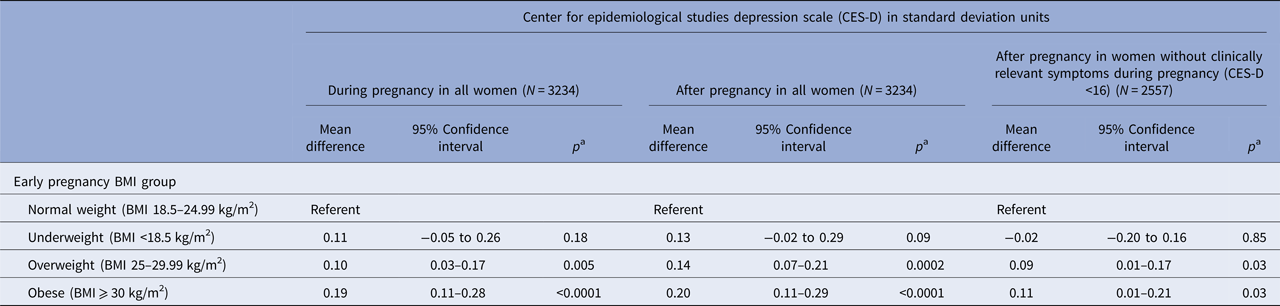
In the model adjusted for maternal age at delivery, education, parity, PA, smoking, and alcohol use during pregnancy as between-person time-invariant covariates and gestation week as a within-person time-varying covariate, obese and overweight women in comparison to the normal weight women reported higher levels of depressive symptoms during pregnancy (Table 2, first column). Figure 2a shows that the levels of depressive symptoms remained stably higher throughout pregnancy in the overweight and obese groups, and there were no significant BMI group x gestation week interactions. None of these group differences in depressive symptoms levels changed when we made further adjustments for maternal hypertensive or diabetic pre-pregnancy or pregnancy disorders (all p values<0.002). When maternal depressive symptoms during pregnancy were dichotomized at the clinical cut-off, maternal early pregnancy overweight was associated with 1.23-fold (95% CI 1.02–1.48, p values = 0.03 after all covariate adjustments) and maternal obesity with 1.43-fold (1.15–1.77, p values<0.001 after all covariate adjustments) odds for clinically relevant depressive symptoms during pregnancy compared with normal weight women. Figure 2b shows that the proportion of women with clinically relevant depressive symptoms was consistently higher throughout pregnancy in the overweight and obese groups, in comparison to normal weight group, and there were no significant BMI group x gestation week interactions. Underweight women did not differ significantly from the normal weight women in depressive symptoms during pregnancy (Table 2, first column; Fig. 2a and b).
Maternal depressive symptoms measured by using the Center for Epidemiological Studies Depression Scale (CES-D) during and after pregnancy in early pregnancy body mass index (BMI) groups. Panel a represents the mean of CES-D scores at the biweekly measurement points between 12 + 0 to 13 + 6 and 38 + 0 to 39 + 6 gestational weeks + days, and at 2.4 and 28.2 weeks after pregnancy in the early pregnancy BMI groups. Panel b represents the proportion of women scoring 16 or above at the biweekly measurement points between 12 + 0 to 13 + 6 and 38 + 0 to 39 + 6 gestational weeks + days, and at 2.4 and 28.2 weeks after pregnancy in the early pregnancy BMI groups. p Values refer to BMI group x gestation week and BMI group x time point after pregnancy interactions derived from the linear or generalized linear mixed model analyses.

Associations between early pregnancy body mass index (BMI) and depressive symptoms during and after pregnancy

Note: The analyses during pregnancy are adjusted for maternal age at delivery, maternal education, parity, maternal physical activity, smoking, and alcohol use during pregnancy as time-invariant between-person covariates and gestation week as time-varying within-person covariate; the analyses after pregnancy are adjusted for maternal age at delivery, maternal education, parity, maternal physical activity, smoking and alcohol use during pregnancy, child's gestational age, birth weight, and sex as time-invariant between-person covariates and time point after pregnancy as time-varying within-person covariate.
a Exact p values are given unless they are below 0.0001.
These group differences did not change when we excluded women who reported a history of physician-diagnosed depression before pregnancy or those who were enrolled to the study based on their known risk-factor status for pre-eclampsia or intrauterine growth restriction (p values<0.01).
Maternal early pregnancy BMI groups and maternal depressive symptoms after pregnancy
In the model adjusted for maternal age at delivery, education, parity, PA, smoking and alcohol use during pregnancy, child's gestation length, birth weight, and sex as between-person time-invariant covariates and time (2.4 and 28.2 weeks after pregnancy) as a within-person time-varying covariate, obese and overweight women in comparison to the normal weight women reported higher levels of depressive symptoms after pregnancy (Table 2, middle column). Figure 2a shows that these group differences remained stable after pregnancy and there were no BMI group x time interactions. None of these group differences in depressive symptoms levels changed when we made further adjustments for maternal hypertensive or diabetic pre-pregnancy or pregnancy disorders (p values < 0.0003). When depressive symptoms were dichotomized at the clinical cut-off, overweight women had 1.22-fold (1.00–1.49, p values = 0.05 after all covariate adjustments) and obese women had 1.36-fold (1.07–1.71, p values = 0.01 after all covariate adjustments) odds for reporting clinically relevant depressive symptoms after pregnancy compared with normal weight women. The odds to report clinically relevant depressive symptoms after pregnancy was 1.68-fold (1.13–2.53, p values = 0.01 after all covariate adjustments) for the underweight women compared with normal weight women. Figure 2b shows that the proportion of women with clinically relevant depression symptoms after pregnancy remained stably higher for overweight, obese, and underweight women in comparison to normal weight women and there were no BMI group x time interactions.
Table 2 (third column) shows that the depressive symptoms levels were also higher for overweight and obese women in comparison to normal weight women, even when we excluded women who reported clinically relevant depressive symptoms during pregnancy from the analyses. In the women, who did not report clinically relevant depressive symptoms during pregnancy, overweight and obesity did not, however, predict clinically relevant depressive symptoms after pregnancy (p values > 0.45; data not shown).
These group differences did not either change when we excluded women who reported a history of physician-diagnosed depression before pregnancy or those who were enrolled to the study based on their known risk-factor status for pre-eclampsia and intrauterine growth restriction (p values < 0.03).
Maternal hypertensive and diabetic pre-pregnancy and pregnancy disorders and maternal depressive symptoms during and after pregnancy
Online Supplementary Table S1 shows that maternal hypertensive and diabetic pre-pregnancy and pregnancy disorders were not significantly associated with depressive symptoms during or after pregnancy when we made adjustments for maternal early pregnancy BMI (p values > 0.23). There were not either any significant differences in depressive symptoms during or after pregnancy between women with and without any hypertensive and diabetic pre-pregnancy and pregnancy disorders when these differences were tested separately in the normal weight, underweight, overweight, or obese groups (see online Supplementary Table S2).
Discussion
Our study shows that maternal early pregnancy overweight and obesity are associated with consistently higher levels of depressive symptoms throughout pregnancy and consistently higher proportion and odds to report symptoms that are clinically relevant. Of the overweight and obese women nearly 23% and 27%, respectively, reported clinically relevant symptomatology during pregnancy, in comparison to 19% of normal weight women. The odds for clinically relevant symptomatology during pregnancy were 23% and 43% higher for overweight and obese women, respectively, in comparison to those who were normal weight.
Maternal early pregnancy overweight and obesity also increased the odds to report clinically relevant symptoms after pregnancy by 22% and 36%, respectively. Importantly, our study revealed that this risk was also increased for underweight women by 68%. While early pregnancy overweight and obesity were significantly associated with higher depressive symptoms levels also in women without clinically relevant depressive symptomatology during pregnancy, the associations with clinically relevant symptoms after pregnancy did not reach significance in this subgroup.
Our study also showed that maternal hypertensive and diabetic pre-pregnancy and pregnancy disorders did not explain any of the early pregnancy BMI effects. These disorders did not either add to the effects of maternal early pregnancy BMI. Rather, our study showed that any significant associations between hypertensive and diabetic pre-pregnancy and pregnancy disorders were accounted for by the maternal early pregnancy BMI.
Our study has many strengths. Unlike in any of the previous studies, we measured depressive symptoms consecutively throughout and after pregnancy. Second, we studied the associations in a large sample of which a subset was chosen to increase the incidence of pre-eclampsia and intrauterine growth restriction resulting in an increased statistical power to test associations of early pregnancy BMI and hypertensive and diabetic pre-pregnancy and pregnancy disorders with repeatedly measured depressive symptoms. A related strength of our study is that early pregnancy weight and height were extracted from antenatal clinical measurements and pre-pregnancy and pregnancy disorders were derived from medical records and for a subset verified by a clinical jury. In only a handful of the previous studies have weight or height been measured (Fowles et al. Reference Fowles, Timmerman, Bryant and Kim2011; Lukose et al. Reference Lukose, Ramthal, Thomas, Bosch, Kurpad and Duggan2014; Mina et al. Reference Mina, Denison, Forbes, Stirrat, Norman and Reynolds2015; Molyneaux et al. Reference Molyneaux, Pasupathy, Kenny, McCowan, North and Dekker2016a) and in only one of the previous studies (Sundaram et al. Reference Sundaram, Harman, Peoples-Sheps, Hall and Simpson2012) have these pre-pregnancy and pregnancy disorders been taken into account. Finally, sample attrition during follow-up was minor, and we were able to account for a number of relevant covariates.
A major study limitation relates to not knowing what the biological mechanisms are that underpin these associations. These may relate to alterations in hypothalamic–pituitary–adrenocortical (HPA) axis activity and inflammatory markers that are related to maternal BMI (Lindsay & Nieman, Reference Lindsay and Nieman2005; McEwan et al. Reference McEwan, Lins, Munro, Vincent, Ponnampalam and Mitchell2009; Denison et al. Reference Denison, Roberts, Barr and Norman2010; Duthie & Reynolds, Reference Duthie and Reynolds2013; Godfrey et al. Reference Godfrey, Reynolds, Prescott, Nyirenda, Jaddoe and Eriksson2017). Emerging data suggest that alterations in HPA axis activity and inflammation may also be associated with maternal depressive symptoms or distress during pregnancy (Haeri et al. Reference Haeri, Baker and Ruano2013; Shelton et al. Reference Shelton, Schminkey and Groer2014). While these same mechanisms may account for the associations with depressive symptoms after pregnancy (Brunton & Russell, Reference Brunton and Russell2008; Anderson & Maes, Reference Anderson and Maes2013; O'Hara & McCabe, Reference O'Hara and McCabe2013), it remains unknown what role do changes in glucocorticoids, estradiol, and progesterone, which take place after parturition, play in these associations; and what is the role of other factors implicated in obesity and depression, such as leptin, tryptophan, and vitamin D (Anderson & Maes, Reference Anderson and Maes2013).
Genetic and epigenetic factors may also underlie the associations between obesity and depression. Twin studies suggest that the genetic component of depression is partially shared with obesity (Afari et al. Reference Afari, Noonan, Goldberg, Roy-Byrne, Schur and Golnari2010; Jokela et al. Reference Jokela, Berg, Silventoinen, Batty, Singh-Manoux and Kaprio2016). According to a recent systematic review of genome-wide association and candidate gene studies pleiotropic genes, such as the FTO gene, may underlie (Amare et al. Reference Amare, Schubert, Klingler-Hoffmann, Cohen-Woods and Baune2017), but findings are however, inconsistent (Walter et al. Reference Walter, Kubzansky, Koenen, Liang, Tchetgen Tchetgen and Cornelis2015). Interactions between genotype, such as the FTO gene, depression, and BMI have also been reported (Clarke et al. Reference Clarke, Hall, Fernandez-Pujals, MacIntyre, Thomson and Hayward2015; Rivera et al. Reference Rivera, Locke, Corre, Czamara, Wolf and Ching-Lopez2017). On the other hand, both depression (Osborne et al. Reference Osborne, Clive, Kimmel, Gispen, Guintivano and Brown2016; Chen et al. Reference Chen, Meng, Pei, Zheng and Leng2017; Edvinsson et al. Reference Edvinsson, Bränn, Hellgren, Freyhult, White and Kamali-Moghaddam2017) and BMI (Dick et al. Reference Dick, Nelson, Tsaprouni, Sandling, Aïssi and Wahl2014; Ligthart et al. Reference Ligthart, Marzi, Aslibekyan, Mendelson, Conneely and Tanaka2016) have been associated with DNA methylation changes at specific genetic loci, including genes regulating inflammatory function.
Behavioral mechanisms may also be involved, including sleep problems and pain that may be aggravated in higher BMI pregnancies and that may induce more depressed feelings. In addition, unhealthy diet and low physical exercise may be involved (Nascimento et al. Reference Nascimento, Surita and Cecatti2012; Jacka & Berk, Reference Jacka and Berk2013). We lack data on the women's dietary patterns and our measure of PA was self-reported. Future studies will need to unravel if these mechanisms are involved. As the association between obesity and depression is suggested to be bi-directional (Luppino et al. Reference Luppino, de Wit, Bouvy, Stijnen, Cuijpers and Penninx2010), we cannot rule out the possibility of reverse causality between BMI and depressive symptoms either.
Other study limitations relate to generalizability from our findings to other groups who are different from our sample. Because a subset of women with risk factors for pre-eclampsia and intrauterine growth restriction was recruited in our study, our sample has a higher proportion of obese women and a higher prevalence of pre-eclampsia and gestational hypertension, compared with the general population of pregnant Finnish women (Girchenko et al. Reference Girchenko, Lahti, Tuovinen, Savolainen, Lahti and Binder2017). Further, even though the attrition in our sample was minor, it was selective: the women in the analytic sample were older, more often primiparous and less often had pre-eclampsia than participating women with a live-born infant without data on depressive symptoms both during and after pregnancy. Finally, although we were able to control for a number of potential covariates, we cannot entirely exclude the possibility of residual confounding.
To conclude, maternal early pregnancy overweight and obesity are associated with higher levels of and proportion and odds to report clinically relevant depressive symptoms during and after pregnancy. Early pregnancy underweight women also have higher risk of clinically significant depressive symptoms after pregnancy. Hypertensive and diabetic pre-pregnancy and pregnancy disorders do not explain or add to these associations. Our findings showing that obese and underweight women are vulnerable to depressive symptoms suggest mental health needs to be considered as part of routine antenatal care. Existing lifestyle interventions in pregnant overweight and obese women have focused on dietary and PA behavior change without considering maternal mental health (Poston et al. Reference Poston, Bell, Croker, Flynn, Godfrey and Goff2015). Our findings suggest that it would be beneficial to take into account the depressive symptoms of the obese women since depression might hinder the effectiveness of the interventions. This will not only benefit the health and wellbeing of women during and after pregnancy, but the offspring as well, as maternal early pregnancy underweight, overweight, obesity, and depressive symptoms during and after pregnancy may increase the offspring's risk of adverse perinatal and physical health and neurodevelopmental (Reynolds et al. Reference Reynolds, Allan, Raja, Bhattacharya, McNeill and Hannaford2013; Rahman et al. Reference Rahman, Abe, Kanda, Narita, Rahman and Bilano2015; Lahti et al. Reference Lahti, Savolainen, Tuovinen, Pesonen, Lahti and Heinonen2017) outcomes in later life.
Supplementary material
The supplementary material for this article can be found at https://doi.org/10.1017/S0033291717003889.
Acknowledgements
This work was supported by the Academy of Finland (K.R., grant numbers 284859, 2848591, 312670; E.K., grant numbers 127437, 129306, 130326, 134791, 263924, and 274794; H.L., grant numbers 121196, 134957, and 278941; M.L-P, grant number 285324; A-K.P.); University of Helsinki Research Funds (S.M.K., M.L-P., S.T., H.L.), British Heart Foundation (R.M.R.); Tommy's (R.M.R.); European Commission (E.K., K.R., Horizon 2020 Award SC1-2016-RTD-733280 RECAP); Foundation for Pediatric Research (E.K.); Juho Vainio Foundation (E.K.); Novo Nordisk Foundation (E.K.); Signe and Ane Gyllenberg Foundation (K.R., E.K.); Sigrid Jusélius Foundation (E.K.); Finnish Medical Foundation (H.L.); Jane and Aatos Erkko Foundation (H.L.); Päivikki and Sakari Sohlberg Foundation (H.L.); and Doctoral Program of Psychology, Learning, and Communication (S.M.K., P.G.). P.M.V, K.H, and E.H received no specific grant from any funding agency, commercial or not-for-profit sectors.
Declaration of interest
Dr Hannele Laivuori has received funding from Finox Biotech Nordics AB, unconditional support for the Meeting of the Nordic Expert Group. Satu M Kumpulainen, Polina Girchenko, Drs Marius Lahti-Pulkkinen, Rebekka M. Reynolds, Soile Tuovinen, Kati Heinonen, Anu-Katriina Pesonen, Pia M Villa, Eero Kajantie, Esa Hämäläinen, and Katri Räikkönen declare no conflict of interest.