I
The floundering and subsequent collapse of many private banks in 2008–9 led to increased calls for cooperative and government-controlled banks.Footnote 1 Now the cloud of dust from the financial ruins has started to settle, government-controlled banks are regarded as offering better guarantees in terms of transparency, democracy and efficiency. Government-controlled or public banks turn out to be the offspring of the so-called late medieval crisis in Europe. At some point in the second half of the fourteenth century, the need for public banks became urgent in most economically progressive regions of Europe. In Venice, the earliest proposal for the formation of a public bank dates back to 1356. The proposal's author, one of the leaders of the Council of Forty (la Quarantia), apparently did not go far enough with his ideas, which were consequently not realised (Lane and Mueller Reference Lane and Mueller1985, p. 82; Mueller Reference Mueller1997, pp. 18, 56 and 112). The oldest municipal public banks originated not in Italy, but in Spain and more specifically in Catalonia, which lay on the sea route from Italy to north-west Europe. Cities such as Barcelona (with the Taula del cambi, Taula de canvi or Taula de la Ciutat in 1401), Valencia (with the Taula de cambis or Taula de canvis in 1407), Gerona (with the Taula de canvis in 1443) and Palma de Mallorca (with the Taula del General in 1454), played a pioneering role. The oldest and best-known example in Italy is the Banco di San Giorgio, which opened in Genoa in March 1408. The authorities also tried to provide for a public alternative to local private bankers in other regions (e.g. Perpignan, Nuremberg). Although the structure of these banks differed greatly – the Taula in Barcelona acted for the municipal treasury, the Banco in Genoa worked for private customers – they all shared an ephemeral existence. After about half a century, these public banks had proved to be just as vulnerable as the private banchi di scritta. The Catalonian banks, for example, lacked any monopoly on attracting deposits, and provided substantial loans to municipal authorities, so that they too faced problems of liquidity (Usher Reference Usher1943, pp. 246, 269–73; Riu Reference Riu1982, p. 183; Reference Riu, Gerli, Armistead and Burns2003, p. 143; Aerts Reference Aerts and Felloni2006, pp. 52–7).
With the commercial expansion of the sixteenth century and the powerful revanche méditerranéenne (F. Braudel) after 1550 (Braudel Reference Braudel1966, pp. 495–8; transl. Reference Braudel1978, pp. 545–8; Cipolla Reference Cipolla1976, pp. 238–9), new public banks were established in Italy. This first occurred in Palermo (1552) and Turin (1563), followed later on by Naples (1584), Genoa (1586), Venice (1587), Messina (1587), Milan (1593) and Rome (1605). The best-known bank was the Banco della piazza di Rialto, established in Venice in April 1587. It was intended as a continuation of the private deposit and transfer banks which had forfeited the confidence of the merchants after 1560. Current account loans were prohibited. Even more successful was the Banco Giro of Venice established in May 1619, which managed Venice's public debt via the issue of interest-bearing obligations (partite). In Catalonia, several public banks from the late Middle Ages revived in the first half of the seventeenth century under Italian influence (Van der Wee Reference Van der Wee, Rich and Wilson1977, pp. 312–15; Reference Van der Wee, Van der Wee and Kurgan-van Hentenryk2000, pp. 129, 131). Such public transfer banks also practised outside the Mediterranean region, monopolising the clearing system and hence exerting a great power of attraction. In Amsterdam, which was soon to become the Wall Street of the seventeenth century, the Wisselbank started its activities in 1609. Other banks imitating the Amsterdam model followed quickly in Middelburg (1616), Hamburg (1619), Nuremberg (1621), Delft (1621) and Rotterdam (1635), while the Amsterdam prototype itself had simply copied its regulations from the Banco della piazza di Rialto (Prak Reference Prak2002, p. 283; transl. Reference Prak2005, p. 270; De Vries and Van der Woude Reference De Vries and Van der Woude1995, p. 109; transl. Reference De Vries and Van der Woude1997, p. 131). By 1700, probably 25 public banks existed in Europe, all of which accepted and paid out deposits, made transfers between accounts, traded in bills of exchange and were engaged in clearing operations (Parker Reference Parker1978, p. 551).
Conspicuous by its absence from the list of regions where experiments with public banks were conducted from the late Middle Ages onwards is the Southern Low Countries. This absence may rightly be regarded as surprising. Since the high Middle Ages, principalities such as Flanders and Brabant had been among the most economically progressive in Europe (Aerts Reference Aerts, Kelders and Duvosquel2009, pp. 23–4). Quite apart from their favourable position in a network of long-distance trade, which would subsequently lead to the creation of metropolises such as Bruges and Antwerp, they constituted the industrial heartland of medieval Europe since the twelfth century (Spufford Reference Spufford2006, p. 228). The southern part of the Low Countries was not only a prosperous and densely populated region, but also had numerous relatively large cities where, depending on the period, between a fifth and a third of the total population lived.Footnote 2 This strong urban tradition did not just ensure vigorous resistance to the overweening authority of the state (Blockmans Reference Blockmans, Koenigsberger and Müller-Luckner1988, pp. 150–4; Boone and Prak Reference Boone, Prak, Davids and Lucassen1995, pp. 99–134). Cities there were also transformateurs électriques of tensions, concepts, theories and relations.Footnote 3 With their printing presses and publishers, schools, chambers of rhetoric and in some cases colonies of resident foreign merchants, large urban conglomerations had not only the material but also the intellectual infrastructure for the exchange and distribution of ideas (Van der Wee Reference Van der Wee and Van der Wee1993a, pp. 265–7, 276–7; Van Nierop Reference Van Nierop and Darby2001, pp. 42–3).
According to Giuseppe Felloni, public banks were set up by licence from the government and were also subject to the supervision of that government (Felloni Reference Felloni1997, p. 116; Reference Felloni, Wilson and Parker1977, p. 18). In the late Middle Ages, these governments seem to have been inspired to take the initiative, against a background of bullion scarcity or even shortage, to stabilise the currency and to ensure stable exchange rates. The way to do this was to provide stable bank money guaranteed by three conditions: the presence of nearly all cash deposits at all times,Footnote 4 the exclusion of loans to private individuals and the prohibition of overdrafts on current accounts. The concern to manage the public debt of the municipal administrations or city states more effectively was another important motive (Martínez Reference Martínez, Boone, Davids and Janssens2003, p. 41). Even in early modern Europe the poor quality of the indigenous currency was a factor in the foundation of public municipal banks. Worn-out, clipped and trimmed coins were bad not just for transactions in common money, but also for the increasingly popular transactions in bills of exchange. After all, bills that were drawn had to be paid out sooner or later. Beneficiaries dreaded the possibility of their bill being paid in inferior coin. Drawing bills of exchange on accounts at a public bank and having them paid out in bank money (in banco, moneta di banco, marc banco) of the same, unchanging quality and outstanding reputation enabled this problem to be circumvented (North Reference North2009, p. 89). According to an intelligent observer such as Adam Smith, it was to this that the famous Bank of Amsterdam owed its origin.Footnote 5
So did such factors not play a role in the monetary and financial history of the Southern Low Countries? The question has been asked before, including by myself,Footnote 6 but has never been answered. In what follows, I present a number of hypotheses for the two most important principalities, Flanders and Brabant, between the end of the fourteenth century and the end of the eighteenth century. Section II focuses on private money changers in the late Middle Ages and their role as cashiers or bankers; Section III deals with the consequences of government interference in the fifteenth century, and Section IV surveys the activities of municipal money changers in the late Middle Ages. Sections V and VI assesses the performance of cashiers in Antwerp and Bergen op Zoom and the determinants of new proposals to create a public bank. Section VII discusses the possible effect of municipal debt management in Antwerp in the early modern age, whereas Section VIII analyses the reasons behind the failure of the attempt to establish a public or central bank in the Austrian Netherlands in the eighteenth century. Section IX concludes.
II
In Bruges, the 15 or 16 local private money changers had developed banking functions from the first decade of the fourteenth century onwards, along the lines of the Italian cambiatori (Murray Reference Murray2005, pp. 153–5). They accepted deposits, performed giro transfers between account-holders, including at other banks, settled the transfers bilaterally with their fellow money changers and applied the principle of the fractional reserve, so that their cash reserves only represented a certain proportion of their deposits. The released funds were invested by them as silent partners in commercial and industrial transactions, but they also used them to grant small advances to good customers on their current account. Unfortunately, in their investments money changers neglected their spreading of risks. Together with the often narrow basis of their solvency and the absence of any central bank or rediscount institution, this ensured that bancarotte – bankruptcies – were a common occurrence. Raymond De Roover, the Belgian-American historian who was the first to study their activities in detail (De Roover Reference De Roover1948, pp. 203–4, 210, 247, 256–9, 261–2, 272–6, 310–11, 317),Footnote 7 believed that the money changers also played a banking role in other cities in the Southern Low Countries in the fourteenth and fifteenth centuries.Footnote 8 However, this is an open question at the moment.Footnote 9 According to Vercouteren (Reference Vercouteren1985, pp. 9–13), money changers outside Bruges – and certainly in the duchy of Brabant – tended to be financial intermediaries who, as is clear from several princely ordinances, looked after merchants' money and executed payments or processed withdrawals for them, although always in cash. In short, these were cashiers rather than bankers.Footnote 10 Examples from Brussels, Leuven and Antwerp show that such money changers also accepted and looked after money for foreign merchants, and that in time they paid cash to a creditor of these merchants in the desired currency and at the desired place, usually one of the fairs in Antwerp or Bergen op Zoom. All operations were thus performed in cash: there was no credit, no transfers, no creation of a system of bank money. The money changers' premium was a reward for services rendered, not interest. In support of Vercouteren's thesis is the fact that even in Bruges, most residents regarded the money changers more as payment issuers of wages. Only a small financial elite of 10 per cent at most had accounts and deposits or used the money changers to deal in bullion (Murray Reference Murray2005, pp. 166–70, 176–7, 286; Spufford Reference Spufford2008, p. 33; Van Dillen Reference Van Dillen1953, p. 237). However, the fact that the municipal money changers, i.e. money changers working exclusively for the town exchange office (see below), did combine transfers and banking activities with their money-changing activity questions Vercouteren's thesis. According to some scholars, it therefore was in fact possible for money changers to act as bankers in large or larger cities that were linked to the Bruges banking system and where supply of and demand for money was largely available.Footnote 11
Cashiers or on certain occasions bankers, it cannot always have been easy for the money changers to find coins of the required quality for their demanding customers in a period of growing bullion scarcity. As a result, they were blamed by the public for bicqueteren – sorting and picking or culling out the better coins.Footnote 12 The government also harboured this suspicion, and imposed regulatory restrictions in the fourteenth century.Footnote 13 Complaints about their behaviour (‘Major shortcomings which occur on a daily basis’)Footnote 14 prompted the dukes of Burgundy to take a tougher line during the great monetary crises of the final decades of the fifteenth century.Footnote 15
III
According to Herman Van der Wee, a distinction arose at a certain moment between money changers in the strict sense of the word (taflettiers) and money changers–bankersFootnote 16. Although the sources designate the latter as wisselaers banckiers or changeurs bancquiers, these, it is claimed, were rather money changers who combined their profession with that of the cashier.Footnote 17 Both groups of money dealers were the subject of a number of ordinances from May 1480 onwards. The Antwerp municipal authorities likewise warned in a number of legal texts (e.g. 25 May 1480 and 16 September 1486) that a number of money changers had absconded during the fairs. Numerous merchants ‘menende aldaer wel bewaert zijnde’ (‘believing that their belongings were well kept by them’) had lost their money and jewellery as a result. All merchants therefore had it impressed upon them that the depositing of money and valuables with money changers was undertaken at their own risk and that the city could not be held liable for any loss.Footnote 18 The consequence of these irregularities was that both groups were explicitly banned by Maximilian I in the great monetary ordinance of 14 December 1489.Footnote 19 It was claimed that they had ruined numerous merchants by their operations as cashiers, and they were also said to be responsible for the export of good coins abroad.Footnote 20 Henceforth it was no longer permitted for the money changers–cashiers ‘to receive or to keep in deposit any coins belonging to the aforesaid merchants, nor to make payments with these coins to others’.Footnote 21
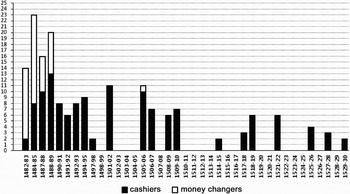
In contrast to what has been claimed in the historiography, the ordinance of 1489 did not really sound the death knell for the activities of money changers–cashiers. Quite the contrary: in 1497, Maximilian's successor, Philip the Fair, restored the money-changing business. Ten years later, for example, mention is made of ‘andere ende nyeuwe wisselairs’ (‘other and new money changers’).Footnote 22 At the Brabant fairs, a sharp increase in the number of money changers–cashiers was already a fact by the turn of the century. However, the number of ordinary money changers remained insignificant (Vercouteren Reference Vercouteren1985, pp. 22, 25, table and graph; see also Figure 1). It can be no coincidence that it was precisely the group of money changers who also acted as cashiers that survived and expanded. Apparently, despite the constant complaints from central and municipal authorities about the export of high-quality coins, ruined merchants and the deterioration of the currency,Footnote 23 they performed an indispensable function on the money market. Possibly they played the role that was reserved for public banks in Mediterranean Europe. As cashiers at the fairs and very probably in a few large cities too, they continued to provide the merchants with quality coinage. It is true that they did not create a transfer bank money system like their colleagues in Catalonia and Italy, or did so to a much lesser degree. Precisely because they were not regular bankers, but ‘only’ cashiers, they were less subject to the tension between long-term investments and short-term liabilities (De Roover Reference De Roover1948, p. 310). Merchants were also protected by a special caution sum that the money changers had to deposit with the municipal authorities. In the event of a cashier's insolvency, claims could be made upon this money.Footnote 24 By way of comparison, the city administration of Genoa required its private bankers to have deposits of caution money for the first time in 1447 and 1448 so that customers could always be paid in periods of liquidity crises (Heers Reference Heers1961, p. 58). However, this measure was only proclaimed after Italy's first public bank, the Banco di San Giorgio, had ceased all activity in 1445. In the end, merchants who lacked confidence in private money changers could still go to the municipal authorities themselves, which had also developed activities as cashiers and bankers.
Money changers and cashiers at the fairs of Bergen op Zoom (1482–1530)

Let us summarise. Private money changers existed throughout the late Middle Ages and survived regulation by central government as cashiers, and possibly as bankers. As such they were capable of fulfilling the role of a public bank. This hypothesis gains credibility if Raymond De Roover's thesis is correct and the money changers also exercised typical bankers' functions outside Bruges. If the money changers were cashiers only, merchants and industrial entrepreneurs must have turned to other money dealers for their credit. If that is so, in the late Middle Ages those other dealers were probably the municipal money changers.
IV
In the absence of public municipal banks in the Southern Low Countries, a solution needed to be found for the management of the urban finances, and in particular the urban debt. In Section I we recalled that the oldest public banks in Catalonia and Genoa were also assigned the task of managing the urban debt. Moreover, the famous Banco di San Giorgo was in fact merely a branch of a larger consortium (Officium comperarum et bancorum Sancti Georgii) which was responsible for looking after public loans (compere). In most of the cities of the Southern Low Countries, revenue collectors or receivers (paymeesters, rentmeesters, massars, recheveurs, thesauriers) were responsible for everyday financial dealings (Boone Reference Boone1990, p. 199), but not in the large cities of the duchy of Brabant. There, the so-called town exchange office (stadswissel) had existed since at least the fourteenth century. This was controlled by a city-appointed municipal money changer, who was thus distinct from the private urban money changers. Although he was in the service of the actual receivers, who supervised him like a kind of political appointee, the municipal money changer was in reality responsible for managing the city funds (L. Van Buyten Reference Van Buyten1981, p. 554; De Roover Reference De Roover1948, p. 182; Vercouteren Reference Vercouteren1985, p. 5). Such an exchange office was active in cities such as Antwerp, Bergen op Zoom, Brussels, Leuven, Mechelen and 's-Hertogenbosch.Footnote 25 Municipal money changers were rich technicians who often also had political influence.Footnote 26 As their name suggests, they evaluated the numerous types of coins that the city received and changed these currencies (except in Brussels, where the municipal money changer had to leave the actual changing of money to an independent money changer). Above all, they acted as municipal cashiers who collected the municipal revenues, carried out expenditure, and kept all the money that circulated within the municipal administration in a coffer. They had a significant stake in the city's credit policy, and played a pivotal role in the issue of annuities and hereditary rent charges (lijf- en erfrenten).Footnote 27 They were also involved in the purchase and sale of bills of exchange, were active in a wide range of commercial enterprises and helped collect the duke's direct taxes (aides, beden).Footnote 28
In practically all cities, these municipal money changers were also explicitly permitted to collect money from private individuals and look after it (Vercouteren Reference Vercouteren1982, p. 95). In fact, this was an obvious step. The town exchange office not only had the technical knowledge and requisite infrastructure (coffers with various locks, a chambre forte in a protected building), but often had a far better reputation than the private money changers. This confidence was helped by the fact that in a number of cases the city guaranteed foreign merchants' deposits in the event of their town exchange office's insolvency (Vercouteren Reference Vercouteren1982, pp. 80, 173). But the municipal money changers were not just cashiers; they also acted as bankers. They regularly granted advances to the municipal authorities, either to cover shortfalls in the current budget or to look after urgent expenses without immediately having to take out expensive loans. The fact that a number of town exchange offices were prohibited from lending money to private individuals proves that such lending did in fact take place in practice. In connection with such loans, the municipal money changers even accepted assignments. The context in which such ‘municipal banks’Footnote 29 operated was highly progressive for the time. Around the mid fourteenth century, the municipal money changers had developed an extensive interurban network in which significant amounts of capital circulated and double-entry bookkeeping alla veneziana was not unknown (Blockmans Reference Blockmans and Friedland1990, pp. 29–31; Reference Blockmans1985, pp. 209–11). Town exchange offices were perfectly capable of managing the public debt. They were also uniquely well placed to provide private merchants with reliable means of payment. In this way, they fulfilled the roles of the municipal deposit banks in Southern Europe.
According to most scholars, these town exchange offices disappeared at the time of the financial crisis at the end of the fifteenth century (Van der Wee Reference Van der Wee1991, p. 1163).Footnote 30 In these towns, the urban receivers took over some of their tasks. In Leuven, the town exchange office ceased to exist as early as around 1430 (Van Uytven Reference Van Uytven1961, pp. 39, 42, 45). Whether the local money business was greatly inconvenienced by this is doubtful: in fact, not even bills of exchange were traded in Leuven at that time (Van Uytven Reference Van Uytven1961, p. 460).Footnote 31 By contrast, in some larger cities the town exchange office continued to exist. Such was the case in Mechelen (Mertens Reference Mertens1982, vol. I, p. 132). According to most historians, the town exchange office was typical of the duchy of Brabant (Van Uytven Reference Van Uytven1961, pp. 38 n. 1, 45, 652). In the county of Flanders with its more pronounced Italian presence, with the possible exception of some large cities, no comparable institution seems to have existed. The ordinary urban receivers – often rich Tuscans – advanced money there, while Italian financiers or local rich burghers lent money to the municipal authorities (H. Van Werveke Reference Van Werveke1934, pp. 275, 291; Blockmans Reference Blockmans1985, pp. 206, 207, 214). However, in fifteenth-century Bruges, deposits were also centralised in de wissele (‘in the exchange office’) (Bigwood Reference Bigwood1921, vol. I, p. 432).Footnote 32
V
It used to be believed that in Antwerp, the metropolis of international trade and finance in the sixteenth century, real deposit banks ‘never took root as typical institutions’ (Van der Wee Reference Van der Wee, Rich and Wilson1977, p. 323; Reference Van der Wee, Van der Wee and Kurgan-van Hentenryk2000, p. 192; De Roover Reference De Roover1948, p. 340). However, as we have seen in the previous section, money changers–cashiers did survive despite decades of mistrust and regulation on the part of central and urban governments, and in the early sixteenth century even experienced a revival at the fairs of Antwerp and Bergen op Zoom. In quantitative terms, this development can best be traced for the two free fairs of Bergen op Zoom, where the number of money changers and cashiers was registered both at the Paasmarkt (Easter Fair) and at the Koude Markt (Cold Fair) in the municipal accounts every year. Sure enough, Figure 1 shows that ordinary money changers disappeared from the fairs after 1489, with a few exceptions. Money changers who also functioned as cashiers remained present until around 1530. From 1534, no money changers or cashiers were reported at the fairs at all.Footnote 33 However, this point has nothing to do with government regulations, but closely reflects the economic situation, which started to decline from the 1530s (Kortlever Reference Kortlever and Cavaciocchi2001, pp. 641, 642; Reference Kortlever, van Gelder and Mijers2009, p. 21). A decree of Charles V (1541), stating that payment for goods traded in Bergen op Zoom had to take place in Antwerp, dealt the final blow to some financial activities. Apparently the presence of financial specialists was no longer necessary.
The situation was very different in the world market of Antwerp, which had the wind in its sails in the first half of the sixteenth century. It was perhaps with the growth and above all the democratisation of international trade in Antwerp in the sixteenth century that these money changers–cashiers developed into the so-called independent cashiers who would remain active on the Antwerp money and capital market throughout the Ancien Régime. A more traditional explanation traces the commencement of their role to the activities of a kind of bookkeeper for the numerous merchants.Footnote 34 These latter had an employee on their permanent payroll who took care of everyday income and expenses, accounted for transactions and kept the money in a coffer. Some cashiers also collected debts and even bought or sold merchandise (Stols Reference Stols1971, vol. I, pp. 288–9).Footnote 35 Because smaller merchants could not afford a full-time cashier, quite a few cashiers worked for various clients, who might often even be foreigners (De Ruysscher Reference De Ruysscher2009, pp. 223–4). Herman Van der Wee believed that several cashiers had already acquired independent status around the mid sixteenth century, whereas Roland Baetens assumed that such independent cashiers only emerged around 1640 (Van der Wee Reference Van der Wee1963, vol. II, p. 359; Reference Van der Wee, Rich and Wilson1977, p. 324; Baetens Reference Baetens1976, p. 241). In the second half of the seventeenth century, the profession's reputation increased and veritable dynasties of cashiers arose which persisted into the eighteenth century (Degryse Reference Degryse2005, p. 153). Thus cashiers practised cash management in the broadest sense of the term, but also conducted transactions involving bills of exchange and letters obligatory. Importantly for the merchants, the cashiers opened accounts for their customers and accepted transfers from account to account. This money of account could be converted into cash virtually immediately. According to some sources, albeit from the beginning of the eighteenth century, this operation took less than two hours (Degryse Reference Degryse2005, p. 195 n. 1)! With some of the large cashiers, the boundary with the banking system (lending and investing money from others with the application of a fractional reserve coefficient, the appliance of current overdrafts, etc.) will have been very slight and was possibly crossed on some occasions.Footnote 36 However, it seems likely that most Antwerp cashiers, like their colleagues in Amsterdam up to 1650, did not engage in credit operations until well into the seventeenth century (Van Dillen Reference Van Dillen1953, p. 240; Heyvaert Reference Heyvaert1975, pp. 118, 128).Footnote 37 All the same, their share in the giro money supply seems to increase from the second half of the seventeenth century onwards (Degryse and Everaert Reference Degryse and Everaert1989, pp. 125, 126). Texts from about 1600 even suggest that some persons (cashiers are not explicitly mentioned) had developed a system of clearing for assignments and assisted each other for payments in cash (Denucé Reference Denucé1931, p. 134).
VI
On the basis of the foregoing, it is not absurd to suppose that in the sixteenth and seventeenth centuries, specialised money dealers such as the cashiers in some large cities, especially Antwerp, assumed the role of the public banks. They looked after merchants' money and ensured that they had access to reliable coin rapidly and at any moment. Like their medieval predecessors, they were not real bankers, which explains why they also went bankrupt less frequently. Merchants looking for credit in Antwerp from the second or third decade of the sixteenth century onwards could turn to a new group of money dealers ‘faisant des marchandises d'argent en les donnants a gaing et frait’ (‘doing money business by giving at profit and at interest’). Unlike the cashiers, these did give credit. Their activity was recognised on 4 October 1540 by an imperial ordinance on condition that the rate of interest did not exceed 12 per cent per annum. Two years later, this ban was found to have been breached so frequently that the Antwerp municipal authorities republished the provisions of the ordinance of 1540.Footnote 38 These money dealers also bought matured (i.e. payable) or nearly matured letters obligatory (Van der Wee Reference Van der Wee1963, vol. II, pp. 358–60; Reference Van der Wee1965, p. 497; Reference Van der Wee1967, p. 1086; Reference Van der Wee, Van der Wee and Kurgan-van Hentenryk2000, pp. 192 (where the chronology of the appearance of the new money dealers is situated somewhat later), 195; Van der Wee and Materné Reference Van der Wee, Materné and van den Eerenbeemt1987, p. 75).Footnote 39 The expansion of the popular assignment principle on the Antwerp market (Van der Wee Reference Van der Wee1963, vol. II, pp. 344–5; Reference Van der Wee, Van der Wee and Kurgan-van Hentenryk2000, p. 184) had meant that merchants often had to contact various people fruitlessly in order to get their money (Van Dillen Reference Van Dillen1927, p. 49; Van der Wee Reference Van der Wee1972, pp. 154–5). From a letter from the Antwerp magistrate to the Council of Brabant in 1560 it can be deduced that cashiers also cashed such assignments in return for a premium or agio. Footnote 40 Apparently, the new money dealers did not constitute a closed group, and their numbers also occasionally included cashiers, as well as money changers, goldsmiths and, at least around 1600, even merchants (Denucé Reference Denucé1931, p. 135, doc. XXVII).
Like their colleagues in Amsterdam (Heyvaert Reference Heyvaert1975, pp. 103, 105), the Antwerp cashiers were subject to accusations from Brussels throughout the sixteenth and seventeenth centuries of being responsible for numerous abuses. Merchants also complained about liquidity problems with some cashiers, so that they were compelled to present their assignments to different cashiers each time before they could recover their deposits (Janssens Reference Janssens1957, pp. 257, 258). Some abused the strict stock exchange hour, appeared much too late and ran away the moment they heard the small exchange clock (cloxken op de borsse, clochette de la bourse) ringing, just to avoid payment (Denucé Reference Denucé1931, p. 130, doc. XXIII). The government accused the cashiers of debasing the quality of the currency. Although all these complaints about monetary problems doubtless had some foundation, it would be wrong to single out the cashiers as their sole cause. Apart from the money changers,Footnote 41 foreign merchantsFootnote 42 or even the goldsmiths were also regularly blamed. Very often the cashiers were powerless to do anything about the phenomena of which they were accused. One of the effects regularly ascribed by the government to the nefarious actions of the cashiers was the increase in gold prices. I have deliberately chosen this example because a similar complaint in 1408 lay at the basis of Italy's oldest public bank, the Banco di San Giorgio (Aerts Reference Aerts and Felloni2006, pp. 55–6; Van Dillen Reference Van Dillen1927, p. 37). The government claimed that cashiers gave a higher price for certain gold coins than was permitted in the ordinances.Footnote 43 However, it is clear that the rise in the price of gold coins, which incidentally took place on all European money markets, was not the consequence of the action of a few individuals, but of deeper-lying factors such as the disparity between the official gold–silver ratio and that on the free market (Coenen Reference Coenen1980, pp. 822–9).
In short, cashiers turned out – like their medieval predecessors, the money changers, and despite the accusations made against them – to be indispensable in a money marketFootnote 44 on which no public bank operated. Not that serious consideration was not given to establishing such an institution, which would combine the advantages of the cashiers (availability of quality coinage for commerce) with the absence of their disadvantages (liquidity problems). For in fact all historians have completely overlooked a clause in one of the numerous seventeenth-century monetary and financial ordinances. On 20 July 1652, the governor of the Spanish Netherlands observed once again that the rates of gold coins on the free market in Brabant and Flanders were set higher than the official tariffs (Brants Reference Brants1914, p. 244). An over-regulatory approach based on official evaluations would drive the gold coins out of circulation. The idea was therefore raised of creating public banks in the two cities of the Spanish Netherlands which had international monetary transactions, Antwerp and Lille (villes de change).Footnote 45 Following the example of other countries, these would be able to make quality coinage available at a fixed price.
Such a plan was never put into practice. For the time being, money changers and especially cashiers remained the only ones offering giro transactions on the money market. Valéry Janssens points to ‘economic and financial decline’ as the primary cause.Footnote 46 It is true that the deplorable state of the public finances, numerous military operations and the shift in economic conditions after 1665 were not particularly propitious for new state initiatives (Aerts Reference Aerts1996, pp. 140, 145; Reference Aerts and Van Uytven2004, pp. 421–44; Coppens Reference Coppens1992, pp. 293, 342, 370). But other factors played a role as well. The numerous problems associated with the shortage of high-quality coins for long-distance trade had in fact led to a public bank in Amsterdam. But the seventeenth century was not the same in the south as it was in the north. Not only had foreign trade greatly declined in the Southern Low Countries (Aerts Reference Aerts and Van Uytven2004, pp. 430–2), but in terms of regional economics the existence of the Amsterdamse Wisselbank probably made the need for a public bank for the Southern Low Countries less acute. After all, the major merchants from there had current accounts in stable bank guilders in Amsterdam. Moreover, from the mid-seventeenth century onwards, there was a highly reputable money of account for these merchants in the form of the gulden wisselgeld (florin de change, bonne monnoye) based on the bank money of the Amsterdam bank (moneta di cambio, moneta di banco) (Janssens Reference Janssens1955, pp. 8–13).Footnote 47
Nevertheless, the idea that was raised in 1652 shows that even in difficult times some members of the government were aware of the advantages of a municipal public bank, if only to improve the monetary circulation.
VII
At first sight, it is surprising that in the city which was Europe's great commercial metropolis in the sixteenth century, and that remained the largest city in the Southern Low Countries until 1670–80, such an initiative never materialised. Concern about the quality of the coinage may have been primarily a complaint of the central government, but the Venetian Banco Giro in 1619 shows that a public bank could also be an efficient instrument for the management of urban debt.
Studies of Antwerp's municipal finances have shown that the city was involved in the financial policy of the central government from as early as the Burgundian period (Van der Wee Reference Van der Wee1963, vol. II, p 85).Footnote 48 Parallel with the city's growing commercial success, the central government's interest grew in the city corpus as the basis for the issue of annuities and the placing of loans. The price that the city paid for this was high. In the late Middle Ages, Antwerp scarcely had any consolidated debt, but in the sixteenth century a substantial burden of debt arose which was monitored closely by the government in Brussels: in the event of a moratorium, creditor confidence would vanish and the government would be unable to issue any more loans. In other words, the government's credit was largely dependent on the city's credit (Masure 1985–6, vol. I, p. 281; 't Hart and Limberger Reference 'T Hart and Limberger2006, pp. 39 n. 10, 45 n. 29, 48). A number of internal measures by the municipal authorities proved of little help.Footnote 49 Around 1540, the total imperial debt in the city amounted to the phenomenal sum of nearly 572,000 guilders (Masure 1985–6, vol. I, p. 276).Footnote 50 At this point, the central government decided to take action. Government commissioners were sent, and on 9 June 1544 governor Mary of Hungary issued a strict ordinance containing detailed measures regarding all kinds of income and expenditure items, the status of various kinds of personnel and their expenses statements, the issue of annuity rents and so on, with the general aim of increasing the town's income and reducing its costs (Lameere and Simont Reference Lameere and Simont1910, pp. 65–72). With the rationalisation plan of 1548, the city effectively accepted central government interference in its financial policy.
Despite central action that was far-reaching, and under governor Alva even drastic, the eventual rationalisation failed.Footnote 51 In the seventeenth century, the consolidated state debt was passed on and accumulated further. This development explains why central government control remained just as tight throughout the seventeenth century. Precisely this approach of government supervision led to a high degree of rigidity and a lack of flexibility or innovation in Antwerp municipal finances ('t Hart and Limberger Reference 'T Hart and Limberger2006, pp. 58, 64).Footnote 52 It is clear that the high level of spending left little opportunity and few resources for experiments such as a public bank. Strict supervision remained necessary because the urban debt again assumed gigantic proportions in the early decades of the eighteenth century and remained a cause for concern throughout the century (Blockmans Reference Blockmans1952, pp. 50, 59).
VIII
During the final decades of the seventeenth century and the first half of the eighteenth century, commerce and industry in the Spanish and, after 1713, in the Austrian Netherlands languished. In 1736, the minister plenipotentiary referred to the ‘commerce fortement diminué et languissant’.Footnote 53 The crisis was equally apparent on the Antwerp money market (Degryse Reference Degryse2005, pp. 146–7). Despite the difficult economic conditions, a number of cashiers remained active in Antwerp. Like their counterparts in earlier centuries, they received money from important merchants, opened current accounts for their customers, accepted transfers from one account to another, paid bills of exchange, and so on. In a mémoire from 1727, it is even claimed that ‘ces caissiers ont entre leurs mains presque tous les deniers des negociants de la ville d'Anvers’ (Janssens Reference Janssens1957, pp. 258, 259 n. 1). During the second half of the eighteenth century, which was characterised by expansion in many economic sectors (Vandenbroeke Reference Vandenbroeke1975, pp. 148, 621), they are said to have brought the giro-based system to a high degree of perfection (Michielsen Reference Michielsen1952, p. 121). In the 1760s, one cashier even opened accounts for all merchants and bankers, and thus functioned as a kind of central clearing house (Janssens Reference Janssens1957, p. 260).
With the decline of the Antwerp money market from the end of the sixteenth century and the departure of the large Mediterranean bankers, there were also fresh opportunities for domestic private bankers. These appear in Antwerp particularly towards the end of the seventeenth and in the early eighteenth century (Janssens Reference Janssens1957, pp. 223–4; Degryse Reference Degryse2005, p. 143). Some of them were able to work their way up to become so-called state or better government bankers. Successive examples of such banks include De Pret (early eighteenth century), Proli (until c. 1744) and above all Nettine (until c. 1780) and its successor, Walckiers (Janssens Reference Janssens1957, pp. 224–33). Such bankers provided the central government with substantial loans or advances and looked after money transfers from Brussels to other countries (Coppens Reference Coppens1992, pp. 138, 265, 284, 285, 336; Houtman-De Smedt Reference Houtman-de Smedt1983, p. 53). In exchange, they received all kinds of favours such as the almost exclusive supply of bullion to the Mint and the right to collect certain forms of government revenue. In addition, of course, these government bankers were ordinary private bankers, who quite commonly combined public and private funds in their coffers. Together with a growing number of banks in Antwerp, Bruges, Brussels and Ghent, the government bankers were also active in the exchange business: in other words they accepted, drew and paid bills of exchange, very often via the Amsterdamse Wisselbank. Bankruptcies, usurious interest rates and lack of liquidity gained some of these bankers a poor reputation.
As a result, the need for a public and even a central bank became increasingly apparent during the second half of the eighteenth century. Foreign examples were cited more and more frequently in all kinds of memoranda and advisory notes: Amsterdam, Hamburg, Nuremberg and also Vienna, where a Stadt-Bank had been set up in 1706 and also had issue rights of banknotes since 1761 (Dickson and Sperling Reference Dickson and Sperling1970, p. 311; Dickson Reference Dickson1987, p. 220; North Reference North1994, pp. 126, 138). It was probably under the influence of this last institution that in 1763 the powerful Austrian chancellor, Prince von Kaunitz, launched the idea of a public deposit and transfer bank for the Austrian Netherlands. The bank was modelled on the example of the Amsterdamse Wisselbank. It was to look after the trade in bills of exchange, with all merchants, including the foreign ones, being required to make their payments via the new institution. In addition, the bank would also issue banknotes and discount commercial paper. Kaunitz foresaw opposition in the Netherlands, and therefore asked the minister plenipotentiary, Count von Cobenzl, to seek support from state banker Nettine: ‘Madame Nettine nous fera des prosellites et des partisans. C'est donc elle qu'il faudra consulter en secret, avant tout.’Footnote 54 The minister was someone with l'esprit d'entreprise for economic matters, as well as someone who was in favour of the increased influence of the central state, indeed inclined towards economic dirigisme (Heirwegh Reference Heirwegh1987, pp. 77–8; Lenders Reference Lenders1987, pp. 102, 106; Moureaux Reference Moureaux1971, p. 281). To start with he was therefore very much in favour of the project of his political protector, Kaunitz, calling it ‘grand, adapté au génie de la nation et fait par main de maître’ (Boom Reference Boom1932, p. 190). Far less taken with Kaunitz's idea was the energetic widow Nettine, who saw her position as state banker as being threatened. Cobenzl, who had a close friendship with the banker's wife, was completely talked round by her (Janssens Reference Janssens1969, pp. 685–6; Galand Reference Galand2000, p. 75). Suddenly the minister saw a large number of ‘obstacles’ to the chancellor's idea: the States-General would be opposed, the necessary funds were lacking, the public was not ready for an experiment with paper money. The chancellor, who realised that his idea was impracticable without Nettine's help, dropped his plan. However, he noted aggrievedly in a letter dated 19 December 1763 that ‘il viendra un temps qu'on nous priera d'accorder ce qu'on croit à cette heure ne pouvoir accepter’.Footnote 55 Thus Nettine got what she wanted, just as other state bankers such as De Pret had also won their battle several decades earlier (Janssens Reference Janssens1957, p. 246 n. 4). Although a rumour went round in May 1783 that a public bank would be established in Brussels after all,Footnote 56 the Southern Low Countries was never to experience a public bank during the Ancien Régime.Footnote 57
Finally, why did Antwerp itself not take any initiative in the form of a public bank in order to rationalise and reorganise its excessive urban debt during the eighteenth century, especially in the second half of that century? As in the previous section, the answer lies in the central government's initiative. In that section, it was shown how the city had already inherited a substantial level of debt from previous centuries for which no remedy had been found (Blockmans Reference Blockmans1952, pp. 50, 59). Yet in large commercial centres elsewhere in Europe, a public municipal bank had been found to be an effective instrument for managing such debt as early as the sixteenth and seventeenth centuries. This was not the case in the Austrian Netherlands, where after the Treaty of Aix-la-Chapelle (1748) the central government made discharging or at least reducing the often crippling consolidated burden of debt of the local administrations a point for particular action (Van Buyten Reference Van Buyten1970, p. 264). The supervision and rationalisation of these administrations' finances was at first entrusted to the somewhat inefficient Jointe pour l'audition des comptes (1749–64) and subsequently to the Jointe des administrations et des affaires des subsides or, in Kaunitz's words, the Jointe des administrations municipales (1764–94) (Lenders Reference Lenders and Aerts1995a, 710–18; Reference Lenders and Aerts1995b, 719–30).
This Jointe focused mainly on the so-called ‘direct debt’ or the total outstanding loans (Lenders Reference Lenders1980, pp. 54, 75). In Antwerp, as in most cities, the administration did not know exactly how large this debt was. When it was finally quantified in 1782, it turned out to amount to the colossal sum of approximately 47,250,000 guilders – more than the total debt of Brussels, Ghent and Bruges combined (Lenders Reference Lenders and Houtman-de Smedt1989, p. 17). On average, this urban debt absorbed some 57 per cent of revenue every year. The creation of the Jointe marked the end of the relative financial autonomy that the city had experienced since the end of the seventeenth century.Footnote 58 The action of government commissioners on behalf of the Jointe turned out to have positive effects (Boumans Reference Boumans1947, pp. 156–7). A number of items of spending were cut drastically, and new forms of revenue were created so that positive balances on the annual accounts began to be recorded on a systematic basis (Blockmans Reference Blockmans1952, pp. 47, 59). The price for this partial rationalisation was, as in the sixteenth and seventeenth centuries, fairly extensive dependence on Brussels.
IX
Brabant and Flanders, the two core economic areas of the Southern Low Countries, never had a public bank, unlike other regions in Europe. Most of the public exchange banks originated in countries with strong political decentralisation (Italy, the Holy Roman Empire, the Republic), whereas the Southern Low Countries, in the often quoted words of Henri Pirenne, was a textbook example of ‘une monarchie absolue tempérée par des autonomies locales’ (Pirenne Reference Pirenne1949, p. 476). This political factor was undoubtedly relevant. Towns in the Southern Low Countries had to take account of a growing process of state formation from the time of the Burgundians onwards. From 1430, the great Flemish and Brabant cities had the same ruler, and rivalry between the cities took place within the same political set-up (Leuven and Brussels in the Middle Ages, Bruges and Antwerp in the fifteenth century, Brussels and Antwerp in the seventeenth and eighteenth centuries, and so on). But a political explanation by no means provides a complete explanation. After all, at a time when Flanders and Brabant were still autonomous principalities (Flanders until 1384, Brabant until 1430), public banks had not been created either. Moreover, after the integration into the Burgundian personal union, a strong tradition persisted of urban city states with enough economic potential to create a municipal public bank, yet this did not happen. The reasons were complex, being a combination of the presence of adequate substitutes on the one hand and countervailing factors (adverse economic conditions, insufficient financial resources, special interests of persons and lobbies) on the other hand.
The rationalisation of the money circulation and the high-quality provision of currency for commerce were the primary aim of public banks. In the absence of such banks, merchants and others therefore looked around for alternatives such as charitable monti di pietà (Felloni Reference Felloni1997, pp. 117–18; Van der Wee Reference Van der Wee, Van der Wee and Kurgan-van Hentenryk2000, pp. 122–4, 129; Reference Van der Wee, Rich and Wilson1977, p. 303) or notaries,Footnote 59 and practices and instruments may even have been resorted to without the familiar banking institutions.Footnote 60 In Flanders and Brabant, as in the other principalities of the Southern Low Countries, the quality of the currency was entrusted during the Middle Ages to private money changers. These also acted as cashiers, possibly even as bankers. Despite complaints about repeated insolvency and the deterioration of the currency, the money changers succeeded as cashiers in surviving the regulations by the dukes of Burgundy. Merchants seeking credit could turn to the stadswissels or town exchange offices (see also below), where money could be deposited, but also borrowed. Whereas the cashiers disappeared in cities where financial activity dried up (e.g. in Bergen op Zoom after 1530), their importance and reputation on the Antwerp money market increased. As in the Middle Ages, they were responsible for the primary money supply (gold and silver coin), but also to an increasing extent for a system of payments that did not involve the use of specie (deposit transactions and book transfers) from the mid seventeenth century onwards. Around 1600 some cashiers apparently had set up a system of mutual clearing. A century later cashiers even organised a central clearing house. They were not yet bankers. From the early decades of the sixteenth century credit could be obtained with specialised money dealers, although these did not constitute a strictly closed group, while in the second half of the seventeenth century separate, domestic bankers also emerged. Under Austrian rule, some of them were to acquire the enviable position of state or government banker. Complaints about the cashiers remained the same as in earlier centuries. Abroad they led to the establishment of public banks. In the mid seventeenth century open consideration was therefore given to the establishment of such banks in Antwerp and Lille. The adverse economic conditions of that time were responsible for such ideas remaining vague suggestions and non-committal speculation. When economic recovery took hold after 1748, the self-interest of some state bankers, especially Nettine, prevented the realisation of a number of plans which were regarded favourably in Vienna.
The management of the urban debt in a commercial metropolis such as Antwerp might have been another reason for the establishment of a municipal exchange bank. But here too, there were alternatives, or specific forces that worked against such an outcome. Since at least the fourteenth century, the town exchange office (stadswissel) had existed in Brabant and possibly also in some large centres outside the duchy. Wealthy people provided credit to the authorities and to private individuals there, and also ran the urban debt efficiently. In fact, in their progressive performance these town exchange offices displayed all the characteristics of the public municipal banks in other countries. Around 1500, this specific institution had probably disappeared everywhere, also in Antwerp. Shortly afterwards, the city was integrated into the financial policy of the Habsburg empire, and immediately started to build up the severe burden of debt that it would never get rid of again during the Ancien Régime. In another approach, this mountain of debt might have led to the establishment of a municipal bank like the Venetian Banco Giro – but not against the background of growing state intervention, which would keep Antwerp's financial policy on a tight rein from the mid sixteenth century onwards. Although the intended rationalisation was not really a success, the central government's control remained in place, and even grew tighter during the last decades of the eighteenth century. As the largest financial centre of the Spanish and Austrian Netherlands, Antwerp was too important for the creditworthiness of the Brussels government. The influence of central government and the high level of urban expenses prevented the municipal authorities, had they wished to do so, from experimenting with a municipal bank to reduce their debt. However, this powerful influence of an expanding central state cannot be interpreted exclusively in negative terms. After all, the most explicit initiatives for the formation of a public bank, in both 1652 and 1763, derived from the government in Brussels. What is clear, though, is that sound principles of government administration and intervention were not practicable in the field when fiscal or other state income came under threat.Footnote 61