INTRODUCTION
Theories about the politics and economics of resource-rich or “rentier” states have been around for almost four decades now (Mahdavy Reference Mahdavy and Cook1970; Beblawi Reference Beblawi, Beblawi and Luciani1987; Chaudhry Reference Chaudhry1997; Humphreys et al. Reference Humphreys, Sachs and Stiglitz2007). Political scientists and economists have argued that rents have a negative impact on levels of democracy (Luciani 1987; Ross Reference Ross2001), on the quality of institutions (Chaudhry Reference Chaudhry1997; Isham et al. Reference Isham2005), and on economic growth (Sachs and Warner Reference Sachs and Warner2001). Although much debate has been conducted over these macro-correlations, far less attention has been devoted to the causal mechanisms behind them. There is still no unified theory of rentier states, and the micro-foundations of rentier systems in particular have gone largely unexplored.
As long as we do not know the mechanisms through which rents are distributed, and what kinds of interests and social relationships this process generates, it will be difficult to unpack rentier state effects. What is lacking in the current debate, in other words, is a concrete political sociology of rent circulation.
This paper proposes a theoretical and empirical micro-basis for rentier-state analysis by examining one core social mechanism characteristic of rentier systems that has hitherto been overlooked: brokerage of state resources through individuals in privileged positions. I will analyze the particular histories of brokerage in six oil-rich monarchies of the Gulf Cooperation Council (GCC) as case studies to develop my general argument. While the latter is tentative and calls for future comparative research, my account of the cases is more conclusive and gives us a new handle on the economic sociology of six of the world's richest rentier systems.
My guiding assumption is that rentier states, especially during early resource booms, tend to be characterized by an imbalance of resources between state and society. The relative abundance of state resources gives societal actors strong incentives to seek access to them. Because rentier state bureaucracies are relatively inaccessible through conventional administrative channels, societal actors seek alternative ways of tapping state resources. These are provided by “brokers,” intermediaries who hold privileged positions and can make such resources available to nationals and foreigners who are not as well connected. Such brokers are a defining feature of state-society relations in rentier states.
Although bureaucratic brokers exist in practically every political system and in developing countries with weak administrations in particular, the specific combination of abundant state resources and limited state capacity seems to make them ubiquitous in rentier systems. “Brokerage” captures many of the characteristics of state-society relations in the Gulf rentiers and is different in several important ways from conventional, more general arguments about “rent-seeking,” “clientelism,” and “corruption.”
Although a strict quantitative proof that brokerage is more prevalent in rentier states is not possible, I do offer a qualitative account of their omnipresence in the Gulf as well as a number of sector-specific quantitative estimates. As important, I recount how Gulf governments have deliberately created regulations that encourage the emergence of brokers, and in many cases have made mere citizenship an important base for brokerage of state resources to non-nationals.
After developing my theoretical argument and linking it to existing literature, I analyze a variety of important brokerage positions that are widespread in state-society relations in all GCC countries and provide a general taxonomy. I complement this survey with an overview of goods that are typically brokered. I briefly compare rentier brokerage in the Gulf to brokers in non-rentier developing countries, and link my findings, in a more tentative fashion, to the broader debate about the politics of rentier states.
Empirical sources for the article include one and a half years of field research and participant observation in the Saudi Arabian bureaucracy, and shorter field visits to other GCC states, as well as local press materials and governmental and non-governmental reports.Footnote 1
ASSUMPTIONS AND ARGUMENT
The rentier literature has usually dealt with states and societies in the aggregate (Luciani 1987; Anderson Reference Anderson1987; Shambayati Reference Shambayati1994; Karl Reference Karl1997). Alternatively, rentier systems have sometimes been analyzed at the level of individuals, with “rent-seeking” (Krueger Reference Krueger1974) or, in the fashion of folk psychology, a “rentier mentality,” posited as a defining feature of the behavior of bureaucrats, businesspeople and citizens more generally (Beblawi Reference Beblawi, Beblawi and Luciani1987).
Between these extremes, there is a large gap in that social structures and relations between political actors on the micro-level have been overlooked. I argue here that it is on this level that rentier systems provide the most interesting and distinct empirical material, which allows for the richest theoretical findings. Even if one's interest is in macro-outcomes, micro-mechanisms will arguably be needed to explain them: lack of growth, lack of democracy, or low-quality institutions—as far as they obtain—will be difficult to comprehend without an understanding of how rents impact the mundane social behavior and state-society interactions that produce these results.
This paper treads into largely virgin territory since little has been written on the political sociology of rentier states. My analysis will draw eclectically upon concepts taken from the patron-client literature in anthropology and political science, writings on corruption in economics and political science, and, in more general terms, micro-oriented economic and analytical sociology.
“Brokers” between bureaucracy and individuals in society have been discussed in a few case studies on India (Reddy and Haragopal Reference Reddy and Haragopal1985; Khanna and Johnston Reference Khanna and Johnston2007; Oldenburg Reference Oldenburg1987; Jeffrey Reference Jeffrey2002) and are sometimes mentioned in passing in the writing on other developing countries. Although the literature on India offers some useful conceptual insights, on which I will draw, it is based on micro-case studies of brokers in very specific social and institutional contexts. No one has attempted a systematic general survey of brokerage roles between state and society, and there is no general model of brokerage.
The present article will treat the Gulf states as “critical cases” on which the theory of brokerage makes particularly strong predictions. My analysis is thus exploratory: If brokerage does not occur here, the theory will not hold anywhere. On the other hand, if brokerage indeed is particularly pronounced here, this will allow us to single out and unpack its mechanisms with more clarity, laying the groundwork for future comparative research. My findings on the comparative prevalence of brokerage outside of the Gulf are suggestive rather than conclusive, but nonetheless a strong case is made that nowhere does brokerage reach as deeply into the lower rungs of society as in the Gulf.
Definitions
A broker in my understanding is an intermediary between state resources and a non-state party trying to access these resources who is less well connected than the broker is. Brokers can peddle access to resources—and usually little else—thanks to some kind of privileged position relative to the state. They usually do this in return for something from the supplicants who avail themselves of their services. This “something” can take many forms, including a direct payment, some other directly reciprocal act, a more diffuse future-oriented obligation, general loyalty, or signs of deference to the broker's social status.Footnote 2
Brokers are usually individuals. Their brokerage function is often concealed behind a more innocuous outward position: businessman, lawyer, provider of “typing services,” consultant, prince, and bureaucrat are some of the roles behind which a broker can lurk. Brokerage is not necessarily the person's main vocation; it is a function that many players can perform to various degrees in different social and institutional contexts. Brokers in one context can be supplicants in another. The more complex the system, the more likely it is that transactions will involve cascades of brokerage, with several intermediaries between a good and its recipient.
Brokers can be office-holders, but do not have to be. Their privileged status can be formal or informal in nature; often it is merely their citizenship. The resources they can provide access to include valuable information, state-provided goods and services, and specific bureaucratic acts and decisions.Footnote 3 The latter are generally individual, one-off acts, differentiating brokerage from political lobbying that is oriented towards more fundamental changes of rules and regulations. The more monopolistic a broker's position is, the higher the value of the access they provide (Corra and Willer Reference Corra and Willer2002).
Conditions for the Emergence of Brokers
Some authors in the rentier debate have argued that large rent inflows accruing to the state tend to give it a particularly large role in politics and economics (Karl Reference Karl1997: 59; Ross Reference Ross2009: 49f.). A natural corollary of this observation would seem to be that state resources will also play a larger role in both arenas. This in turn should boost the role of actors who can make these resources available. Despite the great importance of brokerage for state power as well as quotidian social practices in rentier states, this has not yet been clearly spelled out in the literature, and the consequences of this causal conjecture for state-society relations have gone unexplored.
To be precise, what matters is not so much the absolute size of the state's resources as the ratio of its resources to resources in society: state services will be relatively less valuable and sought after if society has enough productive capacity to satisfy individual needs through private provision. Less individual effort will be put into accessing state services and resources. Conversely, less private wealth and lower productive capacities in society relative to the state will reinforce the reorientation of individuals towards goods provided by the state. The ratio of state to societal resources, however, is specifically skewed in rentier states.
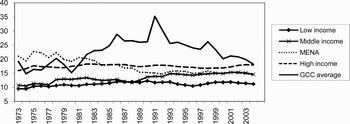
The disproportionate role of state resources in GCC nationals' lives is reflected in state provision of free or subsidized health, education, and utilities. As Figure 1 shows, the share of government final consumption in GDP has historically been high in the GCC rentiers. We should note that this measure severely understates the role of the government, since it excludes the oil sector that is largely or wholly state-controlled.
Government Final Consumption as Percentage of GDP. (Source: World Bank Development Indicators)

This is only an aggregate measure of the state's resources relative to society. A more useful way to categorize material resources and productive capacities in society is in terms of specific economic production factors such as capital, human resources, and organization. These are distributed unevenly and can therefore be used by specific groups to generate non-state services and resources even in the face of a generally dominant state.
Different production factors are present in very different degrees in GCC societies. While the private sector in the Gulf has by now accumulated large capital resources and has also improved its managerial capacities, enabling the privatization of at least some public service functions, the broader outlook on human resources and labor productivity among GCC nationals remains rather bleak. As Table 1 shows, excepting Bahrain, in each country the majority of the national workforce is employed in the overstaffed public sector, compared to a developing-world average of 6 percent (International Labor Organization 1994). Expatriates dominate private labor markets in the Gulf, where most nationals are unable to compete in either salaries or skills. GCC countries rank badly on international benchmarks of educational attainment like the TIMSS, PIRLS, and PISA tests.Footnote 4
Share of Public Employment in Total Employment of Nationals (2005)

Source: based on Gulf Investment Corporation data. (No detailed UAE data is available; the ratio probably is close to that in Qatar and Kuwait.)
The dearth of opportunities for gainful and productive employment for semi-educated nationals denotes low societal capacities on the individual level of most Gulf citizens. We should expect that this will drive them to seek state resources, and to invest in becoming brokers rather than in private activities that generate value-added.
A resource imbalance between state and society is a necessary, but not sufficient condition for brokerage to emerge on a large scale. If a state, however rich, delivers all its goods and services swiftly, equitably, and transparently to all supplicants, there is little need for intermediation. Brokers can only enjoy a privileged position if others are less privileged, that is, if the general degree of state accessibility through non-brokerage channels is relatively low.
Unresponsiveness and low accessibility of the state through non-discriminatory, public channels is usually tied to low “unfocalized” (i.e., not personalized) trust between bureaucrats and subjects (Roniger Reference Roniger1990). This tends to obtain in the Gulf rentier states, which have been built only recently with external resources, do not look back on a long bureaucratic tradition, and in which bureaucratic posts are often treated as sinecures. Accessibility is further limited through fragmentation and over-centralization of decision-making structures that reduce the formal bureaucracy's accountability and responsiveness (Saudi Arabian General Investment Authority 2003; Hertog Reference Hertog2010).
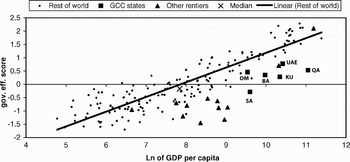
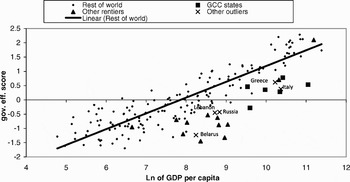
While much of the writing on Gulf and rentier bureaucracies is anecdotal, recent statistical research has found that rent income is indeed a strongly negative predictor for the quality of state institutions in a number of categories (Isham et al. Reference Isham2005). A simple scatter plot confirms that all six Gulf cases perform significantly worse than countries with similar income when assessed for “government effectiveness” (see Figure 2).
Government Effectiveness and GDP per Capita (with bivariate regression line). Source: based on World Bank Governance Indicators, IMF data.

There is another, subtler observation to be made: although GCC states score worse than other rich countries in government effectiveness, they are around or above the global median. That means they are doing better than the great majority of developing countries—a finding impressionistically confirmed by most of my interviewees with experience outside of the Gulf and my own field research non-Gulf Arab countries. What makes richer oil rentier states special is therefore not a particularly low state capacity by global standards (as Chaudhry Reference Chaudhry1997 seems to argue), but their low state capacity relative to the size of their economy and their resources (as the brokerage argument assumes).
What matters for our argument is the relative disparity of state resources and state capacities, and it hence applies even when some of the coarser predictions of rentier theory do not obtain. This relative disparity is arguably what makes rentier states unique and interesting, but to my knowledge, the consequences of this particular relationship have not been investigated.
Against the background of rich but relatively intransparent bureaucracies, a final factor has affected brokerage in the Gulf specifically: brokerage can be boosted through formal state acts which explicitly provide privileged access to state resources for certain strata within a rentier society. Although such acts are possible, and do occur, in many other states, it is the specifically high relative value of state resources in the Gulf that gives such measures unique importance there. All Gulf governments have given local business and nationals in general channels of privileged access that have turned large swathes of local society into part- or full-time brokers of state resources for those lacking such privilege. This deliberate strategy to channel state resources through local society has had momentous consequences for social structures in the GCC countries.
To sum up, the core assumptions of this paper are that rentier states are systems that, at least during a crucial formative phase, have resources that are (a) disproportionate to the resources available in society, and (b) disproportionate to the state's capacity of administering them and making them available in a non-discriminatory fashion. This leads to the emergence of large strata of “brokers”—intermediaries who specialize in making the state's resources available to individuals who are less well connected, be they locals or foreigners. Deliberate state policies creating privileged access for local strata can further boost the phenomenon.
The Argument and Existing Approaches: What Is New?
The term “broker” has been used before in the patron-client literature, for example in the shape of the “patron-broker,” a higher-status individual who provides access to an otherwise inaccessible institution or senior individual for his personal clients (Roniger Reference Roniger1990: 3; Eisenstadt and Roniger Reference Eisenstadt and Roniger1984; Scott Reference Scott1972). The meaning in which I use “broker” in this paper is considerably broader: Whereas brokers indeed often are personal patrons of the supplicants at hand, in many other cases brokers are on the same or even a lower level of hierarchy than the supplicant. Moreover, the relationship between broker and supplicant need not be long-term, and need not have the moral or personal dimension usually found in patron-client relationships (Eisenstadt and Roniger Reference Eisenstadt and Roniger1984). Finally, conventional patrons tend to have considerable resources of their own, whereas brokers focus on mediating state resources in a larger institutional context (Scott Reference Scott1972). This is why the patron-client literature is relevant for the present research, but does not allow for direct comparisons, since the categories of actors involved overlap, at best, only partially.
Although this paper draws on insights from the literature on administrative corruption, brokerage is not identical with it, but again broader. The main distinction is that brokerage can involve forms of influence peddling that are not illegal, which can actually be formally licensed and, in some cases, encouraged by governments. Moreover, brokerage does not always involve the exchange of money for state services—it is often used for “softer” purposes of building relationships. Corruption is clearly present in the Gulf, but it is not clear that it is more pervasive there than in other developing countries. What arguably distinguishes the Gulf is the ubiquity of brokerage in general.
Finally, brokerage is related to, but distinct from “rent-seeking” (Krueger Reference Krueger1974; Khan and Jomo Reference Khan and Sundaram2000). Rent-seeking in its most basic form simply involves one actor skimming off resources from another institution or individual. Brokerage requires at least three parties, rent-seeking only two. Moreover, while a broker might siphon off resources himself, his main function is to make resources available for others, and sometimes brokers get no direct material rewards for this. Rent seeking is of course widespread in the Gulf—the scale of idle state employment alone is staggering—but its presence as such tells us little about the sociology of rent distribution or the structure of state-society relations in a rentier system.
The closest existing concept to brokerage is the idea of “wasta,” a term widely used in Arab societies. It stems from the Arabic root for “middle” and vividly depicts the idea of social intermediation. Having wasta means knowing someone who can provide access to something otherwise inaccessible. Bureaucratic and other forms of wasta play an important role in daily life in most Arab countries; it is the stuff of much informal chatter and is routinely decried in local editorials. Yet with the exception of one useful descriptive account of the Jordanian case (Cunningham and Sarayrah Reference Cunningham and Sarayrah1993) wasta seems to not have been taken up by social scientists. Moreover, wasta relates to informal, personalized influence peddling, whereas brokerage can also be formalized or, even if informal, so anonymous and monetized as to lose the personal character of wasta.
BROKERS IN SAUDI ARABIA AND THE GULF
GCC states are rich and relatively inaccessible through formal channels, while productive capacities in society are limited. Where, then, are the brokers? The short answer is that they are practically everywhere. The following section will give a detailed overview of brokerage in GCC state-society relations from two perspectives. The first is a survey of a number of formal and informal positions which are defined through brokerage of specific goods. The second is an overview of goods and services that are brokered in more diffuse ways and are less neatly tied to specific positions. The latter is complemented by a discussion of two important general positions—ruling family member and bureaucrat—which can be used for more diffuse brokerage of a variety of goods.
It should be pointed out that mine is a structural political economy account rather than a thick ethnography. This is due to the necessarily broad empirical scope of the article, and because the different variants of brokerage often have little in common in terms of the cultural and linguistic concepts involved, since they occur in very different social contexts and on very different levels of hierarchy. Brokerage is a crosscutting phenomenon that is defined by important structural commonalities—in terms of the resources involved and the material positions of brokers and supplicants relative to the state—rather than by cultural and discursive ones. It is, in this sense, an external analytical imposition.
Gatekeepers around Senior Regime Players
The kind of broker that is perhaps best documented in the Western press and popular writing about the region is the gatekeeper around senior regime figures, usually princes and shaikhs. Part of the wider entourage around Gulf VIPs, gatekeepers control access to a high-level individual and therefore, indirectly, to the resources this individual can dispose of. “Gatekeepers” existed already in pre-oil Arabia, but they have gained much in significance with the increasing riches, centralization, and administrative complexity of Gulf monarchies.
Famous examples from the 1970s oil boom are Adnan Khashoggi and Ghaith Pharaon in Saudi Arabia, who acted as go-betweens for such senior royals as Crown Prince (later King) Fahd and Minister of Defense Prince Sultan. Taking care of the nitty-gritty of large state contracts, they took notoriously large cuts,Footnote 5 providing Western contractors with access to a decision-making system that commanded large resources, but was informal and opaque at its core.
Although the most flamboyant gatekeepers of the first oil boom are by and large gone, the function still exists and is now taken by lower-profile individuals. The Tuwaijri family around King Abdallah in Saudi Arabia, and the close merchant friends of rulers in the UAE from families such as Tayer, Tajir, Ghurair, and Gergash fall into this category. So do personal secretaries and advisors and, sometimes, close family members of senior shaikhs such as brothers, wives, cousins, and sons.Footnote 6 Not all of them monetize the privileged access they can provide, but all can broker large-scale resources for third parties. Due to the over-centralization of Gulf government systems and the discretionary power of rulers, the information-filtering function that gatekeepers undertake is of great importance.
Gatekeepers and senior advisors are generally considered more powerful than other commoners with a formally senior cabinet post, whose function is more technocratic.Footnote 7 They have historically often come from non-tribal (“khadhiri” or “bayasir”) backgrounds, and as such have no status group to fall back on. Together with the “contract brokerage” described below, gate keeping is the form of brokerage that has imparted the highest social mobility. Id bin Salem rose from being a simple car mechanic to become keeper of the privy purse and lead advisor under King Saud in 1950s Saudi Arabia. The Darwish family, of humble non-Arab background, worked its way up to leading advisory positions at the court of the Al-Thani rulers in Qatar, acting as go-betweens for foreign companies.Footnote 8 Although gate keeping usually implies complete dependence on the patron, the links involved are often “sticky” and stable over generations and can lead to the cooptation of gatekeepers' families into the national notability.
Many ruling family members also maintain a traditional court structure around themselves, which can include manumitted slaves and their descendants, other servants, and “little brothers” (“khuwayy”), scions of servant families with whom a prince or shaikh was brought up. The aggregate size of these courts is large—in Saudi Arabia they count tens or even hundreds of thousands of individualsFootnote 9—and court positions are frequently used to provide access to a ruling family member. This can be used to guarantee legal protection, influence administrative decisions and contract awards, or provide access to state services on behalf of a supplicant.
Several factors combine to give the access-brokers around regime decision-makers inordinate influence and a widespread presence: the resources at stake, the informal and opaque nature of the regime cores in all Gulf states, the large number of ruling family members (between a couple of hundred and many thousands) and the weakness or absence of more formal mechanisms to access the elite.
Mucaqqibs: Paper Pushers around the Bureaucracy
The gatekeeper has a more mundane cousin, familiar from other developing countries: the petty administrative paper pusher who uses his inside knowledge and contacts in a bureaucracy to help applications along that would otherwise become stuck. In the Gulf, these individuals are sometimes known as mucaqqibs (derived from the Arabic verb for “to pursue”).
Due to the much larger size of bureaucracies and budgets in the Gulf, the number of these individuals is probably greater there than in most non-rentier cases. Again, the combination of large state resources with relative bureaucratic impenetrability creates demand for brokers. This is not to say that some parts of Gulf administrations are not working rather well and operating on clear formal rules, after four decades of oil-funded development. Yet, the most efficient parts of Gulf states are usually not in charge of large-scale interactions with citizens and business; instead, the most prominent “islands of efficiency” tend to be insulated bodies like central banks, national oil companies, or utility regulators (Hertog Reference Hertog2007; Reference Hertog2010). Service-oriented line ministries such as commerce, labor, education, or health are often still slow and opaque by rich-country standards, and hence they nurture legions of paper pushers.
Mucaqqibs are often lower-class nationals, frequently of non-tribal background, and sometimes expatriates. They have invested time in establishing networks in government agencies that they use to expedite paperwork for less patient or well-connected customers. Although less glamorous than even the lowest-profile senior gatekeepers, they sometimes are under the patronage of (usually lower-tier) ruling family members, whose names they can deploy to speed up procedures.Footnote 10Mucaqqibs closer to senior positions have in the past worked their way up to become full-blown gatekeepers to senior decision-makers, usually on the basis of luck and persistence rather than education. More often, however, their unglamorous work around the lower rungs of large bureaucracies does not lend itself to easy social climbing.
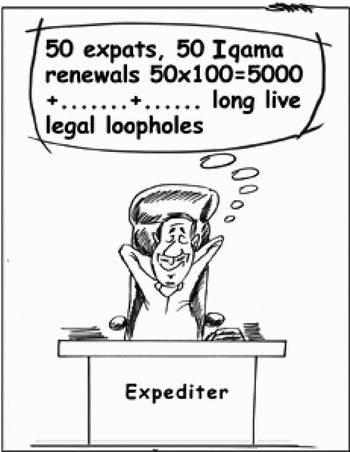
Paper pushers often run small “typing offices” in front of administrative buildings, and some of them also act as consultants or lawyers.Footnote 11 They seem to be particularly ubiquitous in front of large passport and labor agencies and customs offices.Footnote 12 Different services come at different prices, and the better-connected touts can also deliver services which are technically illegal, such as coming up with “missing” documents and getting them accepted (such as visa transfers or extensions for foreign workers, see Fig. 3 and below). Scarce coupons and documents are sometimes leaked from the administration and traded informally.Footnote 13 It is usually obvious to all parties involved, including the bureaucrats, that certain procedures are illegal; how spoils are divided tends to be the secret of the tout. Crackdowns against paper pushers are rare and usually half-hearted.Footnote 14 In some cases, such as in the UAE, “typing offices” are formally regulated, and in the emirate of Ras Al-Khaimah they are now even allowed to conduct official licensing procedures.Footnote 15
The Mucaqqib. Saudi Gazette, 30 June 2008. (“Iqama” is the residency permit for foreigners in Saudi Arabia.) Copyright © 2008 Saudi Gazette.

Larger private companies usually keep their own “government relations” staff, which specializes in getting access to government agencies, sometimes cooperating with and sometimes supplanting independent paper pushers.Footnote 16 A European company I was associated with employed a non-Gulf Arab for just this purpose on an impressive salary. He had little education and no grasp of the company's business, but an amazing facility in establishing contacts and getting paperwork done; it was generally recognized that he was taking his share, too. In the UAE, the job of government relations officer has recently been restricted to Emirati nationals. Saudi Arabia has officially restricted all mucaqqib jobs to Saudis (Economic Studies House 2002).
Contract Brokers
A less petty variant of the administrative intermediary is the contract broker. This role entails the peddling of exclusive information, and of bureaucratic decisions over government contracts. This function is usually performed by well-connected local companies (sometimes under shaikhly control) toward either foreign or less-connected local companies. The contract broker function can overlap with that of the gatekeeper, as in the Khashoggi and Pharaon examples, or that of Wafic Said in the more recent Yamamah defense procurement affair, who has acted as private advisor for sons of the Saudi defense minister. Here too, the modal pattern is one of creating access to large state resources in an otherwise impenetrable environment. Contract brokerage can also lead to rapid social ascendancy, though much less so today than during the 1970s boom period, when many of these links were first established.
Contract brokers can act either as joint-venture partners or simply as representative “agents” for foreign companies, working for a fee that often depends on the size of awards.Footnote 17 In still other cases, businesses winning contracts simply sub-contract most of the work for smaller fees, limiting their own role to that of rent-seeking intermediary. The infrastructure of many companies during the first oil boom was limited to a desk, a telephone, and a fax machine.Footnote 18
Closely related to contract brokerage was the introduction of “commercial agency” regulations in the 1960s, which forced foreign companies to sell their goods through local intermediaries, with the state usually being the largest customer. Although agents could be established commercialists with a serious distribution infrastructure, others, notably ruling family members, contracted out little more than their name. Compulsory agency rules were generally introduced when oil income took off, as were ceilings on foreign direct investment, forcing foreigners into joint ventures with locals.Footnote 19 Many large Gulf family companies got their first break as commercial agents, for example Juffali for Mercedes in Saudi Arabia, and Ghanim and Mannai for General Motors in Kuwait and Qatar, respectively. Rulers would on occasion award agencies as personal rewards.
During the 1970s boom, any local could in principle act as intermediary for foreign enterprises, resulting in what Chaudhry with only slight hyperbole called a “whole society of commission entrepreneurs” in the Saudi case (1997: 153). Hundreds of thousands of small-scale national contracting and trading enterprises were registered in the 1970s and 1980s. In Saudi Arabia, the number of registered companies increased from 77,304 in 1975 to 144,436 in 1980, and reached more than 200,000 by 1985.Footnote 20
Tenders for state contracts usually needed to be submitted through locals in all GCC states, and were preferentially given to nationals,Footnote 21 who were often incapable of fulfilling them on their own. Relationships between contracting agencies, contractors, and sub-contractors frequently were highly personalized (Moon Reference Moon1986). Even in cases when brokerage was not objectively necessary, contract brokers tended to plant rumors that they needed to be paid a commission for specific projects to move ahead, browbeating companies into cutting them in.Footnote 22
Much of the apparently unproductive “leakage” of resources that resulted was arguably part of regimes' deliberate distributional policy: having local companies share in the oil wealth without creating formal distributional obligations, and channeling capital their way, even if it could not be immediately put to productive use. This intentional, and formalized, creation of brokerage seems to differentiate the “leakage” in rentier states from that in other developing countries (Reddy and Haragopal Reference Reddy and Haragopal1985) and, together with the larger size of state resources, contributes to its larger scope. By giving a special value to rentier state citizenship per se, Gulf governments created traditions of brokerage that have defined GCC business and state-society relations until today.
Local businesses in the Gulf states have been playing a much more serious role in contracting during the recent oil boom. Although commission entrepreneurs are still around, it has generally become much harder to get a contract just on the basis of personal connections and without demonstrated project management capacities. Although many businessmen got their first break as mere contract brokers, the bust of the 1980s has separated wheat from chaff, favoring the survival of the more productive ones, and forcing companies to find private, more demanding clients (Vasiliev Reference Vasiliev2000: 454; Luciani Reference Luciani, Aarts and Nonneman2005). Similarly, many commercial agents, even if most of them have kept their national privileges and brand monopolies, have built up a well-developed distribution infrastructure.
Yet, there remain cases of full-blown businesses that specialize most of all in paving the administrative path for foreign companies in return for being taken on as joint venture partners. Such businesses have often built up a close relationship to specific government agencies issuing contracts that allow them to gather insider information or influence tender specifications.
Contract brokerage within ruling families might have been curtailed, but it certainly has not stopped. Allegations sometimes make it into the Western press, as is the case with former Saudi Ambassador to the United States Prince Bandar and former Kuwaiti Oil Minister Ali Khalifa. The current Qatari and Bahraini prime ministers also have a reputation for contract brokerage.
Today, the most important field for unreconstructed brokerage of state assets is probably not government projects but rather the sale and resale of government-owned land.Footnote 23 Because it does not directly drain the state budget, it is easier to conceal; due to continuing population growth it functions as a self-replenishing source of rents. The modal pattern seems to be the following: Ruling family members receive land as a grant from the ruler or through their personal control of a government agency. They resell it in turn to trusted real estate brokers with whom they have a long-term relationship. These then parcel the land out into smaller bits that can be resold to other players on the real estate market (and are often resold again, making for large cascades of brokerage).Footnote 24 At every stage, a more privileged player sells to a relatively less plugged-in actor and large profits are made. In some cases, governments buy back land, converting land handouts to more or less direct fiscal handouts.Footnote 25
The value of land can be strongly influenced through zoning and infrastructure decisions which more senior players often have influence over. The values involved can be gigantic. “Construction” and “ownership of dwellings” contributes between 10.6 and 22.7 percent of GCC non-oil GDPs, and most of the land involved has at some point passed through regime hands.Footnote 26 In Saudi Arabia, most of Riyadh's land seems to have passed at some point through the hands of either Prince Sultan or Prince Mishcal, often to be resold by little-known but very rich broker families like Musa or Sweidan.Footnote 27 In Bahrain, real estate politics are highly charged since most of the island's territory is owned and resold by royals. (Some 90 percent of the coastal lands are supposedly controlled by members of the Al-Khalifa, as Bahraini oppositionists have recently tried to demonstrate with the help of Google Earth.Footnote 28) Not coincidentally, cadastral administrations are among the least developed branches of government in the Gulf countries.Footnote 29
Brokers in the Trade in Labor
Real estate brokerage is important in terms of value, but the number of privileged actors involved is relatively limited. Possibly the largest market for brokers in terms of their sheer numbers is that of trade in visas and expatriate labor. About a third of the GCC's total population, or some twelve to fifteen million people, are expatriates, and they dominate private labor markets. With the renewed oil-driven construction boom since 2004, millions of new work visas have been issued annually.
Supply of foreign labor however is tightly regulated in theory, restricted primarily to the businesses that receive a permission to “import” foreign laborers through government-granted visas. The formal domestic labor market for expatriates is rigid, since they cannot switch to another employer (or “sponsor”) without the acquiescence of the present one, and in some cases not at all (Hertog Reference Hertog2006; Reference Hertog2010). Most sponsorship rules were first introduced with the oil boom in the 1960s, Kuwait being the last to impose them in 1982 (Atiyyah Reference Atiyyah1990).
The large demand for foreign labor in the Gulf oil economies combines with weak labor administrations to create an inordinate number of brokerage opportunities that allow businesses to skirt national quota and sponsorship rules. The main mechanism for making the formally rigid labor market supple, and profiting from discriminatory access to the labor bureaucracy, is that of the “free visa” market.
The basic mechanism is that a sponsor acquires more labor permits from the government than they actually need, usually through a combination of inaccurate documentation and privileged access to the bureaucracy. The laborers that are imported on this basis are then resold on an informal market to other employers who are actually in need of labor but could not acquire it due to their worse access to the labor bureaucracy. Many of the better-connected sponsors conversely own companies only on paper.Footnote 30 Trade in labor, even if it happens in bulk, is not usually an avenue for social climbing; it involves few social or managerial skills and rather reflects one's pre-existing access.
Once again, the largest brokers are often ruling family members,Footnote 31 since they find it easier to get “block visa” grants to import larger numbers of workers. Brokers around them frequently do the reselling. Many free visa workers, however, especially domestic helpers, are directly imported by petty broker-sponsors. By one estimate, 95 percent of Indian maids come to Kuwait illegally,Footnote 32 most of them through small-time sponsors. In the UAE, employees of the Ministry of Labor have been known to issue visas illegally against bribes,Footnote 33 and have themselves registered letterbox companies to import workers. In the summer of 2005 they were rather generously allowed to transfer company registrations to relatives in cases where they had more than ten establishments registered.Footnote 34 In March 2004, I spoke to a Saudi contractor with three hundred employees of whom he had not imported a single one himself.
The direct service that sponsor-brokers receive from the state is only an allowance to import labor, and no direct distribution of material benefits is involved. Visas are of obvious material value, however, which has to do with the high demand for foreign labor that in turn is caused by the GCC countries' rentier nature: local riches increase the demand for labor in (often state-driven) services and construction, while the relative paucity of productive capacities among nationals limits the supply of local human resources.
Sponsors often use their position to extract additional rents. Labor traders can skim off up to 80 percent of the salaries of the labor they sponsor.Footnote 35 Many sponsors also demand money for visa cancellations when workers want to return home, and ask for extortionate sums if workers want to officially transfer their sponsorship to their real employer. During autumn 2007 amnesties for illegal laborers in the UAE and Bahrain, many sponsors refused to return passports to workers unless they paid them back a year's wage or more.Footnote 36 Language barriers, fear of detection, and low levels of education among many expatriate workers increase their helplessness and dependency on sponsors. Foreign workers are often intimidated into dealing only with their sponsors even if they in fact have the right to engage with the labor administration directly, for example in the course of labor market amnesties.
Estimates of the number of free visa workers vary widely, but they constitute a considerable share of the GCC countries' labor force. The Bahraini government gave a cautious estimate of forty thousand out of three hundred thousand private workers in 2005. According to Bahrain's minister of labor, some nine thousand unemployed Bahrainis have been using commercial registrations to import expatriate labor for prompt resale.Footnote 37 A Bahraini labor inspection campaign in 2008 showed that of 6,277 establishments visited only 3,644 were actually active in business.Footnote 38
The UAE in 2004 was estimated to harbor six hundred thousand free visa workers, more than a quarter of the total workforce.Footnote 39 A 2008 press estimate of free visa workers in Kuwait is eight hundred thousand, out of a total workforce of about two million.Footnote 40 In 2004, the new Saudi minister of labor claimed that 70 percent of the work visas issued by the government were sold on the black market.Footnote 41
If on the basis of the above figures we cautiously assume a share of free visa workers in the total foreign labor force in the GCC of one third, this would make for more than four million of them. Presuming that the ratio of free visa sponsors to free visa workers in the whole region is similar to the one observed in Bahrain, we would have about a million free visa sponsors, or more than all privately employed Gulf nationals in 2005. It is hard to think of another country with such a high share of access brokers (of only one type!) relative to productively employed citizens. The estimates are of course rough, but the order of magnitude quite likely is right.
The scale of income from free visa brokerage is even harder to estimate, but individual prices alone—which are better documented—are staggering. GCC workers are reported to pay between US$800 and $8,000 to their sponsors for a visa; the most frequently quoted figures fall between $2,000 and $4,000.Footnote 42 They are also reported to pay similar amounts for officially shifting their registration to a different sponsor.Footnote 43 This compares to a monthly income of many expatriate workers in the Gulf of barely more than $150. The annual fees free visa workers often have to pay to their sponsors range from $1,000 to $3,500, according to a Kuwaiti estimate.Footnote 44
If we presume that of the four million estimated free visa workers an annual six hundred thousand are replaced, and that the average free visa price is $2,500 (both low estimates), this would make for a total GCC-wide free visa income of $1.5 billion annually from the issuing of visas alone.Footnote 45 This is in addition to similarly substantial income from the other extortionate schemes outlined above. Our estimates are on the low side: according to one Kuwaiti civil society activist, the free visa market is worth $3 billion annually in Kuwait alone,Footnote 46 about 5 percent of the country's non-oil GDP. Whatever the exact figure, the visa brokerage market has a considerable volume.
Peddling Citizenship to Foreigners for Business: “Cover-up” Companies
Free visa trade is based on two forms of unequal access to the bureaucracy: The first is access enjoyed by specific individuals who have either cultivated links in the labor bureaucracy or who by virtue of their senior position can extract visas more easily. The second, especially in the pettier variant of visa trade, is more general access that is simply based on the privilege of being a rentier state national, as exemplified by the scores of unemployed Bahrainis moonlighting as sponsors.
An even more brazen version of such “renting out” of citizenship is that of the “cover-up” businesses (“tasattur” in Arabic, from “to be veiled or covered up”). These are enterprises, usually small, in sectors that are off-limits to foreigners, and therefore are formally registered under the name of a national but are in fact owned and run by an expatriate.Footnote 47 They include small-scale restaurants, grocery stores, service companies, and workshops—that is, most of the hundreds of thousands of small enterprises clustered throughout the GCC's cities. Once more, it was usually boom-time decrees from the 1960s onward that limited small-business ownership to locals.
The large scale of the phenomenon again reflects the low productive capacities in local societies relative to the resources and demand at hand. As in the visa trade, the players involved are both senior actors who operate on the bulk level and use their privileged access to have dozens or hundreds of companies registered under their name,Footnote 48 and small-time brokers who might sell their name for only one establishment. Many of the latter are reportedly uneducated and jobless, and see the sale of their citizenship privileges as the only readily available income. “Saudis engaged in cover up either have protection or have nothing to lose.”Footnote 49
“Cover-up” practices are illegal. The occasional crackdowns are desultory, however, and the anti-cover-up commission in Saudi Arabia appears to be “weak and riddled with corruption.”Footnote 50 A study by a Saudi economist in 2004 estimated the number of cover-up businesses in the kingdom at 155,000,Footnote 51 arguably a low estimate.Footnote 52 Extrapolated to the total population in the GCC, we might presume that at least 250,000 to 300,000 of these companies exist, if not more, since both the relative size of the expatriate population and the reservation wage of nationals are higher in most other countries.Footnote 53 If the average broker registers three businesses under his name, perhaps one hundred thousand GCC nationals profit from cover-up. Again, the estimate is rough, but the sheer order of magnitude is impressive.
Monthly cover-up fees can lie between one hundred and several thousand dollars per month, depending on the scale of the business.Footnote 54 If we presume $300 as the average monthly charge, then three hundred thousand cover-up businesses would yield an annual income of more than a billion dollars GCC-wide. Nationals can extract further ill-gotten gains from cover-ups through the expropriation and expulsion of the informal owners.
Cover-ups apparently exist at the highest levels: in spring 2009, an Iranian businessman sued Dubai ruling family member Hasher Maktoum bin Jumaa al-Maktoum for US$1.9 billion, claiming that he was the actual owner of a real estate company registered under the shaikh's name in 2004.Footnote 55 In Kuwait, some national “owners” of cover-up companies have been brazen enough to apply for state grants reserved for innovative small and medium projects run by nationals.Footnote 56
There are further, more diffuse forms of peddling citizenship as channel of access to the state. During the pre-2006 Gulf stock boom, for example, nationals acted as informal stock brokers for foreigners in several countries, buying and keeping stocks on their behalf in return for a fee.Footnote 57 Similarly, nationals have used their citizenship privileges to enable foreigners to invest in local property markets which are officially off-limits to them,Footnote 58 and are illegally subletting subsidized property.Footnote 59
Economic and administrative privileges for rentier-state nationals are not an automatic outcome of rentier-state growth. They are however widespread in all GCC rentier states and, not coincidentally, were mostly created when oil income started to rise. They seem to reflect a redistributive strategy that avoids creating direct material entitlements that could be claimed from the state, yet allows nationals to profit from the boom. Although other developing countries can in principle also embark on such strategies, privileging nationals is more affordable and much more rewarding when foreigners are keen to work in and trade with a country due to its rentier riches. Brokerage opportunities can come at a cost to productive endeavor, however. As one interviewee put it: “Being a Saudi is worth money, and this can sap incentives.”Footnote 60
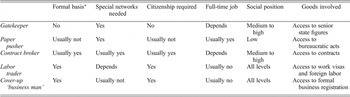
Table 2 summarizes the main forms of brokerage discussed so far, and shows that it exists on all social levels, can be dependent on specific personal access or be generalized to the citizenry at large, and can, but does not have to, draw on formal regulatory privileges.
Types of Access Brokers in the Gulf.

*“Formal basis” means that a formal regulatory privilege is used; it does not mean the practice is legal.
Goods Diffusely Brokered
The article has thus far looked at specific functional positions of brokerage tied to the intermediation of specific state-provided goods. Such mechanisms are the easiest to delimit and their scale is easiest to estimate, relatively speaking. There are however also state resources that can be diffusely brokered through a multitude of social and organizational positions, and conversely there are positions which allow their occupants brokerage of a multitude of different goods through a variety of channels. It is often in these types of exchange that relationships are more diffuse, longer-term, and less monetized. In this regard, they are closer to conventional patron-client relationships, yet they do not necessarily involve the hierarchical relationships that characterize the latter.
Diffusely brokered goods and multifunctional brokerage positions are too amorphous to be comprehensively documented and categorized, let alone measured with any degree of precision. Field research in the Gulf shows that they are pervasive, however, not least due to the extensive scope of state services. I will first discuss goods, then positions.
To be sure, certain public services are delivered relatively smoothly in the Gulf; provision of and access to basic healthcare and basic education, while often brokered goods in the past, nowadays tend to be much better. While getting water and electricity connections can still be difficult, privatization and competition have strongly reduced the importance of wasta in telecoms services. Even if some basic provisions are de facto guaranteed, however, Gulf states aim to offer an extensive range of free or subsidized services above and beyond the basic level. This ambition allows for extensive brokerage of higher-quality services.
Most health services are still provided publicly in the Gulf, and coverage in principle is comprehensive. Different from developing countries, the scope of services is rather large, and in contrast with most developed countries, service provision is largely free, at least in theory. In fact, however, hospital resources are often stretched, quality is mixed, and health administrations are opaque and sometimes corrupt. To receive anything above basic care through formal channels can be difficult.
State-provided health services therefore are an important brokerage resource that can be relayed through a variety of actors: ruling family members, senior bureaucrats, or simply friends and relatives with better personal links to specific health institutions (Shah et al. Reference Shah, Shah and Behbehani1996; interviews). Government payments for treatment abroad are brokered particularly frequently.Footnote 61
The situation in education, higher education in particular, is similar. Much of it is still state-provided, access in principle is universal but in fact can depend on one's connections because admission bureaucracies are often opaque and there are no meaningful appeals mechanisms. Scholarships for study in the West or access to prestigious degree programs at home can depend on wasta, on intermediaries with privileged access.Footnote 62
Finally, government jobs and promotions are an important resource in brokerage games. Although some smaller elite sections of Gulf bureaucracies are reasonably meritocratic, others are staffed with much “deadwood,” a good share of which result from appointments that have been arranged through brokers.Footnote 63 These brokers are usually senior figures in the regime, often ruling family members. Because the civil service plays an inordinately large role in the labor market for nationals who lack competitiveness in the private market, hoping for the right wasta can be a rational strategy.
The public services outlined above can be accessed through brokers of various kinds. Conversely, certain social and organizational positions lend themselves to brokerage of more than one good. The most important multifunctional brokers are bureaucrats and members of ruling families, followed by other members of the social elite such as merchants and notables.
Bureaucrats are involved in day-to-day management of state resources, and in the GCC there are more of them relative to the total national working population than pretty much anywhere else. The scope bureaucrats have for brokerage activities depends upon the resources they have at hand as well as their personal discretion over them, which tends to be closely related to the inaccessibility of their particular bureaucratic agency. Not all bureaucrats act as brokers, but many do, if only out of obligation to friends and family. Although the average bureaucrat probably practices less corruption and favoritism than in other developing countries, the overall number of bureaucrats and resources available is much higher. Even if only half as many GCC bureaucrats exert brokerage functions, their much higher share in national employment (more than half as opposed to 6 percent in the developing world at large) would create a much larger volume of brokerage.
The lower the position of a bureaucrat, the more limited is the range of resources he can usually make available, be it services of immediate monetary value (contracts, subsidies, health and education services, etc.), or decisions of indirect material utility (licenses, certificates, information).Footnote 64 Complaints about ministerial wasta are often heard in the Gulf, but it is often the only way to get something done.Footnote 65
Members of the large ruling families are the arch-brokers in the GCC monarchies, since they have the most immediate discretionary control over state resources. Again, the more senior a player is, the wider the array of services he can make available. Lower-level ruling family members, however, also have more multi-functional roles because their social status crosscuts administrative boundaries.
Ruling family members are very active in free visa markets, in certain sectors of state contracting, and in the resale of government-owned land. They are probably the prime brokers of advanced health and education services. Well aware of ruling family members' discretionary patronage, nationals regularly attempt to access them through petitions, and this in turn under-girds the shaikhs' social status and their reputation for generosity (Le Renard Reference Le Renard2008; being called stingy, “bakheel,” is one of the worst epithets in the Gulf). With a highly centralized formal bureaucracy—to the extent that the cabinet sometimes has to decide on individual license applications—informal access through senior figures comes at a premium.
In addition to bureaucrats and shaikhs, there are many other individuals with diffuse, if comparatively less important brokerage roles. Large merchants or notables often have privileged access to the state. In Kuwait, members of parliament can be important brokers. Parliamentary pork for voters exists in many systems, but Kuwait's legislature has a whole squad of “service” MPs who do little else but make state resources such as jobs or health treatment available to individual constituency members (Tetreault Reference Tetreault2000).Footnote 66 In all GCC states wasta is also acted out more diffusely through links of tribal identity, kinship, friendship, or shared regional background among individuals with differential access, which can but need not involve hierarchical relationships.
Brokerage and Its Social Context
All forms of brokerage discussed thus far, whether regulation-based or informal, specific or diffuse, have one thing in common: an individual in a privileged position makes state resources of some kind available to other individuals lacking access. The phenomenon is particularly pronounced in the Gulf because the state has large resources relative to society and is comparatively inaccessible. Just as important, governments have formally restricted access to the state over the course of the oil boom, creating opportunities for brokerage on a scale unthinkable in non-rentier systems.
Regimes had a clear motivation for this: in the face of limited local skills, creating formal privilege was an effective way of cutting locals in on the boom economy. At the same time, national privileges have created new social boundaries, as citizenship has become more valuable and the social difference between locals and foreigners more pronounced. Policies of national privilege have helped to rear a local private sector, but they have also created new dependent strata of rent- and access-peddlers, creating vested interests in structures that are inefficient in the long run.
In some cases, such as that of gatekeepers, brokerage still comes with “thick” cultural baggage, while in others, such as the free visa trade, it has become little more than a market transaction based on formal privilege. So far as brokerage involves informal, personalized links, it is often equated with wasta in local society, a concept whose generic connotation is negative (Hutchings and Weir Reference Hutchings and Weir2006). However, as is the case with corruption in other contexts (see Jeffrey Reference Jeffrey2002), actors often denounce the wasta used by others, but happily and even proudly resort to it in their own context. With the increasing complexity of state and society, wasta now involves not only kinship links but also friends, colleagues, and acquaintances.Footnote 67
The growth of both population and state apparatuses has increased pressures toward anonymization and marketization of brokerage. They have also created cascades of brokers on several levels. A lowly mucaqqib can act as a broker to a mid-level bureaucrat, who in turn might enjoy the patronage of a deputy minister who allows him to make state resources available and who himself might be under the patronage of a ruling family member. In many cases it is no longer necessary for supplicants to become personally involved with higher-level actors. In some sectors, such as contracting and land trade, state-provided goods get parceled out into smaller bits as they move down a brokerage cascade.
Some of the structural effects of brokerage on state and society at large are clear, while others require more discussion. Among the obvious effects is the sapping of productive incentives for nationals, a frequent gripe of liberal Gulf technocrats complaining about free visa or cover-up activities. Brokerage opportunities increase reservation wages and deepen the division between nationals and expatriates.
Brokerage also tends to undermine the coherence of policy implementation. Labor reforms in several countries have been stymied through the free visa trade, and the effect of recent investment liberalization policies has been limited in several cases through the de facto need for foreign investors to get a local partner to push papers. In Saudi Arabia, a new “one-stop shop” supposed to facilitate transactions for foreign investors has in fact led to the emergence of new brokers offering investment licenses to circumvent mandatory minimum capital requirements.Footnote 68
Less clear is the impact of brokerage on domestic class formation. On one hand, during the boom era domestic merchant classes were economically boosted through contracting and agency rules. On the other, the process has created individualized dependence on the state, depriving them of much of their status as “class for itself.” Merchants' families remain important, but unlike the past they now tend to lobby the rulers individually.
Other forms of brokerage such as free visa and cover-up have arguably hampered the emergence of national labor and professional classes with clear economic interests. Needless to say, these strata of brokers remain atomized themselves—there is no organized lobby, whether directly or by proxy, of free visa or tasattur interests.
None of this is to deny that on the individual level certain social groups have profited more than others from some types of brokerage: Urban strata have disproportionately benefited from bureaucratic employment and contacts with the state apparatus, perhaps comparable to the petty “intermediate classes” in India that have capitalized strongly on access to the expanding bureaucracy there (Jeffrey Reference Jeffrey2002; Harriss-White Reference Harriss-White2003).
There has also been a diffuse trickle-through and trickle-up of tribal and regional identities into informal networks of brokerage in Gulf bureaucracy and business, resulting, for example, in an unusually high number of Saudis from the country's central region in privileged positions. However, this process has developed mostly as a result of rulers' top-down decisions. Bureaucratic brokers might represent their region, clan, or family individually, but there are few cases of collective “capture” of state agencies by larger groups, such as we know from African or Asian cases (see Bayart Reference Bayart1979; Szeftel Reference Szeftel2000; Jeffrey Reference Jeffrey2002; Khan and Jomo Reference Khan and Sundaram2000). The only exception seems to be Kuwait, where ideological movements such as the Salafists and Muslim Brothers have managed to gain control over specific public enterprises in the hydrocarbons sector thanks to a much stronger tradition of organized politics. But their class basis remains diffuse.
In general, and in contrast with the Indian case (see Jeffrey Reference Jeffrey2000), bureaucratic recruitment and mobility in the Gulf are tightly controlled by a small central elite and are difficult to manipulate locally. Contingency and elite choices played a large role in who emerged on top in the course of the boom and, as we saw, previously marginal actors sometimes found themselves in highly privileged positions. And despite a pro-urban bias, thanks to relatively small populations most social strata have had a shot at obtaining at least some kind of state employment. Forms of brokerage based on mere citizenship status have provided further opportunities for marginal groups. The system in this sense has not been as effectively or exclusively used to reproduce class or status group privileges as the Indian one (Gupta Reference Gupta1995; Jeffrey Reference Jeffrey2002).
That said, the types of brokerage widely available to marginal groups usually imply much lower chances of social mobility. Gatekeeping and business intermediation have led to stellar careers when linked with the right patron-client network. The brokerage involved in most forms of paper pushing, or the anonymous brokerage that merely draws on an individual's formal status as national, is much less likely to transform the broker's social status.
BROKERAGE IN COMPARISON
The GCC countries seem suffused with brokerage. The striking similarities of scale and scope of outcomes in the six different cases allows us to control for a number of factors in explaining the phenomenon. Higher levels of political participation in Kuwait as such do not seem to lead to less brokerage: although the parliament creates tighter checks on the ruling family's business involvement, it functions at the same time as a defender of citizen privileges and as a major channel of brokerage itself. Size of country does not seem to have much influence on brokerage levels, nor do levels of ethnic and sectarian heterogeneity or the (absence of) colonial experience, nor the timing of state formation or of “first oil.”
It is hard to fathom intra-GCC differences in their respective levels of brokerage. Anecdotally, it appears that brokerage is less pronounced in Bahrain and Oman, as one would expect for two systems with relatively higher levels of state accessibility and a less skewed relationship of state and societal resources. Brokerage in terms of free visa trade and cover-up businesses seems to involve a higher share of nationals in Abu Dhabi, Qatar, and Kuwait, the countries with the highest state resources per capitaFootnote 69 and the lowest participation of nationals in private labor markets.Footnote 70 The more fundamental and definitive finding however is that all of the GCC cases evince high levels of brokerage, as our argument would lead us to expect in broader comparative context.
A brief diachronic comparison further confirms our suspicion that the ratio of state to societal resources, combined with levels of state accessibility, influences levels of brokerage. Due to lack of detailed data, these comparisons must remain suggestive rather than definitive.
I have mentioned that brokerage has decreased in a few bureaucratic fields that have been professionalized or privatized. More interestingly, it seems to be exactly the strata of society that have deepened their own resources that nowadays rely less on brokerage: Although many Gulf businessmen were little more than commission entrepreneurs in the 1970s, those among them who survived the bust of the 1980s have generally increased their managerial capacities dramatically and have learned to cater to private demand rather than relying exclusively on fluctuating state contracts.Footnote 71 Their share in GDP and, even more so, national capital formation, has increased strongly.
Given its higher capacities, we should expect business to put less effort into making money through sheer brokerage. This prediction is borne out by a prima facie comparison between the 1970s boom and the current one. Although the volume of public projects is back to the heights of the last boom, there is much less raw contract brokerage this time around, as local businesses are instead competing for state deals through offering substantial services.Footnote 72 The new boom has not led to a reemergence of the hundreds of thousands of letterbox contracting companies known from the 1980s.
Higher capacities in business have not been accompanied by a comparable increase in productivity among nationals in general. Below the highest level, local businesses are still largely staffed with expatriates, and most nationals remain uncompetitive on the private labor market. We should therefore expect that incentives to invest effort into becoming a broker have not decreased significantly. This indeed seems to be the case: free visa brokerage has recently been somewhat reduced through government crackdowns and amnesties, but the system remains entrenched. The same is true of cover-up businesses. Neither, apart from a few streamlined agencies, has there been any discernible change in paper pushing or brokerage of state services through bureaucrats and ruling family members; interviewees report that there has been little change since the 1970s in the importance of shaikhly patronage in the administration.
Ruling family members as well as cover-up and free visa brokers find it more difficult to evolve into a productive role in the way contracting businesses have, while bureaucratic salaries in the GCC have hardly kept up with inflation and important parts of Gulf administrations remain rather opaque. For all of these actors, relative incentives for seeking brokerage roles have changed less than they have for business actors.
State access is never perfectly equitable or free of effort, and brokers between state and society exist all over the world. To my knowledge, there are no other system-wide studies of their scope and scale of the sort I have attempted here. Nevertheless, by comparing our account with the more fragmented evidence from the literature we can sharpen our understanding of the phenomenon's range and its underlying mechanisms.
The literature contains references to “gatekeepers” or their equivalents in centralized and unaccountable systems in very different times and places, be it King Mohammad VI's Morocco (Denoeux Reference Denoeux2000), Suharto's Indonesia,Footnote 73 Peter the Great's Russia (Zitser Reference Zitser2005), or Louis XIV's France (Kettering Reference Kettering1988). Although the only detailed accounts I have found focus on rural India (Reddy and Haragopal Reference Reddy and Haragopal1985; Oldenburg Reference Oldenburg1987; Jeffrey Reference Jeffrey2000), paper pushers very likely exist in many places.Footnote 74 Cases of contract brokerage are documented for large parts of the developing world (and certainly are not absent in the developed world).Footnote 75 The diffuse brokerage function of bureaucrats qua corruption and patronage is also documented for many cases (Bayart Reference Bayart1993; Le Vine Reference Le Vine1975; Szeftel Reference Szeftel1982; Reference Szeftel2000; Robertson-Snape Reference Robertson-Snape1999: 594f.; Waterbury Reference Waterbury1973: 547f.; Wade Reference Wade1982: 314ff.; Ledeneva Reference Ledeneva2006; Reference Ledeneva2008; Harris-White 2003: 79–81; Jeffrey Reference Jeffrey2002).
The literature is heterogeneous and does not usually focus on brokerage (or rentier states) per se, but certain themes do recur. The rise of the state and its resources encourages brokerage, as do opacity and high centralization of the administration. Privileged access is the main basis for the activities of brokers, who can have a vested interest in making the bureaucracy appear as less transparent and more arbitrary than it in fact is.
The corruption and favoritism described in the literature are often more brazen and wide-reaching than in the Gulf, as are the obligations office-holders have to their friends and kin (Szeftel Reference Szeftel2000; Bayart Reference Bayart1979). Nowhere in the literature, however, is a stratum of brokers mentioned that approaches the scale of what I have described for the GCC. This is no surprise, since none of the developing world cases involve such large budgets and state apparatuses, or governments providing as many goods in daily life as do those in the GCC.
The best-documented case study of pervasive bureaucratic brokerage probably is Robert Wade's detailed investigation of the irrigation bureaucracy in a Southern Indian region (1982). Irrigation bureaucrats act as brokers of state-provided resources and services vis-à-vis peasants and public works contractors, using lower-level administrators as go-betweens. Despite pervasive corruption that allows mid- and higher-level officials to augment their income many times above their official salary, Wade estimates the direct financial costs of brokerage as rather low for peasants (about 1–5 percent of their profits). This apparent discrepancy can only be explained by the limited number of brokers relative to the population at large.
A similar, if less detailed account of the manipulation of land records by local bureaucrats in India mentions an average of two officials per village, a far cry from the omnipresent bureaucracy in the Gulf (Gupta Reference Gupta1995: 379). In his field research on rural elites in Uttar Pradesh, Craig Jeffrey found three to four middle-caste individuals acting as informal brokers to the local administration in each of three settlements that contained between 4,000 and 10,000 inhabitants (2000: 1029). This is about one broker per thousand villagers in the smaller settlements, while in our Gulf free visa estimate, for example, we arrive at one free visa broker per twenty Gulf nationals. In Sarayra and Cunningham's Reference Cunningham and Sarayrah1993 book on wasta in Jordan, those providing access to the state also seem to be a relatively few senior individuals serving larger communities.
Even if developing country administrative systems are more corrupt and impenetrable than those in the Gulf—as seems the case in the Indian examples—they appear to provide space for fewer brokers than in the GCC countries. This is not to deny that bureaucratic access in poorer countries can be as vital as in the Gulf, but there is a quantitative difference in that most GCC citizens have to deal with their bureaucracy much more frequently than does the average Indian peasant.
Further evidence for the wider presence of brokers among Gulf citizens is that many of them are lower-class individuals, who seem to predominate in particular lines of brokerage, such as paper pushing. In India, by contrast, few individuals below the country's “intermediate classes” (Harriss-White Reference Harriss-White2003; Jeffrey Reference Jeffrey2000) manage to carve out brokerage positions.Footnote 76 In the literature on Africa, too, brokerage seems to mostly involve privileged strata (Bayart Reference Bayart1993; Le Vine Reference Le Vine1975; Szeftel Reference Szeftel1982; Reference Szeftel2000).
In addition to the putative quantitative differences, there are also qualitative differences between brokerage in the Gulf and elsewhere. The non-Gulf literature holds no examples of individuals brokering their status as nationals through mechanisms such as trade in free visa or cover-up business licenses. Rentier citizenship seems to impart unique opportunities in this regard. Rentier resources have allowed the GCC states to engage in a special redistributive strategy in which citizenship plays a pivotal role, and can itself become a brokered good, as has happened for example in Kuwaiti and Bahrain. Some Kuwaiti nationals reportedly offer to register expatriate Arabs' children as their own for a fee of $35,000 to $70,000.Footnote 77
Conversely, there are forms of brokerage in the wider world that are absent or only marginally present in the GCC. Brokerage of state resources through political machines, parties, and career political bosses, known from the United States, India, Africa, and Latin America (Jeffrey Reference Jeffrey2002; Johnston Reference Johnston1979; Lemarchand Reference Lemarchand1972; Wantchekon Reference Wantchekon2003; Van de Walle Reference Van de Walle2003; Szeftel Reference Szeftel2000; Fox Reference Fox1994) is absent in the Gulf with the partial exception of the Kuwaiti parliament.
Some developing countries such as Indonesia also have seen the sale of offices through senior bureaucrats (Kristiansen and Ramli Reference Kristiansen and Ramli2006), and in India there are shadow markets in government jobs that exclude specific social strata (Jeffrey Reference Jeffrey2000). Such phenomena are hardly known in the more discreet Gulf, where jobs are rather used as tokens of soft, personalized patronage controlled by high-level figures. Bureaucracies in the Gulf are comparatively more institutionalized and contain fewer full-scale “prebends” (Van de Walle Reference Van de Walle2003) below the highest level. Although bureaucratic posts can be given as a reward, the intended enrichment tends to take place through salaries rather than through “planned corruption.”
In general, the GCC distributional brokerage seems to be stronger than the extortionate corruption familiar from developing countries, where supplicants engage in an exchange not to receive a service of material value, but simply for the privilege of being left alone by the state, be it the police, tax authorities, or health and safety inspectors (Bayart Reference Bayart1993; Jeffrey Reference Jeffrey2000).
CONCLUSION
In this paper I have developed a simple model to explain why “brokers” of state resources emerge, and I have presented evidence of brokerage in the GCC countries across sectors and over time. I have also briefly compared brokerage in the Gulf with some of the available fragmentary evidence from other cases. These comparisons have pointed to further sub-types of brokerage outside of the GCC, but they also seem to show underlying causes for brokerage to be the same, regardless of the social level or level of formality it is embedded in.
Brokerage emerges due to both structural causes—low state capacity and large state resources—and specific government policies of creating national privileges and formal exclusion. The latter however will only induce large-scale brokerage if the former conditions are fulfilled. Therefore, large-scale, state-induced brokerage is hard to conceive of outside of rentier states. In contrast to the general rentier debate, my argument focuses on relative rather than absolute weakness of state institutions, and on the state's resources relative to society rather than its absolute resources.
Although brokerage is universal, the Gulf rentier states seem to be unique in two regards. First, brokers appear to be more prevalent in the Gulf than in any non-rentier state—hundreds of thousands of them among relatively small national populations of several millions. Second, the GCC cases exhibit some sub-types of the phenomenon that seem to be unique, among them free visa traders and cover-up businesses. These are linked to the extensive use of rentier citizenship as a brokerage resource and, in parts, to the encouragement of brokerage by the state at different points in history through policies of national privilege. In no other system in the world, it seems, is citizenship such a prized and versatile economic resource.
The ubiquity of brokerage has important consequences for economic incentives in society, for social stratification, and for state-society relations. It can make the state more accessible, but also creates great inequalities in access and deadweight losses, and it can undermine the coherence of the administration. Moreover, once a brokerage role has been established, it creates vested interests that endure beyond the time when it might have served a useful purpose. Cover-up businesses and free visa trade are notoriously difficult to eradicate side effects of a protectionist policy that has outlived its usefulness as a device for creating a national business class.
Politics of Brokerage
Brokers are a large “interest group” that has been left out of the literature on the politics of development (Oldenburg Reference Oldenburg1987: 533). One reason they have been overlooked might be that they are such a heterogeneous group, with little in common and interests that are usually local and highly specific. Moreover, in the GCC many forms of brokerage are part-time occupations at best, acted out in specific social and institutional contexts that constitute just a small part of the broker's life.
Only some sub-classes of brokers have collective political agency: ruling families and, sometimes, sections of business. Contractors and commercial agents in the Gulf have repeatedly managed to stymie official attempts at reducing their national privileges (Chaudhry Reference Chaudhry1997; Hertog Reference Hertog2010). Beyond this role of veto player, they have not pursued their collective interests as brokers systematically. Small-time brokers such as mu caqqibs, lower-level courtiers, or cover-up business “owners” have almost no collective agency.
As I have argued, brokerage in the GCC context is, if anything, likely to undermine class formation and collective action. Brokerage interests are individualized, often personalized, informal and local in nature. As far as they are tied up with illegal activities, political lobbying on their behalf is a risky undertaking. Many brokers moreover are in a hierarchical relationship to state agents in a highly centralized and authoritarian system. In many regards individual brokerage substitutes for collective interest representation (Khanna and Johnston Reference Khanna and Johnston2007), and some authors have linked the emergence of brokerage to a weakness of the public sphere (Reddy and Haragopal Reference Reddy and Haragopal1985). With the exception of Kuwait, GCC states score very badly on measures of voice and accountability, making individual and informal as opposed to collective and formal access to the state the preferred choice of most nationals.
Altogether, the tradition of accessing the state through brokers has probably led to an atomization of state-society relations. Though brokerage can also occur among peers, it tends to be enmeshed in vertical structures of authority and dependence which are, in the final analysis, linked to the regime elite. This works against horizontal interest representation. There seems to be a political logic in this: Gulf ruling families have discouraged or sanctioned collective action in their societies while encouraging nationals to present petitions to pursue their individual interests on a case-by-case basis, which can result in generous payoffs.Footnote 78
Brokerage opportunities as well as many of the brokered goods can be granted by the regime, but do not usually constitute a formal entitlement. They can therefore be taken away more easily, also on a case-to-case basis, which makes them a suppler instrument of patronage. Their removal is a potent threat, especially if they involve illegal transactions. Competition for individual spoils and privileged access can fragment and de-politicize elites.Footnote 79 Brokerage in this context may help to explain the persistence of authoritarianism in Gulf rentier states. While brokerage creates economic costs, it also has political uses.
Given the important political consequences of brokerage structures, their secular decline in the Gulf, at least relative to the last boom, is politically significant. With increasing nationalization of private labor markets, progressive liberalization of business regulations, and, in some areas at least, maturation of the bureaucracy, levels of brokerage are bound to decline. Due to international pressures, some states are now even mooting an abolition of the sponsorship system, which would put an end to the free visa system it its current form.
Discretionary spending of rulers and some other core areas of brokerage however are likely to remain untouchable for many years. It is no accident that almost all economic sectors have been opened for foreign investment in Saudi Arabia in the course of WTO accession except for labor recruitment and real estate trade,Footnote 80 two core areas of brokerage in which royals are strongly involved and which have not evolved towards higher levels of productivity like other areas of business have. Similarly, commercial agencies and real estate remain off-limits for foreign investors in Qatar even after comprehensive FDI reforms.Footnote 81
The Gulf states arguably constitute an extreme case of rentier brokerage, not least due to their policies of national privilege. Future research will have to show how important brokerage is in non-Gulf rentiers, and whether it could be the basis for a general political sociology of rentier systems, which have too often been treated as black boxes. Much of the rentier literature does not go beyond generalizations about patronage and the “buying off” of social groups, leaving the specific social structures involved largely unexplored. It seems plausible that brokerage is an important micro-mechanism involved in creating various rentier effects, including slow growth, low productivity, weak policy implementation, and weak political participation.
Moreover, rentier states are merely one sub-set of cases about which the brokerage model makes particularly pronounced predictions. The basic argument made here is more universal: the extent of brokerage depends on the balance of resources between state and society, combined with the level of state accessibility. Figure 4 seems to impressionistically confirm the generalized brokerage argument. The more extreme non-rentier cases that combine bad bureaucracy with relatively high levels of income are all closely associated with particularly ubiquitous clientelism and favoritism (such as Greece, Italy, and Lebanon), or pervasive corruption (such as Russia and Belarus).
Government Effectiveness and GDP per Capita (see Fig. 2).

This calls for further, more detailed research on non-rentier states, both those with accessible bureaucracies and high levels of resources, and those with inaccessible bureaucracies and various levels of resources. Such comparative investigation will also allow finer-grained conceptual work on different categories of brokerage, potentially linking different types—coercive, distributional, formalized and informal, and so forth—to different regime types and resource levels. Due to the poor quality of data currently available, this will require further field research.