Echimyidae is the most widely diversified family among hystricognath rodents, both regarding number of living taxa and variety of lifestyles (arboreal, terrestrial to fossorial, and semiaquatic; Eisenberg & Redford Reference Dunn, Strömberg, Madden, Kohn and Carlini1999; Galewski et al. Reference Flynn, Charrier, Croft, Gans, Herriott, Wertheim and Wyss2005; Emmons et al. Reference Emmons, Lacey and Myers2015; Fabre et al. Reference Ercoli, Álvarez, Verzi, Villalba Ulberich, Quiñones, Constantini and Zurita2016). Extant species are distributed mainly in northern South America, inhabiting Atlantic, Amazonian, and Andean forests, and occasionally the Cerrado and Caatinga (Eisenberg & Redford Reference Dunn, Strömberg, Madden, Kohn and Carlini1999; Emmons & Feer Reference Emmons and Fabre1999; Patton et al. Reference Patton, Emmons, Patton, Pardiñas and D'Elía2015; Fabre et al. Reference Ercoli, Álvarez, Verzi, Villalba Ulberich, Quiñones, Constantini and Zurita2016). The only living echimyid distributed up to high latitudes of South America is Myocastor (Woods et al. Reference Verzi and Olivares1992; Patton Reference Palazzesi and Barreda2015a). According with timetrees and fossils, the family is at least as old as the late Oligocene or even late Eocene (Wood & Patterson Reference Verzi, Olivares, Hadler, Castro and Tonni1959; Patterson & Pascual Reference Palazzesi and Barreda1968; Frailey & Campbell Reference Fernández-Monescillo, Mamani Quispe, Pujos and Antoine2004; Upham & Patterson Reference Solórzano, Encinas, Kramarz, Carrasco, Montoya-Sanhueza and Bobe2015; Verzi et al. Reference Verzi, Olivares, Morgan and Álvarez2016; Álvarez et al. Reference Álvarez, Arévalo and Verzi2017; Courcelle et al. Reference Contreras, Baraldo, Salfity and Marquillas2019). Late Oligocene to Pliocene echimyids are known essentially from southern South America. Late Oligocene to middle Miocene representatives are related to living arboreal Echimyini (sensu Fabre et al. Reference Ercoli and Armella2017) from Amazonian and Atlantic forests, which agrees with the persistence of forests with tropical elements as far as southern Argentina in this period (Palazzesi & Barreda Reference Olivares, Verzi, Vucetich and Montalvo2007). From the late Miocene on, southern fossil echimyids belong to lineages of terrestrial and fossorial Euryzygomatomyinae and Myocastorini (sensu Fabre et al. Reference Ercoli and Armella2017) that currently inhabit open, shrubby to grassland environments, and dry forests (Reig Reference Patton, da Silva and Malcolm1986; Verzi et al. Reference Verzi, Olivares and Morgan1994, Reference Verzi and Olivares1995, Reference Verzi, Olivares and Morgan2014, Reference Verzi, Olivares, Morgan and Álvarez2016, Reference Upham, Ojala-Barbour, Brito, Velazco and Patterson2019; Vucetich Reference Verzi, Montalvo and Vucetich1995; Vucetich et al. Reference Verzi, Deschamps and Tonni1997; Cartelle Reference Cartelle, Eisenberg and Redford1999; Hadler et al. Reference Goloboff, Farris and Nixon2008; Olivares et al. Reference Nasif2012b, Reference Olivares, Verzi, Vucetich and Montalvo2017, Reference Olivares, Verzi and Vucetich2020; Sostillo et al. Reference Reig and Fontdevila2015; Candela et al. Reference Candela, Cenizo, Tassara, Rasia, Robinet, Muñoz, Cañón Valenzuela and Pardiñas2020). This taxonomic composition of the fossil record of echimyids is concurrent with Cenozoic palaeoclimatic changes (Pascual & Ortiz Jaureguizar Reference Orlando, Mauffrey, Cuisin, Patton, Hänni and Catzeflis1990; Janis Reference Hoffstetter, Vuilleumier and Monasterio1993; Denton Reference Cozzuol1999; Zachos et al. Reference Vizcaíno, Cassini, Fernicola and Bargo2001, Reference Voss, Lunde and Simmons2008; Tripati et al. Reference Sant'Anna-Filho2009; Arakaki et al. Reference Arakaki, Christin, Nyffeler, Lendel, Eggli, Ogburn, Spriggs, Moore and Edwards2011; Le Roux Reference Landry2012; Palazzesi & Barreda Reference Olivares, Verzi, Contreras and Pessôa2012; Dunn et al. Reference Domingo, Tomassini, Montalvo, Sanz-Pérez and Alberdi2015). The expansion of open environments in southern South America since the late Miocene progressively restricted the distribution of echimyids to northern tropical habitats, starting with the forest-adapted lineages and following with the open-adapted ones except for Myocastor (Pascual Reference Olivares, Álvarez, Verzi, Pérez and De Santi1967; Verzi et al. Reference Tripati, Roberts and Eagle2018).
In this context, one of the fossils that remains controversial is Eumysops ponderosus Rovereto, Reference Rasia1914 from the late Miocene of northwestern Argentina. This extinct species has lower molars with occlusal morphology somewhat more complex than that of species from open environments, which is why it was more recently linked to the Amazonian genus Proechimys (Bond Reference Bond1977; but see Reig Reference Patton, Pardiñas and D'Elía1989). Besides the holotype, no other material of this species had been found so far. In this work, we describe a new mandibular remain from an additional locality of the late Miocene of western Argentina and revise the taxonomic status and phylogenetic affinities of this peculiar echimyid. We erect a new genus for this species and discuss its evolutionary meaning relative to the modern radiation of the family.
1. Material and methods
The specimens studied are housed in the following institutions: Museo Argentino de Ciencias Naturales, Bernardino Rivadavia, Argentina (MACN-Pv); Museo de La Plata, Mastozoología, La Plata, Argentina; Museu Nacional, Universidade Federal do Rio de Janeiro, Brazil (MN UFRJ); Museum of Vertebrate Zoology, University of California, USA (MVZ); Museu de Zoologia, Universidade de São Paulo, Brazil (MZUSP); Instituto y Museo de Ciencias Naturales, Universidad Nacional de San Juan, Argentina (PVSJ); Museu de Zoologia, Universidade Federal da Bahia, Brazil; Universidade Federal da Paraiba, Brazil; Universidade de Brasília, Brazil. Nomenclature of craniomandibular traits follows Woods & Howland (Reference Vizcaíno, De Iuliis and Bargo1979) and Verzi et al. (Reference Verzi, Olivares, Morgan and Álvarez2016). Dental nomenclature follows Verzi et al. (Reference Verzi, Olivares, Morgan and Álvarez2016) and modifications by Verzi et al. (Reference Upham, Ojala-Barbour, Brito, Velazco and Patterson2019) (Fig. 1). The third lower molar (m3) of PVSJ 319 was damaged anterolingually when obtaining its cast (Victor H. Contreras, pers. obs. 2020), but the missing portion was preserved in the latter. Both the original specimen and the cast are stored together.
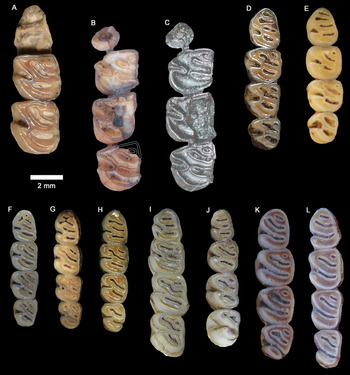
Nomenclature and measurements of lower molars (right m1–2, inverted, MACN-Pv 8377). Abbreviations: Af = anteroflexid/fossettid; Ald = anterolophid; AP = antero-posterior length; TW = transverse width; Hld = hypolophid; Hyp = hypoflexid; Mes = mesoflexid/fossettid; Met = metaflexid/fossettid; Msd = mesolophid; Prt = protoconid area; Psd = posterolophid.

A parsimony analysis was performed based on a combined matrix of morphological characters and nine genes (supplementary material available at https://doi.org/10.1017/S175569102100027X). The morphological matrix is based on Verzi et al. (Reference Verzi, Olivares, Morgan and Álvarez2016) and Olivares et al. (Reference Olivares, Verzi, Vucetich and Montalvo2017). The nine gene fragments were obtained from GenBank: five mitochondrial genes, ribosomal subunits 12S (975 bp), and 16S (819 bp); cytochrome c oxidase subunit I (COI, 1545 bp), and II (COII, 684 bp); cytochrome b (cytb, 1118 bp), and four nuclear genes, growth hormone receptor (GHR, 850 bp); interphotoreceptor retinoid binding protein (irbp, 1183 bp); transthyretin gene (TTH, 932 bp), and the von Willebrand factor (vWF, 1140 bp). Gene selection followed Upham & Patterson (Reference Serafini, Bustos and Contreras2012) and Álvarez et al. (Reference Álvarez, Arévalo and Verzi2017). Gene sequences were aligned using BioEdit 7.2.0 (Hall Reference Goloboff, Farris and Nixon1999) with the default values of gap opening and gap extension. This matrix contained a total of 9311 characters (64 morphological) and 64 taxa, including Dasyprocta, Cavia, Dolichotis (Cavioidea), and Chinchilla, Lagidium, and Lagostomus (Chinchilloidea) as outgroups. The parsimony analysis of the combined morphological and DNA matrix was carried out treating gaps as missing data in TNT 1.5 (Goloboff et al. Reference Frailey, Campbell and Campbell2008a, Reference Galewski, Mauffrey, Leite, Patton and Douzeryb). The analysis was based on 1000 random stepwise-addition replicates and tree bisection reconnection (TBR) branch swapping, saving 100 trees per replicate. In addition, we performed an extra round of TBR on the optimal trees to increase the possibility of finding all minimum-length topologies (Bertelli & Giannini Reference Bertelli and Giannini2005). Zero-length branches were collapsed if they lacked support under any of the most parsimonious reconstructions (Coddington & Scharff Reference Coddington and Scharff1994). Branch support was calculated using bootstrap absolute and bootstrap GC (for ‘Group present/Contradicted’), and with absolute and relative Bremer support indices (Bremer Reference Bremer1994). All characters were considered equally weighted, and multistate characters were coded as non-additive.
2. Systematic palaeontology
Order Rodentia Bowdich, Reference Bowdich1821
Suborder Hystricomorpha Brandt, Reference Brandt1855
Superfamily Octodontoidea Waterhouse, Reference Verzi, Olivares and Morgan1839
Family Echimyidae Gray, Reference Gaudioso, Pérez, Olivares and Diaz1825
Subfamily Echimyinae Gray, Reference Gaudioso, Pérez, Olivares and Diaz1825
Tribe Echimyini Gray, Reference Gaudioso, Pérez, Olivares and Diaz1825
Paralonchothrix gen. nov.
(Figs 2A–C, 3)
- 1914
Eumysops Rovereto: 67, fig. 32 (partim).
- 1977
Proechimys Bond: 312.
Occlusal morphology of left lower molars. (A) m1–2 and roots of dp4 of Paralonchothrix ponderosus comb. nov. MACN-Pv 8377 (holotype); (B) m1–3 and root of dp4 of P. ponderosus comb. nov. PVSJ 319; (C) cast of PVSJ 319; (D) dp4–m3 of Lonchothrix emiliae MN UFRJ 4853; (E) dp4–m3 of L. emiliae MZUSP 3939; (F) dp4–m3 of Mesomys hispidus MVZ 190653; (G) dp4–m3 of Mesomys sp. MZUSP S/N; (H) dp4–m3 of M. hispidus MN UFRJ 27956; (I) dp4–m3 of Proechimys brevicauda MVZ 153623; (J) dp4–m3 of Proechimys roberti MVZ 197578; (K) dp4–m3 of Trinomys paratus MZUSP 29419; (L) dp4–m3 of T. paratus MZUSP 20420 (inverted right molars in A, I, L).

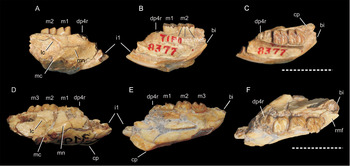
Paralonchothrix ponderosus comb. nov. (A–C) Right hemimandible of MACN-Pv 8377; (D–F) left hemimandible inverted of PVSJ 319. (A, D) lateral; (B, E) medial; (C, F) occlusal views. Abbreviations: af = anteroflexid; bi = base of the lower incisor; cp = chin process; dp4r = deciduous premolar roots; i1 = lower incisors; lc = lateral crest; mc = masseteric crest; mes = mesoflexid; met = metaflexid; mn = mandibular notch for the tendon of medial masseter muscle; rmf = retromolar fossa. Scale bar = 10 mm.

LSID. urn:lsid:zoobank.org:act:DE1B0202-A174-40E8-BC7D-3AA0BC80916D.
Etymology. Greek, para, alongside, and Lonchothrix, referring to it being closely related to this genus.
Type and only species. Paralonchothrix ponderosus comb. nov.
Distribution. Late Miocene of western and northwestern Argentina and western Brazil (Fig. 4).
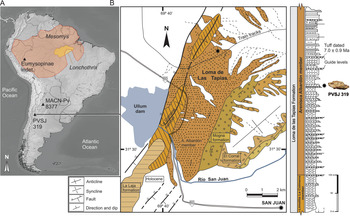
(A) Location map showing localities bearing specimens studied, PVSJ 319 from Loma de Las Tapias Formation, Ullum, San Juan Province; MACN-PV 8377 from ‘Araucarense’, Valle de Santa María, Catamarca Province (both in Argentina), and Eumysopinae indet. from upper Juruá River, Acre region, southwestern Amazonia, Brazil (Sant'Anna-Filho Reference Reguero, Dozo and Cerdeño1994); (B) geologic map of Loma de Las Tapias Formation and stratigraphic section located in the N area of rail tracks of this formation. Black star indicates the location of PVSJ 319. Modified from Olivares et al. (Reference Olivares, Verzi, Vucetich and Montalvo2017).

Diagnosis. Medium-sized echimyid diagnosed by the following unique combination of characters: tetralophodont and subquadrangular m1–3; protoconid area acuminate, extended labially; mesolophid short, curved, and joined to the middle part of the anterolophid; anteroflexid/fossettid transverse; metaflexid and mesoflexid quite similar in length; metaflexid more persistent than mesoflexid; hypoflexid not very penetrating, extended through less than half of the occlusal surface of the molar; mesial portion of the hypoflexid facing the mesial portion of the metaflexid (Fig. 2A, B); lower incisor thick; bottom of lower incisor posterior to m3; mandibular symphysis scarcely protruding, with the chin process slightly anterior to the fourth lower deciduous premolar (dp4); notch for the tendon of the infraorbital part of the medial masseter muscle elongated and located at the level of m1; anterior border of the masseteric fossa, delimited by the lateral crest and the origin of the masseteric crest, curved; base of coronoid process at level of the m3 (Fig. 3).
2.1. Remarks
The upper teeth and maxillae of Paralonchothrix gen. nov. are unknown. Sant'Anna-Filho (Reference Reguero, Dozo and Cerdeño1994) reported an isolated lower molar (AMNH 55836; plate VIII, fig. 5) of ‘Eumysopinae’ indet. from the late Miocene deposits of the upper Juruá River (Acre region, southwestern Amazonia) (see Cozzuol Reference Courcelle, Tilak, Leite, Douzery and Fabre2006; Kerber et al. Reference Jablonski, Belanger, Berke, Huang, Krug, Roy, Tomasovych and Valentine2017). This m1 or m2 (antero-posterior length: 2.37 mm; transverse width: 2.15 mm) is somewhat smaller than the molars studied here, but it shares the following characteristics with the latter: short and curved mesolophid joined to the middle part of the anterolophid, elongated metaflexid with a similar length to that of the mesoflexid, and hypoflexid extended through less than half of the occlusal surface. In addition, the hypolophid is straight and transverse, and the mesoflexid is notably curved anterolabially as in MACN-Pv 8377. These morphological similarities allow us to refer this specimen to Paralonchothrix gen. nov.
Paralonchothrix ponderosus comb. nov. (Rovereto, Reference Rasia1914)
(Figs 2A–C, 3)
- 1914
Eumysops ponderosus Rovereto: 67, fig. 32.
- 1977
Proechimys ponderosus Bond: 312.
- 2012
‘Eumysops’ ponderosus Olivares et al., Reference Morrone2012a.
Holotype. MACN-Pv 8377, right mandibular fragment with intra-alveolar portion of incisor, m1–2, and roots of the dp4 (Figs 2A, 3A–C).
Referred material. PVSJ 319, left mandibular fragment with intra-alveolar portion of incisor, broken m1–3, and roots of the dp4 (Figs 2B, C, 3D–F).
Geographical and stratigraphical provenance. The holotype comes from Valle de Santa María, Catamarca Province, northwestern Argentina; ‘Araucanense’ (sensu Rovereto Reference Rasia1914), late Miocene. PVSJ 319 was found in Loma de Las Tapias, Ullum, San Juan Province, western Argentina; Loma de las Tapias Formation, Albardón Member, late Miocene (Serafini et al. Reference Reguero, Candela, Salfity and Marquillas1986; Rodríguez Reference Patton, Emmons, Patton, Pardiñas and D'Elía2004; Contreras & Baraldo Reference Contreras, Tomassini, Perez and Oliva2011); the specimen of this locality comes from a level below a tuff dated at 7.0 ± 0.9 Ma (Bercowski et al. Reference Bercowski, de Berenstein, Johnson and Naeser1986; Fig. 4).
Emended diagnosis. Same as for the genus.
Measurements. See Table 1.
Dental measurements (in mm) of Paralonchothrix ponderosus comb. nov. Abbreviations: AP = antero-posterior length; TW = transverse width; IW = incisive width; IT = incisive thickness; Dm = depth of mandible below m1.

2.2. Description
Medium-sized echimyid, larger than the extinct Ullumys, Pampamys, Dicolpomys, Theridomysops, and Reigechimys, and smaller than Paramyocastor; it is larger than the living Thrichomys, Proechimys, Mesomys, Lonchothrix, and euryzygomatomyines, and smaller than Isothrix, Kannabateomys, Dactylomys, Makalata, and Myocastor. The holotype, MACN-Pv 8377, corresponds to a juvenile individual, whereas the specimen PVSJ 319 corresponds to an adult, non-senile individual.
Only the roots of the dp4 are preserved in both specimens. The lower molars are subquadrangular and tetralophodont, different from those in the most of extinct southern Echimyidae that are trilophodont (see Verzi et al. Reference Verzi, Olivares and Morgan1994, Reference Verzi and Olivares1995, Reference Tomassini, Garrone and Montalvo2015, Reference Tripati, Roberts and Eagle2018; Vucetich Reference Verzi, Montalvo and Vucetich1995; Olivares et al. Reference Morrone2012a, Reference Nasifb, Reference Olivares, Verzi, Vucetich and Montalvo2017; Olivares & Verzi Reference Olivares2015; Candela et al. Reference Candela, Cenizo, Tassara, Rasia, Robinet, Muñoz, Cañón Valenzuela and Pardiñas2020). The extinct Paramyocastor (see Verzi et al. Reference Strecker, Alonso, Bookhagen, Carrapa, Hilley, Sobel and Trauth2002) and Tramyocastor (see Rusconi Reference Rasia and Candela1936), and the extant Myocastor coypus also have tetralophodont molars, with the mesolophid as a complete crest. In contrast, the m1–3 of Paralonchothrix gen. nov. have a short mesolophid connected to the middle part of the anterolophid, being curved in shape. This latter pattern is represented in the living Lonchothrix, Proechimys, Mesomys, and most of the Trinomys species (see Fig. 2). The anteroflexid/fossettid is transverse in the new taxon, whereas it is more obliquely oriented in Mesomys, Lonchothrix, Proechimys, and Trinomys. Unlike these latter genera, the metaflexid/fossettid and mesoflexid/fossettid of Paralonchothrix gen. nov. are similar in length. The mesoflexid is anterolabially oriented in Paralonchothrix and Lonchothrix, and oriented towards the protoconid area in Mesomys. The hypoflexid extends through less than half of the occlusal surface, as in Mesomys, Lonchothrix, and the m1–2 of Proechimys. The mesial portion of the hypoflexid is facing the mesial portion of the metaflexid; only in the m1 of the holotype of Paralonchothrix ponderosus, the hypoflexid is somewhat displaced anteriorly with respect to the mesial portion of the metaflexid, as in Mesomys. In Mesomys and Proechimys, the hypoflexid is anterior to the mesial portion of the metaflexid. In the holotype MACN-Pv 8377, the lingual portion of the hypolophid is markedly straight and transverse to the sagittal axis of the molar. In PVSJ 319, this lingual portion is slightly oriented posteriorly and aligned with the protoconid area. The described m1–3 have the posterolophid connected labially to the hypolophid via the anterior arm of the hypoconid. This configuration is like that of Lonchothrix, Mesomys, and Proechimys (except for the juvenile m3), and different to that of Trinomys in which the metaflexid is connected to the hypoflexid. In P. ponderosus, the labial end of the protoconid area of m1–3 is more extended than in Mesomys, Trinomys, and Proechimys, similar to that in Lonchothrix.
Unlike octodontids, the mesoflexid closes earlier than the metaflexid. In the juvenile m1–2 of the holotype MACN-Pv 8377, the metaflexid is open when the anteroflexid and mesoflexid are almost closed (Fig. 2A). In lingual view (Fig. 3B, E), the depth of the anteroflexid is only slightly lesser than that of the mesoflexid in m1–2, evidencing an almost synchronic closure. In the adult PVSJ 319, the m1 shows a little anterofossettid, a long mesofossettid, and the metaflexid nearly closed (Fig. 2B, C). The m3 shows an anterofossettid long, the mesoflexid almost closed, and the metaflexid open. The m2 of this specimen is slightly larger than the subequal m1 and m3. The posterior margin of the teeth is curved.
In labial view, the difference in height of the hypoflexid between the m1 and m2 is greater in MACN-Pv 8377 than in PVSJ 319 (Fig. 3A, D). Moreover, the anterior and posterior walls of the molars are more vertically straight in the former. These differences denote variation in hypsodonty – that is, MACN-PV 8377 has higher crowned molars than PVSJ 319, even taking into account that the former is ontogenetically younger. The same pattern is present between Ullumys intermedius from the ‘Araucanense’ of Catamarca Province and Ullumys pattoni from Loma de Las Tapias in San Juan Province (Olivares et al. Reference Olivares, Verzi, Vucetich and Montalvo2017). It is possible that the two specimens assigned to Paralonchothrix gen. nov. also represent two morphologies resulting from a temporal pattern of change.
The mandible is represented by partially preserved hemimandibles lacking the anterior part of the diastema, coronoid process, and angular process. The posterior portion of the diastema is excavated, with a moderate ledge in the anterior alveolar border of the dp4. The symphysis is scarcely protruding, and the chin process is slightly anterior to the dp4; the ventral margin, posterior to the symphysis, is gradually ascending backwards. In Lonchothrix and Mesomys, the chin process is located at the level of dp4, and the ventral margin of the mandible is more markedly ascending; as a result, the symphysis appears more prominent in these genera. The mandibular notch (for the tendon of the infraorbital part of the medial masseter muscle) reaches the level of dp4 in the juvenile MACN-Pv 8377 and the m1 in the adult PVSJ 319. This change in the position of the masseteric notch is observed in the ontogeny of other echimyids (see Gaudioso et al. Reference Frailey2021). The anterior border of the masseteric fossa is at the level of the posterior portion of m1 or m2. It is curved as in Lonchothrix and different to Mesomys and the rest of Echimyini, Myocastorini, and Euryzygomatomyinae, in which it is more acute. The lateral crest is shorter than that of Eumysops and Ullumys, extending between the posterior portion of m1 and the middle portion of m2 in the juvenile MACN-Pv 8377, and between the middle portions of m2 and m3 in the adult PVSJ 319. The base of the coronoid process is located at the level of the m3. In PVSJ 319, the posterior portion of the lower incisor, near to the bottom of its alveolar sheath, is located posterolaterally to the m3 (Fig. 3). The base of the incisor is damaged in the holotype MACN-Pv 8377.
2.3. Remarks
Eumysops ponderosus was originally described by Rovereto (Reference Rasia1914), who provided a plate illustrating the occlusal view of the specimen MACN-Pv 8377. This species was named ponderosus because of its large size, representing the largest among the new species described by this author as members of the extinct Eumysops. Later, Kraglievich (Reference Janis1965) considered this species as not belonging to Eumysops and transferred it to the genus Cercomys ( = Thrichomys) but without any justification. Bond (Reference Bond1977) assigned E. ponderosus to the extant Proechimys; however, Reig (Reference Patton, Pardiñas and D'Elía1989) regarded this assignment as not convincing. Similarly, Olivares (Reference Marshall and Patterson2009) agreed in transferring it to a different genus other than Eumysops and Thrichomys, but considered that its attribution to Proechimys is contingent on a revision. In this regard, Olivares (Reference Marshall and Patterson2009) was cautious and favoured the use of open nomenclature for this species, suggesting the assignment to Proechimys? ponderosus. Indeed, although this taxon presents some similarities with the living Proechimys, especially in the morphology of the anterolophid–mesolophid, there are some characteristics that preclude the attribution to that genus, such as the morphology of the protoconid area and configuration of the masseteric fossa. In addition, Olivares et al. (Reference Olivares, Verzi, Vucetich and Montalvo2017) discarded including E. ponderosus within the variation of the extinct Ullumys.
Besides E. ponderosus, Rovereto (Reference Rasia1914) recognised four other new species within the variation of Eumysops, two for the Valle de Santa María, Catamarca Province, and two for the Huayquerías de San Carlos, Mendoza Province, all from the late Miocene of western Argentina. These species are currently not considered as belonging to Eumysops (Bond Reference Bond1977; Vucetich Reference Verzi, Montalvo and Vucetich1995; Verzi et al. Reference Verzi, Montalvo and Vucetich1999; Olivares et al. Reference Morrone2012a, Reference Olivares, Verzi, Vucetich and Montalvo2017), except for Eumysops serridens, assigned to Thrichomys by Bond (Reference Bond1977; although see Reig Reference Patton, Pardiñas and D'Elía1989), and which is pending a formal revision.
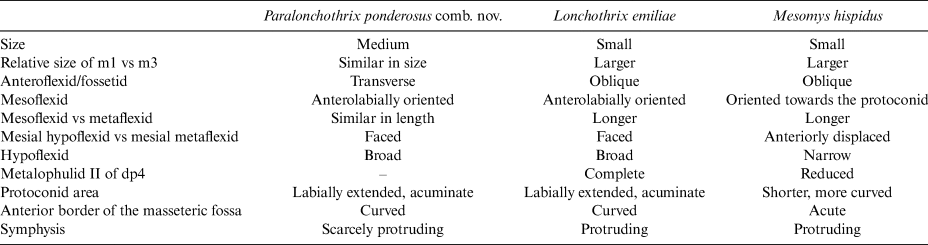
Despite its significantly larger size, the new taxon shows morphological similarities with the living Mesomys, Lonchothrix, and some species of Proechimys. These taxa share the presence of mesolophid connected to the middle part of the anterolophid, hypoflexid not very penetrating, and the posterolophid labially connected to the hypolophid through the anterior arm of the hypoconid. The morphology of the protoconid is similar to that of Lonchothrix. However, when compared in detail, some morphological differences such as less obliquely oriented anterofossettid, presence of more transversally oriented lingual portion of the hypolophid, metaflexid and mesoflexid with similar length, m1 similar in size to the m3, and lesser protruding mandibular symphysis, justify the erection of a new genus (Table 2).
Characters of extinct Paralonchothrix, and the extant Lonchothrix and Mesomys.

2.4. Phylogeny
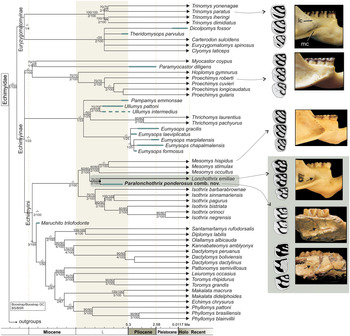
The parsimony analysis of the echimyids based on morphological and molecular characters resulted in eight most parsimonious trees, 14,081 steps long (consistency index, CI = 0.382; retention index, RI = 0.442; Fig. 5). Paralonchothrix ponderosus comb. nov. was recovered as the sister species of Lonchothrix emiliae, with which it shares the anterior margin of masseteric fossa curved (character 63.1), and the protoconid area of m1–2 labially extended, acuminate, and posterolabially oriented (character 64.1). This clade had moderate support but no character conflict (i.e., high relative Bremer support values; Fig. 5). Paralonchothrix and Lonchothrix formed a clade with Mesomys, supported by one morphological character-state – that is, supraorbital ridges conspicuous, extending in parallel along frontals and squamosal–parietal suture (character 20.1; absent in Paralonchothrix). These three genera clustered with the brush-tailed rat Isothrix, in a clade that also had moderate support but no character conflict. This clade, together with the Miocene Maruchito trilofodonte and other arboreal echimyids (((Santamartamys + Diplomys) (Olallamys (Kannabateomys + Dactylomys))) ((Pattonomys (Leiuromys + Toromys)) (Makalata (Echimys + Phyllomys)))) form the Echimyini tribe in recent phylogenetic analyses (Álvarez et al. Reference Álvarez, Arévalo and Verzi2017; Fabre et al. Reference Ercoli and Armella2017; Emmons & Fabre Reference Emmons, Leite, Patton, Patton, Pardiñas and D'Elía2018; Courcelle et al. Reference Contreras, Baraldo, Salfity and Marquillas2019). The monophyly of the Myocastorini was recovered in four out of the eight most parsimonious trees.
Strict consensus of eight most parsimonious trees of 14,080 steps resulting from parsimony analysis of morphological and molecular data. Nodal support is indicated with bootstrap absolute frequency/bootstrap GC frequency (above), and Bremer support/relative Bremer support values (below), next to each node. Biochrons of extinct Echimyidae are shown. On the right, occlusal view of molars of tretralophodont echimyids (except Myocastor, which has four complete lophids), and lateral view of mandibles showing the morphology of anterior portion of the masseteric fossa (black arrow). Abbreviations: Holo = Holocene; lc = lateral crest; mc = masseteric crest.

3. Discussion and conclusions
The new genus Paralonchothrix increases the diversity of both the extinct echimyids in southern South America (Olivares et al. Reference Olivares, Verzi, Vucetich and Montalvo2017; Candela et al. Reference Candela, Cenizo, Tassara, Rasia, Robinet, Muñoz, Cañón Valenzuela and Pardiñas2020) and the clade that includes the living Mesomys and Lonchothrix (Lara et al. Reference Kerber, Negri, Ribeiro, Nasif, Souza-Filho and Ferigolo1996; Leite & Patton Reference Lara, Patton and Da Silva2002; Galewski et al. Reference Flynn, Charrier, Croft, Gans, Herriott, Wertheim and Wyss2005; Upham & Patterson Reference Serafini, Bustos and Contreras2012, Reference Solórzano, Encinas, Kramarz, Carrasco, Montoya-Sanhueza and Bobe2015; Emmons & Fabre Reference Emmons, Leite, Patton, Patton, Pardiñas and D'Elía2018). Our systematic and phylogenetic analyses show that the closest relative of Paralonchothrix is the monotypic Lonchothrix, and both are sister to Mesomys. Hence, Paralonchothrix becomes the first extinct genus known among the spiny tree-rats (Echimyini sensu Fabre et al. Reference Ercoli and Armella2017) recorded in the late Miocene of southern South America.
The precise stratigraphic provenance of the holotype of Paralonchothrix ponderosus is unknown (Rovereto Reference Rasia1914). The ‘Araucanense’ of Valle de Santa María represents the late Miocene–Pliocene interval (Marshall & Patterson Reference MacFadden1981; Bossi & Muruaga Reference Bossi and Muruaga2009; Reguero & Candela Reference Reguero, Dozo and Cerdeño2011; Esteban et al. Reference Emmons and Vucetich2014). However, the specimen recovered from Loma de las Tapias, assigned to this species, comes from a deposit below a tuff dated at 7.0 ± 0.9 Ma (Bercowski et al. Reference Bercowski, de Berenstein, Johnson and Naeser1986; Fig. 4). The Loma de las Tapias Formation includes two successive late Miocene faunal associations assigned to the Chasicoan Stage/Age (assemblage A) and the Huayquerian Stage/Age (assemblage B). The specimen PVSJ 319 was collected from the middle levels of the Arenisca Albardón Member (Fig. 4), and it is included in the younger faunal assemblage B (Contreras & Baraldo Reference Contreras, Tomassini, Perez and Oliva2011; Contreras et al. Reference Contreras, Bracco, Baraldo, Nasif, Esteban, Chiesa, Zurita and Georgieff2019).
Therefore, the late Miocene Paralonchothrix provides a minimum age for the divergence between the living Mesomys and Lonchothrix. Molecular dating indicated that the split between these last two genera took place during the Pliocene (Leite & Patton Reference Lara, Patton and Da Silva2002) or previously, from 7.6 Ma (Upham & Patterson Reference Serafini, Bustos and Contreras2012; Reference Solórzano, Encinas, Kramarz, Carrasco, Montoya-Sanhueza and Bobe2015; Upham et al. Reference Upham, Patterson, Vassallo and Antenucci2013; Fabre et al. Reference Esteban, Nasif and Georgieff2014) to 14.05 Ma (Álvarez et al. Reference Álvarez, Arévalo and Verzi2017). Using the minimum date provided by Paralonchothrix (ca.7.0 Ma), the divergence time among spiny tree-rats could be more accurately constrained.
The evolutionary history of echimyids is linked to forested areas of Central America and especially northern South America. Living representatives primarily occupy Amazonian and Atlantic forests, with only a few lineages having colonised open areas (Patton et al. Reference Patton, Emmons, Patton, Pardiñas and D'Elía2015; Wilson et al. Reference Verzi, Olivares, Morgan and Álvarez2016). Echimyids recorded in the late Oligocene–middle Miocene of the current Patagonian Subregion (sensu Hershkovitz Reference Gray1958) are related to living arboreal clades currently inhabiting Amazonian or Atlantic forests (Emmons & Vucetich Reference Emmons, Leite, Patton, Patton, Pardiñas and D'Elía1998; Carvalho & Salles Reference Carvalho and Salles2004; Verzi et al. Reference Verzi, Olivares and Morgan2014, Reference Tomassini, Garrone and Montalvo2015, Reference Verzi, Olivares, Morgan and Álvarez2016; Olivares & Verzi Reference Olivares2015; Olivares et al. Reference Olivares, Verzi, Vucetich and Montalvo2017). From these echimyids, the genus Maruchito from the middle Miocene of central–southern Argentina and Chile (Vucetich et al. Reference Verzi, Deschamps and Vucetich1993; Solórzano et al. Reference Reig, Vuilleumier and Monasterio2020) was so far the last record of an Echimyini in southern South America.
Global Cenozoic drying and cooling trends following the middle Miocene Climatic Optimum (Denton Reference Cozzuol1999; Zachos et al. Reference Vizcaíno, Cassini, Fernicola and Bargo2001, Reference Voss, Lunde and Simmons2008; Tripati et al. Reference Sant'Anna-Filho2009), along with Andean orogeny promoting a rain shadow in most of southern South America (see Le Roux Reference Landry2012), favoured aridification spread in tandem with expansion of open habitats (Pascual & Ortiz Jaureguizar Reference Orlando, Mauffrey, Cuisin, Patton, Hänni and Catzeflis1990; Janis Reference Hoffstetter, Vuilleumier and Monasterio1993; Arakaki et al. Reference Arakaki, Christin, Nyffeler, Lendel, Eggli, Ogburn, Spriggs, Moore and Edwards2011; Hynek et al. Reference Hall2012; Palazzesi & Barreda Reference Olivares, Verzi, Contreras and Pessôa2012; Dunn et al. Reference Domingo, Tomassini, Montalvo, Sanz-Pérez and Alberdi2015; Amidon et al. Reference Amidon, Fisher, Burbank, Ciccioli, Alonso, Gorin, Silverharta, Kylander-Clark and Christoffersen2017; Carrapa et al. Reference Carrapa, Clementz and Fengc2019). These ecological transitions promoted changes in the taxonomic composition of the fossil echimyid fauna from the Patagonia Subregion. Thereby, southern echimyids recorded since the late Miocene are restricted to lineages of Euryzygomatomyinae (sensu Emmons Reference Eisenberg and Redford2005) and Myocastorini (sensu Fabre et al. Reference Ercoli and Armella2017) that currently occupy open, shrubby to grassland environments and dry forests in the Chacoan Dominion (sensu Morrone Reference MacFadden, Cerling and Prado2014) (e.g., Reig Reference Patton, da Silva and Malcolm1986; Verzi et al. Reference Verzi, Olivares and Morgan1994, Reference Verzi and Olivares1995, Reference Stein, Lacey, Patton and Cameron2004, Reference Tomassini, Garrone and Montalvo2015, Reference Verzi, Olivares, Morgan and Álvarez2016, Reference Tripati, Roberts and Eagle2018; Vucetich Reference Verzi, Montalvo and Vucetich1995; Cartelle Reference Cartelle, Eisenberg and Redford1999; Hadler et al. Reference Goloboff, Farris and Nixon2008; Olivares et al. Reference Morrone2012a, Reference Nasifb, Reference Olivares, Verzi, Vucetich and Montalvo2017; Olivares & Verzi Reference Olivares2015; Sostillo et al. Reference Reig and Fontdevila2015; Candela et al. Reference Candela, Cenizo, Tassara, Rasia, Robinet, Muñoz, Cañón Valenzuela and Pardiñas2020). That is the case of some material assigned to Eumysopinae indet. from the Andalhuala Formation (Catamarca province; Nasif Reference Marshall, Hoffstetter and Pascual1998), Theridomysops from the ‘Araucanense’ of Catamarca (Rovereto Reference Rasia1914), Ullumys from the ‘Araucanense’ of Catamarca and the Loma de Las Tapias Formation (San Juan Province; Olivares et al. Reference Olivares, Verzi, Vucetich and Montalvo2017), and ‘Eumysops’ serridens from the Mendoza province (see Rovereto Reference Rasia1914), all from southern peri-Andean areas. Therefore, the Echimyini Paralonchothrix is an exceptional record that raises the need to review the postulated evolutionary pattern for echimyids recorded at high latitudes since the late Miocene (Vucetich et al. Reference Verzi, Deschamps and Tonni1997; Olivares et al. Reference Morrone2012a, Reference Nasifb; Verzi et al. Reference Tomassini, Garrone and Montalvo2015, Reference Verzi, Olivares, Morgan and Álvarez2016, Reference Tripati, Roberts and Eagle2018).
The living Lonchothrix and Mesomys have arboreal modes of life. Lonchothrix emiliae lives in lowland mature and secondary (capoeira) rainforests in a limited area of eastern Brazilian Amazonia (Patton Reference Pascual2015b; Fabre et al. Reference Ercoli, Álvarez, Verzi, Villalba Ulberich, Quiñones, Constantini and Zurita2016). Mesomys has a wider geographic range, occupying lowland rainforest throughout the Amazon Basin and the Guianan region, and even extending up to an elevation of 2000 m in the upper montane forests along the eastern slope of the Andes (Patton et al. Reference Pascual and Odreman Rivas2000; Voss et al. Reference Verzi, Vucetich and Montalvo2001; Orlando et al. Reference Olivares, Verzi and Vucetich2003; Upham et al. Reference Upham, Patterson, Vassallo and Antenucci2013; Patton & Emmons Reference Pascual and Ortiz Jaureguizar2015; Dias de Oliveira et al. Reference Denton, Bromage and Schrenk2019). Preserved morphology in Paralonchothrix does not allow reliable inference on its habits. Nevertheless, some indicative features may be mentioned. Paralonchothrix differs from all arboreal echimyids in its less protruding mandibular symphysis (see Olivares et al. Reference Olivares, Verzi and Vucetich2020). In addition, the PVSJ 319 specimen preserves the posterior portion of the incisor, which is long, thick, and with its base located posterolateral to the m3. This position of the base of the incisor of P. ponderosus is slightly more posterior than that observed in Mesomys and Lonchothrix, and markedly more posterior than that in the rest of arboreal echimyids and the semiaquatic Myocastor, which have shorter incisors; it is similar to that of the terrestrial Thrichomys and Proechimys, and more anterior than that observed in fossorial echimyids (supplementary Fig. S1). A deeper insertion of the lower incisors is linked to the frequency of use of them and the development of forces at their tips (Verzi & Olivares Reference Upham and Patterson2006). This condition implies relatively longer incisors, with the basal generative zone far from the point in which the pressure is exerted (Landry Reference Jansson, Rodríguez-Castañeda and Harding1957; Lessa Reference Latorre, Quade and McIntosh1990; Stein Reference Rodríguez2000; Zuri & Terkel Reference Vucetich2001). Furthermore, P. ponderosus has a retromolar fossa located posterior to the dental series (Fig. 3), as in the terrestrial Thrichomys and fossorial genera. This fossa is lateral and shallower in arboreal echimyids and the semiaquatic Myocastor. The retromolar fossa is the insertion area of the orbital portion of the temporal muscle, whose function is mainly the elevation of the mandible (Woods Reference Verzi, Olivares and Morgan1972; Woods & Howland Reference Vizcaíno, De Iuliis and Bargo1979).
Palaeoecological data discernible from the faunal association B at the Loma de las Tapias site, where P. ponderosus is recorded, suggest the dominance of open environments. Paralonchothrix is associated to the xenarthrans Vasallia sp., Chorobates villosissimus, Euphractinae indet., the notoungulates ?Hoplophractus sp., Typotheriopsis ?silveyrai and Paedotherium sp. cf. P. borrelloi, and with the rodents Protabrocoma sp., Ullumys pattoni, Lagostomopsis sp. ( = Lagostomus; see Rasia Reference Patterson and Pascual2016; Rasia & Candela Reference Patton, Patton, Pardiñas and D'Elía2017), dolichotines, and caviines (Contreras & Baraldo Reference Contreras, Tomassini, Perez and Oliva2011; Contreras et al. Reference Contreras, Bracco, Baraldo, Nasif, Esteban, Chiesa, Zurita and Georgieff2019; pers. obs. 2019). The pampatheriid Vasallia¸ registered too in the ‘Araucanense’ of Catamarca province (Esteban et al. Reference Emmons and Vucetich2014), has been interpreted as feeding on grasses (grazer), consuming mainly coarse vegetation (Vizcaíno et al. Reference Upham, Patterson, Vassallo and Antenucci1998). The dasypodid Chorobates has been inferred as a dweller of temperate to warm, open environments (Carlini & Scillato-Yané Reference Carlini and Scillato-Yané1996; Contreras et al. Reference Contreras, Baraldo, Salfity and Marquillas2013), similar to those currently occupied by the euphractines Zaedyus and Euphractus (Wetzel et al. Reference Verzi, Morgan, Olivares, Cox and Hautier2007). Chorobates has also been recorded in the ‘Araucanense’ of Catamarca province (Esteban et al. Reference Emmons and Vucetich2014). The glyptodontid Hoplophractus has been described as a bulk-feeding inhabitant of moderately open habitats (Vizcaíno et al. Reference Verzi2011). Typotheriopsis (Notoungulata) is considered as an inhabitant of open, dry areas, with fossorial abilities and masticatory specialisations for the consumption of hard food items (Fernández-Monescillo et al. Reference Fabre, Patton, Leite, Wilson, Lacher and Mittermeier2018; Ercoli & Armella Reference Emmons and Feer2021). Paedotherium was a small terrestrial herbivorous that resembles extant leporids, probably adapted to open and semi-arid habitats (Cerdeño & Bond Reference Cerdeño and Bond1998; Reguero et al. Reference Patton, Patton, Pardiñas and D'Elía2007; Tomassini et al. Reference Rusconi2017 and references therein). The living abrocomid rodents related to Protabrocoma are specialised for life in rocky cliff faces in Andean regions (Patton et al. Reference Patton, Emmons, Patton, Pardiñas and D'Elía2015). The chinchillid rodent Lagostomus currently occupies grasslands and lowland deserts (Patton et al. Reference Patton, Emmons, Patton, Pardiñas and D'Elía2015). The other echimyid rodent recorded in the Loma de Las Tapias Formation, Ullumys, has a peculiar craniomandibular morphology, with wide and posterior orbits, reflecting specialisations to open environments (Olivares et al. Reference Olivares, Verzi, Vucetich and Montalvo2017, Reference Olivares, Verzi and Vucetich2020).
Sedimentological analyses of deposits from the El Jarillal Member (Chiquimil Formation) and the base of the Andalhuala Formation, dated to between 9.14 ± 0.09 Ma and 6.70 ± 0.05 Ma, at the Catamarca province, Araucanense, suggested the presence of a savanna-type environment with areas with closed tree vegetation and an annual wet season (see Pascual & Odreman Rivas Reference Olivares and Verzi1971; Esteban et al. Reference Emmons and Vucetich2014).
On the other hand, the evidence of stable carbon isotope data from tooth enamel of extinct mammals in Argentina, including the Valle de Santa María, suggested an increase in C4 plant contribution to herbivore diets after ~8 Ma (MacFadden et al. Reference Leite and Patton1996), as expected for temperate and tropical savanna-type environments. Expansion of C4 plants at about 8 Ma in the southern central Andes has been linked to an increase in seasonality (Latorre et al. Reference Kraglievich1997). Recently, other evidence from stable isotopes record from paedogenic carbonates preserved in southern central Andes suggested subtropical aridification and a shift toward expansion of C4 grasses during the late Miocene cooling (Carrapa et al. Reference Carrapa, Clementz and Fengc2019; see also Domingo et al. Reference Dias de Oliveira, Oliveira da Silva, Rodrigues da Costa, Sampaio, Pieczarka and Nagamachi2020).
These available data are consistent with palaeoenvironmental inference proposed by Pascual & Odreman Rivas (Reference Olivares and Verzi1971) favouring the predominance of open environments. Nevertheless, based on the record of fossil trees and climate-sensitive mammals, these authors suggested the presence of forested environments in peri-Andean valleys of western and northwestern Argentina during the late Miocene (see also Vucetich Reference Verzi, Vucetich and Montalvo1986; Esteban et al. Reference Emmons and Vucetich2014). More recent palaeobotanical (Anzótegui et al. Reference Anzótegui, Mautino, Horn, Garralla, Robledo, Nasif, Esteban, Chiesa, Zurita and Georgieff2019), palaeozoological (Ercoli et al. Reference Emmons and Fabre2021), and geological evidence (Strecker et al. Reference Rovereto2007) supports this interpretation. This area, already biogeographically differentiated from the Pampean plains of central Argentina by that time, would have maintained connections with tropical biomes of northern South America (Pascual & Odreman Rivas Reference Olivares and Verzi1971; Ercoli et al. Reference Emmons and Fabre2021). Such a scenario could explain the presence of Paralonchothrix in western and northwestern Argentina and western Brazil, and its absence in contemporary deposits from the Pampean region where large samples of small mammals were collected; nevertheless, biases in the fossil record explaining this pattern should not be discarded.
The current outstanding diversity of Echimyidae contrasts with the paucity of its southern fossil record, which does not match geographically with the main area where this clade radiated (Reig Reference Patton, da Silva and Malcolm1986; Verzi et al. Reference Tripati, Roberts and Eagle2018). The Amazonian region exhibits low diversity of fossil echimyids, with scarce remains reported from the late Miocene of Acre River and Upper Juruá River in Brazil (including Paralonchothrix) and the Upper Purus River in Peru (Frailey Reference Fabre, Vilstrup, Raghavan, Der Sarkissian, Willerslev, Douzery and Orlando1986; Sant'Anna-Filho Reference Reguero, Dozo and Cerdeño1994; Campbell et al. Reference Campbell, Frailey and Romero-Pittman2006; Kerber et al. Reference Jablonski, Belanger, Berke, Huang, Krug, Roy, Tomasovych and Valentine2017). Fossil echimyids are mainly known from Patagonia Subregion (Flynn et al. Reference Fabre, Upham, Emmons, Justy, Leite, Carolina Loss, Orlando, Tilak, Patterson and Douzery2008; Vucetich et al. Reference Vucetich, Mazzoni and Pardiñas2015; Verzi et al. Reference Verzi, Olivares, Morgan and Álvarez2016; Olivares et al. Reference Olivares, Verzi, Vucetich and Montalvo2017), probably as a consequence of the biased distribution of fossil deposits or bias in the fossil collecting methodology (Marshall et al. Reference Lessa, Nevo and Reig1983; Hoffstetter Reference Hadler, Verzi, Vucetich, Ferigolo and Ribeiro1986; MacFadden Reference Le Roux2006; Kerber et al. Reference Jablonski, Belanger, Berke, Huang, Krug, Roy, Tomasovych and Valentine2017). The late Miocene–Holocene echimyids from southern South America have been interpreted as being part of episodes of southward drift extension of their distributions from the Brazilian Subregion (sensu Hershkovitz Reference Gray1958), the southern record representing an impoverished sample of the extraordinary diversity reached by this family in the northern tropical and subtropical areas (Vucetich et al. Reference Verzi, Deschamps and Tonni1997; Verzi Reference Sostillo, Montalvo and Verzi2002; Verzi et al. Reference Verzi, Olivares and Morgan2014, Reference Verzi, Olivares, Morgan and Álvarez2016, Reference Tripati, Roberts and Eagle2018; Olivares et al. Reference Olivares, Verzi, Vucetich and Montalvo2017). Following this interpretation, the ancestor to all tree spiny tree-rats (Paralonchothrix, Lonchothrix, and Mesomys) is most likely to have occupied an Amazonian range. Consequently, Paralonchothrix would have adapted to more open habitats after its dispersal from the Amazonian basin to the Patagonian Subregion during the late Miocene. The occurrence of Paralonchothrix in the late Miocene of the Amazonian Acre region supports this idea. There are indeed studies showing that lineages tend to originate in the tropics and then expand out of the tropics to encompass also temperate zones (e.g., Jablonski et al. Reference Hershkovitz2013; Jansson et al. Reference Hynek, Passey, Prado, Brown, Cerling and Quade2013). Although a S–N transition cannot be excluded, this is a most unlikely scenario. Upham et al. (Reference Upham, Patterson, Vassallo and Antenucci2013) identified at least four transitions between the Andes and Amazonia within arboreal echimyids. According to these authors, reciprocal exchange between Andean and Amazonian lineages has been a continual process since the late Miocene (ca.12 Ma). However, this biogeographical pattern does not involve latitudinal changes.
The record of Paralonchothrix in western and northwestern Argentina supports the hypothesis of faunistic exchanges between the tropical biomes of northern South America and the Patagonian Subregion. New studies are necessary to test whether the corridor represented by peri-Andean valleys (Pascual & Odreman Rivas Reference Olivares and Verzi1971) and that from plains of central Argentina (Verzi et al. Reference Tripati, Roberts and Eagle2018) could have functioned selectively according to the ecological requirements of echimyids and other small mammals.
4. Data availability statement
The authors confirm that the data supporting the findings of this study are available within the article and its supplementary materials.
5. Supplementary material
Supplementary material is available online at https://doi.org/10.1017/S175569102100027X
6. Acknowledgements
We thank R. Martínez (PVSJ), A. Martinelli, M. Ezcurra, L. Chornogubsky (MACN), J. L. Patton, E. Lacey, C. Conroy (MVZ), J. Oliveira (MN UFRJ), W. Kliem (Universidade Federal da Bahia), P. Cordeiro Estrela, A. Feijo (Universidade Federal da Paraiba), and M. de Vivo (MZUSP) for granting access to materials under their care; and A. Álvarez and M. Ercoli for their valuable suggestions. A. Álvarez provided us images of Trinomys paratus from MZUSP, Brazil. We thank L. Kerber and one anonymous reviewer for their valuable revisions that improved the manuscript. This research was supported by the Agencia Nacional de Promoción Científica y Tecnológica (ANPCyT PICT 2016-2881). P. P. is beneficiary of a postdoctoral fellowship from the Argentinian Consejo Nacional de Investigaciones Científicas y Técnicas (CONICET).