1. Setting the Scene
The existence of museums and their institutional purpose are not often under ethical scrutiny. Museum practices, however, are subject to ethical auditing. The emergence of codes of ethics for museums is seen as a response to the conflict of interests between museums and their different stakeholders with regard to the guardianship, broadly construed, that museums exercise over their collections.
At present, codes of museum ethics aim to provide a tool for ethical decision making that will enable museums to provide a satisfactory resolution, within an adequate legal framework, to possible conflict of interests arising from their diverse audience. Nevertheless, codes of museum ethics and directions of compliance are mainly narrowly defensive, designed to protect the institution and its professionals.Footnote 1 Codes of museum ethics are too general to capture the multilayered responsibilities that shape the duty of care museums have to the objects in their collections. They tend to provide a set of directions describing the duty of care in a schematic manner. For instance, access for all to museum collections, competent preservation, and furtherance of knowledge are the main aims described in museum codes of ethics. These aims reflect the spirit of the duty of care, but they do not shed any light onto its normative background. More importantly, museum codes of ethics do not provide a framework for understanding the museums' duty of care. My main purpose here is to explain some key dimensions of museums' duty of care and to argue for a framework for understanding it. Towards these aims, I provide a novel reading of what museums do and, on the basis of this, I propose a triangular framework for understanding the museums' duty of care.
To understand the duty of care we need to grasp what museums do. Museums do keep objects in their collections, but they are not merely depositories of objects for the furtherance of knowledge. Museums are in a unique position to account for the transit of objects between past and future in such a way as to secure the transfer of their significance, broadly construed. By ‘transit’ here I mean that museums not only convey the physical objects in their collections, but they are also conveyors of the objects from one stage of their lives to the next. Given that this is the modus operandi for museums, the duty of care for museums concerns how the transit from past to future is accomplished.
According to the triangular framework I propose, an adequate vehicle to accommodate the transit from past to future is trusteeship. Given that anticipation of how things will develop in the future is central to trust, then it would seem that trust, and more precisely museum trusteeship, is a good candidate to secure the transfer of the significance of objects into the future.Footnote 2 ‘Trust’ has been under scrutiny in the social sciences (particularly in economics and organisational theory) for a long time, and in recent years philosophers have turned their attention to the ethics and the epistemology of trust.Footnote 3 Both the social scientists and the philosophers, however, have left out of their focus the notion of trusteeship. An explanation might be that trusteeship is often understood as a legal concept and is therefore taken to be of little concern to social scientists and philosophers. I argue that an understanding of trust as entrusting fits with museum trusteeship because it focuses on the question of what is entrusted and not who should be trusted.Footnote 4 This matches museum trusteeship because it demands that museums make sense of what falls under their trust powers and also tests the limits of their discretionary powers, which are also entrusted to the trustees along with museum objects.
Following from this, the triangular framework explains how museums can make sense of what is entrusted to them by exploring the objects' significance via a biographical approach. According to Igor Kopytoff, it is possible to write the biography of objects, just as we write the biography of people, by following an object's life from birth to death.Footnote 5 Constructing biographies of objects is a useful tool that can reveal relationships between people and objects. The episodes of an object's biography shape its significance by shedding light onto the associations that people developed with it during its history. Communities survive via their objects and shape their current meaning; while objects shape communities and define their relationship with the past.
In museums what is in transit from past to future is more than just the physical objects themselves. The transit also includes the significance of objects, which, as we have seen, has been shaped by the different stages of their lives and by their relationships with communities. What is preserved from an object's significance, which stage of its life is given priority, and what reasons recommend the secure transfer of the object with this particular significance to the future, are a result of negotiation. Negotiation is what completes the triangular framework for understanding the duty of care museums have to the objects in their collections. It is the ethical catalyst for museums' duty of care because it entails compromise. Compromise is grounded on the recognition of all relevant stakeholders. Similarly, recognition requires respect not only for the objects themselves but also for the objects in relation to other objects and in different contexts. This is possible only if one pays attention to the objects and how their multiple identities affect their significance over time. Hence, my claim is that a museums' duty of care can be understood as the duty to negotiate the transit from past to future of the objects in their care in such a way as to secure their significance. A quick objection invites itself here: if the biography of objects facilitates the transit from past to future naturally, why is the transit from past to future important? Although the biography of objects can provide information about the object's life stages and how the object shifts from past to future, it does not provide sufficient answers as to what can be moved from past to future and how it can be moved. The notion of transit not only refers to that which is moved but also establishes an outline that helps us to understand the limitations of an object's move from past to future. For the purpose of my argument, transit should be considered in relation to negotiation. Negotiation is the catalyst by which we come to understand what and how the object might be moved from past to future.
2. What is in a Museum?
A primary aim of museum ethics is to help us understand how museum governing bodies exercise their duty of care for the benefit of others.Footnote 6 To reach an understanding of museums' duty of care we must addresses three interrelated questions: ‘For what do museums care in their collections?’, ‘For whom do museums care for their collections?’, ‘What are the appropriate means that museums deploy to care for their collections?’. In what follows, I consider the first of these questions. To illustrate my argument I will refer to two different kinds of museums: the National September 11 Memorial Museum at Ground Zero in New York, and the British Museum in London. I will use these museums to show that, independently of the motivations shaping the establishment of a museum, museums have under their care much more than physical objects.
Lynn Meskell describes succinctly the development of the new museum at Ground Zero in New York, where the Twin Towers were located before the 9/11 terrorist attack.Footnote 7 According to Meskell and the reports she cites, developers chose materials from the remains of the destroyed buildings in order to display them in a museum that would be established at Ground Zero to commemorate the tragedy. The museum opened its doors to the public in May 2014. During the preparation of the museum exhibition, members of the public were invited to donate things that had belonged to their loved ones who lost their lives in the Twin Towers. Members of the public were also asked to contribute their own stories about the tragic events, stories which reveal the developed associations between the public and the Twin Towers.
Given this history, to exercise their duty of care the trustees of the National September 11 Memorial Museum at Ground Zero need to address a set of questions such as: ‘What kind of objects does the Museum at Ground Zero exhibit?’, ‘How are these objects related to the past, and more importantly to the past of the people of New York?’, ‘What is the relevance of those objects for future generations?’. Given that the museum commemorates the tragic events ensuing from a terrorist attack that had global ramifications, another salient question is: ‘Does this museum exhibition involve stakeholders beyond the residents of New York?’. It is not my purpose here to answer these questions, but instead to compare them with a set of questions that arise from interrogating a different kind of museum: the British Museum.
The British Museum is what is often understood as an encyclopaedic, or Enlightenment, or universal museum.Footnote 8 According to James Cuno, ‘the encyclopaedic museum is a modern institution, born of the intellectual ferment of early modern Europe’.Footnote 9 This kind of museum is a development from the cabinets of curiosities that were popular in Europe during the Renaissance and the Enlightenment. Cabinets of curiosities accommodated the collections of seventeenth and eighteenth-century philanthropists and travellers and they were full of objects from different parts of the world. Those objects provided an opportunity to those who viewed them to exercise their capacity to observe and use reason.
Similarly, the British Museum, as an encyclopaedic museum, is entrusted with objects from different parts of the world that are held and exhibited for the benefit of humanity. Part of the mission of such a museum is to exhibit different kinds of objects from different countries in new contexts and thus to contribute to our understanding of other cultures. In the case of the encyclopaedic museum, trustees typically make sense of their duty of care by responding to challenges arising from particular objects in their collections. Take, for instance, the Benin Bronzes at the British Museum. These well-crafted plaques were probably cast in the sixteenth century to clad the wooden pillars of the Oba's palace, and they mostly show scenes of palace life and ritual. Castings showing the plaques in situ suggest that they were made in matching pairs. The plaques were removed from their original location during a British punitive expedition in southern Nigeria in March 1897.Footnote 10 Here are some of the questions that might be asked with a view to the museum's duty of care: ‘What does the history behind the acquisition of the plaques reveal about the role of the museum as an institution?’, ‘How are the plaques exhibited in relation to African and non-African culture?’, ‘How are they related to African identity?’, ‘Do the plaques have a special meaning for current and future generation of African immigrants in London and elsewhere in UK?’, ‘Do they contribute to their well-being?’, ‘Do the plaques shed light onto aspects of the British Empire that have otherwise remained beyond debate?’.
The sets of questions arising from the National September 11 Memorial Museum at Ground Zero and the British Museum, respectively, highlight that the ethical status of a museum depends not only on the content of its collections but also on how collections are treated and displayed. More importantly, both cases considered above reveal that what is in transit from past to future is more than physical objects.
In the case of the Museum at Ground Zero, what is under transit from past to future is not merely ruins of a steel frame from the Twin Towers. The memories of people who are associated in multiple ways with the Twin Towers are also part of the transit. They might be memories of the death of loved ones. They might be memories of working at a place that no longer exists. They might be memories of the sky line of New York prior to the attack. They might be memories of the safeguard teams helping victims a few hours after the event. Also, they might be memories shaped by what happens in other parts of the world in the aftermath of the events of 9/11. Likewise, what is at stake in the case of the Benin Bronzes is more than the transit of hunks of metal into the future. The Bronzes provide an enormous amount of information about the era and the area where they were originally erected. This information is central to what is in transit from the past. Undoubtedly, this information adds to the significance of the object and reminds us that there is something more than a mere collection of physical objects in transit from past to the future here.
In both of the cases examined, what is in transit includes physical objects and the associations that have been developed between them and people in different contexts. Hence, to understand how the duty of care is exercised requires more than merely identifying what is deposited in a museum. It requires us to understand the two-way relationship between objects and communities, according to which communities survive via their objects and thus shape their significance, and objects survive via communities and contribute to their lives.
One would expect current codes of museum ethics to address this issue. However, codes of museum ethics focus on the question of what is deposited in museums because they treat museums primarily as depositories of knowledge. Current codes of museum ethics thus overlook the dynamic role of museums as trajectories from past to future.
Take, for instance, John Merryman's proposal for the operation of museums.Footnote 11 In line with the spirit of the current codes of museum ethics, Merryman connects the web of museum beneficiaries and the operation of museums. He argues that the operation of museums can be divided into three equally significant tasks: (a) preservation and protection of the museum's collections, (b) research and furtherance of knowledge, and (c) facilitation of public access to the museum's collections. These tasks highlight good museum practice, and shape the ethical responsibilities that codes of museum ethics stipulate. More importantly, Merryman's three tasks complement each other and at the same time they bring to the fore the two interrelated operations which take place in every museum. One operation is the scientific work which takes place behind the scenes of the museums, where curators, historians, conservators, and archaeologists work on objects for the production and furtherance of knowledge.Footnote 12 The other operation has to do with the public displays and exhibitions of museum objects, which make it possible for all members of the public to discover relevant information about exhibited objects and develop their own associations with them. Both operations complement each other because the scientific work taking place in museums provides the framework for the understanding of objects in public displays, and the exhibitions and displays provide access to the knowledge produced behind the scenes. This is how museums fulfil their role as social institutions. The complementary relationship of the two operations suggests that one can make sense of an ethical outlook for museums if one locates the obligations that are rooted in these operations and identifies the potential beneficiaries. This is the first step in articulating the ethical responsibilities that museums have towards different audiences. However, it is one thing to address the significance of the duty of care and its relevant potential beneficiaries, and another to present a framework of understanding that renders the duty of care intelligible. Merryman's three tasks address the former by providing a guide for good museum practice, but they do nothing to render the duty of care intelligible.
If we stress the role of the museum as providing a trajectory from past to future – an understanding of museum practice that is not normally discussed – we can begin to make sense of the duty of care museums have. To identify what is in transit from past to future will allow us to locate the obligations that develop as a result of this passage.
The triangular framework outlined below provides a framework for understanding museums' duty of care that moves beyond codes of museum ethics. The framework does not merely stipulate that there are obligations to museum stakeholders. It explains the source of these obligations and renders them intelligible. It also explains how museum trustees engage with their obligations and how this is compatible with the function of museums as sites for the transit of objects from past to future.
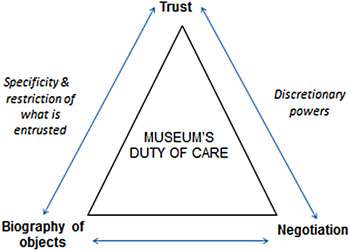
Figure 1 illustrates how the triangular framework operates. The museums' duty of care is defined by trusteeship which is grounded on a model of trust as entrusting. According to this model, trustees' discretionary powers are defined by the specificity and the restrictedness of what is entrusted to them. We can make sense of what is entrusted at any time by exploring the biographies of the objects in their care. This informs the trustees of the limits of their discretionary powers and highlights that there is more to an object than its material composition. Trustees negotiate the transfer of an object's significance as that significance, in its possible multiple forms, is revealed by its biography. Negotiation is the ethical catalyst for the museums' duty of care because it is not limited to mere awareness of the concerns of different beneficiaries and stakeholders. It is a process that takes into consideration how these different parties are involved in the transit of an object from past to future, given that they shape what an object is and what it can be in the future. It is now time to reveal how this framework operates starting from the notions of trust and trusteeship.
The Museum's Duty of Care.

3. Museum Trusteeship and Trust
Trusteeship is a mode of governance for museums that are established as equitable trusts and are managed by a board of trustees in whom the collections are vested in perpetuity for public benefit.Footnote 13 This definition of trusteeship clearly stipulates that the beneficiaries of a museum's duty of care are the public. As Jonathan Williams, the Deputy Director of the British Museum, points out:
The model of trusteeship borrows the notion of trust from private family law. Trustees do not own the collection and they have to act as they judge best in the interest of future and unborn beneficiaries. Trusteeship involves two complementary kinds of ownership, legal and equitable, which are essential to common law trusts of all kinds. Collections are normally vested by statute in trustees who have legal ownership of the collections for the benefit of the public who have what is known as equitable, or beneficial, title to the collections, i.e. the right to use them. The public are, therefore, the beneficiaries of the trust for whose execution the trustees are responsible.Footnote 14
Williams also draws attention to the relationship between trustees and museum collections, stressing the fact that ‘although trustees are the legal owners of the collections, they have no extraordinary rights to benefit from them, only obligations towards their beneficiaries, the public’.Footnote 15
Williams comments on the operation of trusteeship as a legal tool for museums and he also discusses the ethical obligations that arise from its exercise. Trusteeship is a useful mechanism for museums. It offers them a net of legal protection as it makes clear to whom museum trustees are accountable for their actions, and it frames their responsibilities and decision making powers.Footnote 16 The legal aspect of trusteeship ensures that trustees follow the right procedures so that the ‘trust’ is maintained for future generations.
Sissela Bok rightly points out that ‘whatever matters to human beings, trust is the atmosphere in which it thrives’.Footnote 17 Independently of her claim, trust has remained somewhat absent from discussion in ethics. Recently, however, trust has enjoyed a revival of interest among philosophers who have explored its nature and its significance in epistemology and ethics.Footnote 18 Although the ethical dimensions of trust have been discussed in professional practice debates within such fields as medicine, business (banking included) and politics, museum and heritage authorities seem to have been untouched by this debate.
Let me briefly summarize my working understanding of trust before explaining how trust is central to museum practice. Trust is plentifully present in our everyday actions. Children trust their parents to take good care of them while they grow up. We trust teachers to teach our children well. We trust postmen to deliver our post for us. We trust public institutions to act in the interests of public benefit. We trust strangers when we ask directions in foreign places. Likewise, we trust strangers not to harm us while we are using public transport. We trust our friends. These are only some instances where trust is present and plays a significant role in our attitudes towards others. We can now see that trust can be understood as involving a tripartite relationship illustrated in the following schema: A trusts B with C.Footnote 19 Moreover, from the moment that A transfers the custody of C to B, A accepts vulnerability because C is at risk in case B does not take care of it competently. Trusting our health to medical doctors is tantamount to transferring the protection of our health – of what matters to us – to the experts in whom we trust. So, what is entrusted in a trust relationship is something that matters to the trustor because it concerns her interests. Furthermore, by entrusting that which is in the trustor's interests to the trustee, the trustor accepts that his interests are at risk because they are vulnerable to the extent to which he has trusted the trustee to take care of them. For instance, at the restaurant I trust the chef not to poison my food. From the moment I decide to dine at the restaurant, I accept that my health is vulnerable to the chef. Trust and vulnerability go hand in hand.
The proposed schema can be applied to museums and uncovers the layers of trust between them and their multiple publics. By entrusting museums with the custody of objects, we accept that these objects are vulnerable to whether or not museums will competently carry out the duty of care towards them (see Figure 1). Hence, museum practice is by default related to trust. The striking feature revealed by considering trust in relation to museum practice is that objects are important to different individuals for different reasons at different times. Museum trustees should be able to address the multiple interests of all concerned individuals for a single object. Take, for instance, the pillars of Ashoka (part of the British Museum's collection), stone inscriptions giving lifestyle advice erected by King Ashoka for the benefits of the citizens of his kingdom.Footnote 20 Local communities in places where these inscriptions are found still feel strongly about the meaning of the pillars and consider them significant within their own life narratives. The Ashoka pillars still play a role for those communities and help them define who they are. However, as a European participating in a culture that celebrates and values the written tradition, I might perceive the Ashoka pillars as predominantly an example of early public message boards. The museum trustees in this case have to address the interests of all concerned communities and individuals, past, present, and future, when they exhibit the Ashoka pillars. But this raises a further question: Using the tripartite schema, how do we understand what is entrusted to the trustees at any given time? I now turn my attention to this concern.
3.1 Trust as entrusting and the biography of objects
I now argue that an account of trust that puts the emphasis on what is entrusted is most appropriate for use in a theory of museum trusteeship. According to this model, the question we ought to ask is not ‘who do you trust?’ but ‘what do you entrust?’. This implies that from the perspective of the tripartite relationship – A trusts B with C – C is of primary importance for our understanding of trust.Footnote 21 The question ‘what do you entrust?’ not only underlines the significance of what is entrusted but also introduces a set of considerations that accompany our understanding of trust as entrusting.Footnote 22 ‘What is entrusted?’ is the first question that museums ask of their collections. Answers to this question will illuminate why the collections have been established in the first place. Given that by entrusting we hand over the custody of things that matter to us, this immediately raises further questions about the vulnerability of objects in museum collections. For instance, objects can be in museums because they cannot be looked after by their owners or they cannot be exhibited in their original context as they are in danger of getting damaged. Museum objects are often vulnerable to the powers of time and human beings, and, at the same time, to the museums which are their guardians.
A review of the discretionary responsibilities of the trustees concludes the set of considerations that are relevant to the model of trust as entrusting. According to Baier, we entrust more than what we value to trustees; we also entrust them with discretionary powers as to how they will treat that valuable thing. This part of the entrusting model of trust is central to the duty of care which boards of trustees exercise (see Figure 1). Moreover, it complements the argument so far because the discretionary powers of the trustees define the limits of the negotiation of the transit of an object from past to future. How are we to understand this? Take for instance the Rosetta Stone in the British Museum, which was first erected to honour a pharaoh but later discarded and lost. Much later still it became the key to the decipherment of the hieroglyphic script, an object of contention between Britain and France, important testimony to the cosmopolitanism of the Nile Delta, and (most recently) a symbol of Egyptian national identity. Both original and subsequent features of objects need to be recognized, as do their changing symbolic significances. In this case, museum trustees have the duty to care for the object and their discretionary powers need to take into consideration that objects travel through time and they might lose parts of their initial identity that leads to an accretion of a new identity as their uses change. More importantly, they exercise their discretionary powers over the different significances that the object has acquired over time and try to weigh the interests of the different stakeholders who have developed various associations with the object. The restrictedness and the specificity of what is entrusted is central to the realisation of discretionary powers according to the model of trust as entrusting. To capture the restrictedness and the specificity of the entrusted object, trustees should be in a position to track what made the object what it was and how the object has changed through time (see Figure 1). I now argue that we can understand the restrictedness and the specificity of an entrusted object if we follow its biography.
Constructing biographies of objects is a method that reveals relationships between people and objects. Igor Kopytoff was the first to suggest that it is possible to write the biography of objects, just as we write the biography of people, by following the lives of objects from birth to death.Footnote 23 Kopytoff's insight was that, as objects accumulate histories over time, it should be possible to reveal relationships between people and objects by unravelling object histories.Footnote 24
As objects travel in time and the patina of time adds more detail to their biographies, their use changes and they acquire different meanings. The method of biographising objects stresses their contextual nature. Objects embody the life history of the community of which they form a part. As Chris Gosden and Yvonne Marshall write: ‘Objects can be understood through looking at the cultural contexts which originally produced them and the new circumstances into which they later removed’.Footnote 25 Recall here the example, discussed above, of the Rosetta Stone. All the different trajectories in the Rosetta Stone's biography act as channels for the different meanings it has acquired through time and use. We value the Rosetta Stone in virtue of the history of human and natural processes that together went into making it. It embodies the work of prior human generations. Hence, the narrative structure of the biographical approach to objects offers not just information but also understanding.Footnote 26
The biographies of objects can play a significant role in the exercise of the discretionary powers of trustees and in their decision making process about the treatment of objects. As noted earlier, the discretionary powers of the trustees are constrained by the restrictedness and the specificity of what is entrusted. The biography of objects provides the context which renders the specificity of any object intelligible because it sheds light onto all the relevant information and processes that have contributed to what the entrusted object has been at any given moment of time. Similarly, an approach centred on the biography of objects helps the trustees gain insight into the restrictedness of an entrusted object, as the thread of its narrative discloses details about the limits of its material construction and the limits of its associations with different stakeholders.
The method of the biography of objects unravels the specificity and the restrictedness of an entrusted object. It elucidates what the object is, and for whom the object has been significant, and, possibly, for what reasons. Consequently, it shapes the trustees' duty of care because it reveals who the beneficiaries of the exercised duty of care are and frames what kind of future is appropriate for the entrusted objects (see Figure 1). If trustees cannot grasp the specificity and the restrictedness of an entrusted object, their discretionary powers can be misdirected. To see how this works, consider the following example. An ivory carving in a museum collection may be related to an Indigenous community and for them it is a sacred image and an icon of cultural identity; while for archaeologists, the significance of the object lies in the information we can get from it about craft techniques, trade or inter-cultural influences. If the carving is not to be repatriated, the question is how the museum trustees should discharge their duty of care in the face of such different ideas as to what the object is, and, consequently, what kinds of interests are attached to it. The narrative thread of the biography of the ivory carving can unfold all the details that are relevant for the Indigenous community, archaeologists and museum practitioners; it specifies what the object is and what the restrictions of its treatment are. For instance, the fact that it is made of ivory calls for a mode of conservation that protects the object from the decaying powers of time. Or, the fact that it is perceived as a sacred image by Indigenous communities sets restrictions on how this object is to be exhibited.
So far, I have shown that museum trusteeship that is shaped by a model of trust as entrusting and takes into account the biography of objects can secure the transit of an object from past to future in such a way as to also secure the transfer of the objects’ significance. Trust is the vehicle for transit to the future as it focuses concern on the future prospects of what is, at any given time, the present. The significance of museum objects is subject to frequent change and they therefore contain many possibilities for being understood differently in the future. As explained above, the method of biographising objects untangles what is specific and what is restricted about the entrusted object and thus it sets the limits of the trustees' discretionary powers. Is the framework for the understanding of museums' duty of care now complete?
Earlier I claimed that to reach an understanding of museums' duty of care we need to address three interrelated questions: ‘For what do museums care in their collections?’, ‘For whom do museums care for their collections?’, and ‘What are the appropriate means that museums deploy to care for their collections?’. Although the preceding discussion of trust and the biography of objects has addressed the first two questions, we do not yet have a fully developed response to the third. How do trustees exercise their discretionary powers and adjudicate between different interpretations of an object's significance? The answer to this question will complete the sketch of my triangular framework.
4. Negotiation
An account of the negotiation of an object's transit from past to future will complete the framework I have proposed for understanding museums' duty of care. Entering the stance of negotiation requires recognition of the peculiar nature of the transit from past to future. On the one hand, the past is unknown and/or there is a limit to how much information we can elicit from the remains which have reached us from the past. On the other hand, the future is unknown and there is no guarantee that what is chosen to be transited from the past will be appropriate to that future. Recognition of these limitations calls for compromise.
To illustrate what is at issue let me go back to the example of the National September 11 Memorial Museum at Ground Zero. Part of the museum exhibition is comprised of steel frames which were damaged by the fire after the airplanes hit the Twin Towers. The museum preserves these material remains and provides information about, and access to, them. This, however, is not sufficient to cover the museums’ duty to care in this instance. What is under transit from past to future is not merely ruins of a steel frame from the Twin Towers. As I noted earlier, the memories of people who are associated in multiple ways with the Twin Towers are also part of the transit. These might be memories of the death of loved ones or they might be memories shaped by what happened in other parts of the world in the aftermath of the tragedy. The trustees – in exercising their discretionary powers – enter into a negotiation recognising the limitations of what can be transferred securely to the future, and face a set of compromises arising from the associations people have developed with the remains of the Twin Towers. For instance, young Muslims who are residents in New York might have developed associations with the Twin Towers that are different from those of people who lost loved ones during the tragic event, or of those who used to work there. Trustees are called to negotiate between these different sets of associations and to bear the burden of making compromises between them. However, compromising between different associations does not simply involve overlooking some of them and prioritising others. It requires the identification of all relevant people who have a stake in what is under negotiation and the recognition that their stakes are equally weighed. Hence, a significant component of negotiation and compromise here is respect.
Dillon rightly points out that to respect a particular object is to develop a sense of what is appropriate.Footnote 27 What is distinctive about Dillon's point is his attention to the historic calibre of respect. This fits with the trustees' respect towards objects. What is appropriate towards an object is not defined merely by what happens here and now, and by an individual's relation with an object. By contrast, one judges what is appropriate for an object in relation to other objects in multiple contexts and what is appropriate for other respecters. Respect is more than mere recognition of those who have a stake in an object in a museum collection. It involves acceptance that, because the objects in museums are shaped by those who have a stake in them, stakeholders should be regarded as equals in the negotiation of what is transferred to the future.Footnote 28
A good example showing the relation between negotiation and respect is the Australian Bark Shield at the British Museum. As Neil MacGregor, the Director of the British Museum, points out in A History of the World in 100 Objects, the Australian Bark Shield is symbolically charged and the patina of time has added layers of different stories, legends and race relations.Footnote 29 Following the biography of the shield, we learn the following: that it is an Aboriginal shield and is one of the first objects brought from Australia to England by Captain James Cook. The precise date that the Bark Shield came into Cook's hands was 29 April 1770. According to the description of the Bark Shield at the British Museum, it is rough-hewn and a rich-reddish brown, made of mangrove wood. The shield is about a metre high and thirty centimetres wide, and gently curved. There is more, however, to the biography of the Bark Shield than the craft and technical details that accompany this object. The shield marks the first encounter between Europeans and Aboriginals at Botany Bay, New South Wales, Australia. Sufficient written resources inform us about this encounter, and a few paintings in the nineteenth century retell its story. Aboriginals, however, did not write anything about their encounter with the first white people on their land; the Bark Shield is their statement about that first encounter at Botany Bay in 1770. That first encounter with Captain Cook and his men was the start of the deprivation of Aboriginal rights and their struggle for survival in the next centuries.Footnote 30
The biography of the Bark Shield reveals that what is entrusted is not merely a surviving exploration artefact. What shapes the biography of this object and defines its multiple meanings is the first encounter between the first white men and Aboriginals and what follows from this encounter. On the one hand, the Bark Shield can be seen as a reminder of Cook's great expedition to discover new lands. For Aboriginals, on the other hand, the Bark Shield is an icon of oppression and their resistance to it. In this case, the trustees will exercise their discretionary powers in entering into the negotiation of these two different aspects, trying to be respectful, attentive and responsive to the experiences of all relevant parties who have developed associations with the Bark Shield. Respect sets negotiation between parties in motion. And negotiation in relation to museums' duty of care does not merely acknowledge that there are different stakeholders but also shows that different stakeholders shape the museums' duty of care.
5. Conclusion
A closer look at what I have understood broadly as the ‘ethics of museum trusteeship’ reminds us that there is more to museum ethics than the repatriation of objects or compliance with professional codes of ethics. I have sketched a triangular framework to understand the museums' duty of care and argued that an account of trust as entrusting coupled with a sensitivity to the biography of objects and complemented by the negotiation of an object's transit from past to future can constitute the normative backbone of the museums’ duty of care. The triangular relationship captures accurately the beneficiaries of museum trusteeship and thereby defines its obligations. Addressing the source of obligations is fundamental for museum trustees. Accountability entails more than compliance with the law of trusts and a disposition to conform to formulas of good professional practice; it involves allowing room for those stakeholders who can shape the transit of an object from past to future.Footnote 31