Implications
Heat stress (HS) jeopardizes animal welfare and profitable pork production during the warm summer months. Environmental hyperthermia compromises the intestinal barrier function resulting in increased permeability to luminal content (bacteria and bacterial components). The leakage of luminal content into the portal and ultimately the systemic circulation might in part mediate the harmful effects of HS on animal agriculture. Identifying nutritional strategies to alleviate the negative impact of HS is critically important. Interestingly, zinc improves gut health in a variety of diseases, which are characterized by increased intestinal permeability. Herein we demonstrate that supplementing zinc amino acid complex partially ameliorates the negative effects of HS on ileal integrity in growing pigs.
Introduction
Heat stress (HS) negatively influences animal agriculture and undermines genetic, nutritional and pharmaceutical advances in feed efficiency. HS-induced economic losses are a result of poor sow performance, reduced and inconsistent growth, decreased carcass quality, and increased veterinary costs (St-Pierre et al., Reference St-Pierre, Cobanov and Schnitkey2003; Renaudeau et al., Reference Renaudeau, Gourdine and St-Pierre2011). In addition to high ambient temperatures, genetic selection for leaner phenotypes decreases pigs’ thermal tolerance, as enhanced protein accretion results in increased basal heat production (Brown-Brandl et al., Reference Brown-Brandl, Nienaber, Xin and Gates2004). Therefore, HS is likely one of the primary factors limiting profitable animal protein production and will certainly continue to compromise food security, especially in developing countries (Baumgard and Rhoads, Reference Baumgard and Rhoads2013). Consequently, identifying nutritional strategies to alleviate the negative impact of HS is critically important.
The deleterious consequences of HS might be partially mediated by its effects on intestinal integrity. For instance, the small intestine is highly sensitive to heat damage (Kregel, Reference Kregel2002), and is one of the first tissues up-regulating heat shock proteins during hyperthermia (Flanagan et al., Reference Flanagan, Ryan, Gisolfi and Moseley1995). HS increases intestinal permeability (Lambert et al., Reference Lambert, Gisolfi, Berg, Moseley, Oberley and Kregel2002; Pearce et al., Reference Pearce, Mani, Boddicker, Johnson, Weber, Ross, Rhoads, Baumgard and Gabler2013b) and leads to increasing concentrations of lipopolysaccharide (LPS) in portal and systemic blood (Hall et al., Reference Hall, Buettner, Oberley, Xu, Matthes and Gisolfi2001). Further, endotoxemia is common among heat stroke patients (Leon, Reference Leon2007) and it is thought to play a central role in heat stroke pathophysiology, as survival increases when intestinal bacterial load is reduced (Bynum et al., Reference Bynum, Brown, Dubose, Marsili, Leav, Pistole, Hamlet, LeMaire and Caleb1979) or when plasma LPS is neutralized (Gathiram et al., Reference Gathiram, Wells, Brock-Utne and Gaffin1987).
Zinc is essential for normal intestinal barrier function and the regeneration of damaged gut epithelium (Alam et al., Reference Alam, Sarker, Wahed, Khatun and Rahaman1994). Dietary zinc effectively prevents or improves the loss of intestinal integrity during malnutrition (Rodriguez et al., Reference Rodriguez, Darmon, Chappuis, Candalh, Blaton, Bouchaud and Heyman1996), ethanol-induced intestinal damage (Lambert et al., Reference Lambert, Zhou, Wang, Song, McClain and Kang2003), chronic inflammatory bowel diseases (Sturniolo et al., Reference Sturniolo, Di Leo, Ferronato, D'Odorico and D'Incà2001) and infectious diarrhea (Alam et al., Reference Alam, Sarker, Wahed, Khatun and Rahaman1994). Supplemental zinc also reduces intestinal permeability of piglets during weaning (Zhang and Guo, Reference Zhang and Guo2009).
The objective of the current study was to determine the effects of increasing amounts of zinc amino acid complex (ZnAA) supplementation on intestinal integrity in growing pigs exposed to HS. We hypothesized that feeding ZnAA would prevent or ameliorate the deleterious effects of HS on gut permeability.
Material and methods
Animals and experimental design
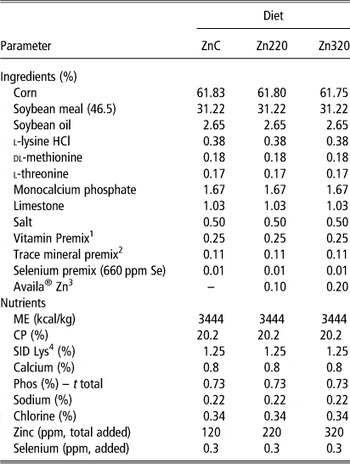
Iowa State University Institutional Animal Care and Use Committee approved all procedures involving animals. Forty-three crossbred gilts (43±6 kg BW; Pig Improvement Company C22/C29×L337, Carthage Veterinary Service, Carthage, IL, USA) were blocked by initial BW and randomly assigned to one of three diets: (1) control (ZnC; containing 120 ppm Zn as ZnSO4; n=13), (2) control+100 ppm Zn as ZnAA (Zn220; containing a total of 220 ppm Zn; n=14), and (3) control+200 ppm Zn as ZnAA (Zn320; containing a total of 320 ppm Zn; n=16). The amount of dietary Zn in the ZnC treatment was selected based upon typical commercial diets for growing pigs in North America. The other supplemental Zn diets represented a 100 and 200 ppm Zn increase relative to the ZnC diet, in order to evaluate the effects of increasing supplemental Zn on intestinal integrity during HS. Other than added ZnAA, all diets were similar in ingredient and nutrient composition and were formulated to meet or exceed the predicted requirements (National Research Council, 1998) for energy, essential amino acids, protein, minerals and vitamins (Table 1). ZnAA complex was provided from Availa® Zn (Zinpro Corporation, Eden Prairie, MN, USA). Pigs were ad libitum fed their respective diets and had free access to water throughout the entire experiment. The study was divided into three experimental periods (P): P0, P1 and P2. During P0 (20±1 day in length), pigs were housed in groups according to their dietary treatment for prophylactic enrichment with Zn. At the beginning of P1 (5±1 day in length), pigs were moved into individual pens (57×221 cm) and kept in thermal-neutral conditions (19°C; ∼61% humidity; temperature-humidity index≈64; Federation of Animal Sciences Societies, 2010) for baseline body temperature indices and production parameters collection. During P2, pigs were exposed to constant HS conditions (36°C; ∼50% humidity; temperature-humidity index≈85.5) for either 1 or 7 days to evaluate the effects of acute and chronic HS, respectively. Pigs were sacrificed at the end of the environmental exposure using the captive bolt technique followed by exsanguination. A total of five pigs were culled from the study: one due to illness (ZnC day 1) and four due to excessive (>40.95°C) hyperthermia (two from ZnC day 7, one from Zn220 day 1, and one from Zn220 day 7). Data from these pigs were not included in the final analysis. Because of logistic constrictions with the Ussing chambers, four replicates were necessary to complete the study with two animals per dietary treatment and day of sacrifice per replicate; except for those replicates where animals were culled. Within a replicate, the variables measured and their timing relative to HS initiation were similar.
Ingredients and formulated dietary nutrients

1 Provided the following per kg of diet: vitamin A, 7656 IU; vitamin D, 875 IU; vitamin E, 62.5 IU; vitamin K, 3.75 mg; riboflavin, 13.75 mg; niacin, 70 mg; pantothenic acid, 33.75 mg; vitamin B12, 62.5 μg.
2 Provided the following per kg of diet: Fe, 121 mg as ferrous sulfate; Zn, 121 mg as zinc sulfate; Mn, 28.6 mg as manganese sulfate; Cu, 12.1 mg as copper sulfate; I, 0.22 mg as calcium iodate; Se, 0.22 mg as sodium selenite.
3 Zinpro Corporation, Eden Prairie, MN, USA.
4 Standardized ileal digestive lysine.
During P0, environmental conditions were not tightly controlled, but were within the pigs’ thermal-neutral zone (Federation of Animal Sciences Societies, 2010). Once in the environmental rooms (P1 and P2), temperature was controlled but humidity was not governed, and both parameters were monitored and recorded every 30 min by a data logger (Lascar EL-USB-2-LCD, Erie, PA). Temperature-humidity index ranged between 62.5 to 65.5 and 84.0 to 86.5 during P1 and P2, respectively.
During both P1 and P2, body temperature indices (respiration rate and rectal temperature) were obtained four times a day (0800, 1200, 1600 and 2000 h) and condensed into daily averages. For P1, measurements were further condensed into a single average represented as day−1. Respiration rates (RR) were determined by counting flank movements and rectal temperatures (Tr) were measured using a digital thermometer (ReliOn, Waukegan, IL, USA). Individual feed intake (FI) was recorded daily as-fed during P1 and P2. BWs were obtained at the initiation of each experimental period, and immediately before sacrifice.
Blood was obtained (BD® vacutainers, Franklin Lakes, NJ, USA; containing 12 mg of K3EDTA) at sacrifice and kept in ice until processing. Plasma was harvested by centrifugation at 1300×g and stored at −80°C for later analysis. Whole sections from both the proximal ileum (1.5 m proximal to the ileal–cecal junction) and distal colon (0.5 m proximal to the rectum) were harvested immediately following euthanasia. Intestinal segments were flushed of luminal contents, and placed immediately into Krebs-Henseleit buffer (KHBB; containing 25 mM NaHCO3, 120 mM NaCl, 1 mM MgSO4, 6.3 mM KCl, 2 mM CaCl and 0.2 mM NaH2PO4; pH 7.4) under constant aeration, and transported to the laboratory for mounting into modified Ussing chambers as previously described (Pearce et al., Reference Pearce, Mani, Boddicker, Johnson, Weber, Ross, Rhoads, Baumgard and Gabler2013b). In addition, ileal sections were fixed in 10% formalin for histological analysis.
Ussing chambers
Ileal and colonic segments of each animal were mounted into modified Ussing chambers (Physiological Instruments, San Diego, CA, USA) for determination of intestinal integrity and active nutrient transport as described by Pearce et al. (Reference Pearce, Mani, Boddicker, Johnson, Weber, Ross, Rhoads, Baumgard and Gabler2013b). Briefly, intestinal samples were placed into the chambers, connected to dual channel current and voltage electrodes. Both the mucosal and serosal sides of the tissue were bathed in KHBB and provided with a constant O2-CO2 mixture. Individual segments were then voltage clamped at 0 mV, and transepithelial electrical resistance (TER) was determined. After 30 min of stabilization, ileal nutrient transport was measured for glucose, lysine, glutamine and methionine. Additionally, intestinal segments were tested for permeability to the macromolecule fluorescein isothiocyanate-labeled dextran (FITC-Dextran; 4.4 kDa; Sigma®, St. Louis, MO, USA) and FITC-labeled LPS (FITC-LPS, Sigma®, St. Louis, MO, USA); and apparent permeability coefficients (APP) were calculated as follows (Pearce et al., Reference Pearce, Mani, Boddicker, Johnson, Weber, Ross, Rhoads, Baumgard and Gabler2013b):
 $$APP=dQ/\left( {dt{\times}A{\times}C_{0} } \right)$$
where dQ/dt is the transport rate (µg/min); C 0 the initial concentration in the donor chamber (µg/ml); A the area of the membrane (cm2).
Histology
Whole ileal samples were fixed in formalin for 24 h and then transferred into 70% ethanol. Fixed samples were referred to the Iowa State University Veterinary Diagnostic Laboratory for sectioning and hematoxylin and eosin staining. Ten intact villi per pig were imaged using Q-capture Pro 6.0 software (Qimaging®, Surrey, BC, Canada), and each villus height and crypt depth was measured using Image-Pro Plus 7.0 (Media Cybernetics®, Bethesda, MD, USA). Finally, an average height and depth was calculated per pig.
Blood parameters analyses
Plasma glucose concentrations were measured enzymatically using a commercially available kit (Autokit Glucose C2; Wako Chemicals USA, Richmond, VA, USA). LPS binding protein (LBP) concentrations were determined using an ELISA kit (Hycult® biotech, Plymouth Meeting, PA, USA). The intra- and inter-assay coefficients of variation were 2.8 and 3.8, and 12.7 and 4.9% for glucose and LBP, respectively.
Statistical analyses
All data were statistically analyzed using SAS version 9.2 (SAS Institute Inc., Cary, NC). Single measurements were analyzed using PROC GLM, and PROC MIXED was utilized to test daily observations (Tr, RR and FI) by repeated measures with an auto regressive covariance structure and day as the repeated effect. The models evaluated day of sacrifice both independently and together, and included replicate, treatment, day and treatment×day interaction as fixed effects. Orthogonal contrasts to test for linear and quadratic effects of dietary treatment were performed. When available, the initial value (value during P1) of the parameter of interest was used as a covariate. Data are reported as LSmeans and considered significant if P⩽0.05 and a tendency if 0.05<P⩽0.10.
Results
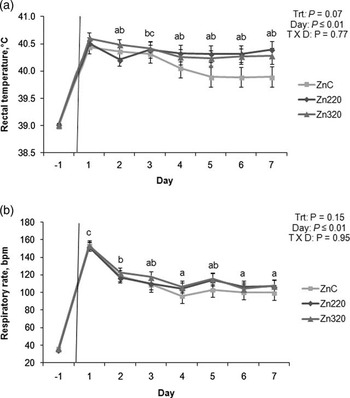
As expected, there were no treatment differences in P1 body temperature indices (Figure 1). During P2, Tr and RR markedly increased in all treatments (P<0.01; an average of 1.3°C and threefold, respectively; Figure 1a and b) relative to P1. Both Zn220 and Zn320-fed pigs tended to have increased average Tr (P=0.07; +0.27°C; Figure 1a) compared with ZnC-fed pigs.
Effects of feeding 120 ppm Zn from ZnSO4 (ZnC), 120 ppm Zn from ZnSO4+100 ppm Zn from Zn amino acid (ZnAA) complex (Zn220) and 120 ppm Zn from ZnSO4+200 ppm Zn from ZnAA complex (Zn320) on (a) rectal temperature and (b) respiratory rates in growing pigs exposed to thermal-neutral conditions (day−1; period 1; 19°C) and heat stress conditions (days 1 to 7; period 2; 36°C). Vertical lines indicate the transition from periods 1 to 2. a,b,cRepresent differences between days of heat stress (P⩽0.05).

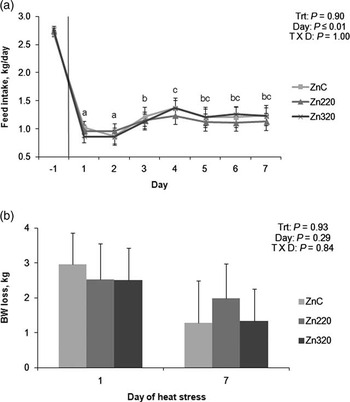
During P1, FI did not differ among treatments (2.74 kg/day). During P2, HS-induced FI reduction averaged 59%, and the response was not different among treatments (Figure 2a). From day 2, FI increased (P<0.05; +0.40 kg) until plateauing on day 4 (Figure 2a). During P1, there was a quadratic effect (P⩽0.05) on average daily gain as Zn220-fed pigs outgained ZnC and Zn320-fed pigs (1.3 v. 1.2 kg/day; data not shown). BW did not differ among treatments (data not shown) at the initiation of P1 (70.3 kg) and P2 (78.8 kg). Pigs in all treatments lost a similar amount of BW independently of day of HS (2.1 kg; Figure 2b).
Effects of feeding 120 ppm Zn from ZnSO4 (ZnC), 120 ppm Zn from ZnSO4+100 ppm Zn from Zn amino acid (ZnAA) complex (Zn220) and 120 ppm Zn from ZnSO4+200 ppm Zn from ZnAA complex (Zn320) on (a) feed intake in thermal-neutral conditions (day−1; period 1; 19°C) and heat stress conditions (days 1 to 7; period 2; 36°C); and (b) body weight loss after 1 or 7 days of heat stress in growing pigs. Vertical line indicates the transition from periods 1 to 2. a,b,cRepresent differences between days of heat stress (P⩽0.05).

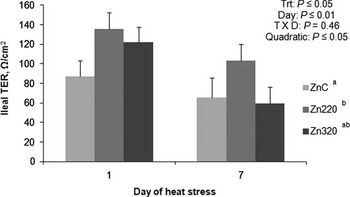
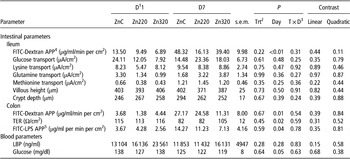
Irrespective of treatment, ileal TER decreased from days 1 to 7 (P⩽0.01; 33% on average). Feeding ZnAA quadratically improved ileal TER (P⩽0.05) as Zn220-fed pigs had an increased ileal resistance (P⩽0.05; 56%) compared with ZnC, whereas Zn320-fed pigs did not differ from the other two treatments (Figure 3). Colonic TER also decreased (P⩽0.05; 22%) as heat exposure progressed, but no differences were observed among dietary treatments (Table 2). Both ileal and colonic FITC-Dextran APP increased (P⩽0.01; 13- and 56-fold, respectively), and colonic FITC-LPS APP tended to increase (P=0.07; threefold) from days 1 to 7 of HS; but no dietary treatment differences were detected (Table 2). Overall, there were no treatment effects on ileal glucose, lysine, glutamine or methionine transport; nor did these parameters change from days 1 to 7 (Table 2). However, when analyzing day of sacrifice separately, day 1 glucose transport linearly decreased (P⩽0.05) with increasing levels of ZnAA (24.11, 12.30, 7.42 µA/cm2 for ZnC, Zn220 and Zn320, respectively) as Zn320-fed pigs tended to have decreased transport (P=0.07; 69%) compared with ZnC. Irrespective of sacrifice day, no differences in small intestinal architecture (villi height or crypt depth) were observed among treatments (Table 2).
Effects of feeding 120 ppm Zn from ZnSO4 (ZnC), 120 ppm Zn from ZnSO4+100 ppm Zn from Zn amino acid (ZnAA) complex (Zn220), and 120 ppm Zn from ZnSO4+200 ppm Zn from ZnAA complex (Zn320) on ileal transepithelial electrical resistance (TER). a,bRepresent differences between dietary treatment (P⩽0.05).

Effects of increasing levels of dietary Zn amino acid complex on intestinal and blood parameters in heat-stressed growing pigs

TER=transepithelial electrical resistance; LBP=lipopolysaccharide binding protein.
ZnC=120 ppm Zn from ZnSO4; Zn220=ZnC+100 ppm Zn from Zn amino acid complex; Zn320=ZnC+200 ppm Zn from Zn amino acid complex.
1 Day of heat stress.
2 Treatment.
3 Treatment by day interaction.
4 Fluorescein isothiocyanate-labeled dextran apparent permeability coefficient.
5 Fluorescein isothiocyanate labeled lipopolysaccharide apparent permeability coefficient.
Overall, circulating LBP concentration did not differ among dietary treatments (Table 2). When analyzing day 1 separately, LBP tended to increase linearly (P=0.06) with increasing levels of ZnAA (13104, 17240, 23561 ng/ml for ZnC, Zn220 and Zn320, respectively). Plasma glucose decreased from days 1 to 7 of HS (P⩽0.05; 134 v. 122 mg/dl), but did not differ between dietary treatments (Table 2).
Discussion
Despite advances in heat abatement technologies, HS still compromises animal welfare and reduces productivity during the warm summer months. Genetic selection for thermal tolerance is one potential strategy to mitigate the effects of HS, but this is a long-term solution, and is almost always accompanied by reduced productivity during thermal-neutral conditions (Baumgard and Rhoads, Reference Baumgard and Rhoads2013). Identifying flexible management approaches to immediately decrease HS susceptibility without negatively influencing traditional production traits would be of great value to global animal agriculture. Dietary supplementation is an example of an easily adjustable tactic that could be utilized by a variety of animal industries and is amenable to diverse production systems.
The consequences of HS on animal productivity might be partially mediated by reduced intestinal integrity (Baumgard and Rhoads, Reference Baumgard and Rhoads2013). Dietary zinc is required for normal intestinal barrier function (Alam et al., Reference Alam, Sarker, Wahed, Khatun and Rahaman1994), and supplemental zinc improves integrity characteristics in a variety of experimental models and human bowel diseases (Alam et al., Reference Alam, Sarker, Wahed, Khatun and Rahaman1994; Rodriguez et al., Reference Rodriguez, Darmon, Chappuis, Candalh, Blaton, Bouchaud and Heyman1996; Sturniolo et al., Reference Sturniolo, Di Leo, Ferronato, D'Odorico and D'Incà2001; Lambert et al., Reference Lambert, Zhou, Wang, Song, McClain and Kang2003; Zhang and Guo, Reference Zhang and Guo2009). The aforementioned beneficial effects of dietary zinc on bowel pathologies led us to hypothesize that supplemental dietary zinc would alleviate the decrease in intestinal integrity observed in pigs during HS.
In the present study, pigs were exposed to severe constant HS conditions, resulting in a marked increase in all body temperature indices. Interestingly, pigs receiving ZnAA tended to have a slightly elevated Tr (+0.27°C) compared with ZnC-fed pigs and this agrees with zinc’s effects in an endotoxemia model (Roberts et al., Reference Roberts, van Heugten, Lloyd, Almond and Spears2002). This is surprising, as ZnAA-supplemented pigs had similar FI and BW, which are two key variables associated with basal heat production. Respiratory rate was also sharply elevated (threefold) during heat exposure, but did not differ among treatments. Regardless, both Tr and RR indicate that animals were severely heat-stressed, and understanding why ZnAA-supplemented pigs had a slightly elevated Tr and whether or not this is of biological significance is of interest.
As expected, HS caused an immediate and similar decrease in FI in all dietary treatments. The magnitude of reduction and temporal pattern of nutrient intake is comparable to those observed in a recent experiment by our group (Pearce et al., Reference Pearce, Gabler, Ross, Escobar, Patience, Rhoads and Baumgard2013a). FI reduction during HS is a highly conserved response among species and presumably represents an attempt to decrease metabolic heat production (Collin et al., Reference Collin, van Milgen, Dubois and Noblet2001; Baumgard and Rhoads, Reference Baumgard and Rhoads2012). Heat-induced decreased nutrient intake was traditionally assumed to be the reason for reduced weight gain during HS (Collin et al., Reference Collin, van Milgen, Dubois and Noblet2001), but we have recently demonstrated that HS causes a variety of metabolic changes independent of nutrient intake (Baumgard and Rhoads, Reference Baumgard and Rhoads2013), and pigs actually gain more BW during HS than pair-fed thermal-neutral controls (Pearce et al., Reference Pearce, Gabler, Ross, Escobar, Patience, Rhoads and Baumgard2013a). In the current experiment, pigs lost ∼2.5 kg of BW within the first 24 h and had a total weight loss of ∼1.5 kg by day 7 of HS. The improvement in both FI and BW variables (Figure 2) as HS progressed implies pigs were acclimating to their environment. Interestingly, almost all aspects of intestinal integrity deteriorated from days 1 to 7 of HS (Table 2) and this suggests that acclimation (from a production perspective) is partially independent of HS-induced intestinal barrier dysfunction.
Heat-stressed animals divert blood flow from the viscera to the periphery in an attempt to maximize heat dissipation (Lambert et al., Reference Lambert, Gisolfi, Berg, Moseley, Oberley and Kregel2002), which in addition to hyperthermia leads to intestinal hypoxia (Hall et al., Reference Hall, Baumgardner, Oberley and Gisolfi1999). Enterocytes are particularly sensitive to hypoxia and nutrient restriction (Rollwagen et al., Reference Rollwagen, Madhavan, Singh, Li, Wolcott and Maheshwari2006), resulting in ATP depletion, and increased oxidative and nitrosative stress (Hall et al., Reference Hall, Buettner, Oberley, Xu, Matthes and Gisolfi2001). This contributes to tight junction dysfunction, and gross morphological changes that ultimately reduce intestinal barrier function (Lambert et al., Reference Lambert, Gisolfi, Berg, Moseley, Oberley and Kregel2002; Pearce et al., Reference Pearce, Mani, Boddicker, Johnson, Weber, Ross, Rhoads, Baumgard and Gabler2013b). Consequently, HS increases portal and systemic blood LPS concentration (Hall et al., Reference Hall, Buettner, Oberley, Xu, Matthes and Gisolfi2001; Pearce et al., Reference Pearce, Mani, Boddicker, Johnson, Weber, Ross, Rhoads, Baumgard and Gabler2013b), which is a potent immunogenic signal that might mediate some of the negative effects of HS on animal production (Baumgard and Rhoads, Reference Baumgard and Rhoads2013).
In the current study, small intestine integrity parameters (permeability and resistance) markedly deteriorated with progressive heat exposure. As we hypothesized, supplementing ZnAA improved both ex vivo measures of integrity and this was especially evident on day 7 as Zn220-fed pigs had 66% and 58% improvement in ileal permeability and electrical resistance (Figure 3). Reasons why intestinal barrier function was not further improved in the Zn320-fed pigs is not clear, but there appears to be a breakpoint where excess dietary Zn is not beneficial and it may in fact have negative consequences (Fujimura et al., Reference Fujimura, Matsui and Funaba2012). Similar to the ileum, colonic permeability and TER deteriorated from days 1 to 7 of HS. However, in contrast, aspects of colon integrity were not ameliorated with supplemental ZnAA. Zinc is primarily absorbed in the small intestine and little or none is taken up by colonocytes (Krebs, Reference Krebs2000) and this site of absorption difference might help explain ZnAA’s regional effectiveness. Regardless, reasons why supplemental ZnAA improved ileal and not colonic integrity are not obvious, but understanding the interaction between ZnAA mechanisms and colon physiology remain of interest.
LBP is an acute phase protein that binds LPS and mediates its interaction with toll-like receptor 4 (Lu et al., Reference Lu, Yeh and Ohashi2008), resulting in the activation of the innate immune response. Interestingly, high circulating concentrations of LBP inhibit LPS-induced inflammation (Hamann et al., Reference Hamann, Alexander, Stamme, Zahringer and Schumann2005). Once activated, immune cells become obligate glucose utilizers (MacIver et al., Reference MacIver, Jacobs, Wieman, Wofford, Coloff and Rathmell2008), which might trigger a whole body shift in nutrient partitioning in order to spare glucose for the immune system (Baumgard and Rhoads, Reference Baumgard and Rhoads2013). The gut contributes to the homeorhetic response and the increased ileal glucose transport observed during HS in poultry (Garriga et al., Reference Garriga, Hunter, Amat, Planas, Mitchell and Moreto2006) and pigs (Pearce et al., Reference Pearce, Mani, Boddicker, Johnson, Weber, Ross, Rhoads, Baumgard and Gabler2013b) might be a coordinated consequence of increased glucose demand by the activated immune system. Although not affected by dietary treatments overall, circulatory LBP and ileal glucose uptake reciprocally changed after 1 day of HS, as LBP tended to be linearly increased and glucose transport decreased with increasing ZnAA dose (when analyzing day 1 separately). Both parameters can be difficult to interpret but it is plausible that ZnAA increased LBP levels, which attenuated LPS-induced immune system activation and thus its glucose utilization. If this was the case, there would be less need for up-regulating intestinal glucose transport.
The mechanisms by which zinc improves intestinal integrity are not well understood. Zinc supplementation prevented tight junction opening in a rat colitis model (Sturniolo et al., Reference Sturniolo, Fries, Mazzon, Di Leo, Barollo and D'inca2002) and reduced intestinal permeability, while increasing the concentration and expression of tight junction proteins in weaning piglets (Zhang and Guo, Reference Zhang and Guo2009). In vitro, zinc supplementation increased TER in Caco-2 cells (Wang et al., Reference Wang, Valenzano, Mercado, Zurbach and Mullin2013). In agreement, Caco-2 cells grown in zinc-deficient media had decreased TER, and reduced and delocalized tight junction proteins (Finamore et al., Reference Finamore, Massimi, Conti Devirgiliis and Mengheri2008). Zinc supplementation also induces metallothioneins expression in Caco-2 cells (Wang et al., Reference Wang, Valenzano, Mercado, Zurbach and Mullin2013), which might act as antioxidants because of their capacity to sequester reactive oxygen species and nitrogen intermediates (Waeytens et al., Reference Waeytens, De Vos and Laukens2009). In addition, zinc increased the expression and concentration of antimicrobial substances like β-defensins in IPEC-J2 cells (Mao et al., Reference Mao, Qi, Yu, He, Yu and Chen2013). Consequently, there appear to be a variety of mechanisms by which dietary zinc can reduce gut ‘leakiness’.
In the aforementioned literature, the amount of supplemental zinc was highly variable ranging from 0.3 mg to 762 mg/day. In the current study and before HS, Zn220 and Zn320-fed pigs were receiving ∼274 and 548 mg/day of Zn from ZnAA, respectively; in addition to the 329 mg of Zn as ZnSO4 present in the control diet. However, differences in model (in vivo v. in vitro), species, zinc source, supplementation duration, physiological state and the type of intestinal insult make it difficult to compare and contrast Zn doses across studies.
Our primary objective was to determine if increasing levels of dietary ZnAA affected intestinal barrier integrity during HS. The current experimental design prevents us from discriminating between the effects of zinc source. Future research to determine differences between ZnAA and inorganic zinc supplementation is warranted. In addition, pigs were exposed to severe HS, and these extreme thermal conditions may have partially blunted the potential benefits of ZnAA. Whether or not milder and cyclical HS (more typical of commercial conditions), would allow for further improvement is of obvious interest. Herein we demonstrate that supplementing ZnAA is effective in partially alleviating the negative effects of severe HS on ileal integrity. Further research is needed to determine whether ZnAA-supplementation benefits at the intestine are translated into production improvements.
Acknowledgments
Results described here within were supported by Zinpro Corporation, the Fulbright Graduate Student Program for Spaniards from the Commission for Cultural, Educational and Scientific Exchange between the United States of America and Spain; and the Agricultural and Food Research Initiative Competitive Grant no. 2011-67003-30007 from the USDA National Institute of Food and Agriculture. Any opinions, findings, conclusions or recommendations expressed in this publication are those of the authors and do not necessarily reflect the view of any of the above mentioned organizations. The authors express their appreciation to Levi Long, Nathan Upah, Amir Nayeri, Dr Ekin Sucu, Dr Venkatesh Mani, Martha Jeffrey, Samantha Lei and Jay Lampe for their assistance in the live and laboratory phases of the experiment.