Yet it is an iron rule of history that every imagined hierarchy disavows its fictional origins and claims to be natural and inevitable.
Yuval Noah Harari (Reference Harari2015, 134)
Introduction
One meaning of embodiment is the manner (or manners) in which people experience and engage with the material world from the perspective of their bodies. As an approach to understanding materiality, embodiment theory addresses the body ‘as a material grounding for subjective experience’ (Preucel & Meskell Reference Preucel, Meskell, Meskell and Preucel2004, 15). Implied as well is a theory of being. The body is a shared concern for our self-reflecting species, and among the issues involved are birth, growth and death, all of which are universal experiences that demand explanations (Meskell & Joyce Reference Meskell and Joyce2003; Robb & Harris Reference Robb and Harris2013). Explanations reside in social responses or institutions contrived to cope with these issues, and cultural relativism offers a bewildering variety of ways in which the body is perceived and acted on by societies and cultures today and in the past (DeMarrais et al. Reference DeMarrais, Gosden and Renfrew2004; Meskell & Joyce Reference Meskell and Joyce2003; Robb & Harris Reference Robb and Harris2013).
Bound by culture, representations of the human body generate and communicate social meanings and relationships. The embodiment of ideas in material culture is an active process that underlies the creation, dissemination and manipulation of ideologies and cosmologies (DeMarrais Reference DeMarrais, DeMarrais, Gosden and Renfrew2004, 11). Through its representations and attire, the body materializes ideologies as it serves to reinforce ‘a particular social philosophy’, and in so doing the body functions as an active participant in social practice, communicating with the human community as well as the ambient realm of the supernatural (e.g. Preucel Reference Preucel2006, 14, 129). These issues are complex, however, and may be approached from a variety of perspectives, and portrayals of the human body provide clues as to a diversity of cultural solutions. Images of the human body can be analysed for what they reveal about continuities and changes in worldviews throughout history, as well as social status and hierarchy, social roles and identity (Robb & Harris Reference Robb and Harris2013). In a detailed analysis of human representations in Egyptian and Maya art, Lynn Meskell and Rosemary Joyce (Reference Meskell and Joyce2003) address bodily ideals pertaining to these cultures and how they reveal and promote cultural perspectives on being and becoming, gender and gender roles, mortuary practices, community and humanity's relationships to other forms of life.
Of fundamental concern in the discussion to follow is the blurring of boundaries between humanity and other entities that is visually promoted in the American Indian art of the Southwest. Traditionally, taxonomies imply boundaries, and how boundaries are defined becomes an issue, as rigid categorization is reevaluated through nuanced contextual analyses (Preucel & Meskell Reference Preucel, Meskell, Meskell and Preucel2004, 15). Depictions of humanity conflated with other life forms or cosmological entities conflict with our own notions of objects and subjects as discrete and essential entities that inhabit impermeable worlds, and these images demand a reconsideration of taxonomies, combined identities and their social significance (Meskell & Joyce Reference Meskell and Joyce2003, 10; Preucel & Meskell Reference Preucel, Meskell, Meskell and Preucel2004, 16). This view challenges the binary opposites of mind and body of the Cartesian perspective that structures dualistic Judaic–Christian thinking wherein rigid boundaries prevail. In Egyptian and Maya art as well as that of the American Southwest, and elsewhere, hybrid or transformational images cross corporeal boundaries, especially when divine or spiritual powers are implicated (Meskell & Joyce Reference Meskell and Joyce2003, 67–94). As noted by Meskell and Joyce (Reference Meskell and Joyce2003, 10), ‘objects associated with embodiment are more than costumes or props; they are extensions of the materiality of the embodied person’.
Images, in themselves are not simply static remains of some previous activity. In addition to engaging the observer on an intellectual front, religious art, including rock art, embodies agency that exerts a direct effect on observer and place (e.g. Gell Reference Gell1998; VanPool & Newsome Reference VanPool and Newsome2012). Viewed as invested with an animistic, person-like, in-dwelling spiritual component, imagery such as human figures in rock art may be ritually manipulated to intervene in cosmological processes or human affairs. Just as stories abound about the power of anthropomorphic ‘idols’, or statues, of Christian saints (e.g. Christian Reference Christian1981), the Holy People represented in Navajo dry paintings attract the spiritual entities they represent, who cannot resist occupying their pictures (Schaafsma & Tsosie Reference Schaafsma, Tsosie and Christie2009, 25). Among the Navajo,
Pictures of the Holy People in the ceremonial dry paintings are said to be invisible powers made visible. . . . The Holy People represent the inner forms of natural phenomena, the ‘lying-in ones’. These powers may be dangerous and Navajo sandpainting rituals are designed to control these Holy People for positive and specific ends. (Wyman Reference Wyman1983, 552)
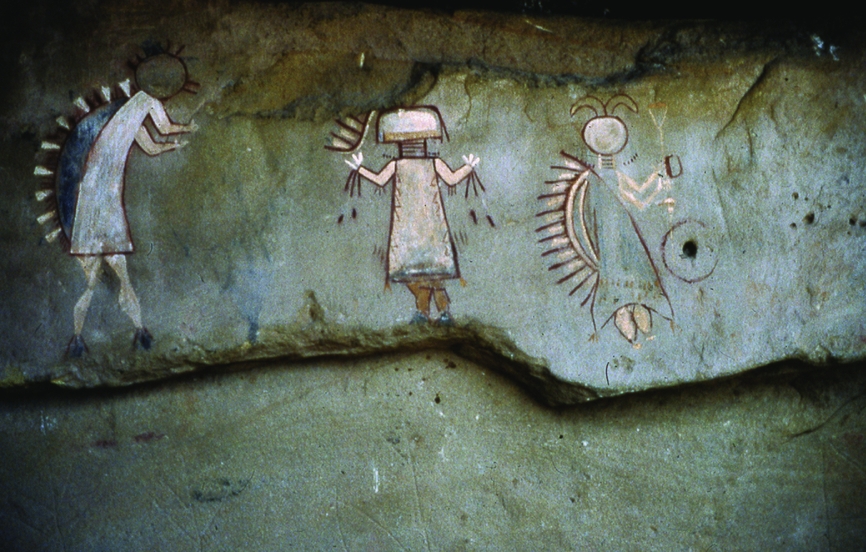
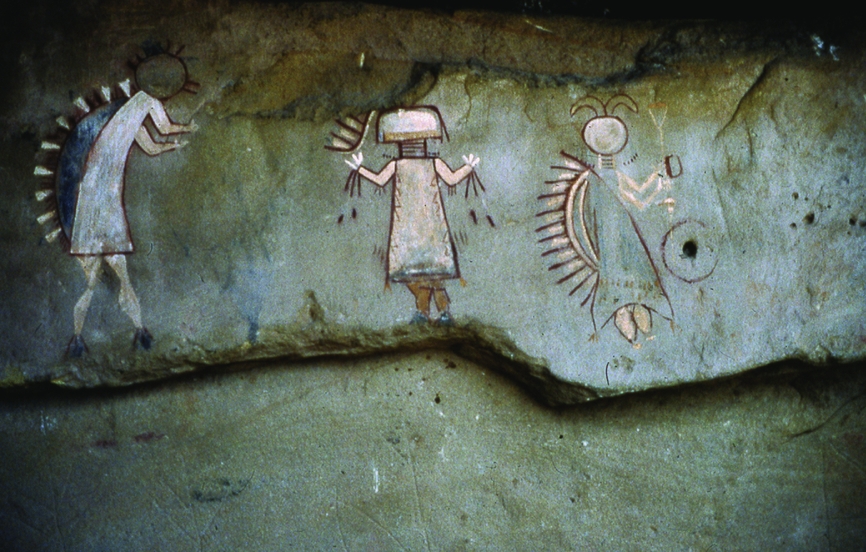
While fundamentally ‘human’ in form, their masks and geometric stylization distance them from the natural world, establishing their divinity, and as ‘magnetic fields’ when pictured on cliffs in landscape settings, they empower place with their presence (Fig. 1). Today it is said that the images of the Holy People on the cliffs were made by the Holy People themselves ‘like a Xerox’, so that they would not be forgotten as they departed after completing the creation of the world (Schaafsma & Tsosie Reference Schaafsma, Tsosie and Christie2009, 25).
Navajo rock paintings of Holy People, or ye'i, c. ad 1680–1750, Rio Arriba County, New Mexico, USA.
In this way, the imagery embodies the sacred, thereby possessing inherent powers that may be addressed and acted on by the human community in numerous ways. Just as rock-art imagery engages the observer, it also spiritually engages the landscape, marking locations that function as portals, facilitating communication between the living community and the ‘other’, or spirit realm. In sum, rock art functions as an active social agent, as a relational presence in the land that ‘interacts with the human observer, mediating between country, spirits of the deceased, and the general well-being of nonhuman kin’ (Brady et al. Reference Brady, Bradley and Kearney2016, 28).
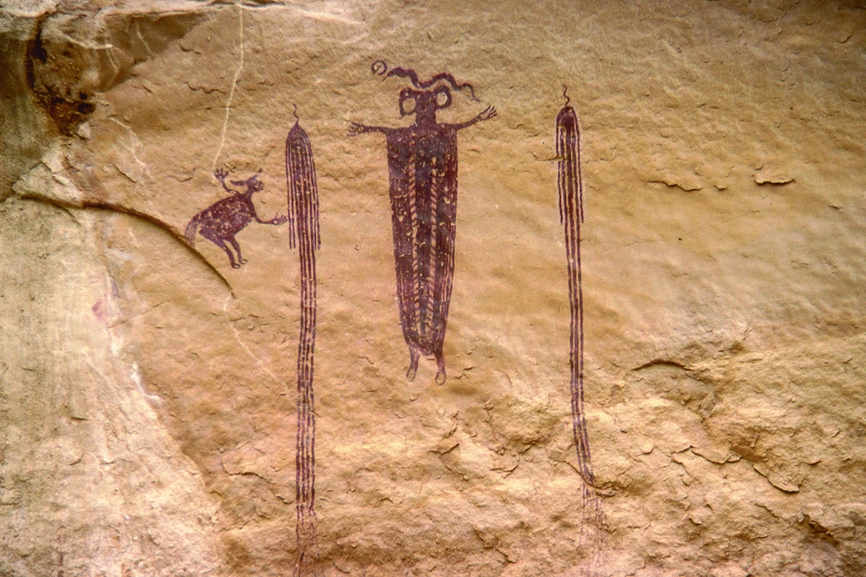
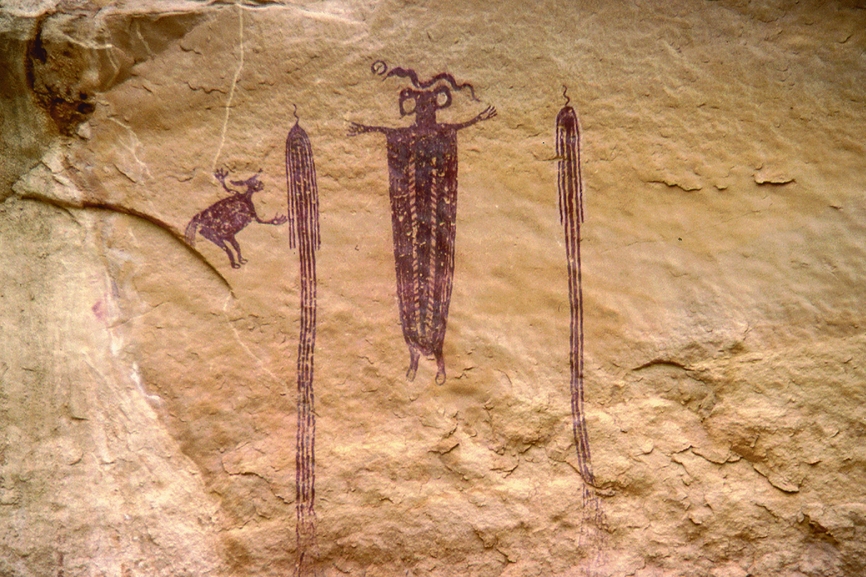
Just as the body as represented can be viewed as a system of signs signifying a set of social and ritual practices (Hampson Reference Hampson2016), the manner of representation also indicates the values ascribed to it. Like the elongated figures in Navajo dry paintings, Archaic rock paintings in Utah and Texas are abstracted, elongated silhouette shapes, lacking limbs, but harbouring a human likeness, thereby evoking a powerful sense of awe and otherworldliness in today's observer. Presumably they did so in the past as well (Fig. 2). In these cases, the floating human bodily form has been distorted, suggesting that this is a figure inhabiting an ethereal space apart from the experienced ‘reality’ of the viewer. Such figures, often surrounded by birds in flight or small animal spirit helpers, are thought to represent entities encountered, or the shamans’ experiences in a trance state (Schaafsma Reference Schaafsma and Turpin1994a; Turpin Reference Turpin and Turpin1994; Reference Turpin2011). As such, these paintings describe, communicate and reinforce spiritual relationships with the natural world.
Elongated stylized anthropomorphic figure with huge eyes, Archaic period, Barrier Canyon style, Utah, USA.
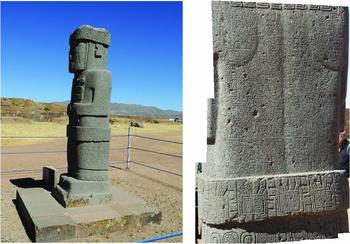
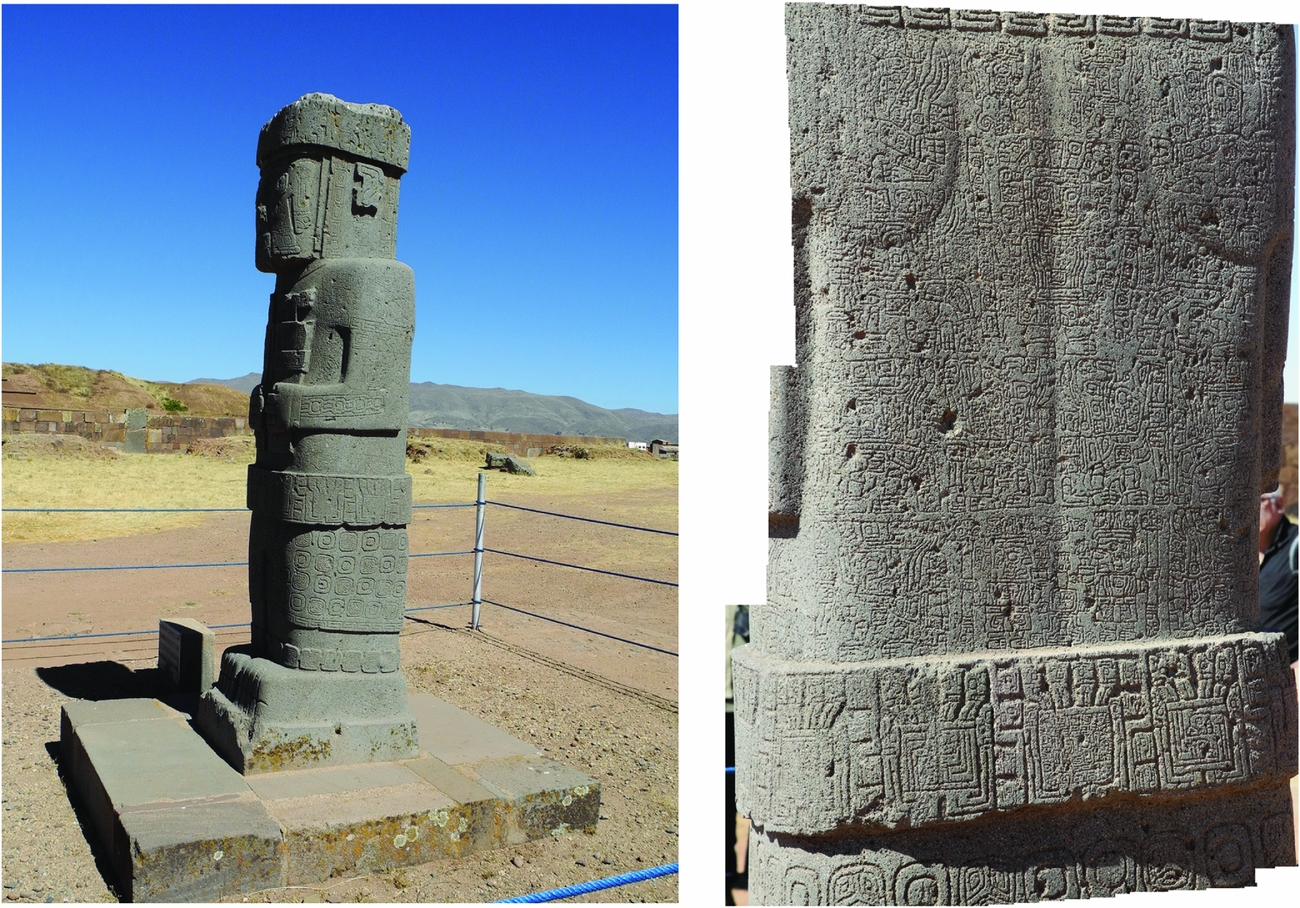
This discussion is not limited to the ‘body’ alone. Although the human form itself and the ways in which it is represented are pertinent to understanding humanity's cultural roles, all of its potential additional ritual trappings are significant. These additions may not only identify the figure in question, but go further to establish social and religious values and empower the figure thus embodied by carefully chosen items of costume (Sweet Reference Sweet2004, fig. 17). Costume details not only communicate further information, but, as observed by Boric et al. (Reference Boric, Harris, Miracle, Robb, Harris and Robb2013, 37), ‘Ornaments and clothing create a “second skin” blurring the boundaries between the body and the world. They give the body a surface linking it to the world around it.’ One might add body paint and other manipulations of the bodily surface to this ‘second skin’ (Fig. 3).
Views of Ponce Stela at Tiwanaku, Bolivia: (left) View showing overall blocky conventionalized form; (right) Detail of inscribed surface of the torso with details with reference to cosmological/political affiliations.
Using embodiment theory as an analytical tool (e.g. Hampson Reference Hampson2016), this essay addresses human and other anthropomorphic representations in the graphic arts as well as the costuming of ritual participants among the Pueblos in the American Southwest from primarily around ad 1000 to the present. Religious in nature, these manifestations of the ‘ritual person’ incorporate symbols and metaphors that reveal humanity's multitudinous relationships to and interactions with the cosmos and supernatural world. It is essential to acknowledge that these attributes are not ‘decorations’, and that they possess agency that facilitates communication with the spirit world. There is no recognized ‘secular’ art within the body of material addressed here. In fact, documentary, biographical and self-promotional pictures, common in Western societies, appear largely in the historic period in the Southwest when indigenous worldviews and art were impacted by Euro-American values.
Importantly, in the American Southwest, interpretation of this imagery is not reliant on a phenomenological approach that includes sensory experiences of the archaeologist or ‘imagined narrative’ (e.g. Weiner Reference Weiner2015), but rather on indigenous accounts and perspectives (e.g. Bunzel Reference Bunzel1932; Schaafsma Reference Schaafsma, Sanchez, Sanchez-Clark and LeBeau2008; Schaafsma & Tsosie Reference Schaafsma, Tsosie and Christie2009; Wyman Reference Wyman1983; Young Reference Young1985; Reference Young1988, among others).
River gods: Illissos and the horned serpent: a useful comparison
Before proceeding further, I wish to digress momentarily to compare the visual information latent in representations of two river gods, Illissos from the Parthenon in ancient Greece (447–431 bc) and the horned serpent deity from the American Southwest. Considered together as river deities, they provide exemplary contrasts relevant to this discussion, each embodied with the conceptual universes from which they derive. Neither possesses any direct references to rivers in their representations.
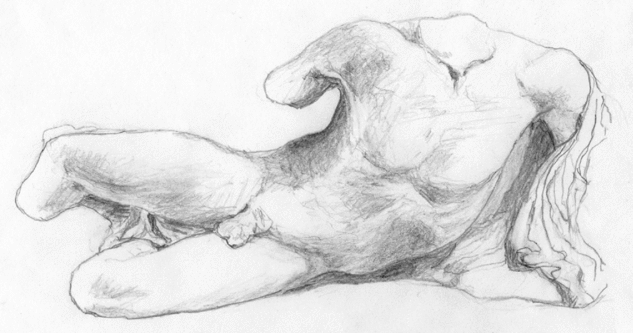
With regard to Illissos, the art of Europe is rife with imagery in which little or no distinction is made between the idealized human body and the divine (Fig. 4). In the Parthenon frieze, Illissos is represented as a flawless youth in a semi-reclining pose, adapted to suit his placement within the acute triangle at the left end of the frontal pediment. He is supported by his left arm, over which drapes some nondescript and equally non-symbolic cloth—like a rag—belonging to a robe or similar item serving as a background prop. His head is now missing, but his torso and thighs, carefully rendered, dominate the visual force of this sculpture that portrays human physical perfection. Lacking any associated attributes to distract the viewer, the idealized human body itself is sanctified, while any association with rivers is an intellectual exercise. Situated in the frieze, Illissos, along with other humanized and idealized gods, was elevated above an impressionable audience that one may safely assume was comprised of physically less perfect viewers! The effect is not unlike that of the use of stylized aspirational bodies that play a major role in the West today (Harris & Robb Reference Robb and Harris2013, 218).
Illissos, a Greek river god from the Parthenon, Athens, Greece, c. 447–431 bc.

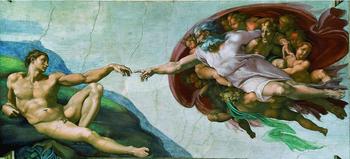
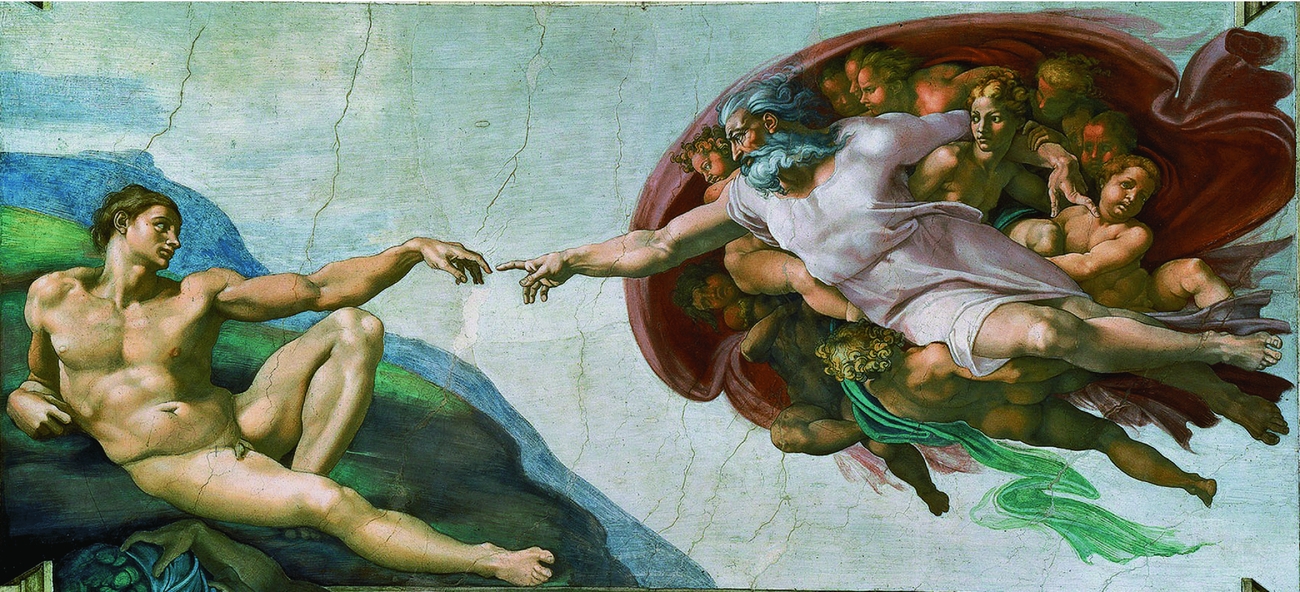
This is only one of countless examples in Western European art in which divine or supernatural beings are rendered as human replicas emphasizing bodily perfection and evoking admiration. Nearly 2000 years later, a slightly more flamboyant sketch of a river god by Michelangelo perpetuates this tradition (Coughlan Reference Coughlan1966, 99). Michelangelo's early sixteenth-century Renaissance painting of the creation of Adam in the Sistine Chapel continues this theme, with an even a more explicit message of hierarchy, one that bestows human primacy and sanctity over all other forms of life (Fig. 5). As with the Greeks, in the Christian and Western anthropocentric perspective, ‘Deity’ is embodied as a perfect human. In the Sistine Chapel mural, God with the aspect of a familiar, but fearsome, paternalistic individual, creates Man to look like himself—a repeated theme throughout the public spaces of European cities and elsewhere in the Western world today. In fact, of course, humanity created God in its own image, and then claimed the opposite was true, a strategic move perpetuated as a ‘truth’. This ‘truth’ implicitly places people above and distinct from all other life, over which humanity is said to have ‘dominion’. In these biblical representations, God and ‘holy’ humans may be attended by few winged cherubs and angels, and the dove representing the Holy Spirit, all commonly ascending toward a heaven in the sky, escape from earthly traumas being commonly emphasized as a goal. The dove is merely an abstract symbol, and the winged entities signify something close to Heaven and therefore holiness, but they are not part bird!
’The Creation of Adam’ by Michelangelo, early sixteenth century, Sistine Chapel, Rome, Italy.
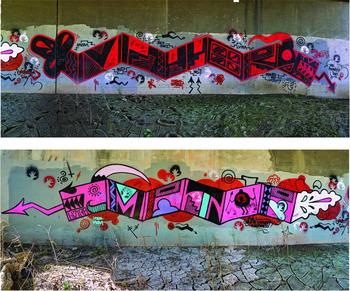
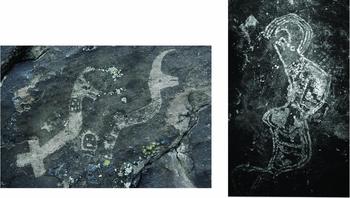
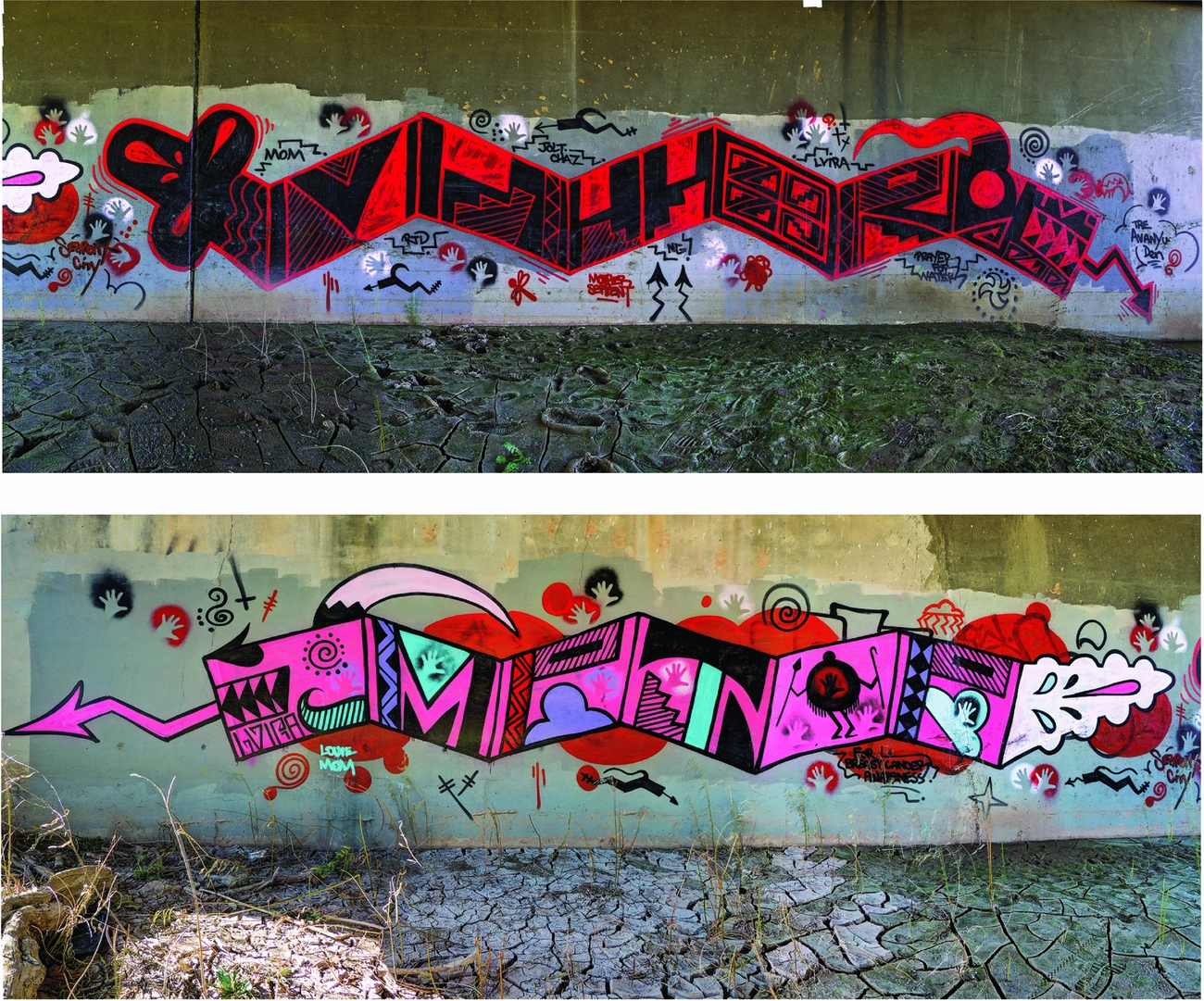
In vivid contrast to human Illissos are the representations of the horned serpent in the southwestern United States. Although possessing the body of a snake, this serpent is a contrived being with no true natural analogue. Startling in their effect, a pair of large horned serpents recently boldly painted on the cement supports under a bridge in Albuquerque exude enormous reptilian power (Fig. 6). Further, they are more elaborately decked out with symbolic references than any of the prehistoric examples, although the symbolism is consistent with tradition. These modern examples are preceded in time by numerous horned serpent depictions in rock art and other media in New Mexico and Chihuahua that go back nearly a thousand years (Fig. 7).
Contemporary paintings of the horned serpent, a Pueblo river deity, under a bridge, Albuquerque, New Mexico, USA. (Photographs courtesy of Mathew Schmader.)
Prehispanic Rio Grande style Pueblo horned serpents: (left) From San Cristobal Pueblo, Galisteo Basin, New Mexico, USA (c. ad 1325–1680). The element on the tail may symbolize a cloud or four-pointed star, intentional ambiguity being possible; (right) Large serpent in white on blackened cave, Jornada Mogollon region of West Texas, USA. Cloud designs are painted on the body and feathers fall over the horn.

This serpent is multifaceted in meaning, although today it is most commonly said to be in charge of the waters in rivers, and it also inhabits springs and other ground-water sources. As a bringer of clouds, these chthonic relationships are apt (Schaafsma Reference Schaafsma, Fields and Zamudio-Taylor2001, 144; Reference Schaafsma2015). Its zigzag shape, while faithfully portraying a moving snake, also alludes to river courses. Symbolic features commonly include clouds on the body or tail, and a chequered neckband signifies corn. Feathers and even the Morning Star are explicit references to this deity's ambiguous and dynamic nature with ties to both the chthonic and celestial realms (Schaafsma Reference Schaafsma, Fields and Zamudio-Taylor2001, 147). The large horn embodies power.
Human attributes may be conflated with prehispanic representations of the horned serpent (Hibben Reference Hibben1975, fig. 34; LeBlanc Reference LeBlanc1999, fig.2.7; Schaafsma Reference Schaafsma1980, fig. 155). Prehispanic petroglyphs near Albuquerque depict snakes wearing masks, some of which are horned. Hybrid human/serpent depictions in southern New Mexico and at Casas Grandes and vicinity in Chihuahua are thought to represent the appropriation and embodiment of the powers of this supernatural serpent by religious/political leaders, a model derived from Quetzalcoatl and his avatars in Mexico (Carrasco Reference Carrasco2000; Gillespie Reference Gillespie1989; Schaafsma Reference Schaafsma, Fields and Zamudio-Taylor2001). In these instances and others, boundaries are blurred or erased between animal-like supernatural powers and human beings, in this case social elites seeking to benefit from identity with the serpent. It is highly unlikely, however, that these southwestern portrayals allude to specific individuals in an historical sense, but rather to a particular office that was linked to and empowered by elements in the broader cosmology.
In summary, these contrasting representations of the Greek and Southwest river gods broadly exemplify contrasting, even opposing views, of the human role within the perceived spiritual worlds and cosmological structures of their respective cultures. The discussion can now be extended with an in-depth look at other human portrayals in the American Southwest, their relationships and the values they thereby embody.
Picturing relationships in the Rio Grande Tradition: cosmology and human representations
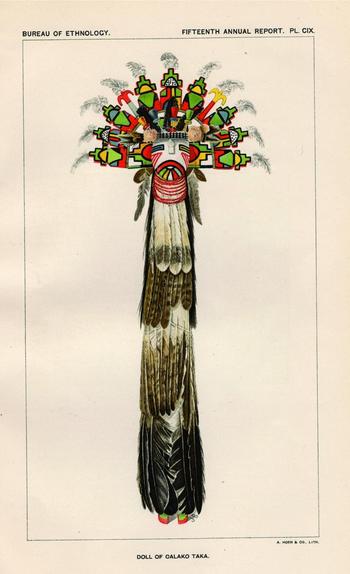
In Native America strategies for replicating realistic likenesses of the human body were not developed in the Pre-Columbian past, as they would have served no particular function. Realistic portrayals venerating the body would, in fact, have detracted from the function of any imagery produced with a religious context, since the real goal of representation was to elucidate and activate humanity's and the community‘s relationships with the ambient forces of the earth and sky. Ritual participants and representations of deities and other spiritual beings are portrayed as abstract, highly stylized impersonal entities embellished with symbolic details that integrate them with selected cosmological forces of the natural world. This is commonly accomplished by costuming that at times overwhelms the human body, even to the point of nearly obscuring it (Fig. 8).
Hopi Shalako represented as a kachina effigy. The body is hidden by feathers and a face mask and complex headdress filled with cloud symbols dominate the figure. (Fewkes Reference Fewkes1897, pl. CIX.)

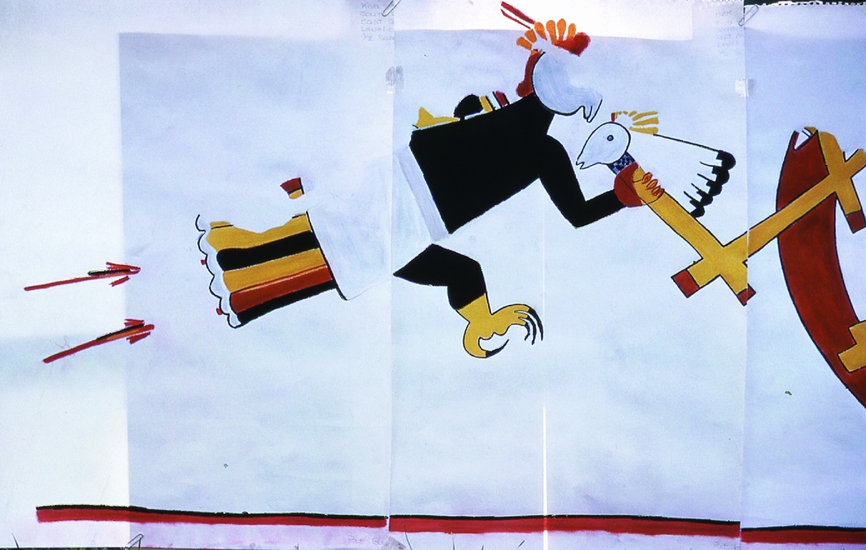
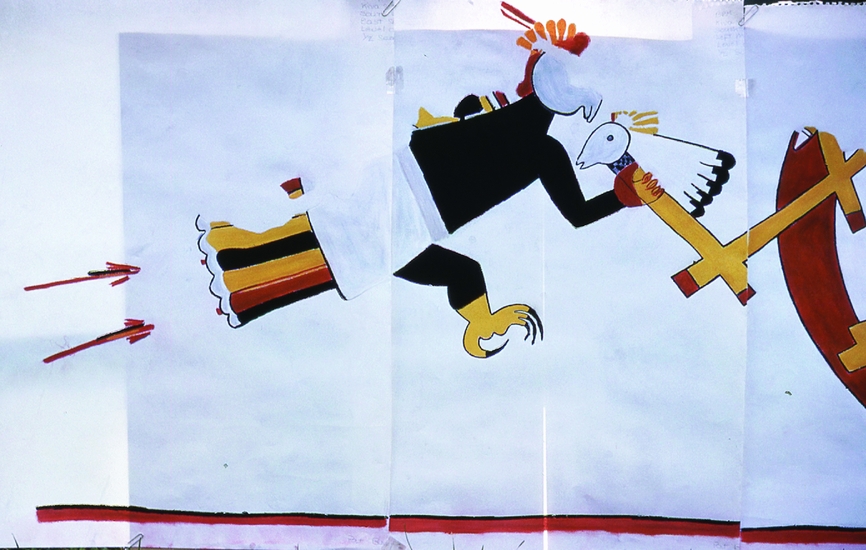
In rock art and kiva murals dating between the fourteenth and seventeenth centuries, human performers and anthropomorphic spiritual entities are depicted within prescribed canons of stylization that distance them from the viewer and impersonalize them (e.g. Dutton Reference Dutton1963; Hays-Gilpin & Schaafsma Reference Hays-Gilpin and Schaafsma2010; Hibben Reference Hibben1975; Schaafsma Reference Schaafsma1980; Reference Schaafsma1992; Smith Reference Smith1952). In brief, rectangular and otherwise boxy bodies and highly abstracted faces prevail among these non-individualized figures. Limbs may be stick-like, especially among figures in the rock art. Although in Pueblo IV kiva murals and in some rock art of the times (c. ad 1350–1600), there is an attempt to define human contours with a few customized curves, these depictions resemble highly stylized, flat, paper-doll-like cut-outs, and their identity and meaning lies in the details of their costuming (Fig. 9). As embodiments of symbolic associations there is little need for references to actual people or natural bodily representations.
Stylized ceremonial figure, part bird and part human, Pottery Mound, New Mexico, USA (c. ad 1370–1500). (Photograph courtesy of Patricia Vivian.)
Human/animal conflations, transformations: meanings and responses
Among the Pueblos, humanity is regarded as simply as a weak component on a low rung of the natural order, an order that is laden with a plethora of spirits and powers—including those of animals and other things—with which humans must engage in order to live. The horned serpent has already been considered along these lines. Mediators between people and the spirit realm include the animal gods of the directions—the so-called Beast Gods—and a myriad of other forms of life. Mediation can occur via representation, when the representation in itself commands the presence of the entity depicted (Young Reference Young1988, 128–30).
Boric et al. (Reference Boric, Harris, Miracle, Robb, Harris and Robb2013) address the human/animal composites depicted in Europe's Palaeolithic caves, suggesting that ‘they evidence a theory of being unlike our own, where the boundaries between human and animal may have been understood as permeable rather than rigid’ (2013, 40–41). As noted, this view stands in contrast with much later times in the West and the development of complex societies, in which religions and behaviours are predicated on humanity's perceived superior status. By granting humanity a unique position by virtue of its likeness to God, it is thereby given mastery over the earth, a stance very much at odds with Native American perspectives (Harris & Robb Reference Harris, Robb, Robb and Harris2013a, 12; Harris et al. Reference Harris, Robb, Tarlow, Robb and Harris2013b, 172). And as is readily apparent, these differences are made explicit in the visual traditions of these societies.
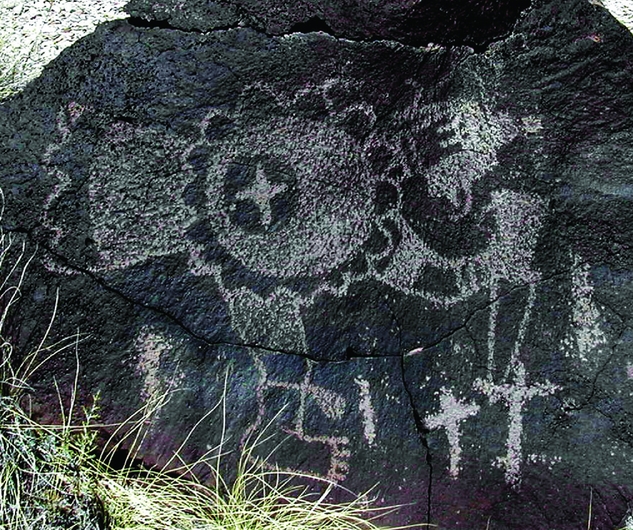
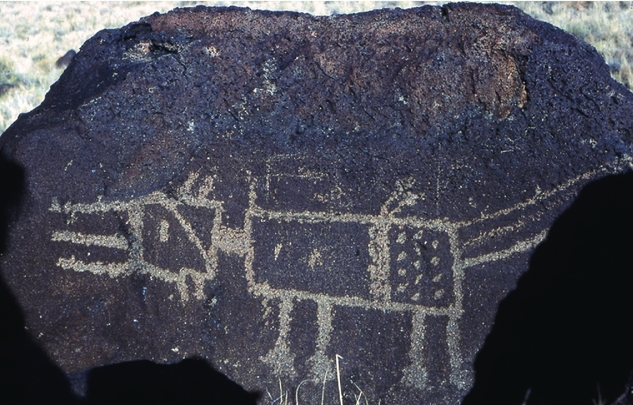
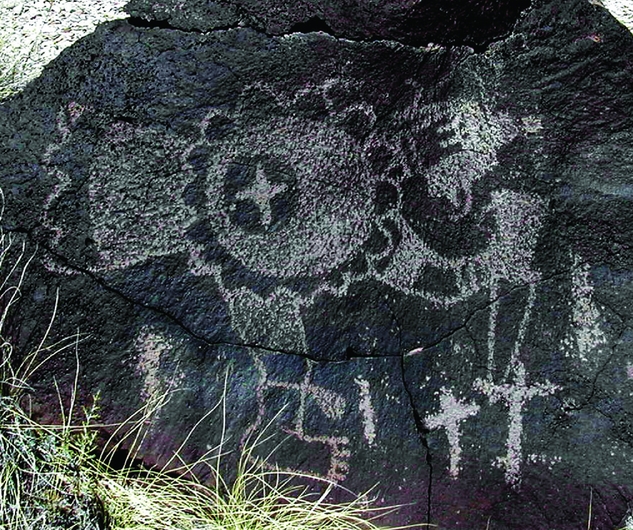
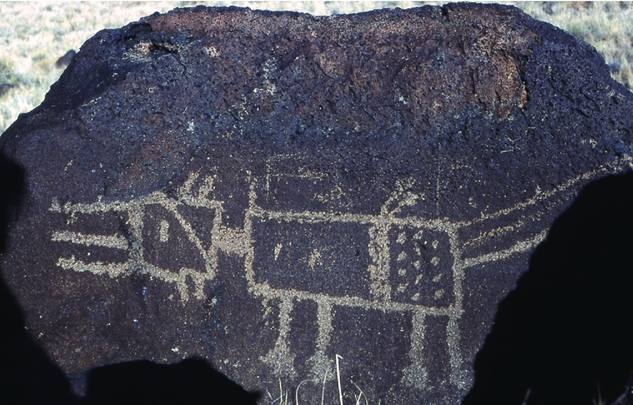
To the horned serpent/human synthesis may be added numerous other examples of human/animal conflations in the American Southwest. Found commonly on Mimbres ceramics (c. ad 950–1130), they also occur after the thirteenth century in Pueblo kiva murals and rock art where the visual conflations of eagles and warriors, men and mountain lions, or humans with attributes of bears, illustrate the unfettered fluid relationships between living beings in Puebloan cosmology (Figs. 10 & 11). These images underscore the perceived need for humanity to establish relationships with and acquire power from other forms of life that possess desirable powers of their own, and importantly that humans lack.
Composite figure of a shield-bearing warrior depicted as a human/eagle, Northern Tewa region of the Rio Grande Valley, New Mexico, USA. The added Latin crosses may have been an attempt to nullify what was regarded as evil or dangerous by later Christian sheepherders.
A human/mountain lion synthesis (c. ad 1325–1600), Petroglyph National Monument, Albuquerque, New Mexico, USA.
The ability of humans via petitions (prayers), offerings, and even through representations to access animal powers toward desired ends—success in hunting, healing, war, and weather control—is essential in a Pueblo universe in which the human participant acting alone is viewed as the least powerful in the hierarchy of beings. From the Zuni and other Puebloan perspectives, humans are viewed as having less control and influence in the world than other forms of life, that, in turn, may also be considered spirit beings by virtue of their ties to the events of the mythic past. Humanity is therefore dependent on the so-called ‘raw’, or spirit beings in order to engage successfully with the cosmos. Humans and spirit animal beings may also interact toward each other as kinsmen (Ladd Reference Ladd and Schaafsma1994, 18; Tedlock Reference Tedlock and Ortiz1979, 499; Young Reference Young1988, 126–7).
Accordingly, it is apparent that the conflated images in the graphic arts are not visual ‘similes’, implying that the warrior is ‘fierce like the eagle’ or even ‘like an eagle’, to explain such a composite figure. Rather, the image is a statement of belief, that humans can actually incorporate and thus truly embody the predatory powers of the eagle, or vice versa. Boundaries between them are fluid and permeable. Further, the ascribed powers of animal deities and their accessibility to humans and are clearly expressed in Zuni oral literature in which success in war and obtaining an enemy scalp is attributed to the animal gods, in this case the ‘beast bow priests’ operating through human combatants:
Additional Pueblo stories describe how powerful, but seemingly ordinary animals, by removing their skins, readily convert themselves into humans for purposes of giving a helping hand in times of crisis, and then revert to their animal forms by putting on their animal skins back on (Cushing Reference Cushing1896, 439; Reference Cushing1920, 395–515; Parsons [Reference Parsons1926] 1994, among many others). This perception of seamless continuities between humanity and other living beings, for example, is built into the Zuni language in which a word for ‘being’ includes all life forms, as well as the sun, moon and earth, and even plants (Walker Reference Walker and Ortiz1979). In the domain of Zuni linguistics and schemes of classification, as described by Walker (Reference Walker and Ortiz1979, 510),
At various key points in the Zuni ‘being’ domain, then, human and nonhuman beings are equated by the terminology. Given this situation, it is extremely unlikely that any Zuni prior to European contact could have conceptualized humans as opposed to animals . . . or conceived of the exploitation of nature by man; for the categories human, animals, nature, and man are all alien to the native Zuni classification of the universe insofar as this is known to linguists.
We are again reminded that the Cartesian split is a peculiarity of Western thought.
Among other examples, from a Tewa Pueblo perspective, the fluidity of being—even between living and non-living entities—is expressed by the word ‘Xayeh’, that refers to the tangible manifestations of ancestral souls in seashells, stone axes, arrowheads and lightning stones (Ortiz Reference Ortiz1969, 31). Harrington (Reference Harrington1916, 41) notes that ‘opa’ refers to the world and everything in it and that it is all alive. Humanity's identity rests in its interaction with the cosmic process and all of the spiritual entities held within it. This interaction is referred to as the social ‘work’ necessary to sustain life (Ortiz Reference Ortiz1969). This ‘work’, with all societies acting in coordination through the year, is based on the ritual calendar tied to seasonal changes and is deemed necessary in order to ensure that the desired cyclical changes within an animistic universe will proceed normally in nature (Ortiz Reference Ortiz1969, 98). While functioning in concert with the whole, in this case, human agency is indispensable to the yearly seasonal round.
The concept of permeable boundaries between humanity and animals has not been considered here through the lens of shamanism that is one means of affecting such a synthesis. In a volume now pending publication (Berlant et al. in press), the case is made that Mimbres paintings represent shamanic transformation via the use of Datura. The existence of shamanic transformational practices in search of power would seem to be likely among societies in which humans and animals are regarded as ‘kin’. Nevertheless, in the Pueblo ethnographic literature mentions of such practices are touched on only tangentially, and individual vision questing is seemingly not practised to the degree that it was on the Plains (Irwin Reference Irwin1994). Under the heading of ‘The Cult of the Beast Gods’, Bunzel (Reference Bunzel1932, 528–32) correctly observes, however, that the knowledge harboured by esoteric Pueblo societies is well hidden. Her description of bear curing rites at Zuni involving drums, rattles and dancing to the point of hysteria resounds with out-of-the-body experiences linked to shamanic transformation. At some point the most knowledgeable and ‘qualified to impersonate the bear’ don bear paws and proceed to imitate the bear's cries and behaviour, the paws possessing the agency of transformation equal to that of the kachina mask. In addition to the acquisition of animal powers toward positive ends, there exist oral accounts of shape-changing by jumping through a hoop, events usually linked to witchcraft, indicating that such power is potentially dangerous, depending on how it is used (Cushing Reference Cushing1920, 395–515; Parsons Reference Parsons1932, 434). Perhaps, however, there is an historical link here between the hoops and the shields in the Prehispanic kiva murals at Pottery Mound and Awatovi. In these paintings the shield appears to be a vehicle for human/feline transitions by means of which warriors acquire feline powers to benefit them in conflict (Hibben Reference Hibben1975, fig. 28; Schaafsma Reference Schaafsma2000, 123).
In contrast, while the so-called ‘animal/human theory’ is not unknown in Europe and the West, since the Middle Ages images synthesizing human and animal characteristics have overtones of being evil (Blume Reference Blume, Quilter and Miller2006). At no point in the West did hybrid human/animal imagery communicate the use of animal powers toward positive ends or as a means to elevate humans, since, as discussed, this would be meaningless or impossible in a world in which by definition human beings are dominant by virtue of their likeness (and thus nearness) to God. But for a while, in late thirteenth-century Europe, before hybrid depictions assumed malevolent overtones, human/animal conflations were used to describe the unknown (i.e. the unfamiliar and, therefore, strange) encountered through travel and trade. Similar practices are described among native tribes in the Vaupés region of Columbia (Helms Reference Helms, DeMarrais, Gosden and Renfrew2004, 114). In Europe, hybrid images were also used toward intellectual ends, serving ‘as tools for the development of memory, meditation, and reflection, activities of the mind used to orient the world and self toward the elusive theological and ontological realms’ (Blume Reference Blume, Quilter and Miller2006, 353–4). In a similar vein, a late sixteenth-century secular Iranian painting shows human figures beleaguered with animals, all within a camel. The figures allude both to the creativity within God, while the animals are metaphors representing base instincts to be overcome on a road to spiritual purity (Canby Reference Canby, Ekhtiar, Soucek, Canby and Haider2011, 214–15). When human/animal composites occur in Greek imagery, for example, they were used as commentary to show where humans could go wrong by becoming bestial, a visual means of displaying an exaggerated inner nature. In other words, these examples of conflated imagery were contrived to emphasize the value-laden discrepancies between humans and other animals (Harris et al. Reference Harris, Hughes, Osborne, Robb, Stoddart, Robb and Harris2013a, 110). Eventually hybrid imagery took a more ‘malicious’ turn, creating an even greater divide between humans and other forms of life. Accordingly, the devil was often pictured as half man, bird, bat, or goat, or a combination of the same, an evil ‘stew’ of brutality and brutishness (Blume Reference Blume, Quilter and Miller2006, 353–7). In a drawing by a missionary to the Saami published in 1673, the devil with bat wings, goat horns and clawed feet is pictured behind a shaman beating his drum. Elsewhere in the illustration a Saami is shown worshipping a composite figure, while in the upper corner, a devil flies off with a woman (Beach Reference Beach, Klein and Widbom1994, 106).
It is thus no surprise that in New Mexico, historic Latin crosses are often found carved near synthesized or transformational human/animal figures in prehispanic Pueblo petroglyphs. It is hypothesized that, in response to fear of these images, the Christians, probably Hispanic sheepherders, inscribed a counter icon—the cross—an animistic and powerful iconographic weapon of their own harbouring the power to counter any resident evil perceived in a rock-art image (Fig. 10) (Carrillo Reference Carrillo, Schmader and Hays1986).
Human bodies, kachinas, and bringing the rain in life and death
In the Pueblo world, beyond the human/animal transformations or conflations considered so far, there are aspects of embodiment and representation related to the living and the dead. The dead are part of the spiritual essence of the universe with which the living formally interact (e.g. Bunzel Reference Bunzel1932). The living body, the body at death and the body in the afterlife form a seamless continuity united via ritual practices with the goal of transforming the deceased into a kachina that is variously conceived of as a cloud, rain-bringer, or go-between between the living and the rain deities. Within this complex, the human head is a focus of attention.
In addition to kachina ideology, to be discussed here at length, relationships between the enemy dead and rain include the ritual induction of enemy scalps into the village as rain-bringers (Schaafsma Reference Schaafsma2000, 154–7). These scalps, regarded as spiritual entities, are fed and well cared for and commonly referred to in kinship terms by the scalp taker (Parsons 1939, 350–52.). And beyond this and without much ado about it, even living attendees at kachina dances may be solicited for the rain-bringing potential they embody in their scalps. Standing on a Hopi rooftop under a blazing sun watching a kachina dance, it seemed unreasonable when some Hopi men requested that we remove our hats. If we did not, they assured us, that the rain would not come. Ready explanations are provided in a Zuni ode to enemy scalps in which the scalp is described as one's ‘water-filled’ or ‘rain-filled covering’, or, similarly, as viewed by the Tewa as ‘mist’ or ‘light rain’ (Bunzel Reference Bunzel1932, 678, 687; Parsons 1939, 351). It is therefore reasonable within the native paradigm that like attracts like, that the bare head of a living person has more power to attract rain-clouds than a head covered with a hat. Furthermore, the more bare-headed folks on the roof the better! In the plaza below, ritually outfitted masked figures are enhanced by body paint, sprigs of Douglas fir, cotton rain sashes and other cotton attire, feathers, and hand-held items, all of which, as described previously, possess agency and attract the rainmakers. In fact, these line dancers embody the kachina spirits themselves.
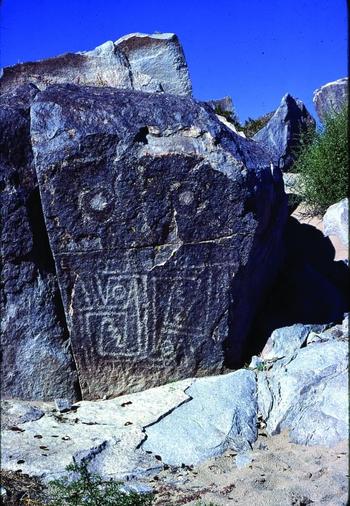
Kachinas are among the anthropomorphic powers represented prehistorically in the Rio Grande Tradition, and these include masked personages as well as stand-alone kachina faces (Schaafsma Reference Schaafsma and Schaafsma1994b). Precedents for a kachina ideology in the Southwest appear in Jornada-style rock art in southern New Mexico along with the related southwestern Tlaloc or rain god image beginning around ad 900 or possibly slightly earlier (Hyman et al. Reference Hyman, Sutherland, Rowe, Armitage and Southon1999). The latter is identified as a rain deity with relationships to the masked storm deity of Mexico by virtue of its signature eyes and the symbolism on the torso (Schaafsma Reference Schaafsma2015; Schaafsma & Taube Reference Schaafsma, Taube, Quilter and Miller2006). While the abstracted trapezoidal or rectangular head and body shape and huge eyes allude to an anthropomorphic form, the cosmological relationships of this figure are denoted by the stepped cloud and lightning symbolism on its torso that serves as a field for picturing these details (Fig. 12). The torso patterns also have added symbolic references to designs on pottery vessels and cotton fabrics, both of which have powerful metaphorical roles in the cosmology and rituals associated with rain-making in the Pueblo Southwest and in Mesoamerica (Schaafsma Reference Schaafsma and Turpin2002; Reference Schaafsma2013a; Reference Schaafsma2015; Schaafsma & Taube Reference Schaafsma, Taube, Quilter and Miller2006). Along with the Tlalocs, highly abstracted, expressionless masks evoke the ancestors and spirit world of the rain-makers.
Storm/rain god or Southwestern Tlaloc, Jornada style (c. ad 800–1450), Rio Grande Valley, southern New Mexico, USA. Large eyes are his signature feature, while the torso commonly serves as a field in which to display cloud and lightning symbolism, as seen here. The petroglyph embodies the rock face that conforms to this deity's trapezoidal shape, probably accounting for it s selection.

Kachina
The Pueblo kachina is an exemplary avenue through which to explore how the human body is understood as a performative agent in its interaction with the cosmos in Pueblo ritual in both life and death. Kachinas represent the corporate community of Pueblo ancestors that resides in springs, lakes and watery places commonly associated with hills and mountains. They are therefore integral to the cultural landscape, and above all, ancestral spirits as kachinas are cloud- and rain-bringers intimately tied to the living community between which active reciprocal relationships are maintained (Hieb Reference Hieb and Schaafsma1994, 25, fig. 4.3). Kachinas dance underground in the afterlife, and they periodically return to their village of origin in kachina form as masked dancers, where they dance for the living and bring rain. As spiritual entities, their presence is assured through the agency of masks that transform the living dancer into the spirit itself (Bunzel Reference Bunzel1932, 849). In addition, clouds themselves may be regarded as the ancestors, or kachinas, and in Pueblo art today and in the past, clouds with faces visually attest to this connection (Schaafsma Reference Schaafsma1992, fig. 126).
At Zuni, Hopi and elsewhere among the Pueblos, at death specific procedures are followed in regard to the body that erase any personal identity and transform the deceased into a rain-maker, or as a go-between involving the living and the rain-makers of the four directions, such ambiguity not being a problem. In describing the preparation of officers of the Kachina society for burial, Bunzel (Reference Bunzel1932, 483) states that they wear ‘the white embroidered kilt and embroidered blanket [both of which are cotton] of the katcinas and, possibly, masks’. This places the emphasis on the male ceremonial apparel that identifies the deceased with clouds, enabling transformation to being a kachina. According to Ladd (Reference Ladd and Schaafsma1994, 18), at Zuni the mask also is ‘buried with you or buried at the time you die’. Stevenson (Reference Stevenson1904, 307), 90 years earlier, however, specified that the mask and clothing along with other belongings are buried west of the village near the river bank, but that the mask is buried separately from the other things, thus leaving specifics open to question. As for the Hopi, at burial it is said, ‘You are no longer a Hopi, you are changed into a kachina, you are Cloud (O'mauuh)’ (Stephen Reference Stephen and Parsons1936, 825). It is the cotton death mask, ‘a white cloud mask’ as described by Stephen, along with other ritual procedures involving cotton and white clay, that are said to change the dead into a Cloud Person, the cotton mask bestowing anonymity and a new identity. Further, ‘One becomes a katsina when he dies . . . . For this reason they attach an eagle-down feather to someone [i.e. after death], and then he can look down through that . . . that eagle down becomes a cloud and then someone [i.e. the deceased] lies on it and watches his relatives here’ (Malotki n.d. 25, 27 in Hieb Reference Hieb and Schaafsma1994, 25). This text continues with a plea for the dead person to return with rain. Hopi women do not own masks, but at marriage acquire a white cotton woven wedding robe that assures them a place among the rain-makers upon death, at which time it serves as a shroud (Schaafsma Reference Schaafsma, Schaafsma and Riley1999, 189; Reference Schaafsma2013a, 22; Stephen Reference Stephen and Parsons1936, 825, 1234). At Keres-speaking Laguna, white paint was (is) applied to the forearms and feathers or tufts of cotton put in the hair of the deceased: ‘it is said that when terraces of cotton have been placed on top of a deceased person's head, his spirit will return with four tiers of rain clouds on his head, bringing rain . . .’ (Hewett & Dutton Reference Hewett and Dutton1945, 29). Just as the Hopi cloud mask identifies the dead as a rain-maker, among the Tewa of Ohkay Owingeh the corpse is painted in a process called ‘marking him to become Oxua’ (Ortiz Reference Ortiz1969, 96). Similarly, in other Tewa villages the dead become oxuhwa, or cloud beings. Traditionally, at Santa Clara the body of the deceased was sewn up in a blanket, and the face whitened with meal before the spirit of the dead left for the lake, where it would assume the role of a rain-maker or negotiate with the cloud people to bring rain (Hill Reference Hill and Lange1982, 171–2, 177). At the death of any Tewa person of distinction, rain is expected, and the deceased return as masked deities in Tewa rituals.
During life, active steps are taken to achieve a place among the rain-makers in the afterworld. Every Tewa ‘Made Person’ (i.e. a member of various ceremonial organizations) looks forward to joining the Oxua as a reward for a lifetime of service involving hard work and dedication to religious societies (Ortiz Reference Ortiz1969, 17–18). Deceased Cochiti who have earned status in their community go to Wenima, the home of the spirit rain-makers, although the need for the mask or other preparations at this point is not clear (Dumarest Reference Dumarest1919, 166–74). Bunzel describes a similar function for the masks among Zuni men. To possess a mask is to be ‘valuable’. To own a mask one must work hard, and mask ownership is likewise associated with good behaviour and ceremonial participation (Bunzel Reference Bunzel1932, 844 n. 4, 849).
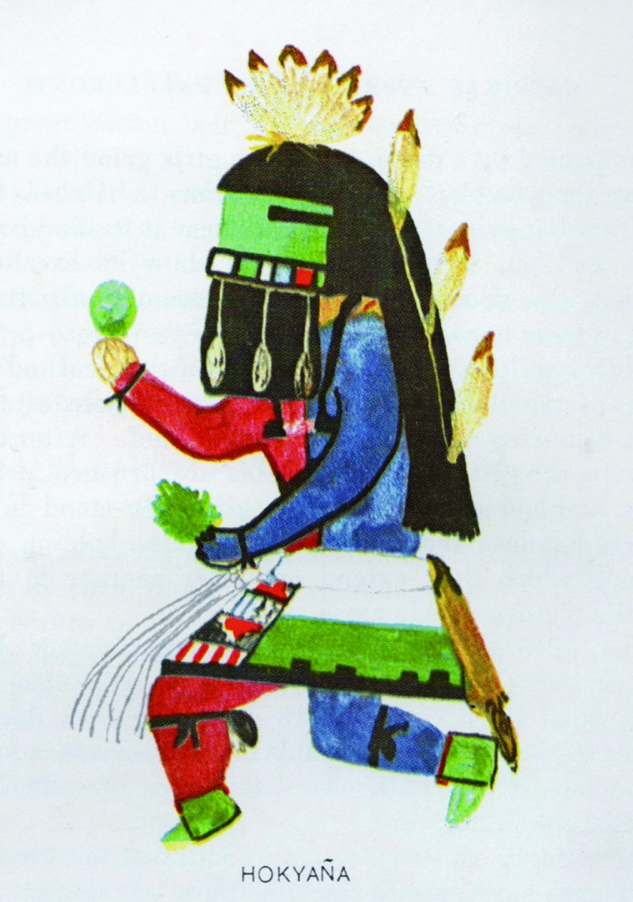
What eventually follows is the return of the rain-making ancestors to the living village as dancing kachinas. Masked and partially concealed beneath ceremonial regalia of elaborate headgear, cotton kilts, rain sashes and fox skins, turtle-shell rattles, bandoliers of shell tinklers, ruffs of evergreen, feathers and body paint—all of which facilitate interaction with the rain-bringing cosmological elements—kachina dancers elude a close human identity (Fig. 13; and see Bunzel Reference Bunzel1932; Fewkes Reference Fewkes1897; Wright & Bahnimptewa Reference Wright and Bahnimptewa1973, among others). Their distinctive calls and songs, muffled by the masks, contribute to their other—the masks and other details transform the kachina dancer into a vehicle embodied with powers with which to summon beneficent spiritual entities and bring rain.
Hopi painting of the Hokyaña, or so-called ‘long-hair’ kachina. The black beard and long hair symbolize rain and the blue-green colour of the mask vegetation and growth. His cotton kilt alludes to white clouds, the rattle in his right hand makes the sound of falling rain, and in his left he carries a sprig of evergreen with reference to the high mountain homes of the kachinas (katsinam) in the San Francisco Peaks south of Hopi, around which summer rain clouds gather. (Fewkes 1903, pl. XXXIII.)

Connections to the cultural landscape reside not only in the kachina ‘homes’, but in the dancers’ body paint made from pigments and clays gathered from springs and lakes related to the times of origin. This paint is imbued with power, conflates the times of the beginning with the present, establishes timelessness within the ritual moment and bestows sanctity. By means of body paint associated with muddy washes, lakes and springs, ritual participants function as messengers to the clouds for rain. At Hopi:
Ka'nη dips his hands in the clay, and rubbing the clay in his hand with his saliva, passes round the kiva, rubbing with the palm of his right hand a white streak on the breast, back, each shoulder, mid-thigh, and each cheek of every person in the kiva . . . It is a prayer to Cloud that he may see we desire the white clouds to hasten with rains. It is white on our bodies that Cloud may see. (Stephen Reference Stephen and Parsons1936, 701)
Dark muds and pigments obtained from springs, in which the rain-makers reside, mimic the undersides of summer rain clouds and like white paint, also have a role in attracting them. At Hopi, chins of ritual performers and the deceased may be painted with dark clay to identify them and empower them as rain-makers (Stephen Reference Stephen and Parsons1936, 713, 853, fig. 275).
Yet among all of the ceremonial regalia worn by the dancing kachinas, the mask, embodying the ancestral spirits, is the most powerful and most sacred.
The mask
In the mask resides the power of the kachina. In design, kachina masks, or faces, are infinitely variable, some vaguely anthropomorphic and others animal-like or bearing abstract designs with allusions to various cosmological entities. There are 200 or more individual kachinas represented by the Hopi and Zuni today, and their forms are flexible and subject to change (Fig. 12). The variation seen in contemporary kachina faces is also evident in the ancient rock art. Picturing the distant and unfamiliar, these are not copies of human faces, and in spite of details such as eyes and mouths, a human likeness is usually remote. Some represent animals, or the paintings on them may be highly abstract, defying any relationship to any living being. At Hopi the mask is referred to as ‘face’, and the spirit of the mask is addressed by the mask's owner as ‘my friend’ (Kwaatsi), or ‘double’ (Fewkes Reference Fewkes1897, 263; Lomatuway'ma et al. Reference Lomatuway'ma, Lomatuway'ma, Namingha and Malotki1993, 451). In the Zuni language, ‘Kokko’ means the mask, the dancer and a spirit of the afterworld (Ladd Reference Ladd and Schaafsma1994, 18), and it is addressed as ‘father’ by the owner, who, in turn, is also perceived as ‘father’ to the spirit of the mask (Bunzel Reference Bunzel1932, 853).
Its construction involves prescribed procedures that assure its efficacy and possession of an inherent spirit (Bunzel Reference Bunzel1932). The mask to be used in dancing the kachina becomes a ‘person’ at the time of its construction, by virtue of the sacred paint and by rubbing it with chewed seeds:
Now I have given you life. We shall have one another as father. I have made you with seeds and given you life. Bless us with your strong spirit, and whenever our day may come call the rains for us as long as you live. Now it is finished. I have made you into a person. (Bunzel Reference Bunzel1932, 851)
Once a mask harbours a living spirit it is treated accordingly. It is carefully guarded, prayed over and given food offerings and ‘given a smoke’ at appropriate intervals or times, especially prior to a ceremony (Bunzel Reference Bunzel1932, 517; White Reference White1932, 29; Reference White1935, 95).
As stated from the perspective of Zuni, the mask, by which the ancestors return to Zuni, is regarded as ‘the very substance of death’ (Bunzel Reference Bunzel1932, 483, 845). Functionally similar to the white death mask of cotton signifying clouds are the tops of many of the Keresan helmet dance masks that also are made of white unspun cotton (White Reference White1932, 33; Reference White1935, figs. 21–25; Reference White1942, 237). The transformational powers of the mask—to invoke the dead and bring the deceased back to the village to dance, or, conversely, as a ticket into Kachina Village for the recently dead—are among roles of the animated mask.
At Zuni a mask is a man's personal fetish, conveying status both in this life and after death, as it functions as a ‘passport to Kothluwalaaw'a’, the Kachina Home (Ladd Reference Ladd and Schaafsma1994, 19). There is nevertheless, some ambiguity as to whether or not the mask serves as a vehicle for travel to Kothluwalaaw'a or simply as a ‘ticket’ for admission. Perhaps the distinction is not so important. What is primary is the fact that the mask needs to be with you at Kothluwalaaw'a, and in addition, individual masks are the means of returning after death to delight the living (Bunzel Reference Bunzel1932, 517). The implication here is that the spirit of the masks at Kothluwalaaw'a are resident in those worn by the Zuni dancers.
The perceived agency and role of the mask during ritual performance has long been a topic of interest to Pueblo scholars (Bunzel Reference Bunzel1932; Tedlock Reference Tedlock and Schaafsma1994). Wright (Wright & Bahnimptewa Reference Wright and Bahnimptewa1973, 2) states that when Hopis impersonate a kachina they become the supernatural, curing disease, bringing rain and reinforcing discipline (see also Geertz Reference Geertz1987, 27). Bunzel (Reference Bunzel1932, 517) refers to the mask as ‘the corporeal substance of the god and in donning it the wearer, through a miracle akin to that of Mass in Roman Catholic ritual, becomes the god’. A separation between dancer and the mask is often not acknowledged, although an alternative interpretation views the dancer as standing behind the mask. Arguing from this perspective, Tedlock (Reference Tedlock and Schaafsma1994, 171) describes how dancers are acutely aware of the mask as a physical object that impairs their hearing or presses on their nose to the point of making it sore. White (Reference White1935, 101) concurs, saying that the dancers report being hot, uncomfortable and unable to breathe and that they did not express any transformational or ‘religious’ feelings. Elsewhere, however, he states that the transformative agency of the masks temporarily grants a common person the power to mediate with the rain-makers (White Reference White1942, 185). On the other hand, the Hopi say that discomfort arises when the mask detects something negative about its wearer. In such a case, the mask takes revenge and will turn on the dancer (Lomatuway'ma et al. Reference Lomatuway'ma, Lomatuway'ma, Namingha and Malotki1993, 453).
Stories about the supernatural powers of the mask abound. The potentially dangerous agency of the masks is revealed in Zuni stories about masks adhering to a dancer's face and killing him if strict protocols are not observed. Such accounts function to enforce correct behaviour as well as the belief in the mask's efficacy (Tedlock Reference Tedlock and Schaafsma1994, 172–3). At Zuni, if you try on a mask when not participating in a ceremony you will die, or if you use human hair or hair of a live horse on a mask, that person or horse will die (Bunzel Reference Bunzel1932, 845). On a positive note, masks are said to have the ability all by themselves to make it rain: ‘In one Tewa folk-tale as soon as the masks are taken out from their bowl, and the kachina begin to dance, rain begins to fall.’ In another story,
Two naughty little boys steal the masks which are hanging up (after the dance) while the people sleep. The boys take the masks home, and there in their town they had ‘summer all the time and rains.’ In the town [from] whence the masks had been taken, it remained very dry. (Parsons Reference Parsons1929, 269)
In sum, kachinas in their various manifestations—whether they be representations on rocks, the kachina masks themselves, or the plaza dancers wearing them—they are not static entities, and in all forms they embody sacred powers. Just as the animated mask guarantees its owner access to the residences of the departed as a rain-maker, it is the vehicle through which the spirits of the ancestors as real kachinas come to the villages and dance. Remaining for further consideration is the agency of rock art.
Image, agency and landscape: a synthesis
The onset of the summer rainy season in the American Southwest is always uncertain and awaited with anxiety, as the crops need rain to mature. Thus the Pueblos deem it necessary to petition the rain-making powers to ensure that the rainy season will arrive in time, or even at all. Further, summer showers tend to be localized, as scattered thunderstorms pour down rain in restricted localities with the result that the fields of some villages may receive adequate moisture, while others fare poorly. Due to such random distribution of life-giving rains, the deities in charge appear to be selective, favouring the fields of one village over another's. It thus stands to reason that picturing rain deities, clouds and kachinas on rocks throughout one's territory, in concert, perhaps, with offerings, will be beneficial. Ritual competition for Cloud's favour was made explicit by a Hopi ritual leader from the village of Shipaulovi in conversation with Alexander Stephen (Stephen Reference Stephen and Parsons1936, 744). It is therefore reasonable to suggest that Cloud might also have his favorite petroglyphs (Schaafsma Reference Schaafsma2015, 6).
Mediation between worlds is facilitated by means of visual representations of supernatural entities. The preceding discussion makes it abundantly evident that anthropomorphic portrayals of supernatural beings are not to be viewed as simply static icons to be analysed intellectually, but from the emic perspective, these figures embody agency in themselves, enabling their function as portals to the spiritual dimension. Philip Lauriano, a Sandia Pueblo elder, described the West Mesa landscape of Petroglyph National Monument in Albuquerque, where kachinas and other religious icons occur in large numbers, as a ‘Great Divide’—an interface where communication between the living and the ancestors and spirit realm is facilitated because the spirits represented are attracted to these localities (Schaafsma Reference Schaafsma, Sanchez, Sanchez-Clark and LeBeau2008, 103).
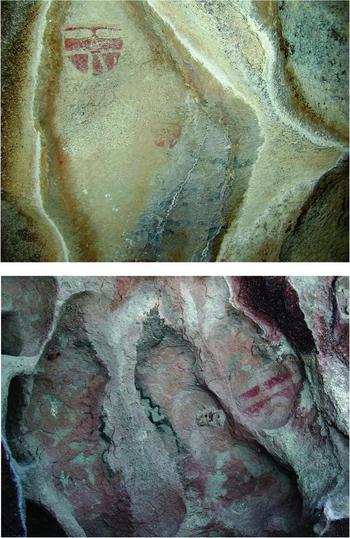
Depictions of kachinas, numbering in the thousands throughout the Rio Grande valley, are a sort of permanent investment in attracting the rain spirits. On cliffs, boulders and the rocky heights transformed into symbolic mountains and kachina homes, these images grant power to the land, just as the dancer is transformed by the mask. On a micro-topographic level, in places these images were made where water runs over them (Fig. 14), or in recesses symbolic of chthonic origins of rain common to Puebloan and Mesoamerican worldviews (Schaafsma & Taube Reference Schaafsma, Taube, Quilter and Miller2006). As with representations of the Navajo Holy People, if an image is pleasing to the supernatural being represented, it will attract that being's presence (e.g. Schaafsma & Tsosie Reference Schaafsma, Tsosie and Christie2009). The Southwestern rain god deity described earlier and prevalent in Jornada-style rock art (Schaafsma Reference Schaafsma2015) is not uncommonly represented on a boulder or rock face that naturally conforms to his generalized trapezoidal shape. In these instances, the rock seems to have been selected for the placement of these representations, perhaps even ‘recognized’ as the a priori embodiment of the deity, which is then confirmed by inscribing its image on its ‘residence’. Following Hopi commentary (Stephen Reference Stephen and Parsons1936, 198), such rock faces were probably deemed ‘pleasing’ to the deity who therefore would have chosen to reside there, and issues of priority are debatable, or perhaps not important at all.
Jornada-style masks painted in water streaks and recesses, Hueco Tanks, Texas, USA.

While untested, it is not unreasonable to suggest that painted imagery may embody additional powers via the use of sacred paint sources, just as kachina masks and dancers embody the landscape through the use of sacred clays and other pigments. The horned serpent deity in rock paintings, for example, is rather consistently painted with a blue-grey clay thought to represent, or even consist of, mud obtained from the bottom of springs (Schaafsma & Taube Reference Schaafsma, Taube, Quilter and Miller2006, 273; Wright Reference Wright and Bahnimptewa1973, 246–7). The use of sacred pigments would extend to these figures the spiritual agency of those springs and their resident deities. In addition, the use of mud washes in Hopi kivas is described by Stephen (Reference Stephen and Parsons1936, 198) as having mimetic properties that attract rain; a similar function could apply to rock paintings. In the Hopi case, the mud-washed designs representing lightning, clouds and handprints on the beams in Hopi kivas are to attract rain: ‘they want the rain to come and make the sand in the valley as is this sandy wash that they are now using’ (Stephen Reference Stephen and Parsons1936, 198). This time-honoured practice of mimetic magic pervades Pueblo ritual (Bunzel Reference Bunzel1932, 489–92; Young Reference Young1988, 160). Added to the use of paint and clays, the techniques and gestures behind the application of these clay paintings may also be been regarded as critical to their efficacy, adding a performative component to an image. Even as non-graphic statements, paint splashed, spattered, or smeared across the rock surface mimics the watery sources from which they were obtained, all of which contributes to their inherent powers as petitions for rain.
In landscape contexts, the intended ‘consumers’ of the rock art were (are) primarily the residents of the spiritual world itself. Pueblo people are also the consumers, however, as they continue to interact with these figures and leave offerings at shrines where rock art is present. Rock-art imagery also reinforces beliefs and establishes rights (past or present) to place and territory. Interaction with rock art has implications affecting various aspects of social behaviour, and responses may include cyclical or circumstantial visits and rituals performed by the makers or members of descendent communities.
It is a Pueblo practice to leave pahos, or prayer sticks, at shrines, including places where rock art occurs, to interact with the spirit world. ‘Fashioned like human beings, the stick is the body, the feathers, the robes, the cotton cord is the belt, the paint is the flesh’ (Bunzel Reference Bunzel1932, 625 n. 16). Faces may be added (Stephen Reference Stephen and Parsons1936, fig. 227). These ‘humanized’ wands are living beings empowered by their sacred attire that resembles that of the kachinas and other ritualists. As explicitly stated in a Zuni prayer to the ancients, ‘we gave our plume wands human form’ (Bunzel Reference Bunzel1932, 625). Dressed with elements from the natural world that are in themselves symbols and agents of supernatural powers, boundaries are again blurred between the thus empowered human form and the environment and its resident spirits. In sum, prayer wands function as surrogate human messengers when offered to the divinities at the appropriate and preordained places in the landscape.
Numerous rock-art figures, prayer sticks, the preparation of the dead for the afterlife in the kachina home and the kachinas themselves incorporate bodily enhancements to attract the rain-bringers, and all engage the sacred landscape. This unity between the land, community and the spirit world is dramatically enacted periodically at Zuni Pueblo just before the onset of the rainy season through a ritual pilgrimage by religious officers and other ritual participants to the kachina home and other shrines. Offerings are left for the resident spirits, and sacred items linked to the times of origin are gathered and brought back to Zuni for future or immediate use. Upon their return, the participants in the journey embody the sacredness of the mythic time and spaces they have encountered. In this way, embodiment can be viewed as a dynamic process enacted through movement from the sacred landscape to the community via the bodily experiences as pilgrims. Back at Zuni the Long-hair kachina, or Kokoshi, dance in the village plazas. This final ritual enactment blurs boundaries between the living community, the ancestors, the land, uniting them with the spirit world, the times of origin and the present.
This discussion could be expanded to consider more thoroughly the significance of the physical contexts within which religious representations of human and human-like beings occur, contrasting indigenous American landscapes and rock art with religious art of the Christian West, commonly found inside places of worship. The implications of these differences opens up further discussion on the topic of human representations, the role of pilgrimages, and how these inform on larger worldviews.
Some conclusions and final thoughts
The ways in which people experience the world through their bodies ‘is disclosed against different historical, material, and social backgrounds’ (Harris & Robb Reference Harris, Robb, Robb and Harris2013a, 17), and some of these issues have been explored here, highlighting the stark contrast between Pueblo views in regard to the body and those of the Western world. The Western template of body-worship, so well established in antiquity, persists today in both religious and secular contexts.
As participants in the secular realm, we are bombarded daily by innumerable media via visual and written texts obsessed—for a multitude of reasons—with elevating the human body—a topic insightfully considered elsewhere (Robb & Harris Reference Robb and Harris2013) and worth a few additional remarks here. In the Western perspective, rather than being linked to the natural world, humanity is divorced from it by virtue of its perceived inherent linkage to the divine, as described at the beginning of this paper. Just as divinities and the religious elite are portrayed as exemplary humans in Christian art, in the mundane world we experience on a daily basis, the tradition of body worship continues, forcefully projected onto the public by the general media, advertisements, ‘celebrity’ idealism, and so forth. The Photoshopped (or not) images to which one is led to aspire—like the Greek deities mentioned at the beginning of this essay—set the standards. As noted by Harris and Robb (Reference Harris, Robb, Robb and Harris2013b, 218), Classical sculptures presented the human body in an idealized, schematized and generic way, functioning much like the shop mannequins and models in catalogues nowadays, providing ‘a form for the viewer to project himself or herself into the picture’. In addition, the means for achieving these ends are profusely offered by advertisements for all kinds of beauty and health products—recommendations as to diet, workout regimes (and exercise machines), cosmetics, hairstyles, anti-ageing schemes, and clothing, all with rather narcissistic goals of attaining bodily perfection while feeding the capitalistic maw (Harris & Robb Reference Harris, Robb, Robb and Harris2013a, 8). As well, Harris and Robb (Reference Harris, Robb, Robb and Harris2013b, 218) note that, as with the Greeks, in the West today ‘Stylized aspirational bodies whose virtues are ostensibly universal [are] in fact strongly class marked’. This commentary merely hints at the intricate and profound links between human representations and the political, social and religious implications they hold, today and throughout Western history. Unconsciously, we accept these bombardments as ‘the way it is or the way to be’. By aspiring toward a goal of physical perfection, Westerners are assured of social success, happiness and, by implication, even wealth.
Alternatively, the Pueblo body in its ritual contexts and in the manner in which it is represented displays a cosmovision within which humanity's relationships with the natural ambience and its resident spiritual forces must be maintained. Within this framework, bodily perfection is not a concern. Whether in graphic depictions or via the adornments added to persons in ritual contexts, attributes added to bodily representations work to establish and affirm these relationships. The absence of realism, naturalism, portraiture and, as a consequence, the lack of reification of the human body in graphic portrayals is both meaningful and significant. These lacks are in accord with humanity's unheralded status within the indigenous hierarchical spectrum and cosmovision, and whose successful manipulations of the cosmos are dependent upon reciprocal relationships between society and nature. In this worldview, boundaries are permeable and humanity relates to animals as ‘co-species’. Humans, along with other forms of life, are components of an animistic cosmos populated by the earth, sun, water, plants, wind, rocks—all entities that are considered sentient beings. Clearly, humanity as seen through Pueblo depictions and ritual manifestations is not the centrepiece of the cosmos.
The differences described here between indigenous views and those of Western societies have relevance today beyond the confines of the academy and enter the realm of practical concerns. An exploration and a definition of conflicting values embedded in contrasting worldviews are useful background for furthering an understanding of contemporary issues relating to the acquisition by Western collectors of indigenous religious objects such as figurines or ritual regalia (e.g. Colwell-Chanthaphonh et al. Reference Colwell-Chanthaphonh, Hollowell and McGill2008, 31–3; Ferguson Reference Ferguson1990). Agency in particular is very much an issue that has taken centre stage when religious items perceived as invested with spiritual powers by indigenous communities are then subject to a redefinition by collectors who buy these items as ‘investments’, conversation pieces and décor. The sale of kachina masks and other religious objects at Paris auctions is high among the contentious issues faced between the West and indigenous peoples today. Removing objects embodied with spiritual powers from their rightful contexts does not, in fact, divest them of their sanctity. A case in point is that of the Zuni War Gods. Being stolen from their landscape shrines, thus removing them from the control of the Bow Priests, is said to endanger the whole world. Unchecked, these effigies are said to have the ability to unleash rampant warfare (Schaafsma Reference Schaafsma2000, 183). In the course of the last several decades, many War God effigies have been returned to Zuni.
These are not the only significant ethical issues at stake, but linked to these are others, such as land use, with broad social, political and religious implications (Schaafsma Reference Schaafsma2013b). It is therefore critical that archaeologists and anthropologists understand and make explicit the contrasting worldviews that underlie the differences in the many ways in which human and anthropomorphic representations are perceived, dispelling the variety of European-based prejudices attached to art forms of non-Western origins.
Acknowledgements
This paper is an extended version of my presentation in the symposium ‘Rock Art, Embodiment, and Identity’ at the 82nd Annual Meeting for the Society for American Archaeology in Vancouver, British Columbia, 2017. I thank session organizers Jamie Hampson, Liam Brady and Courtney Nimura for inviting my participation. I am indebted to Allison Colbourne, librarian at the Museum of Indian Arts and Culture/Laboratory of Anthropology in Santa Fe, who has been extremely helpful in locating and securing the materials needed. I am grateful to Livio Dobrez for reading an earlier version and providing valuable commentary. Matthew Schmader and Patricia Vivian kindly gave me permission to publish their photographs. All other photographs and drawings are by the author. Finally, two anonymous readers provided valuable commentary that significantly improved this discussion.