

INTRODUCTION
Salinity is one of the major environmental stresses affecting plant productivity and crop quality (He et al., Reference He, Zhu, Yang, Ni and Zhu2009; Munns and Tester, Reference Munns and Tester2008; Yamaguchi and Blumwald, Reference Yamaguchi and Blumwald2005). Of the world's salt-affected soils (over 800 million hectares), approximately half are considered saline, while the remainder are considered sodic, having high exchangeable Na+ contents and a high concentration of carbonate/bicarbonate anions (Qadir et al., Reference Qadir, Oster, Schubert, Noble and Sahrawat2007). Climate change is expected to cause a net increase in land classified as semi-arid and saline mainly as a consequence of rainfall reduction (Yeo, Reference Yeo1998). Irrigation with poor quality water contributes to soil salinity, and dry land salinity is linked to rising water tables brought about by increased deep drainage of rainfall following forest clearance and a change from deep-rooted perennial plants to shallow-rooted annual crops (Flowers and Flowers, Reference Flowers and Flowers2005). In addition, urban wastewater with high salt concentration has been identified as a promoter of soil salinity. Salt-affected soils contain enough concentrations of soluble salts to reduce the growth of most plant species. The first component of salinity is referred as an osmotic or water deficit effect (Munns et al., Reference Munns, James and Läuchli2006). If excessive amounts of salts enter the plant through the transpiration stream, serious injury may occur to cells in the transpiring leaves, causing further reductions in growth. This is also called an ‘ion-specific’ effect of salinity (Greenway and Munns, Reference Greenway and Munns1980).
The growth inhibition observed in many plants under saline conditions is generally associated with several physiological disturbances, including ion toxicities, osmotic stress, stress-induced deficiencies in essential elements, photosynthesis inhibition or generation of reactive oxygen species (Parida and Das, Reference Parida and Das2005). Particularly in cultivated tomato (Solanum lycopersicum L.), the long-term damage has mainly been related with the excessive accumulation of Na+ and Cl− in leaves as well as salt-induced modifications in the plant water status (Cuartero and Fernández-Muñoz, Reference Cuartero and Fernández-Muñoz1999; Flores et al., Reference Flores, Navarro, Carvajal, Cerdá and Martínez2003). Among the primary metabolic processes, photosynthesis is especially sensitive to salt stress (Munns et al., Reference Munns, James and Läuchli2006). Usually, the water potential (Ψw, MPa), osmotic potential (Ψs, MPa) and turgor (Ψp MPa) decrease as the salinity in the leaf and root tissues increases (Maggio et al., Reference Maggio, De Pascale, Angelino, Ruggiero and Barbieri2004).
For a given plant species, the responses to salinity vary depending on the genotype and the phenological stage. Although numerous plant species are especially salt-sensitive at the young seedling stage, salinity may also directly influence the reproductive processes. In the cultivated S. lycopersicum, flower abortion and pollen viability in relation to Na+ accumulation in various tissues have been described for the flowers belonging to the first inflorescence (Ghanem et al., Reference Ghanem, Van Elteren, Albacete, Quinet, Martínez-Andújar, Kinet, Pérez-Alfocea and Lutts2009). However, the consequences of further fruit development are still unknown. Yield properties must consequently be considered when breeding for salinity resistance (Dorai et al., Reference Dorai, Papadopoulosa and Gosselin2001; Estañ et al., Reference Estañ, Martinez-Rodriguez, Pérez-Alfocea, Flowers and Bolarin2005; Flores et al., Reference Flores, Navarro, Carvajal, Cerdá and Martínez2003; Krauss et al., Reference Krauss, Schnitzler, Grassmann and Woitke2006). The enhancement of crop salt resistance will require not only traits directly influencing yield but also the combination of several physiological traits allowing the plant to cope with detrimental Sodium chloride (NaCl) concentrations on a long-term basis (Cuartero and Fernández-Muñoz, Reference Cuartero and Fernández-Muñoz1999; Cuartero et al., Reference Cuartero, Bolarín, Asíns and Moreno2006; Lutts et al., Reference Lutts, Bouharmont and Kinet1999). Therefore, tomato breeding is focused on discovering and exploiting genes controlling those traits in wild relatives belonging to the tomato germplasm (Bai and Lindhout, Reference Bai and Lindhout2007).
Tomato (Solanum lycopersicum) is the cultivated species among a dozen wild relatives, several of which exhibit halophyte properties (Spooner et al., Reference Spooner, Peralta and Knapp2005). Two wild tomato species originating from the Northern part of Chile (S. chilense and S. peruvianum) possess a high capacity to withstand salinity and drought (Chetelat et al., Reference Chetelat, Pertuze, Faundez, Graham and Jones2009; Zhou et al., Reference Zhou, Sauvé, Liu, Reddy, Bhatti, Hucko, Fish and Thannhauser2011). Under salt stress imposed in laboratory conditions, S. chilense is able to induce a specific gene expression that is involved in adaptation to its natural habitat (Tapia et al., Reference Tapia, Verdugo, Yañez, Ahumada, Theoduloz, Cordero, Poblete, González and Ruiz-Lara2005). Specific modifications of proteomes in response to NaCl have been also methodically described recently (Zhou et al., Reference Zhou, Sauvé, Liu, Reddy, Bhatti, Hucko, Fish and Thannhauser2011). However, despite its fascinating ability to cope with high external NaCl levels, the physiological behaviour of S. chilense has received little attention until now in comparison to other wild-relatives, such as S. cheesmanii and S. pennellii.
In studies dealing with plant responses to salt in wild tomato relatives, high doses of exogenous NaCl are usually applied for short periods at the vegetative stage to identify the gene(s) sustaining the halophytic nature of these species. However, the inclusion of wild tomato relatives in breeding schemes may also modify numerous fruit properties, such as flavour, taste, shape, size or post-harvest behaviour. Therefore, there is an urgent need to consider the long-term behaviour of these wild-relatives at realistic NaCl doses and to monitor NaCl impact on fruit set. The present study aims to analyse the long-term impact of moderate salinity on fruit set and relevant properties of the halophyte S. chilense and to compare its behaviour with the response of the cultivated glycophyte S. lycopersicum.
MATERIAL AND METHODS
Plant material, growth conditions and stress treatments
Plants of a cropped tomato genotype (Solanum lycopersicum L. var. cerasiforme (Alef) Fosberg, cultivar Rubino Top) and a wild-relative species (Solanum chilense (Dunal) Reiche) were grown in a hydroponic system under greenhouse conditions at the Regional Center of INIA-La Cruz, Valparaíso Region (32°59´ LS; 71°10´ LW, 105 metres above sea level (m.a.s.l.)) during the 2009–2010 (first repetition) and 2010–2011 (second repetition) southern hemisphere spring–summer season. Seeds of the wild species belong to accession LA4107 issued from Catarata-Taltal, Northern Chile and were kindly provided by the INIA-Intihuasi (Experimental Center Vicuña) seed bank. Seeds of both genotypes were sown and seedlings grown in a germination chamber in four outdoor containers filled with a perlite-vermiculite mixture (1:3 v/v), moistened regularly with half-strength-modified Hoagland nutrient solution containing the following chemical concentrations: KNO3 5 mM, NH4H2PO4 1 mM, MgSO4 0.5 mM, Ca(NO3)2 5.5 mM, KCl 25 μM, H3BO3 10 μM, MnSO4 1 μM, ZnSO4 1 μM, CuSO4 0.25μM, Na2MoO4 10 μM and Fe-EDDHA 1.87 mg L−1. The plants were transplanted to a greenhouse in September (spring in the Southern hemisphere), three weeks after germination, setting 2.6 plants m−2. Plants were grown in rock wool beds (four plants per bed). The pH and the electrical conductivity (EC) of the nutrient solution were set to 6.65 and 3.0 dS m−1 respectively.
The saline stress was imposed seven days after transplantation by adding 0 mM (3 dS m−1), 40 mM (6 dS m−1) or 80-mM (9 dS m−1) NaCl to the nutrient solution. The EC and pH were recorded periodically with a handheld pH-EC meter (Hanna® Instruments, HI98130) in the supply solution and adjusted accordingly. According to Cayuela et al. (Reference Cayuela, Estañ, Parra, Caro and Bolarin2001), the natural light intensity at the top of the canopy was 300 μmol m−2 s−1 (photosynthetic photon flux density (PPFD)). The air temperature ranged from 25 °C to 28 °C during the day, with an average of 18 °C during the night. The relative humidity was maintained at 80 ± 5% during the night and at 60 ± 5% during the day.
Shoot growth, biomass and yield
Leaves, stems and bunches were harvested from each replicate after 112 days of treatment and used for the measurement of several parameters. The mean relative growth rates (RGR, g g−1 month−1) of the shoots were calculated as follows: RGR = (lnWf – lnWi) Δt−1, where Wf and Wi were final and initial fresh weight (FW) or dry (DW) weight, respectively, and Δt was the elapsed time between the two measurements (Martínez et al., Reference Martínez, Ledent, Bajji, Kinet and Lutts2003), when using the transplantation as the initial time. Plant growth was also recorded on the basis of shoot fresh weight and dry weight per plant. RGRFW, RGRDW, shoot fresh and dry weights (estimated after 48 h in an 80 °C oven) were determined using six plants per treatment and the whole shoot. Fresh and dry weights of total fruit yield per plant were calculated as an average using the total yield per replicate over the harvest period divided by the number of plants per replicate (n = 6). The total yield was recorded at the harvest and arbitrarily fixed after four months of culture, at a time when both genotypes have produced three bunches.
Shoot water status and leaf conductance of water vapour
The leaf water potential, stem potential (Ψx MPa), osmotic potential and water content (WC, %) were measured between 1200 and 1400 hours on the leaf located just below the first raceme on six individual plants per treatment. The leaf conductance (gs) was determined by measuring the abaxial stomatal conductance with a Li-Cor steady state diffusion porometer. The leaf water potential and stem potential were measured using a pressure chamber (Model 610, PMS, Corvallis, OR, USA; Scholander et al., Reference Scholander, Hammel, Bradstreet and Hemminbsen1965). Stem water potential was measured on leaves enclosed for at least 2 h in a sleeve of aluminium foil within a zip-lock plastic bag. The solute potential (Ψs) was quantified on extracted tissue sap (Martínez et al., Reference Martínez, Ledent, Bajji, Kinet and Lutts2003, Reference Martínez, Lutts, Schanck, Bajji and Kinet2004) using a freezing point depression osmometer (Advanced Instruments, INC, FiskeR Associates Model 210). The osmolarity (c) of the tissue sap was converted from mosmol kg−1 to MPa using the following formula: Ψs (MPa) = –c (mosmol kg−1 × 2.58 × 10−3 at 37 °C). The water content was calculated on the basis of fresh weight (WCFW, %) and dry weight (WCDW, g g−1 DW) as follows:


where FW corresponds to the leaf fresh weight, and DW corresponds to the leaf dry weight (48 h at 80 °C).
Fruit parameters
The first inflorescence appeared at the same time in the two plant species used. Subsequent analysis therefore focuses on the first bunch, although bunches no. 2 and 3, which appeared later on S. chilense, were also collected. Fruits were harvested at 119 days after transplanting (corresponding to 112 days of stress) to measure the total fruit fresh weight of the first bunch, the number of fruit per bunch, the mean individual fruit fresh and dry weights (g fruit−1), the diameter (mm) and the water content (g g−1 DW).
The fruit pressure firmness was measured using a fruit pressure tester (PrF 327) with an 8-mm plunger. Fruit tissues from each replicate of both S. lycopersicum and S. chilense were homogenised with a mortar and pestle. The juice was filtered through miracloth and analysed for total soluble solids (TSS) and titratable acidity (TA) according to standard procedures: TSS was determined at 20 °C using a hand-held temperature-compensated refractometer (Atago Co., Tokyo, Japan) and expressed as °Brix. The pH of the juice was recorded with a pH meter (Ezodo PL-500). The titratable acidity was determined by titration of an aliquot of 10 mL of tomato juice with 0.1 mM NaOH until reaching pH 8.2 and expressed as mequiv of citric acid L−1 of fresh extract, following the protocol reported by Almasoum (Reference Almasoum2000). The fruit pressure firmness and TSS were obtained from six fruits per replicate. For determination of TSS, TA and TSS TA−1, six plants per treatment were randomly chosen for analysis.
Statistical analysis
Data were analysed using a two-way analysis of variance (ANOVA) at a significance level of p ≤ 0.05. The model was defined as a split plot design on the basis of fixed effects and hierarchical classification criterion with six free random blocks and six plants per replicate. The effects of the main factors corresponded with the species and NaCl doses, and their interaction was also considered. When the ANOVA was significant at p ≤ 0.05, the Duncan Multiple Range Test was used for comparison of means. The data were analysed by an SAS statistical package (SAS Institute Inc., Cary, NC, USA). The experiment was performed twice, and similar results were obtained. Data presented hereafter are therefore from one representative experiment.
RESULTS
Relative growth rate and shoot biomass
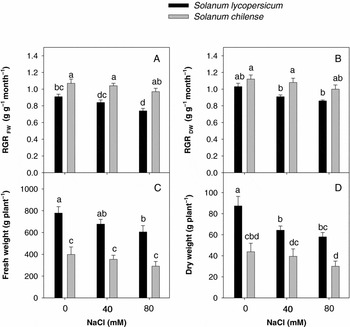
The fresh weights at the time of NaCl application were 13.4 g for S. lycopersicum and 5.6 g for S. chilense. All plants of both tomato species remained alive until the end of the treatment, flowered and set fruits. Salt stress did not delay flowering. S. chilense exhibited higher RGR values than S. lycopersicum on the fresh weight basis at all NaCl doses tested (Figure 1a). Salt stress had no significant impact on RGRFW of S. chilense but decreased the RGRFW of S. lycopersicum (p ≤ 0.05) (Figure 1a). In both species, however, salt stress had no significant impact on RGRDW (Figure 1b). Salt stress significantly reduced the shoot FW and DW in S. lycopersicum (Figures 1c and d), while S. chilense was only marginally and not significantly affected under stress conditions (p ≤ 0.05).
Impact of salinity on the shoot relative growth rates estimated on (a) fresh biomass (RGRFW), (b) dry biomass (RGRFW), (c) shoot fresh weight and (d) shoot dry weight in two species of tomato (cultivated Solanum lycopersicum and wild-relative S. chilense) cultivated for 112 days in nutrient solution containing 0 (control), 40 or 80 mM NaCl. The RGRs were calculated using the transplanting date as the initial time. Each value represents the mean ± SE (n = 6). Lower-case letters indicate differences (p ≤ 0.05, Duncan test) between treatments and species.

Water status
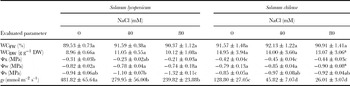
The means of the leaf WCFW, WCDW, Ψx, Ψw, Ψs and gs for the three salt treatments and the two tomato species are summarised in Table 1. The leaf WCFW, WCDW and Ψw were not significantly affected by species and salt treatment. The leaf Ψx values were higher in S. lycopersicum than in S. chilense, and it increased in response to NaCl in the former but remained unchanged in the latter. The leaf Ψs of S. lycopersicum decreased in response to salt stress (p ≤ 0.05), but was unaffected in S. chilense. The stomatal conductance (Table 1) was lower in S. chilense than in S. lycopersicum in all treatments, and in both cases salinity reduced the gs values. At the highest stress treatment, gs was almost 10 times higher in the domesticated species than in the wild halophyte.
Impact of salt stress on water status in leaves of two tomato species (cultivated Solanum lycopersicum and wild-relative S. chilense) cultivated for 112 days in nutrient solution containing 0 (control), 40 or 80 mM NaCl. The water content was estimated on the basis of fresh weight (WCFW, %) and dry weight (WCDW, gg−1 DW). The stem potential (Ψx, MPa), water potential (Ψw, MPa), osmotic potential (Ψs, MPa) and leaf conductance of water vapour (gs, mmol m−2 s−1) were recorded on the leaf at the axis of the first bunch. Each value represents the mean ± SE (n = 6).

Lower-case letters indicate differences (p ≤ 0.05, Duncan test) between treatments.
Yield and fruit parameters
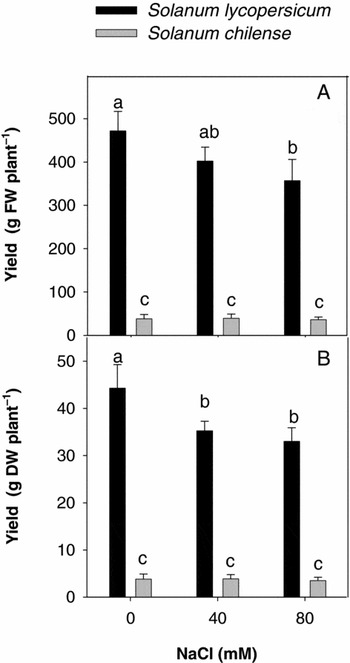
Total fruit yield on both fresh and dry weight basis significantly decreased in salt-treated S. lycopersicum plants compared with controls (p ≤ 0.05; Figure 2). In contrast, the total fruit yield of the wild species S. chilense was not affected by salt stress (interaction p ≤ 0.05).
Impact of salinity on the total fruit yield estimated on (a) fresh weight basis, or (b) dry weight basis in two species of tomato (cultivated Solanum lycopersicum and wild-relative S. chilense) cultivated for 112 days in nutrient solution containing 0 (control), 40 or 80 mM NaCl. Each value represents the mean ± SE (n = 6). Lower-case letters indicate differences (p ≤ 0.05, Duncan test) between treatments and species.

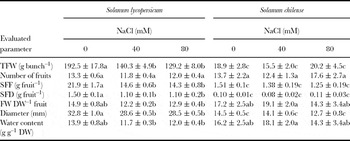
Table 2 summarises fruit productivity determined using the first bunch for both species. The total fresh weight of the bunch was 10 times lower in the wild species S. chilense than in the domesticated species, S. lycopersicum. NaCl significantly reduced the total fresh weight of the first bunch in S. lycopersicum, but had no significant effect on the fruits of the wild plants (p ≤ 0.05). The impact of salinity on the second and third bunches was similar to the NaCl impact on the first bunch (detailed data not shown). Salinity did not affect the ripening process in S. lycopersicum and all fruits of the first bunch were mature at the time of harvest. In S. chilense, however, the maturation stage was more difficult to assess because the fruits did not accumulate lycopene and turned from light green to white in colour at maturity.
Impact of salt stress on yield-related parameters in two tomato species (cultivated Solanum lycopersicum and wild-relative S. chilense) cultivated for 112 days in nutrient solution containing 0 (control), 40 or 80 mM NaCl. Yield parameters were estimated considering the first bunch only: total fruit fresh weight of bunch (TFW, g bunch−1), number of fruits per bunch, fresh weight per fruit (SFF, g fruit−1), dry weight per fruit (SFD), fresh-to-dry weight ratio (FW DW−1), fruit diameter (mm) and water content on the basis of fruit dry weight (g g−1 DW). Each value represents the mean ± SE (n = 6).

Lower-case letters indicate differences (p ≤ 0.05, Duncan test) between treatments.
Salinity had no impact on the number of fruits per bunch, as illustrated in the first bunch (Table 2) in either species. The diameter and the mean individual fruit fresh and dry weights of the fruits of the first bunch of S. lycopersicum plants were affected by salt stress, but no difference was observed between the two NaCl doses. However, the mean individual fruit fresh weight and diameter decreased 17% and 13%, respectively, in response to salt stress in Solanum chilense. Although not negligible from the relative point of view, such decrements were not statistically significant.
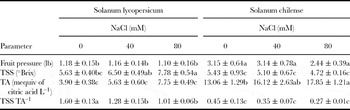
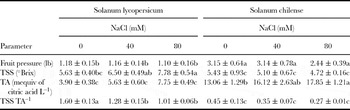
Table 3 shows fruit quality parameters for the two tomato species. The fruit pressure firmness was higher in S. chilense than in S. lycopersicum (p ≤ 0.05). This parameter was not affected by NaCl. The TSS was similar for the fruits of both species under control conditions. The fruits of S. lycopersicum showed a significant increase in TSS in response to NaCl; however, no impact was recorded in S. chilense in response to NaCl. One of the most conspicuous qualitative differences between the fruits of domesticated and wild species was the TA values, which were higher in S. chilense than in S. lycopersicum (p ≤ 0.05). TA also increased in response to salinity in S. chilense; however, no significant increase was observed in S. lycopersicum. As a consequence, the TSS-to-TA−1 ratio was higher in S. lycopersicum than in S. chilense. Salt treatment decreased this ratio in S. lycopersicum only.
Impact of salt stress on fruit qualitative parameters in two tomato species (cultivated Solanum lycopersicum and wild-relative S. chilense) cultivated for 112 days in nutrient solution containing 0 (control), 40 or 80 mM NaCl. Fruit pressure, total soluble solids (TSS, °Brix), titratable acid (TA, mequiv of citric acid L−1) and TSS-to-TA ratio were evaluated from fruits harvested on the first bunch. Each value represents the mean ± SE (n = 6).
Lower case letters indicate differences (p ≤ 0.05, Duncan test) between treatments.
DISCUSSION
The aims of our study were to describe and understand the response of the halophyte Solanum chilense to moderate NaCl doses that are frequently encountered in tomato production systems and to compare the wild species to the closely related cultivated tomato species (Solanum lycopersicum). A major finding was that 80-mM NaCl doses applied during four months had no significant impact on S. chilense (except TA and gs), while numerous morpho-physiological (Ψx, Ψs, RGRFW, FW and DW) and agronomical (total fruit yield, TSS) parameters were altered in S. lycopersicum.
In addition to ionic toxicity, water stress resulting from the salt-induced decrease in external Ψs of the soil solution has been described as a major source of metabolic disorders (Munns et al., Reference Munns, James and Läuchli2006; Parida and Das; Reference Parida and Das2005; Yamaguchi and Blumwald, Reference Yamaguchi and Blumwald2005). This osmotic component of the salt stress is prominent when very high (and often unrealistic) NaCl doses are used in a short-term experimental approach (Greenway and Munns, Reference Greenway and Munns1980; Hasegawa et al., Reference Hasegawa, Bressan, Zhu and Bohnert2000). In the present study, the plant water content remained unaffected in response to salinity in both species, indicating that both plants, including the cultivated glycophyte, were able to manage this osmotic constraint on a long-term basis under NaCl doses representative of field conditions. Nevertheless, our work also shows that the physiological strategy used by the two species to achieve this equilibrium is different. S. lycopersicum used osmotic adjustment to maintain the hydration of tissues. A decrease in internal Ψs is usually reported as a strategy to maintain cell turgor, which allows growth through cell elongation under low external water potential (Hasegawa et al., Reference Hasegawa, Bressan, Zhu and Bohnert2000; Sakamoto and Murata, Reference Sakamoto and Murata2002; Yamaguchi and Blumwald, Reference Yamaguchi and Blumwald2005). In our work, salinity had no impact on shoot Ψw such that decrease in Ψs lead to an increase in turgor. However, such an increase did not allow the plant to avoid growth inhibition, as suggested by a salt-induced decrease in the shoot biomass. Osmotic adjustment is related to the accumulation of inorganic and organic solutes. Synthesis of organic solutes has a metabolic cost, which could explain why it does not necessarily constitute the most efficient option to cope with water shortage, as demonstrated in some xerohalophyte species (Martínez et al., Reference Martínez, Ledent, Bajji, Kinet and Lutts2003, Reference Martínez, Lutts, Schanck, Bajji and Kinet2004).
Solanum chilense displayed a completely different strategy. It did not perform osmotic adjustment but maintained both water content and shoot biomass throughout the four months of exposure to 80-mM NaCl. Moreover, it is noteworthy to note that turgor was far lower in S. chilense than in S. lycopersicum, although the former exhibited higher RGR values than the latter in both control and stress conditions. One possible explanation is that cell wall characteristics are different in the two species, as cell wall rheological properties are directly influenced by cell wall composition and have been shown to contribute to water stress adaptation under drought conditions (Maatallah et al., Reference Maatallah, Ghanem, Albouchi, Bizid and Lutts2010). An important difference between these two species is that the stem potential is constitutively lower in S. chilense than in S. lycopersicum. Stem potential is considered to be the leaf water potential in the absence of transpiration. A lower value in the wild species suggests that anatomical differences exist in the xylem of the two species and that the wild species may be better adapted to maintain water fluxes under low transpiration rates. This hypothesis is supported by our observation that stomatal conductance was always lower in S. chilense than in S. lycopersicum.
In tomato, the flowering processes is only slightly affected by salinity; however, a laser ablation approach revealed that Na+ accumulated in high concentrations within the ovaries of flowers on the first inflorescence (Ghanem et al., Reference Ghanem, Van Elteren, Albacete, Quinet, Martínez-Andújar, Kinet, Pérez-Alfocea and Lutts2009). The total fruit yield was more affected in S. lycopersicum than in S. chilense. The yield decrease was not related to flower abortion or defects in pollination, as the number of fruits per bunch was unaffected by salt stress. The differences in yield can be explained by the salt-induced decrease in the total weight of the first bunch. A similar observation was made for bunches no. 2 and 3, although they did not appear simultaneously in the two species making the comparison more difficult.
The mean individual fresh and dry weights of the fruits are important factors that determine the yield of tomato, and also appeared to be significantly affected by salt stress in the cultivated species. A decrease of 17% was observed for the mean individual fresh weight of the S. chilense fruit, but it was not statistically significant. This result suggests that fruit growth and not fruit initiation is the salt-sensitive step, and that S. chilense possesses interesting properties that allow fruit formation to be maintained in the presence of salt.
A decrease in the fruit size has been observed in salt-treated tomato plants (Estañ et al., Reference Estañ, Martinez-Rodriguez, Pérez-Alfocea, Flowers and Bolarin2005 and references therein). Nevertheless, it is noteworthy to note that the impact of salt treatment on fruit weight was higher in the present study than its impact on mean fruit diameter. This modification in fruit density may be a result of stress-induced modifications in the growth process that affect S. lycopersicum but not S. chilense. However, these modifications should not necessarily be regarded as negative. According to Dorai et al. (Reference Dorai, Papadopoulosa and Gosselin2001) and Maggio et al. (Reference Maggio, De Pascale, Angelino, Ruggiero and Barbieri2004), the negative effects of salinity on fruit yield may be, at least partly, compensated by positive effects on qualitative properties. Improvements in the overall flavour intensity and antioxidant capacity and an increase in sugar concentration and TA increase have been reported during salt-treatment in S. lycopersicum (de Pascale et al., Reference de Pascale, Maggio, Fogliano, Ambrosino and Ritieni2001; Dorai et al., Reference Dorai, Papadopoulosa and Gosselin2001; Maggio et al., Reference Maggio, De Pascale, Angelino, Ruggiero and Barbieri2004; Petersen et al., Reference Petersen, Willumsen and Kaak1998). These data are only partly confirmed for the cherry cultivar used in this study. TSS was only moderately increased, while the TSS-to-TA−1 ratio decreased in response to salinity. Changes in the fruit pressure firmness may be related to changes in the composition and metabolism of the cell wall. However, we did not observe any changes in the fruit pressure firmness under salt stress in either tomato genotypes, suggesting that enzymes, such as pectate lyases and other hydrolases involved in cell wall degradation (Marín-Rodríguez et al., Reference Marín-Rodríguez, Orchard and Seymour2002), were not activated by our NaCl treatments. The salt-induced increase in TA was the only modification in S. chilense that was not clearly observed in S. lycopersicum, which was not significant in this later case. The high acidity in the fruit of the wild species should not be regarded as a desirable trait for tomato improvement. The precise identification of the accumulating organic acid should help us understand the biochemical mechanisms and physiological significance of these properties.
The inhibitory effect of salt stress on biomass accumulation is well documented in the literature (Flowers and Flowers, Reference Flowers and Flowers2005). The inhibition of growth observed in many plants under salinity conditions is usually associated with several physiological disturbances, including ion toxicity, osmotic stress and generation of reactive oxygen species (ROS; Parida and Das, Reference Parida and Das2005). Zhou et al. (Reference Zhou, Sauvé, Liu, Reddy, Bhatti, Hucko, Fish and Thannhauser2011) recently conducted a thorough proteomic analysis in S. chilense and demonstrated that salt-induced proteins are mainly associated with selective ion transport, carbohydrate metabolism and antioxidant activities. It was also recently demonstrated that S. chilense displays a fascinating ability to cope with salt-induced oxidative stress at the seedling stage (Martínez et al., submitted).
Although the cherry tomato used in this study is often considered salt-resistant, the present data suggest that S. chilense may be a promising source of genes for breeding, confirming the view of Rick (Reference Rick1991) regarding the usefulness of wild-relatives for cultivated tomato improvement. This study reveals that the wild S. chilense was less affected by moderate salinity than the cultivated S. lycopersicum in terms of total fruit yield. Hence, S. chilense could be an interesting candidate for increasing salt resistance in S. lycopersicum. Because of the large genetic distance between the two species, hybrids could not be used for the immediate selection of new salt-resistant tomato cultivars. Nevertheless, the study of inter-specific hybrids (S. lycopersicum × S. chilense) recently obtained by our laboratories will help us to unravel the physiological properties involved in salt resistance, as well as the genetic basis and putative interest as rootstock material.
Acknowledgements
This research was supported by the FONDECYT (Grant project no. 1090405), National Commission for Scientific & Technological Research (CONICYT), Ministry of Education, Chile. The authors are very grateful to ML Hardessen for efficient technical support and to Dr. Pedro Léon (INIA-Intihuasi (Experimental Center Vicuña) seed bank) for kindly providing the seeds.