

I SETTING THE CONTEXT
Among Western policymakers and in media commentaries, confusion generally reigns supreme when it comes to discussing Chinese corporations. Private Chinese firms are frequently conflated with Chinese government entities despite the lack of convincing evidence, and Chinese State-controlled business groups are often assumed to be no different from State organs, blindly following the Chinese government’s orders with little concern for their own interests.Footnote 1 This confusion partly stems from the complex ownership and corporate governance structures of most large Chinese firms, which developed within a rapidly changing political and legal environment necessitating constant adaptation and pragmatic compromise.Footnote 2 But it also results from a lack of detailed analysis of how individual Chinese firms apply corporate governance rules to their specific situations.
There are certainly numerous books and articles on Chinese corporate governance, but most focus on the general laws, regulations, and problems of implementation, or engage in broad statistical surveys of large numbers of firms without analyzing and comparing the ways that selected individual firms have structured their governance within or beyond the legal framework.Footnote 3 Most previous studies also share the tendency of comparative corporate governance research to restrict their focus to public listed companies, or in the case of China, the listed arms of large, mainly State-controlled, corporate groups.Footnote 4 Certainly, listed corporations are subject to stricter corporate governance regimes due to the fact that they issue shares to retail investors, but to focus only on listed companies overlooks some of the more innovative ways that private Chinese firms have structured their governance systems.Footnote 5 It also downplays the fact that many listed Chinese firms are controlled by unlisted parent corporations that do not follow the same corporate governance rules.Footnote 6 In other words, many of the unique corporate governance practices that differentiate Chinese from non-Chinese firms are only visible among private firms and powerful unlisted State enterprise groups.
This article seeks to unravel the structures of four large Chinese internet and communications technology (ICT) firms in an effort to bring more clarity to why these firms chose their governance structures and what problems have resulted from their choices. It also considers whether these corporate governance structures comply with international corporate governance principles and Chinese regulations, and if so, whether those principles and regulations provide the optimal framework to ensure that large corporations are appropriately governed in China.
We take the OECD Principles of Corporate Governance (OECD Principles), issued in 1999 and revised in 2004, as the basis of our analysis of the four selected corporations’ governance frameworks.Footnote 7 The OECD Principles have been particularly influential in prompting governments to update their corporate governance frameworks, including in China. For example, in 2011, the China Securities Regulatory Commission (CSRC) published a self-assessment report on the extent to which China’s corporate governance framework for listed companies complied with the OECD Principles.Footnote 8 The CSRC Report set out the relevant Chinese corporate laws, regulations, and listing rules in great detail, giving the impression that all the OECD Principles have been addressed. While noting that ‘enforcement’ will remain a major challenge, the report suggested that there are no longer any significant deficiencies in the Chinese legal framework when measured against the OECD benchmarks.Footnote 9
Drawing from the key OECD Principles, we focus on four issues. The first is the ownership structures of these corporations and the rights of their shareholders, based on the principle that ‘the corporate governance framework should protect and facilitate the exercise of shareholders’ rights’.Footnote 10 Second, we explore the role of the board of directors in relation to the senior executive and other governance bodies within each corporation, reflecting the principle that good corporate governance should involve ‘effective monitoring of management by the board’ and accountability of the board to the company and shareholders.Footnote 11 Third, given the fact that a Chinese Communist Party (CCP) Branch/Committee is present in the majority of large Chinese corporations regardless of their ownership structure, we give particular attention to the role of the CCP within each corporation and its interaction with corporate management and/or shareholders. Finally, disclosure and transparency regarding corporate finances and management policies is a key principle of effective corporate governance,Footnote 12 and in our discussion we note the availability (or otherwise) of public information about each corporation, and the consequences that can follow from the failure of Chinese corporations to clarify their ownership, control, and governance structures.
In our conclusion, we suggest ways in which each corporation could better comply with the OECD Principles, and note the disjunctions between the current Chinese regulatory framework and those Principles. Where there are differences between the practices of the selected corporations and the OECD Principles, we explain whether those differences are due to the unique features of the PRC Company Law and the PRC Code of Corporate Governance of Listed Companies (or in the case of Hong Kong-listed corporations, the Corporate Governance Code as set out in Appendix 14 to the Hong Kong Securities Exchange Listing Rules), or whether they result from the individual corporation’s own choices.Footnote 13 Finally, we propose a modification of the current Chinese corporate governance system to account for the unique features of the Chinese business environment.
This article focuses only on ICT firms. ICT is an umbrella term that includes any communication device or application, as well as the various services and applications associated with them. It is an expansive term that stresses the role of unified communications and the integration of telecommunications, computers, and audio-visual systems, which enable users to access, store, transmit, and manipulate information.Footnote 14 ICT firms include both telecom service providers and internet/communications equipment manufacturers.
We have chosen to focus on ICT firms for several reasons. First, the telecom industry is one that has expanded dramatically over the past two decades. To give some brief statistics, the number of mobile phone users in China grew from around 47,000 in 1991 to over 1.2 billion by late 2013; and the number of internet users grew from effectively zero in the early 1990s to around 632 million by 2014.Footnote 15 The corresponding expansion and restructuring of ICT firms provides an excellent case study of the need to create more sophisticated corporate governance processes and structures as a business develops. Second, the industry contains a mix of ownership forms, with telecom/internet service providers remaining under majority State ownership, but equipment/hardware producers now dominated by private or mixed ownership businesses. Third, the US and other governments have been particularly vociferous in declaring their suspicions about Chinese telecom and internet hardware manufacturers such as Huawei Technologies and ZTE, which are two of the firms discussed in this article.Footnote 16 Yet these suspicions are based on unsound evidence and speculation rather than solid analysis of these firms’ corporate governance structures and activities. By comparing these two purportedly private firms with two State-controlled telecom firms, the major differences in their ownership and control should become immediately apparent to objective observers. Finally, limiting the discussion to one industry brings focus to the topic rather than rashly trying to cover several industries with diverse histories and regulatory environments.
II CORPORATE GOVERNANCE OF STATE-OWNED TELECOM FIRMS
In this part, we examine two major Chinese State-owned telecommunications corporations in detail – China Telecom and China Mobile. We focus on the four key areas of corporate governance identified in the introduction, namely, share ownership and rights, board composition and senior executive appointments, Communist Party committees within firms, and disclosure of corporate information to the public.
A Brief History of China Telecom and China Mobile
China Telecom originated as the telephone service arm of the PRC Ministry of Post and Telecommunications (MPT), but was spun off from the MPT as a State-owned enterprise (SOE) in 1994.Footnote 17 This was the first stage in a gradual process that separated the government’s regulator MPT from telecom service providers, created several new service providers, and increasingly encouraged commercialization and market competition between these providers. As the discussion below demonstrates, however, after twenty years of reform, there are still close links between the government and the three biggest telecom corporations.
During the first stage, China Unicom was formed as a competitor to China Telecom, but initially struggled to make headway due to the strong personal links between the MPT and China Telecom’s management.Footnote 18 However, in 1997, the MPT was merged with the former Ministry of Electronic Industry (MEI) to form a new regulator, the Ministry of Information Industries (MII).Footnote 19 MEI had been closely associated with China Unicom, and influenced by the new balance of power, the newly merged Ministry soon began to promote more vigorous competition by breaking up China Telecom into four separate companies in 1999-2000: a smaller China Telecom (focusing on fixed line services); China Mobile (for mobile phone services); China Satellite (for satellite services); and China Netcom (for internet and paging services). A further company, China Tietong, was formed by China’s Ministry of Railways to focus on internet services.Footnote 20
However, this restructuring did not noticeably increase competition, as most of the new companies were operating effective monopolies in different subsectors of the telecom industry. The situation was partly remedied in 2002, when the new China Telecom was further divided into two separate corporations – China Telecom North and China Telecom South. Then, through a process of asset sales and opening up of market sectors, all seven telecom firms began to actively compete for customers.Footnote 21 Ironically, the fierce competition between these new firms, coupled with a more liberalized mergers and acquisitions environment, resulted in consolidation of the telecom market back to three major corporations by 2008: China Netcom took over China Telecom North and was then absorbed into China Unicom; China Tietong was taken over by China Mobile; and China Telecom continued to capture much of the telecom and internet market in the south.Footnote 22
Despite this complex deregulation and commercialization process, all three of the remaining telecom service providers in China are still majority controlled by the Chinese government. At the same time, they have all listed their shares on public securities markets either in China or overseas, and they claim to have adopted the standards of corporate governance required for listed companies. Yet, as we will argue, continuing government ownership and control has led to anomalies in the way that these telecom corporations structure and manage themselves, which detract from their assertions that they are complying with international corporate governance norms. Due to scope and length considerations, we will focus on the corporate governance practices of the two largest telecom service providers, China Telecom and China Mobile.Footnote 23
B China Telecom Corporation Ownership Structure
As noted above, China Telecom has a long history, but in its current incarnation, it was registered as China Telecommunications Group Corporation (CT Group) on May 17, 2000.Footnote 24 As an integrated information service provider, China Telecom provides customers with broadband internet access, mobile communications, information technology applications, and fixed-line telephone services. CT Group has subsidiary divisions in all of China’s provinces and regions, but it has divided its core and secondary businesses between two major listed subsidiaries: China Telecom Corporation Limited (CT Corporation) and China Communications Services Corporation Limited (CCS). CT Corporation listed ‘H’ shares in Hong Kong and American Depositary Receipts in New York in 2002, whilst CCS listed ‘H’ shares on the Hong Kong Stock Market in 2006.Footnote 25
CT Corporation claims to be the world’s largest fixed line telecom and broadband services provider. By the end of 2013, the company had about 156 million fixed access lines in service, over 100 million fixed line broadband subscribers, and approximately 186 million mobile subscribers.Footnote 26
By contrast, CCS provides integrated telecom infrastructure services including planning, consulting, design, engineering construction, and project supervision; business process outsourcing services including maintenance and distribution of telecommunications services and products, and facilities management; and other systems and internet integration services. It is interesting to see that both China Mobile and China Unicom are CCS’s customers and minority shareholders. This creates an unusual situation where these two companies are using services provided by their direct competitor in the same market, which certainly does not appear very often in telecom industries elsewhere in the world. In addition, CCS also provides services to other domestic Chinese customers including government agencies, industrial customers, small and medium enterprises, as well as overseas customers.Footnote 27
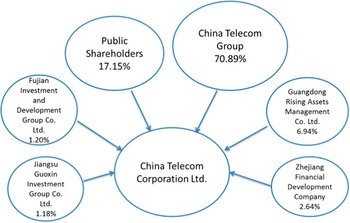
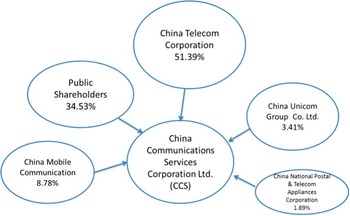
Even though CT Corporation and CCS are listed companies, CT Group maintains majority control over both of them. It holds 70.89% of the shares of CT Corporation shares, and 51.39% of the shares of CCS. Only 17.15% of CT Corporation’s shares and 34.53% of CCS’s shares are held by members of the public. The balance of shares in these two subsidiaries are held by various Chinese State-owned institutional investors, and in the case of CCS, China Mobile holds 8.78% and China Unicom holds 3.41%.Footnote 28 Figures 1 and 2 show the distribution of shareholdings for CT Corporation and CCS.
CT Corporation’s Shareholders.

CCS Corporation’s Shareholders.

CT Group itself is a 100% SOE directly under the PRC State Council and it is administered by the State-Owned Assets Supervision and Administration Commission (SASAC).Footnote 29 Though it is the holding company for the two listed corporations, CCS and CT Corporation, CT Group is not a listed company, so publicly available information regarding CT Group is limited to what it chooses to post on its website, along with some indirect information disclosed by its listed subsidiaries. This is a common issue with State-controlled Chinese corporate groups: their listed subsidiaries comply with exchange disclosure requirements to the letter, but the ultimate controlling entity remains partly hidden in the background, obscuring the true locus of control from ordinary public investors.Footnote 30
The complex overlap between CT Group and its subsidiaries affects its whole corporate governance framework, most notably the board structures of each company in the group and the appointment of senior executives in the major subsidiaries, as we will demonstrate below.
C China Mobile Ownership Structure
After meteoric growth, China Mobile currently has the world’s largest mobile phone network and the world’s largest mobile customer base. China Mobile originated as a Hong Kong and New York-listed corporation in 1997.Footnote 31 The controlling shareholder is a company registered in the British Virgin Islands (BVI), which in turn is wholly-owned by China Mobile Communications Group Corporation (CMCC), a mainland Chinese SOE. Through the BVI subsidiary, CMCC controls 74.07% of the listed company China Mobile Limited (referred to as CM Ltd below). The other 25.93% of CM Ltd’s shares are held by members of the public.Footnote 32 CM Ltd in turn controls 38 telecom service subsidiaries throughout mainland China and Hong Kong.Footnote 33 Figure 3 gives a schematic diagram of CM Ltd’s share structure.
CM Ltd. Share Structure.

Despite the greater complexity of the corporate structure – with an interposed BVI corporation that was probably necessary to allow the company to list its shares on the NYSE – we see again a listed Hong Kong subsidiary controlled by a large mainland Chinese SOE group.
D Boards of Directors at the Major Subsidiaries of China Telecom and China Mobile
There is a great deal of overlap between the senior management of these two firms’ parent companies and the Boards of their major subsidiaries. Looking first at China Telecom Group’s two listed subsidiaries, CT Corporation has established a board of directors which currently includes 12 members. Of these, seven are executive directors, one is a non-executive director, and the other four are ‘independent’ directors.Footnote 34 This means that CT Corporation complies with the CSRC’s requirement that at least one-third of a listed Chinese company’s directors be independent.Footnote 35 CT Corporation’s independent directors appear to be highly experienced business leaders or business academics, although one of them, Madam Laura Cha May Lung, is a Hong Kong Delegate to the 12th National People’s Congress of the PRC, and a Member of the Executive Council of the Government of the Hong Kong Special Administrative Region. This may create a conflict of interest when China Telecom deals with regulatory issues in Hong Kong.Footnote 36 The non-executive director is Zhu Wei, who is currently the Chairman of Guangdong Rising Assets Management (a State-owned financial services firm that is one of the domestic shareholders of CT Corporation). This shareholding relationship means that Zhu Wei is not independent of CT Corporation, but he has never been an employee or manager of CT Corporation.Footnote 37
However, the majority of CT Corporation’s Board are executive directors, serving simultaneously as senior managers of the company. There is no separation between the CEO and the Chairman of the Board, with both roles currently occupied by Wang Xiaochu, something that is not recommended by the OECD Principles, as it limits the ability of the Board to monitor the executives.Footnote 38 There is no doubt that all the executive directors have been appointed by CT Group, as they all concurrently have senior executive positions in CT Group as well: Wang Xiaochu is Chairman of CT Group, and the other 6 directors are either President or Vice Presidents of CT Group.Footnote 39
The situation at CCS is a bit more complex. The CCS Board of Directors has nine members, of whom three are listed as executive directors, two as non-executives, and four as independent directors. This means that CCS does appear to have a majority of non-executive directors, and the independent directors can in theory outvote the executives by four votes to three. However, two details cast doubt on the true independence of the CCS Board from management and from CT Group’s control. First, one of the ‘independent’ directors, Wei Leping, was formerly an executive vice-president at CT Corporation and senior engineer at CT Group, and is currently Chairman of the Science and Technology Advisory Committee of CT Group. With this background and present position, it is not clear why he is listed as an independent director, as he clearly has very close ties to the majority shareholder CT Group. Second, CCS also lists Wang Xiaochu, the current Chair of CT Group and Chair/CEO of CT Corporation, as ‘Honorary Chair’ of the CCS Board. While the website notes that Wang is not a ‘member of the Board’ and does not have any power or right to vote on matters discussed by the CCS Board, it is highly likely that the actual Board members (except possibly the two non-executives from other companies) will defer to his opinion. The fact that Wang’s name is placed at the top of the list of CCS ‘Directors, Supervisors and Management’ on the company’s website suggests that his role will be more than purely ornamental.Footnote 40
Clearly, there is a great deal of overlap between the management of CT Corporation, CCS, and CT Group, with the parent corporation exerting a controlling influence. Although formal annual general meetings are held by both CT Corporation and CCS for their shareholders to elect board members, and in theory minority shareholders with 3% of the votes could propose candidates for the Board,Footnote 41 in practice it is certain that all the directors are nominated by CT Group. The only exceptions are two non-executive directors at CCS and one at CT Corporation, who are nominated by large minority shareholders.
Turning to CMCC, the Board of Directors of its main subsidiary CM Ltd currently comprises 10 directors, including six executive directors and four independent directors.Footnote 42 All six executive directors are concurrently senior executives of the SOE parent CMCC, except for Huang Wenlin, who ceased to be a director of CMCC in June 2014. Xi Guohua, the Chairman and executive director of CM Ltd, is Chairman of the Board of Directors and Communist Party Secretary of CMCC, and Li Yue, the CEO of CM Ltd, is President and Director of CMCC. The three other Vice Presidents of CM Ltd are also Vice Presidents of CMCC.Footnote 43 While CM Ltd’s four independent directors are all highly distinguished and experienced business leaders, they are clearly in the minority on the Board.
E Boards of Directors at Parent Companies of China Telecom and China Mobile
Since most of the directors of the major subsidiaries of both CT Group and CMCC are appointed by their parent companies, it is relevant to ask how these two parent companies appoint their own senior management and what their Board structures are. Unlike the listed subsidiaries, this information is much harder to locate, and it is not clear whether the two firms comply with either the OECD Principles or even the PRC Company Law.
Though it calls itself a ‘group company’ (jituan gongsi), it is not clear whether CT Group is registered as either a limited liability or joint stock company under the PRC Company Law. Certainly, it does not comply with the requirement of the PRC Company Law to have a board of directors of at least three for a limited liability company (or at least five for a joint stock company).Footnote 44 CT Group only lists two directors (dongshi) on its website – Wang Xiaochu, the Chair, and Yang Jie, Group President. The other eight members of CT Group’s ‘management team’ are listed as Vice-Presidents but are not directors.Footnote 45 The PRC Company Law does contain a separate chapter of provisions for ‘wholly State-owned companies’ (Arts 65-71), but these do not state that a company can dispense with a board of directors, only that the board members should be elected by SASAC rather than at a shareholders’ meeting (Article 68). This lack of a full board of directors probably stems from CT Group’s history as a SOE. Many of China’s SOEs were originally formed before the PRC Company Law required all corporations to establish boards, and even now they have not all set up modern corporate governance structures.Footnote 46 SASAC itself passed a provisional regulation in 2004, which states that boards of directors would be introduced in centrally administered SOEs on an experimental basis, and all SOEs should have established boards by 2007.Footnote 47 The provisional regulation also states that ‘at least two’ of the directors on these SOE boards should be ‘external directors’, in other words, not employees of the company. CT Group seems to have ignored this requirement as well, as both of its current directors are longstanding employees of CT Group and its subsidiaries.Footnote 48
In terms of the appointment process for CT Group’s directors and senior executives, while the PRC Company Law states that SASAC has the power to appoint SOE’s board members, the senior executives are supposed to be appointed by the board of directors itself.Footnote 49 However, there is no information on CT Group’s website on how its directors or senior executives were appointed. We will return to this issue in the analysis section below.
By contrast, China Mobile’s parent company CMCC does have a full board of directors with seven members including four non-executives and one employee-elected director.Footnote 50 Assuming the non-executives are independent from the company, this would comply with both SASAC’s provisional rules on SOE boards of directors and with the OECD Principles, which is a promising development. However, apart from listing the names and positions of these executives, there is no other information on CMCC’s website or in its Annual Reports about the background and qualifications of the non-executives, or when and how they were appointed.Footnote 51 Further transparency would be helpful to demonstrate that the firm is accountable to public stakeholders.
F Sub-committees under the Boards of Directors
The listed subsidiaries of China Telecom and China Mobile have all established Board sub-committees, including the standard audit, remuneration, and nomination committees. These committees are all staffed by a majority of independent directors, in compliance with OECD and other international corporate governance best practices. However, it is noteworthy that in all of these companies, three independent directors take on virtually all the sub-committee work, which begs the question as to why there are several different committees rather than simply one.Footnote 52 Are these companies just adopting a ‘tick-the-box’ approach to corporate governance without actually considering whether each director is best qualified for each subcommittee, or are there simply not enough independent directors to cover all the positions? How can these directors deal with such a heavy workload when they are all acting as independent directors for several other major companies and running their own businesses or acting as government representatives too?Footnote 53
G Supervisory Committees
As Chinese-registered companies, both CT Corporation and CCS are required under the PRC Company Law to establish a Supervisory Committee to monitor the performance of the board of directors and other senior managers and prevent them from abusing their powers. The Supervisory Committee is independently accountable to the Shareholders’ Meeting and has the power to bring representative lawsuits on behalf of the company and its shareholders when directors have not fulfilled their duties to the company.Footnote 54
CT Corporation’s Supervisory Committee currently has five members, with its Chairman as the head of the Discipline Inspection Division of CT Corporation. This is a lower level appointment than the executives on the company’s board of directors. The four other supervisors are also lower level employees of the company: one is the Vice Chairman of the Labour Union, one is Deputy Managing Director of the Legal Department, another is a senior economist, and the last is from the audit department of the company.Footnote 55 The situation is similar at CCS where the Supervisory Committee consists of three members, two of whom are lower level employees of the company.Footnote 56 The obvious question is how can lower level employees effectively supervise their superiors in the company and expect to keep their jobs? As we will discuss in the conclusion, this is not the fault of these corporations, who are following the PRC Company Law requirements for Supervisory Committees to the letter, but rather a longstanding defect within the existing Chinese legal framework.
The parent company CT Group does not appear to have a Supervisory Committee despite the requirement to establish one for wholly State-owned companies in Article 71 of the PRC Company Law. At China Mobile, CM Ltd is a Hong Kong-incorporated company, so it is not required to establish a Supervisory Committee. However, China Mobile’s parent company CMCC has not set up a Supervisory Committee either, despite being registered in mainland China. Instead, it has substituted an Advisory Committee for Development of Strategy (ACDS). The role of ACDS in China Mobile is to provide recommendations and suggestions for further development of the company to assist the decision-making of company executives.Footnote 57 Members of the ACDS are appointed by company executives, and their appointment is for a term of four years. There are 20 committee members currently sitting on the ACDS. The ‘honorary director’ is Wu Jichuan, the former Minister of Information Industry, and the executive director is Zhang Ligui, the former CEO of CM Ltd. Seven committee members have extensive experience working in senior roles in the State Administration and six members are professors at various major Chinese universities who specialize in the telecom field.Footnote 58
This is a very interesting innovation, and even though it has no formal power to supervise the Board or management, clearly the range of contacts and expertise of the ACDS would make it potentially an excellent source of advice for CMCC’s Board and management, and probably more useful than the weak Supervisory Committees in many Chinese companies.
H Party Presence and Government Influence
Given the fact that China Telecom and China Mobile are majority State-owned corporations, the Communist Party plays an important role in these firms’ operations and management. There are comprehensive Chinese language links on CT Group’s website detailing the Party’s activities within the firm, although unlike other parts of the website there is no equivalent English language version available.Footnote 59 Within China Telecom, there are about 10,000 Communist Party Offices established in all the local divisions, 1,000 Party Committees (a level higher than Party Offices), and altogether about 200,000 Party members in the firm, which comprises around 25% of the total number of employees.Footnote 60 In-house Party Newsletters and Journals are published regularly, together with stories of exemplary Party Member employees praising their dedication to the Party and their hard work for the firm.Footnote 61 Within the large structure of the Party Committees, there are separate divisions looking after detailed Party-related operations including Party research and publications, Party promotional activities, Party corporate culture, youth-related work, and a separate ‘red letter box’, which is an email address for any Party-related communications.Footnote 62 China Telecom Workers’ Union is also part of the Party structure.Footnote 63 The impression is that all of the firm’s main in-house publications and social/cultural activities are organized by Party-affiliated groups, and through them employees are constantly exposed to the latest Party policies and campaigns.
For China Mobile there is no information on its corporate website about the number of Party Committees and Offices in the firm, or how many employees are Party members.Footnote 64 However, the authors’ Google search located several websites describing CMCC’s Party activities in mind-numbing detail, including a 2015 report which stated that the China Mobile Group had established over 8,000 Party organizations at various levels, and over 133,000 of the firm’s 570,000 plus employees were Party members.Footnote 65
There is an obvious overlap between the management of these two firms and the Party. Wang Xiaochu, the Chairman/CEO of CT Corporation and Chair of CT Group, also serves as the Secretary of CT Group’s Party Leadership Group (PLG), and all of CT Group’s other top executives are also members of the PLG. Likewise, all the executives of CMCC and CM Ltd are members of CMCC’s Communist Party Leading Group. This information is specified clearly in the executives’ online profiles.
It is therefore fair to infer that the Communist Party’s presence in these two firms is vital and exerts a powerful influence over their operations. However, there is no clear explanation in the articles of these firms’ listed subsidiaries about the role of the Party and how it interacts with their Boards of Directors and Supervisory Committees, and their annual corporate governance reports do not mention Party activities at all. It is also not clear from the firms’ various websites what role the Party plays in appointing the parent corporations’ senior executives, though presumably it must be closely involved, since all of them are ranking Party members.
I Analysis: China Telecom, China Mobile, and the OECD Corporate Governance Principles
Yukyung Yeo’s study of the relationship between SASAC and Chinese State-owned telecom firms stated that the Communist Party’s Central Organization Department (zhongzubu) is the body that selects suitable candidates for senior positions in SOEs in consultation with bureaucrats at SASAC, and while management talent is certainly one factor, the top executives are essentially political appointees rather than simply business professionals.Footnote 66 This explains why virtually all the senior executives in CT Group and China Mobile have extensive past experience as government officials in the State’s telecom administration. It also explains why it is common for senior telecom executives to be transferred from one firm to a directly competing firm and then occasionally back again within a short period of time: the Organization Department regularly shuffles executives in this way to discourage them from building networks of patronage that might tempt them to engage in corruption, and the executives have little choice but to accept these moves.Footnote 67 For example, Wang Xiaochu was previously Director General of the Hangzhou Telecommunications Bureau in Zhejiang province and Director General of the Tianjin Posts and Telecommunications Administration (both government positions). He was then appointed Chairman and CEO of China Mobile’s listed arm and Vice President of China Mobile’s parent company before being transferred in 2004 to become President and then Chairman/CEO of China Mobile’s main competitor CT Corporation.Footnote 68
During the same period, Zhang Chunjiang, former vice-minister of MII, became CEO of China Netcom (in 2003); Wang Jianzhou, Chairman and President of China Unicom, became Chairman and President of China Mobile; and Chang Xiaobing, Vice-President of China Telecom, became Chairman of China Unicom (both in 2004).Footnote 69 All the senior executives of CMCC and CM Ltd were in senior positions in the State telecom administration before joining China Mobile. For example, Xi Guohua, the current Chairman of the group, served as Vice Minister at the MII, the telecom regulator. Xue Taohai, Vice President and Chief Financial Officer of CM Ltd, served as Deputy Director General in MII. The fact that Wu Jichuan, former Minister of Information Industry, is honorary chair of CMCC’s advisory committee also emphasizes China Mobile’s strong ties with the Chinese government bureaucracy.
Are there any conflicts of interest created by this shuffling of telecom executives and regulatory officials, such as confidential information being leaked to competitors, and are the various moves really in the best interests of shareholders? It is not clear that the Party is considering these issues or the interests of minority public shareholders of listed subsidiaries when it engages in these sudden reshuffles, and no information is publicly disclosed about the Party’s decision-making process.
China Telecom has won several awards for its corporate governance, including the ‘Overall Best Managed Company in Asia’ and ‘No. 1 Best Corporate Governance in Asia’ by Euromoney for five consecutive years, and ‘The Best of Asia – Icon of Corporate Governance’ award from Corporate Governance Asia in 2013. But these awards were given to the listed subsidiary CT Corporation, not to the parent CT Group. As we have shown, the listed subsidiaries of China Telecom, China Mobile, and many other centrally-controlled SOEs superficially disclose large amounts of information to shareholders and the public about their management, operations, and finances, but their controlling parent corporations remain quite opaque, both in terms of corporate governance structures and financial information.
The OECD has acknowledged that SOEs should be subject to a modified set of principles due to their majority State ownership.Footnote 70 Yet even these modified principles strongly recommend a clear separation between the State’s role as regulator and its role as owner of enterprises. They also recommend hiring independent Boards of Directors with transparent recruitment processes to ensure that the most qualified candidates are chosen to run the businesses. And they state that even if SOEs are not listed on a securities exchange, as ‘public bodies’ they should provide detailed disclosure of their finances and governance structures so that opportunities for ‘rent-seeking’ by managers and bureaucrats are reduced, and so that members of the public (i.e. taxpayers) can see that the State is investing their money efficiently and monitoring its public servants closely.Footnote 71 It would be more in line with the OECD Principles and the SOE Guidelines to make the selection process for CT Group and China Mobile’s leadership more transparent, to clarify the role of the Party in that process and its interaction with the other governing bodies of each firm in the group, and to publish detailed financial reports as if these SOE holding companies were also listed corporations.
While CT Group and its subsidiaries have managed to avoid major public scandals up to now, neither CT Group nor China Mobile have fully complied with the OECD Principles as they relate to SOEs and the PRC Company Law. The risks of failing to comply are apparent when we look at the recent history of China Mobile. Based on Chinese and international media reports, at least 16 senior executives of CMCC and its subsidiaries have been sentenced to lengthy jail terms since 2009 for taking bribes in return for influencing China Mobile’s purchasing decisions or guiding business to favoured suppliers.Footnote 72 These executives have even included directors of CM Ltd and CMCC, such as Zhang Chunjiang (Deputy Chairman of CM Ltd and Vice President/Party Secretary of CMCC from 2008-9), given a suspended death sentence in 2011; Lu Xiangdong (Vice President and Director of CMCC), sentenced to life imprisonment in 2013; and Xu Long (Executive Director of CMCC and Chair/Party Secretary of China Mobile’s Guangdong Division), expelled from the Communist Party in early 2014 and currently awaiting trial for commercial corruption.Footnote 73 The lack of transparency surrounding CMCC’s finances, hiring practices, and internal controls has clearly allowed numerous senior executives to engage in corrupt activities without being detected for several years.
There is an incongruity between the apparently comprehensive corporate governance framework of CM Ltd and the systemic corruption revealed by these ongoing criminal prosecutions of senior executives. Reading the ‘Corporate Governance Report’ from CM Ltd’s 2008 Annual Report, when both Zhang Chunjiang and Lu Xiangdong were directors of the company, we find language such as ‘we have established good corporate governance practices following the principles of sincerity, transparency, openness, and efficiency’, ‘we have conducted a variety of anti-corruption disciplinary activities’, and ‘a corporate culture that emphasizes honesty and integrity’.Footnote 74 But the company’s internal controls apparently failed to spot the enormous bribes received by Zhang, Lu, and various other executives, and Lu was not removed as a director until 2012, having received over RMB 25 million in bribes between 2003 and 2011. The investigation that revealed the corruption was carried out mainly by the Chinese government’s National Audit Office, not by the company itself.Footnote 75
It should be no surprise that executives of a large SOE with a privileged market position in a massively expanding industry would be tempted to take large kickbacks when choosing between suppliers. But the fact that CM Ltd failed to put in place proper monitoring systems to spot these corrupt practices despite its ‘best practice’ corporate governance framework suggests that it has been merely engaging in a ‘tick-the-box’ approach rather than encouraging its independent directors, audit committees, supervisors, and external auditors to vigorously uncover financial and operational irregularities.
III PRIVATE AND MIXED OWNERSHIP ICT FIRMS
How does the corporate governance framework of State-controlled ICT firms compare with privately-controlled firms? We will now turn to two of China’s largest and most internationally successful telecom equipment manufacturers to examine the impact of significant private control over corporate governance practices.
A Unlisted Private ICT Firm: Huawei Technologies (Huawei)Footnote 76
Huawei is a highly successful communications technology firm, with its core business focused on internet and telephone network hardware. It has business operations or sales in over 170 countries, supplying some of the world’s largest telecom and internet service providers, and over half of its annual USD 39 billion revenue come from outside China.Footnote 77 Huawei’s founder and CEO Ren Zhengfei was once a relatively low-ranking officer in the Chinese military engineering corps.Footnote 78 However, he left the army in 1983, and a few years later in 1987 he set up a private business selling simple telephone exchange switches imported from Hong Kong, which later grew into Huawei.Footnote 79
1 Huawei’s ownership structure
Originally Huawei had six investors including Ren Zhengfei who together invested RMB 21,000 as Huawei’s initial capital, but the other five investors were soon bought out.Footnote 80 From the early 1990s, Huawei was run as an employee-owned collective enterprise, with Ren and the other founding employees holding the majority of the shares. According to Chinese accounts of the firm’s development, in its early stages Huawei’s employees were all given the opportunity to buy shares in the firm, and the returns on their investment were extremely high as Huawei expanded rapidly, soon making its employees the highest paid in the telecom industry.Footnote 81 However, Huawei was not registered as a company until 1997, and its employee shares were not typical of a registered Chinese company’s shares: they were not transferable, carried no votes, and could not be retained if employees ceased to work at the firm.Footnote 82 Control of Huawei’s management and finances remained with the incumbent CEO and a small circle of senior managers, and there were no formal board of directors or supervisory committees, and no shareholders’ meetings.Footnote 83
Interestingly, during the 1990s, Huawei also set up various subsidiaries and joint ventures – some accounts put the number at over 30 – in partnership with local branches of China Telecom and China Unicom, in which officials and employees of these State telecom service providers were encouraged to buy shares.Footnote 84 This was the main way Huawei was able to build up a ‘community of mutual interests’ with its main Chinese customers, the telecom service providers, despite being a private enterprise, and to compete with State-controlled equipment suppliers. Telecom officials were happy to purchase Huawei’s switching hardware on behalf of their firms, knowing that the more equipment they purchased, the more profits they would make personally. It was not unusual for annual returns on their shares in these joint ventures to reach 70%.Footnote 85 The telecom officials and employees never owned shares in Huawei Technologies itself; they only had ownership interests in Huawei’s subsidiary joint ventures and companies. Despite the obvious conflicts of interest involved in officials profiting from their firms’ purchases, this kind of arrangement was not illegal back in the 1990s: it was a legal grey area.Footnote 86 But in the late 1990s, the government restructured the State telecom firms and discouraged officials from running businesses on the side, so Huawei had to buy out all the joint ventures and find more orthodox ways to attract customers.Footnote 87
Another reason for Huawei’s restructuring was to comply with the PRC Company Law, which had been implemented in 1994. Huawei registered as a company called Huawei Investment & Holding Co., Ltd. in 1997, and the PRC Company Law requires a company with more than 50 shareholders to give each shareholder one vote per share.Footnote 88 Huawei expanded rapidly during the 1990s, hiring thousands of employees and paying them partly in shares, and senior management did not own sufficient shares to retain control over voting under the PRC Company Law rules.
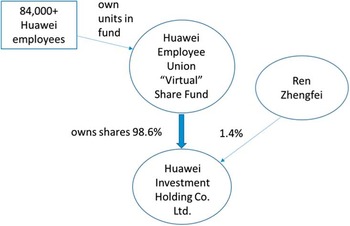
So as part of Huawei’s restructuring in the late 1990s, the firm set up an employee investment fund, called the Union of Huawei Investment & Holding Co., to acquire Huawei’s shares from its employees and become the controlling shareholder.Footnote 89 In return, the employees were allotted units in the investment fund instead of shares, which did not give them direct voting power but allowed them to share in the company’s profits.Footnote 90 Huawei refers to these employee units as ‘virtual restricted shares’ (xuni shouxian gu), but this is misleading because the registered shareholder is the Union.Footnote 91 Figure 4 gives a schematic diagram of Huawei’s current ownership structure.
Huawei’s Ownership Structure.

Since 2010, the investment fund has been governed by an employees’ representative commission, which casts votes in shareholder meetings on behalf of the employees, electing directors and approving profit distributions, capital increases, and company by-law amendments.Footnote 92 There are 51 regular employee representatives on this commission and nine alternates, all of whom were elected by Huawei’s employees in 2010 for five-year terms. But the CEO Ren Zhengfei has always had veto power over any decisions made by the commission, including appointments to Huawei’s Board.Footnote 93 This is the firm’s current ownership structure, and it means that even though there are about 84,000 Huawei employees who hold units in the investment fund that owns Huawei’s shares, the firm is still effectively controlled by its senior management.Footnote 94
Huawei’s ownership structure is certainly unorthodox, designed to get around the inflexible rules on share voting in the PRC Company Law and to avoid the firm having to organize regular meetings of all 84,000 employee shareholders.Footnote 95 Many foreign observers have erroneously assumed that somewhere in this structure lurks Chinese government or military control, but the facts do not support such a conclusion.Footnote 96
Having said this, there were serious irregularities in the way this gradual restructuring process was carried out. During the 1990s, employee shareholders had never been given share certificates recording how many Huawei shares they held, and even those employees who kept their own records had no idea how their proportion of shares corresponded to Huawei’s total issued share capital.Footnote 97 Former employees have even claimed that they were told to sign blank sheets of paper, to which the firm later added the text of the agreement to transfer their shares to the employee investment fund.Footnote 98 Several employees left Huawei around the time of the restructuring, some even bringing lawsuits against the firm alleging that their shares were being redeemed by Huawei at a value much lower than the firm’s market value per share, and that they had not been notified that the valuation formula was changed when the shares were transferred to the fund.Footnote 99 Clearly, Huawei’s senior management did not view employee shareholders as the true owners or controllers of the firm.
One reason for Huawei’s lack of transparency towards employees is that the firm’s senior management wants to maintain flexibility in how they reward employees and to raise or lower distributions to employees based on their performance.Footnote 100 If employees knew what proportion of units they held in comparison to Huawei’s total capital, they would easily calculate their expected return based on Huawei’s end of year profits, and they might be tempted to behave like passive investors, free-riding on the work of other employees, rather than actively seeking to maximize the firm’s profits.
Whether this motive justifies Huawei’s lack of transparency towards employees is debatable, but one major consequence of adopting this unorthodox system has been to delay the firm’s listing on a securities exchange.Footnote 101 Listing would require full public disclosure of the firm’s share structure and the formulas for distributing profits to unit holders each year, to allow outside investors to assess the potential future return on shares that they purchase. Huawei’s failure to list means that it has been forced to rely on raising money from its own employees, telecom firms investing in its subsidiaries, and bank loans, rather than from the broader investing public.Footnote 102
2 Board of directors
With Huawei’s restructuring as a company, it has established a Board of Directors and Supervisory Committee based on the requirements in the PRC Company Law. It is not clear when these were first set up, but Huawei has listed the members of the Board and Supervisory Committee in its annual reports since 2010, and the most recent reports also include brief profiles of their background and qualifications.Footnote 103
The Huawei Board of Directors currently consists of seventeen directors, with Sun Yafang as Chairman and Ren Zhengfei as one of four Deputy Chairman along with Guo Ping, Xu Zhijun, and Hu Houkun.Footnote 104 These last three are currently taking turns to serve as Huawei’s ‘rotating CEO’ every six months, a unique system that will be discussed below. However, Ren Zhengfei appears to have retained his position as CEO, so it would be more accurate to refer to the rotating CEOs as deputy CEOs.Footnote 105 None of Huawei’s directors are independent, as they are all current or former senior executives, or full-time senior managers at Huawei.Footnote 106
The Board of Directors is elected by Huawei’s Representative Commission, and this Commission is in turn elected by all the firm’s Chinese employees.Footnote 107 The Representative Commission currently consists of 51 members, and these members attend Huawei’s annual shareholders meeting where Board elections and other decisions requiring shareholder approval take place. While this process appears to give the employee ‘owners’ indirect control over Board composition, there are three features of the current system that significantly restrict this. First, the company’s articles state that Ren Zhengfei holds veto power over any decisions made at shareholder meetings, and it appears that all candidates for the Board of Directors are actually selected by Ren in consultation with his senior executive team, and then approved by the shareholders meeting.Footnote 108 Second, the composition of the Representative Commission is heavily weighted towards senior managers (who are also investors in the employee Union fund). It is not clear how these representatives were nominated, or whether rank and file employees were given any choice of candidates, but at least 27 of the 51 current Representative Commission members (comprising 52.9%) are either Huawei directors, supervisors, or senior managers.Footnote 109 Finally, there does not appear to be a fixed term for the directors, and it is not clear how they might be removed or replaced.Footnote 110
In other words, despite Huawei’s restructuring into a company that appears to have majority employee union control, the firm is still effectively controlled by its senior management. Having said this, it is possible that a broader cross-section of Huawei’s employees will gain influence over Board elections after Ren’s veto power expires in 2018.Footnote 111
3 Sub-committees under the board of directors
Huawei is a private company, not a public listed company, so it is not required to follow the requirements for board committees in the PRC Code of Corporate Governance of Listed Companies or similar rules issued by overseas securities exchanges. Nevertheless, the firm has established various Board committees, including human resources, finance, strategy and development, and audit, which appear to cover the main areas recommended by the OECD Principles and the PRC Code. The functions and membership of each committee are listed in Huawei’s Annual Reports. However, there is no attempt to comply with Chinese or international best practices that would require a significant proportion of directors on each committee to be independent. As noted above, none of Huawei’s directors is independent, and all the members of these various committees are full-time senior managers of Huawei.
4 Supervisory Committee
As a PRC-registered limited liability company, Huawei is required to have at least one supervisor,Footnote 112 and the firm has established a Supervisory Committee consisting of five members. The current Supervisory Committee was elected by the shareholders Representative Commission in 2010.Footnote 113 The PRC Company Law states that a company’s Supervisory Committee must include both shareholder and employee representatives, but as Huawei has no shareholders who are not also employees, it effectively meets this requirement by default. As with the Board of Directors, there is no information in Huawei’s Annual Reports on how long its supervisors may serve before seeking re-election. However, Article 53 of the PRC Company Law states that supervisors must seek re-election every three years. It is not clear whether Huawei held the required re-election of the 2010 Supervisory Committee in 2013.
One of the main functions of the Supervisory Committee is to monitor the board of directors and senior executives of the company to ensure they are acting in the company’s interests,Footnote 114 which is why Article 52 of the PRC Company Law states that ‘no director or senior manager may concurrently work as a supervisor’. Huawei’s Supervisory Committee does not include any directors, but the members all appear to be senior managers in the company based on their profiles, even if they are not on the executive team.Footnote 115 It is not clear how they would effectively monitor their superiors in the management hierarchy. This is a problem common to many Chinese corporations, and we will discuss the awkward role of Supervisory Committees in our final analysis section below.
5 Senior executives
In theory, Huawei’s CEO is appointed by the Board of Directors, but in practice Ren Zhengfei has been Huawei’s CEO since 1988, and as the founder and guiding force of the company, it is highly unlikely that the Board would challenge his position.Footnote 116 However, Ren is already over 70 years old and has suffered various health problems, so he recently selected three potential successors as ‘Rotating and Acting CEOs’. Since late 2012, each Rotating CEO has served for six months at a time to give them experience in the top job in preparation for Ren’s eventual retirement.Footnote 117 This is an interesting experiment, as it allows the company to test out the candidates without committing to them in the long term. On the other hand, it means that when Ren retires, Huawei is virtually certain to replace him with an internal appointment rather than hiring from the broader executive market. All of the current Rotating CEOs have worked at Huawei since the late 1980s or early 1990s.Footnote 118 The other potential problem with this system is that it is not clear how the Rotating CEOs interact with Ren Zhengfei, who still retains his CEO title: are they really CEOs or just deputy CEOs lacking ultimate decision-making power?
Besides the Rotating CEOs, Huawei has also established an Executive Committee of the Board of Directors, whose role is to run the company on a day-to-day basis. This Committee includes the three Rotating CEOs and four other directors.Footnote 119 Selection of candidates for senior executive positions is made by the Human Resources Committee and appointments are then approved by the Board of Directors, but it is likely that in practice Ren Zhengfei plays a central role in approving the choice of senior executives.Footnote 120
It should be no surprise that like many other privately-controlled Chinese corporations, some family members of Huawei’s founder have risen to senior positions in the firm. Ren Zhengfei’s daughter Cathy Meng (Chinese name Meng Wanzhou) was appointed as Chief Financial Officer of Huawei in 2011 and is also on the Board of Directors; his brother, Ren Shulu, is on Huawei’s Supervisory Committee and acts as Chair of the firm’s internal management committee. However, Ren has publicly stated that none of his family members will become the next CEO of the company, and none of the current Rotating CEOs is related to Ren.Footnote 121
6 Huawei’s Communist Party branch
It is clear from the above analysis that Huawei is a private firm owned by its employees through an investment fund, but controlled by its senior management. While employees have in recent years been given more say in elections to the Board of Directors, Ren Zhengfei has still not relinquished control over the nomination and selection process, though this may change in 2018 when his veto expires. There is no government control or direct influence over Huawei’s business or management decisions, and no present or former government officials sit on Huawei’s Board or Supervisory Committee. Unlike State-controlled firms, the selection of Huawei’s senior managers does not go through the Communist Party’s Central Organization Department.
Like the majority of other medium to large Chinese companies, Huawei has established a Communist Party branch office, with one of its executives acting as Party Secretary in addition to his role as Chief Ethics and Compliance Officer.Footnote 122 Ren Zhengfei is also a CCP member, but does not lead Huawei’s Party branch.Footnote 123 However, there is no evidence that the Party branch acts as a conduit for government interference in the firm’s business decisions, and it likely plays a role similar to Party branches in other private firms: helping to motivate employees, organizing social and cultural activities to improve employees’ ‘spiritual welfare’ and to remind them how much the Party cares for them, and creating awareness among employees of the government’s latest policy campaigns.Footnote 124
7 Evaluating Huawei’s corporate governance system
While Huawei has clearly made efforts to overcome its slapdash treatment of employee shareholders in the past, sought to improve the transparency of its corporate governance structure, and open up its financial performance to public scrutiny with the assistance of international audit firms, some obvious defects remain. In particular, there is insufficient transparency with respect to share distributions and too much concentration of control with senior managers rather than the broad majority of employee shareholders. These defects are the result of business decisions made by Huawei’s management; they are not designed to conceal government or military influence, as some foreign lawmakers have alleged.Footnote 125 But it should be possible to design an employee remuneration system that allows for complete transparency, rather than using the current ‘closed box’ of a Union investment fund. Likewise, Huawei should include more open discussion in its Annual Reports about the role and membership of its Communist Party branch to prove that there is no interference by Chinese government institutions in the firm’s business management.
Still, despite these defects, Huawei has managed to produce remarkably high growth and exceptional returns to its employee investors year after year, making them among the highest paid employees in the telecom/electronics industry. As long as this situation continues, an employee-shareholder rebellion against senior management is highly unlikely. However, it will be interesting to see whether the next election to the shareholders Representative Commission will allow for broader nomination of candidates by lower level employees and lead to a truly ‘representative’ membership balance. If the firm wishes to expand its sources of funding by listing on a securities exchange, especially overseas or in Hong Kong, it will need to further open up its business to monitoring by outside investors, and this may require changes to its employee investment fund remuneration system to avoid discriminating against non-employee shareholders. At the same time, listing would require Huawei to hire independent directors to fulfil a more objective monitoring function over the senior management. Interestingly though, Ren Zhengfei publicly declared in 2013 that Huawei has no plans to list in the next 5 to 10 years, as it would not be conducive to the firm’s development.Footnote 126
B ZTE Corporation: A Listed Private/Mixed Ownership ICT FirmFootnote 127
ZTE is Huawei’s main Chinese competitor in the telecom and internet hardware business. Like Huawei, it is based in Shenzhen, and while it cannot match Huawei’s market share, it is currently ranked second in the world for sales of optical network products and has sold its products or services in over 160 countries with reported revenues in 2013 of over RMB 75 billion (USD 12.1 billion). Over 50% of its revenue come from its overseas operations.Footnote 128 Unlike Huawei, ZTE is listed on both the Shenzhen and Hong Kong Securities Exchanges, and is therefore subject to the corporate governance and public disclosure rules of those market operators and the PRC Code of Corporate Governance of Listed Companies.Footnote 129
Along with Huawei, ZTE was investigated by the US Congress in 2012, and the congressional committee’s report concluded: ‘The history and structure of ZTE … reveal a company that has current and historical ties to the Chinese government and key military research institutes.’Footnote 130 But does this characterization fairly reflect ZTE’s ownership and corporate governance structure?
1 ZTE’s ownership
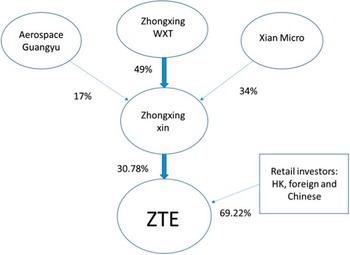
ZTE was first established as a joint stock company in 1997 and in the same year offered its shares to the public on the Shenzhen Securities Exchange. In 2004, it increased its capital by issuing new shares and listing them on the Hong Kong Securities Exchange. This means that 18.28% of the company’s shares are owned by Hong Kong or foreign investors, and 81.72% of the shares are currently owned by investors based in mainland China.Footnote 131 Although it is a public listed company, ZTE is effectively controlled by its parent company Zhongxingxin,Footnote 132 which owns 30.78% of ZTE’s shares. Zhongxingxin is able to maintain control because no other shareholders own more than 1.69% of ZTE’s shares.Footnote 133
To fully understand ZTE’s ownership structure, we need to go further back into the history of its controlling shareholder Zhongxingxin. This was originally a private enterprise called Shenzhen Zhongxing Semiconductor Limited Liability Company established by ZTE’s current Chairman Hou Weigui and six engineers in 1985 to produce telephone exchange switches.Footnote 134 In 1993, under a new government policy allowing so-called mixed ownership enterprises, Zhongxingxin was permitted to seek investment from State enterprises to assist its capital needs, and this appears to be the time when Xi’an Microelectronics, a State research institute, and Aerospace Guangyu, a wholly-owned subsidiary of the State-controlled aerospace conglomerate CASIC, purchased 34% and 17% of Zhongxingxin’s shares respectively.Footnote 135
In 1997, in preparation for listing on the Shenzhen Exchange, Zhongxingxin’s business was restructured. ZTE was registered as a joint stock company, with Zhongxingxin transferring most of its business assets and undertaking to ZTE while retaining a controlling stake in ZTE’s shares, and the rest of ZTE’s shares were sold on the market to a mix of retail and institutional investors.Footnote 136 In 2004, with the listing of approximately 18% of ZTE’s shares in Hong Kong, ZTE’s current ownership structure was basically fixed. Figure 5 gives a schematic representation of ZTE’s controlling shareholders.
ZTE Ownership Structure.

Though Zhongxingxin does have two large State-controlled shareholders, its third and largest shareholder is a private company called Zhongxing WXT,Footnote 137 which owns 49% of Zhongxingxin’s shares. Zhongxing WXT appears to be an investment vehicle for ZTE’s Chairman Hou Weigui and several dozen senior officers of ZTE, most of whom were founders and longstanding employees of Zhongxingxin prior to its restructuring.Footnote 138 While Zhongxing WXT does not own a majority of Zhongxingxin’s shares, it is able to nominate four of Zhongxingxin’s nine directors, which means that it only needs the support of one other director to exert control over Zhongxingxin’s Board and by extension control elections to ZTE’s Board.Footnote 139
From this analysis of ZTE’s ownership structure, it is clear that despite significant equity investment from the public and from State-controlled institutions, its senior officers have a disproportionate influence over the company’s management and profits, even if not to the same extent as the privately-owned Huawei Technologies.
2 ZTE’s Board of Directors
As a listed company in both Shenzhen and Hong Kong, ZTE publishes much more detailed information on its corporate governance structures and procedures than Huawei. Besides lengthy annual reports running to several hundred pages, the company also posts its Articles of Association and various other interim announcements and company rules/regulations on its website in both English and Chinese.Footnote 140 From these documents, one receives the initial impression of a company run according to a combination of Chinese and international corporate governance best practices and public disclosure procedures.
Unlike Huawei, elections to ZTE’s Board of Directors do not require the preliminary selection of a ‘shareholders representative committee’ but are conducted at the company’s annual meeting with all shareholders entitled to vote. Shareholders with an aggregate of 3% of the votes can propose directors for nomination to the Board and other motions to be considered at company meetings, and the company has adopted a cumulative voting system for director elections to give minority shareholders the option to cast all their votes for a single candidate.Footnote 141 Again, unlike Huawei, ZTE complies with the requirement for listed Chinese companies to have at least one-third of its Board consisting of independent non-executive directors who have no management, employment or significant shareholding relationship with ZTE. Of its 14 Board members, five are currently independent, mostly drawn from the business and legal faculties of Chinese universities.Footnote 142 Independent directors form a majority on ZTE’s Board committees, as discussed below.
Yet when we look more closely at the incumbents on ZTE’s Board, it is clear that they are effectively representatives of the company’s controlling shareholder Zhongxingxin. All nine of ZTE’s Board members who are not classified as independent are either concurrently on the Board of Zhongxingxin or previously worked at Zhongxingxin in senior managerial positions before ZTE was established in 1997. While ZTE’s articles do state that the company’s independent directors may propose motions for discussion by the Board or the shareholders, and the company’s Annual Report does refer in vague terms to suggestions of the independent directors that the company adopted in 2013, the fact that the independent directors are in a minority means that, as in other Chinese listed companies, their influence on substantive management decisions will be extremely limited.Footnote 143 Since the independent directors are not shareholders, they will have little incentive to propose changes to the company’s management that would maximize benefits to the minority shareholders at the expense of the controlling shareholder. With 30.78% of votes controlled by Zhongxingxin and another 18.28% of shares owned by foreign shareholders, it would be virtually impossible for a Chinese minority shareholder to solicit sufficient votes to pass a company resolution to replace directors with candidates not approved by Zhongxingxin. As discussed below, this may explain why no significant changes to the company’s Board or senior executives occurred following the company’s massive RMB 2.84 billion loss declared in the 2012 financial year, which the company’s Chairman admitted was due to various management errors.Footnote 144
3 Sub-committees under the Board of Directors
ZTE has established the standard Board committees for listed companies, including audit, nomination, and remuneration committees, and these are chaired by independent directors with a majority of committee members also being independent directors.Footnote 145 However, there are two details revealed by the company’s public disclosures that cast doubt on the effectiveness of these committees in monitoring the Board. First, Hou Weigui, ZTE’s Chairman and founder, is a member of all three Board committees. This would presumably constrain frank discussion among the independent directors about issues relating to remuneration, executive hiring, and internal group financing that affect Hou’s interests and the interests of ZTE’s controlling shareholder Zhongxingxin, in which Hou has a very large personal stake through Zhongxing WXT. Second, the attendance record of some independent directors at these committee meetings in 2013 was quite poor. For example, Wei Wei, who is Chair of the remuneration and evaluation committee, only attended five out of nine committee meetings. Wei is also a member of the nomination and audit committees, but only attended two out of four and three out of seven meetings of those committees respectively.Footnote 146 Though ZTE’s articles allow committee members to appoint a proxy to vote at meetings, and Wei did so for all the meetings that he missed, the main reason for having independent directors is to provide advice and guidance to the executive directors based on their professional expertise – which in Wei’s case is business managementFootnote 147 – and merely voting via proxy falls far short of that intended role. Even those independent directors who attended ZTE’s committee and Board meetings may not have had time to sufficiently digest all of the relevant information about ZTE’s business operations and make fully informed and independent decisions. This is because three of ZTE’s five directors are full-time senior university academics and also concurrently serve on the boards of at least four other large Chinese corporations.Footnote 148
4 Supervisory Committee
ZTE has established a Supervisory Committee with five members, two of whom are elected by the shareholders and the other three by employees in a ‘democratic’ process.Footnote 149 As with directors, the shareholder-elected supervisors can in theory be nominated by shareholders with an aggregate of 3% of votes. The employee-elected supervisors are actually elected by ZTE’s ‘staff representatives’, and it is not clear how those staff representatives were chosen.Footnote 150 ZTE’s articles also make it clear that no director or senior officer can serve concurrently as a supervisor.Footnote 151
It is interesting to look at the background of the current supervisors to see whether this complex appointment system results in a Supervisory Committee that is truly independent of ZTE’s management.Footnote 152 Not surprisingly, the two shareholder representatives on the Supervisory Committee both have longstanding ties to the controlling shareholder Zhongxingxin. Xu Weiyan worked at Zhongxingxin from 1989 and then transferred to ZTE upon its founding in 1997, where she held various positions including ‘Head’ of the Tender Department. Chang Qing was a senior officer at Zhongxingxin and Zhongxing WXT during the 1990s, and he is still the assistant to the general manager and chair of the workers’ union of Zhongxingxin, as well as a director of a Zhongxingxin affiliate called Shaanxi Zhongxing. More concerning is that among the three ‘employee’ representatives on the Supervisory Committee, the Chair Xie Daxiong worked at Zhongxingxin for many years in the 1990s, and then served as ZTE’s Executive Vice President until 14 January 2013, when he resigned his position and was elected as Chair of the Supervisory Committee in February 2013. Xie is still a director of six subsidiaries of ZTE. Clearly he is more of a management appointee rather than a representative of ZTE’s rank and file employees. The other two employee-elected supervisors appear to be more representative of the regular employees: He Xuemei is chair of ZTE’s labour union, and does not appear to hold any officer positions in Zhongxingxin or ZTE’s affiliates. Zhou Huidong is the head of ZTE’s financial control department and a qualified accountant, which should make him a good supervisor over ZTE’s financial affairs. However, with a majority of supervisors having such close ties to Zhongxingxin and ZTE’s senior management, it is difficult to see how the Supervisory Committee can objectively monitor and challenge decisions of ZTE’s Board of Directors.
5 Senior executives
ZTE’s President (equivalent to the CEO) and other senior executives are appointed by the Board of Directors with the assistance of the nomination committee.Footnote 153 As noted above, ZTE’s Board is heavily stacked with Zhongxingxin nominees, and this influence of the controlling shareholder is also clear in the background and connections of ZTE’s senior executives.Footnote 154 ZTE has three executive directors including the president, Shi Lirong, plus six executive vice presidents. All except one of these nine executives were already working in a management position at Zhongxingxin during the 1990s and then transferred to ZTE’s management when the company was registered in 1997. Wei Zaisheng, ZTE’s Executive Vice President and Chief Financial Officer, is currently still a director of Zhongxingxin. The three executive directors of ZTE and Wei Zaisheng are all concurrently directors or supervisors of Zhongxing WXT, the 49% shareholder of Zhongxingxin. Clearly, there is a lot of overlap between the most senior figures in ZTE, the company’s controlling shareholder Zhongxingxin, and Zhongxing WXT. According to one report, 38 of ZTE’s most senior current and former managers are beneficial owners of shares in Zhongxing WXT.Footnote 155 We will discuss the consequences of this arrangement further below.
6 ZTE’s Communist Party branch
There is no information about ZTE’s Communist Party branch on the company’s English or Chinese websites, or in its annual reports. However, the company did provide some information in its testimony to the US Congress in 2012. From that evidence, it is clear that like other large Chinese companies, ZTE does have a Communist Party branch with a committee of 19 members, and two of ZTE’s directors concurrently hold leading positions in the Party branch committee, as do some of the ‘major shareholders in ZTE entities’.Footnote 156 Though ZTE provided the names of the committee members to the US congressional commission, it requested that the names be kept confidential ‘for fear that the company or the individuals might face retaliation by the Chinese government or Communist Party’.Footnote 157
We are not aware of any Chinese law that requires the names of companies’ Communist Party branch members to be kept confidential, and after a brief internet search we were able to find out that the Party Secretary (dangwei shuji) of ZTE’s Communist Party branch committee is Zhang Taifeng, whom we noted above is also Chair of the company’s Supervisory Committee and former Chairman of ZTE; and He Xuemei, another Supervisor and chair of ZTE’s workers’ union, is the director of ZTE’s Party Office (dangban zhuren).Footnote 158
This unnecessary secrecy about the membership of the Communist Party branch and its role within the company contrasts dramatically with ZTE’s transparency in most other aspects of its corporate governance. It may also have negative commercial consequences, as ZTE’s failure to clearly describe the role of its Communist Party branch was one of the factors that led the US congressional committee to suspect ZTE of having government and military ties and to recommend blocking US government and private institutions from buying its products.Footnote 159
7 Evaluating ZTE’s corporate governance system
Compared to Huawei, ZTE is much more transparent about its corporate governance practices and has adopted a more orthodox system of shareholder elections and nominations of directors and senior executives. Nevertheless, it is clear from a careful reading of its public disclosures that despite the company’s claims to be an independent legal entity, it is overwhelmingly controlled by Zhongxingxin and especially by Zhongxingxin’s 49% shareholder Zhongxing WXT, and most of ZTE’s directors, supervisors, and top executives have close ties to the much more opaque private corporation Zhongxing WXT. Considering that Zhongxing WXT only owns an indirect 15.39% stake in ZTE’s shares, this degree of control should be of concern to the 60.22% majority of ZTE’s smaller outside investors, and possibly also to ZTE’s employees.
Unlike Huawei, which does not have any outside shareholders and has generously shared its profits with the vast majority of employees through its employee union investment fund, ZTE’s returns to shareholders have been quite weak in the past few years, and in 2012 it suffered a huge RMB 2.84 billion loss. Likewise, ZTE’s employees currently receive lower salaries on average than those at Huawei, and very few of them are permitted to participate in ZTE’s share-based incentive system.Footnote 160 ZTE’s Chairman, Hou Weigui, has declared that share incentives are not necessary to motivate employees to work hard for the firm.Footnote 161 Yet, while ZTE’s outside shareholders saw the value of their shares drop in 2012 and employees were told to tighten their belts, Hou and most ZTE’s senior executives still managed to profit handsomely from their shares in ZTE-affiliated companies. To give just two examples, ZTE reported spending RMB 278 million in 2012 and RMB 426 million in 2013 purchasing ‘raw materials’ from a Cayman Islands registered company called Mobi Antenna, which is controlled through an intermediary company by Zhongxing WXT and a group of current and former ZTE senior executives.Footnote 162 Likewise, a company called Zhongxing Energy (Zhongxing nengyuan), which was contracted to set up a major solar power farm in Tianjin, reported net profits of RMB 203 million in 2012. ZTE only has a 23.26% interest in Zhongxing Energy, and the rest of the shares are held by Zhongxing WXT and two of its affiliated companies in which ZTE has no shareholdings.Footnote 163 It is not clear why ZTE was only given a minority holding in Zhongxing Energy.
ZTE’s controlling shareholder Zhongxingxin and its two State-controlled investors have not missed out on the opportunity to profit from supplying ZTE, as ZTE also purchased RMB 235 million of ‘raw materials’ from Zhongxingxin in 2012, and another RMB 227 million in 2013.Footnote 164
It is true that ZTE’s annual reports do disclose these related party transactions, but they do not make it clear how extensive the personal interests of ZTE’s executives are in most of the affiliated companies. Outside investors would need to laboriously trawl through the public disclosures of several other companies to find out the complex interconnections between them. Though ZTE’s annual reports declared that these various purchases and related party transactions were all conducted at ‘market value’, and were approved by ZTE’s independent directors and shareholders, there appears to be a major conflict of interest when such large amounts of money are being diverted to affiliated companies in a way that directly benefits the de facto controlling shareholders and senior executives, at the expense of ZTE’s public shareholders. If ZTE had not experienced major losses in 2012, leading to intense media scrutiny, its opaque corporate structure might never have been exposed to the public.Footnote 165
The suspicions of the US congressional committee that ZTE is somehow allied with the Chinese government and military, and therefore its products pose a risk to US national security, appear overblown. While it is true that two of Zhongxingxin’s three shareholders are State-controlled entities – one being a research institute and the other a State-controlled business enterprise – the largest shareholder of Zhongxingxin is a private company, Zhongxing WXT, which is controlled by Hou Weigui and several other senior ZTE executives. And based on their passive behavior over the past 17 years since ZTE was set up, it appears that the motives of the two State-controlled investors are purely commercial rather than political, in other words, to maximize their profits from ZTE and Zhongxingxin’s other business ventures.
Nevertheless, to allay foreign government suspicions about potential Chinese government influence over ZTE, the company should be much more transparent in explaining the role and leadership of ZTE’s Communist Party branch, how it interacts with ZTE’s Board and senior executives, and where it fits into the company’s corporate governance structure. It should also explain what role the two State-controlled shareholders of Zhongxingxin play in managing ZTE (if any), and rationalize its business structure to ensure that any profits from affiliated companies go through ZTE rather than being diverted to its parent company or to Zhongxing WXT at the expense of ZTE’s retail shareholders.
IV ANALYSIS OF CURRENT CHINESE AND INTERNATIONAL CORPORATE GOVERNANCE DISCLOSURE RULES AS APPLIED BY CHINESE ICT FIRMS
In its 2011 self-assessment report on Chinese corporate governance, the CSRC claimed that there are no longer any significant deficiencies in the Chinese corporate legal framework when measured against the benchmarks set out in the OECD Principles.Footnote 166
The problem with this claim is that it assumes the OECD Principles provide an effective basis for creating a corporate governance framework and are appropriate for the Chinese business and political environment. But as we saw with the four corporations discussed above, they manage to sidestep many of the rules by setting up structures with ultimate controlling corporations that are much less transparent than their listed subsidiaries; or, in the case of Huawei, they are unlisted, and therefore are not subject to many of the corporate governance disclosure rules in the first place. As a result, while the listed arms of these corporations appear to disclose large amounts of information about their businesses and have created corporate governance structures that tick all of the compliance boxes, some key details are missing, such as how their parent corporations are governed, and how the senior executives of the parent corporations are appointed. This information is material for investors because of the overlap between the parent corporations’ executives and board members of the listed subsidiaries.
This problem is certainly not unique to China. In many East Asian countries, large conglomerates, either state- or family- controlled, often with listed subsidiaries, play a major role in local and regional economies – South Korean chaebol and Japanese keiretsu being the most famous examples.Footnote 167
The obvious solution to this problem is to require the controlling corporate shareholders to disclose information to the same extent as their listed subsidiaries. This may seem draconian, but in the case of State-owned parent corporations, the OECD has itself recommended that they publish audited financial statements and information about how their senior managers are appointed, so that they will be accountable to the taxpayers who ultimately fund them. This recommendation appears in the OECD’s separate set of SOE Guidelines, drafted in 2005 specifically to address the unique governance challenges in countries like China with significant state ownership of business entities.Footnote 168 However, the Chinese State-controlled corporations that we discussed have not responded to this recommendation, and the CSRC’s self-assessment does not refer to the OECD’s SOE Guidelines at all. This is a curious omission considering the large number of Chinese listed corporations that are controlled by SOEs.
In the case of mixed ownership listed corporations like ZTE, if SOEs own a significant minority of their shares, the same public interest factor would make it desirable to require detailed disclosure by these corporate shareholders in the listed companies’ reports. Even when the majority or ultimate controlling shareholder of the listed company is a private corporation, detailed disclosure would be desirable. It would discourage individual shareholders from hiding behind corporate vehicles to disguise their ownership, as happened with ZTE and its ultimate controller Zhongxing WXT. If a major shareholder of the parent corporation is controlled by the senior executives of the listed company, this fact should be disclosed to outside shareholders in the listed company’s reports, so they do not have to engage in extensive investigation of corporate registration files in mainland China or opaque offshore jurisdictions like the British Virgin Islands and Cayman Islands.Footnote 169
For private corporations like Huawei, which have never been listed, there are currently no mandatory public disclosure requirements, and there are only minimal rules on board structure and shareholder participation in the PRC Company Law. It is true that Huawei has recently made an effort to increase transparency by publishing audited financial statements and details on its employee shareholding fund and board appointment process. Yet this is entirely voluntary, and other Chinese private firms may not be so forthcoming. There are also questions about whether Huawei’s employee representative commission truly complies with the shareholder voting principles in the PRC Company Law, which stipulate that shareholders with more shares should receive more votes. This is particularly important when it comes to electing Huawei’s Board of Directors. It is likely that many other large private Chinese firms have engaged in even more unorthodox corporate governance practices, but due to lack of disclosure they remain under the radar. Even though they are private entities, there may be significant social disruption if such firms suddenly collapse due to corrupt or fraudulent behaviour by their executives, impacting not only thousands of employees but also suppliers and local communities.
One solution would be for the Chinese government to introduce a graduated system of disclosure for unlisted corporations similar to countries like Australia. Small unlisted (or proprietary) corporations would be exempt from public disclosure, but large unlisted corporations would be required to publish detailed annual and quarterly reports and audited financial statements just like listed corporations. The only difference is that unlisted corporations would not need to do continuous disclosure whenever a material change occurs, as their share prices are not subject to fluctuation on a public securities market. The definition of a large unlisted corporation would be based on whether the corporation meets two out of three conditions relating to the total value of its assets, the number of employees, and its annual revenue.Footnote 170
The Chinese government appears to be heading in the direction of greater disclosure requirements for all Chinese corporations. In 2014, the Legislative Office of the State Council issued a set of regulations entitled ‘Provisional Rules for Public Disclosure of Information by Enterprises’.Footnote 171 These Rules require government regulators to publicly disclose various kinds of information submitted to them by all business enterprises in China, including all registered limited liability and joint stock companies. In particular, SAIC must publicly disclose details of all companies’ shareholders and share transfers, any registered personal property security agreements, and any administrative penalties exacted against companies.Footnote 172 Companies also have a legal duty to publicly disclose information about their shareholders.Footnote 173 Finally, SAIC has the power to place business enterprises that do not comply with these disclosure duties on a publicly available list of ‘abnormally operated’ businesses for up to three years, and if the non-compliance continues after three years, or if SAIC has suspended its business license for non-compliance, the enterprise will be placed on a list of ‘enterprises that have seriously breached the law’.Footnote 174 Potential creditors and investors will see this as a warning to keep their distance from enterprises on these name-and-shame lists, and government institutions will be discouraged from granting them tenders or procurement contracts.Footnote 175
This new disclosure system appears to be much broader than those in place in most other jurisdictions.Footnote 176 If properly enforced, these rules should create a more market-based system for protecting creditors and investors than the previous system, which has effectively allowed unlisted corporations to remain completely opaque. However, even in their current form, they include a major loophole that allows companies to opt out of having much of their detailed financial information disclosed to the public.Footnote 177 A graduated disclosure system with no such loopholes focusing on larger unlisted corporations would be more manageable, and would provide greater protection to potential investors, employees, and members of the public.
Another key issue that emerged from our analysis of Chinese ICT corporations was the lack of clear guidelines for disclosing the role and composition of corporations’ CCP Committees. China Mobile and China Telecom’s listed arms make no secret of the fact that all their senior executives are concurrently leaders of the parent corporations’ CCP Committees. But while they provide plenty of information on how CCP policies are being promoted within their firms, and describe various social and cultural activities organized by their CCP Committees, they do not clearly explain how the CCP Committees interact with the board of directors of the listed corporations, or what role the CCP plays in appointing senior personnel of those corporations. There is no doubt that the CCP has a major influence on such appointments, as we saw with the sudden reshuffle of CEOs of several State telecom firms in 2004. But if this is the case for all State-controlled firms, the PRC Company Law or Code of Corporate Governance should introduce specific rules to regularize the CCP’s executive appointment function and to require companies to explain why the CCP’s choice of executives is in the best interests of the corporation and its shareholders. The PRC Company Law should also set out in more detail the functions of the CCP Committees within business firms and the limitations on their powers, as currently occurs with the board of directors, supervisory committee, and shareholders assembly.Footnote 178
The CCP’s role in State-controlled corporations is no secret, even if it is often omitted in the public disclosures of their listed arms. But as we saw with Huawei and ZTE, privately-controlled or mixed ownership firms are often reluctant to publicize the role or existence of their CCP Committees, for fear of ‘revealing State secrets’. This fear may be exaggerated, as some private firms have disclosed this information without repercussions. Yet it vividly demonstrates the need for explicit guidance in the PRC Company Law or other regulations. If private firms are required to establish CCP Committees, they should be encouraged or required to publicly reveal the leadership of those Committees, how they interact with the firm’s management, and how their role differs from that of the managers. As with financial disclosures, this requirement could be waived for small unlisted corporations, becoming mandatory for larger unlisted and public listed corporations. There is no reason why the CCP Committees should remain in the shadows, as they are an integral part of Chinese firms’ corporate governance structures.
V CREATING A MORE EFFECTIVE SYNTHESIS OF INTERNATIONAL AND CHINESE CORPORATE GOVERNANCE PRACTICES
The unclear role of the CCP in business firms relates to a broader problem with the current Chinese corporate governance framework. The attempt by Chinese regulators to import international corporate governance approaches that comply with the OECD Principles and graft them onto an existing, partly State-dominated, industrial structure has resulted in an over-complex, hybrid system where authority is dispersed over many different organs, without a careful consideration of how those organs should interact with each other. For example, the OECD Principles recommend independent directors, so the CSRC requires each listed firm to have independent directors, but being in a minority on the board, they have no real power to demand changes from the executive directors. Unlike supervisors, independent directors do not have the right to bring a lawsuit against other directors for breaching the PRC Company Law. Footnote 179
By contrast, supervisors do have various powers granted under the PRC Company Law, including calling shareholder meetings and bringing representative lawsuits against directors; but as we saw earlier, most supervisors are full-time employees of firms with a lower rank than the directors they are supposed to supervise. If they want to keep their jobs, they will have no incentive to offend wayward directors by challenging their decisions or threatening lawsuits against them.
Due to a shortage of qualified candidates, it may not be possible to have a majority of independent directors on Chinese boards, but rather than maintaining the current ineffective approach, it would be more sensible to replace the independent director system with an ‘independent supervisors’ system. The selection criteria for independent supervisors could be similar to those for independent directors – experienced business people with no material ties to the company – but by appointing them as supervisors they would have much greater powers to monitor executive behaviour and enforce compliance, and unlike current supervisors, they would not be concerned about losing their jobs in the firm.Footnote 180
This recommended change to the independent director system, along with the proposals for expanded disclosure by unlisted and parent corporations discussed above, would make corporations more transparent and accountable to both shareholders and the general public. They would take account of the unique features of the Chinese business and political environment in a way that ‘tick-the-box’ adherence to the OECD Principles does not. They would also help to reduce the incidence of corrupt behaviour and opaque related party transactions that have plagued so many large Chinese corporations over the past decades, including ICT firms. Such changes would support the development of the kind of rule of law society that the current Chinese leadership has strongly advocated for.