Introduction
Jatropha (Jatropha curcas L., Jc) is an oil-bearing tree for biodiesel production. The most important obstacle for jatropha to be commercialized is that the plant is still wild (Tar et al., Reference Tar, Tanya and Srinives2011), giving low seed yield of less than 2000 kg/ha in 4- to 5-year-old plants with uneven fruit maturity (Everson et al., Reference Everson, Mengistu and Gush2012). However, wood from jatropha coppice is a potential source of energy containing about 15.5 MJ/kg at 15% moisture (Sotolongo et al., Reference Sotolongo, Beatón, Diaz, de Oca, del Valle, Pavón and Zanzi2009). However, jatropha wood is very light with a density of about 0.35 g/cm3, high in moisture content and burnt too rapidly; thus, it is rarely used as a fuel-wood source.
Interspecific crosses have been widely used in plant improvement to combine desirable characters that are available in wide relatives, as in biomass breeding of willow (Johansson and Alström, Reference Johansson and Alström2000), poplar (Vries and Turok, Reference Vries and Turok2001), eucalyptus (Christine et al., Reference Christine, Tentchev, Prin, Goh, Japarudin and Perrineau2009) and Leucaena (Brewbaker and Sorensson, Reference Brewbaker, Sorensson, Janick and Simon1990). Improvement of jatropha for wood biomass is also possible through interspecific cross with a wide relative, Jatropha integerrima (Ji), an erect ornamental shrub with hard wood (Lakshminarayana and Sujatha, Reference Lakshminarayana and Sujatha2001). In this study, we produced interspecific hybrid plants from a cross of Jc × Ji and determined their potential as a biomass source. Heterosis of biomass yield and yield components were also examined.
Materials and methods
Interspecific cross and cultivation
Interspecific hybridization was made between a large canopy type of Jc from Mexico and an erect and tall canopy type of Ji from Thailand. The parents and F1 hybrid were planted in a randomized complete block design with three replications, having five plants per plot. The experiment was conducted during March 2011 to March 2012 in a field of the Kasetsart University-Kamphaeng Saen campus, Thailand. The spacing used was 1 m between plants and 1.5 m between rows. A commercial compost was applied at 80 g per hill prior to transplanting. A compound fertilizer of 15:15:15 (N–P2O5–K2O) was applied at 20 g/plant, 4 and 8 months after transplanting. The field was furrow-irrigated twice a month. At 1 year old, the plants were harvested at 40 cm above ground to estimate for biomass yield and its components.
Measurement of biomass characters and heterosis
Upon harvesting, data were individually recorded for biomass yield and quality. Calorific value (MJ/kg) was determined using an oxygen bomb calorimeter (Calorimeter Model 6200; Parr Instrument Company). The composition of cellulose, hemicellulose and lignin was assessed following Van Soest et al. (Reference Van Soest, Robertson and Lewis1991), while ash content was determined using AOAC standard method 942.05 (AOAC, Reference Helrick1990). Heterosis of biomass yield and its components were determined by comparing the F1 hybrid with the mid-parent value and using a t-test to declare the significance of heterosis (Soehendi and Srinives, Reference Soehendi and Srinives2005).
Statistical analysis
All traits measured were subjected to analysis of variance. Once an F-test for difference between generations was declared significant, the treatment means were compared by Duncan's multiple range tests and the significant traits were calculated for correlation coefficient (r). All statistical analyses were performed using the R freeware program (R Development Core Team, 2010).
Results and discussion
Interspecific hybridization
Seed set was obtained only when Jc was used as the female parent. When Ji was used as the female parent in the reciprocal cross, all young fruits dropped within 7 d after pollination. Out of 60 pollinations in the direct cross, 22 seeds were obtained, of which 17 germinated to vigorous seedlings.
Biomass yield and its components
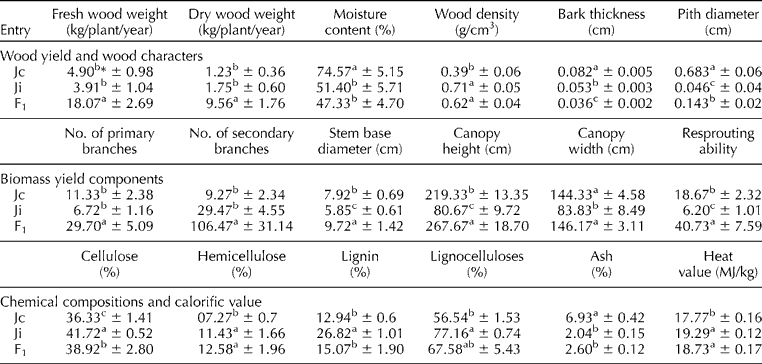
At 1 year after transplanting, the F1 plants were superior than their parents in the number of primary branches, the number of secondary branches, stem base diameter, canopy height and resprouting ability. The canopy width of the hybrid was not different from Jc, but was larger than Ji (Table 1). The F1 hybrid was superior to both parents in fresh wood weight per plant, dry wood weight per plant and bark thickness, with a higher wood density but a lower moisture content and a smaller pith diameter than Jc. The F1 hybrid had a larger pith diameter but thinner bark than Ji, and significantly superior to Jc in both traits. Dry wood and wood chip of the F1 hybrid and Ji appear heavy and firm, while those in Jc appear light and wrinkled. The F1 hybrid set only a few seeds similar to Ji. The vigorous growth of the hybrid plants probably came from the accumulation of photosynthate (Ps) to promote only vegetative growth. Silip et al. (Reference Silip, Armansyah, Hambali, Surahman and Sutrisno2010) postulated that the indeterminate growth habit of Jc is probably a result of continuous translocation of Ps to both the vegetative and reproductive parts at the same time. The F1 plants showed positive correlations of dry biomass yield with fresh biomass (r= 0.977) and stem base diameter (r= 0.974), but negative between moisture content and wood density (r= − 0.955) (data not shown). Most leaves of the hybrid plants dropped in the dry season such as Jc, and this trait is desirable to facilitate harvesting for wood. The F1 hybrid showed exceptional ability to resprout. Its plant type was erect V-shaped and thus can be planted at a spacing of as low as 1 m × 1.5 m (~6667 plants/ha). A large-scale test for biomass production of the hybrid will be undertaken before commercializing it in a coppice plantation.
Mean±SD of biomass characters (per plant basis) at the harvesting of Jc, Ji and their interspecific F1 hybrid

* Mean values with unlike superscript letters were significantly different at P≤ 0.01.
Chemical composition and calorific values
Components of lignin and lignocelluloses of the F1 hybrid were similar to those of the parents, while the cellulose content of the F1 hybrid fell between the two parents. The contents of hemicelluloses, lignocelluloses and ash, and the heat value of the F1 hybrid were not different from those of Ji, but significantly superior to those of Jc. Percentages of cellulose and lignin in the F1 hybrid were similar to the first-year copping of Leucaena leucocephala (41.2 and 19.4%, respectively; López et al., Reference López, García, Yánez, Tapias, Fernández and Díaz2008). The gross heat values of wood in Ji and the F1 hybrid were not different but higher than that of Jc. The F1 plants showed a similar gross heating value to 1-year copping willow (18.70 MJ/kg; Peter, Reference Peter2002), and 3-year copping L. leucocephala (18.94 MJ/kg; Feria et al., Reference Feria, López, García, Pérez, Zamudio and Alfaro2011). The solid biofuels from 1-year-old plants of poplar and eucalyptus also gave similar heating values (Klasnja et al., Reference Klasnja, Kopitovic and Orlovic2002; Telmo et al., Reference Telmo, Lousada and Moreira2010).
Hybrid vigour of the F1 plants
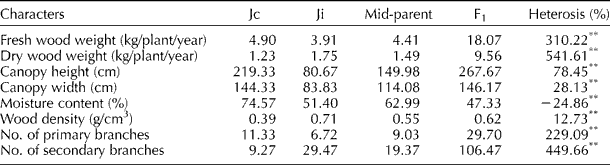
The F1 hybrid exhibited significant positive heterosis in all traits, except negative for moisture content, which revealed that the F1 hybrid has less wood moisture than the average value of Jc and Ji (Table 2). The weight of dry and fresh wood per plant showed exceptionally high heterosis over the mid-parent (541.61 and 310.22%, respectively). For biomass components, high heterosis was observed for number of primary and secondary branches at 229.09 and 449.66%, respectively. While canopy height, canopy width and wood density gave a heterosis of 78.45, 28.13 and 12.73%, respectively. The negative heterosis of moisture content ( − 24.86%) is an advantage as the F1 wood would need less time and/or energy for drying to a required moisture content. These desirable traits can be fixed through cutting propagation of the F1 plants.
Heterosis for biomass yield and yield components in the F1 hybrid between Jc and Ji

** Indicate significant differences between the mid-parent and F1 hybrid at P≤ 0.01.
Conclusion
This study is the first to report on developing a new woody hybrid jatropha for short rotation coppice. Although the hybrid plants set only a few seeds, they gave a high wood yield and density, fibre content and heat value, but a low moisture content, ash percentage, bark thickness and pith diameter.
Acknowledgements
N. M. was supported by the Office of the Higher Education Commission for the Strategic Scholarships Fellowships Frontier Research Networks (specific for the southern region of Thailand). This research was funded by the Chair Professor Project of Thailand's National Science and Technology Development Agency.