Suicidal behavior, e.g. a suicide attempt, is one of the leading causes of injury and death worldwide, particularly among young adults (ed. World Health Organization, 2014). With the goal of identifying individuals at elevated risk, research has emphasized understanding the correlates of suicidal ideation and behavior, including genetic (Sokolowski et al. Reference Sokolowski, Wasserman and Wasserman2014), biological (van Heeringen & Mann, Reference van Heeringen and Mann2014), neuroanatomical (Martin et al. Reference Martin, Zimmer and Pan2015), cognitive (Joiner et al. Reference Joiner, Steer, Abramson, Alloy, Metalsky and Schmidt2001), behavioral (Joiner, Reference Joiner2005), sociodemographic (Kessler et al. Reference Kessler, Borges and Walters1999), interpersonal (Beautrais et al. Reference Beautrais, Joyce and Mulder1997), and personality (Brezo et al. Reference Brezo, Paris and Turecki2006) factors, among others. Neuroticism has been a consistent candidate that may characterize individuals with suicidal ideation and those who report a history of suicidal behavior, specifically attempted suicide. There has recently been a suggestion that neuroticism may serve as an endophenotype for suicidality (Jimenez-Trevino et al. Reference Jimenez-Trevino, Blasco-Fontecilla, Braquehais, Ceverino-Dominguez and Baca-Garcia2011). However, support is mixed with respect to the association between neuroticism and suicidal behavior (Brezo et al. Reference Brezo, Paris and Turecki2006). Understanding the role of neuroticism in suicidality requires clarifying the nature of the association of neuroticism with suicidal ideation and behavior, specifically attempted suicide.
Though various models of personality have been established, all incorporate a concept of neuroticism containing features such as negative affectivity (Eysenck & Eysenck, Reference Eysenck and Eysenck1975; McCrae & Costa, Reference McCrae and Costa1987). The formulation of neuroticism appears stable within various countries, including China (Yang et al. Reference Yang, McCrae, Costa, Dai, Yao, Cai and Gao1999), and is a consistent risk factor for psychopathology including depression (Kendler et al. Reference Kendler, Kessler, Neale, Heath and Eaves1993a , Reference Kendler, Neale, Kessler, Heath and Eaves b ) and anxiety (Jardine et al. Reference Jardine, Martin and Henderson1984). However, given the consistent association of psychopathology (e.g. depression) with suicidal ideation and attempt (Beautrais, Reference Beautrais2000), it is imperative that research adjust for comorbid diagnoses to avoid conflating suicidal ideation and attempt with related psychopathological syndromes. Similarly Kendler et al. among others, have demonstrated the role of stressful life events in suicidal ideation and behavior, specifically attempted suicide (Statham et al. Reference Statham, Heath, Madden, Bucholz, Bierut, Dinwiddie, Slutske, Dunne and Martin1998; Fergusson et al. Reference Fergusson, Woodward and Horwood2000; Roy, Reference Roy2003a , Reference Roy b ; Fanous et al. Reference Fanous, Prescott and Kendler2004; Bi et al. Reference Bi, Xiao, Zhang, Gao, Tao, Niu, Wang, Wang, Chen, Sun, Li, Fu, Gan, Sang, Zhang, Yang, Tian, Li, Yang, Sun, Li, Rong, Guan, Zhao, Ye, Zhang, Ma, Li, He, Chen, Cai, Zhou, Luo, Wang, Gao, Liu, Guo, Guan, Kang, Di, Li, Shi, Li, Chen, Flint, Kendler and Liu2012; Fang et al. Reference Fang, Heisel, Duberstein and Zhang2012; Zhu et al. Reference Zhu, Zhang, Shi, Gao, Li, Tao, Zhang, Wang, Gao, Yang, Li, Shi, Wang, Liu, Zhang, Du, Jiang, Shen, Zhang, Liang, Sun, Hu, Liu, Wang, Miao, Meng, Li, Hu, Li, Huang, Li, Ha, Deng, Mei, Zhong, Gao, Sang, Zhang, Fang, Yu, Yang, Liu, Chen, Hong, Wu, Chen, Cai, Song, Pan, Dong, Pan, Zhang, Shen, Liu, Gu, Wang, Liu, Zhang, Li, Chen, Kendler, Flint, Liu and Hashimoto2013; Chan et al. Reference Chan, Chiu, Lam, Wong and Conwell2014). Neuroticism may increase the risk to experience stressful life events or to perceive life events as stressful (Kendler et al. Reference Kendler, Gardner and Prescott2003; Pickles et al. Reference Pickles, Aglan, Collishaw, Messer, Rutter and Maughan2010). Therefore, it is also imperative that research on the correlates of suicidal ideation and attempted suicide adjust for stressful life events to evaluate the direct impact of neuroticism.
Suicidal ideation
Research on the link between neuroticism and suicidal ideation consistently demonstrates elevated neuroticism among people who report suicidal ideation (Lester, Reference Lester1987; Cox et al. Reference Cox, Enns and Clara2004; Lester & Voracek, Reference Lester and Voracek2013; Li et al. Reference Li, Aggen, Shi, Gao, Li, Tao, Zhang, Wang, Gao, Yang, Liu, Li, Shi, Wang, Liu, Zhang, Du, Jiang, Shen, Zhang, Liang, Sun, Hu, Liu, Wang, Miao, Meng, Li, Hu, Li, Huang, Li, Ha, Deng, Mei, Zhong, Gao, Sang, Zhang, Fang, Yu, Yang, Liu, Chen, Hong, Wu, Chen, Cai, Song, Pan, Dong, Pan, Zhang, Shen, Liu, Gu, Wang, Liu, Zhang, Flint and Kendler2014; DeShong et al. Reference DeShong, Tucker, O'Keefe, Mullins-Sweatt and Wingate2015), especially among women (Velting, Reference Velting1999; Bluml et al. Reference Bluml, Kapusta, Doering, Brahler, Wagner and Kersting2013; Mandelli et al. Reference Mandelli, Nearchou, Vaiopoulos, Stefanis, Vitoratou, Serretti and Stefanis2015). While much of the research in this area does not address the potential confound of diagnosis, many do adjust for comorbid internalizing disorders (Naragon-Gainey & Watson, Reference Naragon-Gainey and Watson2011; Batterham & Christensen, Reference Batterham and Christensen2012) and stressful life events (Statham et al. Reference Statham, Heath, Madden, Bucholz, Bierut, Dinwiddie, Slutske, Dunne and Martin1998; Fergusson et al. Reference Fergusson, Woodward and Horwood2000, Reference Fergusson, Beautrais and Horwood2003; Farmer et al. Reference Farmer, Redman, Harris, Webb, Mahmood, Sadler and McGuffin2001; Fanous et al. Reference Fanous, Prescott and Kendler2004; Pickles et al. Reference Pickles, Aglan, Collishaw, Messer, Rutter and Maughan2010; Bi et al. Reference Bi, Xiao, Zhang, Gao, Tao, Niu, Wang, Wang, Chen, Sun, Li, Fu, Gan, Sang, Zhang, Yang, Tian, Li, Yang, Sun, Li, Rong, Guan, Zhao, Ye, Zhang, Ma, Li, He, Chen, Cai, Zhou, Luo, Wang, Gao, Liu, Guo, Guan, Kang, Di, Li, Shi, Li, Chen, Flint, Kendler and Liu2012; Zhu et al. Reference Zhu, Zhang, Shi, Gao, Li, Tao, Zhang, Wang, Gao, Yang, Li, Shi, Wang, Liu, Zhang, Du, Jiang, Shen, Zhang, Liang, Sun, Hu, Liu, Wang, Miao, Meng, Li, Hu, Li, Huang, Li, Ha, Deng, Mei, Zhong, Gao, Sang, Zhang, Fang, Yu, Yang, Liu, Chen, Hong, Wu, Chen, Cai, Song, Pan, Dong, Pan, Zhang, Shen, Liu, Gu, Wang, Liu, Zhang, Li, Chen, Kendler, Flint, Liu and Hashimoto2013). Research that adjusts for comorbid diagnoses generally confirms the association of suicidal ideation with elevated neuroticism (though see Vrshek-Schallhorn et al. Reference Vrshek-Schallhorn, Czarlinski, Mineka, Zinbarg and Craske2011).
Suicidal behavior
Research on the link between neuroticism and suicidal behavior, specifically attempted suicide, has shown considerably less consensus than research on suicidal ideation. Individuals who report a past suicide attempt report higher neuroticism than healthy control participants (Rozanov & Mid'ko, Reference Rozanov and Mid'ko2011), community samples where diagnostic status is unknown (Lester, Reference Lester1998; Beautrais et al. Reference Beautrais, Joyce and Mulder1999; Fang et al. Reference Fang, Heisel, Duberstein and Zhang2012; Sharif et al. Reference Sharif, Parsnia, Mani, Vosoghi and Setoodeh2014; Tanji et al. Reference Tanji, Kakizaki, Sugawara, Watanabe, Nakaya, Minami, Fukao and Tsuji2015), and treatment seeking samples including substance (O'Boyle & Brandon, Reference O'Boyle and Brandon1998; Roy, Reference Roy2003a ) and alcohol abuse (Roy, Reference Roy2003b ). However, evidence is mixed (Lester, Reference Lester1987, Reference Lester2005; Cox et al. Reference Cox, Enns and Clara2004; Lester & Voracek, Reference Lester and Voracek2013; Livingston et al. Reference Livingston, Heck, Flentje, Gleason, Oost and Cochran2015). For example, in one of the largest samples in this literature, the National Comorbidity Survey, there may not be evidence of an association of neuroticism with a prior suicide attempt either lifetime or within the past 12 months (Cox et al. Reference Cox, Enns and Clara2004).
Evidence of an association between neuroticism and attempted suicide is particularly mixed when adjustments are included for comorbid psychopathology. There is some evidence that neuroticism, or similar indices, is elevated among participants who report a past suicide attempt (Statham et al. Reference Statham, Heath, Madden, Bucholz, Bierut, Dinwiddie, Slutske, Dunne and Martin1998; Maser et al. Reference Maser, Akiskal, Schettler, Scheftner, Mueller, Endicott, Solomon and Clayton2002; Fergusson et al. Reference Fergusson, Beautrais and Horwood2003; Dumais et al. Reference Dumais, Lesage, Alda, Rouleau, Dumont, Chawky, Roy, Mann, Benkelfat and Turecki2005; Pickles et al. Reference Pickles, Aglan, Collishaw, Messer, Rutter and Maughan2010; Draper et al. Reference Draper, Kõlves, De Leo and Snowdon2014) and among individuals who report multiple suicide attempts as compared with those who report one attempt (Pallis & Jenkins, Reference Pallis and Jenkins1977). However, several large samples with adequate power have found no evidence of a direct association between neuroticism and attempted suicide when adjusting for comorbid depression (Fergusson et al. Reference Fergusson, Woodward and Horwood2000; Batterham & Christensen, Reference Batterham and Christensen2012; Bi et al. Reference Bi, Xiao, Zhang, Gao, Tao, Niu, Wang, Wang, Chen, Sun, Li, Fu, Gan, Sang, Zhang, Yang, Tian, Li, Yang, Sun, Li, Rong, Guan, Zhao, Ye, Zhang, Ma, Li, He, Chen, Cai, Zhou, Luo, Wang, Gao, Liu, Guo, Guan, Kang, Di, Li, Shi, Li, Chen, Flint, Kendler and Liu2012; Zhu et al. Reference Zhu, Zhang, Shi, Gao, Li, Tao, Zhang, Wang, Gao, Yang, Li, Shi, Wang, Liu, Zhang, Du, Jiang, Shen, Zhang, Liang, Sun, Hu, Liu, Wang, Miao, Meng, Li, Hu, Li, Huang, Li, Ha, Deng, Mei, Zhong, Gao, Sang, Zhang, Fang, Yu, Yang, Liu, Chen, Hong, Wu, Chen, Cai, Song, Pan, Dong, Pan, Zhang, Shen, Liu, Gu, Wang, Liu, Zhang, Li, Chen, Kendler, Flint, Liu and Hashimoto2013; Chan et al. Reference Chan, Chiu, Lam, Wong and Conwell2014).
Adjustments for comorbid psychopathology can be incorporated into the analysis at sample ascertainment (i.e. by selecting only participants who meet diagnostic criteria) or by statistical adjustment (i.e. including comorbid diagnoses as analytic covariates). Three studies analyzed the association between neuroticism and attempted suicide without adjustment and then with adjustment for comorbid diagnoses. Before adjustment, neuroticism was elevated among individuals who reported a past suicide attempt. Following adjustment, the association was substantially reduced suggesting that this association may be due, at least in part, to comorbid psychopathology (Fergusson et al. Reference Fergusson, Woodward and Horwood2000; Batterham & Christensen, Reference Batterham and Christensen2012; Chan et al. Reference Chan, Chiu, Lam, Wong and Conwell2014). This emphasizes the importance of adjusting, statistically or in ascertainment, for comorbid psychopathology.
Additionally, as discussed above, there is considerable evidence that stressful life events are more common among participants who endorse having attempted suicide and that neuroticism predisposes to experiencing stressful life events. However, only a fraction of studies on the association between neuroticism and attempted suicide have adjusted for stressful life events. Among studies that adjust for stressful life events, the majority also adjust for comorbid psychopathology and do not find evidence of an association between neuroticism and attempted suicide (Fergusson et al. Reference Fergusson, Woodward and Horwood2000; Bi et al. Reference Bi, Xiao, Zhang, Gao, Tao, Niu, Wang, Wang, Chen, Sun, Li, Fu, Gan, Sang, Zhang, Yang, Tian, Li, Yang, Sun, Li, Rong, Guan, Zhao, Ye, Zhang, Ma, Li, He, Chen, Cai, Zhou, Luo, Wang, Gao, Liu, Guo, Guan, Kang, Di, Li, Shi, Li, Chen, Flint, Kendler and Liu2012; Fang et al. Reference Fang, Heisel, Duberstein and Zhang2012; Zhu et al. Reference Zhu, Zhang, Shi, Gao, Li, Tao, Zhang, Wang, Gao, Yang, Li, Shi, Wang, Liu, Zhang, Du, Jiang, Shen, Zhang, Liang, Sun, Hu, Liu, Wang, Miao, Meng, Li, Hu, Li, Huang, Li, Ha, Deng, Mei, Zhong, Gao, Sang, Zhang, Fang, Yu, Yang, Liu, Chen, Hong, Wu, Chen, Cai, Song, Pan, Dong, Pan, Zhang, Shen, Liu, Gu, Wang, Liu, Zhang, Li, Chen, Kendler, Flint, Liu and Hashimoto2013; Chan et al. Reference Chan, Chiu, Lam, Wong and Conwell2014), though results are mixed (Statham et al. Reference Statham, Heath, Madden, Bucholz, Bierut, Dinwiddie, Slutske, Dunne and Martin1998; Fergusson et al. Reference Fergusson, Beautrais and Horwood2003).
Finally, suicidal ideation has long been considered a lower severity step in the progression to a suicide attempt (Kessler et al. Reference Kessler, Borges and Walters1999; Fergusson et al. Reference Fergusson, Woodward and Horwood2000; Posner et al. Reference Posner, Brown, Stanley, Brent, Yershova, Oquendo, Currier, Melvin, Greenhill, Shen and Mann2011). Clinical intervention seeks to reduce both suicidal ideation and attempt; however, research is needed to distinguish between the two. For example, the correlates of suicidal ideation may differ from the correlates of attempted suicide among individuals who report suicidal ideation. Research has begun to compare the correlates of suicidal ideation and attempt with indications that the factors which predispose an individual to suicidal ideation differ from those which influence whether an individual attempts suicide (Kessler et al. Reference Kessler, Borges and Walters1999; Nock et al. Reference Nock, Hwang, Sampson and Kessler2010; Katz et al. Reference Katz, Yaseen, Mojtabai, Cohen and Galynker2011; Rappaport et al. Reference Rappaport, Moskowitz, Galynker and Yaseen2014). For example, Nock et al. (Reference Nock, Hwang, Sampson and Kessler2010) have suggested that depression predicts suicidal ideation but not the transition from suicidal ideation to a suicide attempt, which is associated with disorders characterized by anxiety and impulsivity. This agrees with recent findings in the National Epidemiologic Survey on Alcohol and Related Conditions suggesting that panic symptoms predict attempted suicide when adjusting for concurrent suicidal ideation and major depressive disorder (MD) (Rappaport et al. Reference Rappaport, Moskowitz, Galynker and Yaseen2014).
However, while most existing research adjusts for suicidal ideation in analyses of attempted suicide, differing base rates for the two phenomena complicates direct comparison of the association of a correlate with suicidal ideation and attempted suicide. This is addressed in the continuation ratio test, which provides a correction that permits the examination of a set of correlates in the transition to higher levels of disease severity (MacLean, Reference MacLean1988). In this framework, a lower severity of the condition is regressed on a set of correlates. The sample is then restricted to participants who endorse that lower severity condition and a high severity level is regressed on the same set of correlates. Then, for each correlate, the two resulting regression estimates can be compared to evaluate whether the correlate has a similar magnitude of impact on the condition as severity increases.
The present study sought to clarify the association of neuroticism with suicidal ideation and attempted suicide by adjusting for comorbid psychopathology and stressful life events. Moreover, suicide risk assessment and prevention requires an understanding of the factors that determine whether an individual with depression will experience suicidal ideation and whether an individual who reports suicidal ideation may engage in suicidal behavior (i.e., make a suicide attempt). For this reason, the present study examined the correlates of suicidal ideation within a sample diagnosed with MD and the correlates of attempted suicide within those participants who reported suicidal ideation. Specifically, the present study hypothesized that participants with a history of MD would report elevated neuroticism compared with control participants and that, within MD cases, a history of suicidal ideation would be associated with elevated neuroticism. Additionally, the present study hypothesized that the association of neuroticism with a history of attempted suicide would be distinct from the association with suicidal ideation, though the present study was conducted to clarify the nature of this difference once necessary adjustments were included to account for comorbid psychiatric diagnoses and stressful life events. A continuation ratio test (MacLean, Reference MacLean1988) was used to empirically examine the differences between correlates of MD, suicidal ideation, and attempted suicide.
Method
Participants and procedure
The present study was drawn from the China, Oxford, and VCU Experimental Research on Genetic Epidemiology (CONVERGE) study, which recruited women (N = 5864) with diagnosed MD from 53 provincial mental health centers or psychiatric departments within 41 cities in 21 provinces throughout China including Beijing, Shanghai, Tianjin, and Chongqing. A comparison sample (N = 5783) of women was recruited of control participants from individuals undergoing minor surgical procedures at general hospitals or community centers with no history of MD. All participants reported that all four grandparents were of Han Chinese descent. Participants were excluded if they reported a history of bipolar disorder, psychosis, mental retardation, or reported alcohol or substance abuse prior to their first major depressive episode (MDE). Participant age ranged from 30 to 60; MD participants tended to be younger (M = 44.44, s.d. = 8.94) than control participants (M = 47.68, s.d. = 5.59), t(9824) = 23.47, p < 2.2 × 10⁻¹⁶. Other demographic information on the sample, including those participants who reported suicidality, is provided elsewhere (Yang et al. Reference Yang, Li, Xie, Shao, Ren, Wu, Zhang, Zhang, Zou, Zhang, Qiao, Gao, Li, Hu, Deng, Wang, Du, Wang, Liu, Gan, Peng, Wei, Pan, Chen, Sun, Jia, Liu, Chen, Wang, Cao, Lv, Chen, Ha, Ning, Chen, Kendler, Flint and Shi2011; Bi et al. Reference Bi, Xiao, Zhang, Gao, Tao, Niu, Wang, Wang, Chen, Sun, Li, Fu, Gan, Sang, Zhang, Yang, Tian, Li, Yang, Sun, Li, Rong, Guan, Zhao, Ye, Zhang, Ma, Li, He, Chen, Cai, Zhou, Luo, Wang, Gao, Liu, Guo, Guan, Kang, Di, Li, Shi, Li, Chen, Flint, Kendler and Liu2012; Gan et al. Reference Gan, Li, Xie, Shao, Yang, Shen, Zhang, Zhang, Tian, Yin, Chen, Liu, Tang, Zhang, Liu, Sang, Wang, Liu, Wei, Xu, Sun, Wang, Li, Hu, Cui, Liu, Li, Zhao, Zhang, Sun, Chen, Zhang, Ning, Shi, Chen, Kendler, Flint and Zhang2012; Zhu et al. Reference Zhu, Zhang, Shi, Gao, Li, Tao, Zhang, Wang, Gao, Yang, Li, Shi, Wang, Liu, Zhang, Du, Jiang, Shen, Zhang, Liang, Sun, Hu, Liu, Wang, Miao, Meng, Li, Hu, Li, Huang, Li, Ha, Deng, Mei, Zhong, Gao, Sang, Zhang, Fang, Yu, Yang, Liu, Chen, Hong, Wu, Chen, Cai, Song, Pan, Dong, Pan, Zhang, Shen, Liu, Gu, Wang, Liu, Zhang, Li, Chen, Kendler, Flint, Liu and Hashimoto2013).
Participants were assessed through computerized assessment, which lasted on average 2 h, led by an interviewer trained by the CONVERGE team for 7+ days. Where participants consented, interviews were recorded for review. 10% of these recordings were reviewed to provide feedback to interviewers. Assessment included demographic information, personality, stressful life events, and assessment of psychopathology. The Ethical Review Board of Oxford University and ethics committees in participating hospitals in China approved the CONVERGE study.
Measures
Diagnoses of depressive (MD and dysthymia) and anxiety disorders (generalized anxiety disorder and panic disorder with and without agoraphobia) were established with the Composite International Diagnostic Interview (CIDI; WHO lifetime version 2.0; Chinese version), which is based on the Diagnostic and Statistical Manual of Mental Disorders (DSM-IV) criteria (American Psychiatric Association, 1994). Specific phobias and social phobia were assessed based on DSM-III criteria using questions from the Virginia Adult Twin Study of Psychiatric and Substance Use Disorders (VATSPSUD, Kendler & Prescott, Reference Kendler and Prescott2006). Participants self-reported age of initial onset of depressive symptoms, duration since first depressive episode, and number of depressive episodes.
Suicidal ideation (‘…did you feel so low that you thought a lot about committing suicide?’) and suicide attempt (‘Did you attempt suicide?’) were each assessed via an item within the depression assessment. Suicidal ideation and suicide attempt were assessed with respect to the participant's lifetime worst depressive episode. Suicide attempt was nested within suicidal ideation such that it was asked only of participants who endorsed experiencing suicidal ideation (Posner et al. Reference Posner, Brown, Stanley, Brent, Yershova, Oquendo, Currier, Melvin, Greenhill, Shen and Mann2011).
Neuroticism was assessed with the neuroticism subscale of the Eysenck Personality Questionnaire (Eysenck & Eysenck, Reference Eysenck and Eysenck1975). This measure demonstrated high inter-item reliability overall (α = 0.97, ω h = 0.88) and among both case (α = 0.94, ω h = 0.81) and control participants (α = 0.95, ω h = 0.81). Lifetime stressful life events were assessed using the 16 stressful life events developed in VATSPSUD (Kendler et al. Reference Kendler, Karkowski and Prescott1998). All study measures were translated into Mandarin by psychiatrists at the Shanghai Mental Health Centre and reviewed by the CONVERGE team.
Statistical analysis
Logistic regression was used to examine correlates of depression, suicidal ideation, and suicide attempt. Due to prior evidence that education, marital status, employment status, social class, and age at interview correlate with depression and suicidality (Yang et al. Reference Yang, Li, Xie, Shao, Ren, Wu, Zhang, Zhang, Zou, Zhang, Qiao, Gao, Li, Hu, Deng, Wang, Du, Wang, Liu, Gan, Peng, Wei, Pan, Chen, Sun, Jia, Liu, Chen, Wang, Cao, Lv, Chen, Ha, Ning, Chen, Kendler, Flint and Shi2011; Gan et al. Reference Gan, Li, Xie, Shao, Yang, Shen, Zhang, Zhang, Tian, Yin, Chen, Liu, Tang, Zhang, Liu, Sang, Wang, Liu, Wei, Xu, Sun, Wang, Li, Hu, Cui, Liu, Li, Zhao, Zhang, Sun, Chen, Zhang, Ning, Shi, Chen, Kendler, Flint and Zhang2012; Zhu et al. Reference Zhu, Zhang, Shi, Gao, Li, Tao, Zhang, Wang, Gao, Yang, Li, Shi, Wang, Liu, Zhang, Du, Jiang, Shen, Zhang, Liang, Sun, Hu, Liu, Wang, Miao, Meng, Li, Hu, Li, Huang, Li, Ha, Deng, Mei, Zhong, Gao, Sang, Zhang, Fang, Yu, Yang, Liu, Chen, Hong, Wu, Chen, Cai, Song, Pan, Dong, Pan, Zhang, Shen, Liu, Gu, Wang, Liu, Zhang, Li, Chen, Kendler, Flint, Liu and Hashimoto2013), these variables were included as covariates in all subsequent analyses. Education, marital status, employment status, and social class were considered as nominal variables. Additionally, characteristics of the depressive syndrome were included as covariates in the continuation ratio test from suicidal ideation to suicide attempt. These included, specifically, age of onset of the first depressive episode, duration since first depressive episode, and number of depressive episodes. Since this data was only applicable to depressive cases, characteristics of the depressive syndrome could not be adjusted for in the continuation ratio test from depression to suicidal ideation. Age at interview was removed from the continuation ratio test from suicidal ideation to suicide attempt due to algebraic multicollinearity with age of onset and duration of syndrome. Neuroticism and stressful life events were added to each logistic regression to evaluate the association of neuroticism with suicidal ideation and suicide attempt while adjusting for stressful life events. Neuroticism was standardized for each analysis so that reported odds ratios (OR) reflect the increased risk in suicidality associated with a one standard deviation increase in neuroticism.
Continuation ratio tests, developed by MacLean (Reference MacLean1988), were used to examine predictors of the transition from depression to suicidal ideation and from suicidal ideation to suicide attempt. In this analysis, correlates of MD were examined in the full sample. Correlates of suicidal ideation were then examined within the sample of participants diagnosed with MD. Similarly, correlates of suicide attempt were then examined within the sample of participants who reported suicidal ideation. The continuation ratio statistic is computed based on comparing the regression weight for the more severe condition (i.e. suicidal ideation or suicide attempt) against the regression coefficient for the less severe condition (i.e. depression or suicidal ideation) weighted by the prevalence of the more severe condition. In this manner, it is possible to evaluate different magnitudes of influence for a specific correlate (e.g. neuroticism) as severity of the condition increases (e.g. suicidal ideation and suicide attempt).
Analyses for suicidal ideation and suicide attempt were rerun including dysthymia, generalized anxiety disorder, panic disorder, agoraphobia, social phobia, and phobias as covariates due to considerable evidence of an association with anxiety disorders (see above). Substantive results were unchanged. As including these covariates may present an over adjustment, results are presented for models without comorbid diagnoses.
Finally, specificity of the association of neuroticism with suicidality was assessed by regressing each depression symptom on age at assessment, education, marital status, employment status, social class, age, stressful life events, and neuroticism. Logistic regression was used as depression symptoms were assessed in a binary format (present/absent). Analyses were completed in R version 3.2.3 (R Core Team, 2015). Plotting data used the car (Fox & Weisberg, Reference Fox and Weisberg2011), multcomp (Hothorn, Reference Hothorn2008), effects (Fox, Reference Fox2003), and ggplot2 (Wickham, Reference Wickham2009) packages. Regression analyzes used the psych package (Revelle, Reference Revelle2015).
Results
Demographic information on the CONVERGE study, including the subsample of participants who endorsed suicidal ideation or suicide attempt, has been reported elsewhere (Gan et al. Reference Gan, Li, Xie, Shao, Yang, Shen, Zhang, Zhang, Tian, Yin, Chen, Liu, Tang, Zhang, Liu, Sang, Wang, Liu, Wei, Xu, Sun, Wang, Li, Hu, Cui, Liu, Li, Zhao, Zhang, Sun, Chen, Zhang, Ning, Shi, Chen, Kendler, Flint and Zhang2012; Zhu et al. Reference Zhu, Zhang, Shi, Gao, Li, Tao, Zhang, Wang, Gao, Yang, Li, Shi, Wang, Liu, Zhang, Du, Jiang, Shen, Zhang, Liang, Sun, Hu, Liu, Wang, Miao, Meng, Li, Hu, Li, Huang, Li, Ha, Deng, Mei, Zhong, Gao, Sang, Zhang, Fang, Yu, Yang, Liu, Chen, Hong, Wu, Chen, Cai, Song, Pan, Dong, Pan, Zhang, Shen, Liu, Gu, Wang, Liu, Zhang, Li, Chen, Kendler, Flint, Liu and Hashimoto2013). This prior work suggests that age, educational attainment, occupational status, marital status, social class, and stressful life events should be included as covariates when examining the association of suicidal ideation and suicide attempt with person-specific risk factors. These variables were included as covariates in the following analyses.
Depression
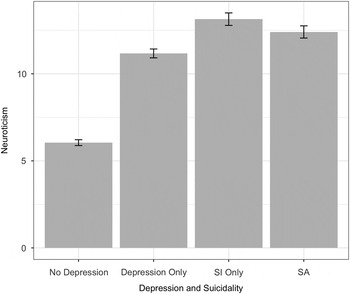
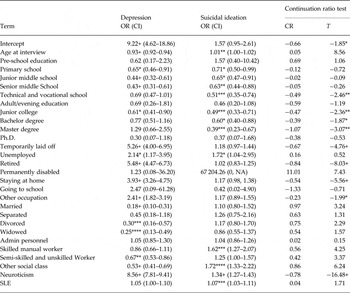
The present study replicated expected associations of education, occupational status, marital status, social class, neuroticism, and stressful life events with depression as compared against a non-depressed control sample (see Table 1 and Fig. 1). In particular, greater educational attainment was associated with a lower rate of depression. With respect to occupational status, depression was associated with unemployment (permanent or temporary), retirement, and staying at home though depression was less prevalent among participants who worked in semi-skilled or unskilled jobs. With respect to marital status, depression was more prevalent among participants who were never married compared with participants who were married, divorced, or widowed. Relevant to the aims of this study, neuroticism was elevated among participants with MD.
Neuroticism as a function of depression, suicidal ideation, and suicide attempt. Notes. SI = suicidal ideation; SA = suicide attempt. Mean neuroticism is adjusted for covariates included in main analyses: age at assessment, education, occupation, marital status, social class, and stressful life events. Error bars indicate ±2 error s.e.

Continuation ratio test for depression to suicidal ideation

Notes. OR,odds ratio; CI, 95% confidence interval; SLE, stressful life events; CR, continuation ratio. Reference groups for nominal variables are: education (no education), occupation (working for pay), marital status (never married), social class (executives, major professionals), *p < 0.05, **p < 0.01, ***p < 0.001, ****p < 0.0001, +p < 1 × 10⁻⁵.
Suicidal ideation
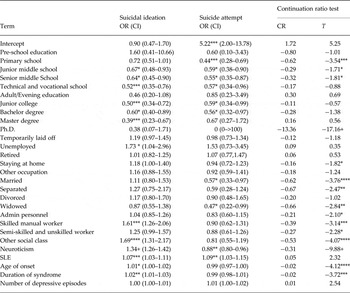
The present study largely replicated expected associations of suicidal ideation with education, occupational status, greater stressful life events, and neuroticism (see Table 1 and Fig. 1). Greater educational attainment was associated with a lower rate of suicidal ideation. Additionally, participants were more likely to report suicidal ideation if they were unemployed or worked as a skilled manual worker. Neuroticism and stressful life events were associated with increased rates of reporting suicidal ideation. Results held when adjusting for age of onset of depression symptoms, duration of depressive syndrome, and number of depressive episodes (see Table 2). Additionally, suicidal ideation was more prevalent among participants who reported an earlier age of onset of depressive symptoms and greater duration of depressive symptoms.
Continuation ratio test for suicidal ideation to suicide attempt

Notes. OR, odds ratio; CI, 95% confidence interval; SLE, stressful life events. Reference groups for nominal variables are: education (no education), occupation (working for pay), marital status (never Married), social class (executives, major professionals), *p < 0.05, **p < 0.01, ***p < 0.001, ****p < 0.0001, +p < 1 × 10⁻⁵.
Based on the continuation ratio test, greater educational attainment may reduce risk for suicidal ideation more strongly than it reduces risk for depression (see Table 1). Similarly, whereas temporary unemployment, retirement, and staying at home are associated with depression, there is no evidence of an additional contribution to risk for suicidal ideation. Relevant to the aims of the present study, while neuroticism is associated with both increased risk for depression and suicidal ideation, elevated neuroticism may confer greater risk for depression than for suicidal ideation.
Suicide attempt
The present study demonstrates similar associations of education and stressful life events with a history of suicide attempt as with suicidal ideation (see Table 2). Even among participants who reported suicidal ideation, greater educational attainment was associated with reduced risk of attempted suicide. Similarly, participants who were married or widowed reported a lower rate of suicide attempt than participants who reported any other marital status. Additionally, participants who reported a prior suicide attempt reported greater stressful life events. In contrast to results for suicidal ideation, neuroticism was associated with decreased likelihood of having attempted suicide (see Fig. 1).
Based on the continuation ratio test, whereas greater educational attainment was associated with both decreased rate of suicidal ideation and suicide attempt, greater educational attainment may reduce risk for suicide attempt more than for suicidal ideation. Additionally, the continuation ratio test supports the assertion that, while not associated with suicidal ideation, marital status, specifically being married or widowed, is associated with decreased risk for suicide attempt among participants who report suicidal ideation. Similarly, the continuation ratio is consistent with evidence that age of onset of depression symptoms and duration of depressive syndrome are associated with increased risk for suicidal ideation but not suicide attempt.
Specificity within depression
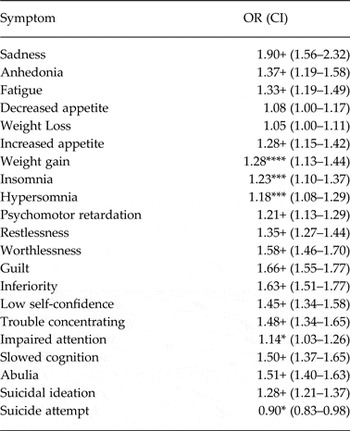
Neuroticism was associated with increased likelihood of reporting most depression symptoms (see Table 3). Examination of confidence intervals in Table 3 suggests that neuroticism is associated with each depression symptom, except for attempted suicide, to a similar extent. The inverse association between neuroticism and having attempted suicide appears to be specific to suicide attempt. This indicates that the inverse association between neuroticism and suicide attempt risk is not better explained by an overall association between neuroticism and a tendency to report depression symptoms. In fact, there seems to be a tendency for more neurotic participants to endorse depression symptoms.
Association of neuroticism with depression symptoms

Notes. OR, odds ratio; CI, 95% confidence interval; covariates are age, educational attainment, occupational status, marital status, social class, and stressful life events. *p < 0.05, **p < 0.01, ***p < 0.001, ****p < 0.0001, +p < 1 × 10⁻⁵.
Discussion
The present study examined the correlates of suicidal ideation and attempted suicide within a large sample of Chinese women with MD with the goal of clarifying the association of neuroticism with suicidal ideation and attempted suicide. Elevated neuroticism was associated with suicidal ideation despite a stronger association with MD. However, the role of neuroticism markedly changed in predicting attempted suicide among participants who reported suicidal ideation. In summary, whereas elevated neuroticism was associated with increased risk for MD and suicidal ideation, elevated neuroticism was associated with decreased risk for attempted suicide among participants who reported suicidal ideation. Therefore, while neuroticism seems to be associated with increased risk for suicidal ideation, it may have a protective effect with respect to attempting suicide following the onset of suicidal ideation.
Additionally, the present study reaffirmed prior evidence of the correlates of depression and suicidal ideation, which were both associated with lower educational attainment, permanent unemployment, and neuroticism. Additionally, depression was more prevalent among participants who were temporarily unemployed, retired, staying at home, or who were never married whereas suicidal ideation was more prevalent among participants who reported a greater number of stressful life events. Among participants who reported suicidal ideation, attempted suicide was associated with lower educational attainment and a greater number of stressful life events. Additionally, attempted suicide was more prevalent among participants who were never married as compared with those who were married or widowed.
The continuation ratio test analysis permitted an assessment of similarity between the correlates of MD, suicidal ideation, and suicide attempt. Several correlates (i.e., educational attainment, temporary unemployment) contributed to risk for suicidal ideation more strongly than risk for MD. Similarly, several correlates (i.e., educational attainment, age of onset and duration of depressive syndrome) contributed to risk for suicide attempt more strongly than risk for suicidal ideation.
Evidence of elevated neuroticism among participants who reported suicidal ideation is consistent with prior research (e.g., Statham et al. Reference Statham, Heath, Madden, Bucholz, Bierut, Dinwiddie, Slutske, Dunne and Martin1998; Fergusson et al. Reference Fergusson, Woodward and Horwood2000). However, while prior research has demonstrated this association adjusting for concurrent MD, the present study clarifies that, within a sample of participants with MD, neuroticism is elevated among those participants who report suicidal ideation. Moreover, the present study suggests that neuroticism increases risk for depression more strongly than it does risk for suicidal ideation.
The present study provides a potential explanation for mixed findings regarding the association of neuroticism and suicide attempt, particularly when adjusting for concurrent depression (Fergusson et al. Reference Fergusson, Woodward and Horwood2000; Batterham & Christensen, Reference Batterham and Christensen2012; Chan et al. Reference Chan, Chiu, Lam, Wong and Conwell2014). The pattern evident in the present results, wherein neuroticism is elevated among participants who report suicidal ideation but decreased among the subset of participants who additionally report a suicide attempt, may explain previous null findings. For example, Fergusson et al. (Reference Fergusson, Woodward and Horwood2000) report evidence of a robust association between elevated neuroticism and suicidal ideation, however any association between neuroticism and suicide attempt was not robust to adjustment for concurrent psychopathology. This result is consistent with the present study, which indicates a decrease in neuroticism among participants who report a suicide attempt relative to those who report only suicidal ideation. Additionally, while replication is needed to support the association of neuroticism with decreased risk for attempted suicide, the present study provides a demonstration of the importance of examining, specifically, the transition from suicidal ideation to suicide attempt.
Several limitations are evident in the present study. Primarily, the CONVERGE study included only women of Han ancestry throughout China with MD as evidenced by two or more lifetime MDEs. While the sample was recruited throughout China, including Beijing, Tianjing, Shanghai, and Chongqing, further research is needed to examine the extent to which these results apply to western populations. Similarly, results may be limited to the association between neuroticism and suicidality within MD among women. Results were robust to adjustment for comorbid anxiety disorders and dysthymia, however there was not a sufficient number of participants who met criteria for any single disorder other than MD to examine the association of neuroticism and suicidality within another diagnostic group. Prior research suggests that anxiety disorders, particularly panic, may confer risk for suicidal ideation and attempted suicide beyond comorbid MD (Rappaport et al. Reference Rappaport, Moskowitz, Galynker and Yaseen2014). Future research is needed to clarify the association of neuroticism and suicidality within other pertinent syndromes. Additionally, while women may report different levels of neuroticism (Costa et al. Reference Costa, Terracciano and McCrae2001), future research is needed to examine what effect, if any, gender has on the association of neuroticism with suicidal ideation or suicide attempt.
Given the above limitations, several strengths of the present study provide important improvements over the existing literature on the association of neuroticism with suicidal ideation and attempted suicide. One of the strengths is distinguishing between the correlates of attempted suicide and suicidal ideation. MacLean's continuation ratio test was used to further compare the correlates of suicidal ideation and attempted suicide by statistically testing the difference between the association with suicidal ideation and the association with attempted suicide. As illustrated in Fig. 1, if the present study had failed to examine the correlates of attempted suicide independently from those of suicidal ideation, we may have reached the incorrect conclusion that neuroticism was associated with increased risk for attempted suicide. Overall, this statement would be technically accurate with respect to the full sample, but this conclusion may provide poor clinical guidance in the goal of estimating risk for a suicide attempt among individuals who report suicidal ideation. Similarly, examining the correlates of suicidal ideation independently from those of MD would have led to an overestimation of the magnitude of the association of neuroticism with suicidal ideation.
The clinical implications of these results are two-fold. Initially, further research is required though the present study suggests that each transition from MD to suicidal ideation to suicide attempt be considered as a distinct process with unique correlates and risk factors. Principally, the role of neuroticism as a risk factor for suicidal ideation may be markedly different from the role of neuroticism as a risk factor for suicide attempt. Secondly, this study illustrates the need for caution when incorporating research on risk factors into clinical practice. Research is needed on specific transitions points in the development of psychopathology; missing important transition points, e.g., examining correlates of suicide attempt in a community sample, may lead to incomplete or misguided conclusions.
Another strength of this study was that results were adjusted for stressful life events and comorbid depressive and anxiety disorders. Results pertaining to the association of neuroticism with suicidal ideation and attempted suicide were robust to adjustments for comorbid psychopathology. The adjustments included in the present study may clarify the reasons for discrepant findings in prior research on the association of neuroticism and attempted suicide.
In conclusion, while the present study replicated prior research suggesting that neuroticism is associated with increased risk for suicidal ideation, we clarify that, among individuals who report suicidal ideation, neuroticism may be associated with decreased risk for attempted suicide. The present study included a large sample of women recruited throughout China and demonstrated that neuroticism may increase risk for MD and suicidal ideation, however, among individuals reporting suicidal ideation, neuroticism may be a protective effect that reduces risk for a suicide attempt.
Acknowledgements
This work was supported by the Wellcome Trust (WT090532/Z/09/Z, WT083573/Z/07/Z, WT089269/Z/09/Z) and the National Institute of Mental Health (1R01MH100549; T32MH020030). The authors wish to acknowledge the researchers at hospital sites around China who assisted in data collection. The authors do not have any financial interests that might influence this research. The authors assert that all procedures contributing to this work comply with the ethical standards of the relevant national and institutional committees on human experimentation and with the Helsinki Declaration of 1975, as revised in 2008.