Building collapses have been an important cause of significant numbers of morbidity and mortality, especially in the past decade. High- and middle-income countries, such as the United States, South Korea, Turkey, Austria, and China have suffered disasters due to collapsed buildings. 1–6 Although ceaseless and heroic efforts are made in most such incidents, the number of survivors from structural collapses is very small. Reference Bartels and VanRooyen7 However, the number of natural or man-made disasters as well as number of structural collapses due to technological reasons has been increasing along with mortality rates of victims worldwide. 8 Because the chance of survival of victims under the debris is closely associated with time, searching under the debris of collapsed buildings is actually a race against time. Reference Macintyre, Barbera and Smith9,Reference Coburn and Spence10
It must be kept in mind that using only a single method is not sufficient for a successful search and rescue effort. On many occasions, the reaction of the local community is characterized by self-rescue attempts of survivors by using simple tools or bare hands. On the other hand, most popular operational methods used by professional teams for entrapped victims are physical void search, voice search, use of fiber optics/boroscope, infrared/thermal imaging, electronic listening device, and canine search. Reference Wong and Robinson11
As mentioned above, searching under the debris of collapsed buildings is a fierce race against time. The survival rate of individuals trapped under the debris of collapsed buildings decreases by 50% after the first 24 h. Reference Yılmaz and Demiröz Yıldırım12 Therefore, fast and effective operation of prehospital emergency health services is of utmost importance in these disasters. Coordination of prehospital emergency health services by organizations such as the National Medical Rescue Team (NMRT; also Ulusal Medikal Kurtarma Ekibi, UMKE) and Disaster and Emergency Management Presidency (DEMP) to be prepared for disasters such as building collapses in a country like Turkey, which has frequent tectonic activities and many active fault lines, allows quick evaluation and fast intervention. As 112 Emergency Health Services, we have aimed in our study to evaluate and share the incident of a building collapse on February 6, 2019, in our country and the search and rescue process performed and shared in coordination and on a hierarchical basis with the local people, search and rescue teams, and local authorities.
Methods
The information flow, hierarchy, treatment and rehabilitation processes, and rescue organization and planning during the rescue attempt for 35 people who needed help due to a building collapse that occurred on February 6, 2019, and the literature related with this incident were reviewed.
Statistics
Descriptive statistics for categorical variables were stated as number (n) and percentage (%). The chi-squared test was used to compare data between groups. The fit of continuous variables to normal distribution was assessed using the Kolmogorov-Smirnov test. Descriptive statistics were stated as median values (25-75%), as none of the variables conformed to normal distribution. The Mann Whitney U-test was used for group comparisons. Spearman correlation coefficients were calculated to evaluate the relationships between variables. A value of P < 0.05 was accepted as statistically significant (2-tailed test).
Results
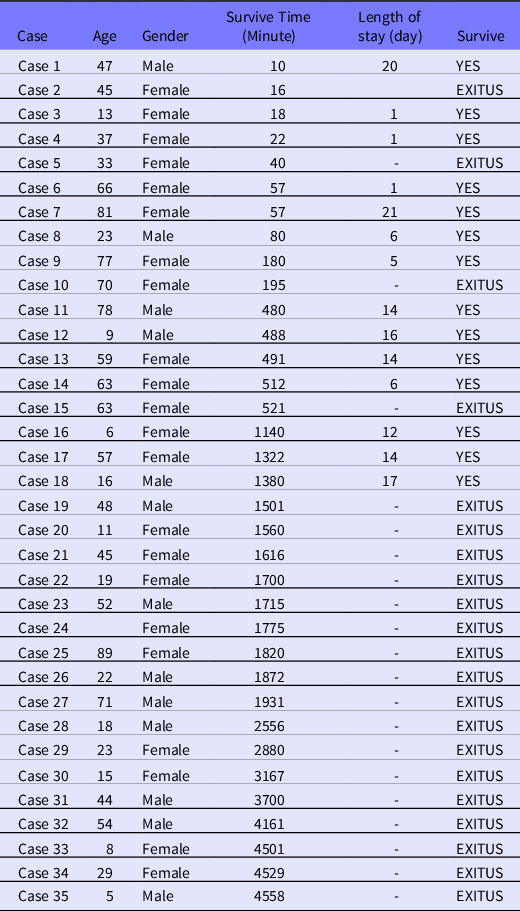
Of the 43 people who lived in this 8-story building, 35 were inside the building during the collapse; 14 (40%) of them were assessed as injured and 21 (60%) as exitus. Nine (64.3%) of the injured individuals who were rescued were women, as shown in Table 1. The mean age of the rescued injured people was 52 (15.2-68.7) y, the mean length of stay in hospital was 13 (4.0-16.2) d, and the mean duration until rescue was 330 (57.0-512.0) min. There was no correlation between rescue duration and length of stay (r = 0.374; P = 0.188).
The necessity of promoting the incident to the level of a disaster was obviated by the localized nature of the incident; it was also because the incident was confined to a small area around 1 building. Nevertheless, the planned and performed methods during the rescue interventions allowed the testing of reflex and capacities of institutions before and during a possible disaster scenario.
Demographic characteristics of the cases

Operation During the First 2 Hours
The first notification call for the 8-story building collapse that occurred on February 6, 2019, in İstanbul Province was made to the 112 Command and Control Centre at 3:59 pm. Based on this notification call, 12 ambulances were directed to the incident area, and the first 112 team arrived on the scene at 4:06 pm.
The incident zone was in great chaos due to panic and uncontrolled human crowd; scene management had not been done, and many people started rescue attempts by clearing the debris with or without awareness. The uncontrolled crowd comprised individuals residing or working nearby as well as relatives and neighbors who heard the incident.
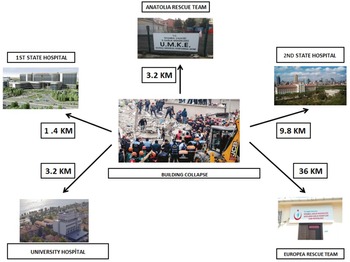
All roads around the incident zone were nearly completely blocked by civilian cars that had stopped to help and the vehicles of teams that arrived for rescue operation; therefore, traffic flow was interrupted considerably. The Municipal Police Teams and teams of Security Directorate had difficulty in sustaining traffic flow, keeping curious crowd complicating rescue attempts out of incident zone, and controlling them. In addition, some 112 teams without personal protective clothing and equipment joined the rescue operation removing the debris and became vulnerable to fall and injuries. Units were informed according to hierarchical order (for example, if patient was high-risk, that person was sent to the big hospital) organized in accordance with information derived from teams at the incident area (Figure 1) and scene management had been performed by the 112 team until the NMRT members arrived (20 min).
Graph showing the distance of building collapse from the hospital centers.

While the NMRT members started to perform rescue operations with citizens and fire department and police department personnel, they also communicated with the NMRT Center and delivered the first data from the incident area. In the light of information obtained from citizens at the scene, it was told that support NMRT teams are needed, personal protective equipment and gear must be brought in full due to debris work, and necessary measures must be taken due to possibly prolonged duration of rescue work.
Coordinates of the incident area and notice call to move to the incident area with personal protective equipment were given to the NMRT personnel by the NMRT Center through communication channels.
Ambulances directed to the incident area by the first NMRT team were positioned in coordination with the 112 Anatolian CCC on the line, which was close to the incident area; then records were kept of NMRT personnel who arrived at the scene after the notice call was sent. The closest and the most suitable hospital was chosen, and it was kept informed of current information.
During the first 2 h, the number of 112 ambulances directed to the area increased to 43, whereas the number of NMRT personnel who arrived after the NMRT Center notice call reached 50. The support teams moved from the NMRT Center to the incident area and working principles of teams at the scene were determined.
Three live and 1 dead person were pulled out of the debris during the first 2 h. One fire department personnel attending the rescue work was injured during this period.
Operation During 3rd to 8th Hours
A high school, which was the closest public institution, was assigned as the Governorship Crisis Coordination Center. Records of NMRT personnel on the scene were kept and appropriate teams were formed; thereafter, transition to shift working was started due to the anticipated prolonged relief effort. Logistic support efforts were started for providing personal protective equipment and gear that would be required by the NMRT personnel.
Orthopedic surgeons and anesthesia specialists were in demand because of the likely predominance of cases with multiple traumas, extremity fractures, and crush syndromes in alive individuals who would be pulled out from the debris.
A disaster victim reached under the debris was examined by NMRT personnel who entered into the debris, due to entrapment of victim’s left arm and left leg between concrete blocks; a cervical collar was placed, fluid replacement was started under the debris after providing intravenous access. The injured victim was carried in accordance with recommendations of orthopedic and traumatology specialists after consulting with them.
After increased security measures at the incident scene and the arrival of DEMP and other rescue teams, 2 ambulance pools were created at Banks Street and Sorgun Street. Ambulances were placed in these pools under control, and ambulance overaccumulation was prevented by determining case queues for them. Ambulance traffic flow was also reorganized, and records of ambulances that were leaving with cases or arriving at the scene, as well as records of transferred disaster victims, were regularly kept.
Management of the incident area was taken over by the DEMP after their arrival at the scene; then the management of health services, medical intervention under the debris, transfer of injured victims to the 112 ambulances, and ambulance traffic flow were all performed in a coordinated manner by the UMKE.
Cervical collar brace protection was provided to all patients pulled out from the debris, and intravenous fluid replacement was started. In addition, the hospital closest to the incident area that had an intensive care unit, trauma surgery and emergency services, including operation theaters and medical capabilities such as a hyperbaric oxygen unit for victims with crush syndrome, was chosen and informed.
Five live and 1 more dead person were pulled from the debris between the 3rd and 8th h. One Red Crescent personnel attending the rescue work was injured during this period.
Operation After the 9th Hour
Work in 8-h shifts was planned due to the presumed prolonged operation for DEMP personnel who were grouped into teams and waiting at the scene; making shift lists, keeping communication channels open, activating 24-h work principle for the 112 and NMRT teams were also conducted. According to prepared shift lists, personnel whose shifts were over were sent to take a rest for preventing unnecessary crowds and maintaining maximum personnel efficiency.
While the search and rescue teams worked under the debris, the 112 ambulance teams waiting at the scene attended to the medical problems of citizens waiting for their relatives under the debris. This was in addition to the transferring of disaster victims who had to be admitted to hospital for further treatment.
As a health precaution, ambulance and other health personnel were kept in condolence houses created by the Governorship Crisis Coordination Center, and acted as first responders to rapidly comfort distraught citizens.
The 112 mobile command vehicle was brought to the incident area to coordinate the movement of ambulances at the scene and to keep case records; it was used actively until the end of the rescue operation.
Catering service was provided to the attending personnel by Red Crescent and other relief organizations.
Medical interventions of victims pulled out of the debris at the 9th, 19th, and 45th h were started even when the victims were still under the debris, placing cervical collars and orthopedic splints on fractured extremities and starting intravenous fluid replacement. The victims were then transferred to the 112 ambulances by NMRT teams using appropriate carrying techniques. One NMRT personnel and 1 fire department personnel were transferred to the hospital due to construction nail punctures and orbital foreign body injury, respectively.
A total of 8 NMRT vehicles and 101 NMRT personnel of the DEMP, 1 obese ambulance, 1 four-bedded ambulance, 1 mobile command vehicle, 127 ambulances, and 387 personnel of the Department of Emergency Health Services along with the Ambulance Service Chief of Staff attended to the rescue operations from the onset of the incident on February 6, 2019 (3:59 pm) until the end of the operation on February 10, 2019 (4:00 pm). Fourteen people were rescued from the debris, and 21 people died in the building collapse; 5 people involved in the search and rescue operation were injured and transferred for medical treatment.
Discussion
First response of the people on the scene of the incident until professional help arrives is quite an important factor in helping victims and decreasing mortality. On many occasions, the first spontaneous response of the local people and survivors after a disaster is to attempt rescue using simple tools or just bare hands. However, this is only possible if it is performed by individuals with first aid and disaster awareness and whose actions do not interfere with the operation of professional teams; these individuals should also not do anything that could be potentially harmful to the victims. Especially in developing and underdeveloped countries, cases of further harm to survivors by local rescuers through incorrect handling and unsafe incident zone practices have been frequently observed. As observed in our rescue operation, the most apparent factors that can delay the rescue process are interrupted work on the debris due to the uncontrolled effort of the surrounding crowd and the attempt of a few official rescue personnel to record the incident with cell phones for sharing on social media. The factors facilitating the rescue process are taking the lead role at the scene by the 112 team on first arrival, their rapid and accurate triage for estimated number of injured people along with the severity of injury, informing a sufficient number of support teams as soon as possible, and coordinated efforts of both professional teams and local people at the incident scene without interrupting the professional teams’ work. Therefore, informing and training citizens for at least a basic level of knowledge is quite important for their correct interventions in possible incidents and for ensuring their own safety during these processes.
Six people died and more than 20 people were injured at 2 apartments that collapsed due to gas explosion in New York. 1 There were 2 large-scale building disasters in Mumbai, India, in April 2014, and 45 people (15 of them were children) died and 70 people were injured in these disasters. 13 In our disaster incident, 14 people were injured and 21 people died. We thought that our numbers of injured and dead individuals were relatively lower considering the extended amount of time required for search and rescue work. We suggest that demographics of injured victims are also affected by the presence of workplaces in the building, time of day and season of the collapse, as well as the structural quality of the building, because these factors (workplaces, time, and season) influence the number and population of people present in the building.
Physical void space searches can be performed by untrained personnel without the need for special equipment; nevertheless, it has been considered dangerous because it cannot locate unconscious victims and provides only limited access to void areas. Voice call method provides similar advantages mentioned above, and it can be used in combination with listening devices. However, very young or physically weak individuals and unconscious victims may not be able to answer when the hitting sound is weak. Infrared and thermal cameras, electronic listening devices, and canine searches are searching methods that can cover large areas in a short time. Reference Statheropoulos, Agapiou and Pallis14
No chemical sensor can reach the sensitivity of a canine’s nose; however, these dogs may be exposed to many toxic hazards and other risks. Reference Gwaltney-Brant, Murphy and Wismer15 Other more developed techniques involve use of search robots, Reference Murphy, Casper and Micire16 autonomous camera-based devices, Reference Dandoulaki and Andritsos17 and microwave systems. Reference Chen and Norman18 Recently, chemical search has been recommended to mimic the performance of canine search. Reference Agapiou, Mikedi and Karma19,Reference Huo, Agapiou and Bocos-Bintintan20 This method uses human tissue (eg, skin, lungs, etc.) and chemical profiles of human smell. Reference Mochalski, Agapiou and Statheropoulos21–Reference Mochalski, Unterkofler and Hinterhuber23 Our search and rescue operations used dogs, camera-based devices, and microwave systems. The number and breed of dogs must be increased and varied, respectively, in larger-scale disasters.
In addition, the 112 Emergency Health Services routinely perform training and education sessions and seminars, and publish and distribute education brochures/posters/stands for both adults and children.
Conclusions
In conclusion, the leading and important factors to increase the success rate in search and rescue interventions can be listed as follows:
-
Informing official authorities as first early warning by individuals who can clearly define the situation (112 personnel if possible);
-
Early security measures by security forces arriving before health and search-rescue teams;
-
Accurate identification of estimated number of injured victims;
-
Identifying and informing appropriate hospitals as to which victims rescued from the debris will be transferred;
-
Maintaining information flow in the same network;
-
Work sharing in a particular working schedule among the working teams according to the event scale;
-
Proper preparation of personnel attending search and medical rescue operations by bringing personal protective clothing and equipment;
-
Maintaining high-level skills of radio use for uninterrupted communication of all personnel attending the process;
-
Training canines for both the search and rescue period and rehabilitation;
-
Performing drills with the use of up-to-date equipment and search-rescue methods.