1 Ongoing discussion about the fate of the Celts after the Anglo-Saxon conquest
The earliest narrative sources, Gildas’ De excidio et conquestu Britanniae (sixth century) and Bede's Historia ecclesiastica gentis Anglorum (eighth century),Footnote 2 leave no doubt that the Anglo-Saxons were victorious but that Britannia became England only gradually, starting out from the earliest settlement areas in the south and east and after a long series of battles. For the losing side, Bede's Historia ecclesiastica, I.15 describes three types of destiny: flight, death, or slavery (see Colgrave & Mynors Reference Colgrave and Mynors1969: 52f.). Until today, many scholars have assumed on linguistic grounds that the great majority of the Celts either chose to flee or died in battle, since Old English as well as Modern English contain remarkably few Celtic loanwords.Footnote 3 An explicitly linguistic early version of this assumption, by an Oxford historian (Freeman Reference Freeman1888: 103), reads as follows:
Those who thus lived side by side with their conquerors in Gaul, in Spain, in Lombardy, kept their language. Why did those who were in exactly the same case in Britain lose theirs? . . . because in Britain there was a real displacement of one people by another, while in Gaul, Spain, and Italy there was not.
A very recent version of the same view, but with particular reference to the situation in the early core areas, is found in a paper by Richard Coates (Reference Coates2007: 173f.):
I argue that the linguistic evidence favours the traditional view, at least for the south and east, . . . there is no reason to believe large-scale survival of an indigenous population could so radically fail to leave linguistic traces.
More than a century before Coates, Otto Jespersen offered a very different explanation for the extremely small number of Celtic loanwords. He related the linguistic evidence to the unequal relationship between winners and losers after the Anglo-Saxon conquest:Footnote 4
There was nothing to induce the ruling classes to learn the language of the inferior natives; it could never be fashionable for them to show an acquaintance with that despised tongue by using now and then a Keltic word. On the other hand the Kelt would have to learn the language of his masters, and learn it well.
Thus, according to Jespersen, the adoption of the new, Germanic language by the Celts after the Anglo-Saxon conquest left practically no trace of their original language in English whereas Celtic suffered a dramatic loss of speakers over the centuries. Baugh & Cable (Reference Baugh and Cable2002: § 54) basically support Jespersen's view, though not for the early settlement areas:
The Celts were by no means exterminated except in certain areas . . . In the east and southeast, where the Germanic conquest was fully accomplished at a fairly early date, it is probable that there were fewer survivals of a Celtic population than elsewhere. Large numbers of the defeated fled to the west.
But the view that only a few Celts remained in the areas of early settlement does not tally with the place name evidence. According to the place name expert Margaret Gelling, the evidence for the Southern core areas of early Anglo-Saxon settlement strongly suggests early large-scale immigration of Germanic settlers and, at the same time, ‘the continuance of British speech in conditions of peaceful coexistence during at least the first two centuries of the Anglo-Saxon period’ (Gelling Reference Gelling1993: 51). She therefore tries to explain the virtual absence of Celtic loanwords as due to a ‘community of interests’ between Saxon and Celtic farmers ‘who would be fully equipped with all the words they needed for the things which concerned them in their daily lives’ (Gelling Reference Gelling1993: 56). However, her assumption of ‘peaceful coexistence’ fails to take account of the evidence of the narrative sources for long series of battles between slowly advancing Anglo-Saxons and retreating Celts, especially by Gildas, Bede, and, most importantly for Wessex, in the Anglo-Saxon Chronicle (see Blair Reference Blair2003: ch. I.6). And, in a different way, Gelling's assumption also fails to account for the evidence of Ine's laws for early Wessex, which demonstrate that after the subjection of an area to Saxon rule the new ruler was interested in peaceful coexistence between Saxons and Celts within his territory – but on terms which did not entail equal rights for West Saxons and Celts, as will be discussed in section 4 below.
Thus, taken together, Jespersen was basically right with regard to the assumption that the inequality of the contact situation was the main reason for the few lexical traces of Celtic in English, but he – just like most later scholars of English – did not look for possible structural traces in English left by Celts who shifted to the language of the victorious Anglo-Saxons. However, in treatments of language contact outside the field of English studies, it has meanwhile become textbook knowledge that such unequal contacts between two peoples resulting from a conquest have very different effects on the two languages concerned, that of the conquerors (the superstratum) and that of the losing side (the substratum).Footnote 5 The effects of superstratal contact can be illustrated with the changes resulting from the Norman conquest. Although English eventually prevailed, after centuries of foreign dominance, the French superstratum had an excessive effect on the lexicon of the English substratum.Footnote 6 In contrast to a superstratum language, a substratum language has little lexical effect on the superstratum, for the reasons already pointed out by Jespersen for Celtic in relation to English and other languages, though without reference to a stratal terminology.Footnote 7 Nevertheless, a substratum language may exert far-reaching structural influence on the phonology, morphology, and syntax of the superstratum if many speakers of the substratum abandon their own language for the superstratum, i.e. in case of large-scale language shift.Footnote 8 Thus, scholars looking for Celtic loanwords in English as a result of the Anglo-Saxon conquest are looking for the wrong type of traces of this kind of contact,Footnote 9 in particular since Britannia represented the same type of habitat as the old homes of the Anglo-Saxons, with a familiar fauna and flora and with opponents and neighbors of a type that the Germanic invaders had been in contact with in continental Europe for centuries.Footnote 10
Wolfgang Keller (Reference Keller1925), on the basis of a study of the syntax of Yeats and Synge (van Hamel Reference Hamel1912), was the first to point out that instead of looking for Celtic loanwords, scholars should search for traces of Celtic influence in the syntax of English. He compared the contact situation of Celtic and English to that of German and Slavic and argued:Footnote 11
Nicht im Wortschatz, sondern in der Syntax ist der Einfluß der fremdsprachigen Unterschicht in erster Linie zu spüren, denn es handelt sich für den deutsch sprechen den Slaven ebenso wie für den englisch sprechenden Kelten zunächst um ein Einsetzen der fremdsprachigen Wörter in den Satz der eigenen Sprache, ein wörtliches Übersetzen.
The scholars who followed Keller's suggestion, mostly Celticists and Germanists, in particular Walther Preusler (Reference Preusler1938, Reference Preusler1956), Ingerid Dal (Reference Dal1952), and Heinrich Wagner (Reference Wagner1959: 143–52), noted that Celtic influences on various features of English syntax became much more pronounced in the later history of English, and Wagner (Reference Wagner1959: 151) assumed that this was helped by the collapse of the Anglo-Saxon power structures after the Norman conquest. Very recently, however, some authors have gone so far as to claim that compared to later stages of English, Old English is practically free from Celtic influence. This view is presented most explicitly in two recent papers by Hildegard Tristram,Footnote 12 where she claims that written Old English represents the language of the Germanic elite and that the language of the Celtic-influenced lower classes did not make it into the Old English sources (Tristram Reference Tristram2004: 103):
The written language was, of course, that of a small powerful elite, ethnically the Anglo-Saxons . . . In the later period, there must have been a tripartite division of the types of OE: a) the written language of the elite the norms of which were carefully maintained (OEW), b) the spoken vernacular of the elite (OEH), . . . and c) the vernacular of the bulk of the population, which was largely of British and in the Danelaw areas also of Scandinavian extraction (OEL) . . . Of the two types of spoken Old English, only the low variety surfaced after the replacement of the Anglo-Saxon elite by William the Conqueror.
In contrast to Tristram (Reference Tristram2004, Reference Tristram2007), who assumes strong Celtic substratal influence for spoken Old English of the majority, the Indo-Europeanist and Celticist Peter Schrijver claims that the Lowland areas, which were affected by the Anglo-Saxon conquest earliest and most strongly, experienced little direct contact with Celtic (Schrijver Reference Schrijver2002: 109):Footnote 13
Germanic settlers that began occupying the North Sea basin from the fourth century onwards from northern Germany and Denmark primarily came into contact with speakers of North Sea Celtic in the British Highland Zone . . . and with speakers of Northwestern Romance in the British Lowland Zone and in the Low Countries, where Saxon, Kentish, Coastal Dutch and Frisian came into being.
Thus, with regard to the Saxons as the most important Low German group that settled the Southern Lowlands, Schrijver argues that there was hardly any contact with Celtic-speaking Celts but instead with Romanized Celts who spoke Latin. This would mean that our extant West Saxon texts lack obvious Celtic contact features. I disagree with both Tristram's and Schrijver's views, and I do so on the basis of Old English textual evidence – evidence that has been referred to before but with less specific emphasis on Old English and largely without reference to principles of modern general contact linguistics.
2 Structural evidence for Celtic substratum influence on (pre-)Old English: the twofold paradigm of the Old English verb ‘to be’
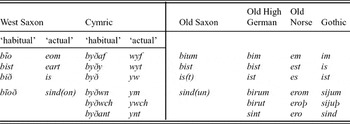
Probably the most important structural piece of evidence for the assumption of direct Celtic substratum influence on (pre-)Old English is the Old English present-tense paradigm of the verb ‘to be’, which agrees both formally and functionally with the Celtic languages in all Old English dialects and, at the same time, differs from all other Germanic languages, even from Old Saxon, which is generally believed to be the closest relative of West Saxon English (Morris Jones Reference Morris Jones1913: § 189; Campbell Reference Campbell1959: § 768; Krahe & Meid Reference Krahe and Meid1969: § 98; see table 1 overleaf). The twofold paradigms of West Saxon and Cymric distinguish two sets of forms and functions, the ‘habitual’ present and the ‘actual’ present.
The twofold present indicative of the verb ‘to be’ in West Saxon and Cymric and the simple paradigms in the other Germanic languages

West Saxon had b-forms not only in the present indicative but also in the subjunctive and imperative. Grammars of Old English and handbooks describe the twofold paradigm as a feature of Old English without any reference to Celtic, some contrast the situation in Old English with Middle English when this distinction gradually disappeared.Footnote 14 Krahe & Meid (1969: 141) assume ‘besondere Bewahrung’ (‘special preservation’) of the b-forms in Old English, which may be due to language contact with Celtic. Wolfgang Keller (Reference Keller1925) was the first to suggest that the twofold paradigm was introduced into pre-Old English by the early Britons in their efforts to acquire the language of the new rulers of Britain – and was thus an Old English innovation under Celtic influence. With regard to the forms of the twofold paradigm in Cymric and Old English, Keller (Reference Keller1925: 58f.) pointed out:
Dem perfektiven (konkreten) Präsens wyf . . . steht das imperfektive (generelle, habituelle) Präsens byðaf . . . gegenüber, das . . . zugleich für das Futur gebraucht wird: bydd heißt noch heute, genau wie altenglisches bið (byð), ‘ist immer’, ‘ist im allgemeinen’ und ‘wird sein’ . . . Dazu bildet das Kymrische einen Konjunkt[t]iv (Subjunktiv) . . . der genau dem altenglischen bēo, bēon entspricht. Endlich gehört dazu, wie im Altenglischen, ein Imperativ bydd ‘sei’. . . . Allerdings bildet das Kymrische von der Wurzel *bheu auch noch ein generelles Imperfekt byddai ‘er war im allgemeinen’ . . . Footnote 15
And, with reference to the formal agreement of the b-paradigms in Old English and Cymric, he stated: ‘Das ist eine sehr weitgehende Übereinstimmung der Formen, die bei der häufigsten Form byð sogar bis zu vollständiger Gleichheit geht.’Footnote 16 But he emphasized that the functional agreement between the two neighboring languages was even more remarkable, since it implied ‘eine größere Ähnlichkeit des Denkens bei Angelsachsen und Briten . . . als bei Angelsachsen und Friesen oder Deutschen’.Footnote 17 His analysis of the Old English evidence was based on a detailed study by Karl Jost (Reference Jost1909), which is basically corroborated by the recent assessment of the DOE s.v. bēon, on the basis of the entire evidence. The DOE lists three different types of usage distinctions, (a) future vs present, (b) actional vs statal, and (c) durative vs non-durative, for which see the following examples:Footnote 18
(1) Future vs present
gemyne þis & ongyt þe sylfne, þæt þu eart nu þæt ic wæs io; & þu byst æfter fæce þæt ic nu eom
‘consider this and understand that you are now what I once was and that you will be eventually what I am now’ (HomU 20.116)
(2) Actional (vs statal)
ðurh ða earan ða word bioð onfangen, & on ðæm mode hie beoð acennedu ðurh ðæt ondgiet [quia dum per aurem sermo concipitur, cogitatio in mente generatur]
‘words are received by your ears, and processed by your brain in your mind’ (CP 15.97–2)
(3) Durative or iterative (vs non-durative)
simle þu bist halig, dryhtna dryhten
‘you are holy forever, Lord of Lords’ (ChristA 404)
The Old English evidence, which began in the eighth century, almost three centuries after the Anglo-Saxon conquest, shows that the usage distinctions between the two paradigms were observed with some degree of consistency in texts of all kinds.Footnote 19 Thus, by the time of the first Old English texts, the distinction between the two paradigms of ‘to be’ was clearly no longer a feature of lower-class speech only, which suggests early and large-scale language shift from Celtic to Old English. Keller (Reference Keller1925: 60), on the basis of his comparison of the formal and functional parallels between Old English and Cymric, came to the following conclusion:
Hier hat das Altenglische vom Britischen entlehnt. Die altenglischen Formen und Funktionen der Wurzel *bheu, die den anderen germanischen Dialekten fremd sind, entstanden im Munde und im Denken von englisch sprechenden Briten.Footnote 20
The twofold paradigm of ‘to be’ represents the most obvious but not the only syntactic evidence for early Celtic substratum influence due to language shift by speakers of Celtic which was addressed by Keller. He also discussed the English progressive but in that case concentrated on the rise of the -ing form in Middle English (Keller Reference Keller1925: 61–6; see Filppula Reference Filppula and Tristram2003 and Filppula et al. Reference Filppula, Klemola and Paulasto2008: 59–72 for the entire development and its relation to Celtic). But later on, in a very substantial article, Ingerid Dal (Reference Dal1952) demonstrated that there were rare attestations of the -ing form also in late Old English and that the rules for its uses agreed with those for the much more widely used present participle. In Lutz (in press), the use of the present participle instead of the -ing form in early Wessex is discussed as an adequate earlier attempt at translating the same nominal Celtic construction type by Celts who switched to the language of the new rulers. Other syntactic features that have been made plausible as a result of Celtic substratum influence are evidenced only rarely in Old English (see Vennemann Reference Vennemann, Lucas and Lucas2002 for the loss of the external possessor construction) or did not surface until much later.
In Keller's time, the explanation of structural similarities as being due to language shift from the substratum to the superstratum was novel. Meanwhile, however, it has become textbook knowledge of general contact linguistics and is described as a consequence of imperfect learning in the course of language shifting (see Thomason & Kaufman Reference Thomason and Kaufman1988) and, more precisely, as relexification of structures of the substratum with the lexical means of the superstratum.Footnote 21 Keller's ideas were taken up by some Celticists and Germanists but largely ignored by Anglicists until recently (see Filppula et al. Reference Filppula, Klemola and Pitkänen2002b: 8–12, Filppula Reference Filppula and Tristram2003:154–8). An early exception is Hermann Flasdieck (Reference Flasdieck1937), but his criticism of Keller's interpretation of the twofold paradigm of ‘to be’ as the result of Celtic influence may have contributed to the long neglect of Keller's pioneering study. Flasdieck (Reference Flasdieck1937: 332f.) found the Old English b-paradigm and its formal and functional agreement with Celtic, in particular that between West Saxon and Cymric, remarkable but was not convinced by Keller's explanation:
Daneben blieb das voll ausgebildete bh-Verb mit der 2. Pers. bist in besonderer Bedeutung bestehen, dessen Eigenleben wohl am stärksten im sächs. Gebiet war . . . In der neuen Heimat mag die Erhaltung überdies gefördert worden sein durch das Zusammentreffen mit der kelt. Bevölkerung. Denn die kelt. Sprachen, insbesondere das Kymrische, haben neben dem gewöhnlichen konkreten Präs. . . . ein . . . abstraktes (generelles, iteratives; ‘praes. consuetidinis’) Präsens der Basis *bheu, das auch futur. Bedeutung haben kann; dazu gehören auch Konjunktiv, Imperativ sowie Verbalnomina (Inf. und Part. Präs.). Indes wird man die ae. Formen nicht mit Keller als Entlehnung aus dem Brit., entstanden im Denken und Sprechen von englisch redenden Briten, ansehen dürfen.Footnote 22
For this, Flasdieck advanced three arguments,Footnote 23 all three of which can be invalidated:
(i) In contrast to Celtic, Old English lacks b-forms in the preterite.
It is true that Cymric distinguishes two past-tense sets of forms and meanings, as was also pointed out by Keller. However, it has meanwhile been shown for Irish and Irish English that in the course of shifting to the superstratum, features of the substratum are transmitted to differing degrees, depending on the nature and degree of the contact (see Winford Reference Winford2003: 239–41). The fact that West Saxon had b-forms in the present-tense paradigm (including the subjunctive and imperative) but not in the preterite may be due to the higher frequency of use of the present tense in daily oral contact, for which see also section 4 below.
(ii) The reduction of the b-paradigm is most pronounced in the North.
Flasdieck, just like Baugh (see section 1 above), seems to have been under the impression that Celtic influence was least pronounced in the Southern core areas and particularly strong in the North; it will be shown in section 4 that stronger substratum influence on West Saxon than on other Old English dialects, as suggested by the evidence of the b-paradigm, is what we should expect.
(iii) Old Saxon likewise preserves *bheu.
Here, Flasdieck seems to have referred to the fact (see table 1, above) that, in contrast to Gothic and Old Norse, Old Saxon and also Old High German contained some b-forms in their simple paradigms, as also mentioned by Keller (Reference Keller1925: 56f.). But Flasdieck failed to realize that Keller (Reference Keller1925:59) had based his assumption of ‘a greater similarity of thinking between Anglo-Saxons and Britons than between Anglo-Saxons and Frisians or Germans’ on the observation that Old English and Celtic had twofold paradigms whereas the continental West Germanic languages had simple paradigms. For a more detailed discussion of the situation on the continent see the following section.
3 Differences between the Celtic influence on (pre-)Old English and earlier influences of Celtic on the West Germanic languages
In a recent paper, the Celticist Stefan Schumacher addressed the question of language contact between Old English and Insular Celtic in the larger context of contact between the Germanic and Celtic languages both in Britain and on the Continent.Footnote 24 He adduced lexical, semantic, onomastic and structural evidence and rightly emphasized that the character of the contacts in prehistoric central Europe, which extended over a long time span and a large area of central Europe, must have been extremely varied.Footnote 25 The contact zone extended from the Rhine estuary to western Slovakia, as shown by his map on p. 169. As an example for structural evidence, Schumacher discussed the twofold paradigm of ‘to be’ in Celtic and Old English. He pointed to the fact that some of the Germanic simple paradigms of the continental Germanic languages also have b-forms, as shown in table 1 above: all continental West Germanic languages have b-forms in the first and second persons singular, Old High German also in the first and second persons plural. By contrast, Gothic and Old Norse do not have any b-forms. Schumacher referred to Krahe & Meid (1967: 140f.) – but not to Flasdieck's article – for the assumption that the preservation of the twofold paradigm in Old English was possibly due to contact with Celtic. He criticized Keller for not explaining the b-forms in the continental West Germanic languages and stated: ‘Dadurch, daß Keller diese Formen als irrelevant beiseite ließ, wurde seine Analyse des altenglischen Befundes ahistorisch und somit falsch.’Footnote 26 Stephen Laker (Reference Laker, Aertsen and Veldhoen2008: 28f. and note 33), who cites Schumacher extensively and likewise criticizes Keller's analysis for not explaining the mixed continental West Germanic paradigms, points out that (2008: 29) ‘a similar criticism of Keller's proposal was already made by Flasdieck (Reference Flasdieck1937: 332–3)’.
In my view, Schumacher's assessment of Keller's study is not to the point. Keller was aware of the b-forms in the simple paradigms of the continental West Germanic languages but focused his attention on what he rightly considered to be the linguistically essential formal and functional difference between Old English and Celtic on one hand and the remaining Germanic languages on the other, namely that between the twofold and the simple paradigm, and he interpreted the twofold paradigm of Old English with its semantic differentiation as (couched in modern terminology) the result of relexification of the twofold paradigm of Celtic due to language shift from the Celtic substratum to the Anglo-Saxon superstratum. Keller's analysis is thus perfectly sound from the viewpoint of modern general contact linguistics, and it takes account of the historical fact of the Anglo-Saxon conquest of a Celtic-dominated area.
Schumacher's own interpretation of the Celtic and Germanic evidence for the verb ‘to be’ is basically as follows (see Schumacher Reference Schumacher2007: 193–202): the twofold paradigm of Old English is not due to language contact between Celtic and (pre-)Old English but to much earlier contact of Celtic with West Germanic (but not with North and East Germanic). Shortly before the earliest attested texts, this twofold paradigm developed into the formally mixed simple paradigms of Old Saxon and Old High German that we have, whereas Old English, under the renewed influence of Celtic after the Anglo-Saxon conquest, preserved this twofold paradigm much longer, until after the Norman conquest. Thus, Schumacher interprets the situation in Old English as due to ‘special preservation’ in the sense of Krahe & Meid yet, in contrast to them, explicitly assumes language contact between Celtic and West Germanic to have been responsible for a twofold paradigm in all West Germanic languages.
Schumacher is certainly right to address the problem of the b-forms in the continental West Germanic paradigms, since they are of interest from a contact-linguistic viewpoint as possible evidence for language contact between Celtic and West Germanic. However, I consider the assumption of a twofold paradigm for West Germanic much less likely than the assumption of formally mixed paradigms as actually attested in Old Saxon and Old High German, namely on account of the fact that our evidence for contact between Celtic and West Germanic differs from the evidence for contact between Celtic and Old English. The West Germanic evidence shows characteristics that are partly typical for superstratal influence, partly for cultural borrowing and/or intimate borrowing on roughly equal terms (see the examples discussed by Schumacher Reference Schumacher2007: 172–85). This scanty and extremely varied evidence for language contact between Celtic and West Germanic seems to be in agreement with the long and varied common prehistory as far as we can reconstruct it. The most plausible examples for Celtic superstratum influence on West Germanic are the words for ‘empire’ and ‘office’ (G. Reich, Amt and OE rīce).Footnote 27 For these and many related words, modern English has French terms that go back to the Norman conquest. More generally, the varied evidence for contact between Celtic and West Germanic on the Continent, with its array of lexical and structural loans, contrasts with the contact situation after the Anglo-Saxon conquest of Britannia, which is characterized by an extreme paucity of lexical loans from Celtic and by the relexification of the Celtic twofold paradigm in Old English and thus represents a clear case of substratum influence.
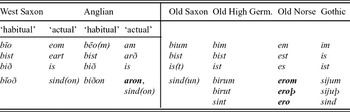
As regards the mixed paradigms of ‘to be’ in Old Saxon and Old High German, I would like to point to what I consider some kind of a parallel in Old English, namely the plural form of the ‘actual’ paradigm (e)aron ‘are’ attested in the Anglian dialect from early on (besides sint/sindon), since aron is assumed to reflect early language contact between Anglian and Old Norse; note the plural forms with initial vowel (bold face) in Anglian and Old Norse in table 2.Footnote 28
Differing formal parallels between the Old English ‘actual’ paradigms and the simple paradigms in the other Germanic languages

Formal admixture affecting an existing paradigm, as assumed for Anglian, is what we also find in the later history of English, when forms derived from the Old Norse demonstrative pronoun were integrated into the paradigm of the personal pronoun in the Danelaw dialects of Old and Middle English (they, them, as opposed to the West Germanic Southern forms hi, hem), from where the borrowed forms eventually spread into Standard English. These examples of Scandinavian influence are commonly attributed to intimate borrowing on roughly equal terms.Footnote 29 So far, no one has ever suggested that such formal admixture was preceded by functionally differentiated paradigms as attested in Old English for the verb ‘to be’ under Celtic influence and as Schumacher assumes for West Germanic, under earlier Celtic influence on the continent. Schumacher's assumption of a twofold paradigm for West Germanic cannot be completely ruled out for the entire contact territory but seems rather unlikely as the result of the types of contact that Schumacher's examples suggest. By contrast, the Celtic influence on (pre-)Old English, which resulted in the well-attested twofold paradigm of the Old English dialects, was clearly substratal, and Keller was right to suggest that such formal and functional restructuring as reflected in the Old English paradigms could only occur in the mouths and minds of English-speaking Britons.
The following section concentrates on lexical and semantic characteristics of Old English and, in particular, of the West Saxon dialect, that lend support to the assumption of early Celtic substratum influence particularly in the Southern Lowlands.
4 Lexical and semantic evidence for Celtic substratum influence on (pre-)Old English
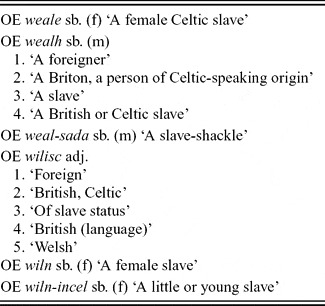
The lexical evidence that can be adduced in support of Celtic substratum influence due to language shift from Celtic to (pre-)Old English does not consist of loanwords but of Old English designations for Celts, especially those referring to their status as slaves. The following discussion is based on David Pelteret's comprehensive study of slavery in Anglo-Saxon England.Footnote 30 The evidence for Old English words meaning ‘slave’ reflects the fact that the institution of slavery was well-established in Anglo-Saxon England, as in other parts of Europe, and that Anglo-Saxons figured as slave owners, as slavers, and as slaves. Before dealing with wealh and etymologically related words it needs to be emphasized that the most widely used Old English word meaning ‘slave’ is ðēow /ðēowa (with a large number of derivatives), which survives in ModG. dienen ‘serve’, Diener ‘servant’, and Dirne ‘prostitute’ (Pelteret Reference Pelteret1995: 41–5, 305–16; Kluge & Seebold Reference Seebold2002 s.vv.). The ‘slave’ meaning of OE wealh has been adduced as linguistic evidence for the status of the Celts before (see esp. Faull Reference Faull1975: 20–44, but also Barber Reference Barber1993: 102 and Hickey Reference Hickey1995: 103–5). However, Pelteret's detailed study of the entire word family, which is based on the complete Old English evidence, allows for a much more differentiated assessment of its historical and linguistic relevance. The list of words for ‘slave’ deriving from wealh(-) in table 3 above, together with Pelteret's investigation of the textual evidence (see esp. Pelteret Reference Pelteret1995: 319–22, 325–8), deserves a detailed discussion.
Pelteret's list of words for ‘slave’ deriving from wealh(-)

Only two of the four meanings of the noun wealh refer to slave status, sense 3 generally, sense 4 to that of a person of Celtic origin. According to Pelteret (Reference Pelteret1995: 320f.), the attestations of sense 3 betray a remarkable regional concentration:
This sense see[m]s to have been limited to the south of England. In biblical translations it appears only in those composed in the West-Saxon dialect. Thus in the West-Saxon version of Matthew 24: 50 weales (weles, wieles) translates serui . . . In the Vespasian Psalter, undoubtedly in the Mercian dialect even though transcribed in Canterbury, seruus is always glossed þiow; in the Rushworth Gospels the corresponding word is esne; and the Lindisfarne Gospels have either esne, ðea, or þræl.
This regional concentration of the evidence was also discussed by Faull (Reference Faull1975: 35f.), who even referred to the contrastive use of different words for ‘slave’ just quoted from Pelteret (Reference Pelteret1995). But Faull also pointed to the (undeniable) fact of the extremely uneven attestation of the Old English dialects, which may give us a somewhat skewed picture of the dialectal situation. Pelteret (Reference Pelteret1995: 321), with particular reference to the late Old English works of Abbot Ælfric, emphasizes that even the West Saxon evidence for the meaning ‘slave’ is not uniform but seems to reflect changes in the attested history of this dialect:
Ælfric's use of wealh [‘slave’] seems to have been limited to his earlier writings, and even then its appearance is a rare occurrence . . . he eliminated it over a period of time, perhaps because of the possibility of confusing it with sense 2.
The evidence for the legal status of the Celts under West Saxon law is difficult to interpret. On the basis of Ine's laws dating from the late seventh century, Charles-Edwards (Reference Charles-Edwards and Green1995: 730f.) characterizes their position in early Wessex as follows:
They had a legal status, but their wergilds were around half those enjoyed by the corresponding Frankish or English rank. . . . the West Saxon noble had a wergild of 1,200 shillings, but the Welsh noble within the West Saxon kingdom had a wergild of 600 shillings.
Thus, slave status was just one form of a more general legal inequality between Saxons and Celts at least in early Wessex.Footnote 31 Grimmer (Reference Grimmer and Higham2007: 107) rightly emphasizes that the explicit treatment of the rights of Britons in this early law code is remarkable in itself: ‘The fact of their inclusion in the Code obviously implies a large enough population of Britons in Wessex to require protection under law.’ He also points out:
The laws tell us that Britons and Saxons co-existed in Wessex under the same authority. The fact of their differentiation strongly suggests the circumstance of West Saxons living amongst Britons, or vice versa.Footnote 32
By King Alfred's time, the legal status of Celts in Wessex was no longer specified, but it is important to note that Ine's laws survive as an appendix to Alfred's. Pelteret (Reference Pelteret1995: 84) interprets this fact as follows:
The main body of the code indicates that changes had taken place in West-Saxon society since the time of Alfred's predecessor, Ine. The latter's legislation, promulgated between 688 and 694, had recognized that the British were an important ethnic group in Wessex, even though many of them appear to have been slaves. No consideration is given to them in Alfred's laws and one must assume that in some measure they had been integrated into Anglo-Saxon society during the intervening two centuries, even though the process still had some way to go as the South-west had not yet been completely subjugated.
And Grimmer (Reference Grimmer and Higham2007:114) rightly emphasizes that the assimilation of Britons in Wessex ‘must have required the complicity and active participation of a whole social system, in this case West Saxons as well as Britons’. But the laws of Alfred leave much room for speculation about the details of this presumably very long process.
The evidence for OE wīln ‘female slave’ (<*wealhin) tells a somewhat different and simpler story. First of all, the word wīln never refers to the Celtic origin of such a person, as is emphasized by Pelteret (Reference Pelteret1995: 327):
The association of the word with wealh is to be seen in the alliterative tag wealas and wylna, which is used in the Old English Heptateuch as the equivalent of seruos et ancillas (Genesis 20:14). Unlike wealh, however, the word is never used as any sort of national appellative for the Celts in extant sources . . . the word always represents ancilla.
Pelteret (Reference Pelteret1995: 43) rightly assumes that the form type with i-mutation suggests a very early date for the formation of *wealhin (< wealh), before this prehistoric sound change took effect (cf. Campbell Reference Campbell1959: § 200). The change of meaning of the word to ‘slave’ occurred in the centuries between the Anglo-Saxon conquest and the earliest attested sources, which suggests that the employment of Celtic women as slaves was very common in the Southern core areas at least in those early times.Footnote 33 The early formative wīln needs to be distinguished from wēale ‘female Celtic slave’, a weak n-stem without i-mutation, a more recent derivative from wealh, which combines senses 2 ‘Briton, Celtic-speaking person’ and 3 ‘slave’, and is attested only in two Riddles.Footnote 34
The textual evidence for wīln clearly points to the Southern Lowlands, which were affected by the Anglo-Saxon conquest earliest and most strongly. According to Pelteret (Reference Pelteret1995: 328), most attestations for wīln are from the late West Saxon works of Ælfric, but occasionally the word is also used by Wulfstan, who was presumably born in the south-eastern Danelaw and became bishop of London and eventually archbishop of York and Worcester (Lapidge et al. Reference Lapidge1999 s.n. Wulfstan the homilist). In the following quotation from one of his homilies, þēowa (the most widely used word meaning ‘male slave’ in all dialects) is contrasted with hlāford ‘lord’, and wīln ‘female slave’ with hlæfdige ‘lady’:Footnote 35
Ealswa baldlice se þeowa clypað and namað on his pater noster his Drihten him to fæder swa se hlaford, and seo wylen eallswa wel swa seo hlæfdige.
Nevertheless, most of the textual evidence for wīln ‘female slave’ is concentrated in the South, just like the evidence for wealh ‘slave’. This suggests that, in the early centuries at least, slaves in Anglo-Saxon England were frequently of Celtic extraction in this Southern core area and that in the same area female slaves were typically of Celtic origin.Footnote 36
With regard to the exact contextual meaning of wīln, Pelteret (Reference Pelteret1995: 327) notes that the word always seems to refer to legal status. He quotes from Ælfric's homily On the Epiphany of the Lord:Footnote 37
Hit gelimpþ forwel oft þæt on anre tide acenð seo cwen and seo wyln, and ðeah geðicð se æðeling be his gebyrdum to healicum cynesetle and ðære wylne sunu wunað eal his lif on ðeowte.
This quotation also helps to explain how a child attained the status of a wīln-incel. Pelteret (Reference Pelteret1995: 327) further emphasizes that there are several indications that wīln ‘was not just used to denote a female slave in general but that it referred more specifically to one who had a personal relationship with her owner’, for which he adduces a quotation from Ælfric's Sermon on Auguries:Footnote 38
Ac seo sawl is ðæs flæsces hlæfdige and hire gedafnað þæt heo simle gewylde ða wylne, þæt is þæt flæsc, to hyre hæsum. þwyrlice færð æt ðam huse þær seo wyln bið þære hlæfdian wissigend and seo hlæfdige bið þære wylne underðeodd.
In another quotation from the same sermon, Ælfric refers to a female slave as seo wyln, who is elsewhere specified as an minra wimmanna (Pelteret Reference Pelteret1995: 327f.). The relationship between a female slave and her master is also attested in a law of Cnut presumably devised by Archbishop Wulfstan, ‘which lays down penalties for a married man who has sexual relations with his own slave. The latter is referred to as a wyln.’Footnote 39 Ælfric and Wulfstan, in their functions as high-ranking men of the church (and, in the case of Wulfstan, as legal adviser of two kings, Æthelred and Cnut), were obviously concerned with the moral and legal problems related to Anglo-Saxon masters and their house slavesFootnote 40 in late Anglo-Saxon England. And the fact that they addressed such problems in homilies and law codes suggests that they were not dealing with isolated cases.
What kinds of linguistic conclusions can be drawn from this lexical and semantic evidence for the assumption of a Celtic substratum in Anglo-Saxon England, and more particularly in Wessex? The evidence especially for wīln and its early wholesale change of meaning to ‘female slave’ suggests that in the Southern Lowlands, at least in early Anglo-Saxon England, the prototypical female slave was of Celtic origin. The knowledge of (pre-)Saxon among such women would have been characterized by interference from Celtic to various degrees, particularly in their syntax and phonology. According to the principles of general contact linguistics, this is likely to have led to the types of early substratum influences on the verbal system discussed above, especially if female house slaves were recruited in considerable numbers and also from monolingually Celtic enclaves for an extended period of time. Direct influence of their ‘imperfect’ Saxon on their masters’ language, i.e. on that of adult men of higher rank, is doubtful. But as house slaves they would have been in close daily contact not only with their masters but, linguistically more important, also with their masters’ children. Hickey (Reference Hickey1995: 104f.) rightly pointed to the possibility of language contact in Anglo-Saxon England between care persons of Celtic origin and their masters’ children. Based on Dillard (Reference Dillard1992), he also drew parallels with the role of black nurses in the southern United States, but he did not have access to the detailed and specific evidence for female Celtic slaves in the (pre-)Saxon core areas provided by Pelteret (Reference Pelteret1995), and it is this type of evidence which makes the assumption of language contact between care persons of Celtic origin and their masters’ children particularly plausible. Note moreover that although the West Saxon laws of Ine and Alfred permitted all free men (ceorlas) to own slaves (see Pelteret Reference Pelteret1995: 84), members of the upper ranks of society can be assumed to have owned more slaves than did ceorlas for doing menial work in and around the house. This means that members of the Saxon upper classes are likely to have come into particularly close contact with Celticized forms of Saxon.
Does this picture of the situation in the (pre-)Saxon core areas, which is based on syntactic evidence for Celtic substratum influence and on the textual evidence for the role of Celtic slaves, tally with Schrijver's assumption, based on writing in Roman-dominated Britannia, of massive language shift from Celtic to Latin for the entire British lowland population in the fourth and fifth centuries? In my view, the different types of evidence for Roman-dominated Britannia and Anglo-Saxon England can be reconciled quite easily, if we assume various degrees of Celtic−Latin bilingualism, most concentrated in the Roman towns and villas, for the Roman-dominated lowlands. After the Anglo-Saxon conquest of these areas, it would have been the most Romanized members of the upper classes who left the lowlands, either for the West Country or for Brittany. And it would have been the lower classes, particularly in the rural areas, with little or no knowledge of Latin, who stayed behind since they had little to lose. On the contrary, e.g. as house slaves, they could hope to improve their situation eventually or at least that of their children, namely by working for their new masters and by learning their language. And in doing so, in the course of centuries, they gradually transformed the structures of that language, due to relexification and imperfect learning and to transmitting such forms of Saxon to their masters’ children. The evidence for wīln suggests that this applied particularly to women. In later Wessex, when the term wīln had attained the more general meaning ‘female slave’, the use of this word need no longer refer to a woman of Celtic origin, and if it did, we do not know whether such a person spoke Celtic or to what particular degree her Old English was influenced by the Celtic substratum. However, by that time, i.e. more than four centuries after the Anglo-Saxon conquest, West Saxon itself had become Celticized to a considerable extent, as is shown by the textual evidence for the twofold paradigm of ‘to be’. By the late ninth century at the latest, from which we have the bulk of the early West Saxon texts, this syntactic feature had become part of the language of the highest ranks of West Saxon society. And since King Alfred and, following his initiative, Ælfric and his contemporaries contributed to the development of a first standard language on the basis of West Saxon, the same feature entered standard late Old English.
5 Conclusion and prospects
This article has concentrated on one of two syntactic features that were first adduced by Wolfgang Keller as linguistic evidence for Celtic influence due to language shift to Old English – the twofold paradigm of ‘to be’. In addition, I have discussed Pelteret's detailed evidence for slavery based on words deriving from words for Celts. My main aim was to show that the structural change of the English superstratum began to operate before our earliest attested sources and that it was the heartlands of Anglo-Saxon England conquered early on that provided the sociolinguistic conditions for large-scale language shift. Keller could not build on a general theory of language contact and the terminology now available, yet he perfectly understood that the twofold paradigm of ‘to be’ represented a significant structural and semantic difference between Old English and the other Germanic languages. Nevertheless, his study offered only a beginning, as he stated in his concluding remark (Keller Reference Keller1925: 66). One of the questions that he could have asked on the basis of the two syntactic features he dealt with is why one Celtic feature (the twofold paradigm of ‘to be’) established itself in the superstratum very early on (and disappeared a few centuries later), why the other (the progressive) took a whole millennium for its present-day stage of grammaticalization, and why others only appeared after the Norman conquest or as late as Early Modern English (see the evidence discussed in Filppula et al. Reference Filppula, Klemola and Paulasto2008 and in other articles in this issue). In my view, such questions need to be addressed not only from a sociolinguistic viewpoint but also with more attention to the correspondences between particular structures of the substratum and the superstratum at various given points in time and on the basis of our knowledge about structural preferences of languages and language change. Quite obviously, all this requires intense co-operation between linguists of different disciplines.