In the face of globalization, the education and training of young people has become a major issue in most countries, in Europe as in Latin America and the United States. Teachers are therefore confronted by a dual challenge: ( a ) to cope with increasing numbers of children in response to parental demands for education, and ( b ) to adapt their teaching methods to meet the needs of children who frequently differ socially, economically and culturally from those they are used to teaching.
For the public authorities, the temptation is to recruit large numbers of new teachers who lack basic experience (Tenti Fanfani, Reference Tenti Fanfani2005). These new recruits see their job first and foremost as a means of earning a living, far removed from the vocational approach of more experienced teachers (Tenti Fanfani, Reference Tenti Fanfani1999).
In this way, the teaching profession is affected severely by changes in the educational system: the identity crisis now being experienced by teachers can largely be explained by the undermining of their professional skills and the vocational character of their work (Lang, Reference Lang and Tenti Fanfani2006). This research, based on environmental psychology, aims to gain a better understanding of the attachment of teachers to their workplace by identifying the places to which they become attached and which are meaningful in terms of their work.
Attachment to place: a concept of environmental psychology
Research on place attachment is a major issue in environmental psychology today. One of the first references to this concept appeared in a classic study by Fried and Gleisher (Reference Fried, Gleisher, Proshansky, Ittelson and Rivlin1976), who found that, when the inhabitants of a Boston suburb were forced to move, the disruption to the spatial and group components of their identity produced reactions similar to those following the death of a loved one and disturbed their sense of community.
Following their study, research increased during the 1980s with frequent references to the issue of place attachment in the environmental literature (Canter, Reference Canter1977; Carp & Carp, Reference Carp and Carp1982; Giuliani, Reference Giuliani1991; Kasarda & Janowitz, Reference Kasarda and Janowitz1974; Riger & Lavrakas, Reference Riger and Lavrakas1981; Sampson, Reference Sampson1988; Sixsmith, Reference Sixsmith1986; Stokols, Shumaker, & Martinez, Reference Stokols, Shumaker and Martinez1983). There was no common definition of the concept of place attachment among researchers at that time, although they attributed physical, social, and/or psychological features to it. Considerable controversy was generated by terminological and methodological confusion, preventing further advances in this field of research (Giuliani, Reference Giuliani, Bonnes, Lee and Bonaiuto2003; Giuliani & Feldman, Reference Giuliani and Feldman1993; Lalli, Reference Lalli1992) until the end of the 1980s, when some consensus appeared concerning a definition of place attachment as a positive affective link between a person and a specific space (Fullilove, Reference Fullilove1996; Giuliani, Reference Giuliani, Bonnes, Lee and Bonaiuto2003; Rivlin, Reference Rivlin1982; Shumaker & Taylor, Reference Shumaker, Taylor, Feimer and Geller1983), highlighting the emotional involvement aroused by a given place (Hummon, Reference Hummon, Altman and Low1992). For example, based on the Theory of Place Attachment proposed by Shumaker and Taylor (Reference Shumaker, Taylor, Feimer and Geller1983) and further developed by Giuliani (Reference Giuliani1991) and Altman and Low (Reference Altman and Low1992), Bonnes and Secchiaroli (Reference Bonnes and Secchiaroli1995) defined place attachment as the affective component of the link between a person and a given place. More precisely, and with reference to the work of Ainsworth, Blehar, Waters, and Wall (Reference Ainsworth, Blehar, Waters and Wall1978) and Bowlby (Reference Bowlby1969; Reference Bowlby1973; Reference Bowlby1980) which postulated that the main characteristic of attachment is the desire to maintain proximity with its object, place attachment could be understood as a tendency to personalize a place. Thus, place attachment is clearly distinguished from closely related concepts, such as place dependence, which involves a behavioral purpose, and place identity, which refers to the cognitive component of the sense of place.
This redefinition of the concept led to a large number of studies (e.g., Giuliani, Reference Giuliani, Bonnes, Lee and Bonaiuto2003; Morgan, Reference Morgan2010; Rollero & De Piccoli, Reference Rollero and De Piccoli2010; Scannell & Gifford, Reference Scannell and Gifford2010) focusing in particular on housing (Giuliani, Reference Giuliani1991; Hidalgo & Hernández, Reference Hidalgo and Hernandez2001; Lewicka, Reference Lewicka2008; Windsong, Reference Windsong2010), the residential district (Bonaiuto, Fornara, & Bonnes, Reference Bonaiuto, Fornara and Bonnes2006; Lewicka, Reference Lewicka2005), the town (Giuliani, Ferrara, & Barabotti, Reference Giuliani, Ferrara, Barabotti, Moser, Pol, Bernard, Bonnes, Corraliza and Giuliani2003; Hidalgo & Hernández, Reference Hidalgo and Hernandez2001; Knez, Reference Knez2005; Rioux & Mokounkolo, Reference Rioux and Mokounkolo2005), or natural or wild places (Brown & Raymond, Reference Brown and Raymond2007; Hammitt, Backlund, & Bixler, Reference Hammitt, Backlund and Bixler2006; Kyle, Graefe, & Manning, Reference Kyle, Graefe and Manning2005).
Attachment to the workplace
Despite the wealth of studies on place attachment in the environmental literature, only a few studies have examined the attachment that people may have for their workplace (Deasy & Lasswell, Reference Deasy and Lasswell1985; Hubiak & Banning, Reference Hubiak and Banning1994; Inalhan, Reference Inalhan2006; Inalhan & Finch, Reference Inalhan and Finch2004; Rioux, 2007a). For example, Deasy and Lasswell (Reference Deasy and Lasswell1985) considered that the workplace should be physically, cognitively, and affectively suited to the work carried out there and recommended a balance between these three elements in the organization. They made three recommendations to human resource managers: (a) provide each employee with a personal space, (b) involve the personnel in the design process, and (c) increase the sense of attachment, which the authors considered to be closely linked to the sense of belonging and territoriality, by creating boundaries, markers, and control. The third recommendation was developed further by Hubiak and Banning (Reference Hubiak and Banning1994), who considered that the organization should develop a sense of community among its employees—and, hence, an attachment to their workplace—to avoid the effects of international competition, social change, and technological innovations. However, the authors recommended that managers promote their employees’ attachment to the workplace without first defining the concepts of place and attachment.
Other authors (Inalhan, Reference Inalhan2006; Inalhan & Finch, Reference Inalhan and Finch2004; Milligan, Reference Milligan1998; Reference Milligan2003a; Reference Milligan2003b) focused more specifically on the processes of workers’ place attachment in a socio-spatial transition situation. Milligan (Reference Milligan1998; Reference Milligan2003b) showed that, when an organization moves to another place, the employees experience this move as a loss and as a form of organizational death. Developing this work further from a longitudinal perspective, Inalhan (Reference Inalhan2006) studied how employees’ attachment to the former (vs. new) workplace evolved during the process of change in the physical work environment. In particular, Inalhan found that place disruptions or move experiences interrupt the processes that bind people to their social environments, thereby significantly hindering their integration into their new workplace. Inalhan and Finch (Reference Inalhan and Finch2004) demonstrated that loyalty to the organization is increasingly determined by social and place attachment; managers should therefore take greater account of this concept and the mechanisms that support the employees’ sense of attachment to their workplace. This recommendation was backed up by results obtained by Rioux and Pignault (Reference Rioux, Pignault and Gangloffin press) that showed that workplace attachment was a predictor of the decision by teachers in the French Education System to request a posting elsewhere, and that workplace attachment was more powerful than the level of affective involvement in the organization.
Several studies that focused more specifically on the process of attachment to the workplace, particularly those carried out among administrative staff (Rioux, Reference Rioux, Battistelli, Depolo and Fraccaroli2005) and hospital staff (Rioux, Reference Rioux and Avram2007b), have concluded that the degree of attachment varies according to the use of the workplace. For example, convivial areas for more or less informal socializing were found to arouse a more intense sense of attachment than those more directly associated with the task and to be independent variables of attachment to the workplace. In addition, Rioux (Reference Rioux, Battistelli, Depolo and Fraccaroli2005) showed that the “Intrinsic satisfaction” items of the French version (Roussel, Reference Roussel1996) of the Minnesota Satisfaction Questionnaire (MSQ) by Weiss, Dawis, England, and Lofquist (Reference Weiss, Dawis, England and Lofquist1977), and the “Work interest” and “Authority and social usefulness” items of the motivation scale in the study by Roussel (Reference Roussel1996) are all highly significant predictors of the workplace attachment of hospital staff. Since the items for these factors relate to the notion of the meaning of work, defined by Morin (Reference Morin, Vandenberghe, Delobbe and Karnas2003) as “a coherence effect between the characteristics a subject seeks in his work and those he perceives in the work he performs,” it is worth exploring in greater depth the links between workplace attachment and the multidimensional concept of the meaning of place.
Our research falls within the framework of environmental psychology and extends studies on work environments. From the conceptual point of view, it takes a transactional and systemic perspective of the human/environment relationship wherein the environment and the individual form a system whose elements cannot be understood in isolation (Morval, Reference Morval2007; Moser & Weiss, Reference Moser and Weiss2003). Thus, for each worker, the organizational space constitutes a “place,” which Canter (Reference Canter and Furnham1986) defined as a unit of environmental experience that is the result of interrelationships between the person’s past, present, and future actions and the physical or representational characteristics of the place.
Objectives and research hypothesis
From this transactional perspective, the preferences and needs of the workers interact continuously and dynamically with the characteristics of their work environment; these interactions lead them to set up appropriate strategies to modify their environment and/or needs in order to optimize their well-being. Thus, the attachment constitutes essential processes that the workers must undertake in order to adapt to their work environment, transforming it into a work place. Moreover, as a collective space, it is endowed with the social meaning given it by its occupants—what Stokols and Schumaker (Reference Stokols, Shumaker and Harvey1981) called “social imageability”. Because the maneuverability of workers in occupying their workplace depends on how autonomous they are in their professional activity, we chose to carry out our research with a group of people who have relative control over their time management, namely secondary school teachers.
Our research examines the links between overall workplace attachment and the attachment to the places that give meaning to work. More specifically, the study has four main objectives:
-
(a) To define the attachment of secondary school teachers to their workplace, which is both a single entity and also a mosaic of specific places. Basing our research on the Theory of Place Attachment proposed by Shumaker and Taylor (Reference Shumaker, Taylor, Feimer and Geller1983) and Low and Altman (Reference Low, Altman, Altman and Low1992), we expected that every worker would be attached to his/her workplace in general (hypothesis 1). Moreover, in keeping with empirical results (Inalhan, Reference Inalhan2006), we postulated that every worker would present a differentiated attachment based on the place (hypothesis 2).
-
(b) To identify the spaces that give meaning to the teachers’ work. While numerous studies have investigated the concept of the meaning of work (Isaksen, Reference Isaksen2000; Morin, Reference Morin, Vandenberghe, Delobbe and Karnas2003), to the best of our knowledge, none have specifically examined the places that give meaning to work. In keeping with empirical results (Inalhan, Reference Inalhan2006; Rioux, Reference Rioux, Battistelli, Depolo and Fraccaroli2005), we hypothesized that there are some types of places which teachers find more meaningful for work than others (hypothesis 3).
-
(c) To evaluate the links between overall workplace attachment and a number of variables. These are sociodemographic variables (age, sex, level of education), variables related to professional career (status, length of service in the establishment, length of service in the post), variables linked to professional activity (time spent outside the classroom building during the day and time spent talking to colleagues), and/or psychosocial variables (attachment to the different workplaces).
-
With regard to sociodemographic variables, we chose age, sex and level of education. From a large number of studies on neighborhood attachment (including Carp & Carp, Reference Carp and Carp1982; Carp,1987; Kasarda & Janowitz, Reference Kasarda and Janowitz1974; Mesch & Manor, Reference Mesch and Manor1998) indicating that the people who are most attached to their neighborhoods are adolescents and elderly people, we expected that the oldest workers would be most attached to their workplace (hypothesis 4). We also postulated, based particularly on the work of Rioux (Reference Rioux and Avram2007b), that women would be more attached to their workplace than men (hypothesis 5).
-
We chose three variables linked to professional career: status in the organization, years of service in the organization, and years in the current post. Knowing that place attachment is greater when the person’s professional and social status is low (Goudy, Reference Goudy1990), we hypothesized that there would be a negative correlation between workplace attachment and status in the organization (hypothesis 6). Basing our research on the work of Beggs, Hurlbert, and Haines (Reference Beggs, Hurlbert and Haines1996) and Sampson (Reference Sampson1988), who concluded that place attachment is a process that occurs over time, we postulated that the length of service in the organization and/or post would influence workplace attachment, in that the longer a person spends in a place, the more opportunities he or she has to build networks of social relationships and to become attached to the place (hypothesis 7). Moreover, we postulated that there would be a strong link between workplace attachment and the two activities related to work activity (time spent out of the classroom building, time spent talking to colleagues) (hypothesis 8). Likewise, we expected that the people who were able to spend time outside their classroom building would feel more independent and more attached to their workplace (hypothesis 9).
-
-
(d) To identify the variables that predict global attachment among those that correlate to workplace attachment. In line with the findings of Rioux (Reference Rioux and Avram2007b) with a sample of hospital workers, we expected that the variables related to attaching meaning to work would also explain overall attachment to the workplace (hypothesis 10).
Method
Participants
The secondary school in which the survey took place is situated in the Paris region and has more than 2000 pupils living in residential zones or in disadvantaged neighborhoods. The secondary school population thus comprises very varied sociocultural groups. More than 200 teachers work in the school. Some are or wish to become settled in the city and in the school, while others see the job as a step towards returning to their home region. Staff turnover is the same as the turnover reported in similar-sized secondary schools in France.
Our sample consisted of 158 teachers working in this school. They were aged between 27 and 56 years (M = 32; SD = 11.58); 74 percent lived with a partner (69% with children) and 26 percent lived alone (18% with children). Among the participants living with a partner, 14 percent lived alone during the week, joining their spouses only at weekends and during vacations. Sixty-eight were holders of the “agrégation,” the highest qualification for secondary school teachers, 77 had the “CAPES,” a post-graduate teaching qualification, and 13 were contract teachers. Ten percent of the teachers had worked at least one year in the state education system, 53 percent had worked for one to five years, and 37 percent had worked for more than five years. Sixteen percent had worked for less than one year in the school, 41 percent had worked there for one to five years, and 43 percent had worked there for more than five years.
Instruments
The questionnaire had in four parts.
Open-ended items evaluating attachment to each workplace.
Semi-structured interviews were held with ten teachers. The first question, “Can you tell me about your place of work?”, was deliberately very open in order to identify which places were mentioned spontaneously. Data were processed using the Alceste Method, a computer program for discourse analysis. All ten participants mentioned eight places: the corridor, the staff room, the classroom, the medical room, the administrative offices, the photocopying corner, the school canteen, and the resource room.
Based on the work of Gerson, Stueve, and Fischer (Reference Gerson, Stueve, Fischer, Fischer, Jackson, Stueve, Gerson, Jones and Baldassare1977) and Mesch and Manor (Reference Mesch and Manor1998), who recommended using one item involving a situation in which the person was removed from the place, one questionnaire item per place was then asked. Many authors (Brown & Perkins, Reference Brown and Perkins1992; Hidalgo & Hernández, Reference Hidalgo and Hernandez2001; McAndrew, Reference McAndrew1998; Proshansky, Fabian, & Kaminoff, Reference Proshansky, Fabian and Kaminoff1983) have considered that an individual is unconscious of his or her attachment to a place as long as he or she is not separated from it. For example, the item concerning attachment to the office was “If I had to leave this workplace, I would miss the office.” Responses were rated on a 5-point Likert scale ranging from 1 (completely disagree) to 5 (completely agree).
Items to identify the places perceived as giving meaning to work.
For the items related to the identification of the places perceived as giving meaning to work, we used Morin’s (Reference Morin, Vandenberghe, Delobbe and Karnas2003) meaning-of-work scale, which consists of thirty items divided into eight dimensions: Ethics (seven items), autonomy (four items), support (four items), usefulness (four items), learning (three items), recognition (three items), relationships (four items), and enjoyment (four items). For each of these dimensions, we kept the item with the highest loading and created one item per place. For example, for the staff room, the item was “When you are in the staff room, you have the impression of being in a place…
…that respects your human values (Ethics).
…that allows you to make decisions (Autonomy).
…where you are supported by your colleagues (Support).
…that is useful (Usefulness).
…where you can learn something new (Learning).
…where you are recognized by your colleagues (Recognition).
…where you can have interesting contacts with others (Relationships).
…that is enjoyable” (Enjoyment).
Each participant ticked the item(s) that corresponded most closely to their opinion.
A scale of general attachment to the workplace.
We chose Rioux’s (Reference Rioux2006) scale of workplace attachment (Echelle d’Attachement au Lieu de Travail - EALT), which was based on work by Altman and Ginat (Reference Altman, Ginat, Mazis and Karaletsou1992). Altman and Ginat considered that attachment can have different, but equally important, definitions depending on whether the aim is to analyze the consequences related to feelings aroused by the environment or the social and psychological processes that occur between a person and his or her environment—in other words, the reasons for the attachment. This seven-item scale has a unidimensional structure and accounts for 76 percent of the variance. Internal consistency is reliable (Cronbach’s alpha = .91). Participants answered on a 5-point Likert scale and an overall score of 7 points thus indicates no attachment. For the purposes of this study, we adapted the EALT to our sample of teachers. For example, the term “this workplace” was replaced by “lycée” in some items, in line with the terms used by teachers in the informal interviews to describe their place of work. This new version of the EALT was then tested with ten teachers (four of whom held an “agrégation”, four of whom held a CAPES, and two contract teachers) to check the clarity and relevance of the series of items.
Sociodemographic and organizational variables.
Items were constructed in order to determine the sociodemographic (age, sex, qualification) and organizational characteristics (length of service in the state education system, length of service in the school, time spent outside the classroom building during the day, number of conversations with colleagues during the day). The self-assessment of functional mobility was made with the item, “How many times a day do you go out of the building in which you usually teach? (None, 1 to 4, 5 to 8, more than 8”).The time spent talking to colleagues was evaluated with the item, “How many colleagues do you talk to every day? (None, 1 to 4, 5 to 8, more than 8”).
Procedure
Once the school director’s agreement had been obtained, a social psychologist attended a staff meeting to present the research project and the data-collection procedure. A questionnaire was left in each teacher’s cubbyhole, and the teachers placed the completed questionnaires in a container in the staff room. Fifty-six percent (63) of the questionnaires were returned. Five were rejected because they were void, incorrectly filled in, or incomplete. Therefore, our final sample consisted of 158 questionnaires.
Data analysis
The general strategy for data processing was to determine whether attachment to the places that give meaning to work predicts overall attachment to the workplace. The data analysis stage began with a descriptive analysis of the results obtained from the personal variables (attachment to different workplaces, the places that give meaning to work, and the place attachment scale). We then analyzed the correlations between the factorial scores for the attachment scale and the sociodemographic variables, and between the variables linked to professional career and activity and the psychosocial variables (hypotheses 4-9). Finally, a hierarchical regression analysis was carried out to test hypothesis 10.
Results
Descriptive analysis of the results (hypotheses 1-3)
Attachment to different workplaces
All of the participants in the pre-study interviews mentioned eight places: the corridor, the staff room, the classroom, the medical room, the administrative offices, the photocopying corner, the school canteen, and the resource room. Table 1 shows the results of the thematic content analysis, which revealed three categories linked to the function each place was given by the teachers:
-
(a) informal communication areas (the school canteen, the staff room, and the corridor):
-
“In the canteen, we talk about this and that…. We get to know each other.”
-
(In the staffroom) “There are sub-groups …. Some don’t like to talk about work, but in the end they all do…. In fact, that’s where you hear information that nobody wants to put in writing.”
-
“When I have something to say to a colleague, it’s often in the corridor. I can say something about a pupil without other colleagues hearing.”
-
-
(b) places for managing stress (the photocopying corner, the administrative offices, and the medical room)
-
“I go to the photocopying corner when I’m feeling irritated; it’s a way of finding a bit of peace and quiet.”
-
The photocopier backs onto the center of a wall, so it is not actually in a corner. The expression “photocopying corner” is probably a reference to its being quiet, at least psychologically.
-
“For everything to do with contact with the families, we go to the office. We go there when we have to deal with a problem. In fact, I usually go there when I’ve got a bit of free time and I don’t want to meet certain colleagues in the staff room.”
-
From observation of the way the school operates, it appears that only teachers with administrative responsibilities have a reason to go to the administrative building. Therefore, the administrative offices represent places for managing stress and that enhance the teachers’ status.
-
The medical room, where the nurse is readily available and willing to listen to the teachers’ problems with the pupils, is also a place for managing stress. In particular, the nurse helps teachers think of alternatives to a punishment that they see as inappropriate.
-
“The nurse is great. She’s always got a kind word, always listens to the pupils and the teachers. When I want to talk about a problem with a kid, I often go to the nurse. And it gives me a bit of breathing space…. Our job is really stressful, you know.”
-
-
(c) places perceived as constituting the essence of the work (the classroom and the resource room).
-
“The classroom, it’s, well… the classroom. We’re here to teach.”
-
“We complain that we don’t always find what we’re looking for, but the resource room isn’t so bad; we’ve got everything we need to prepare our lessons, and I don’t know what we’d do without it.”
-
Description of the Workplace Attachment Items (N = 158)

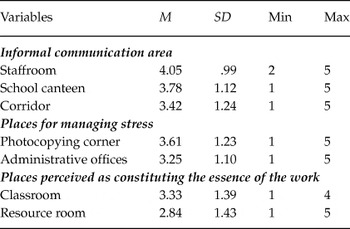
Table 1 also shows the means, the standard deviations, and the number of people that answered each of the nine items used for this research.
The means of scores ranged from 2.84 for the item “I am attached to the resource room” to 4.05 for the item “I am attached to the staffroom.” Standard deviations ranged from .99 (“I am attached to the staff room”) to 1.63 (“I am attached to the medical room”). The item “I am attached to the staff room” had the highest mean score and the weakest dispersion.
Places that give meaning to work
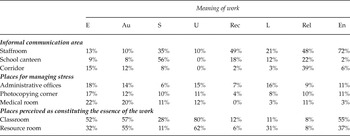
Eight items were selected to identify the places perceived as giving meaning to work. The results are shown in Table 2. In general, it is the places seen as constituting the core business, the essence of work, that give the most meaning to work in terms of usefulness (62-80%), autonomy (55-57%), and to a lesser degree, ethics (33-52%) and enjoyment (37-55%). By contrast, places for informal communication refer more to the support of colleagues (35-56%), recognition at work (12-49%), and the quality of perceived relationships (22-48%). More precisely, the classroom is where the teachers feel most useful and most enjoy doing their work (80% and 62%, respectively), while they believe that the staff room is where they gain the most recognition for their work (49%) and have interesting contacts with others (48%). Finally, all aspects of Morin’s (Reference Morin, Vandenberghe, Delobbe and Karnas2003) scale are involved in the meaning of work in a given place.
Places which Give Meaning to Work (percentage of participants)

E: Ethics. Au: Autonomy. S: Support of colleagues. U: Usefulness. Rec: Recognition at work. L: Learning. Rel: Relationship. En: Enjoyment.
The workplace attachment scale
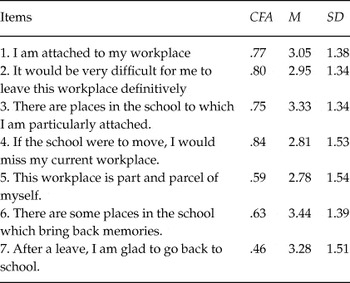
Table 3 shows the means and standard deviations for each item. First, the participants showed a moderate general level of attachment to their workplace (M = 3.08 on a 5-point scale) but with a relative dispersion of responses (SD = 1.43). More specifically, the means varied from 2.78 for the item “This workplace is part and parcel of myself” to 3.44 for the item “There are some places in the school which bring back memories”. The relative heterogeneity of answers concerns all the items, as the standard deviations varied from 1.34 for the item “If the school were to move, I would miss my current workplace”and “It would be very difficult for me to leave this workplace definitively” to 1.54 for the item “This workplace is part and parcel of myself”.
Confirmatory Factorial Analysis of Workplace Attachment (N = 158)

A confirmatory factorial analysis was then carried out to check the unidimensionality of the work attachment scale in our sample, the results of which are also shown in Table 3 (χ2 = 66.16, df =21; RMR = .05; GFI = .93; CFI = .94). The scores of the seven items were averaged to give a single measure of work attachment (α = .83). All the parameters of the model were significant at the .05 level. From these results, it can reasonably be concluded that our data are in line with the model proposed by Rioux.
Correlations between workplace attachment and the research variables (hypotheses 4-9).
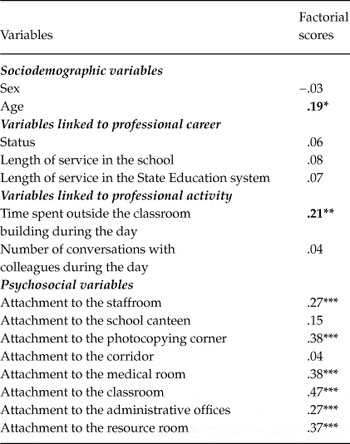
Pearson’s correlations were calculated between the factorial scores for the attachment scale and the sociodemographic variables, the variables linked to professional career and activity and the variables evaluating attachment to each work place. The correlations are shown in Table 4.
Correlations between the Factorial Scores for the Attachment Scale and Sociodemographic, Organizational and Psychosocial Variables (attachment to different places)

*p < .05 ** p < .01 *** p < .001.
Among the sociodemographic and organizational variables, only age, r(156) = .19, p < .05, and time spent outside the classroom building during the day, r(156) = .20, p < .05, were significantly correlated with the results of the place attachment scale. Consequently, older teachers and those who go out of the classroom building most often had the highest workplace attachment scores.
With regard to the variables evaluating attachment to the different places, six were significantly and positively correlated with workplace attachment: attachment to the classroom, r(156) = .47, p < .001, the photocopying corner, r(156) = .38, p < .001, the medical room, r(156) = .38, p < .001, the resource room, r(156) = .37, p < .001, and, to a lesser extent, the staff room, r(156) = .27, p < .001 and the administrative offices, r(156) = .27, p < .01.
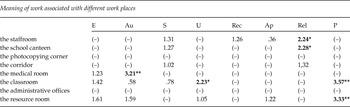
With regard to the correlations between the workplace attachment scale and the variables pinpointing the meaning given to work in each place, we conducted a Student’s t-test, retaining only the dimensions of Morin’s (Reference Morin, Vandenberghe, Delobbe and Karnas2003) meaning-of-work scale (e.g. Usefulness or Recognition) identified by at least 30 participants (19%). The results presented in Table 5 show that six variables giving meaning to work correlate significantly with attachment to the workplace: enjoyment of work in the classroom (t = 3.57, p < .01) and in the Resource room (t = 3.33, p < .01), perceived autonomy in the medical room (t = 3.21, p < .01), the relationships built up in the restaurant (t = 2.28, p < .05) and staffroom (t = 2.24, p < .05), and the feeling of usefulness in the classroom (t = .2.23, p < .05).
Correlations between the Factorial Scores for the Attachment Scale and the meaning of work associated with each place

* p < .05 ** p < .001.
E: Ethics. Au: Autonomy. S: Support of colleagues. U: Usefulness. Rec: Recognition at work. L: Learning. Rel: Relationship. En: Enjoyment.
The predictors of workplace attachment (hypothesis 10).
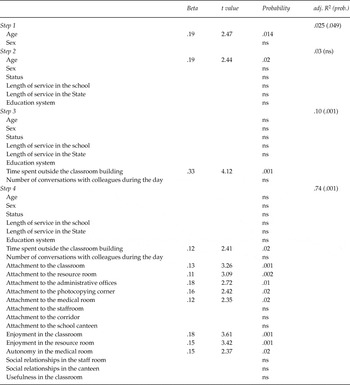
We carried out a hierarchical regression analysis using the factorial score on the workplace attachment scale as the criterion. First, sociodemographic variables (age, sex) were entered into the regression equation. Secondly, variables linked to professional career (status, length of service in the school, length of service in the state education system) and variables linked to professional activity (time spent outside the classroom building during the day, number of conversations with colleagues during the day) were entered. Finally, psychosocial variables—attachment to the staff room, attachment to the school canteen, attachment to the photocopying corner, attachment to the corridor, attachment to the medical room, attachment to the classroom, attachment to the administrative offices, and attachment to the resource room—were entered.
Taken together, the independent research variables accounted for 77 percent of workplace attachment, and the sociodemographic variables explained 2.5 percent of workplace attachment, with only age contributing significantly (see Table 6). Beta coefficients indicate that the older the participant, the greater the attachment to the workplace. No significant impact was found for any of the variables linked to professional career. Variables linked to professional activity explained 10 percent of workplace attachment, over and above the variance explained by the variables entered in the two previous steps. Beta coefficients indicated that the more participants left the classroom building during the day, the greater their attachment to the workplace. Psychosocial variables, which were entered in the fourth step, explained a high proportion of variance in workplace attachment (Δ = 42%), over and above the variance explained by the variables entered in the previous steps. Beta coefficients indicated that teachers who were most attached to the classroom, resource room, photocopying corner, administrative offices and medical room found most meaning in terms of enjoyment in the classroom and resource room, spent most time out of the classroom building during the day and therefore experienced greatest attachment to the workplace.
Summary of Hierarchical Regression Analysis to explain Workplace Attachment (N = 158)

Discussion
The primary purpose of this study was to determine the links that maintain the overall attachment to a workplace and the attachment to the places that give meaning to work. Four objectives were defined.
The first objective was to evaluate secondary school teachers’ attachment to their workplace. We observed a moderate general attachment (M = 3.08) but one that was relatively inconsistent (SD = 1.43). No teacher obtained an overall score of 7 points indicating no attachment. More specifically, overall scores varied between 11 and 35 (the maximum score), from which it can be deduced that all the teachers were attached to their place of work—and some of them very attached. This result confirms hypothesis 1.
Our findings also indicate that the participants had a different level of attachment to each of the areas that they frequent, with the means for each area ranging from 2.84 to 4.05 and standard deviations of 0.99 to 1.63. The highest mean scores were for the meeting and/or social contact areas (the staff room, the school canteen), and the lowest mean scores were for the areas seen as constituting the essence of work (the classroom, the resource room). This result is in line with Rioux (Reference Rioux and Avram2007b), who found that hospital workers showed a strong attachment to the informal meeting areas (entrance hall, restroom, office), while the areas directly associated with their work (patients’ rooms, treatment rooms) had the lowest scores. This result confirms hypothesis 2.
Our second objective was to identify the places that give meaning to the teachers’ work. We observed that all of the places give meaning to work, as none of them scored zero on any of the eight dimensions of the scale. However, the places perceived as constituting the essence of work (the classroom, the resource room) had greater meaning in terms of usefulness, autonomy, ethics, and enjoyment, whereas informal communication areas (the staff room, the school canteen, and the corridor) had higher attachment scores in terms of support of colleagues, recognition of work, and quality of relationships. Thus, our hypothesis 3, that work has more meaning in certain types of places, is not supported. Instead, there appear to be places in which certain dimensions of the meaning of work are more important than they are in other places.
A more detailed analysis indicates that, overall, the highest scores for the meaning of work were for the classroom, with percentages ranging from 8 percent to 80 percent. More than half the teachers identified the classroom as giving meaning to work in terms of usefulness (80%), autonomy (57%), enjoyment (55%), and ethics (52%). The photocopying corner had the lowest scores overall, ranging from 4 percent to 17 percent for the different dimensions. Although no single place provides a focus for the highest vs. the lowest scores, some places (e.g., the classroom) give greater meaning to work than others (e.g., the photocopying corner). Therefore, each workplace can be differentiated according to the meaning given it by the teacher in terms of both quality and intensity.
The third objective was to define the variables linked to overall workplace attachment. Our hypothesis 4, which postulated that the oldest workers would also be the most attached to their workplace, was moderately supported, r(156) = .19, p < .05. This result is in agreement with that of Rioux (2007a) with a similar population. On the other hand—and in contrast to the results obtained by Rioux (Reference Rioux and Avram2007b) with hospital workers—hypothesis 5 is not supported: women are not more attached to their workplace than men. We can assume that the specificity of the population studied by Rioux, a culture of care that is historically the purview of women, explains this difference at least partially. In addition, hypothesis 6, that there would be a negative correlation between attachment to place and the teacher’s status, is not supported, which contradicts the findings of Hunter (Reference Hunter1975) and Goudy (Reference Goudy1990).
Contrary to what we postulated in hypothesis 7, length of service in the organization and/or in the post did not correlate significantly with place attachment. Although place attachment is a process that takes time, once established, it appears to stabilize in that longer periods of time in the job do not increase attachment. It would be useful to investigate this point further by determining at what point a teacher begins to feel attachment.
Only one of the two hypotheses concerning the variables linked to work activities is confirmed. Time spent outside the classroom building during the day correlates significantly, r(156) = .20, p < .05 with overall attachment to the workplace (hypothesis 8). This result supports the work carried out by Rioux in a French public services department (2005) and in a hospital (2007b) which found a strong link between movement outside the department and workplace attachment, connecting it in particular with the sense of control that a person who moves has on his/her workplace. Surprisingly, hypothesis 9, which postulates that “the more a person has the opportunity to develop networks of social relationships, the more he or she becomes attached to his or her workplace,” is not supported. Therefore, the process of attachment to the place occurs over time, but in particular by developing special relationships, not just any social relationships. The fact that teachers have variable timetables may explain this result, but future research is needed to clarify this point.
To meet our fourth objective of evaluating the impact of different variables on the overall attachment to the workplace, we carried out a hierarchical regression analysis. As shown in Table 6, in the fourth step nine explanatory variables emerged, F(9, 141) = 41.85, p < .001, R 2 = .77.
The four most significant predictors concern the meaning given to work (enjoyment in the classroom and in the resource room) and attachment to these places. It should be noted that these places are perceived as constituting the essence of the work.
The first two predictors refer to enjoyment experienced in the places constituting the essence of the profession. This is in line with work by Audebrand and Morin (Reference Audebrand and Morin2003) showing that enjoyment of work underlies the desire to become positively attached to an organization, to identify with it and become involved in it. Our work further refines this result as it shows that it is pleasure experienced in the places constituting the essence of the work that predicts attachment to the organization. Furthermore, this aspect of meaning of work is a better predictor of overall attachment than attachment measured in these places (classroom and resource room). This raises the question of whether the enjoyment experienced in the places constituting the essence of work is a mediator between attachment to these places and overall workplace attachment. Further research is required to answer this question. It would also be interesting to examine in greater depth the link between meaning of work and sense of place, by contrasting the meaning given to work in a given place and the sense of place as defined by Jorgensen and Stedman (Reference Jorgensen and Stedman2001) and developed by Stedman (Reference Stedman2003; Reference Stedman2006). These authors see sense of place as a structural attitude incorporating cognitive, affective and conative responses to spatial settings; in addition to “place identity”, which relates to beliefs, and “place dependence”, which relates to a behavioral intention, this multi-dimensional concept also includes attachment to place.
As predicted by hypothesis 10, attachment to places for managing organizational stress—the photocopying corner, the administrative offices, and the medical room—and the number of times the teacher leaves the classroom building per day emerged as predictors of attachment to the school, although more moderately (threshold of significance .01 to .02). Teachers often control the time they spend outside the classroom building in that they choose where and when to do so. For example, they can leave the teaching area for professional reasons, which allows them to distance themselves temporarily from the children and/or colleagues and, in so doing, rid themselves of the stress related to organizational constraints. Therefore, we can conclude that these four explanatory variables of attachment to the school play a considerable role in the management of organizational stress. Our results are in line with those of Rioux (Reference Rioux, Battistelli, Depolo and Fraccaroli2005), who found that the explanatory variables of tax-office workers’ attachment to their place of work concerned mainly the places connected with work where the workers had some control, particularly those where they could find some privacy, at least psychologically. The fact that the autonomy experienced by teachers when going to the medical room also emerged as a moderate predictor (p = .02) of overall workplace attachment appears to support this interpretation.
Furthermore, this analysis shows that the main places which predict attachment to the school (the classroom and the resource room) are not those to which the teachers are most strongly attached but rather those which give meaning to their work. This result confirms the findings of Rioux’s (Reference Rioux and Avram2007b) study with a sample of hospital workers, which highlighted the importance of places that give meaning to work as predictors of workplace attachment. This counter-intuitive result could be explained by testing the hypothesis mentioned above concerning the variables likely to serve as a link between attachment to place and attachment to the specific areas of which it is composed, and particularly the aspects giving meaning to work identified by Morin (Reference Morin, Vandenberghe, Delobbe and Karnas2003).
Finally, highlighting the impact of cognitive aspects (the meaning given to a place) on place attachment, defined as the emotional link of a person with a given place, could add to the current debate on the operationalization of the concept of place attachment (Devine-Wright, Reference Devine-Wright2011; Lewicka, Reference Lewicka2011; Scannell & Gifford, Reference Scannell and Gifford2010).
This study shows that teachers are attached to their workplace in general but that they show different degrees of attachment to specific places. For example, places for more or less informal social contact arouse a greater sense of attachment than do those directly connected to teaching. In addition, the places to which teachers are most attached do not necessarily predict attachment to the school. For example, the most moderate attachment was felt for the resource room (M = 2.84), the medical room (M = 3.10), the administrative offices (M = 3.25), and the classroom (M = 3.33), although the open-ended items referring to these areas are predictors of attachment to the school, with a significance of .01.
Workplace attachment is a complex process involving how the employee represents and gives meaning to each place that she or he perceives as constituting the work space, the type of social relationships formed there, and the feeling of control over these places, the latter often linked to the time spent there and the activity carried out (whether or not directly related to the job). Therefore, attachment is an element of organizational culture that can help the worker fit into the organization. For this reason, it is important that human resources managers give place attachment the attention it deserves; to ensure that attachment constitutes a strong feature of the organizational culture without hindering change, it is in their interest to encourage among employees a moderate level of attachment both to the places considered part of the essence of the profession and to those that help the worker manage organizational stress.
While a number of studies have investigated the various factors that influence workplace attachment (Inalhan, Reference Inalhan2006; Milligan, Reference Milligan2003a; Reference Milligan2003b), few have focused on the factor of the meaning given to work. Moreover, a large number of studies have varied work contexts and environments in order to determine the characteristics of meaningful work (Isaksen, Reference Isaksen2000; May, Gilson, & Harter, Reference May, Gilson and Harter2004; Morin, Reference Morin1997; Morin & Cherré, 2000; Morin, Reference Morin, Vandenberghe, Delobbe and Karnas2003; Pratt & Ashforth, Reference Pratt, Ashforth, Cameron, Dutton and Quinn2003), but to our knowledge, none have focused on the meaning that workers give to their work in the various places that make up their work space. While we are very conscious of the limitations of this study (small sample, data collection in a single school), we believe that it can create a bridge between these two concepts from associated sub-disciplines. Furthermore, we believe that applying the tools of environmental psychology to the field of work psychology will lead to a better understanding of the way the meaning of work can explain the attachment of workers to the different places that make up their work space.
Finally, workplace attachment could be used as a tool to assess employee integration and to anticipate requests to move or to be posted elsewhere; further research is needed to clarify this aspect. Workplace attachment could also prove to be a valuable tool for practitioners and managers who deal with problems such as employment history, the mental health of workers, work-related stress, spatial well-being, staff turnover and absenteeism. In the educational context, this research can also play a role in understanding the current malaise and unrest experienced by teachers by looking at the issue from a different angle to that of teachers or educational psychologists (e.g., Dubet, Reference Dubet2004; Tenti Fantani, Reference Tenti Fanfani2007) and by suggesting solutions with regard to the physical lay-out of the workplace to help teachers find or maintain the meaning of their work.