Introduction
While tobacco use rates in the United States have begun to decline, smoking continues to be a significant cause of morbidity, mortality, and health care expenditures, with over 443,000 tobacco-related deaths annually in the United States (Centers for Disease Control, 2008). Data suggest that 70% of current smokers want to quit, but without medication or other help, only 4–7% will be successful on any particular quit attempt (Centers for Disease Control, 2008). While many smoking cessation interventions have been studied, even the most successful interventions (combining medication with >8 counselling sessions) result in abstinence rates of about 32% (Stead Lindsay & Lancaster, Reference Stead Lindsay and Lancaster2012; US Public Health Service, 2008). Under the Patient Protection and Affordable Care Act of 2010, smoking cessation is universally included as a covered benefit; however, each insurer decides which methods it will cover (American Lung Association, 2013). A recent cost analysis of smoking cessation interventions estimated that insurer expenditures as high as $800 per smoking cessation attempt would be fully recovered through reduced health care costs within three years after smoking cessation (Leif Associates, 2012).
Most people attempt to quit multiple times before maintaining long-term abstinence from tobacco (US Public Health Service, 2008). Research into interventions to improve quit rates and decrease smoking prevalence is a high priority. Effective non-pharmacologic interventions for smoking cessation are desirable to many smokers who wish to quit. Women often seek such interventions due to concerns about pregnancy, breastfeeding, or weight gain (US Surgeon General, 2002). Non-pharmacologic interventions can also be used in conjunction with pharmacologic therapy to improve the chances of a successful cessation attempt. Yoga is an attractive non-pharmacological option because it can be used safely during pregnancy and lactation, can be combined with other pharmacologic and non-pharmacologic treatments, and can be continued well past the smoking cessation date if desired (Narendran et al., Reference Narendran, Nagarathna, Narendran, Gunasheela and Nagendra2005). Yoga has been studied for cardiovascular disease, obesity, hyperlipidemia, atrial fibrillation, and other chronic diseases, but only a single published study is available for smoking cessation (Bock et al., Reference Bock, Fava, Gaskins, Morrow, Williams and Jennings2012; DiBenedetto et al., Reference DiBenedetto, Innes, Taylor, Rodeheaver, Boxer and Wright2005; Innes et al., Reference Innes, Bourguignon and Taylor2005; Lakkireddy et al., Reference Lakkireddy, Atkins, Pillarisetti, Ryschon, Bommana and Drisko2013; Mourya et al., Reference Mourya, Mahajan, Singh and Jain2009; Murugesan et al., Reference Murugesan, Govindarajulu and Bera2000; Raub, Reference Raub2002). In this study, 55 women were randomized to Vinyasa yoga or a wellness programme (contact control) in addition to eight weeks of group-based cognitive-behavioural therapy (CBT). Women in the yoga group had a higher seven-day abstinence rate (odds ratio [OR] = 4.56; 95% CI = 1.1–18.6) and improved measures of self-efficacy and depressive symptoms than those in the control group (Bock et al., Reference Bock, Fava, Gaskins, Morrow, Williams and Jennings2012). This supports the use of yoga for smoking cessation; however, research is still in its early stages. Further research is needed to define the appropriate style, frequency (dose), and duration of yoga teaching to aid in smoking cessation and to prevent relapse.
Yoga has gained popularity in the United States in recent years and has both physical and mental benefits, such as stress reduction and improved weight control, which are two factors linked to smoking relapse (Velicer et al., Reference Velicer, DiClemente, Rossi and Prochaska1990). Furthermore, because it is relatively low risk and can help to incorporate a potential withdrawal coping mechanism into a cessation attempt, yoga is an attractive potential adjunct to traditional smoking cessation therapies. It is also an option that is accessible to a large number of people who want to quit, in part because it can be practiced in any setting with little to no equipment and can be adapted to fit any fitness level. Moreover, yoga may have advantages over other types of exercise interventions because, in addition to its physical component, yoga also includes a meditative component. Focusing on the breath brings mental focus into the present, which is a form of mindful meditation. Yoga may also include instructor-led meditation using guided imagery to focus the mind and support relaxation. Research has shown guided imagery alone is a successful technique for smoking cessation (Tindle et al., Reference Tindle, Barbeau, Davis, Eisenberg, Park and Phillips2006; Westbrook et al., Reference Westbrook, Creswell, Tabibnia, Julson, Kober and Tindle2013; Wynd, Reference Wynd1992a; Reference Wynd1992b; Reference Wynd2005). The physical exercise aspects of yoga, as well as the breath and meditative components, have the potential to be extremely useful coping tools during a quit attempt.
Aims
The primary objective of this study was to determine the feasibility and acceptability of using Hatha yoga as an adjunct to CBT for smoking cessation to increase quit rates and long-term abstinence from tobacco. In this initial phase of the study, we pilot tested various yoga poses, breathing and meditation techniques, as well as recruitment and retention strategies and evaluation tools, in preparation for a randomized study that will further explore the efficacy of yoga as a smoking cessation tool. We obtained feedback from participants to enhance content and design of the yoga intervention. We assessed adherence to the regimen and use of yoga techniques outside of formal class time. We were also able to assess participant characteristics and preliminary efficacy estimates. Because there have been no large, systematic studies of yoga for smoking cessation, this study will provide pilot data to pave the way for future randomized, controlled trials of yoga for smoking cessation.
We anticipate that a regimen that combines breathing, Hatha yoga postures, and relaxation added to CBT will improve smoking cessation rates compared to CBT alone. Yoga has been studied for a variety of conditions, but there is a paucity of published data for yoga as an intervention for smoking cessation (Bock et al., Reference Bock, Fava, Gaskins, Morrow, Williams and Jennings2012). Hatha yoga is a mind–body technique that emphasizes postures, breathing, and meditation, and is the most commonly practiced form of yoga in the United States (National Center for Complementary and Alternative Medicine, 2013). It can be easily adapted to a wide variety of fitness and educational levels. This project is the first step toward development of an evidence-based yoga regimen that can be used as a non-pharmacologic aid to increase success rates for smokers who wish to quit using tobacco.
Methods
Participants
This study was approved by the Creighton University Institutional Review Board and informed consent was obtained from all participants. This study was open to both men and women aged 19 years or older who smoked at least five cigarettes per day. Participants had to be willing and physically able to participate in yoga, although modifications were offered for those with limited physical mobility. Participants could not be currently practicing any form of yoga, though other mindfulness techniques (such as Tai Chi or meditation) were not exclusions. Exclusion criteria were use of smokeless tobacco or other non-cigarette forms of tobacco. Participants were recruited from the community through print, email, television, and internet advertisements, from affiliated outpatient clinics through flyers, and from those seeking assistance for smoking cessation through our tobacco treatment programme.
Intervention
All who consented to participate received the yoga intervention in addition to the Commit to Quit© CBT programme, which is an eight-session course designed and developed at our institution. Groups of 3 to 10 participants were entered in sequential cohorts. The CBT programme consisted of eight one-hour group sessions conducted over seven weeks. The programme was led by an experienced tobacco treatment specialist. Each session was divided between a lecture devoted to helping individuals understand the critical issues related to stopping smoking and group discussion and support. Topics included self-monitoring, identifying triggers, nicotine fading, lifestyle changes, preparation for the quit day, social support, pharmacologic options, and coping with urges. The target quit date was during the fifth week of the course. Participants were asked to stay an additional 30 minutes beyond the CBT programme time for the yoga portion of the study. The yoga intervention was limited to 30 minutes to minimize the time commitment to the entire programme yet allow participants to experience yoga.
Yoga was divided into roughly 10 minutes of breathing, 10 minutes of postures, and 10 minutes of meditation, though this varied somewhat from week to week. During this time, participants were provided with basic instruction and rationale for using yoga techniques to support their quit process. They were then guided through each session by a certified yoga instructor who is also an occupational therapist (author AM). Participants were also provided written instructions and encouraged to practice the skills they preferred at home or work at least once per day. However, they were allowed to increase the practice to whatever they felt was beneficial to them as part of their quit attempt. Pharmacologic smoking cessation treatments were not provided, but were allowed as desired by participants. Use of pharmacologic smoking cessation agents was documented.
The yoga intervention was a stepwise progression over the eight sessions. Week 1 consisted of discussion and instruction regarding the breathing techniques, yoga poses, and meditation techniques followed with practice of each technique. Participants learned six basic standing yoga poses that could be adapted to seated poses as necessary for participants with balance or orthopedic conditions. Each week the participants were shown various ways to connect and hold poses to make them more or less challenging to meet their specific needs. Participants learned basic chair yoga during a later session. They were also provided with ideas on when and where at home or work they could integrate the yoga poses.
Participants were also taught a variety of yoga breathing techniques. The techniques were practiced alone and in combination with poses and meditation. They were provided with ideas on when and where at work and at home they could practice breathing techniques. They were also instructed on when breathing techniques may be useful during the quit process such as during a craving.
Finally, the participants learned a variety of meditation techniques with an emphasis on mindfulness. They were asked to pay attention to which techniques they responded more positively to and held their attention the most. They practiced the techniques lying down, sitting, and standing. They were provided with ideas of when and where techniques could be practiced at home and at work.
Each consecutive week consisted of a brief discussion as to how the participants were using the techniques and answering any questions the participants had about previously learned skills, followed by practice. Focus was placed on any techniques in which the participants desired additional training. The breathing, poses, and meditation techniques were practiced alone and in combination to help the participants learn various strategies for implementation outside of the class sessions. Focus was placed on providing guidance on ways to implement the yoga techniques into their daily life to help cope with their quit attempt, rather than encouraging formal yoga practice time.
Participants were encouraged to adopt a yoga practice but were encouraged to develop a practice that was specific to them consisting of whichever parts of the yoga instruction they felt was beneficial to them. They were instructed that yoga can be adapted to fit their own needs and lifestyle and does not need to be a specific length or flow to be beneficial. Cook-Cottone (Reference Cook-Cottone2013) reported that we have very little information about ‘therapeutic dosage or the amount of yoga needed to create an effect’ (p. 11). She goes on to state that ‘some research has shown that frequent practice of short duration is of greatest benefit’ (Cook-Cottone, Reference Cook-Cottone2013). Meditation in small doses has also been shown to be effective (Zeidan et al., Reference Zeidan, Johnson, Gordon and Goolkasian2010). The general public often has misconceptions about yoga and how it should be practiced. For example, participants often came to the first session dressed in workout clothing carrying water and a towel and expressing concern that they could not move their body into yoga poses. Participants were encouraged to use their own judgment regarding how to use their new skills and if it was supporting their quit process or their general wellness.
The role of the yoga instructor was not only to teach yoga but to identify the participants’ needs, help them identify how yoga could be used to support their individual quit process, and help identify how they can integrate yoga into their individual lifestyles. Participants participated in breathing, poses, and meditation while in class each week and were encouraged to continue practicing each skill at home. While working at home they were asked to pay attention to how the techniques made them feel and how easily they were able to integrate them into daily life. Participants often expressed concern that they were not practicing enough or they were not using all aspects of yoga. They were reminded that they were to create an individual programme and to work on developing a practice that met their needs and that it was not required that they used all aspects of yoga. They were also reminded that they may discover that yoga is not beneficial or helpful and that this is acceptable. Participants who were interested in learning additional yoga skills were provided with resources to continue their learning. During class, participants reported a variety of approaches to using their yoga skills, often sharing ideas and strategies. Many participants reported using breathing strategies when in public or work situations to help combat cravings. Some participants reported doing yoga poses to replace other smoking-related behaviours, such as doing yoga in place of morning coffee which was always combined with a cigarette in the past. One participant reported using tree pose while talking on the phone instead of lighting a cigarette. Many participants reported using meditation techniques combined with breathing to help induce sleep, or a mindfulness meditation approach when eating to decrease snacking when weight gain was a concern. During class there was an emphasis on using the skills in any manner they determined helpful to them and less emphasis on doing yoga ‘correctly’.
Evaluation
Participants completed an initial smoking assessment with a detailed smoking history prior to the first session. At the end of the eight sessions, three months, and six months post-study, participants were asked which of the three yoga components (breathing, poses, or meditation) was most appealing and useful for their quit attempt and post-cessation. Participants were also asked which strategies were used outside of class and the frequency of use. In addition to the yoga assessment, evaluation included:
-
a) Fagerström Test for Nicotine Dependence at the beginning of the study (Heatherton et al., Reference Heatherton, Kozlowski, Frecker and Fagerstrom1991). Scores range from 0–10 with higher scores indicating higher levels of nicotine dependence.
-
b) Stage of Change at the beginning of the study (Prochaska et al., Reference Prochaska, DiClemente and Norcross1992).
-
c) Self-Efficacy and Situation Temptation Scales (Velicer et al., Reference Velicer, DiClemente, Rossi and Prochaska1990) – (a scale to evaluate self-efficacy in relapse situations) was conducted at the beginning and end of the class series. This scale has subjects rank their confidence in their ability to not smoke in particular situations from 1 (not confident) to 5 (extremely confident). The scores from the 20-item tool are averaged for an overall mean score. In addition, subscores for social situations, negative affect situations, and habitual/craving situations were calculated. A higher score indicates more confidence to refrain from smoking, both on the overall scale and each situational sub-score.
-
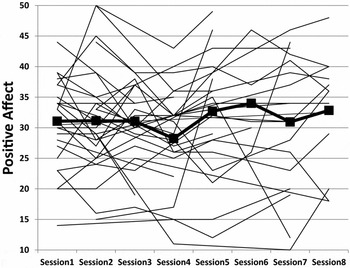
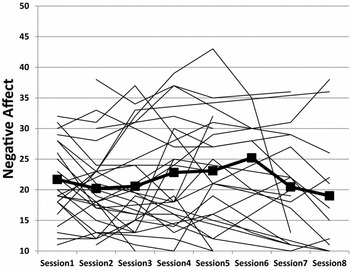
d) Positive and Negative Affect Schedule (PANAS; Watson et al., Reference Watson, Clark and Tellegen1988) – a scale of positive and negative affect – was assessed weekly. This 20-item tool has subjects rank their intensity of specific feelings or emotions. The tool produces a positive affect score and a negative affect score that can each range from 10–50, with higher scores denoting higher levels of either positive or negative affect.
-
e) Signs and symptoms of nicotine withdrawal were assessed weekly (Hughes & Hatsukami, Reference Hughes and Hatsukami1986). Participants were asked to rate the severity of eight symptoms of nicotine withdrawal on a scale of 0 (not present) to 3 (severe) at the beginning of each class session.
-
f) Expired carbon monoxide (CO) was assessed at the beginning of the study, week 5 (quit week), and at the conclusion of the series. Expired CO was assessed using Vitalograph BreathCO monitor (Vitalograph USA, Lenexa, Kansas) and is reported in parts per million (ppm).
Outcome Measures
The primary outcome for this pilot study was participant satisfaction and assessment of perceived beneficial aspects of yoga (i.e., breathing, poses, and/or meditation) as reported by participants. Secondary outcomes include changes in responses to the assessment tools noted above and abstinence from smoking at the end of the CBT/yoga series. Self-report of smoking abstinence (defined as no smoking for the previous seven days) was used as the primary measure of abstinence. Smoking abstinence was biochemically confirmed by expired CO (cut-off point 8 ppm to be considered abstinent) at baseline, week 5, and end of treatment. Self-reported smoking abstinence at three months and six months post-intervention was collected by phone call or email.
Statistical Analysis
Because of the exploratory nature of this project, most results are descriptive. Changes in the responses for the Self-Efficacy and Situation Temptation Scales between pre- and post-intervention were evaluated by Wilcoxon signed-rank test due to the ordinal nature of the scoring.
Linear mixed models were employed to model change in positive and negative affect (PANAS) scaled scores and CO readings over the 49-day study period. Generalized linear mixed models were estimated to model change in response for each ordinal withdrawal symptom rating separately. PANAS scores and withdrawal symptom ratings were collected at all eight sessions whereas CO readings were collected at sessions 1, 5, and 8.
For analyses of PANAS, CO, and withdrawal symptoms, time was considered continuous, as the number of days between sessions were not equal, and was centred at the fifth session (i.e., Session 5 = time 0). The independent variable of interest was smoking status, which was collected at each session and allowed to vary across sessions. As a result, smoking status had variance both within participants and between participants and required explicit partitioning for which we used grand mean centering.
PANAS and CO ratings were modelled using maximum likelihood (ML) estimation and the Satterthwaite approximation for denominator degrees of freedom. Withdrawal symptom ratings were modelled using numeric quadrature using 15 quadrature points, the cumulative logit link, a multinomial response distribution, with optimal parameter estimates for fixed and random effects indicated by gradient values (i.e., partial first derivatives of the log-likelihood function with respect to each estimated parameter) approaching zero (i.e., ≤0.0001). All models were estimated using SAS v. 9.3 with p < 0.05 indicating statistical significance.
Results
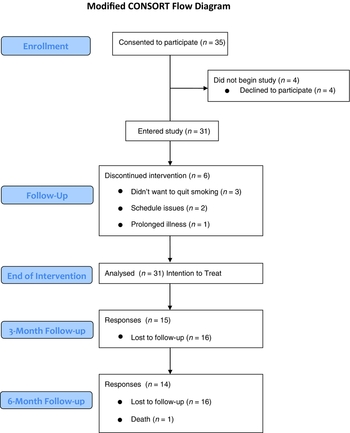
Participant flow through the study is depicted in Figure 1.
Modified CONSORT flow diagram.

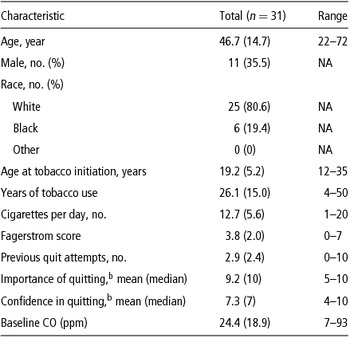
Overall retention in the study was 81% (25/31 participants) which is comparable to retention in our clinical CBT group programme (78%, internal data). Of those who entered the study, participants attended a mean (SD) of 4.7 (1.9) sessions (median = 4). Participant demographics including smoking history are reported in Table 1.
Baseline characteristics of study participantsa

aValues are reported as means (SD) unless otherwise noted.
bRated on a 1–10 scale with 1 being least important or least confident and 10 being most important or most confident.
ppm = parts per million.
The quit rate at the conclusion of the intervention was 29% (n = 9) with an additional five participants (16%) who had quit during the intervention but were absent from the last session to confirm continued abstinence. These five participants did not withdraw from the study and agreed to continue into the six-month follow-up phase. The study dropouts (n = 6) were evenly split by gender and had a mean age of 38 years. The study withdrawals were related to a lack of desire to quit smoking (see Figure 1) rather than with dissatisfaction with the yoga intervention.
At three months post-intervention, 15 participants responded to the follow-up survey (48%). Assuming that those who did not respond were smoking, the abstinence rate was 23% (7/31). At six months post-intervention, 14 participants responded to the follow-up survey (45%). One participant had died during the preceding three months. The abstinence rate was 19% (6/31) at the six-month check-in. At six months, six participants were still using the breathing techniques, three were using the postures, and five were using the relaxation/meditation. Six reported using none of the techniques taught in class.
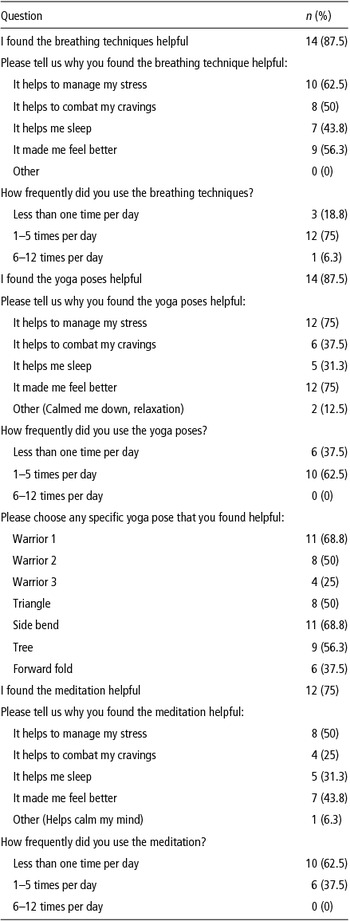
Participant satisfaction with the programme was extremely high with 88% of respondents rating overall satisfaction as Very Satisfied. Response rate for the programme satisfaction survey was 55%. Verbatim comments from subjects about the use of yoga during the quit attempt include: ‘Thank you. I loved the Yoga part, the only thing I would change is more Yoga, or longer Yoga’; ‘I might have quit on my own, but I know the group and the facilitators kept me honest and accountable to myself. I needed all the strength of mind, body and spirit to overcome this addiction’. The response rate for the end of class yoga survey was 51.6%. Satisfaction and evaluation of the yoga regimen are presented in Tables 2 and 3.
Participant satisfaction with the programmea

aValues are reported as n (%) of those who completed the survey.
Use and satisfaction with yoga interventiona

aValues are reported as n (%) of those who completed the survey.
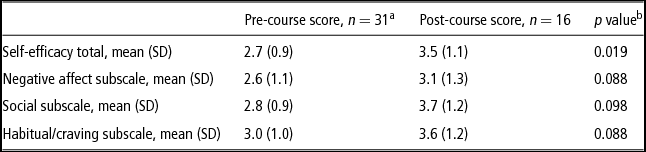
The overall Self-Efficacy and Situation Temptation scores significantly improved from pre-study to the end of the course (p = 0.019) indicating an increase in confidence to not smoke in various situations. However, the social, negative affect, and habitual/craving sub-scores did not significantly change, although all post-course scores were higher than pre-course scores (p = 0.098, 0.088, 0.088, respectively). Self-Efficacy and Situation Temptation results are presented in Table 4.
Self-efficacy and situation temptation scale results

a n = 30 for pre-course habitual/craving subscore due to an omitted page of questions.
b p value for Wilcoxon signed-rank test.
On average, no change across sessions was indicated across for positive or negative affect (see solid black line in Figures 2 and 3, respectively). However, significant individual differences in change were observed within both positive and negative affect (see thin black lines in Figures 2 and 3 as some individuals increased, whereas others decreased). The PANAS scores had the highest negative affect scores during sessions 6 (mean 25.2 + 8.7) and 5 (mean 23.1 + 9.0), and the highest positive affect scores during sessions 6 (mean 34.1 + 7.8) and 8 (mean 32.8 + 9.8). However, session 5 was quit week and 6 was a booster session that occurred during quit week and attendance at the session 6 booster sessions was very low (n = 5). The individual trajectories and session means for the positive affect scores are shown in Figure 2 and negative affect scores are in Figure 3.
Positive Affect Scale – individual trajectories and session meansa aThe thin black lines represent individual trajectories over the eight sessions, whereas the thick black line and boxes represent session means for all participants providing data.

Negative Affect Scale – individual trajectories and session meansa aThe thin black lines represent individual trajectories over the eight sessions, whereas the thick black line and boxes represent session means for all participants providing data.

No change in withdrawal symptom rating over time or smoking status effects were indicated for drowsiness, gastrointestinal symptoms, or headaches. For anxiety ratings, a random linear time slope improved model fit and indicated individual differences in anxiety ratings over the study period (−2ΔLL (≈2) = 5.14, p < 0.05). Smoking status was not associated with greater anxiety ratings. Smoking status was associated with all remaining withdrawal symptom ratings. For cravings, concentration, restlessness, and irritability, a significant linear time-by-smoking status interaction was also indicated, and while the magnitude of this effect varied, the pattern of responses was similar across these withdrawal symptoms. The linear time-by-within-person smoking status interaction indicated the odds ratio of reporting a higher symptom rating between smokers and non-smokers decreased significantly across sessions. Thus, by session 8, the odds of reporting higher symptom ratings were approximately equal for participants who reported smoking compared to those who reported not smoking.
Conclusions
Teaching the yoga skills of breathing, poses, and meditation separately as well as combined allowed participants to experience the different aspects of yoga to determine whether one, two, or all three aspects were beneficial to them and could be incorporated into their individual lifestyle. Emphasizing the different aspects of yoga practice may assist individuals in identifying techniques and creating a practice that is appealing and applicable to their lifestyle. Most participants reported using the breathing techniques rather than the poses or the meditation outside of class. This may be partially due to the limited time to learn these more complex skills. Breathing techniques are also more easily incorporated into any lifestyle. Based on feedback from the participants, the regimen in the randomized trial will continue to teach each skill separately but take a more integrated approach as skills are mastered. This may help participants see how all the skills can be combined more effectively.
The yoga regimen was limited to 30 minutes, as the training occurred immediately following our group CBT sessions (Commit to Quit). Limiting the training to 30 minutes was intended to minimize the time commitment by the participants, but it allowed them to experience and learn a variety of skills related to yoga practice. The majority of participants noted using the breathing exercises outside of class, but few used the poses or meditation. Participants requested a DVD to help them learn and remember the yoga techniques outside of class, because they felt that one day a week was not enough instruction to use them correctly outside of class. This will be incorporated into the randomized trial. However, satisfaction with the poses and meditation during class was rated high. There were no study dropouts that were related to the yoga intervention. All dropouts were related to a lack of desire to quit smoking or scheduling conflicts with the class time.
We recognize that a single arm intervention cannot establish comparative effectiveness of the yoga intervention. This was a pilot project that was not intended to establish efficacy of yoga, but instead was intended to provide information about acceptability and to inform the study team and others who may be working to test yoga for therapeutic benefits about initial experience with Hatha yoga as a therapeutic intervention for smoking cessation.
Some difficulties encountered with the project included: scheduling of classes, compliance with online surveys post-intervention, and group dynamics leading to group successes or group failures. These are the same difficulties that we have encountered with group classes in general clinical practice and this does not seem to be related to the yoga intervention. End-of-class and post-class surveys were sent out by email or by US postal mail based on participant preference. Participants were contacted twice by email and once or twice by phone to request completion of surveys before being considered lost to follow-up. Budgetary limitations precluded participant stipends in this study, and we feel that providing a small stipend for the time needed to complete follow-up surveys could reduce the number of missing surveys. For the next phase of this project (the randomized controlled trial), surveys will be collected on paper on the last day of class whenever possible. Online or mailed paper surveys will be the second line attempt only for those absent or unable to complete the assessments at the last class session and for the three- and six-month follow-up surveys. A $5 gift card will be provided for completing three- and six-month follow-up surveys.
The primary purpose of this study was to assess feasibility and acceptability of the yoga intervention. Through the conduct of this pilot phase of our project, we have found that adding Hatha yoga to a group CBT intervention is feasible and acceptable to participants. This was a single centre experience in the Midwestern portion of the United States. Our experience may not be applicable to other areas of the country where yoga may be more or less accepted. We were very pleased with the diversity of our participants with regard to age, gender, and race. Several participants noted that they responded to the advertisement because they were interested in the yoga more than the group therapy.
The yoga intervention employed in this study incorporated three aspects of yoga practice: breath work; yoga postures; and meditation. The overall goal was to determine the appropriate techniques and frequency of practice that support abstinence from smoking, allowing us to move forward with efficacy and mechanistic studies of yoga for smoking cessation and relapse prevention. This pilot study has established that the yoga intervention is feasible and acceptable to Midwestern smokers, and we have generated a regimen that will be used in a randomized trial that will compare Hatha yoga alone, Hatha yoga plus group behavioural therapy, and group behavioural therapy alone.
Acknowledgements
Dr. Burns was supported in part by the American Society of Health Systems Pharmacists Foundation Research Boot Camp in the conduct of this study.
Financial Support
This work was supported by a Creighton University Health Futures Foundation grant to Dr. Mayer.
Conflict of Interest
None.
Ethical Standards
The authors assert that all procedures contributing to this work comply with the ethical standards of the relevant national and institutional committees on human experimentation and with the Helsinki Declaration of 1975, as revised in 2008.