Implications
Access to pasture allowed the animals to express their natural behaviour, reduced avoidance of humans at the manger and increased immune response. Although grazing animals used no human edible foods, they showed higher digestive capacity and either similar or lower consumptions of protein and energy to reach age of puberty than confined animals. In confinement, heifers showed higher daily weight gains and weight at puberty; however, no differences in terms of age of puberty were observed with the grazing animals. Therefore, for buffalo heifers a free-ranging system may be conveniently used for buffalo heifer farming purposes.
Introduction
Dairy water buffalo farming is a traditional Italian enterprise, which has been conducted for centuries with extensive rearing systems. Buffaloes still present several morphological features acquired through natural selection, which reinforce their ability to thrive well in open environments. For instance, the melanin-pigmented skin of buffaloes is useful for defence against ultraviolet rays. In general, grazing animals allocate the time on different behaviours according to nutritional requirements, the stocking density, the distribution and availability of food, and the perceived threat of predation (Arnold, Reference Arnold1985). From the literature, there are many data on the grazing behaviour of cattle, sheep and goats in the temperate (e.g. Celaya et al., Reference Celaya, Oliván, Ferreira, Martínez, García and Osoro2007) and tropical zones (e.g. Schlecht et al., Reference Schlecht, Hiernaux, Kadaouré, Hülsebusch and Mahler2006). These animal species may devote about 60% of the daylight time feeding, 20% to 26% walking and 12% to 20% resting. Much less is known about the grazing behaviour and grazing time of dairy buffaloes.
Grazing is a major inexpensive tool for grasslands conservation management because of its effect on pasture biodiversity and habitat characteristics. Research has recently focused on extensive grazing systems, especially in mountain areas, due to their environmental sustainability, their function in maintaining biodiversity and landscape ecology (Penati et al., Reference Penati, Berentsen, Tamburini, Sandrucci and de Boer2011). The intake of dry matter (DM) on natural pasture depends on the quality of pasture. Herbage production of Mediterranean pasture depends on the fertility of the soil and meteorological events occurring during the development of the sward (Martiniello et al., Reference Martiniello, Annicchiarico, Caternolo, Bruno and Sabia2011). Buffaloes have a higher feed conversion efficiency compared with cattle, which allows buffaloes to remain productive in pasture-based systems that are limiting for cattle (Zicarelli, Reference Zicarelli1994). In addition, Granum et al. (Reference Granum, Wanapat, Pakdee, Wachirapakorn and Toburan2007) observed that the intake at pasture, in terms of per cent of BW, is higher in Swamp buffaloes than in cattle. Lapitan et al. (Reference Lapitan, Del Barrio, Katsube, Tokuda, Orden, Robles, Fujihara, Cruz and Kanai2004) observed that the apparent digestibility of organic matter in Swamp buffaloes was 70%. However, no studies are available on the effect of grazing on organic matter digestibility in river buffaloes.
Several studies have been conducted to anticipate the age at first calving, with particular attention to heifer management (e.g. Terzano et al., Reference Terzano, Barile, Francia, Malfatti, Todini and Borghese1996). These studies emphasised that feeding and growth play a central role in achieving the weight required for conceptions.
In the last 30 years, buffalo farming has been subjected to a marked intensification of rearing techniques, which has determined a marked reduction of animal welfare (Napolitano et al., Reference Napolitano, De Rosa, Grasso and Bordi2004). Recent European Union policy oriented to de-intensify animal production and promote a sustainable development of otherwise marginal Mediterranean areas, which are often unsuitable for other more productive agricultural practices, have led to renewed interest in extensive rearing systems for species that are well adapted to the environment and, in particular, for categories such as heifers, which can be extensively reared with no negative effects on production. However, in young animals insufficient feed intake and/or unbalanced ration may determine reduced growth performances and a delay of the onset of puberty with a reduction of the farm efficiency. Thus, the present study aims to evaluate the influence of rearing system (free-ranging (FR)v. confinement (C)) on buffalo heifer behavioural and immune indicators, and on efficiency to reach age of puberty.
Material and methods
Management systems
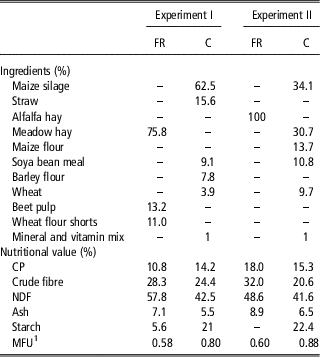
This study has been designed in two experiments. Both experiments were conducted from September 2010 to October 2011. In Experiment I, 32 Mediterranean Italian buffalo heifers (Bubalus bubalis) were used. The experimental animals, aged about 8 to 9 months at the start of experiment, came from the same commercial farm and were managed at origin under the same farming condition (group housed in indoor slatted floor pen with an outdoor paddock). The heifers were divided into two groups: 16 (group C) were group housed in an indoor slatted floor pen (4.0 m2/animal) with an outdoor paddock (4.0 m2/animal) at Eboli, Salerno province, SW Italy (15°03′E, 40°37′N; ∼5 m above sea level); 16 others (group FR) were kept at Gioi, Salerno province, SW Italy (15°13′E, 40°17′N; ∼600 m above sea level). They grazed on a hilly fenced Mediterranean natural pasture of ∼40 ha unsuitable for crop production. From December to March, animals were supplemented in the afternoons with dehydrated beet pulps, wheat flour shorts and meadow hay administered in a free-stall open-sided barn with earth floor (18 m2/head of space allowance) and an ample outdoor paddock (70 m2/head of space allowance). The components and chemical composition of the rations offered to the animals once a day by means of mixer-wagons are reported in Table 1. At the beginning of the experiment, groups were homogenous for age (235±18 and 236±17 days for groups FR and C, respectively) and BW (192±36 and 187±33 kg for groups FR and C, respectively).
Feed and chemical composition (on dry matter basis) of the supplementation offered to free-ranging buffalo heifers (FR) and of the diet offered to confined buffalo heifers (C) in the two experiments
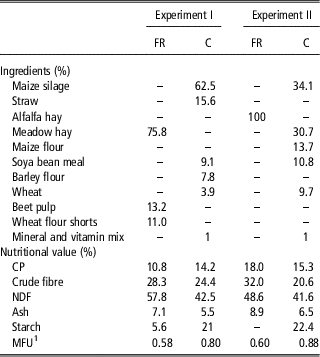
1 Units/kg dry matter; one milk forage unit (MFU)=7.11 MJ of net energy for lactation.
In order to verify whether the results obtained in Experiment I could be replicated in different rearing conditions (reduced pasture availability and different location) but keeping the animals from both treatments at the same altitude, a second experiment was conducted at the same time. Experiment II was conducted at the experimental farm of the Council for Research and Experimentation in Agriculture located in Monterotondo Scalo, Roma (12°57′E, 42°03′N, ~165 m above sea level) on 26 Mediterranean Italian buffalo heifers (B. bubalis). The heifers were divided into two groups: 13 (group C) were group housed in an indoor slatted floor pen (4.0 m2/animal) with an outdoor paddock (4.0 m2/animal); 13 others (group FR) were kept on pasture in the same farm. They grazed on a fenced Mediterranean natural pasture of 5 ha and from December to March were supplemented in afternoons with alfalfa hay. The components and chemical composition of the ration offered to the animals are reported in Table 1. At the beginning of the experiment, groups were homogenous for age (223±22 and 221±28 days for groups FR and C, respectively) and BW (136±40 and 132±40 kg for groups FR and C, respectively).
One stockperson for each experiment was responsible for animal care. This person was not involved in data sampling, which was conducted by an experimental team (four people) operating in both experiments.
Pasture composition and in vivo digestibility
The Mediterranean natural pasture located in Gioi (Experiment I) was characterised by an annual rainfall of ∼950 mm, with 80% falling between September and March. The mean annual temperatures ranged from 1.5°C to 27.4°C. Approximately 10% of the canopy vegetation was dominated by woodland (e.g. Quercus spp., Fraxinus spp.) and shrub (e.g. Calycotome villosa, Cistus spp., Myrtus communis). The rest of the fenced area was occupied by grassy habitat.
The pasture located in Monterotondo Scalo had an annual rainfall of about 512 mm and the mean annual temperatures ranged from 5.5 to 26.9. The total available pasture was occupied by annual grass vegetation.
In both experiments, grass availability in DM (ha), chemical and botanical compositions of the pasture were measured at beginning of November 2010 and March, April, May and June 2011. A total of 15 iron-fenced net boxes (1.5×1.5 m, 1 m height) were randomly placed on grazing area. Herbage was manually harvested at ground level from three 1×1 m areas placed into boxes (Martiniello and Berardo, Reference Martiniello and Berardo2006). The three replicates were individually weighed and for each replicate a random sub-sample of about 500 g of fresh herbage was oven-dried (60°C for 72 h) for determination of DM content and afterwards ground (Cyclotec mill with a mesh screen of 1 mm; Helsinki, Finland). CP, ash (A), ether extract (EE), crude fibre (CF), NDF, ADF and ADL concentrations were also determined (Foss Tecator AB, Hoeganaes, Sweden for the laboratory analyses). The nutritive value of the herbage, expressed in milk feed units (MFU), was calculated from the CP and CF concentrations according to the method used by Andrieu and Weiss (Reference Andrieu and Weiss1981). All chemical analyses were conducted in duplicate. In addition, for each replicate a second sub-sample was used to estimate the botanical composition. The species were grouped into Gramineae, Leguminosae and Compositae, and a miscellaneous group, which included species of the Boraginaceae, Dipsacaceae, Euphorbiaceae, Iridaceae, Plantaginaceae, Ranunculaceae, Scrophulariaceae and Umbelliferae families.
Only in Experiment I, every month, from April to October 2011, faecal samples were collected directly from the rectal ampulla and stored at –20°C before the analysis. Nutrient in vivo digestibility was measured by using acid-insoluble ash (AIA) as internal marker. Feed and faecal samples were analysed in duplicate for AIA using the procedure of Van Keulen and Young (Reference Van Keulen and Young1977).
Grazing behaviour
Free-ranging animals were free to graze throughout the experimental period. Behavioural data were collected through continuous focal animal sampling (Martin and Bateson, Reference Martin and Bateson2007) from April to October 2011 only in Experiment I. During a 6-h period, the behaviour of a focal animal, chosen at random before the start of an observation session, was continuously monitored. They were habituated to the presence of humans following a familiarisation procedure (Braghieri et al., Reference Braghieri, Pacelli, De Rosa, Girolami, De Palo and Napolitano2011). For practical reasons, all observations were performed during daylight. Observation sessions always lasted 6 h and were conducted between 0530 and 1500 h with starting time varying across the seasons. The start and end times (accuracy: 1 s) of the observed behaviours were tape recorded. The behaviours recorded were the following: posture (standing or lying), location (in the sun or in the shade/mud) and activity such as grazing (biting or chewing the herbage or walking with muzzle close to the ground), walking, resting (opened or closed eyes, but no other overt activity), ruminating, whereas all other behaviours (e.g. drinking, alert) were recorded as ‘other’. The proportion of time spent on each behaviour was calculated for each observation session. When the focal animal was grazing, the type of vegetation (wood, shrub or grass) eaten was recorded. The distance covered during the observation session was recorded by means of a pedometer validated for being attached to the waist of the observer (NL-1000, New Lifestyles, Lees Summit, MO, USA). The behavioural observations were divided into three seasons: spring (April to mid-June), summer (mid-June to mid-September) and autumn (mid-September to October), which correspond to plant productivity periods in temperate regions. For each season six observation sessions were performed. Each animal was observed at least once.
Determination of animal intakes, blood metabolites and progesterone levels
In both experiments, animals were weighed at 30-day intervals from September 2010 to October 2011. DM intake, CP and milk forage unit ingestion were estimated on the basis of the BW (91 g DM/kg BW0.75), as suggested by National Research Council (2001). Only for group C, estimated DM intakes were verified by comparison with the actual DM consumptions as routinely registered in the barn (delivered in the trough – trough residuals). Competition with the human nutrition was estimated considering the following components of the diet as inedible by humans: fresh forage from natural pasture, straw, meadow hay, beet pulp and wheat flour shorts, whereas soya bean meal, barley flour and wheat were considered as edible by humans. As to maize silage, 20% (grains) was considered as edible, whereas the remaining 80% (leaves, stalks and cobs) was considered inedible.
At the end of October 2011, the following somatic measurements were recorded: withers height, ileum height, sacrum height, chest depth, chest width, thoracic circumference, body length, rump length, shin circumference, foot back length, heel length, sole length and space between claws.
Throughout both experiments, groups FR and C were temporary gathered before blood sampling at 10-day intervals. Blood sampling was always performed in the morning. Because of the amplitude of pasture, FR animals from Experiment I were collected in the evening before the sampling day and kept in the barn (the same used for feeding supplementation) overnight, whereas group FR from Experiment II and both groups C were gathered just prior blood sampling. Two people moved the heifers through a race from their home environment to a crush, while two others performed blood sampling. Blood samples were collected from the jugular vein into heparinised tubes. The samples were stored in a cold box at 4°C during the transport; within 2 h the samples were centrifuged at 3000×g for 10 min, plasma was collected, immediately frozen and thereafter kept at −20°C until the analysis.
Plasma was assayed for triglycerides, total cholesterol, glucose, urea, total protein, albumin, non-esterified fatty acids (NEFA), phospholipids, β-OH-butyrate, AST, ALT, GGT, ALP, LDH, Ca, P, Mg, Na, Cl, K, total bilirubin, direct bilirubin by ILAB 650 (Instrumentation Laboratory, Lexington, KY, USA) chemistry analyser according to a spectrophotometric method. In addition, progesterone level was determined by a solid-phase P4 radioimmunoassay kit (DPC-solid-phase RIA kit P4; Diagnostic Products Corporation, Los Angeles, CA, USA). The heifers were considered pubertal when plasma P4 levels were above 1 ng/ml for the first time and the following sampling points showed a cyclic trend (Terzano et al., Reference Terzano, Neglia, Maschio, Barile, Razzano, Martiniello, Cannone and Borghese2007).
Other behavioural recordings and immune response
In September 2011, only the animals from Experiment I were subjected to a novel object test. Each animal was exposed to a novel environment (a 6×6 m outdoor and indoor pen for groups C and FR, respectively). Animals of group FR were gathered the evening before the test and kept in the barn (the same used for feeding supplementation) overnight. The test consisted in isolating individual animals from the rest of the group and in leading animals individually through a single-file chute to the testing arena with earth floor and open metal fencing, which was novel to the animals and located ∼20 m away from the home environment. In the middle of the pen a traffic cone (novel object) was located. Animals were isolated from tactile and visual contact from other animals for 5 min. However, they were able to receive auditory and olfactory stimuli from them. Their behaviour during this time was video recorded using a DVL-157 JVC video camera equipped with a wide-angle lens, located at a corner of the test area at a distance from the fence of 6 m and operated by remote control. The number of vocalisation, number of times touching the traffic cone, duration of exploration of the traffic cone (animal approaching the novel object at <50 cm followed by sniffing it), latency time to the first touch of the traffic cone, duration of locomotion (walking slowly, looking in front or around) and number of sustained walking (at least two legs contemporary suspended from the ground, looking in front or around) were recorded. At the end of the test, each animal was returned to the home pen if from group C and to the barn if from group FR.
One week after the novel object test and 5 min after feed distribution, avoidance distance (AD) at the manger was measured. For both groups, a concrete manger with a height of 10 cm and a space of 80 cm/head was available. Animals had access to feed through a metal feed barrier made of two horizontal bars. Heifers were not restrained during feeding. The difference in ground level between the test person and animals was 20 cm. The test was conducted according to the procedure reported by Waiblinger et al. (Reference Waiblinger, Boivin, Pedersen, Tosi, Janczak, Visser and Jones2006). Animals were approached by the test person in a standardised way, that is, directly from the front, starting from a distance of 3 m, walking slowly (around one step per second), looking at the heifer muzzle without staring at the animal’s eyes and keeping an arm in an angle of about 45° in front of the body. The test was ended whenever the heifer withdrew, the latter defined as taking steps away from the observer or turning the head more than 45°. AD was estimated at the moment of heifer withdrawal as the distance between the observer’s hand and the animal’s head with a resolution of 10 cm. A distance of 0 cm was assigned when the heifer was allowed to be touched.
Only in Experiment I, cell-mediated immune response was assessed in vivo by means of a skin test based on non-specific delayed type hypersensitivity to phytohaemagglutinin (PHA). In June 2011, 1 mg PHA (Sigma-Aldrich, Milano, Italy), dissolved in 1 ml of sterile saline solution, was injected intradermally into the middle of a 2-cm wide circle marked on shaved skin on the upper side of each shoulder. The skin-fold thickness was determined before PHA injection, and 24 h after with a calliper. For each animal, a mean increase in skin-fold thickness (24-h thickness – pre-injection thickness) was calculated using the two measurements (Grasso et al., Reference Grasso, Napolitano, De Rosa, Quarantelli, Serpe and Bordi1999).
Statistical analyses
Because of differences in animal genetics, housing, management, stockmanship and location, all data were separately analysed for each experiment; analyses were conducted using SAS (1990).
Means of DM yield, chemical and botanical compositions, and nutritive value of pastures were calculated for each month (November, March, April, May and June) using the three replications as experimental unit. In addition, to summarise the results in a more concise way, the four monthly values from March to June were averaged and presented as a spring season.
For grazing behaviour, only data from Experiment I and group FR were used. Because of the fact that the effect of season was confounded with the animal, no ANOVA could be performed. Therefore, only descriptive statistics (means±s.e.) were calculated.
For each variable, the assumptions of parametric tests were checked before data analyses. A Shapiro–Wilk’s test across the levels of each factor was used to test the normality of distribution, whereas for each factor the homogeneity of variance was assessed with the Levene’s statistic. Organic digestibility (Experiment I), BW and blood metabolites (Experiments I and II) were analysed using the mixed procedure with group as non-repeated factor and time as repeated factor. The heifer variance was considered as random and utilised as the error term to test the main effect of treatment.
In both experiments, the somatic measures, DM intake, CP, milk forage unit ingestion, weight gain, weight and age of puberty were analysed with ANOVA with one factor (group). Pearson correlation coefficients were calculated between daily weight gain v. weight at puberty and age of puberty. Correlation coefficients were calculated both for pooled data (groups FR and C taken together) and for each group separately.
In Experiment I, the variables recorded during the novel object test, AD and skin thickening violated the assumptions of parametric analyses, then we performed the Mann–Whitney U-test using the animal as experimental unit.
Although a complete follow-up study could not be conducted because of the fact that most of the animals used in Experiment I were sold as pregnant heifers, data concerning first-lactation milk production, days to conception post-puberty, weight at first calving and first calving interval were collected from Experiment II (pregnant heifers from group FR were returned to confined conditions 10 days before the expected date of parturition) and subjected to ANOVA with one factor (group).
Results and discussion
Pasture and grazing behaviour
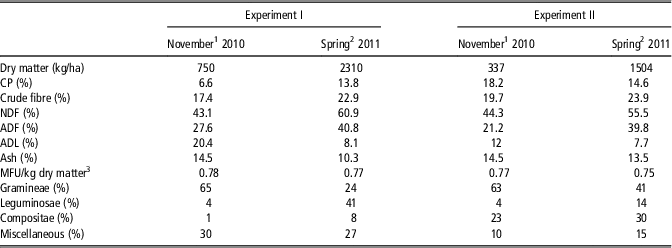
The main characteristics of the pastures used in this study are shown in Table 2. As expected, the peak of productivity, in both experiments, was recorded in spring. In both experiments, the family of Gramineae prevailed in the months of November, whereas the percentage incidence of these plants decreased in spring, when the Leguminosae, Compositae and miscellaneous groups were more represented.
Mean dry matter production, nutritive value, chemical and botanical compositions (on dry matter basis) of the natural pastures used in the two experiments
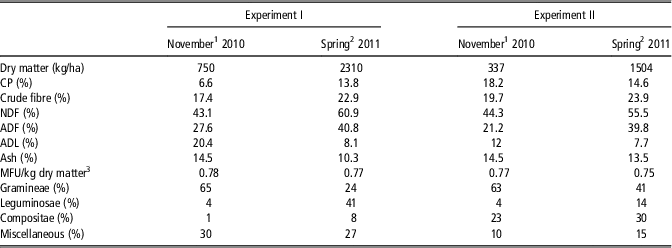
1 Means were calculated averaging three replicates.
2 Means were calculated averaging four monthly values (March to June).
3 One milk forage unit (MFU)=7.11 MJ of net energy for lactation.
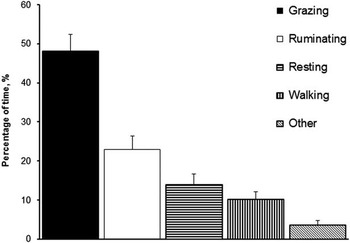
During the behavioural observations conducted in Experiment I, the ingestion of woody or shrub vegetation was rarely observed. These results indicate that Italian Mediterranean buffalo, as also reported for cattle, may be considered grazers rather than browsers (Clauss et al., Reference Clauss, Hume and Hummel2010). Results on grazing behaviour are shown in Figure 1. Although daily distances walked by grazing animals are affected by a number of factors including location of water and food availability, similarly to our results (means±s.e.=2.1±0.3 km). Funston et al. (Reference Funston, Kress, Havstad and Doombos1991) observed that beef cattle covered a mean distance of 3 km/day. As other ruminants, buffalo heifers spent most of their time grazing and ruminating, which was the most expressed behavioural categories. However, they also spent a high amount of time lying either in the mud or in the shade. This is in agreement with previous findings indicating that, when water is available under the form of potholes, ponds or pools, buffaloes lie there for thermoregulatory purposes and protection against ectoparasites (Napolitano et al., Reference Napolitano, Pacelli, Grasso, Braghieri and De Rosa2013).
Main behavioural activities (means±s.e.) of free-ranging buffalo heifers observed over 18 6-h periods in Experiment I.

In vivo digestibility
Digestibility of organic matter as assessed in Experiment I was significantly higher in heifers from group FR than in animals from group C (F 1,30=7.3; means±s.e.=72±1.3% v. 65±1.3%; P<0.01). The level of digestibility observed in groups FR and C are in line with those reported by other authors. Jetana et al. (Reference Jetana, Tasripoo, Vongpipatana, Kitsamraj and Sophon2009) in a study on the digestion and metabolism of nitrogen and purine derivatives observed that the coefficient of digestibility of organic matter was 0.78 and 0.80 in buffaloes and cattle, respectively. Another comparative study on buffaloes and sheep reported digestibility coefficients of 66.68% v. 64.32%, respectively (Bartocci and Terramoccia, Reference Bartocci and Terramoccia2006). The higher digestibility of organic matter observed in grazing animals may be possibly attributed to both the high digestibility of fresh natural forages and, as suggested by Campanile et al. (Reference Campanile, Baruselli, Vecchio, Prandi, Neglia, Carvalho, Sales, Gasparrini and D’Occhio2010), to the lower energy concentration of their diet (see Tables 1 and 2).
Blood metabolites
Plasma concentrations of NEFA, glucose, total cholesterol and triglycerides are shown in Table 3. Heifers from group FR had higher plasma concentrations of NEFA than heifers from group C (F 1,30=87.8, P<0.001 and F 1,24=14.0, P<0.001 in Experiments I and II, respectively). In general, high levels of NEFA in the plasma suggest that lipo-mobilisation is occurring and show an energetic deficit. However, in this study NEFA levels, in both groups, fluctuated within the physiological range for this species (Borghese et al., Reference Borghese, Terzano, Mazzi, Razzano, Sabia and Pacelli2010; Campanile et al., Reference Campanile, Baruselli, Vecchio, Prandi, Neglia, Carvalho, Sales, Gasparrini and D’Occhio2010) and no significant changes were observed during the experimental period. Glucose levels recorded in Experiment I were lower than those obtained in Experiment II. However, glucose levels were generally similar to those reported by a number of other authors (e.g. Haldar and Prakash, Reference Haldar and Prakash2007, report data comparable to those obtained in Experiment I; Campanile et al., Reference Campanile, Baruselli, Vecchio, Prandi, Neglia, Carvalho, Sales, Gasparrini and D’Occhio2010 report data similar to those obtained in Experiment II). In both experiments, plasma glucose concentration was lower in FR than in C (F 1,30=132.6, P<0.001 and F 1,24=16.0, P<0.001 in Experiments I and II, respectively). This is because of the fact that in both experiments a higher amount of energy was given to C animals through the ration. Campanile et al. (Reference Campanile, Di Palo and d’Angelo1997) observed that insulin decreases under conditions of negative energy balance and this is associated with increased utilisation of NEFA to produce glucose. Therefore, it can be hypothesised that in our study high levels of glucose were associated with elevated levels of insulin. Elevated concentrations of both insulin and glucose in circulation are not uncommon in ruminants maintained at high nutrition levels (Campanile et al., Reference Campanile, Baruselli, Vecchio, Prandi, Neglia, Carvalho, Sales, Gasparrini and D’Occhio2010) and, in group C, may have determined a higher weight at puberty by increasing body mass and fat deposition, while being ineffective in reducing the age of puberty. Although the availability of a metabolic fuel such as glucose is assumed to be important, the exact role of glucose in the reproductive function of female ruminants has not been fully elucidated (Haldar and Prakash, Reference Haldar and Prakash2007).
Blood metabolites levels (means±s.e.m.) of free-ranging (FR) and confined buffalo heifers (C) in the two experiments

NEFA=non-esterified fatty acids.
*P<0.05, **P<0.01, ***P<0.001.
Plasma total cholesterol level was lower in FR than in C in both experiments (F 1,30=6.8, P<0.05 and F 1,24=4.5, P<0.05 in Experiments I and II, respectively). The low levels of blood cholesterol recorded in heifers kept on natural pasture may be attributed to the presence of saponins in fresh forages. Immature plants have been found to have higher contents of saponins than mature plants of the same species (Francis et al., Reference Francis, Kerem, Makkar and Becker2002). A number of studies have shown that saponins from different sources lower serum cholesterol levels in a variety of animals including humans (e.g. Potter et al., Reference Potter, Jimenez-Flores, Pollack, Lone and Berber-Jimenez1993). The effect of saponins consists of accelerating cholesterol metabolism in the liver and decreasing intestinal cholesterol absorption by inhibiting pancreatic lipase activity (Singh et al., Reference Singh, Mehla and Singh2012). Alternatively, the lower cholesterol level observed in group FR may be because of the higher physical activity performed by the heifers kept on pasture. Cholesterol, a precursor molecule needed in the biosynthetic pathway of steroid hormones, is related to the ovarian functional activity (Das and Khan, Reference Das and Khan2010). The physiological levels observed by other authors in adult cyclic female buffaloes ranged between 2.08 and 3.78 mmol/l(Campanile et al., Reference Campanile, De Filippo, Di Palo, Taccone and Zicarelli1998; Das and Khan, Reference Das and Khan2010), whereas lower values were found in acyclic Murrah buffalo heifers (Anand and Prakash, Reference Anand and Prakash2008), and even lower levels (1.80 mmol/l), similar to those observed in this study, were observed by Borghese et al. (Reference Borghese, Terzano, Mazzi, Razzano, Sabia and Pacelli2010) in a study on buffalo young bulls.
Animal growth and age of puberty
Somatic measurements of buffalo heifers are shown in Supplementary Table S1. Buffalo heifers from group C showed a longer rump as compared with group FR in both experiments (F 1,30=4.9, P<0.05 and F 1,24=4.5, P<0.05 in Experiments I and II, respectively). Lower withers (F 1,24=6.8, P<0.05), higher ileums (F 1,24=8.2, P<0.01) and sacrums (F 1,24=8.2, P<0.01), and wider chests (F 1,24=10.9, P<0.01) and thoracic circumferences (F 1,24=39.5, P<0.001) were only observed in group C from Experiment II as compared with group FR.
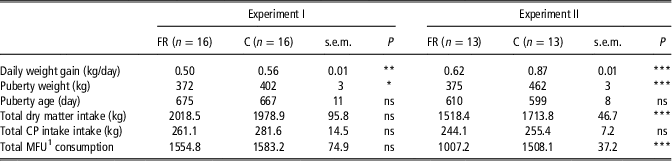
Results on puberty age and BW are shown in Table 4. In both experiments, there were no significant differences between free-ranging and confined animals on age of puberty, whereas puberty weight (F 1,30=4.3, P<0.05 and F 1,24=30.5, P<0.001 in Experiments I and II, respectively) and daily weight gain (F 1,30=7.1, P<0.01 and F 1,24=66.6, P<0.001 in Experiments I and II, respectively) were significantly lower for groups FR than C.
Growth and intakes (means±s.e.m.) of free-ranging (FR) and confined buffalo heifers (C) to reach age of puberty in the two experiments
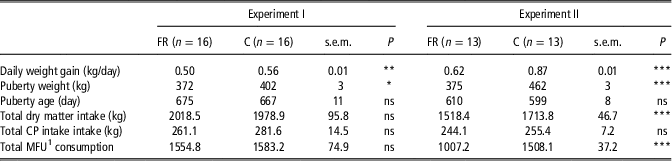
1 One milk forage unit (MFU)=7.11 MJ of net energy for lactation.
*P<0.05, **P<0.01, ***P<0.001.
On 120 buffalo heifers, Borghese et al. (Reference Borghese, Terzano, Barile, Annicchiarico, Allegrini, Zicarelli, Montemurro, Pacelli, Campanile, Esposito, Di Palo, Boni, Seren and Parmeggiani1994) observed an average age of puberty of 623 days and an average weight of 390 kg. The authors suggested that in buffalo heifers the beginning of the ovarian cyclic activity depends on live weight, as buffaloes generally show normal oestrus cycles when they reach 2/3 of their adult BW. Accordingly, in Experiment I overall correlations between daily weight gain v. weight at puberty (r=0.548, P<0.01) and age of puberty were observed (r=−0.299, P<0.10). The scatter plots given in Supplementary Figure S1 show the relationship between daily weight gain v. puberty weight and puberty age. Although significances were not the same, similar results were obtained in Experiment II. The correlation coefficients between daily weight gain v. weight at puberty and age of puberty were r=0.756 (P<0.001) and r=−0.250 (P<0.20), respectively. However, when the two groups from Experiment I were separately analysed, daily weight gain v. age of puberty was significant only for group FR (r=−0.642, P<0.01 and r=−0.099, P>0.20 for groups FR and C, respectively), whereas the correlation daily weight gain v. weight at puberty was significant only for group C (r=0.672, P<0.01 and r=−0.035, P>0.20 for groups C and FR, respectively). Therefore, weight gain seemed to be important only for the animals living on pasture where nutrients were used for development, whereas in confinement, after that the requirements for development were fulfilled, spare nutrients were only used for body mass accumulation and did not affect age of puberty.
The DM intake, CP and milk forage unit ingestion to reach the age of puberty are reported in Table 4. Although in both experiments animals from group C reached higher weights at puberty, they also showed either similar or higher MFU consumption and DM and CP intakes, whereas no significant differences were observed for age of puberty. These results suggest that grazing animals efficiently used the feeding resources available (pasture and a limited supplementation), whereas the higher physical activity performed on pasture did not compromise their reproductive efficiency. More importantly, these performances were obtained taking into account all energy and protein intakes. However, in many cases the feeds used in animal production are inedible by humans and to determine the real efficiency of the system, only consumable energy and protein inputs that are edible by humans should be used for efficiency comparisons. In both experiments of the present study, all the foods consumed by free-ranging animals to reach the age of puberty were inedible by humans; therefore, there was no competition between FR animals and humans. These animals, in fact, grazed natural pastures that could not be used for grain production due to the difficult accessibility to highland pastures, which are often mixed to bushes and trees, and ingested a by-product-based supplementation (Table 1). Conversely, the animals from group C consumed 61.1 and 49.1 kg of protein from foods edible by humans (in Experiments I and II, respectively) and 4542.7 and 3915.3 MJ of energy (in Experiments I and II, respectively).
Although previous studies on dairy cattle revealed that different pre- and post-puberty growth rates can affect first-lactation milk production (Macdonald et al., 2005), data from the animals used in Experiment II showed no effects of pre-pubertal free-ranging on first-lactation milk production (1780±148 and 2019±161 kg in groups C and FR, respectively), days to conception post-puberty (378±7 and 358±5 days in groups C and FR, respectively), weight at first calving (572±12 and 567±13 kg in groups C and FR, respectively) and first calving interval (528±36 and 480±39 days in groups C and FR, respectively).
Other behaviours and immune response
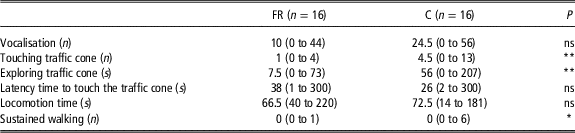
Results are displayed in Table 5. During the novel object test conducted at the end of Experiment I, C animals touched more (z=−2.6; P<0.01) and devoted more time to the traffic cone than FR animals (z=−3.0; P<0.01)), whereas no differences were observed for latency to touch the cone. At least in cattle both a short latency time to explore a novel object and a long exploration time may be interpreted as signs of low fear (Forkman et al., Reference Forkman, Boissy, Meunier-Salaün, Canali and Jones2007). However, exploration can also be expressed by animals kept in barren environments, thus, more motivated in performing investigative activities (Schulze Westerath et al., Reference Schulze Westerath, Laister, Winckler and Knierim2009). Therefore, an alternative explanation may be that in both groups the level of fear was similar (similar latency to touch the cone) but motivation to explore was different (i.e. higher in confined animals). In particular, confined animals, owing to the lack of stimuli in their home environment, were possibly more motivated in exploring a novel object, whereas group FR showed a lower interest for novel stimuli perhaps because they were more accustomed to exploration in a more complex environment (Loberg et al., Reference Loberg, Telezhenko, Bergsten and Lidfors2004). Group C also displayed a higher motivation for locomotory behaviour such as sustained walking (z=−2.1; P<0.05), probably because the expression of this behavioural activity was inhibited in confinement. Similar results were obtained in bovine (Jensen and Kyhn, Reference Jensen and Kyhn2000) and buffalo calves (Napolitano et al., Reference Napolitano, De Rosa, Grasso and Bordi2004).
Median of behavioural activities (minimum–maximum) expressed by free-ranging (FR) and confined buffalo heifers (C) during the 5-min novel object test conducted in the Experiment I
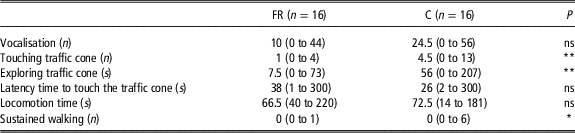
n=number of events, s=duration in seconds.
*P<0.05, **P<0.01.
AD at manger as assessed in Experiment I was lower in group FR than in group C (z=−2.9; 0.54±0.13 v. 1.36±0.21 m, respectively; P<0.01). The reaction of animals to humans may provide useful information about the quality of the relationship in terms of past experience with humans and stockpeople in particular; however, animal response may be also affected by neophobia, general fear and social influences (Waiblinger et al., Reference Waiblinger, Boivin, Pedersen, Tosi, Janczak, Visser and Jones2006). In this study, animals were from the same farm (differences in genetic factors affecting personality and general fear should be reduced to a minimum) and the main difference between groups was free access to pasture for group FR. Consequently, in group FR the human presence was rare and associated with the distribution of feeding supplementation during winter, whereas group C was kept in a farm where neutral routinely farming practices (e.g. cleaning, equipment maintenance, etc.) were also performed by humans. Previous studies showed that farm animals can associate humans with positive events (e.g. Tallet et al., Reference Tallet, Veissier and Boiven2008). Therefore, it can be hypothesised that in free-ranging conditions people were seen as part of an environment, which was positively perceived by buffaloes, thus allowing the establishment of a better human–animal relationship. However, conflicting motivations can also play a role in affecting animal response to humans at the manger, besides previous experiences with stockpeople; physiological data (see ‘Blood metabolites’ section) indicate that FR animals had lower energy supply and this may have contributed to increase the motivation to feed while lowering their AD.
In Experiment I, in vivo cell-mediated immune response to PHA injection was influenced by rearing system (z=−2.9; P<0.01). Skin thickness after PHA injection was higher in FR heifers than in C animals (3.74±0.28 v. 2.38±0.34 mm, respectively). Previous studies showed that the skin test can be used to evaluate the effect of different housing systems on buffalo health and well-being (Napolitano et al., Reference Napolitano, De Rosa, Grasso and Bordi2004). Accordingly, in buffalo calves a higher spatial density determined reduced hypersensitivity to PHA, thus indicating that space restriction may have detrimental effects on cellular immune reactivity (Grasso et al., Reference Grasso, Napolitano, De Rosa, Quarantelli, Serpe and Bordi1999).
Although the lack of repetition of the tests concerning behavioural and immune responses does not allow more conclusive considerations, the results obtained from them seem to converge towards a common indication of a more positive interaction with the environment in free-range conditions.
Conclusions
Although group C had higher daily weight gains and weight at the puberty, the animals from the two groups showed no differences in terms of age of puberty. Therefore, the differences between groups in terms of glucose and NEFA concentrations can be attributed to high-energy inputs in confined animals rather than to energy deficits in animals kept on pasture, at least not to a degree that compromises sexual development. In particular, weight gains seemed to be important only for the animals living on pasture where nutrients were used for growth and development, whereas in confinement, after that the requirements for development were fulfilled, spare nutrients were only used for body mass accumulation. Grazing animals also showed higher levels of organic matter digestibility and no differences in terms of protein and energy consumption for growth. Therefore, these animals were able to reach the age of puberty with similar or lower DM, CP and energy intakes as compared with C animals. In addition, these animals used foods that are inedible by humans.
We also showed that dairy buffalo heifers can be considered as grazers, as they did not ingest shrub vegetation, and displayed a number of behavioural activities (e.g. grazing and wallowing), which were not allowed in confinement. As a possible consequence, grazing animals were less reactive to a novel object and to an unknown person, were less motivated to express sustained walking and also showed a higher cellular immune response. In conclusion, the lower competition with human nutrition, reproductive performances similar to those shown by confined animals and indications given by immune and behavioural variables, suggest that a free-range-based system may be conveniently used for buffalo heifer farming purposes if sufficient nutrient supply is provided.
Acknowledgements
Thanks are due to Prof. A. Borghese for the valuable suggestions given in setting the experiments, A. Bilancione for data collection, G. Migliori and A.M. Riviezzi for laboratory analyses. The authors are also grateful to the two anonymous reviewers for improving the quality of the manuscript with valuable suggestions and considerations.