Introduction
Oesophageal and pharyngeal perforation is rare, with iatrogenic causes being the most frequently cited aetiology.Reference Michel, Grillo and Malt1–Reference Braghetto, Rodríguez, Csendes and Korn3 Following diagnostic rigid oesophagoscopy, a perforation rate of 1.2 per cent has been reported, but this rises to 4.5 per cent after therapeutic procedures such as dilatation, biopsy and foreign body removal.Reference Kubba, Spinou and Brown4 Pain is the most common presenting complaint, and can occur anywhere in the neck, chest or epigastrium.Reference Han, McElvein, Aldrete and Tishler2, Reference Zwischenberger, Savage and Bidani5 Other symptoms include vomiting, haematemesis, dysphagia and breathlessness. The most common signs are tachycardia, fever, subcutaneous emphysema and tachypnoea.Reference Zwischenberger, Savage and Bidani5 Once clinically suspected, a chest or neck X-ray may show surgical emphysema or free air in the mediastinum; the diagnosis is confirmed by a contrast swallow study.Reference Buecker, Wein, Neuerburg and Guenther6
Pharyngo-oesophageal perforation is associated with a high mortality rate of 10–40 per cent, and early diagnosis is therefore essential for appropriate management.Reference Michel, Grillo and Malt1, Reference Han, McElvein, Aldrete and Tishler2, Reference Huber-Lang, Henne-Bruns, Schmitz and Wuerl7 Close post-procedure monitoring is required for early detection of complications, but the appropriate duration of such monitoring is unclear. In 1992, the Royal College of Surgeons of England published guidelines suggesting that same-day discharge was appropriate for patients undergoing rigid upper aerodigestive tract endoscopy.8 However, Kubba et al. queried whether same-day discharge was suitable following rigid oesophagoscopy, reporting that in 40 per cent of patients in whom perforation was diagnosed, no symptoms were noted in the first eight hours after surgery.Reference Kubba, Spinou and Brown4
In order to enable early detection and management of complications, various post-oesophagoscopy protocols have been developed, and used either in all oesophagoscopy patients or only in those considered at higher risk of perforation. However, such a strategy depends not only on the correct identification of high risk patients, but also on the premise that symptoms and signs of complications will develop within the period of close post-operative monitoring. Furthermore, the timing of symptoms and signs indicating post-oesophagoscopy perforation is not well defined.
Therefore, the aim of this study was to examine the timing of the development of symptoms and signs following post-oesophagoscopy perforation. The study also aimed to identify which procedures placed patients at greatest risk.
Materials and methods
A multi-centre, retrospective study was undertaken, involving the following three hospitals: Derby Hospitals NHS Foundation Trust, Nottingham University Hospitals NHS Trust and Univesity Hospitals of Leicester NHS Trust. The electronic Hospital Information Support System was used to obtain the number of patients undergoing rigid oesophagoscopy and/or pharyngoscopy under the care of an ENT consultant. These patients were then cross-referenced with a separate list of patients who had suffered oesophageal or pharyngeal perforation, in order to identify those patients who had suffered a perforation as a result of rigid endoscopy. Morbidity and mortality records were examined to identify any additional cases. In order to include the maximum number of cases, all data available on the Hospital Information Support System were analysed, even though this resulted in different time periods of study for the three centres (i.e. Derby, 1 April 2001 to 1 November 2006; Leicester, 1 January 1997 to 31 December 2006; and Nottingham, 1 January 1995 to 31 December 2005).
The clinical records of index cases were obtained and reviewed. The following information was collected: surgical indications, procedure type, intra-operative findings, and the timing of any post-operative complications. Perforation was diagnosed either intra-operatively or via a contrast study.
Results and analysis
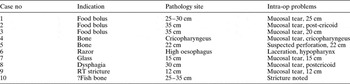
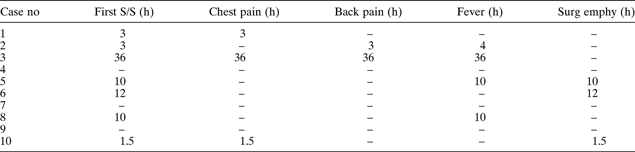
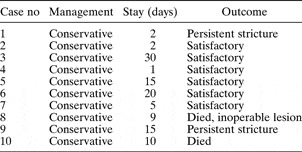
A total of 3459 patients undergoing rigid oesophagoscopy and/or pharyngoscopy was identified, of which 10 developed a perforation (0.29 per cent). These patients comprised five males and four females, with ages ranging from 15 to 83 years (mean 59.5 years). Findings are summarised in Tables I, II and III.
Surgical indications and intra-operative findings of cases with perforation

No = number; intra-op = intra-operative; RT = radiotherapy
Timing of onset of symptoms and signs of perforation
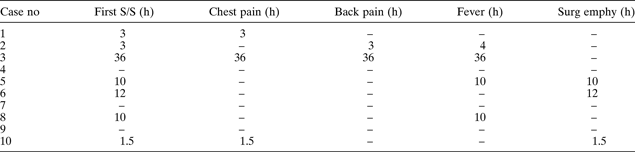
No = number; first S/S = first symptom or sign; h = hours; surg emphy = surgical emphysema; – = none
Management and outcome of perforations

Discussion
This study included 3459 patients undergoing pharyngo-oesophagoscopy. In 10 cases, the procedure resulted in a perforation, giving an overall perforation rate of 0.29 per cent – lower than most previously reported figures, but higher than the perforation rate following flexible oesophago-gastroscopy.Reference Galloway, Gibson and Dalrymple9 All patients were managed conservatively. Two patients who developed mediastinitis died. Patients' hospital stay ranged from just one day to a month. The patients discharged within one to two days either had only superficial mucosal tears, or were either completely asymptomatic post-operatively or rapidly improved within a few days.
Timing of symptoms and signs
Although only a small proportion of patients will develop a perforation after rigid oesophagoscopy, their identification is crucial (ideally as early as possible). This urgency has led to the development of protocols for managing patients after rigid oesophagoscopy. Typically, a patient will be nil-by-mouth for a period of time (usually 4–6 hours), after which they will be allowed only sterile water, while being monitored for tachycardia, chest or back pain, fever, and surgical emphysema. However, it is less clear how long patients should be monitored, and whether this is required in all cases. The decision to keep patients monitored in hospital rests upon the premise that they will develop any symptoms whilst being monitored, thus detecting complications early.
However, relatively little is known about the timing of symptoms and signs developing in actual cases of perforation. In this study, the earliest symptoms and signs developed at 1.5 hours post-operatively, the latest at 36 hours; the mean time of onset was 11.2 hours and the median 10 hours. Some patients developed only one symptom or sign, while others developed multiple symptoms and signs, with no symptom or sign appearing consistently in either the early or late period. Interestingly, three out of nine patients developed no symptoms or signs of perforation, the diagnosis being made intra-operatively. This raises the question of whether some patients may sustain small mucosal tears yet suffer no symptoms or signs and require no treatment, with no adverse outcomes. There was only one patient whose perforation was not suspected intra-operatively; this patient developed symptoms 1.5 hours after surgery and died 10 days later.
Kubba et al. also examined the timing of post-oesophagoscopy perforation symptoms and signs, in a series of 655 patients undergoing oesophagoscopy.Reference Kubba, Spinou and Brown4 Of 15 patients suffering perforation, 27 per cent had developed symptoms or signs by 4 hours post-operatively, 40 per cent by 6 hours, 60 per cent by 9 hours and 100 per cent by 24 hours. All patients developed at least one symptom or sign.
• Perforation after pharyngo-oesophagoscopy is a serious complication, and its identification, through close patient monitoring, is essential; however, little is known about when symptoms and signs develop, and thus how long monitoring should last
• This study found an overall perforation rate of 0.29 per cent; eight of 10 cases had pharyngo-oesophagoscopy for food bolus impaction or foreign body ingestion
• In this study, one patient did not develop symptoms or signs until 36 hours post-operatively, and three patients were asymptomatic; perforation was suspected intra-operatively in all but one case
• Following pharyngo-oesophagoscopy, a contrast swallow should be considered in high risk patients, and a high index of suspicion maintained to ensure early detection of perforation
The data presented here indicate that any post-oesophagoscopy protocol which relies on symptoms or signs developing within a 24 hour hospital stay will not detect all patients with oesophageal perforation. While three of our patients developed no symptoms, one patient developed symptoms 36 hours post-operatively.
Indications for surgery and method of diagnosis
Perforation may be suspected intra-operatively if a procedure is very difficult and traumatic, visibility is poor, bleeding occurs, a mucosal tear is seen, or a sharp foreign body is being pushed distally by instruments. The commonest reasons for post-pharyngo-oesophagoscopy perforation are ingestion of a sharp foreign body or food bolus obstruction; in the present study, all but one perforation was either suspected or diagnosed intra-operatively. This suggests that there may be no need to apply a post-oesophagoscopy protocol to patients undergoing diagnostic endoscopy, providing the procedure was uneventful. However, Kubba et al. found that only one-third of perforations was suspected during the procedure itself, the remaining two-thirds of patients developing symptoms or signs on the ward.Reference Kubba, Spinou and Brown4 Perforation has also been reported following diagnostic endoscopy.Reference Kubba, Spinou and Brown4 The differences between the present findings and those of Kubba and colleagues may be explained by the fact that the latter authors' 15 patients included 11 in whom a perforation was clinically suspected (due to pain, tachycardia or pyrexia) rather that diagnosed intra-operatively or via a contrast study.
Conclusion
Perforation after diagnostic pharyngo-oesophagoscopy is very rare; provided a certain low level of risk is accepted, this procedure may be carried out as a day case, as long as patients are educated appropriately about potential danger symptoms. Therapeutic procedures carry a higher risk of perforation, but symptoms and signs may take longer than 24 hours to develop. Therefore, a contrast swallow should be considered in high risk patients (i.e. in cases with a difficult or traumatic procedure, poor visibility, bleeding, mucosal tear, foreign body, or food bolus). A high index of suspicion must be maintained in order to detect this complication, and patients must be advised appropriately.