Anomalous origin of the right coronary artery from the pulmonary artery is a very rare congenital heart anomaly. Most of the cases are asymptomatic during infancy and childhood, and thus the anomaly is more frequently detected in late childhood, adolescence, and adulthood.Reference Kuhn, Kasnar-Samprec, Schreiber and Vogt 1 We report ARCAPA and aberrant right subclavian in a 2-month male infant.
The case
A 7-week-old male infant was referred to our centre because of heart failure. Manifestations of the patient had begun gradually since the third week of life with intermittent poor feeding, and restlessness. After an ambulatory visit, the patient was admitted in another centre because of increasing clinical manifestations at the age of 5 weeks. Sepsis work-up and relevant evaluations were performed, and the patient was finally referred to our centre for evaluation and management of heart failure at 7 weeks of age. The medical history was uneventful, with a normal vaginal delivery. At presentation to our centre, the patient was underweight, with clinical manifestations of heart failure.
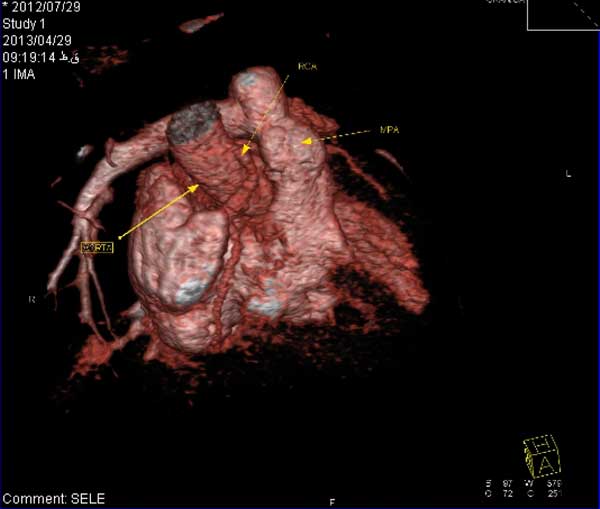
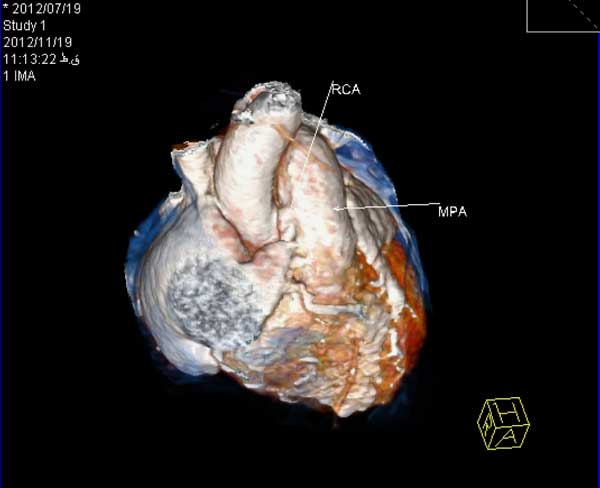
Chest X-ray demonstrated increased cardio-thoracic ratio and pulmonary vascular marking. Echocardiography revealed enlargement of the left atrium, left and right ventricles, moderate tricuspid regurgitation, relatively decreased ejection fraction (40%), and an abnormal diastolic flow in the main pulmonary artery. Computed tomographic angiography revealed abnormal origin of the right coronary artery from the pulmonary artery, also aberrant subclavian artery (Fig 1). Digoxin, captopril and furosemide were initiated for the patient; corrective surgery was also planned. Surgical operation was performed on the seventh day of admission, using direct reimplantation of right coronary artery on the aorta. The post-operative course was uneventful. Computed tomographic angiography after operation revealed normal origin of the right coronary artery from the aorta and no kinking (Fig 2); in echocardiography, the ejection fraction was increased. The patient was discharged from the hospital on the eighth day after surgery with good general condition, good feeding, and no respiratory distress.
Computed tomographic angiography before corrective surgery.

Computed tomographic angiography after corrective surgery.

Discussion
Since the first report of abnormal origin of the coronary artery from the pulmonary artery in 1885 by Brooks,Reference Brooks 2 99 cases of anomalous origin of the right coronary artery from the pulmonary artery (ARCAPA) have been reported.Reference Kumar Kuba, Sharma and Sharma 3 ARCAPA is a very rare congenital heart anomaly estimated to occur in about 0.002% of the population.Reference Jordon, Dry and Edwards 4 The anomaly may originate embryologically from malrotation of the dividing septum of the trunk or malposition of the coronary buds.Reference Kumar Kuba, Sharma and Sharma 3 ARCAPA is the second most common type of anomalous origin of coronary artery from the pulmonary artery, described by Soloff.Reference Soloff 5 The patients are usually asymptomatic during infancy and early childhood, and thus the anomaly is diagnosed commonly at later age.Reference Kuhn, Kasnar-Samprec, Schreiber and Vogt 1
There are few reports of ARCAPA diagnosed at infancy.Reference Brouwer, Beaufort-Krol and Talsma 6 – Reference Tosorsky 9 Except for a 6-week infant with ARCAPA,Reference Willians, Gersony and Hellenbrand 10 our patient is one of the youngest diagnosed case of the anomaly. Heart failure may be a feature of presentation, as in our patient. The associated structural heart defects – more frequently aortopulmonary window, tetralogy of Fallot, ventricular septal defect, and aortic stenosis – were found in more than one-third of the patients.Reference Kuhn, Kasnar-Samprec, Schreiber and Vogt 1 , Reference Bossert, Walter, Doll, Gummert, Kostelka and Mohr 11 With regard to the method of confirming the diagnosis, historically, angiography alone, in addition to echocardiography, has been used, whereas in the recent years non-invasive imaging methods with excellent accuracy – computed tomographic angiography, magnetic resonance imaging – have been recommended for the diagnosis of coronary artery origin anomaly.Reference Tedeschi, Briguori and De Rosa 12 – Reference Su, Krishnamurthy, Churg, Vick and Kovalchin 15 In this way, we used computed tomographic angiography for confirming the diagnosis, and also for the post-operative follow-up. We used the technique of direct implantation of the anomalous right coronary artery from the pulmonary artery to the aorta, as a recommended method for corrective surgery.Reference Qing-yu and Zhong hua 16 – Reference Xu, Guo, Hu, Sun, Song and Sun 18 Post-operative clinical and para-clinical findings of our patients indicated good right coronary artery flow.
This case highlights the special importance of evaluation and appropriate management of correctable causes of heart failure in infancy, including ARCAPA, as well as the presentation of ARCAPA in infancy.