Introduction
Most elderly people report that they prefer to remain in their homes for as long as possible rather than move to nursing homes or other assisted living facilities. By staying in their own homes they are able to maintain the integrity of their social networks, preserve environmental landmarks, and enjoy a better quality of life (Lee et al., Reference Lee, Woo and Mackenzie2002). Furthermore, admission to nursing homes is expensive, both in terms of public and private finances. Again, it has been shown that institutionalization is associated with a number of negative outcomes. Compared to those living at home, studies have shown an increased mortality in nursing homes (van Dijk et al., Reference van Dijk, van de Sande, Dippel and Habbema1992; Wolinsky et al., Reference Wolinsky, Callahan, Fitzgerald and Johnson1992), with a higher mortality risk for males than for females (Dale et al., Reference Dale, Burns, Panter and Morris2001). Furthermore, studies have found that, compared to elderly people living in the community, nursing home placement (NHP) is associated with a lower quality of life in terms of health (Drageset et al., Reference Drageset2008) and with a poorer quality of care (Fahey et al., Reference Fahey, Montgomery, Barnes and Protheroe2003) in terms of monitoring disease and unnecessary drug prescriptions. With regard to mental health conditions, it has been found that depressive disorders are more prevalent in nursing homes than among the community-dwelling elderly (Teresi et al., Reference Teresi, Abrams, Holmes, Ramirez and Eimicke2001; Achterberg et al., Reference Achterberg, Pot, Kerkstra and Ribbe2006), with a significantly greater prevalence of depression in women than in men (Jones et al., Reference Jones, Marcantonio and Rabinowitz2003). For residents with Alzheimer's disease (AD), the mortality risk in nursing homes is higher for males than for females (Lapane et al., Reference Lapane, Gambassi, Landi, Sgadari, Mor and Bernabei2001). The adverse outcomes that accompany institutionalization justify interventions to prevent or delay NHP. Identification of risk factors leading to institutionalization provides the basis for the development and application of pre-admission assessment for older adults.
In recent years a substantial number of studies have considered predictors of institutionalization in the general elderly population (Wingard et al., Reference Wingard, Jones and Kaplan1987; Chenier, Reference Chenier1997; Miller and Weissert, Reference Miller and Weissert2000; Gaugler et al., Reference Gaugler, Duval, Anderson and Kane2007; Luppa et al., Reference Luppa, Luck, Weyerer, König, Brähler and Riedel-Heller2009). However, the analyses in these studies were not gender-specific. According to the demographic situation, a larger proportion of women than men were admitted to nursing homes (Himes et al., Reference Himes, Wagner, Wolf, Aykan and Dougherty2000; Ness et al., Reference Ness, Ahmed and Aronow2004). When gender was analyzed as a predictor of institutionalization, somewhat inconsistent results were reported. Chenier (Reference Chenier1997), Miller and Weissert (Reference Miller and Weissert2000) and Luppa et al. (Reference Luppa, Luck, Weyerer, König, Brähler and Riedel-Heller2009) came to the conclusion that gender alone cannot be considered a risk factor for NHP. In particular, Miller and Weissert (Reference Miller and Weissert2000) and Luppa et al. (Reference Luppa, Luck, Weyerer, König, Brähler and Riedel-Heller2009) showed that 40 of 47 and 12 of 21 studies respectively found no gender effect on risk of institutionalization. Another gender-related issue concerning risk of institutionalization is the analysis of gender differences in predictors of institutionalization. Of the substantial number of studies aiming to predict NHP in the elderly, only a very small proportion deal with gender-specific models of factors of NHP, despite the fact that one cannot assume that all factors leading to NHP can be equally applied to both genders, especially given the different socialization and life conditions of men and women. To the best of our knowledge, in the international literature no systematic review of gender-specific predictors of institutionalization has been conducted. We aimed to review systematically all published studies analyzing gender-specific prediction of institutionalization with the following objectives: (i) to review the rates of institutionalization, (ii) to identify predictors of institutionalization with a special consideration of mental disorders, (iii) to summarize current research findings and drawing conclusions for future research in this area.
Methods
A systematic literature search was conducted. Relevant publications on institutionalization in the elderly were identified by searching the electronic databases MEDLINE, Web of Science, Cochrane Library and PSYNDEXplus as well as bibliographies of identified articles. “Institutionalization”, “nursing home placement” or “nursing home admission” and “factor*” or “predictor*” served as keywords. Studies were selected on the following criteria: (i) they were based on representative samples of community-living elders, (ii) they used a prospective design, (iii) they considered nursing home placement as an outcome criterion, (iv) they identified predictors of nursing home placement by use of multivariate analyses (for adjustment of covariates), and (v) they conducted gender-specific analyses.
Results
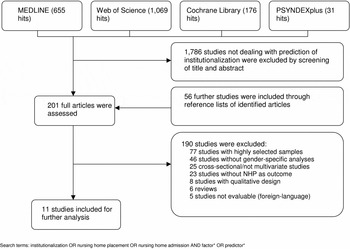
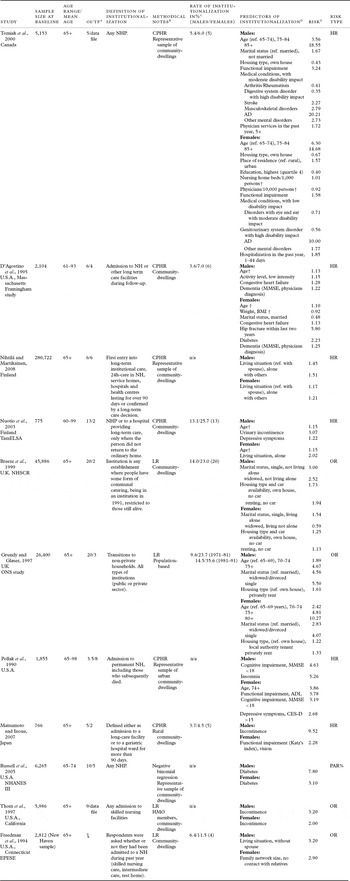
The results of the systematic literature search are shown in Figure 1. Altogether, 201 potentially relevant articles were identified. Of these, 56 were found in reference lists of the identified articles. After perusing all full articles, 190 articles were rejected as not fulfilling the selection criteria (see Figure 1). Eleven studies were assessed and subjected to detailed analysis. Table 1 provides an overview of the studies included, arranged by publication year. Five studies were conducted in the U.S.A., four in Europe, one in Canada, and one in Japan.
Results of the systematic literature search.

Studies of institutionalization in old age

Notes: aObservation interval/number of observation time points; bKind of multivariate data analysis and sample; cCumulative institutionalization rate, (in brackets: observation interval in years); d ↑ for high level, ↓ for low level; (in brackets: instruments measuring factors and/or reference group); e If specified, value of risk, otherwise ↑ for increased risk of institutionalization and ↓ for decreased risk of institutionalization.
Abbreviations: AD = Alzheimer's disease; ADL = Activities of daily living; BMI = Body Mass Index; CES-D = Center for Epidemiological Studies Depression Index; CPHR = Cox Proportional Hazard Regression; EPESE = Established Populations for Epidemiologic Studies of the Elderly; HMO = Health Maintenance Organization; HR = Hazard Ratio; LR = Logistic Regression; MMSE = Mini-mental State Examination; n/a = not applicable; NH = nursing home; NHANES = National Health and Nutrition Examination Survey; NHP = nursing home placement; NHSCR = National Health Service Central Register; ONS = Office of National Statistics; OR = odds ratio; PAR% = population attributable risk percentage; ref. = reference group; TamELSA = Tampere Longitudinal Study on Ageing.
Rates of institutionalization
Rates of institutionalization of male and female elderly were reported by most of the studies. However, rates depended on the definition of institutionalization and were also influenced by age range, periods of investigation of the studies as well as by openings for new admissions in nursing homes. The admission rates for males ranged from 3.6% after five years to 14.5% after ten years, and for females from 4.5% after five years to 35.6% after ten years. The admission rates in most studies were between 40 and 60% higher for women than for men.
Predictors of institutionalization
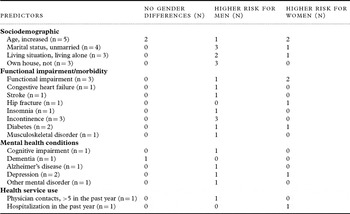
Table 1 shows, besides the methodological characteristics of the studies, the predictors for males and females having a significant effect on institutionalization (with a significance level of p > 0.05). In the following, where available, the minimal and maximal significant results per gender are given in brackets for the particular predictor, otherwise the single result is given. Comparison of absolute risk ratios of males and females was carried out exclusively within the studies, taking into account the methodical differences between studies. In Table 2, we summarize results of studies showing the number of studies finding no gender differences, a higher risk for men, or a higher risk for women.
Summarized results: gender differences on risk of nursing home placement

Socio-demographic characteristics
Regarding increasing age, the studies showed an increased risk of NHP for both genders, some with a higher effect for women, some with similar effects for men and women [males: HR (hazard ratio) 1.13/18.55, OR (odds ratio) 1.89/4.67, females: HR 1.10/14.68, OR 2.42/10.27]. Being unmarried (single, widowed or divorced) was also associated with an increased risk of institutionalization for both genders, with higher effects for men [males: HR 1.67, OR 2.52/5.50, females: HR 2.08, OR 1.54/4.07]. If the person lives alone or with someone as a spouse, the effect on risk of NHP was higher for men than for women [males: HR 1.45/1.51, OR 3.20, females: HR 1.17/2.02]. Not having one's own house showed a higher effect on risk of NHP for men than for women, which was also connected with having no car available (males: HR 2.33, OR 1.61/1.94, females: HR 1.49, OR 1.13/1.33].
Functional impairment and morbidity
Due to functional impairment, two of three studies showed an increased risk only for women, not for men, and one study showed this for both genders, though with a higher effect for men [males: HR 3.24, females: HR 1.58/3.78]. In terms of diseases, congestive heart failure was associated with a higher effect on risk for men compared to women (males: HR 1.28, females: HR 1.13]; stroke [males: HR 2.27] and insomnia [males: HR 5.26] were only associated with an increased risk for men and hip fracture for women [females: HR 5.80]. Incontinence was only associated with a higher risk for men in two of three studies; in the other study the effect on risk was higher for men than for women [males: HR 3.07/9.52, OR 3.20, females: OR 2.00]. For diabetes the risk was increased for men in only one of two studies, for women it increased in both studies; however, in the one study with results for both genders, the effect was higher for men [males: PAR% (population attributable risk percentage) 7.80, females: PAR% 3.10, HR 2.23].
Mental health conditions
For cognitive impairment (measured with the Mini-mental State Examination), one study showed a higher effect on risk of NHP for men than for women [males: HR 4.63, females: HR 3.19]. AD was associated with a higher effect for men [males: HR 20.21, females: HR 10.00]; for dementia the risk was similar for men and women [males: HR 1.22, females: HR 1.25]. Depressive symptoms were associated in one study with an increased risk for men only and in the other study for women only [males: HR 1.22, females: HR 2.68].
Health service use
For men, more than five physician contacts in the past year were associated with an increased risk of NHP [HR 1.72]; for women, hospitalization in the last year was associated with an increased risk [HR 1.85]. No significant associations with risk of NHP in both genders were found for income, self-rated health status, musculoskeletal disorders and sleep duration.
Discussion
The aim of the study was to review systematically all studies analyzing predictors of institutionalization by gender. Despite the potential practical relevance in designing interventions to delay institutionalization, very few studies dealt with gender-specific issues: only 11 studies fulfilled all inclusion criteria, thereby providing the results of the review. In a context of no differences between international studies, we found that gender differences exist for socio-demographic characteristics such us marital status, living situation, housing and car availability as well as for incontinence. Single studies also found gender-differences for somatic diseases such as stroke, hip fracture, diabetes, for mental health conditions such as cognitive impairment and Alzheimer's disease, and for health service use such as number of physician contacts and prior hospitalization (see Results section above). However, in view of the lack of replication of these results, we decided to abstain from their interpretation; further research focusing on these potential differences between genders may elucidate the relationships of these factors to NHP. For both genders the risk of NHP did not substantially differ for the following factors: increased age, functional impairment, as well as for mental health conditions such as dementia and depression.
Regarding marital status and living situation – two closely interrelated factors – our results indicated that the effect of these predictors was different for both genders. We found an increased risk of NHP if the person was unmarried (including single, widowed or divorced) and/or living alone, but with a higher effect on risk of NHP for males than for females. Especially for males, the risk was also increased if they were unmarried and lived with persons other than a spouse. In contrast, for females the risk decreased if they were unmarried and lived with persons other than a spouse. In other words, for males the spouse is the most important person in reducing the risk of NHP, while for females the absence of a spouse did not notably influence the risk of NHP. However, the absence of at least one relative, mostly children, did present an influence. In this context, one should keep in mind that a woman generally outlives her husband, so that the probability of providing care and task support for the spouse is clearly higher for females compared to males. In this regard, it has been shown that over 33% of functionally dependent males are primarily cared for by their wives compared to only 4% of their female counterparts (Gonyea, Reference Gonyea and Hudson1997). However, even if disabled women were married, they received many fewer hours of care compared with their married male counterparts (Katz et al., Reference Katz, Kabeto and Langa2000), which could be explained by sociocultural factors regarding the caregiving role.
In terms of housing, owner occupiers had the lowest rates of transition to nursing homes compared to tenants, with a higher effect on risk of NHP for males than for females. Additionally, not having the use of a car considerably increased the risk for males, but not to the same degree for females. For both genders, home and car ownership has a significant association with the current financial situation, facilitating the disabled person to make arrangements to delay or prevent NHP. Especially for men, it has been shown that lack of a car was strongly associated with male disability but not female (Arber and Ginn, Reference Arber and Ginn1993). The disability led to being less able to drive a car, making it more difficult to carry out tasks and take part in social activities; thus, disability again influenced the risk of NHP.
Urinary incontinence was also a significant predictor of NHP, especially for men. Incontinence in men may be strongly associated with either functional disability or medical disorders, while in women it may occur earlier as an isolated condition (Nuotio et al., Reference Nuotio, Tammela, Luukkaala and Jylha2003; Matsumoto and Inoue, Reference Matsumoto and Inoue2007), and with lower daily time and effort in caregiving for women (Langa et al., Reference Langa, Fultz, Saint, Kabeto and Herzog2002). A common cause of incontinence in men is benign prostatic hypertrophy or other conditions causing an enlarged prostate, which is unlikely to cause physical disability, although it may seriously affect the health-related quality of life (Sagnier et al., Reference Sagnier, MacFarlane, Teillac, Botto, Richard and Boyle1995). Secondly, other than underlying medical disorders, the increased caregiver burden resulting from incontinence may play an important role in the relationship between incontinence and NHP in men. Certainly, the physical caring burden must be greater for caregivers of male incontinent patients than for female patients (Matsumoto and Inoue, Reference Matsumoto and Inoue2007), mainly since caregivers were usually females.
Mental health conditions such as dementia and depression were rarely investigated in studies, which was caused primarily by the low number of studies analyzing gender differences in predictors of NHP in total and, to a lesser extent, by methodological difficulties in measuring dementia and depression in large-scale epidemiological studies. For the final evaluation of the gender-specific impact of mental disorders on NHP, the data currently available were insufficient. Further research of gender differences in mental health conditions is needed to provide evidence for this special point.
Admission rates in most of the studies clearly increased for women. The male to female ratio of rates ranged between 1 to 1.4 and 1 to 1.6. This result for the international studies is in line with previous findings for the U.S.A., showing a ratio of rate of 1:1.62 in 1999 (Ness et al., Reference Ness, Ahmed and Aronow2004). The gender difference in nursing home placements is explained by the higher life expectancy of women, by the tendency of women to marry men who are slightly older, and by a higher remarriage rate for older widowed men than widowed women. As a result, women tend to be widowed and living alone, thus having no spouse to provide care in case of disability.
However, gender-specific analysis and comparison of results may bring about methodical problems which should be discussed. Gender-specific analysis (i.e. separate analysis for men and women) of prediction of institutionalization did not take into account the effect of gender itself on risk of NHP and did not adjust results for gender effect; but otherwise it has been shown that no gender-effect on risk of NHP exists (Miller and Weissert, Reference Miller and Weissert2000; Luppa et al., Reference Luppa, Luck, Weyerer, König, Brähler and Riedel-Heller2009). Furthermore, the gender-specific view on risk of institutionalization provided risk ratios (hazard or odds ratios) of factors for both genders separately; however, only one of the studies analyzed the statistical significance of differences between risk ratios of males and females (Nihtilä and Martikainen, Reference Nihtilä and Martikainen2008). The other studies found one and the same predictor for both genders but with different risk ratios, so one cannot conclusively assume that the differences between the risk ratios of both genders were statistically significant. However, despite the methodical problems outlined, this review is the first to look at prediction of NHP from a gender-specific point of view. It includes – as its strength – studies using a prospective design and multivariate analyses (for adjustment of covariates) for identification of predictors of NHP.
In summary, the present study found only a few studies that anayzed predictors of institutionalization from a gender-specific view, probably because of the statistical difficulties mentioned above. However, we actually found several gender-specific predictors of NHP, which should encourage further research into this gender-specific view of predictors of institutionalization. As individuals live longer, supported by fewer individuals of working age (Wancata et al., Reference Wancata, Musalek, Alexandrowicz and Krautgartner2003), the design and application of interventions to support individuals at home and to delay or prevent institutionalization will become a major topic of health service research. In the light of our results, the incorporation of gender-specific risk factors in, for instance, geriatric assessment tools or multidimensional preventive home visit programs appears to be warranted.
Conflict of interest
None.
Description of authors' roles
M. Luppa, S.G. Riedel-Heller and H.-H. König formulated the research questions and designed the study. M. Luppa and T. Luck analyzed the data. M. Luppa wrote the article. S.G. Riedel-Heller, H.-H. König, S. Weyerer supervised the data collection and the manuscript.