Does the organization of business matter for social policy development in advanced capitalist democracies? This seemingly esoteric question has potentially profound ramifications. Today the gap between haves and have-nots is larger than ever, and in many industrialized countries the long-term unemployed are increasingly excluded from the mainstream economy (Organization for Economic Cooperation and Development [OECD] 1994). Whether programs to train and to employ the marginally skilled are legislated and succeed may depend on employers' political support and programmatic assistance. Thus if organization translates into greater support for social protections, a well-ordered business community may be essential for a more equitable, just society.
Conventional welfare state analysis traditionally paid scant attention to the relationship between business organization and social policy development. Power resources theory portrayed business as an obstacle to significant social reform (e.g., Korpi 1980) and political institutional theory largely ignored employers as political actors in policy debates (e.g., Immergut 1992 and Skocpol 1995). Obvious exceptions are scholars of societal corporatism and varieties of capitalism, who have argued that highly organized employers competing with a high-equilibrium production strategy require extensive social protections (Estevez-Abe, Iversen, and Soskice 2001; Hall and Soskice 2001; Mares 2003).
Yet even these insightful depictions of the linkages among business organization, economic production, and social protection have been incomplete in certain fundamental respects. For one thing, the microfoundations of the relationship are at best hazily understood. Does organization in itself enhance support for social policy or do employers who use a highly skilled workforce (and need programs for training and worker stability) also happen to be well-organized? If the former is true, one wonders precisely how membership in a business group might convince employers to abandon their comfortable neoliberal moorings in favor of support for greater state intervention. For another, one wonders whether the purported benefits of association extend across models types. Do all types of business organization enhance support for social policies or is this causal relationship found only in countries with highly centralized and coordinated corporatist associations? Finally, much emphasis has been placed on the welfare impact of de-industrialization and the shift to services (Iversen and Cusack 2000). How does de-industrialization interact with business organization to shape welfare outcomes?
We suggest that business organization, in fact, augments spending for social programs, in large part because a well-ordered business community inspires greater attention and commitment to collective goals than are found among less organized employers. Certainly firms in many countries with corporatist employers' associations compete with high-equilibrium production strategies, and these efforts increase their preferences for workforce skills development and labor market stability. Yet, in addition, the centralization of representational power, coordination across units, and integration of associations in corporatist policy-making forums result in greater employer support for and participation in social policy formation and implementation. The reasons for this are simple. Employers organized into centralized, encompassing groups tend to develop political positions that transcend the narrow, particularistic demands of individual firms or sectors and, in turn, focus on the collective concerns of their diverse membership. Meeting regularly with government and labor representatives intensifies this focus on broader concerns, as employers are exposed to arguments about how social protections might contribute to higher productivity growth rates, production flexibility, or labor market stability. Thus the process of aggregating business into corporatist associations transforms employers' preferences for social policies.
We demonstrate the strength of our argument with two sets of analyses. First, we show that higher levels of the corporatist organization of business increase contemporary spending on active labor market policy (hereafter ALMP) in 18 developed democracies. In addition, the degree of employer organization conditions the extent to which policy makers respond to “de-industrialization” with ALMP programs. Second, we reveal the underlying logic of the relationship between employer organization and ALMP by showing how a company's membership in an employers' association influences its participation in ALMP programs in Denmark and the United Kingdom. We find that membership in an employer association has a significant positive effect on employer participation in corporatist Denmark but not in the pluralist United Kingdom. This finding confirms the expected differences between corporatist and pluralist business organization in shaping firms' participation in a social program.
This research has important implications for the future of the welfare state. Future social initiatives are likely to gain extensive support when they are seen as a contribution to human capital and productivity rather than a drag on the bottom line. A well-ordered business community is much more likely to view social protections as a positive input into the production process than as a negative detriment. Business organization should also profoundly shape the capacities of state policy entrepreneurs to build cross-class reform coalitions, as support from employers obviously makes it easier for politicians to win broader legislative majorities. Finally, business organization has implications for nations' capacities to reach goals of equality and social inclusion. A high level of employer organization may be critical to bringing a broad cross section of society into the collective project of reintegrating the truly disadvantaged. Whether the long-term unemployed will continue to be excluded from the mainstream economy and whether the marginally skilled workers are to be forgotten may depend considerably on the organization of employers.
ACTIVE LABOR MARKET POLICIES
ALMPs provide an excellent area in which to investigate business preferences and impacts on the welfare state both because employers are important to the implementation of the programs and because country experiments with these plans are conceptually very similar.1
As we detail below, contemporary ALMP diverges somewhat from traditional ALMP (i.e., the programs of the Swedish Rehn–Miedner model), especially in its emphasis on private sector training. It can also be construed to be the area of social policy least connected to welfare state decommodification and, as such, a focus of analysis that limits our ability to generalize. We maintain, however, that our theory clearly has implications for the welfare state beyond ALMP. We provide, in fact, some evidence for the linkages among business organization, business preferences, and general social protection in Swank and Martin 2001. But in the present paper we limit ourselves to ALMP for substantive reasons (e.g., policy area importance) and practical concerns (e.g., length constraints).
ALMP aims to prevent long-term unemployment and, where present, to reintegrate the long-term unemployed back into the core economy; it relies on both programmatic “sticks” in the form of rules about the duration of passive unemployment benefits and “carrots” in the form of access to training or to subsidized jobs (Gilbert
1992; OECD
1994). ALMP involves employers and other voluntary actors far more than traditional interventions, because private sector training or jobs with a wage subsidy are considered more likely to lead to permanent employment than public sector training or subsidized jobs (Madsen
2000; J. Martin
2000). Thus, the 1994 OECD Jobs Study sought to promote “incentives for enterprises and workers to invest in continued learning” and “a sharing of the cost burden of life-long learning between the individual, business and the public purse” (Geyer and Springer
1998, 210; OECD
1994, 48, 37). These active interventions have been sold as a win–win solution to the problems of the modern welfare state—a way simultaneously to correct prior welfare traps and to connect social and economic policies in a more coherent vision (Rhodes
2001; Silver
1998, 38–39).
At least at the conceptual level, national experiments in ALMP have demonstrated an impressive amount of policy convergence. The European Union has been an influential proponent of ALMP and has asked members to report annually their efforts in this area since the November 1997 Luxemburg Employment Summit (Ferrera, Hemerijck, and Rhodes 2000). The fact that the activation concept borrows conceptually from different welfare regimes and draws philosophically from both the right and the left (Crouch 1999, 32; Rhodes 2001) fosters convergence. For example, the Danish (social democratic welfare) state has historically provided virtually all training, yet the active approach uses significantly more firm-based training. In Britain training choices have been left up to private sector markets and labor market strategies have been linked to the reduction of benefits (Cox 1998; King and Wickham-Jones 1998), yet the new initiatives are attempting to shift much more responsibility for training to the state. Jensen (2002) characterizes the changes as “realignments” rather than “path dependencies” in that the policies have transformed social assistance from a right to a state investment in a collective goal.
BUSINESS AND THE WELFARE STATE: HYPOTHESES AT TWO LEVELS
This section offers hypotheses about why some national business communities and individual firms are more agreeable to social policy interventions than others. At the heart of this discussion are propositions about employers and the welfare state. Thus, we offer hypotheses for why employers might (reluctantly or even willingly) accept social spending increases at the national level or might participate in social programs at the micro level and test these hypotheses in national- and firm-level studies. We specify our hypotheses for the case of ALMP for substantive and practical reasons.
It should be noted that the two studies diverge in their direct object of examination. The national-level test evaluates the causal determinants of ALMP spending: Lacking a direct measure of business support for national policies, we use the outcomes themselves as a proxy. We estimate the effects of business organization on ALMP as well as control variables that may influence employers' orientations and policy makers' commitment of national resources to ALMP. The firm-level study evaluates the causal determinants of individual firms' participation in ALMP programs, estimating business organization as well as control variables that might influence a firm's willingness to participate. Although the dependent variables differ in the two studies, the logic behind the causal mechanisms at the two levels is quite similar and we have chosen to offer hypotheses for both the national- and the firm-level studies to emphasize this parallel between the two levels. Thus we begin with the assumption that similar sets of pressures have an impact on national ALMP spending and on employers' participation in ALMP programs.
The first set of hypotheses about employers and ALMP builds on the proposition that firms generally oppose social spending but may be pressured into it by other actors. Firms are assumed to resist any policies that interfere with their profitability, and governments are similarly wary of initiatives that might trigger business disinvestment (Block 1977; Jacobs 1988; Lindblom 1977; and for critical appraisals, see Przeworski and Wallerstein 1988 and Swank 1992). Managers should oppose social programs that increase tax burdens on business, raise the wage floor of collective bargaining, diminish profitability, or interfere with managerial control (Kalecki 1971).
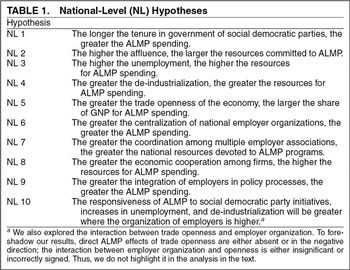
Governments' creation of social policies and employers' begrudging participation in social programs, therefore, reflect the influence or power of other actors. Because welfare states alter the balance of power between capital and labor, countries with a high degree of union organization and working class participation in government through left parties will produce higher levels of social welfare provision (Hicks and Swank 1992; Korpi 1980; Stephens 1980). Social democratic governments have championed high levels of universally available social services and long-term party control enables these governments to take action without business interference (Esping-Andersen 1996; Huber and Stephens 2001; Swank 2002) and/or to alter corporate expectations about the range of possible politics (Hacker and Pierson 2002). At the same time, higher levels of labor organization and social democratic party control do not rule out complementary support from employers, because cross-class coalitions may be essential to legislative success (Castles 1978, 29; Hicks 1999; Swenson 1991). Thus, at the national level, a longer tenure of social democratic party control should produce a larger commitment of national resources to ALMP. (See Table 1, NL [national-level] hypothesis 1.)
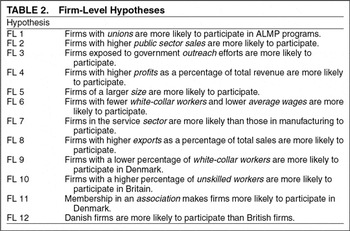
Pressures from workers and government bureaucrats may also alter corporate preferences at the firm level. The presence of unions within the company might convince managers that they should participate in order to reduce labor militancy and to be viewed as socially responsible (Bowman 1985; Gordon 1991). Firms with a higher level of public sector sales may be more susceptible to governmental pressure to participate in social reforms (Dobbin 1992; Grier, Munger, and Roberts 1994; Mitchell 1990). Finally, government policy entrepreneurs may strategically cultivate business allies to build support for their initiatives (C. Martin 1991; McConnell 1966); therefore, government outreach to individual firms may enhance participation. (See Table 2, FL [firm-level] hypotheses 1–3.)
The second set of hypotheses about employers and social spending builds on the proposition that some types of economies and firms will be better able to afford the burdens of social spending than others. For the national level, it is commonly argued that the capacity to finance collective social benefits attendant to high economic development is a principal determinant of social spending (Wilensky 2002). At the firm level, resource-rich firms may participate in the programs to gain political advantages (awarded by the state) over their less robust competitors, who cannot afford to engage. For both economies and firms, some are better able than others to tolerate increased social spending. Thus, all else equal, the level of national affluence will be positively associated with the shares of national product devoted to ALMP. (See Table 1, NL 2.)
At the firm level, companies with higher profits as a percentage of total sales might be more likely to participate because they have the organizational slack to devote resources to social issues. Alternatively, firms with lower profits might participate in order to gain access to cheap labor. Size might enhance firm-level involvement with social programs, because larger firms are more likely to have extant training programs and to view new programs as an extension of their existing efforts, or because they can derive selective advantages in political action (Gordon 1991; Jacobs 1988). (See Table 2, FL 4 and 5.)
The third set of hypotheses about employers and social spending builds on the proposition that national economies and firms under some circumstances derive positive material benefit from social protections. Thus, not only might social programs stem negatives (such as worker unrest), they might also make a positive contribution to the production process. The most prominent contribution of social protections to economic production is in the area of skills for blue-collar manufacturing (and service sector–equivalent) workers. Social protections may include government training programs that directly develop skills. But the development of worker skills is also indirectly aided by other types of social programs that provide future labor force participants the income security and incentives to invest in training activities (Estevez-Abe, Iversen, and Soskice 2001; Mares 2003).
Investment in new skills becomes most critical when economies are in transition. Most notably, Iversen and Cusack (2000) have argued that during the last decades the passage from agriculture to manufacturing production and subsequent “de-industrialization” have driven post–World War II welfare expansion. Declines in manufacturing and related unemployment place systematic pressure on policy makers to expand training, job placement, and related services to assist those in transition from traditional industrial jobs. Thus at the national level, one should expect to find that ALMP spending increases with the secular increase in de-industrialization. In addition, increases in unemployment rates more generally not only automatically swell (passive) unemployment compensation and related programs but pressure policy makers to provide increased access to training, subsidized employment, and labor market services (Hicks 1999; Huber and Stephens 2001; Swank 2002). (See Table 1, NL 3 and 4).
At the firm level, we should expect to find companies with a higher percentage of blue-collar workers to be more likely to participate in the active labor market programs in order to take advantage of training opportunities; therefore, firms with fewer white-collar workers are more likely to participate (Burgoon 2001). Because wages closely parallels skills, those with lower average wages are more likely to participate. In addition, workers need new sets of skills (and worker retraining) when they move from manufacturing to service sectors. Thus, the impact of de-industrialization on the economy should mean that service sector firms have a greater need for training than manufacturing firms to overcome this “skill boundary” (Iversen and Cusack 2000).2
We also examined the joint ALMP impact of service sector employment combined with hiring by the firm, because the skill boundary becomes most significant when service sector firms are hiring new workers. One problem with this approach is that hiring by the firm may be endogenous. In any case, neither hiring nor the joint service sector–hiring factor was significantly related to program participation.
The need for skills seems to be more prevalent in exposed economies. Following this logic for the national level, Katzenstein (1985) highlighted the role of ALMP in the public promotion of flexible adjustment of markets to competitive pressures in economies with high levels of trade openness. In addition, high levels of trade exposure in a national economy have been argued to motivate countries to develop a large counter-cyclical public sector (Cameron 1978). (See Table 1, NL 5.) At the firm level, companies in exposed sectors with a high level of exports to international markets might participate in the program to enhance their workers' skills. (Yet firms with a higher exports level as a percentage of total sales might participate if they viewed the programs as a source of cheap labor). (See Table 2, FL 8.)
The fourth set of hypotheses builds on the proposition that national economies can be sorted into two broad varieties of capitalism with different employer competitive strategies and divergent views of the fit between social protections and economic production. Employers in coordinated market economies (CME) realize that in addition to deriving economic advantage from physical and factor components, they can enhance their competitive positions with institutional arrangements that encourage information exchange and consensus. Consequently, CME firms choose to compete in high-skills market niches and desire government interventions that contribute to the expansion of skills, such as high levels of social protection and policies fostering cooperative labor relations. Alternatively, in liberal market economies (LME) labor–management relations are contentious, neither workers nor employers have incentives to invest in skills, and competitive strategies entailing a high-skilled, productive workforce are discouraged. Scholars generally assume that it is difficult for nations to alter their economic model once in place and that the persistence of policy in one sphere reflects the constraints imposed by deep linkages to other spheres (Hall and Soskice 2001; Huber and Stephens 2001; Visser and Hemmerijck 1997).
One can easily imagine that Danish and British firms would have different skills needs. Danish CME firms should have higher skills needs; therefore, all firms with a low proportion of white-collar workers (i.e., blue-collar workers at all skills levels) might be more likely to participate. In comparison, in the British liberal market economy firms with a larger proportion of unskilled blue-collar workers might participate in order to gain access to cheap labor. (See Table 1, FL 9 and 10.)
The fifth set of hypotheses about employers and ALMP specifies expectations derived from our core theoretical argument that employers' preferences and behavior will be determined by their political economic organization and institutions governing their political participation (a position consistent with the varieties of capitalism approach). We further expand on these mechanisms below, especially in our elaboration of firm-level findings. Generally, membership in an association is considered to be an important institutional determinant of firms' preferences because groups offer employers information about public policy, and this information becomes especially influential under conditions of bounded rationality (DiMaggio and Powell 1991; C. Martin 1995, 2000). Yet while associations may influence preferences, membership in a group might not necessarily translate into greater support for social policy.3
Employer organization alone might not foster increased support for social policy if other mechanisms exist for pursuing common interests and/or the needs of workers. For example, these other mechanisms might include protectionism or firm-level benefits.
Scholars of social corporatism move beyond the general impacts of associations on preferences to differentiate between corporatist and pluralist groups and to suggest that countries with corporatist associations generally have higher levels of support for government intervention in general and, we might add, ALMP in particular. Attributes of social corporatist association—the centralization of representational power, coordination across business interest units, and integration of associations in policy-making forums—should result in greater support for, and participation in, ALMP programs for several reasons.4
The national organization of business in the developed democracies consists of one or more national associations of employers and business enterprises, federations of industry associations, and (often compulsory) chambers. To make analysis manageable, we focus on the national organization of employers while foregoing systematic treatment of all forms of business organization.
While narrowly defined interest groups tend to concentrate on the particularistic self-interests of their members, encompassing associations may focus members' attention on broader shared concerns and collective ambitions. For example, in the economic realm encompassing associations are more likely to accept wage or income restraints in order to achieve the broad, collective goal of price stability. It is possible that this broader definition of political aims may extend to the social realm, with associations desiring policies for skills upgrading, human capital development, and solidarity (C. Martin
2000; Schmitter
1981; Streeck
1992; Visser and Hermerijck
1997).
These cognitive benefits of association are reinforced by the norms of cooperation, trust, and “social partnership” that develop in these groups (Crouch 1993; Katzenstein 1985; Rothstein 2000; Treu 1992; Traxler 2000). Indeed, corporatist institutions have an economic logic (their encompassing organization of functional economic interests internalizes “externalities”) and a political logic (sustained interaction enhances accommodation among social partners) that facilitate a search for the public good (Visser and Hemerijck, 1997). Norms of reciprocity, trust, and public-regarding behavior are reinforced in processes of centralized collective bargaining, in tripartite policy-making forums, and in subnational networks of business–labor exchange. Thus, corporatist interactions and highly organized business groups that participate in them should cultivate relatively supportive views of social policy among member firms.
Social corporatist business and labor associations are often found in coordinated market economies where high levels of publically provided social protection facilitate the operation of employer coordination of markets (Estevez-Abe, Iversen, and Soskice 2001; Hall and Soskice 2001; Mares 2003; Swenson 2002). These systems, marked by high levels of industrial sector coordination and stable labor–business relations, are crucially supported by state regulatory frameworks and generous social policy.
In addition, a high level of organization of business offers governments the institutional vehicle through which to build business support for social welfare initiatives (C. Martin 1991; Streeck 1992). Governments may rely on employer organizations to implement public policy because these associations can motivate a high degree of corporate compliance (Soskice 1990, 43). Generally, higher levels of employer organization will facilitate these processes and produce greater welfare state development.5
It should be noted that the logic of the social corporatist organization of business has been challenged in recent years, with scholars debating whether national employers associations have lost influence. Globalization, industrial restructuring, and EU integration may have complicated economy-wide collective bargaining (Streeck and Schmitter 1991; Thelen 2001; Wallerstein, Golden, and Lange 1997). Alternatively, the dislocation of workers connected to de-industrialization may be creating additional needs for corporatist intermediation (Iversen and Cusack 2000).
At the national level, one should expect to find that active labor market spending increases with greater centralization of power in national employer organizations, greater coordination among multiple employer associations, greater economic cooperation among enterprises, and greater integration of employers in the public policy process.6
Our theoretical argument assumes that where employers are relatively centralized, coordinated, and integrated into national policy processes, they are also relatively densely organized. In fact, using the only density data with which we are familiar (and these data cover only a subset of developed economies), we see that in every case where national employers' associations exist, the density exceeds 50%, where density is defined as the share of the labor force employed by member firms (Traxler, Blaschke, and Kittle 2001). Our argument stresses that at broadly similar levels of significant density (for example, compare the British Confederation of Industry, at 54%, to the Swedish Confederation of Employers, at 56%), the centralization of power in peaks, the coordination across bargaining units, and the integration of groups in the policy process drive the mechanisms that link business organization to policy.
Finally, we expect that highly organized employers will allow national policy makers to more readily develop and implement ALMP in response to direct economic pressures such as unemployment and de-industrialization. (See
Table 1, NL 6–10.)
At the firm level, membership in an association should make firms more likely to participate. Yet membership in an association confers a different set of benefits in corporatist countries than in pluralist ones; therefore, a firm's membership in an association will be significant for participation in Denmark but not in Britain. In addition, firms in corporatist Denmark should be more likely to participate than those in pluralist Britain. (See Table 2, FL 11 and 12.)
CROSS-NATIONAL MACRO ANALYSIS
To assess the impact of employer organization on business support for ALMP at the national level, we estimate the effects of employer organization on 1980–1998 national and temporal variations in spending for ALMP in a sample of 18 developed democracies. We select the late 1970s as a threshold because this point roughly demarcates the acceleration of international and domestic economic and fiscal stress, the ascendance of neoliberal macroeconomic orthodoxy, and the weakening of the Keynesian welfare state (e.g., Scharpf and Schmidt 2001). In other words, the late 1970s begins a new era in the political economy of democratic capitalism, and, for reasons discussed above, it serves as an especially relevant period for studying business support for ALMP. In addition, comprehensive cross-national time-series data on ALMP programs in the OECD are not available before 1980.
We focus on four dimensions of the political organization of employers in our empirical analysis: the degree of centralization of employers' associations, the level of coordination among multiple employers' associations, the level of economic coordination among enterprises, and the integration of employers in corporatist policy-making forums. While we would ideally focus as well on the density of employer organization (e.g., the percentage of workers employed by member firms of national peak associations) and the concentration of employer organization (e.g., the percentage of businesses organized by the largest employer associations), systematic data on these attributes of employer organization do not yet exist. (See footnote 6 on the theoretical role of density versus other dimensions of organization.)
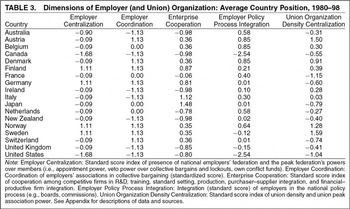
We draw on new data sets on the comparative political economy of advanced economies (Hicks and Kenworthy 1998) and labor and industrial relations systems (Traxler, Blaschke, and Kittle 2001; Wallerstein, Golden, and Lange 1997), and other sources (see below and Appendix), to develop four specific empirical measures of the focal dimensions of employer organization. These indicators are displayed in Table 3. We draw on cross-nationally and temporally varying indices of the presence of a national peak association of employers and the powers of these associations over constituent members and collective bargaining to construct a standard score index of the level of employer centralization. This measure is displayed in the second column in Table 3. As the data suggest, there is substantial variation in the level of centralization across democracies: Nations such as the United States with no national peak association of employers score very low, whereas corporatist countries (Norway and Sweden) and coordinated market economies (Germany) tend to score high.
Table 3 also presents a measure of the cohesion of employers' associations. Given that multiple sectoral associations play substantial political economic roles, scholars have emphasized the importance of cohesion among multiple employer organizations in collective bargaining and other forums. For our analysis, we use a measure developed by Layard, Nickell, and Jackman (1991) and employed by Soskice (1990, 1999) of the coordination of multiple employer associations in collective bargaining. This indicator—expressed as a standard score for comparability—is displayed in the third column in Table 3. Next we utilize new cross-national, time-series data on economic cooperation among firms (e.g., in standard setting, worker training, and research and development), purchaser–supplier relations, and financial–industry linkages to construct an index of economic coordination of enterprises (see Hicks and Kenworthy 1998). Finally, we use a measure developed by Traxler, Blaschke, and Kittle (2001) to assess employer association participation in corporatist policy-making forums. Its standard score is presented in the fifth column in Table 3. To offer comparisons to labor organization, we also present a standard score index of union density and centralization. In subsequent analysis we introduce this (and a control for the level of collective bargaining) as a further check of the robustness of results.
For all models, we include measures of our alternative hypothesized determinants of ALMP spending. We follow Iversen and Cusack (2000) and measure de-industrialization as 100 minus the industrial and agricultural employment as a percentage of the working-age population (and lag this one year). We also include (one-year-lagged) measures of the unemployment rate and the level of affluence defined as the per capita GDP in international prices. (We also substitute indicators of long-term unemployment for the general rate in subsequent analysis.) To measure the strength of social democracy, we use cumulative years in government of social democratic parties (since 1950). We also incorporate in empirical models a one-year-lagged measure of trade openness, or total imports and exports as percentages of the national GDP.
For estimation of our models of ALMP, we use least squares regression with corrections for first-order autoregressive errors, panel correct standard errors (i.e., variance–covariance matrices for panel data corrected for heteroskedasticity and contemporaneous correlation), and full fixed effects, namely, nation and year dummies (see Beck and Katz 1995 on panel correct standard errors). It should be emphasized that while country and year dummies are important to control for unmodeled nation effects and exogenous shocks, respectively (and joint F-tests suggest their statistical inclusion), a full fixed effects specification establishes a very conservative test for our focal hypotheses. This is so because of the limited annual variation of employer organization variables. As such, we occasionally comment below on the results of a more relaxed set of tests where trivial country or year dummies (t<1.00) are deleted from models and the equations reestimated. In addition, recalling that our time series begin in either 1980 or 1985 (due to data unavailability for ALMP spending), we use a standard technique for unbalanced panels where elements of the variance–covariance matrix are computed with all available pairs of panels.
Finally, to assess the robustness of our findings, we reestimate our models with three alternative techniques: a “jackknife” procedure where we estimate 18 new 17-nation models by deleting one nation at a time and, in turn, produce “jackknifed” estimates for each coefficient (Hicks and Swank 1992); a lagged endogenous variable model that is often touted as an alternative to a first-order autoregressive model (Beck and Katz 1996); and an error correction model where changes in the dependent variable are regressed on its lagged levels and levels and changes in independent variables to obviate problems with nonstationary variables and to derive long-term and dynamic short-term effects (Beck and Katz 1996).7
The “jackknifed” coefficient for each independent variable is the mean of the eighteen 17-nation coefficients and its standard error is the standard deviation of the variable formed by the eighteen 17-nation estimates.
Within the context of our models, we test for direct linear effects of employers' organization and the alternative hypothesized determinants discussed above. In addition, we test the hypothesis that the impacts of employer organization are more complex in that the role of employer organization may well be important in conditioning the ALMP effects of social democratic governments, unemployment, and “de-industrialization.” Thus, we employ interaction analysis to explore the mediation of these political economic effects by employer organization.
Findings
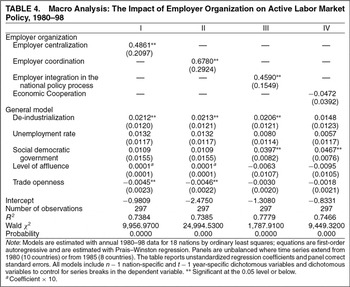
The results of the estimation of our general model of ALMP spending for each of the four focal dimensions of employer organization are reported in Table 4. As the table reveals, the impact of the centralization of employer organization on ALMP spending is statistically significant and substantively large. An increase of one unit in our (standard score) index—about the difference in centralization between employers in Belgium and Norway—leads to an additional 0.5% of the national income allocated to ALMP. Given that the 1980–98 mean of ALMP spending across our 18 nations is 0.81% of the GDP, this is a substantively important effect.
Similar results obtain for the impact of coordination of employer associations and incorporation of employers into state corporatist institutions. The coefficients for coordination and incorporation of employers are significant and substantively large: An increase of one unit on our standard-score indices produces an increase in resources for ALMP of about 0.5% to 0.7% of the GDP. The ALMP effect of economic cooperation, however, is insignificant in our regular full fixed effects specification. On the other hand, if one deletes completely trivial country and time dummies and reestimates the model in Table 4, column IV, the impact of economic cooperation becomes significant and of the same substantive magnitude as other dimensions of employer organization. Given that we wish to avoid rejecting a true null hypothesis, we interpret these results for economic cooperation as inconclusive.
As for our competing hypotheses, the models in Table 4 provide support for the de-industrialization hypothesis that is significant in three of the four models (and in all four models if we use the relaxed tests for the equation in column IV). Recalling the Iversen–Cusack measurement of de-industrialization, we see that an increase of 10 points on our de-industrialization scale is associated roughly with a 0.2% of GDP increase in ALMP. Social democratic government is statistically related to ALMP spending in two of the four models, although the magnitude of this effect is moderate. For instance, examining the impact of social democracy in columns III and IV, one sees that an additional 10 years of social democratic government would result in about 0.4% of the GDP more in ALMP spending. Unemployment and affluence are not related to ALMP spending in Table 4 models, while trade openness is significant in two of the four models but incorrectly signed.8
It should be noted that, first, the unemployment effect on ALMP becomes consistently significant in the relaxed form of the equations in Table 4. We also tested for long-term unemployment effects by substituting percentages of the workforce unemployed for six months and over, and 12 months and over, for the general unemployment variable. These changes in specification produced unemployment effects comparable to general unemployment in the regular full fixed effects and relaxed specifications. In addition, we added measures of international capital mobiliy (see Appendix); these exhibited occasionally positive effects on ALMP spending (consistent with embedded liberalism theory) but did not alter other findings reported in Table 4. Finally, because of multicollinearity and problems of unbalanced panels, one additional country and year dummy was often deleted from the fixed effects specifications to allow model estimation; these were always completely trivial dummy variables (i.e., t statistics close to 0.00).
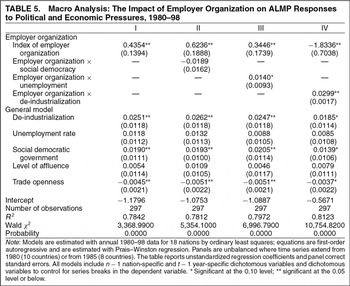
In Table 5, we present a model that (for manageability of analysis) combines the three significant dimensions of employer organization into a single standard score index; results reported in Table 5 do not change if we continue to use the three individual measures. In column I in the table, we simply report the new basic model of ALMP spending with our composite indicator of employer organization. Our core findings for employer organization, social democracy, and de-industrialization remain the same; trade openness is also significant (albeit incorrectly signed and substantively trivial). As one test of the robustness of the our core findings, we estimated this model with the measure of union power in place of social democracy and with the addition of a measure of the centralization of collective bargaining; all core findings remain virtually identical to those of the model in column I.9
Similar to social democratic government, union power is positively and significantly related to ALMP. The level of collective bargaining (see Appendix) is also positively and significantly related to ALMP spending in some specifications. The effects of employer organization, however, remain virtually the same as those reported in the tables in the presence of labor market controls.
In columns II to IV in Table 5, we assess our hypothesis that employer organization conditions the ability of national policy makers to develop and execute ALMP programs in response to political and economic pressures. As the table illustrates, the interaction between employer organization and social democracy is insignificant (but see Table 6). On the other hand, the interactions of unemployment and de-industrialization with employer organization are significant. On specific effects of unemployment or de-industrialization at different levels of employer organization, recall that computation of effects in interactions amount to the use of the following equation: b1+b3 (employer organization), where b1 is the coefficient for unemployment or de-industrialization in the Table 5 equations and b3 is the interaction coefficient. Thus the effect of (a one-unit change in) unemployment at average levels of employer organization (0.00 on our standard score index) is 0.0088; the effect of unemployment at substantial levels of employer organization (e.g., roughly 1.00 on our standard score composite index) is 0.0088+0.014(1.00), or 0.023. Thus, an increase of 5% in the unemployment rate would result in about 0.11% of the GDP being allocated to ALMP spending in political economies with substantial employer organization. An increase of 10 points on the Iversen–Cusack de-industrialization scale would result in an increase of 0.185 (0.0185×10) in ALMP spending at average levels of employer organization; it would be associated with an increase of 0.484, or [(0.0185+(0.0299×1.00))]×10, in ALMP spending at high levels of employer organization. In sum, our expectation that employer organization has both direct and mediating effects on ALMP spending is confirmed in these analyses.
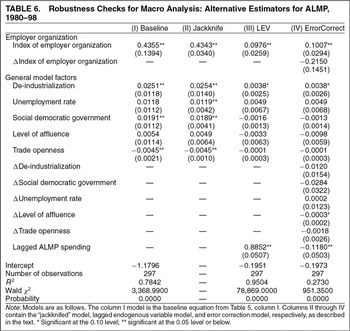
As a check on our results, we estimated the basic linear model in Table 5 with the three alternative estimation techniques discussed above. These results are presented in Table 6. As suggested by the table, our core finding presented in Table 5—that the degree of employer organization has significant and substantively important effects on ALMP—is robust to alternative estimation techniques. In the “jackknifed” model in column II, our index of employer organization (as well as our focal controls of de-industrialization, social democracy, and unemployment) is significant and nearly identical in substantive magnitude to the baseline model. In other words, our findings are highly robust to the influence (presence or absence) of individual cases. Similar to the “jackknife,” our core index of employer organization and de-industrialization retain significance in the lagged endogenous variable and error correction models. In the error correction model, the relationship between employer organization and de-industrialization, on the one hand, and ALMP spending, on the other, is long-term (as indicated by the significant levels effects); short-term changes in either causal variable are not significantly associated with immediate ALMP changes net of the long-term relationships. Finally, we examined the robustness of the interaction of employer organization and de-industrialization to alternative estimators. With all three techniques, the mediation of de-industrialization effects on ALMP by employer organization proved significant. (Full results from the alternative estimators of the interaction models are not reported to conserve space.)
A MICRO STUDY OF DANISH AND BRITISH FIRMS
To evaluate how membership in an employers' association shapes firms' engagement with the welfare state, we test a model that predicts when companies participate in the implementation of active labor market policies.10
A preliminary look at firm-level preferences for social policy is provided by C. Martin (2004). This paper offers a significant expansion of this work in evaluating the importance of sector and in investigating the role of the state.
Some of the data were provided from a series of structured interviews (primarily in the winter and spring of 2001) with human resources officers and CEOs of 52 British firms and 55 Danish ones; 54% of the sample of 200 companies participated. Almost all of the Danish interviews were conducted in Danish by one of the coauthors. The interview data were supplemented with Amadeus company reports and firms' annual reports. The sample was randomly drawn from the Børsen's top 500 list of employers in Denmark and the corresponding
Financial Times list in Britain.
11 Every fifth firm was selected from the lists of the top 500 companies in each country. While we anticipated some selection bias in that active companies would be more willing to participate than inactive ones, some inactive firms welcomed us as a source of additional information and some known activists had no time to see us. While a size differential might indicate a comparison between Danish firms and British business units, we chose to preserve the comparison between the largest firms and most British managers attempted to find out their business units participation. Indeed, in many British firms only a couple of units participated, thus overstating the British participation rates.
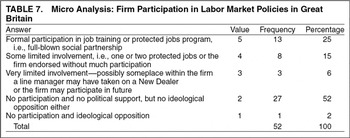
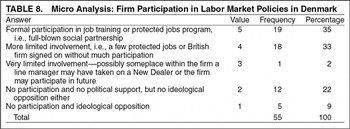
The dependent variable was operationalized as the firm's participation in the set of active labor market programs identified by the two countries in their National Action Plans as mechanisms for expanding employment (United Kingdom Employment Action Plan, 1999; Danmarks Nationale Handlingsplan for Beskæftigelse 1999). The dependent variable was based on data about firm positions on and participation in the programs and consisted of a scale moving from a position entailing full participation to a position ideologically opposed to involvement. Tables 7 and 8 report values of the dependent variable in Britain and Denmark.
The independent variables were operationalized as follows: An estimate of average wages was obtained from Amadeus company reports. The variables unskilled blue-collar workers, skilled blue-collar workers, and white-collar workers were derived from data provided by the company, outlining the percentage of white-collar, skilled blue-collar, and unskilled blue-collar employees in the workforce. The profits measure was taken from Amadeus company reports and was calculated as the net (after tax) profit for the year divided by total sales. The size variable was derived from Amadeus company reports identifying firms' total revenues. A measure of unions was based on information supplied by the firm and was operationalized as a dummy variable, reporting whether or not the company had unions. The exports variable, operationalized as the percentage of total sales devoted to exports, was derived from data supplied by the firm. The variable estimating public sector sales represented the share of total revenues taken up by sales to the public sector and was derived from data supplied by the firm. The sector variable, separating manufacturing from services, was derived from the firm's major SIC code.
The associations institutional variable specified membership in a peak or sector employers' association, based on data obtained from the company. It should be noted that firms joined these groups long before ALMP was on the public agenda and belonged for reasons other than an interest in these policies. We operationalized the state outreach variable as vigorous outreach by government actors, based on information provided by the firm.12
Using firms' self-reporting is problematic because participating firms are probably more likely to recall being contacted by municipalities than nonparticipating firms, yet the issue is partially alleviated by the cross-national comparison. This approach enables us to hold constant problems of self-reporting while determining if the role of the state differs across settings. We specified the variable in both countries as the contact from municipalities and included in the British case outreach by the Blair administration and in the Danish case contact from the regional-level Arbejdsformidlingen.
Running the equation with contact only from the municipalities produced the same results.
We estimated the hypotheses with an OLS regression method, appropriate because of the interval level quality of the dependent variable (Tabachnik and Fidell 1989, 7–9).13
We also estimated the hypotheses with an ordered probit model that, with the exception of the significance of one control variable, produced the same results.
Hours of interviewing convinced us that the firms truly were distributed along an ordinal scale with interval qualities. The statistical results were supplemented and complemented by the qualitative interview evidence that provided added confidence in the assessments of the independent variables in the statistical analysis. With two separate but parallel firm-level comparisons (comparing firms within a country but not between countries), we could isolate significant causal factors driving firm behaviors in each country and compare significant variables across countries. The high correlation between some variables combined with a desire to limit the number to accommodate the small
n prompted several factors. We created factors combining the
wages and
white-collar workers variables for the Danish study and
wages and
unskilled blue-collar workers in Britain, as well as factors of
exports and
unions measures in both countries.
14 The close theoretical connection between skills and wages justified the creation of these factors. We developed slightly different wage/skills variables in keeping with our theoretical expectations for the two countries. Thus the Danish relevant skills group was all blue-collar workers regardless of skills level (or the absence of white-collar workers), while in Britain our anticipated target group constituted unskilled blue-collar workers. In Britain wages and unskilled blue-collar workers were correlated at −0.47; the factor accounted for 73% of the variance, with an eigenvalue of 1.47. The Danish wages and white-collar workers variables were correlated at 0.4; the factor accounted for 70% of the variance, with an eigenvalue of 1.4. The British exports and unions factor accounted for 73% of the variance, with an eigenvalue of 1.46. The Danish factor combining exports and unions explained 60% of the variance and had a eigenvalue of 1.2.
Because the outreach variable is more subjective than our other measures, we ran two equations for each case: the first with the less subjective economic and institutional variables, the second adding
outreach by the state.
Findings
At the time of the survey, 68% of the Danish firms participated in subsidized jobs and training programs for the long-term unemployed; in comparison, only 40% of firms were involved to some extent in parallel programs in the United Kingdom. This is consistent with other studies reporting participation in active labor market programs by Danish and British firms (Hasluck 2000; Holt 1998; Larsen and Weise 1999; Snape 1998). The regression analyses demonstrate that independent variables perform differently in Great Britain and Denmark and we report findings of each study in turn.
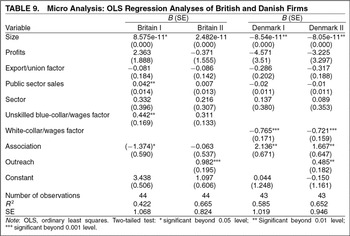
Turning to the first equation in the British study (without the measure of government outreach), the regression analysis surprisingly finds the association variable—expected to have no effect—to have a significant negative impact on participation. The findings give support for three of the control variables' influence on firms' participation: size, public sector sales, and the unskilled blue-collar workers/wages factor (see Table 9). A one billion–pound increase in size produces a 0.08-point increase in participation; a 10% increase in public sector sales produces a 0.4-point increase in participation. A 10-point increase in the unskilled blue-collar workers/wages factor produces a 4-point increase in participation. In the second equation, the addition of the highly significant variable measuring outreach by government makes all other measures lose significance. A one-point increase in state outreach produces a one-point increase in firms' participation. (See Table 9.)
Turning next to the Danish study, the data—as expected—confirm the significance of the institutional variable measuring association membership on firms' participation in social programs: In both equations joining an association produces a two-point increase in participation. Two of the control independent variables have a significant effect on the dependent variable in both equations: the size variable and the white-collar workers/wage factor. In the first equation, a one-point decrease in the white-collar workers/wage factor has an 0.8-point increase in participation and a one billion–kroner decrease in size of sales has a 0.09-point increase in participation. In the second equation the outreach variable is also significant, but (unlike in Britain) it does not alter the other variables' performance: A one-point increase produces a 0.5-point increase in participation. (See Table 9.)
Four points can be gleaned from these findings. First, membership in a corporatist (as opposed to a pluralist) employers' association clearly is an important determinant of involvement in ALMP programs at the firm level, just as corporatist organization is associated with greater welfare state spending at the national level. While membership in the Danish corporatist associations is highly determinant of participation in the ALMP programs, membership in the British employer associations not only fails to spur participation, but surprisingly works against involvement in the programs.15
This finding is partially explained by the fact that joining a trade association in Britain is something of an alternative to developing a large, professional human resources department. Although firms may choose to do both, they often choose one route or the other for gaining information about policies affecting their workforce. Firms with developed human resources departments tend to have more expertise in the human resources area, in part because the alternative—membership in the association—offers so little information.
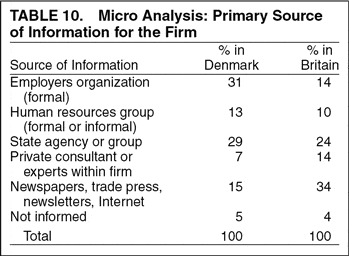
Interview data overwhelmingly confirm the regression findings. Although associations in both countries supported ALMPs, employers groups were much more important in shaping members' preferences in Denmark than in Britain. Firms seemed to interact with their associations on a much more regular basis in Denmark than in Britain and the groups (along with the state) are vital sources of information of public policy. When asked to state their most important source of information about human resources issues and social policy, 32% of the Danes identified an employers association, as opposed to 14% of the British firms, and many Danish firms mentioned associations as their second most important source of information. British companies learned from trade press, Internet, or regular newspapers (34%), government or government-inspired groups (24%), private consultants (14%), or formal and informal human resources groups (10%) (see Table 10). Danish respondents repeatedly reported that their associations instructed them in the new policy ideas about solutions to unemployment. The high level of organization of employers allowed managers to participate in training and subsidized jobs without fear of being penalized for their altruistic behaviors.
Second, while the corporatist associations in Denmark seem to be declining in importance in the collective bargaining sphere (as bargaining has been decentralized to the sectoral level [Due et al. 1994]), the groups have continued to influence firms by providing forums at the local level and informal networks or discussion groups (erfargruppe).16
The studies also suggest a surprisingly limited role for organized labor in bringing firms to participate in active labor market programs: The unions variable was not significant in either of the regression analyses. Although organized labor has been a key source of historical support for the development of the welfare state and the national labor unions have been deeply involved in the policy debates about the unemployment and social exclusion, this national commitment often did not translate to the firm level (interview with L.O., June 2001).
In fact the Danish corporatist employers associations strategically expanded other functions to attract members precisely because they recognized their declining importance in the collective bargaining sphere. Thus, a major sectoral group worried that “fewer firms will need organizations to give them advice about collective bargaining” and set out to organize networks:
The networks provide, along with other things, a platform from which firms can figure out what they think about issues…. Today the associations have to come up with reasons for members to pay for belonging to a group, such as to develop political positions…. Having political influence is a collective good, but you always have the free rider problem. So you have to have some individual goods as well to keep up the membership. (Interview)
Third, while outreach by state actors was important to companies' engagement with labor market programs in both countries, a strong role for government did not diminish the importance of the Danish associations. This finding is supported by the quantitative analysis: State
outreach supplanted the other variables in Britain, but in Denmark other factors remained significant even factoring in the efforts of state policy entrepreneurs. Danish interview data suggest that in some cases firms learned about the programs from their associations and took the initiative with their municipalities; moreover, some complained that many municipalities were neither knowledgeable nor responsive to inquiries about the programs.
There is some qualitative evidence that the Danish state strengthened the associations' role in ALMP and inspired (in both intended and unintended ways) organizational commitment to the programs. The state recently undertook steps to extend formally corporatism to social assistance policy (thus making the social arena resemble the unemployment insurance institutional track). The law required municipalities to form committees consisting of representatives from business and labor to oversee social policy in the community. Dansk Arbejdgiversforening (DA) has the responsibility for selecting company participants to sit on these local Social Coordination Committees. Many respondents identified these committees as vital sources of information and credited their hiring of the long-term unemployed to their committee activities. Firms also felt that the creation of company consultant positions in local municipalities greatly expanded firms' interest in active labor market policy (12/12/00).
Danish state actors have helped to expand support for the policies (and to strengthen the associations in the process) with information campaigns, with the new corporatist forums in the area of labor market policy for those on social assistance, and, paradoxically, with direct appeals to firms. Initially, the Social Ministry pursued a strategy of approaching the employer associations about the reforms. This was a significant deviation from the status quo in that government had historically maintained complete control over policy for those on social assistance while allowing business and labor significant input into labor market policy for those on unemployment insurance. Later the Social Ministry once again broke with the past, by working around the associations to mobilize individual firms (Bach and Kylling 1997; Holt 1998, 9–10). The associations were deeply upset, perceiving this move as an attack on their role as the legitimate representative of business. Yet this audacious move ultimately served to strengthen the associations' resolve to be included in the discussions about social reforms.
Compared with the Danish strategy, the British government has relied much more on attracting corporate participation through market-based incentives, largely sidestepping the established national employers associations. While Blair sought support for the New Deal programs from the Confederation of British Industries, the administration also used an extensive and expensive media campaign to engage individual British firms and sought to involve employers in New Deal programs with personal appeals to the largest British corporations (Wintour, Keegan, and Browne 1998). Yet unfortunately a vast number of companies that signed up to hire New Deal clients never actually hired anyone. The administration also developed a marketing strategy, seeking to make recipients “job-ready,” to tailor the policies to corporate demands, and to reduce firms' costs of participating. These market strategies reflected the policy legacies of a liberal welfare regime and the constraints of working with a poorly organized business community.
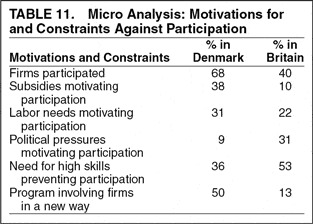
Fourth, because Danish employers were given greater opportunities to shape the policy-making process to their needs and because the Danish associations brought employers to view the programs more positively, Danish firms were more likely than British ones to view the social protections as providing benefits for economic production (see also Estevez-Abe, Iversen, and Soskice 2001). Danish employers believed that the programs would help them gain access to a more highly skilled workforce, either by enhancing the skills of their own employees or by preparing a more skilled labor pool. Thus Danish firms with a high proportion of blue-collar workers (both skilled and unskilled) were statistically more likely to participate in active labor market programs, while only British firms with the least skilled workers were more likely to participate. Despite similar vacancy rates, 31% of the Danish firms (as opposed to 22% of British managers) offered labor shortages as a reason for participating. While the value of the subsidies was nearly equal, 39% of the Danish firms considered subsidies at least somewhat important to mitigating the pains of participation, compared to 10% of the British firms (Table 11).
The British firms were more likely to participate to secure either good public relations or cheap labor. Because some firms engaged for philanthropic motivations or to derive political credit, it makes sense that those with a higher proportion of sales to the public sector were more likely to participate. Thirty-one percent of the companies credited their participation to strong pressure from government and a desire to please the new administration (see Table 11). Often the political commitment to participate came from the very top, after Tony Blair had invited chief executives to Number 10 Downing Street to hear presentations about the New Deal. While Danish CEOs were identified as the agent responsible for deciding to participate in the program in only 9% of the cases, 31% of British firms reported that the CEO had been primarily responsible for involving the firm with the New Deal.
Other British firms reported participating to gain access to cheap labor, as is also reflected in the statistical finding that firms with unskilled blue-collar workers were significantly more likely to participate. Firms felt that the New Deal programs did little to improve the skills of the workforce: While 36% of the Danish firms identified skills needs as a constraint against participation, 53% of the British firms offered this reason.17
A varieties-of-capitalism explanation predicts that Danish firms have higher skills needs than British ones; therefore, we might expect that (all things equal) more, rather than fewer, Danish firms compared to British ones would decline to participate due to higher skills needs.
British firms would decline to participate due to higher skills needs. The programs' limited contribution to skills enhancement is supported by the vacancy rate figures. Danish vacancy rates declined with unemployment rates over the course of the 1990s, suggesting that the programs were matching skills to employment needs. British vacancy rates remained the same even while unemployment dropped as welfare reform forced people back into the workforce (OECD
2001, 13–14). British employers also felt that the programs differed little from earlier government efforts to reduce long-term unemployment—these programs were old wine in new bottles. While 50% of the Danish firms felt that government was asking business to engage in the social arena in a new way, only 13% of British firms felt that the New Deal schemes were new.
The statistical analysis did not offer support for the hypothesis that companies in the service sector made greater use of the programs than manufacturing firms, because employers in both types of sectors participate in the programs.18
It may be that the additional needs for training in service sectors are matched by the additional skills demands in manufacturing sectors with changes in the organization of work.
But interview data suggest some support for a de-industrialization thesis at the firm level, namely, that the programs have aided with the dislocation caused by changing skills needs. As one British manager put it, the training connected with the programs has been important to the “development of new skills for workers transferring from old industries to new industries.” Many firms also pointed to the need for “soft” skills that have arisen with service sector jobs.
CONCLUSION
Does the organization of business matter for social policy development in the advanced capitalist democracies? This article confirms that the social corporatist organization of employers is a positive determinant of ALMP spending in advanced capitalist democracies and of participation by firms in the implementation of active labor market programs. In a national-level analysis of 1980–98 cross-section time-series data, we find that the centralization, cohesion, and corporatist policy-making participation of employers are strongly determinative of shares of national income directed toward ALMPs. A firm-level analysis confirms the importance of corporatist business organization to developing employers' support for social policy. While membership in a corporatist association is a highly significant determinant of participation by Danish employers, membership in a pluralist association may be, in fact, negatively associated with participation by British firms.
A criticism of institutional analysis is its absence of a micro theory of individual behavior (Pontusson 1995), and we stress in this work the reconciliation of structure and agency with insights into the micro foundations of corporatism. Scholars writing about varieties of capitalism develop a micro theory of firm preferences by identifying the economic incentives created by macro structures (Hall and Soskice 2001; Mares 2003). While we fully agree with this approach, we investigate as well the impact of the processes of information gathering and interpretation created by institutional structures. Thus our work moves beyond cross-national variations in economic incentives to illustrate how patterns of business association matter to the interpretations of public policy.
The firm-level study of Danish and British employers' participation in the implementation of ALMPs reveals at the micro level a picture of varieties of employer engagement with the welfare state. Especially salient are the variations in employers' use of ALMP programs to gain skills and in the processes of associational life. Danish employers felt that the programs offered a new labor supply or a mechanism for coping with the declining competencies of their own workers; therefore, firms with a higher proportion of blue-collar workers at all skills levels (and their service sector counterparts) were more likely to participate than companies with higher numbers of white-collar workers. In contrast, British firms most likely to participate were those with workers having only the most minimal of skills.
Interviews with business managers in the two countries also confirm that corporatist and pluralist groups offer different types of benefits to their members and unveil the processes by which high levels of business association matter to welfare state spending. The Danish corporatist groups were much more important than the British groups in shaping their constituent firms' perceptions of and involvement with the programs. Danish associations instructed firms in the new policy ideas about solutions to unemployment and many more Danish firms than British ones identified their associations as a primary source of information about ALMP. Some companies learned about matters of public policy in the associational working groups, created to provide additional information about policy issues. Many Danish companies recalled first engaging in the implementation of the programs when asked by the Danish peak association to serve as the employers' representative in local corporatist forums. Thus, the corporatist processes of business/government relations brought firms to engage in the ALMP programs, and one might conclude that despite threats to national collective bargaining systems, corporatist associations remain important to members' formation of political identities in the spheres of negotiating and implementing public policy.
In addition, our analysis supports and extends two recent and important findings about the evolution of the welfare state. First, our work complements recent scholarship that emphasizes, in sharp contrast with much traditional welfare state theory, that employers have often played important and positive roles in the development of national systems of social protection (Mares 2003; C. Martin 2000; Swenson 2002). Second, our work has provided clear support and elaboration of the recent findings of Iversen and Cusack (2000) that post–World War II de-industrialization in developed capitalism has been fundamentally important in shaping welfare policy across countries and time.
In closing, the future of the welfare state has been widely disputed, and a big question is whether business organization will matter to the outcome. Our work suggests that the future shape of welfare capitalism is deeply intertwined with the persistence (or absence) of social corporatist employers' associations. High levels of business organization, coordination, and policy process integration clearly matter to governments' ability to foster social partnerships and otherwise promote important policy innovations; these capacities, in turn, will have significant impacts on societies' ability to achieve higher levels of social justice and equality.
APPENDIX: NATIONAL-LEVEL DATA
Data for Computation of Variables Measuring the Labor Market Policy
Active Labor Market Policy Expenditure: OECD Social Expenditure Data Base, 2001
Political Data
Left-party cabinet portfolios as a percentage of all portfolios
Source for portfolios: Eric Browne and John Dreijmanis, Government Coalitions in Western Democracies (Longman, London, 1982); Keesings Contemporary Archives (selected years). Sources for classification: (1) Francis Castles and Peter Mair, “Left–Right Political Scales: Some ‘Expert’ Judgments,” European Journal of Political Research 12: 73–88, 1984; (2) Political Handbook of the World (Simon and Schuster, New York, selected years); (3) country-specific sources.
Employer organization
For employer centralization: Miriam Golden, Michael Wallerstein, and Peter Lange, “Union Centralization among Advanced Industrial Societies” (electronic database at www.shelly.polisci.ucla.edu/data). (Some country years were estimated based on the Traxler, Blaschke, and Kittel 2001 database.) For coordination among employers: Layard, Nickell, and Jackman 1991. For economic coordination among enterprises: Hicks–Kenworthy database as described in Hicks and Kenworthy 1998 and updated by the authors for 1994 to 1997 by linear interpolation. (For incorporation of employers into corporatist policy making forums, data are from Traxler, Blaschke, and Kittle 2001.)
Union organization
For union membership: Jelle Visser, “Trade Union Membership Database,” Typescript, Sociology of Organizations Research Unit, Department of Sociology, University of Amsterdam, March 1992; “Unionization Trends Revisited,” Centre for Research of European Societies and Industrial Relations (CESAR), Research Paper 1996/2, February 1996 (and updates provided to the authors by Bernhard Kittel). Data on elements of confederal power, level of wage bargaining, and related union measures are from the Miriam Golden, Michael Wallerstein, and Peter Lange electronic database (see preceding paragraph).
International Variables
Index of restrictions on capital flows
Source: Dennis Quinn, School of Business, Georgetown University. See Dennis Quinn and Carla Inclan, “The Origins of Financial Openness.” American Journal of Political Science 41 (July): 777–813, 1997.
Exports and imports of goods and services in millions (billions for Italy and Japan) of national currency units
Source: OECD, National Accounts of OECD Member Countries (OECD, Paris, various years).
Socioeconomic Data
Percentage of the civilian labor force unemployed, wage and salary workers in manufacturing, and long-term unemployment
Source: OECD, Labor Force Statistics (OECD, Paris, various years).
Real per capita GDP in constant (1995) international prices
Source: The Penn World Table (Mark 6.1). National Bureau of Economic Research (http://www.nber.org).
An earlier version of this paper was presented at the 2003 Annual Meeting of the American Political Science Association, Philadelphia. We thank APSA panel participants, Mark Blyth, John Campbell, Peter Munk Christiansen, John Hall, Gary Herrigel, Helle Holt, Torben Iverson, Per Kongshøj Madsen, Andy Martin, Peter May, Ove Kaj Pedersen, Søren Winter, and the editor and three reviewers of APSR for extremely valuable comments. Financial support for Professor Martin was provided by the United States German Marshall Fund, the Danish Social Science Research Council, and the Danish Study of Power and Democracy.






Comments
No Comments have been published for this article.