Invasive Candida infections , mostly bloodstream infections, have become a major contributor to morbidity and mortality in hospitalised children globally, especially in the paediatric ICUs . Reference Eggimann, Garbino and Pittet1 Although Candida species belong to the normal flora of the human’s mucosal oral cavity and gastrointestinal tract, they may lead to systemic infections (bloodstream infection, endocarditis, central nervous system infections, endophthalmitis, osteomyelitis, etc.) in immuno-compromised patients due to their great adaptability to different anatomical sites. Reference Eggimann, Garbino and Pittet1,Reference Sievert, Ricks and Edwards2 Candida species have been identified as the second most common cause, behind coagulase-negative Staphylococci, of central line-associated bloodstream infections in hospitalised patients in the United States. Reference Wisplinghoff, Seifert and Tallent3 Prematurity, accompanying congenital cardiac, neurologic or other pathologies, complex surgical procedures, prolonged mechanical ventilation and hospital stay, extensive use of total parenteral nutrition , large spectrum antibiotics, and steroids that depress the immune system are important predisposing factors for Invasive Candida infections. Reference Eggimann, Garbino and Pittet1,Reference Krcmery, Laho and Huttova4,Reference Ayık, Atay and Engin5 There are very few studies about the Invasive Candida infections and Candida bloodstream infections following the paediatric cardiovascular surgeries in the literature. Reference Ayık, Atay and Engin5 Therefore, we reviewed our paediatric cardiovascular surgery ICU records and conducted a 5-year analysis of the morbidity, mortality rates, isolated pathogens, and the risk factors of Candida bloodstream infections.
Material and methods
The medical records of 1934 patients, 0–16-year-old, who underwent paediatric cardiovascular surgery in the University of Health Sciences, Kartal Koşuyolu Research and Training Hospital between January 2016 and June 2021, were analysed retrospectively. Blood cultures were obtained from the peripheral and central venous lines of the patients, who needed mechanical ventilation and indwelling devices longer than 5 days, if they had fever ≥38 degrees Celcius (°C), clinical deterioration, gastric intolerance, and increased acute phase reactants (leukocyte count >10000/mm3, C-reactive protein level >1 mg/dl) according to the Center for Disease Control and Prevention criteria. Reference Dowell, Peeling and Boman6 The blood culture samples were immediately carried to the microbiology laboratory in a special transport bag. Incubation of blood samples was carried out in the BacT/ALERT 3D system-bioMerieux. If there was yeast on Gram staining, the sample was cultured on Sabouraud’s dextrose agar. 65 g of the media was suspended in distilled water and mixed until a uniform suspension was obtained. It was sterilised at 121°C for 15 minutes. Streptomycin was added for every millilitre of medium to inhibit the bacterial overgrowth of competing microorganisms. To differentiate the C. albicans, a germ tube test was applied. A very small inoculum from an isolated Candida colony was picked up with a sterile inoculating loop and was suspended in a test tube containing 0.5 ml of normal human serum. The mixture was incubated at 40°C for 2–3 hours. A drop of the mixture was placed in a clean glass slide and covered with a clean coverslip. This was first examined under a low-power objective to locate the group of cells and later, and the presence of the germ tube was confirmed under the high-power objective of the microscope. VITEK-2ID-YST (bioMerieux) was used for the identification of non-albicans Candida pathogens. The medical records of 137 patients, who had fungal growth in their blood cultures, were reanalysed to record their age, weight, cardiac pathologies, length of hospital stay, duration of mechanical ventilation and indwelling medical devices together with the use of broad-spectrum antibiotics (over 5 days), and the presence of accompanying syndrome/pathologies. The study was approved by the University of Health Sciences, Kartal Koşuyolu Research and Training Hospital Ethics Committee.
Statistical analysis
Statistical Package for Social Sciences version 22.0 was used for the statistical analysis. Descriptive data were expressed as mean ± standard deviation, number and per cent frequency. The chi-square test was used to compare the categorical variables. Numerical data that did not show normal distribution were evaluated with the Mann-Whitney U-test. Binary logistic regression test was applied to determine the independent risk factors in Candida bloodstream infections. For all analyses, the criterion for the statistical significance was p < 0.05.
Results
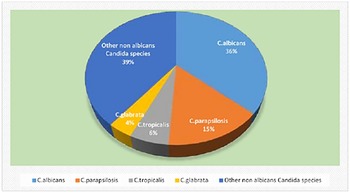
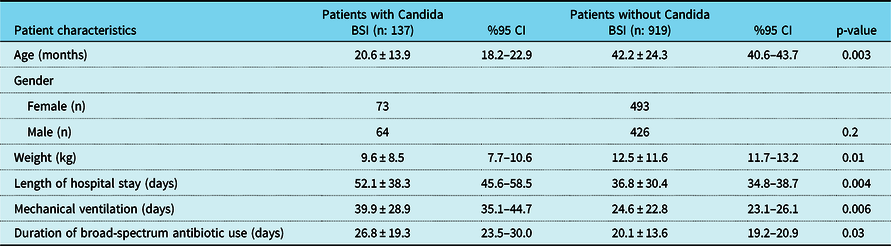
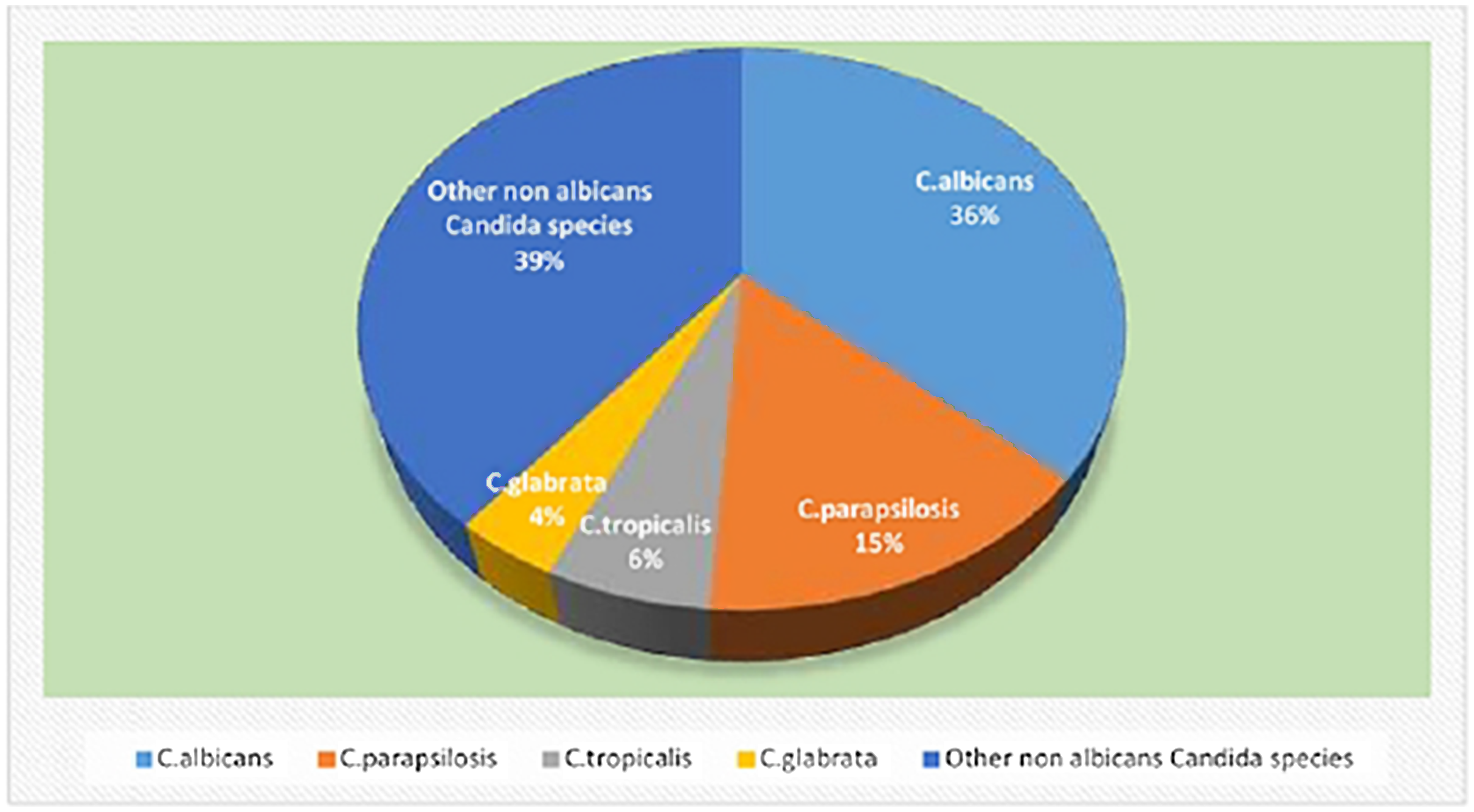
The culture results of 1056 patients, who were on a mechanical ventilator longer than 5 days and had the signs of infection, out of 1934 operated children (54.6%) in the last 5-year period, were evaluated. One hundred and thirty-seven of these one thousand and fifty six patients (12.9%) had positive blood cultures for Candida. The isolated pathogens were C. albicans (n: 50, 36.5%), C. parapsilosis (n: 20, 14.6%), C. tropicalis (n: 8, 5.8%), C. glabrata (n: 5, 3.7%) and other non-albicans Candida species (n: 54, 39.4%) (Fig 1). The mean age of children with Candida bloodstream infections was significantly lower than those without (20.6 ±13.9 months versus 42.2 ± 24.3 months, p: 0.003). The mean duration of mechanical ventilation of the patients with Candida bloodstream infections was significantly longer than those without (39.9 ± 28.9 days versus 24.6 ± 22.8 days, p: 0.006) as well as the mean length of hospital stay (52.1 ± 38.3 days versus 36.8 ± 30.4, p: 0.004). The indwelling medical devices (central venous line, urinary catheter, and feeding tube) were changed regularly Reference Mody, Krein and Saint7 and were replaced as soon as the fungal infection was reported. The mean time between the cardiovascular surgery and the first symptoms of Candida bloodstream infections after the admission of the patient to the paediatric cardiovascular surgery ICU was 12.2 ± 7.8 days. The average duration of broad-spectrum antibiotic use was found longer in patients with Candida bloodstream infections than those without (26.8 ± 19.3 days versus 20.1 ± 13.6 days, p: 0.03). (Table 1)
Distribution of isolated Candida species causing bloodstream infection.
The analysis of characteristics of the patients with/without Candida bloodstream infections
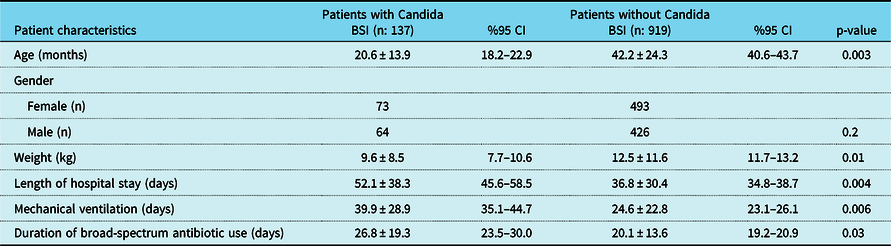
CI: Confidence Interval.
p-value < 0.05 was accepted as statistically significant.
The patients with Candida bloodstream infections had been operated for the following congenital cardiac pathologies: atrioventricular septal defect (n: 26, 18.9%), transposition of great arteries (n: 24, 17.6%), tetralogy of Fallot (n: 17, 12.4%), total anomalous pulmonary venous return (total anomalous pulmonary venous return) (n: 6, 4.3%), hypoplastic left heart syndrome (n: 5, 3.7%), double outlet right ventricle (double outlet right ventricle) (n: 3, 2.2%), pulmonary atresia (n: 2, 1.5%), tricuspid atresia (n: 2, 1.5%), and mostly for combined cardiac pathologies (transposition of great arteries + double outlet right ventricle, total anomalous pulmonary venous return + atrioventricular septal defect, transposition of great arteries + aortic hypoplasia, ventricular septal defect + pulmonary atresia, etc.) (n: 52, 37.9%). Moreover, 22 out of 137 patients (16.1%) with Candida bloodstream infections had the accompanying syndromes/pathologies (Down syndrome (n: 15, 68.2%), urinary tract abnormalities (n: 3, 13.6%), cerebral pathologies (n: 2, 9.1%), and operated gastroesophageal atresia (n: 2, 9.1%)).
88.4% of the patients (121/137) with Candida bloodstream infections were successfully treated by fluconazole (6 mg/kg/day following the 12 mg/kg/day loading dose) or caspofungin (50 mg/m2/day following the 70 mg/m2/day loading dose). Invasive Candida infections mortality rate was 11.6% (16/137).
Discussion
Fungal infections, mostly candidiasis, have become an increasing cause of morbidity and mortality in paediatric ICUs all over the world. Reference Eggimann, Garbino and Pittet1,Reference Wisplinghoff, Seifert and Tallent3 Recently, yeast species have been reported to be the fourth most common cause of systemic infections in children, representing 8–15% of all nosocomial sepsis in the United States of America. Reference Wisplinghoff, Bischoff and Tallent8 Xie et al evaluated the surgical patients with severe sepsis and found that 28.3% of them exhibited Invasive Candida infections; C. albicans was most frequently isolated (58%), followed by C. tropicalis (17%), C. glabrata (15%), and C. parapsilosis (10%). Reference Tortorano, Kibbler and Penman9 As a result of 5-year analysis, we found the Candida bloodstream infections rate of our paediatric cardiovascular surgery ICU as 12.9%, which could be regarded as moderately high, in line with the literature. Reference Ayık, Atay and Engin5 In contrast to the literature, however, non-albicans Candida species were the most frequently isolated fungal pathogens, in the present study. The distribution of identified Candida species were C. albicans (36.5%), C. parapsilosis (14.6%), C. tropicalis (5.8%), and C. glabrata (3.7%). Since it is not possible to definitively identify all Candida species, Reference Lynn, Duane, Clinton and etal10 our microbiology laboratory has reported the remaining 39.4% of Candida growth as other non-albicans Candida species.
Surgical procedures, especially cardiovascular surgery, performed to correct complex congenital heart anomalies have been accepted as an important risk factor for Invasive Candida infections, most commonly Candida bloodstream infections. Reference Jenkins11,Reference Jaworski, Irga and Haponiuk12 Relevantly, the patients with Candida bloodstream infections in our study had undergone surgery for the correction of cardiac pathologies as atrioventricular septal defect (18.9%), transposition of great arteries (17.6%), tetralogy of Fallot (12.4%), total anomalous pulmonary venous return (4.3%), hypoplastic left heart syndrome (3.7%), double outlet right ventricle (2.2%), pulmonary atresia (1.5%), tricuspid atresia (1.5%) and the remaining for combined cardiac pathologies (transposition of great arteries + double outlet right ventricle, total anomalous pulmonary venous return + atrioventricular septal defect, transposition of great arteries + aortic hypoplasia, ventricular septal defect + pulmonary atresia) (37.9%). The RACHS-1, risk adjustment for congenital heart surgery, scores of these surgeries were between 2 and 5 out of 6. Reference Jenkins11
The patients undergoing cardiovascular surgery have increased risk of Candida bloodstream infections because C. albicans and C. parapsilosis can form biofilms on almost any medical devices such as vascular and urinary catheters, cardiac valves, artificial vascular bypass devices, pacemakers, and ventricular assist devices. Reference Tortorano, Kibbler and Penman9,Reference Lim, Rosli and Seow13 It is thought-provoking that the Candida bloodstream infections rate in our study is high despite the issue we have shown to change the indwelling devices (peripheral and central venous lines, urinary catheters, feeding tubes, etc) at recommended times. Reference Mody, Krein and Saint7,Reference Wisplinghoff, Bischoff and Tallent8
Prolonged hospitalisation and ICU stay together with the use of indwelling medical devices are important predisposing factors for Candida bloodstream infections. Reference Leon, Alverez-Lerma and Ruiz-Santana14,Reference Vincent, Rello and Marshall15,Reference Kojic and Darouiche16 In consistence with the literature, the mean length of hospital stay and the mean duration of mechanical ventilation in the present study were longer in the patients with Candida bloodstream infections than those without. As our hospital is a tertiary referral centre for paediatric cardiovascular surgery, most of the accepted children undergo surgery for the correction of complex cardiac pathologies with an elevated risk of prolonged hospital stay, mechanical ventilation, and Invasive Candida infections. Moreover, 16.1% of these operated children had syndromes or accompanying respiratory, neurologic or gastrointestinal health problems. The most common syndrome we encountered was Down syndrome (68.2%), characterised by thymic hypoplasia together with cellular and humoral immunodeficiency. Reference Ram and Chinen17 Therefore, we suggest that when evaluating the children with Down syndrome in the perioperative period of cardiovascular surgery, their increased tendency to candidiasis must be considered. Prolonged use of broad-spectrum antibiotics (longer than 5 days) is also accepted as an important predisposing factor for fungal growth. Reference Chakrabarti, Sood, Parnell and Rubin18,Reference Garcia-San, Cobo and Martos19 Relevantly, the average duration of broad-spectrum antibiotic use in the present study was longer in the patients with Candida bloodstream infections. Although we have taken several measures to prevent nosocomial infections (hand hygiene, wound care, sterilisation, periodic staff educations, and other standard precautions), Reference Mehta, Gupta and Todi20 most of the described patients (42.7%) suffered from nosocomial bacterial infections, which led to the long-term use of broad-spectrum antibiotics and raised the tendency to Candida bloodstream infections.
According to the literature, the median time from the surgical intervention to the first symptoms of fungal infection after admitting the child to an ICU is 19-24 days. Reference Chakrabarti, Sood, Parnell and Rubin18 We found the mean time between the cardiovascular surgery and the first symptoms of Candida bloodstream infections after the admission of the patient to the paediatric cardiovascular surgery ICU as 12.2 ± 7.8 days. Despite their ongoing medical treatment, these patients had fever ≥38°C, clinical deterioration, gastric intolerance, and increased acute phase reactants, which suggested fungal infection. Studies have shown that the sensitivity of blood cultures for candidemia ranges between 63% and 83%, and likely even worse in children due to lower blood volumes used, so the meantime to positivity of the culture for Candida spp exceeds 24 hours, resulting in delays in the initiation of antifungal therapy and increased mortality. Reference Hope, Castagnola and Groll21,Reference Steinbach, Roilides and Berman22 Therefore, we initiated fluconazole treatment, as soon as the suspicion had arisen, after obtaining the blood cultures. Despite multiple trials to define the optimal treatment for fungal infections in adult patients, paediatricians have limited evidence-based guidelines in this regard. Reference Rex, Walsh and Sobel23 There have been prospective multi-centre studies in specific regions of the world, Reference Pappas, Rex and Lee24 but additional investigations are needed to complete the knowledge gaps in paediatric candidiasis.
Furthermore, there are only a few case reports for therapeutic management of Candida bloodstream infections in children undergoing cardiovascular surgery. In concordance with these limited number of guidelines, Reference Clancy and Nguyen25 we treated 88.4% of our patients successfully by fluconazole and/or caspofungin in the recommended paediatric dosages, Reference Rex, Walsh and Sobel23,Reference Clancy and Nguyen25 depending on their clinical course, hepatic, and renal functions and culture results.
Despite the widespread use of antifungals, Candida bloodstream infections remain the most frequent life-threatening fungal disease among ICU patients. Reference Tortorano, Kibbler and Penman9,Reference Lim, Rosli and Seow13 It has been estimated that the attributable mortality of Candida infections in children is 10–15%, which reaches 39% in the subgroup of children with CHD after cardiac surgery, and it may be as high as 83% in the infants below 6 months of age. Reference Chakrabarti, Sood, Parnell and Rubin18,Reference Lai, Wang and Liu26 Based on our findings, the mean age of children with Candida bloodstream infections was 20.6 ± 13.9 months and the mortality rate due to candidiasis following the CVS was 11.6%.
Limitations of our study were being a retrospective analysis and a single-centre study, the results of which could not be generalised.
Conclusion
Blood stream infections caused by non-albicans Candida species are the most common Candida bloodstream infections following the paediatric cardiovascular surgery of congenital cardiac pathologies. Despite the use of antifungals, candidemia remains the most frequent life-threatening fungal disease among paediatric ICU patients. New strategies should be developed to shorten the duration of mechanical ventilation, hospitalisation, and broad-spectrum antibiotic use to reduce the morbidity and mortality rates of Candida bloodstream infections in the paediatric cardiovascular surgery ICU. Multi-centre studies should be carried out to establish new measures for the prevention of Candida bloodstream infections and to create treatment algorithms, especially for the paediatric age groups.
Acknowledgements
There is no acknowledgement.
Financial support
This research received no specific grant from any funding agency, commercial or not-for-profit sectors.
Conflicts of interest
None.