Introduction
Today, approximately 33 million people are living with HIV/AIDS throughout the world. Furthermore, HIV has not affected the world proportionately; sub-Saharan Africa continues to bear the bulk (67%) of the global HIV burden. Although some sub-Saharan African nations are experiencing stabilization or a decline in the spread of HIV, this has been counteracted by increasing rates of HIV prevalence in others (UNAIDS, 2008).
Several studies have attempted to identify the socio-demographic characteristics associated with HIV vulnerability. Some authors focused on the connection between HIV prevalence and wealth, which appears to be positively correlated for a number of sub-Saharan African nations (Mishra et al., Reference Mishra, Bignami, Greener, Vaessen, Hong and Ghys2007). Other authors have pointed to education as a risk factor; however, its relationship to HIV seroprevalence is equivocal (Glynn et al., Reference Glynn, Caraël, Buvé, Anagonou, Zekeng and Kahindo2004; Fortson, Reference Fortson2008). Marital status has also been shown to be associated with HIV infection: individuals who have been married at any time (i.e. currently married, widowed or divorced) are more likely to be infected (Nunn et al., Reference Nunn, Kenyega-Kayonodo, Malamba, Seeley and Mulder1994; Hong et al., Reference Hong, Mishra and Govindasamy2004; Clark, Reference Clark2004; Johnson & Way, Reference Johnson and Way2006). In addition, some authors have identified an association between biological factors and HIV. Sexually transmitted infections appear to be positively correlated with HIV infection (Nunn et al., Reference Nunn, Kenyega-Kayonodo, Malamba, Seeley and Mulder1994; Hong et al., Reference Hong, Mishra and Govindasamy2004). Also, circumcision has been found to have a strong negative association with HIV prevalence in numerous studies (Gray et al., Reference Gray, Kiwanuka, Quinn, Sewankambo, Serwadda and Mangen2000; Agot et al., Reference Agot, Ndinya-Achola, Kreiss and Weiss2004; Auvert et al., Reference Auvert, Taljaard, Lagarde, Sobngwi-Tambekou, Sitta and Puren2005). Moreover, there is strong evidence for the role of alcohol in the spread of HIV (Zablotska et al., Reference Zablotskam, Gray, Serwaddab, Nalugodab, Kigozib and Sewankambob2006).
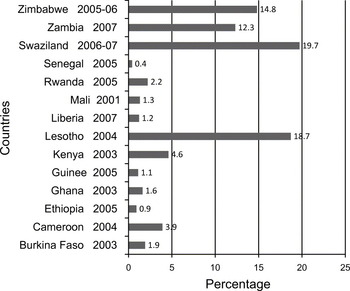
Zambia is in the midst of one of sub-Saharan Africa's worst HIV/AIDS epidemics (Fig. 1). Although evidence points to a decline in incidence among the youth since the 1990s (Fylkesnes et al., Reference Fylkesnes, Musonda, Sichone, Ndhlovu, Tembo and Monze2001; Michelo et al., Reference Michelo, Sandøy, Dzekedzeke, Siziya and Fylkesnes2006), HIV prevalence in Zambia remains extremely high among men (12.3%) (Zambia Demographic and Health Survey, 2007). Furthermore, most Zambians have not undergone HIV testing, and many lack complete knowledge about HIV prevention (ICF Macro, 2009). Hence, this paper analyses the findings of the latest (2007) Zambia Demographic and Health Survey (ZDHS) (CSO et al., 2009), by examining the relationship between HIV seroprevalence and various demographic, social, biological and behavioural characteristics among Zambian men, age 15–59 years, who have had sex. The focus is on the association between HIV status and risk behaviour: in particular, lack of condom use, drunkard status during sexual intercourse, multiple partners and years of being sexually active. Alcohol consumption was found to be a significant factor, which may be explained by the fact that excessive drinking impairs judgement, leading to improper or negligent use of safer-sex methods. Also, individuals who are drunk may be more likely to engage in promiscuous behaviour.
HIV prevalence estimates among sub-Saharan African men. Source: HIV prevalence data from Measure DHS, Macro International Inc.

Methods
The sample is drawn from the 2007 ZDHS, which targeted men age 15–59 from randomly selected households throughout Zambia. First conducted in 1992, the ZDHS aims to gather updated information on a wide variety of respondent characteristics including sexual activity, nutritional status, mortality rates and awareness and incidence of HIV/AIDS and other sexually transmitted infections. Blood samples for HIV and syphilis testing were collected in order to calculate national estimates of prevalence.
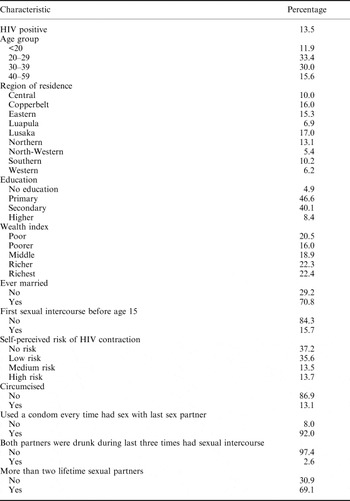
This analysis focuses on men aged 15–59 who have ever had sex (Table 1). Because many of the explanatory variables are associated with sexual behaviour, men who have never had sex are excluded from the study. The dependent variable is HIV serostatus. Of the 5513 total observations, 4434 had an HIV test result (either positive or negative). The explanatory variables can be divided into four categories: biological, behavioural, demographic and social. Multinomial logistic regressions are used to test the explanatory variables for association with HIV prevalence. STATA 11 software is used for all the regression analysis.
Sample distribution of sexually experienced Zambian men aged 15–59 based on selected background characteristics, Zambia DHS 2007

Note: Statistics are reported for population of men (aged 15–59) who have ever had sex.
The biological characteristic in this analysis is circumcision. As mentioned previously, studies (Gray et al., Reference Gray, Kiwanuka, Quinn, Sewankambo, Serwadda and Mangen2000; Agot et al., Reference Agot, Ndinya-Achola, Kreiss and Weiss2004; Auvert et al., Reference Auvert, Taljaard, Lagarde, Sobngwi-Tambekou, Sitta and Puren2005) have shown a strong negative association between HIV infection and circumcision. It is predicted that this analysis will yield similar results.
Behavioural factors selected for this model are condom use during sex, alcohol use during sex and number of lifetime sexual partners. The variable for condom use has two categories: 1=the respondent used a condom during each sexual intercourse with their last sexual partner and 0=otherwise. Many HIV prevention programmes have promoted condom use as an effective strategy in preventing HIV infection. It is predicted that condom use is negatively associated with HIV infection. However, the variable used in this study is not a direct test of the effectiveness of condoms. It only serves as an indicator of safer-sex tendencies and, to some extent, the availability of condoms to the respondent. Alcohol use during sex is a binary variable: 1=both sexual partners were drunk during the last three times the respondent had sexual intercourse and 0=otherwise. Since information related to last three sexual intercourses is used, this variable reflects the general behavioural pattern related to alcohol consumption. It is predicted that alcohol use during sex is positively associated with HIV infection, as it not only alters sexual behaviour but also the ability to remember and to correctly use a condom. Furthermore, the use of alcohol has been previously associated with increased risk behaviours through disinhibiting effects (Zablotska et al., Reference Zablotskam, Gray, Serwaddab, Nalugodab, Kigozib and Sewankambob2006). Number of lifetime sexual partners (two or fewer versus more than two) is also analysed. It is expected that individuals who have had multiple sexual partners in the past are more likely to have HIV.
The demographic characteristics are current age and region of residence. The age variable is divided into four age groups: under 20, 20–29, 30–39 and 40–59 years. Region has nine categories for each Zambian province: Central, Copperbelt, Eastern, Luapula, Lusaka, Northern, North-Western, Southern and Western.
The social factors included are education, wealth, marital status, age at first sex, years since first sex and self-perceived risk of contracting HIV. Education is divided into no education, primary, secondary and higher than secondary. One may hypothesize that more educated individuals possess a greater knowledge of HIV prevention methods, which should lower their risk of infection. Wealth is divided into five quintiles based on the Measure DHS wealth index: poorest, poorer, middle, richer and richest. Wealthier individuals may have greater access to health care and safer-sex methods. Marital status has two categories: never married and ever married. Respondents in the ever-married group were, at the time of the survey, currently married, living together, widowed, divorced or not living together. Age at first sexual intercourse is divided into two categories: before age 15 and age 15 and over. Years since first sexual intercourse has five categories: fewer than 5, 5–14, 15–24, 25–34 and 35 and above. Finally, self-perceived risk of HIV contraction is classified into no, low, medium and high risk. Tested against HIV prevalence, this may reveal how well informed Zambian men are concerning their HIV risk status.
Results
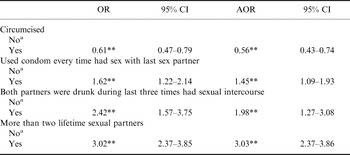
Table 2 reports the crude association between likelihood of HIV infection and behavioural and biological characteristics. Logistic regressions are used to calculate the crude odds ratios (OR), adjusted odds ratios (AOR) and 95% confidence intervals (CI). Independently, all the behavioural characteristics are found to be significantly associated with HIV infection. Furthermore, even after adjusting for all the behavioural characteristics, the associations remain significant. The most significant correlate among behavioural characteristics was having more than two lifetime sexual partners (OR 3.02 and AOR 3.03).
Logistic regression results: likelihood of HIV infection among sexually experienced Zambian men aged 15–59, Zambia DHS 2007

a Reference group for comparison.
** significant at 1%.
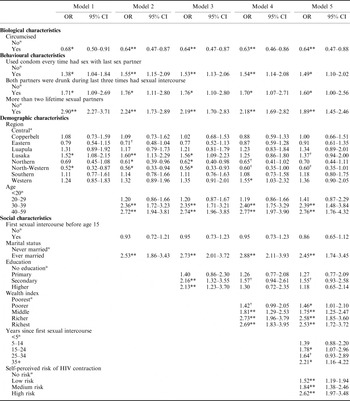
Logistic regression results: likelihood of HIV infection among sexually experienced Zambian men aged 15–59 based on selected characteristics, Zambia DHS 2007

a Reference group for comparison.
† Significant at 10%;
* significant at 5%;
** significant at 1%.
To further account for socio-demographic variables of interest and those earlier found to be determinants of HIV status, these are sequentially entered into the multinomial logistic regressions. Table 3 reports results for five multivariate logistic regressions as other covariates are sequentially added to the models. The covariate are entered in the following sequence: Model I adds eight region dummy variables to biological and behavioural characteristics (the regression from Table 1); Model II adds demographic characteristics age, marital status and first sexual intercourse before age 15 to Model I; Model III adds education; Model IV adds wealth; Model V adds years since first sexual intercourse and self-perceived risk of HIV contraction.
Models I to III highlight regional differences: at a 5% level, residents of Lusaka are more likely to be HIV positive compared with residents of Central region. Conversely, respondents in North-Western are less likely to have HIV. In Model II the demographic variable age shows a statistically significant positive association with HIV prevalence. Compared with respondents under age 20, individuals aged 20–29 are more than 2 times as likely to be HIV positive, while respondents aged 40–59 are more than 2½ times as likely to be infected. Compared with respondents who were never married, those who were ever married are between 2 and 3 times as likely to have HIV. In Model III, education is found to be significantly associated with HIV infection. In Model IV, a positive relationship between wealth and HIV prevalence is observed. Respondents in the richest wealth quintile are more than 2½ times as likely to be HIV positive compared with those in the poorest category.
However, as the wealth covariate is added to the multinomial logistic regression, there is a significant change in the results of other covariates. Comparing Model III and Model IV the region-wise difference in HIV prevalence disappears as wealth is controlled for. Also, education is no longer a significant determinant of HIV status, as was observed in Model III.
In Model V, both years since first sexual intercourse and self-perceived risk of HIV contraction show a strong positive association with HIV prevalence. Respondents who see themselves as high risk for HIV infection are the most likely to be infected. Adding these two covariates, however, does not change any of the signs of the other covariates from Model IV.
The biological factor, circumcision, reveals statistical significance at a 5% level in all models. Respondents who are circumcised have an approximately 40% reduced risk of being HIV positive. All behavioural characteristics are statistically significant in all the models. Condom use provides a protective effect against HIV infection. Individuals who did not use a condom every time they had sex with their last sexual partner are more likely to be HIV positive. Respondents who, along with their sexual partner, were drunk during the last three times they had sexual intercourse are more likely to be HIV positive: this is significant even after adjusting for other sexual behaviour. This makes a strong case for the role of alcohol in the spread of HIV. Having had more than two lifetime sexual partners increases a given individual's likelihood of infection by two-fold.
Discussion
In an attempt to improve current knowledge of the HIV/AIDS crisis in Zambia, this paper has tested key variables that may be associated with HIV seroprevalence among Zambian men. A discussion of these factors follows.
Older age was positively associated with HIV prevalence, with individuals in the oldest age group (40–59) having the greatest likelihood of HIV infection. Older men are likely to have the longest duration of sexual activity, which may increase their probability of contracting the disease through sexual means. This finding is in contrast to that of Johnson & Way (Reference Johnson and Way2006), in their analysis of Kenya, who found that an inverted U-shaped relationship existed between age and HIV prevalence, with the risk of infection peaking for men in the 35–39 age group. With regards to region of residence in this study of Zambia, Lusaka residents were most likely to be infected, while North-Westerners were least likely to be HIV positive. However, the significance of this result decreases as wealth is controlled for. At the region level there are large differences in proportion of circumcisions (Lukobo & Bailey, Reference Lukobo and Bailey2007); North-Western region has a higher proportion of circumcisions. In the above analysis circumcision is included as a covariate and accounts for such differences. Nevertheless, there still exist some regional differences in HIV status. One of the explanations for regional differences may be the population density levels of the two regions. Lusaka is the most densely populated province in Zambia, while North-Western has the lowest population density in the country. A higher population density may facilitate sexual transmission between individuals.
Education was not a statistically significant factor after controlling for wealth in the last two models. This lack of a relationship with HIV seroprevalence has been observed for men in other sub-Saharan African nations (Hong et al., Reference Hong, Mishra and Govindasamy2004; Akwara et al., Reference Akwara, Fosu, Govindasamy, Alayón and Hyslop2005; Johnson & Way, Reference Johnson and Way2006). Wealth status, however, had a strong positive relationship to HIV prevalence. Mishra et al. (Reference Mishra, Bignami, Greener, Vaessen, Hong and Ghys2007) also found a positive association between wealth and HIV prevalence for numerous sub-Saharan African nations. Thus, further support is shown for the claim that HIV, unlike many other diseases, disproportionately affects the wealthy members of the population.
Survey respondents in the ‘married at some time’ group were more likely to be HIV positive compared with those who were never married. Several explanations may be offered for this. Clark (Reference Clark2004) found that early marriage was associated with HIV risk factors, such as decreased condom use and increased frequency of sex. In addition, divorced men may have separated from their wives because of HIV infection, while widowed men may have infected their wives, who have since died of AIDS.
HIV infection peaked among the men who had their first sexual intercourse 15–24 years prior to the time of survey (2007). This period would coincide with 1983–1992, when the HIV prevalence rates in Zambia increased rapidly, and subsequently stabilized (Fylkesnes et al., Reference Fylkesnes, Musonda, Kasumba, Ndhlovu, Mluanda and Kaetano1997, Reference Fylkesnes, Musonda, Sichone, Ndhlovu, Tembo and Monze1998).
Self-perceived risk had a strong positive association with HIV prevalence. A comparable finding was observed for Kenyans (Johnson & Way, Reference Johnson and Way2006), who thought they had a small risk for HIV contraction, but were more likely to be infected than those who had no perceived risk. This may be explained by individuals who see themselves as having a higher risk also being more likely to engage in risky sexual behaviour. Akwara et al. (Reference Akwara, Nyovani and Hinde2003) found a strong positive association between perceived risk of contracting HIV and risky sexual behaviour, including having multiple sexual partners, lack of condom use during last casual sex, and occurrence of an STD.
As expected, circumcision is negatively associated with HIV infection. This finding merely adds to an already large pool of research that indicates the protective effect of circumcision.
Respondents who did not use a condom every time they had sex with their last sexual partner were more likely to be HIV positive compared with men who did use a condom. This suggests that the consistent use of condoms during sexual intercourse protects against HIV infection. Respondents who, along with their sexual partner, were drunk during the last three times they had sexual intercourse were more likely to be HIV positive. This may be explained by the fact that excessive drinking impairs judgement, leading to improper or negligent use of safer-sex methods. Also, individuals who are drunk may be more likely to engage in promiscuous behaviour. The number of lifetime sexual partners had a strong positive relationship to HIV prevalence, which is not surprising, since sexual transmission continues to be the primary mode of HIV spread in sub-Saharan Africa (Schmid et al., Reference Schmid, Buvé, Mugyenyi, Garnett, Hayes and Williams2004).
In conclusion, this analysis reveals that the HIV epidemic in Zambia is multifaceted. A diverse collection of demographic, social, biological and behavioural characteristics are associated with the likelihood of HIV infection among Zambian men. Above all, the findings emphasize the importance of sexual behaviour. Zambian men who do not use condoms during sex, are drunk during sex or have had multiple lifetime sexual partners have a greatly increased likelihood of HIV infection. HIV prevention programmes in Zambia should focus on education around these risk factors with the intention of reducing such behaviour.