It has been extensively documented that those with better education generally enjoy better health, a relationship often referred to as the education–health gradient.Footnote 1 Education may affect health and mortality through several mechanisms, such as increasing the marginal productivity of health inputs, improving access to and ability to process information, providing greater economic resources, reducing stress, and interacting with healthier peers.Footnote 2 It has also been noted that the educational gradient in health evolves over time, but the direction is unclear.Footnote 3 For example, some studies suggest a widening gradient, but selective survival tends to compress gradients at older ages,Footnote 4 limiting what can be deduced about birth cohort gradients from observing the current elderly.
Compared with the rich body of literature for the developed countries, much less is known about developing countries like China, where recent decades have witnessed tremendous social transformations. Although a few studies have reported the presence of an educational gradient in China, they are concerned with the determinants of health in general.Footnote 5 For the very few studies that are exclusively designed to examine the education–health nexus, attention has rarely been paid to its evolution.Footnote 6 It has been unclear whether the educational gradient in China has enlarged or narrowed over time, and why. Yet, answers to these questions are of grave importance for the making of public policies that aim to understand and close health gaps across socio-economic classes.
This study empirically examines the evolution of the educational gradient in health in China. We explore a number of issues of policy relevance, including: to what extent the educational gradient in health exists in contemporary China; whether the gradient has evolved over time across birth cohorts and generations; whether the gradient is sensitive to the measure of health and health-related behaviour used; what are the potential mediating mechanisms at work; and whether the magnitude of the gradient differs among population subgroups.
Our research strategies include presenting the visual trends of how the education–health gradient evolves over time, and also exploring the mediating mechanisms of the gradient through regression analysis. Recent studies of the causal pathways linking education and health tend to be based on “quasi-experimental” designs (such as using compulsory schooling laws as a plausibly exogenous source of variation),Footnote 7 and have not examined the gradient in mortality in China. Our strategy is complementary to that approach.Footnote 8
Drawing from Shanghai mortality datasets (between 1990 and 2005) as well as multiple nationally representative health surveys (between 1998 and 2010), we show that large and, in some cases, steepening educational gradients in health exist in contemporary China, the magnitude of which varies by gender, urban–rural residency, and birth cohort. We also show that the educational gradient can only be partially explained by socio-economic variables; the health effects of education conditional on income are large and appear to be increasing. The remaining portion of the gradient may point to the importance of other policies in addition to those aiming to improve the economic status of the less advantaged.
The paper is structured as follows. We first provide a brief conceptual framework for generating testable hypotheses about the educational gradient in health and its evolution during rapid socio-economic development. We then discuss data and empirical methods. A results section follows in which we report our key findings. Finally, we discuss the limitations of our study and conclude.
Conceptual Framework, Background, and Hypothesis Development
Conceptual framework
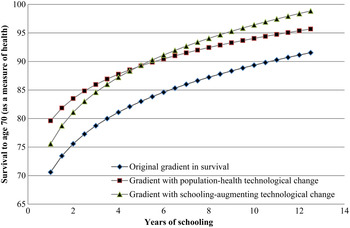
The relationship between health and education, although varying across measures of health and across metrics for education, exhibits in general a concave relationship, captured in the schooling variant of the famous “Preston Curve.”Footnote 9 Consider, for example, Figure 1, which illustrates a curvilinear relation between schooling and premature mortality (with survival to age 70 on the vertical axis). As shown by the diamond-dotted curve entitled the “original gradient in survival,” when average schooling of a birth cohort increases, a population moves up the “Preston Curve”: the educational gradient, i.e. the slope of the curve, is less steep when median schooling is 12 years than when it is four years. Thus, with a constant technology of health production, we would predict a steeper educational gradient in developing countries than in developed countries, with the gradient becoming less steep as a country develops and its citizens attain more schooling.
Educational Gradient in Health with Different Technological Changes in Health Production

However, successive birth cohorts are not only acquiring more schooling but are also exposed to technological changes in the health production function. Figure 1 illustrates two such technological changes: population health technological change and schooling-augmenting technological change. Population health technologies refer to those that have played a central role in global health improvements (such as clean water, sanitation and infectious disease control) over the last century.Footnote 10 For example, David Cutler and Grant Miller show the critical importance of water sanitation for reducing urban mortality in the early 20th century.Footnote 11 Similar points about the importance of population health technologies for early-phase health improvement were raised in the pioneering research on nutrition and mortality of Robert Fogel,Footnote 12 and were later summarized by David Cutler, Angus Deaton and Adriana Lleras-Muney, and separately, Dora Costa.Footnote 13 A similar reduction in the steepness of the educational gradient can also arise from a reduction in the price(s) of health input(s) (for example, the price of accessing clean water), since such a price change spurs those of lower schooling to begin buying health inputs that they previously could not have afforded. As shown by the square-dotted curve in Figure 1, population health technological change disproportionately raises survival among those with low schooling, making the educational gradient less steep for a given schooling level.
By contrast, the epidemiologic transition towards chronic diseases, with complex treatment regimens that may advantage those with better education, points to the growing importance of the second type of technological change – schooling-augmenting technological change – in shaping educational gradients in middle- and high-income countries.Footnote 14 Research on the educational gradient in chronic disease management, for example, suggests that those with greater schooling might be better able to increase their survival by navigating the complicated treatment regimens required for diseases like diabetes.Footnote 15 Such schooling-augmenting technological change, shown by the triangle-dotted line in Figure 1, would disproportionately raise the survival of those with higher education levels, making the educational gradient steeper.Footnote 16
The Chinese context and hypotheses
During the lifetime of China's current elderly, the country has moved rapidly up the Preston curve in terms of both life expectancy and average schooling years, with great changes during the Mao era (when life expectancy increased from below 40 to about 65, with convergence towards high-income countries by the 21st century, over 72 for men and 76 for women). China's health improvement during the 1950s and 1960s has been compared to those achieved in the US and many other high-income countries in the early 20th century.Footnote 17 Further studies on height suggest continuous improvement for China's later birth cohorts from 1980 onwards.Footnote 18 For example, evidence from national surveys of children's health shows that the national mean height for 17-year-old rural males increased from 164.4 cm in 1979 to 169.7 cm in 2005.Footnote 19 That is to say, roughly speaking, a 17-year-old rural Chinese boy born in the late 1980s was 5.3 cm taller than his counterpart born in the earlier 1960s. The significant and relatively fast improvements suggest that China experienced in a shorter period the “technophysio evolution” that has been documented in the West over the past century.Footnote 20
The dramatic health improvement between 1950 and 1980 has been linked to China's increases in educational attainment during that period.Footnote 21 Indeed, between 1950 and 1980, large expansions of education increased the average years of schooling for Chinese adults (aged 15 and older) from 1.61 to 5.31 years, and 5.22 to 7.82 years for those aged 15–19 years old.Footnote 22 Then, in the early 1990s, the Chinese government began to universalize nine-year compulsory education, and in the late 1990s, it significantly expanded the higher education system. After 2000, new efforts were made to provide free compulsory education with universal financial aid provided to students enrolled in secondary vocational schools. By 2010, primary education in China was virtually universal, 82.5 per cent of the relevant age cohorts were enrolled in upper secondary schools, and the enrolment in higher education reached 26.5 per cent.Footnote 23 The average years of education for individuals aged above 15 in 2010 increased to 7.95, and reached 10.23 for those aged 15–19.Footnote 24
While China has achieved great improvements in both education and health, to what extent the education–health gradient has evolved in contemporary China has only received sporadic attention. Based on China's 2000 census, it has been reported that, controlling for demographic differences, GDP per capita and other factors, a one standard deviation increase in average years of schooling was associated with an increase of 0.38 standard deviations (about 1.4 years) in life expectancy.Footnote 25 The analysis undertaken by Li Shuzhuo et al. of the 2000 census shows that Chinese men and women of the 1940 birth cohort (i.e. at age 60) with a college education were expected to live, respectively, 6.5 years and 7.6 years longer than their counterparts with no formal schooling; in comparison, the 1985 birth cohort (i.e. at age 15) who would go on to get a college education were expected to live 12.5 years longer than those with no formal schooling. Their comparative analysis of China's 1990 and 2000 censuses shows that the age-standardized mortality ratio between those with no formal schooling and the college-educated had increased from 2.96 times to 3.4 times during the decade. A closer examination reveals that such a change varied by gender: for men, the ratio increased significantly from 3.3 times in 1990 to 4.4 times in 2000, whereas for women, the ratio increased slightly from 3 to 3.2 times.Footnote 26
It remains unclear how China's education–health gradients have been evolving since 2000 and how those trends differ by birth cohorts. Because China is still at the lower part of the concave Preston curve compared with the US, one might expect China to have a steeper educational gradient in health than that of the US. One might also expect that China's educational gradient would be getting less steep over time if dominated by (1) movement up the Preston curve with increases in schooling, and/or (2) the life-long impacts of early public health investments (made during the period of youth of today's middle-aged and elderly Chinese) that disproportionately increased the health of those with low schooling.
By contrast, one might predict that the educational gradient in health and survival would be steep and getting steeper in China for a variety of reasons. The schooling-augmenting technological change that prevails in contemporary high-income countries may also be at work in China. The lasting impacts of exposures in utero and in childhood would also increase the likelihood of chronic disease in old age.Footnote 27 Contemporary China may also exhibit a steeper gradient with greater returns to schooling in terms of both survival and earnings, which would imply that later birth cohorts have a greater incentive to invest in schooling as China transitions from a “brawn-based economy” to a “brain-based economy.”Footnote 28 That such a dynamic may be at work in contemporary China is suggested by the temptations for rural youth to forgo schooling beyond the compulsory schooling level (or even to evade the latter requirement) to undertake lucrative brawn-based jobs in China's cities.
This study aims to provide evidence about the net effect of these contrasting forces in China and to document how the educational gradient in health and survival has evolved recently. In our analysis, we also pay attention to the heterogeneity of the educational gradient in health among different sub-groups of the population since, as previous research suggests, the educational gradient may have different patterns by gender and age. The pattern can also appear different for rural and urban residents. For example, there is evidence that low educational attainment is significantly associated with undiagnosed hypertension only for rural men.Footnote 29 While the specific mechanism behind these differences is beyond the scope of our study and merits investigation by further research, our documenting such heterogeneity may help policymakers identify the most disadvantaged and design appropriate policies.
Methodology and Data
The Shanghai mortality database
We first analyse the trend of the educational gradient in mortality between 1991 and 2005. Unfortunately, longitudinal national mortality data stratified by age/gender/education are not available, and interpretation of the national mortality trends is complicated by the Chinese death statistics being incomplete or inaccurate.Footnote 30 Dictated by data availability and reliability, our analysis focuses on the Shanghai mortality database. Recent research has shown that China has seen changing mortality patterns since 1990 and suggests that Shanghai is leading the way in this transition.Footnote 31 The education–mortality gradient in Shanghai may help us to understand how the gradient will evolve in China's other areas in the future.
Taking into account that the influx of migrant workers in recent years has considerably changed the age and educational structure of the Shanghai population, we limit our sample to permanent residents with a Shanghai hukou 户口. We also limit our sample to those aged 25–64 for data consistency.Footnote 32 We obtain the age-sex-education-specific number of deaths (i.e. the numerator of mortality stratified by age, sex and education) in 1991, 1995, 2000 and 2005 from the Shanghai vital registration system.Footnote 33 Vital registration in Shanghai started as early as the 1950s. A nationwide vital registration system was established in 1987 by the Ministry of Health. When a death is reported, the local vital registration office fills in the death certificate, based on which the local centre for disease control (CDC) codes the cause of death. The coding is based on the Ninth Revision of the International Classification of Diseases (ICD-9) for the period 1991–2001 and the Tenth Revision of the International Classification of Diseases (ICD-10) for the period 2002–2005. The data reliability has been shown to be high.Footnote 34
The estimation of the age-sex-education-specific population (i.e. the population denominator of mortality stratified by age, sex and education) is more complex. We conduct the estimation in three steps. First, we obtain the age-sex-specific population data over time from the Shanghai household registration system. Because data from this source are not stratified by education, we then in the second step obtain the distribution of education from four alternative datasets as proxies. These four datasets include the 1990 and 2000 Shanghai censuses and the 1995 and 2005 Shanghai 1 per cent population sample surveys. (See data appendix for more detailed references.) In the last step, we estimate the age-education-sex-specific population denominator for mortality by multiplying the population in each age-sex group (obtained from the first step) by the distribution of education for each age-sex group (obtained from the second step).
One technical issue arises here: although the population data stratified by education are separated between those with a Shanghai hukou and those without (i.e. migrants) in the 2000 census and the 2005 population sample survey, the data for the two groups were not reported separately in the 1990 census and the 1995 population sample survey. For most age groups, such a data issue should not seriously bias our estimation, since the share of migrants in the total population of Shanghai was low during the early to mid-1990s. For instance, the share was only 4.5 per cent in 1992.Footnote 35 Therefore, our “direct” estimation method is to use the 1990 and 1995 education data which did not exclude migrants to proxy the education distribution of Shanghai residents with hukou in these two years. Admittedly, since most migrants were young adults (aged 25–44) with low education, we would have overestimated the actual population of the low-educated young residents with a Shanghai hukou in 1990 and 1995 (which is the denominator). Consequently, we would have underestimated the actual mortality rates in 1990 and 1995 for the low-educated young residents with a Shanghai hukou.
As a sensitivity analysis, we alternatively apply the cohort-component method.Footnote 36 In this “indirect” method, we assume the distribution of education for the same birth cohort to be constant over time, and use the distribution of education for each age-sex group in the 2000 census – in which migrants and non-migrants are separated – to proxy for corresponding figures in 1990 and 1995. For example, we assume that the share of low-educated individuals aged 30–34 years in 1995 was equal to the share of low-educated individuals aged 35–39 years in 2000. Because people with low education tend to have higher mortality (higher probability of dying early), this method would have underestimated the actual proportion of those with low education in 1990 and 1995 (which is, again, the denominator). Correspondingly, this method would have overestimated the actual mortality rates for those with low levels of educational attainment.
We report both of our results below using, respectively, the “direct” and the “indirect” methods. The overall differences appear to be small except for those aged 25–44 years with low education. We believe that the actual mortality rates in 1990 and in 1995 for this specific group fall in between the estimates using the two methods, although we urge caution in interpreting the results.
To smooth out any yearly fluctuations, we apply a weighted average strategy to calculate the population denominator for the mortality rate stratified by age, gender, and education. Specifically, we assign a 50 per cent weight on the year under investigation (for example, 1995), a 25 per cent weight on the preceding year (for example, 1994), and a 25 per cent weight on the next year (for example, 1996).Footnote 37 In addition, to facilitate comparison across time and age groups, we standardize the mortality rates by multiplying the World Health Organization's (WHO) world standard population by the observed Shanghai age-education-sex-specific death rates.Footnote 38
Nationally representative surveys
As a complement to our visual presentation of the trends in the Shanghai education–mortality gradient, we also applied regression analysis to explore the recent evolution of the gradients in morbidity and health behaviour further. Theoretical and empirical research on the educational gradient in health shows that causality runs both from schooling to health and vice versa, with part of the correlation explained by other components of socio-economic status such as income.Footnote 39 A recent growing literature uses compulsory school laws as an instrument to address the issue of causality.Footnote 40 In general, studies using this approach conclude that the link between education and health is causal. However, the validity of this method has been challenged. For example, it has been pointed out that it is not always robust to controls for state-specific cohort trends.Footnote 41
Cutler and Lleras-Muney use a two-step regression process to explore the pathways between education and health behaviour.Footnote 42 This approach has been recognized as a worthwhile complement to research on the education–health gradient based on “quasi-experimental” designs.Footnote 43 In the first step, they regress health on education while controlling for basic variables (such as parental traits and health endowments at birth) that “determine education but cannot be affected by it.” If such variables were exhaustively controlled for, the estimated coefficient of education on health and health behaviour, according to the authors, “could be thought of as causal.”Footnote 44 In the second step, they test the potential pathways of the education–health link by adding to the basic regression a set of potential explanatory variables (such as income and cognitive ability) and observing the reduction in the estimated education coefficient on health. Naturally, this approach suffers from endogeneity issues and is “not set in a causal framework.” Yet, adding the variables in the second step could be considered “a sensitive test,”Footnote 45 helping to sort out “which potential pathways may be of first-order importance.”Footnote 46 Based on multiple survey datasets in the US and UK, Cutler and Lleras-Muney show that income, health insurance, family background, knowledge, cognitive ability and social networks can explain a majority of the educational gradient in health.
Largely following their study, we estimate the effect of education on health in the following models:
 $$H_i = {\rm \alpha}_0 + {\rm \alpha}_1 \ast Education_i + {\rm \alpha}_2 X_i + {\rm \varepsilon}_i $$
 $$H_i = {\rm \beta}_0 + {\rm \beta}_1 \ast Education_i + {\rm \beta}_2 X_i + {\rm \beta}_3 Z_i + {\rm \varepsilon}_i $$
where H i is a health/morbidity/health behaviour indicator of individual i; Education i is measured either by schooling years or as a dummy for whether individual i has secondary or above education; X i includes basic demographic factors such as age, gender, and ethnicity; Z i denotes additional socio-economic controls such as household income, marital status, family size, health insurance coverage, rural/urban residence, and province. For some analyses, Z i also includes parental characteristics (their ages and education and whether they are still alive), the level of social integration (frequencies of communicating with neighbours/friends and attending community events), personal well-being (such as depression, attitude towards difficulty), and current and future life satisfaction and forward planning.
Beyond the Cutler and Lleras-Muney paper, our study introduces two additional research dimensions: the time trend and the gender and regional (rural/urban) heterogeneities.Footnote 47 By using cross-sectional data collected at different time points, we are able to quantify the recent trend of the education–health gradients in China. We also explore to what extent the educational gradient differs among gender and rural/urban population subgroups.
Our analysis marshals data from two nationally representative surveys, including the 1998 and 2008 waves of the China National Health Services Survey (NHSS) and the 2010 wave of the Chinese Family Panel Study (CFPS). The data appendix discusses the surveys in more detail. We restrict our samples to individuals aged 25 and above to capture completed educational attainment.
Empirical Results
Educational gradient in mortality: evidence from Shanghai (1991–2005)
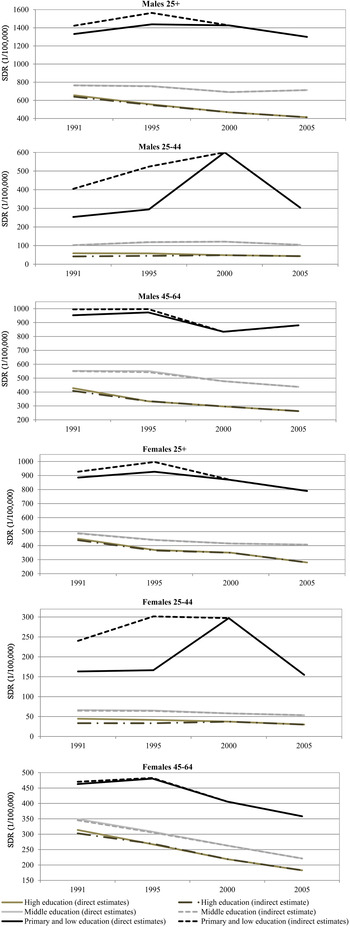
Figure 2 shows the results from Shanghai between 1991 and 2005. First of all, the educational gradient in mortality is substantial: for all years, those with primary or lower schooling had a much higher mortality rate (two- to four-fold, varying by age and sex) than their counterparts with high school education. Further, in general, the gradient has been increasing over the 14-year period, primarily because those with high education enjoyed a clear trend of improving survival, whereas the trend is less clear for those with lower education.Footnote 48 Also, the gradient is greater for men than women in most cases.
Trends of Standardized Death Rates (SDR) in Shanghai by Age, Sex and Education, 1991–2005

For those aged 25–44, the gradient is in general steeper than for the older age cohort. Also, the gradient increases between 1991 and 2000.Footnote 49 However, for those aged 25–44, the 2000–2005 period suggests a closing of Shanghai's mortality gap by schooling level. For example, in 2000, the mortality rate of below-median educated young men was about 12 times that of above-median educated young men (25–44); in 2005, the gap was down to about seven times.Footnote 50 However, since mortality is low among these prime-age adults, the substantial reduction in their mortality accounts for only a small portion of overall mortality and its gradient.
Among the population aged 45–64, the educational gradient in mortality increases over the 14-year period (i.e. for later birth cohorts), including the most recent five-year period. For example, in 1991, the ratio of mortality for men with only a primary school education to those with a high school education was 2.2; the ratio then increased to 2.8 in 2000 and 3.4 in 2005. The corresponding figures for women show a similar increasing trend, but to a lesser degree.
However, for a given birth cohort, the gradient narrows as they age. Consider the cohort born in the 1950s (the first decade of People's Republic of China) – the beneficiaries of large improvements in nutrition, public health and educational investments.Footnote 51 They were in young adulthood (the 25–44 age group) in 1991, and then middle-aged (the 45–64 age group) by 2005. Our analysis of the Shanghai vital statistics reveals that, conditional on survival to the period of this study, the 1950s' birth cohort experienced a declining educational gradient in mortality: the ratio of mortality for men with only a primary school education to those with a high school education declined 20.9 per cent, from 4.3 in 1991 (young adulthood) to 3.4 in 2005 (middle age); the ratio declined 45.9 per cent for women, from 3.7 in 1991 to 2.0 in 2005. Given that we might have underestimated the mortality for those low-educated individuals in 1991 aged 25–44, the decline could have been even more significant. This narrowing of the mortality gap with age may reflect not only selective survival and changing causes of death (for example, from injury among young adults to chronic disease among the elderly) but also the impacts of public health interventions (i.e. population-health technologies) and movement “up the Preston curve” in their lifetimes, both changes associated with a flattening gradient.
Educational gradient in morbidity and health behaviour: evidence from national surveys, 1998–2010
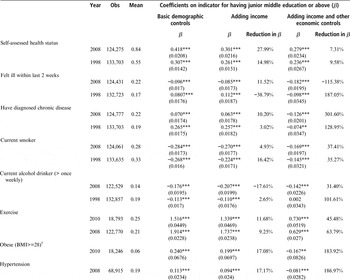
We report in Table 1 the results from the NHSS data over the 1998–2008 decade. We measure the educational gradient in health by the estimated coefficients on the indicator variable for attaining a junior high school (secondary school) education or above – approximately the median level of education for the full sample. With only basic demographic controls, clear gradients exist for all the health variables, with better educational attainment associated with better self-assessed health (SAH), lower likelihood of illness in the past two weeks, smoking (currently or ever), or being a heavy drinker; and higher likelihood of engaging in physical exercise.
Educational Gradient in Health (NHSS 1998, 2008)

Notes:
Demographic controls include age, gender, and ethnicity (for 2008). Economic controls include household income, family size, marital status, working status, whether covered by social health insurance, rural/urban hukou. *** indicates statistically significant at the 1% level; ** indicates statistically significant at the 5% level. †Our cut-offs for overweight and obesity (BMI 24/28) are Chinese cut-offs from the Working Group on Obesity in China and not the World Health Organization cut-offs (BMI 25/30).
Income and other economic controls such as rural residence and locality fixed effects play important roles in explaining the educational gradients in health. For example, as reported in the last column of Table 1, income and other controls account for about one-third of the educational gradient in the likelihoods of smoking and drinking, and account for even more of the gradient in the likelihood of engaging in physical exercise.
Nevertheless, educational gradients in health persist after controlling for these confounders: having above-median education is still associated with a 15–17 percentage point decrease in the likelihood of being a current smoker. Given an average smoking rate of 30 per cent, it suggests a large remaining association of education with smoking: those having above-median education are only half as likely to smoke as their below-median education counterparts.
The correlation of having above-median education with higher likelihood of being diagnosed with chronic diseases can be explained by better-educated individuals receiving more screening for chronic diseases. After controlling for confounders such as rural residence, insurance coverage and locality, the correlation between education and diagnosed chronic disease reversed to be negative: having above-median education is associated with a lower rate of diagnosed chronic diseases.Footnote 52
The time trend of the educational gradient in health between 1998 and 2008 differs by health measure used but, in general, the gradient did not decrease and, in many cases, it became steeper. For example, controlling for income and other economic factors, those having junior middle education or above in 2008 enjoyed a lower likelihood of feeling ill in the past two weeks than in 1998, compared to their less-educated counterparts.
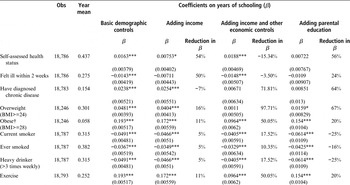
Table 2 shows the results from the CFPS 2010 data. The educational gradient in health is indicated by the estimated coefficients on years of schooling. Again, the regressions controlling for basic demographic characteristics reveal a significant educational gradient for most health measures. For instance, an additional year of schooling is correlated with better SAH, higher likelihood of engaging in physical exercise, lower likelihood of smoking and drinking, and lower likelihood of reporting illness in the past two weeks.
Educational Gradient in Health (2010 CFPS)

Notes:
Demographic controls include age and gender. Economic controls include household income, family size, marital status, working status, whether covered by social health insurance, rural/urban hukou. *** indicates statistically significant at the 1% level; ** indicates statistically significant at the 5% level. †Our cut-offs for overweight and obesity (BMI 24/28) are Chinese cut-offs from the Working Group on Obesity in China and not the World Health Organization cut-offs (BMI 25/30).
Income accounts for a wide range, from 5 per cent (smoking) to over 50 per cent (SAH), of the raw educational gradient, possibly reflecting that the educational gradient responds differently to income for different health measures. Other economic variables are also important, consistent with the research that finds that urban/rural and regional differences play an important role in China.Footnote 53 Income and other economic variables account for 10–18 per cent of the educational gradient in smoking and close to 50 per cent of the gradient in exercise. The raw positive correlation with having a diagnosed chronic disease reverses to be negative once comprehensive economic controls are included, consistent with the finding shown in Table 1 using the NHSS data. The positive educational gradient for obesity is also significantly explained by income and additional controls. The inclusion of other economic controls actually strengthens the educational gradient in SAH and morbidity within the past two weeks. The last two columns of Table 2 report the educational gradient when controlling for parental education. When the parents' education is considered, there is no longer a gradient in SAH or chronic disease. However, the gradients remain for physical exercise and are even stronger for smoking and drinking.
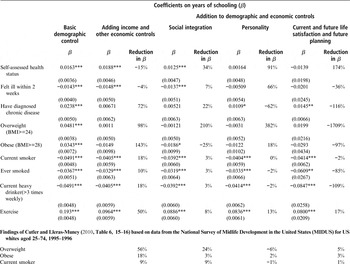
Further following Cutler and Lleras-Muney, in Table 3, we introduce additional measures of social integration, personality, and current/future life satisfaction and future planning. These characteristics do appear to explain some of the educational gradient, the magnitude of which, again, depends on the health measure examined. For example, the additional inclusion of social integration reduces the estimated correlation between SAH and years of schooling by about 34 per cent; for exercise, the reduction is about 8 per cent. In comparison with Cutler and Lleras-Muney's results for overweight, obese, and smoking (shown in the bottom rows of Table 3), the impact of including extra controls appears, in most cases, larger in our analysis.Footnote 54 However, the results should be interpreted with caution given the differences in the survey questions and in how they may differ in capturing the underlying differences in preferences of the survey respondents.
Educational Gradient in Health (CFPS 2010)

Notes:
Demographic controls include age and gender. Economic controls include household income, family size, marital status, working status, whether covered by social health insurance, rural/urban hukou. Social integration measures include frequency of communication with neighbours, of communication with friends, and of attendance of community events. Personality measures include currently perceived depression, the attitude to difficulty, and IQ value. *** indicates statistically significant at the 1% level; ** indicates statistically significant at the 5% level. †Our cut-offs for overweight and obesity (BMI 24/28) are Chinese cut-offs from the Working Group on Obesity in China and not the World Health Organization cut-offs (BMI 25/30).
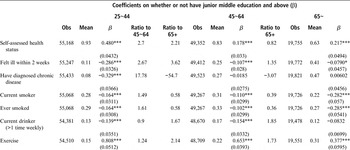
Table 4 explores heterogeneity in the educational gradient by age (birth cohort) using the 2008 NHSS data. The columns of the table report the educational gradient for three age groups (25–44, 45–64, and 65 and above) controlling for basic demographic information, income and other socio-economic indicators. An educational gradient exists in all three age cohorts: those with higher educational attainment are more likely to have good or excellent SAH and to engage in fitness exercise, and are less likely to smoke, drink, fall ill and have a diagnosed chronic disease.
Educational Gradient in Health: Heterogeneity by Age Cohort (NHSS 2008)

Notes:
Demographic controls include age, gender, and ethnicity. Economic controls include household income, family size, marital status, working status, whether covered by social health insurance, rural/urban hukou. *** indicates statistically significant at the 1% level; ** indicates statistically significant at the 5% level.
A common trend observed across different birth cohorts is that the educational gradients are more statistically significant and larger for the later (younger) cohorts. We show this in Table 4 by calculating the ratios of the estimated coefficients on above-median education for the later born cohorts (i.e. younger) to the coefficients for the earlier born (i.e. older) cohorts. In most cases, the ratios are greater than one. For example, consider the health metric of reporting illness in the last two weeks. The estimated coefficient on above-median education for the 25–44 age group is more than twice of that for the 45–64 age group, and three times of that for the 65 and older age group.
Nonetheless, in very few cases, the coefficient ratios between the younger and older cohorts are less than one: for instance, in the case of the likelihood of smoking, the ratio of the coefficient for the younger two cohorts to the coefficient for the older cohort is less than one. That is, the association between education and lower smoking rate is greater for those aged 65 and above than for their younger counterparts.
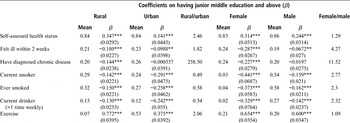
Table 5 explores heterogeneity in the educational gradient by urban/rural residence and by gender, also based on the 2008 NHSS. Educational gradients are present for both urban and rural individuals and for both men and women, and the relative steepness of the gradients varies. Unlike for mortality, as discussed above, there is a larger gradient for women than for men for these health measures. For example, the estimated negative correlation between having a junior high education and the probability of falling ill is more than four times greater in magnitude for women than for men. The results for the urban/rural division are a bit more mixed: while, in most cases, the education–health gradient is stronger for rural residents than for the urban counterparts, it appears to be greater for urban residents in terms of smoking and drinking.
Educational Gradient in Health: Heterogeneity by Region and Gender (NHSS 2008)

Notes:
Demographic controls include age, gender, and ethnicity. Economic controls include household income, family size, marital status, working status, whether covered by social health insurance, rural/urban hukou. *** indicates statistically significant at the 1% level; ** indicates statistically significant at the 5% level.
Discussion
We explore the educational gradient in health in China based on Shanghai mortality data as well as nationally representative data on health (NHSS 1998 and 2008; CFPS 2010). We have a number of findings. Above all, for both the Shanghai data and national data, we find a significant education–health gradient, with better-educated individuals enjoying better health and survival. The steepness of the gradient depends on what dimensions of health are measured (and how the gradient in education is quantified – the distribution of population by education is changing significantly over time). This pattern may also reflect the fact that the educational gradient responds differently to income for different health measures. The mechanism behind the variation awaits further exploration. We also find that the gradient has been in general increasing over time. In the Shanghai case, the increase in the gradient is primarily attributable to a faster decline in mortality for better-educated individuals during 1991–2005.
Based on the Shanghai mortality data, we find that the gradient for a given birth cohort (for example, the 1950 birth cohort) appears to be declining. This narrowing of the mortality gap may reflect not only selective survival but also the impacts of public health interventions (i.e. population-health technologies) and movement “up the Preston curve” in their lifetimes, both changes associated with a flattening gradient.
Based on the national survey data, income and other economic variables in general are mediating a portion of the association between education and income, the magnitude of which, again, depends on the specific health indicator used. In our analysis, income explains less of the educational gradient in smoking in China than in the US, possibly because smoking is more culturally and occupationally required for Chinese men and/or because the measure of smoking in our survey does not adequately differentiate occasional smoking of high-priced brands from chain smoking of lower-priced brands.
The results also indicate that only a small proportion of the gradient can be accounted for by income and other economic controls, suggesting that the wide and seemingly widening educational gradient in health is not merely the offshoot of greater income returns to education and the burgeoning income disparities in China. Rather, the net association of health with education conditional on income appears to be increasing. Both the monetary and non-monetary returns to education appear to be of independent economic significance and increasing.
The 2008 NHSS shows evident heterogeneities in the education–health gradient by cohort, urban/rural residency, and gender. The educational gradient among the younger cohort is in general greater than that among the older cohort; however, smoking is one exception – the educational gradient in smoking is the greatest among the oldest cohort. Also, in most cases, the gradient is larger for rural residents than for their urban counterparts; again, smoking (and drinking) is an exception – the gradient in smoking (and drinking) is greater among urban residents. Last but not least, the 2008 NHSS shows a larger gradient for women than men; in contrast, our analysis of the Shanghai mortality data shows a greater gradient for men than for women. We suspect that the seemingly contradictory results might be because the underlying mechanisms differ between the education–morbidity/health behaviour profile and the education–mortality profile.
Our study suffers from several limitations. Causality is surely a concern. Ideally, we would like to disentangle the mechanisms by applying rigorous econometric techniques to sufficiently informative data; in reality, however, causal pathways are difficult to establish. As we have previously acknowledged, studies that use compulsory school laws to address this technical issue have been challenged. Theoretically, if we are able to control an exhaustive list of variables that “determine education but cannot be affected by it,” the issue of causality is less prominent.Footnote 55 In reality, however, although we use a variety of survey data that offer rich information regarding health and health behaviour, we simply do not have all variables needed. Nor can we always find proper proxies. For example, while previous literature documents the impacts of cognitive ability and tastes on health, our survey data do not adequately ask such questions.Footnote 56 The choice of variables in the regression models is thus often dictated by data availability in addition to theory. Following Cutler and Lleras-Muney, we acknowledge that we are unable to make causal claims.Footnote 57 Yet, our analyses are informative in understanding potential mechanisms. For future research on the education–health gradient, understanding the impact of the quality of education has been suggested as a worthwhile extension.Footnote 58
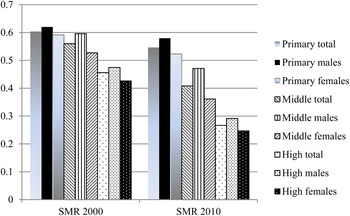
Also, the representativeness of the Shanghai data might be an issue. Unfortunately, however, as we have acknowledged previously, longitudinal national mortality data stratified by age, gender and education are not available, and the trends of mortality in Shanghai are informative for China's future as the country rapidly urbanizes. In addition, to complement our analyses, we also calculate the national standard mortality ratio by education in 2000 and 2010 using the 1990 mortality level as the reference. We show the result in Figure 3. It is clear that mortality decreased more significantly for those with greater educational attainment, which is consistent with our previous findings that the education–health gradient became steeper over the decade.
Standardized Mortality Ratio (SMR) in China by Sex and Education, 2000 and 2010 (Mortality Rate in 1990 = 1)

Conclusion
To date, limited evidence has been made available about the extent of the educational gradient in various health measures in China. It is of interest to know to what extent the gradient can be explained by income and other factors. It is also of interest to know how the gradient has been evolving over time: in rapidly developing economies like China, people of different cohorts have been exposed to very different health conditions over their life course. The educational gradient in health could be flattening if diminishing returns to improved average education levels and the influence of earlier population health interventions outweigh the gradient-steepening effects of new medical and health technologies.
Using multiple datasets at the local as well as the national level, we estimate the relationship between education and health. We find large, and in many cases, steepening (worsening) educational gradients in health, although the gradient flattens with age. We also find that the gradients are being mediated, to different extents, by economic and social resource variables. Nevertheless, a significant share of the educational gradient in health remains after controlling for resource variables. We also find that the gradients are, in most cases, larger for the younger cohorts and among rural residents. Moreover, the gradient in mortality is greater for men, whereas the educational gradient in morbidity and health behaviour is often greater for women.
Our study highlights the double disadvantage of those with low education, suggesting synergies in interventions that foster both aspects of human capital. Policies to enhance health and education among the least advantaged, such as the poor rural population, could have manifold returns for China's future social and economic development.
Acknowledgement
Karen Eggleston gratefully acknowledges support from the US National Institutes of Health/National Institute on Aging, Stanford University Center for Demography and Economics of Health and Aging (CDEHA) AG017253 seed project entitled “Socio-economic gradients in health among the elderly in China.”
Biographical notes
Qiulin Chen is an associate professor at the Chinese Academy of Social Sciences, Beijing, China. He earned his PhD in economics from Peking University and was a postdoctoral fellow in Asia health policy at the Asia-Pacific Research Center at Stanford University.
Karen Eggleston is senior fellow at the Freeman Spogli Institute for International Studies (FSI) at Stanford University, and director of the Stanford Asia Health Policy Program at the Shorenstein Asia-Pacific Research Center at FSI. Her research focuses on comparative healthcare systems and health reform in Asia, especially China; government and market roles in the health sector; payment incentives; healthcare productivity; and the economics of the demographic transition.
Wei Zhang is an assistant professor at the School of Marxism of Tsinghua University, Beijing. Her work focuses on the political economy of health and health care reform.
Jiaying Zhao is a visiting fellow in the School of Demography at the Australian National University. Her work focuses on long-term mortality and health transition, and health inequity. Her articles have appeared in Bulletin - World Health Organization, Journal of Epidemiology and Community Health, Population (English edition), Population Health Metrics, and Journal of Epidemiology.
Sen Zhou is a doctoral student in the economics of education and international comparative education programme at the Stanford Graduate School of Education. Her interests include higher education opportunities, educational choices, health economics and literacy development.
Appendix: Data Sources and Descriptions
A. Shanghai mortality reference population (denominator)
Shanghai Population Sample Survey Office and Shanghai Bureau of Statistics. 1992. Shanghai shi 1990 nian renkou pucha ziliao (Tabulation on the 1990 Population Census of Shanghai Municipality). Beijing: China Statistics Press. http://tongji.cnki.net/kns55/Navi/HomePage.aspx?id=N2008050033&name=YZPCE&floor=1. Accessed 2 April 2016.
Shanghai Population Sample Survey Office and Shanghai Bureau of Statistics. 1997. 1995 nian quan guo 1% renkou chouyang diaocha ziliao Shanghai fence (Tabulation on the 1995 China 1% Population Sample Survey: The Shanghai Volume). Beijing: China Statistics Press. http://tongji.cnki.net/kns55/Navi/HomePage.aspx?id=N2013090164&name=YQRDS&floor=1. Accessed 2 April 2016.
Shanghai Population Sample Survey Office and Shanghai Bureau of Statistics. 2002. Shanghai shi 2000 nian renkou pucha ziliao (Tabulation on the 2000 Population Census of Shanghai Municipality). Beijing: China Statistics Press. http://tongji.cnki.net/kns55/Navi/HomePage.aspx?id=N2013070349&name=YRKSH&floor=1. Accessed 2 April 2016.
Shanghai Population Sample Survey Office and Shanghai Bureau of Statistics. 2007. 2005 nian Shanghai shi 1% renkou chouyang diaocha ziliao (Tabulation on the 2005 Shanghai 1% Population Sample Survey), http://tongji.cnki.net/kns55/Navi/HomePage.aspx?id=N2013060031&name=YSRKC&floor=1. Accessed 2 April 2016.
B. National death data (numerator) and reference population (denominator)
Population Sample Survey Office under the State Council and Bureau of Statistics. 1993. Zhongguo 1990 nian renkou pucha ziliao (Tabulation on the 1990 Population Census of China). Beijing: China Statistics Press. http://tongji.cnki.net/kns55/navi/HomePage.aspx?id=N2008040085&name=YGSRP&floor=1. Accessed 2 April 2016.
Population Sample Survey Office under the State Council and Bureau of Statistics. 2002. Zhongguo 2000 nian renkou pucha ziliao (Tabulation on the 2000 Population Census of China). Beijing: China Statistics Press. http://tongji.cnki.net/kns55/navi/HomePage.aspx?id=N2008050075&name=YWXDS&floor=1. Accessed 2 April 2016.
Population Sample Survey Office under the State Council and Bureau of Statistics. 2012. Zhongguo 2010 nian renkou pucha ziliao (Tabulation on the 2010 Population Census of China). Beijing: China Statistics Press. http://www.stats.gov.cn/tjsj/pcsj/rkpc/6rp/indexch.htm. Accessed 2 April 2016.
C. Comparing the national surveys used in our study