Introduction
With only two native angiosperms, ~116 moss species (Ochyra et al. Reference Ochyra, Lewis Smith and Bednarek-Ochyra2008, Câmara et al. Reference Câmara, Soares, Hernriques, Peralta, Bordin, Carvalho-Silva and Stech2019) and ~27 liverwort species (Bednarek-Ochyra Reference Bednarek-Ochyra, Vana, Ochyra and Smith2000), Antarctic vegetation is often overlooked. Diversity levels have largely yet to be assessed using molecular tools and are likely to be underestimated. Recent studies of Antarctic plant molecular diversity (Biersma et al. Reference Biersma, Jackson, Stech, Griffiths, Linse and Convey2018b, Câmara et al. Reference Câmara, Soares, Hernriques, Peralta, Bordin, Carvalho-Silva and Stech2019) have served to emphasize major gaps in knowledge of bryophyte diversity in the Maritime Antarctic.
It has long been considered that Antarctic coastal areas, where most contemporary terrestrial biodiversity is found, were largely covered by ice during the last glacial maximum (ca. 18–20 ky bp), as well as previous glaciations from the Miocene onwards (for overviews, see Convey et al. Reference Convey, Lewis Smith, Hodgson and Pear2020, Fraser et al. Reference Fraser, Nikula, Ruzzante and Waters2012). If so, this would suggest that most plants present today should be relatively recent in origin, colonizing as ice retreated. This possibility has been widely challenged in recent years by a range of molecular biological and biogeographical studies across multiple groups of invertebrates, microbes and plants (Chong et al. Reference Chong, Pearce and Convey2015, Iakovenko et al. Reference Iakovenko, Smykla, Convey, Kašparová, Kozeretska and Trokhymets2015, Biersma et al. Reference Biersma, Jackson, Stech, Griffiths, Linse and Convey2018b, Cakil et al. Reference Cakil, Garlasché, Iakovenko, Di Cesare, Eckert and Guidetti2021, Verleyen et al. Reference Verleyen, Van de Vijver, Tytgat, Pinseel, Hodgson and Kopalová2021) that support a much more ancient origin and Antarctic distinctness of much of the contemporary terrestrial biota that must therefore have survived in situ in Antarctica during repeated glaciations (Convey et al. Reference Convey, Lewis Smith, Hodgson and Pear2020). However, some studies of both mosses (Biersma et al. Reference Biersma, Jackson, Bracegirdle, Griffiths, Linse and Convey2018a) and the native angiosperm Colobanthus quitensis (Biersma et al. Reference Biersma, Torres-Díaz, Molina-Montenegro, Newsham, Vidal and Collado2020) have pointed to species with more recent, mid- to late Pleistocene, origins in Antarctica. This suggests that both persistence and de novo colonization have played important roles in forming the contemporary Antarctic botanical diversity.
Although studies have addressed the generalities of Antarctic colonization processes (e.g. Hughes et al. Reference Hughes, Ott, Bolter, Convey, Bergstrom, Convey and Huiskes2006), very few have yet documented or quantified stages in its occurrence, such as natural dispersal in air currents or zoochoric attachment to bird plumage (documented at a local scale within Antarctica (Parnikoza et al. Reference Parnikoza, Dykyy, Ivanets, Kozeretska, Kunakh and Rozhok2012) but not in birds arriving from lower latitudes). No instances of natural colonists becoming established in the Maritime Antarctic or Continental Antarctica have been proposed in the period since the first human contact with the continent in the nineteenth century.
In contrast, there has been increasing documentation of the role of human assistance in bringing propagules of non-native species, including many plant species, into Antarctica (Frenot et al. Reference Frenot, Chown, Whinam, Selkirk, Convey, Stoknicki and Bergstrom2005, Chown et al. Reference Chown, Huiskes, Gremmen, Lee, Terauds and Crosbie2012). The possible role of soil or ice in holding non-native propagule banks has also largely not been addressed, although this has been proposed as the source of exotic fern propagules germinated from cryoconite in ice from Signy Island (Smith Reference Smith2013) and propagules of a rush species on King George Island (Cuba-Díaz et al. Reference Cuba-Díaz, Troncoso, Cordero, Finot and Rondanelli-Reyes2012). La Farge et al. (Reference La Farge, Williams and England2013) and Cannone et al. (Reference Cannone, Corinti, Malfasi, Vianelli, Vanetti, Zaccara, Convey and Guglielmin2017) demonstrated the ability of mosses to survive and resume growth after being buried under glacial ice in the Canadian Arctic and on Maritime Antarctic Adelaide Island, respectively, for several hundred years, while Roads et al. (Reference Roads, Longton and Convey2014) demonstrated regrowth of shoots of bank-forming mosses and liverwort propagules contained in a moss core from permafrost on Signy Island dated to 1500–2000 years. Antarctic vegetation clearly responds to climatic changes (Amesbury et al. Reference Amesbury, Roland, Royles, Hodgson, Convey, Griffiths and Charman2017), and it is expected that, over time, more organisms will arrive and become established.
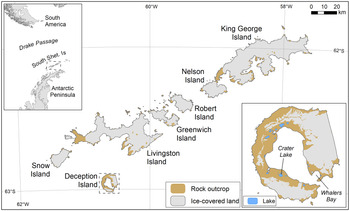
Deception Island (Fig. 1), located in the South Shetland Islands archipelago (62°57′S, 60°38′W), is one of the few active volcanos in Antarctica and one of only two in the region that has had eruptions witnessed by humans (Smith Reference Smith2005). The horseshoe-shaped island has a diameter of ca. 15 km surrounding an internal flooded caldera, Foster Bay. About 57% of the island's land surface is currently covered by ice (Smith Reference Smith2005). The island currently hosts two national Antarctic research stations (the Argentinian Decepción and Spanish Gabriel de Castilla stations). Two other national operators previously operated stations on the island, Chile and the UK, with the latter also operating a runway, but these were abandoned and destroyed or seriously damaged in a series of volcanic eruptions in the late 1960s. In the 1930s, a shore-based whaling station was constructed in Whalers Bay, which formed one centre of the South Shetlands whaling industry until it was superseded by pelagic whaling (Hart Reference Hart2006). The island's unique geology, human history, flora, fauna and aesthetic values, combined with the presence and activity of multiple national operators and strong tourism interest, led to its adoption as an Antarctica Specially Managed Area (ASMA 4) in 2002. Within what is now the ASMA, two Antarctic Specially Protected Areas (ASPAs) were already designated, ASPA 140 (terrestrial, with multiple subsites) and ASPA 145 (marine). The island also hosts two Historic Site Monuments (HSM 71 and 76) associated with the historic activities in Whalers Bay. Tejedo et al. (Reference Tejedo, Gutiérrez, Pertierra and Benayas2015) provide an overview of the research performed on Deception Island.
Location of Deception Island, South Shetland Islands, north-west of the Antarctic Peninsula.

The terrestrial vegetation of Deception Island was last synthesized by Smith (Reference Smith2005) and comprises Bryophyta, Marchantiophyta and Magnoliophyta. According to the island's ASPA management plan, it has the greatest number of rare and extremely rare land plant species of any site in the Antarctic Treaty area (defined as all areas south of the 60° latitude parallel), with 13 species of moss (including two endemic species) that have not been recorded elsewhere in the South Shetland Islands or further south. Although authors differ on precise numbers, Deception Island's flora includes both native Antarctic flowering plants (Deschampsia antarctica E. Desv. and Colobanthus quitensis (Kunth) Bartl.) and over 57 species of bryophyte (Ochyra et al. Reference Ochyra, Lewis Smith and Bednarek-Ochyra2008), equating to ~50% of all moss diversity known in Antarctica. The island also hosts the largest number of non-native species of terrestrial invertebrates and plants known from any location within the Antarctic Treaty area, possibly reflecting its particularly benign environmental conditions resulting from geothermal activity combined with intense human visitation (Greenslade et al. Reference Greenslade, Potapov, Russel and Convey2012, Hughes et al. Reference Hughes, Pertierra and Molina-Montenegro2015).
New molecular biological tools are increasingly being used globally to monitor or assess biodiversity. ‘DNA metabarcoding’, a term introduced by Taberlet et al. (Reference Taberlet, Coissac, Pompanon, Brochmann and Willerslev2012) to designate high-throughput multispecies (or higher-level taxon) identification using the total and typically degraded DNA extracted from an environmental sample such as sediment, water, soil, air or faeces, has rapidly become an important tool for the identification of active or dormant seeds, other propagules, pollen and detritus of plants (Fahner et al. Reference Fahner, Shokralla, Baird and Hajibabaei2016). Environmental DNA (eDNA) metabarcoding has the potential to contribute to the detection and classification of species through whole cells, extracellular DNA or whole organisms or their propagules being present in environmental samples (Barnes & Turner Reference Barnes and Turner2015). Although as yet underutilized in botanical studies, the application of DNA metabarcoding to soil samples opens up the possibility of providing a more comprehensive picture of plant diversity (Fahner et al. Reference Fahner, Shokralla, Baird and Hajibabaei2016) and can reveal the presence of taxa not detectable through traditional surveys. Câmara et al. (Reference Câmara, Carvalho-Silva, Pinto, Amorim, Henriques and Silva2021) recently applied metabarcoding in a survey of green algal communities in soil from two areas on Deception Island, revealing a high number Chlorophyta taxa not previously reported from Antarctica, including some potentially invasive taxa. Metabarcoding has also been used to assess plant and animal communities in the Ross Dependency, Continental Antarctica (Fraser et al. Reference Fraser, Connell, Lee and Cary2018), microorganisms on Livingston Island, South Shetland Islands (Garrido-Benavent et al. Reference Garrido-Benavent, Pérez-Ortega, Durán, Ascaso, Pointing and Rodríguez-Cielos2020) and in studies of fungal diversity (Rosa et al. Reference Rosa, da Silva, Ogaki, Pinto, Stech and Convey2020a, Reference Rosa, Pinto, Šantl-Temkiv, Convey, Carvalho-Silva and Rosa2020b, Newsham et al. Reference Newsham, Davey, Hopkins and Dennis2021).
In this study, we used high-throughput sequencing (HTS) of eDNA to investigate the diversity of Embryophyta (Viridiplantae) present in soil samples from two contrasting sites on Deception Island, one within ASPA 140 subsite B and the other within the popular visitor site and previous industrial and research station location of Whalers Bay.
Methods
Study sites and sample collection
Two sites were sampled. The first was within a protected area (ASPA 140, subsite B) hereafter referred to as Crater Lake, which has a lower degree of disturbance by both volcanic and human activity (and is not accessible to tourist visitors). However, it is ranked 8th of the 12 most studied sites on the island (Tejedo et al. Reference Tejedo, Gutiérrez, Pertierra and Benayas2015) and is only ~1.5 km from the Spanish Gabriel de Castilla research station. Collections were made here near a small stream (see Table I). The second sample site was in Whalers Bay, which has no access restrictions and is one of the most popular tourist visitation sites in the Antarctic Peninsula region, as well as regularly being visited by national operator vessels and staff. Whalers Bay was strongly impacted by the late 1960s volcanic eruptions, and parts of the shoreline and sublittoral zone continue to be actively heated, along with at least one fumarole site on the slopes above the bay. Whalers Bay is 3rd of the 12 most studied sites on the island (Tejedo et al. Reference Tejedo, Gutiérrez, Pertierra and Benayas2015). Collections here were made close to the lake shoreline (Table I). During the summer of 2018/2019, six soil samples (~200 g each) were collected from each site using sterilized spoons. Samples were collected to a maximum depth of 10 cm, avoiding vegetated areas and human-made structures (Whalers Bay) and ~150 m from the coastline. Samples were immediately sealed in sterile bags (Whirl Pack®/US) and frozen (-20°C) as soon as possible after collection until being analysed.
Locals of the sampled soils with geographical coordinates.

m a.s.l. = metres above sea level.
DNA extraction, Illumina library construction and sequencing
To avoid contamination, the bags were opened and DNA extraction was carried out in a sterile flow hood using sterilized tubes and solutions. Total DNA was extracted using the QIAGEN Power Soil Kit, following the manufacturer's instructions. DNA quality was analysed by agarose gel electrophoresis (1% agarose in 1× trisborate-EDTA) and then quantified using the Quanti-iT™ Pico Green dsDNA Assay (Invitrogen). The internal transcribed spacer 2 (ITS2) of the nuclear ribosomal DNA was used as a DNA barcode for molecular species identification (Chen et al. Reference Chen, Yao, Han, Liu, Song and Shi2010) using the universal primers ITS3 and ITS4 (White et al. Reference White, Bruns, Lee, Taylor, Innis, Gelfand, Sninsky and White1990). Library construction and DNA amplification were performed using the Herculase II Fusion DNA Polymerase Nextera XT Index Kit V2, following Illumina 16S Metagenomic Sequencing Library Preparation Part #15044223 Rev. B protocol. Paired-end sequencing (2 × 300 bp) was performed on a MiSeq System (Illumina) by Macrogen, Inc. (South Korea).
Data analyses and taxon identification
Raw fastq files were filtered using BBDuk version 38.34 (BBMap - Bushnell B.; https://sourceforge.net/projects/bbmap) to remove Illumina adapters, known Illumina artefacts and the PhiX Control v3 Library. Quality read filtering was carried out using Sickle version 1.33-q 30-l 50 (https://github.com/najoshi/sickle), to trim 3′ or 5′ ends with low Phred quality score, and sequences < 50 bp were discarded. The remaining sequences were imported to QIIME2 version 2019.10 (https://qiime2.org) for bioinformatics analyses (Bolyen et al. Reference Bolyen, Rideout, Dillon, Bokulich, Abnet and Al-Ghalith2019), and the pipeline was executed for merged pair-ended sequences with the following plug-ins: vsearch join-pairs (Rognes et al. Reference Rognes, Flouri, Nichols, Quince and Mahé2016), vsearch dereplicate-sequences, quality-filter q-score-joined (Bokulich et al. Reference Bokulich, Subramanian, Faith, Gevers, Gordon and Knight2013), vsearch cluster-features-de-novo 97% identity limit and vsearch uchime-denovo. Taxonomic assignments were determined for operational taxonomic units (OTUs) using the feature classifier classify-sklearn against the PLANiTS2 database (Banchi et al. Reference Banchi, Ametrano, Greco, Stankovic´, Muggia and Pallavicini2020) trained with a naïve Bayes classifier.
Various factors, including extraction, polymerase chain reaction and primer bias, can affect the number of reads obtained and thus lead to misinterpretation of absolute abundance (Weber & Pawlowski Reference Weber and Pawlowski2013). However, Giner et al. (Reference Giner, Forn, Romac, Logares and Massana2016) concluded that such biases did not affect the proportionality between reads and cell abundance, implying that more reads are linked with higher abundance (Deiner et al. Reference Deiner, Bik, Mächler, Seymour, Lacoursière-Roussel and Altermatt2017). Therefore, for comparative purposes, we used the number of reads as a proxy for relative abundance.
Ecological diversity analyses
Rarefaction calculations were carried out using the rarefaction analysis command in the software MOTHUR, where we clustered sequences into OTUs by setting a 0.03 distance limit. The following diversity statistics were calculated: Fisher's α, Shannon, Margalef, Simpson and evenness, to assess α diversity. We also performed a diversity t-test for comparison of the Shannon and Simpson diversities found in all sampled areas using PAST 3.26 (Hammer et al. Reference Hammer, Harper and Ryan2001).
Results
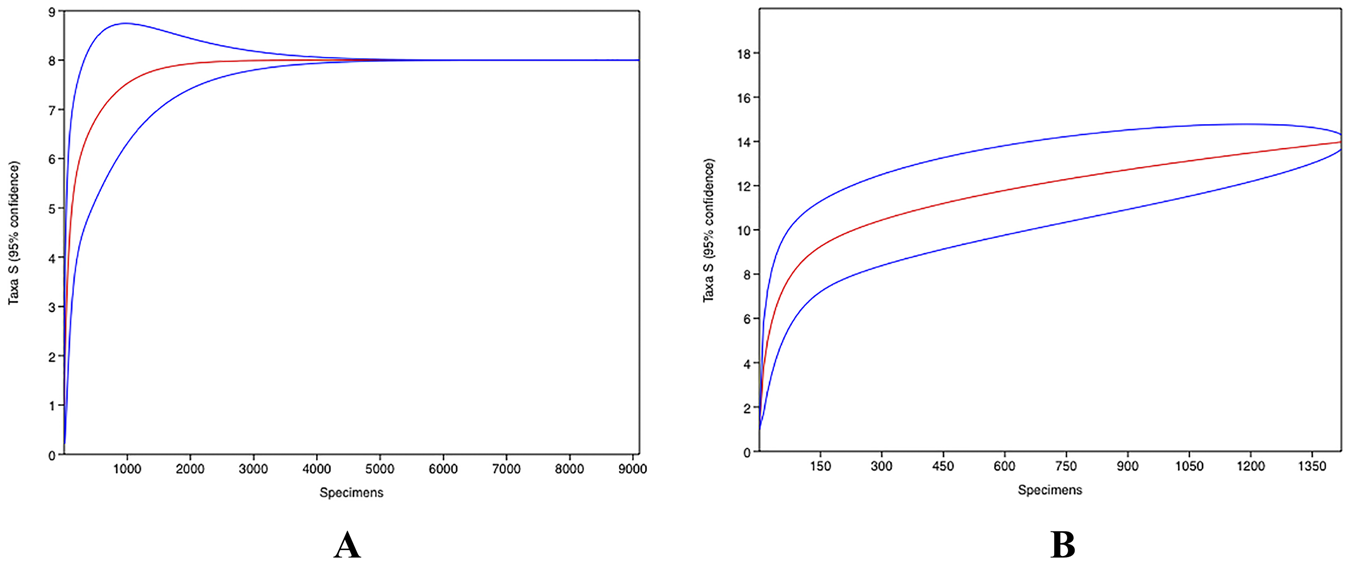
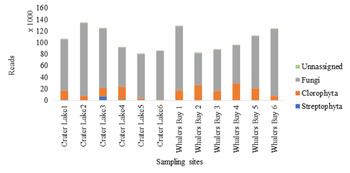
The calculated rarefaction curve for the assemblage detected in the soil of the Crater Lake region indicated that the sampling effort was sufficient to represent the diversity present, whereas that for Whalers Bay had not fully stabilized (Fig. 2). No plant DNA was obtained from two of the six samples from Crater Lake. A total of 2,048,703 paired-end DNA reads were generated in the sequencing run and 1,013,390 reads remained after quality filtering. For the Crater Lake samples, a total of 84% of reads represented fungi, 14% represented Chlorophyta and 2% represented Streptophyta, while at Whalers Bay, 79% of reads represented fungi, 20% represented Chlorophyta and < 1% represented Streptophyta, with ~1% being unassigned (Figs 3 & 4).
Rarefaction curves obtained from a. assemblages present in soil samples from Crater Lake and b. assemblages present in soil samples from Whalers Bay.

Histogram showing the relative abundance of reads from each sample; two of the six samples from Crater Lake did not generate any plant DNA and are not represented.

Relative abundances of all groups found at both sampled sites.

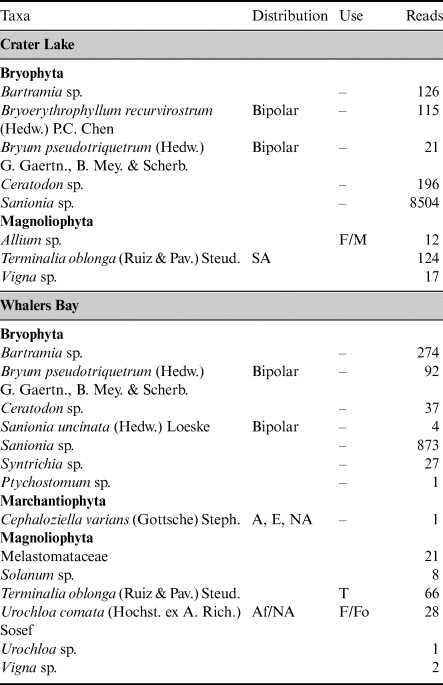
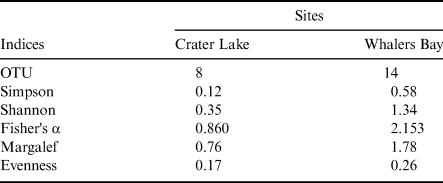
Amongst the Streptophyta we found 16 plant OTUs from three Divisions, including one Marchantiophyta, eight Bryophyta and seven Magnoliophyta (Table II). Sequences of six taxa were identified from both sampling sites, eight were detected only at Whalers Bay and two were detected only at Crater Lake. Ecological indices are shown in Table III. All of the Magnoliophyta sequences (flowering plants) are exotic to Antarctica.
Abundance of plant sequence reads detected in soil samples from Crater Lake and Whalers Bay, Deception Island. Distribution: A = Antarctica; Af = Africa; E = Europe; SA = South America. Uses: F = food; Fo = forage; M = medicinal; T = timber.

Ecological indices obtained from the sampled sites.

OTU = operational taxonomic units.
Discussion
Few Antarctic studies to date have applied metabarcoding, and these have so far focused almost exclusively on microorganisms such as bacteria, algae, fungi and cyanobacteria (Chua et al. Reference Chua, Yong, Gonzalez, Lavin, Cheah, Tan and Wong2018, Garrido-Benavent et al. Reference Garrido-Benavent, Pérez-Ortega, Durán, Ascaso, Pointing and Rodríguez-Cielos2020, Rosa et al. Reference Rosa, da Silva, Ogaki, Pinto, Stech and Convey2020a, Reference Rosa, Pinto, Šantl-Temkiv, Convey, Carvalho-Silva and Rosa2020b, Câmara et al. Reference Câmara, Carvalho-Silva, Pinto, Amorim, Henriques and Silva2021, Newsham et al. Reference Newsham, Davey, Hopkins and Dennis2021). Only Fraser et al. (Reference Fraser, Connell, Lee and Cary2018) presented data including terrestrial plant sequences.
All Marchantiophyta- and Bryophyta-assigned sequences in the current study represent species or genera that are widely distributed in the Maritime Antarctic and known to occur on or near Deception Island. Sanionia uncinata is one of the most common and widespread species in this region. Similarly, Bryum pseudotriquetrum is another widespread and common Antarctic species (Ochyra et al. Reference Ochyra, Lewis Smith and Bednarek-Ochyra2008). Bryoerythrophyllum recurvirostrum has been reported from the nearby Livingston Island but not from Deception Island (Ochyra et al. Reference Ochyra, Lewis Smith and Bednarek-Ochyra2008). At the genus level, two species of Bartramia are recorded in Antarctica. Bartramia patens Brid. is widespread in the Maritime Antarctic, while Bartramia subsymmetrica Cardot is recorded from South Georgia and has also been reported from the Falkland Islands, Patagonia, Kerguelen and south-eastern Australia (Câmara et. al. Reference Câmara, Soares, Hernriques, Peralta, Bordin, Carvalho-Silva and Stech2019). The genus Ceratodon is represented by a single species in Antarctica, Ceratodon purpureus (Hedw.) Brid. Two Sanionia species (Sanionia uncinata and Sanionia georgicouncinata (Müll. Hal.) Ochyra & Hedenäs) and five Syntrichia species (Syntrichia caninervis Mitt., Syntrichia filaris (Müll.Hal) R.H. Zander, Syntrichia magellanica (Mont.) R.H. Zander, Syntrichia sarconeurum Ochyra & R.H. Zander and Syntrichia saxicola (Cardot) R.H. Zander) are present. Ptychostomum is a genus that is generally considered to be a synonym of Bryum (Crosby & Magill Reference Crosby and Magill1981), of which multiple representatives are also common and widespread in Antarctica.
In contrast, our analyses revealed the presence of the DNA assigned to flowering plant taxa previously not recorded in Antarctica, including some potentially invasive species. No sequences were assigned to the two native flowering plants, both of which occur on Deception Island (although not at the specific sampling locations). Of the Magnoliophyta-assigned sequences detected in both sampling sites, Terminalia oblonga (Combretaceae) is a neotropical tree ranging from Mexico to Brazil. Vigna (Fabaceae) is a pantropical genus containing widely cultivated species used as food (e.g. beansprouts, black-eyed peas, adzuki and mung bean all belong to this genus). The genus Allium (Liliaceae) was detected only at Crater Lake and also includes members that are widely cultivated for food and culinary use (e.g. garlic and onions). DNA associated with such foodstuffs plausibly originates from nearby research stations, visiting ships and landing parties. A greater number of flowering plant sequences were detected at Whalers Bay, including Urochloa comata (Poaceae), which is widely used as a forage and food. Grasses in general can travel great distances and include many examples of invasive species (www.invasiveplantatlas.org), whilst forage materials would also probably have been imported to the island during the industrial whaling era and in the early years of research station activity, when domestic animals were commonly present. Solanum is another genus that includes many cultivated species globally (e.g. potatoes, aubergines, tomatoes and tobacco). Identified only at the family level, Melastomataceae is a mostly neotropical family of ~4500 species (www.melastomataceae.net).
A number of non-native angiosperms have been reported from Antarctica (Frenot et al. Reference Frenot, Chown, Whinam, Selkirk, Convey, Stoknicki and Bergstrom2005, Hughes et al. Reference Hughes, Pertierra and Molina-Montenegro2015). Primary amongst these is Poa annua L., which was first recorded on Deception Island in 1953, but was subsequently wiped out by a volcanic eruption in 1967 (Collins Reference Collins1969). The congeneric Poa pratensis was introduced to Cierva Point (north-west Antarctic Peninsula) in the 1950s during a tree transplant experiment, remaining at that specific location until its removal in the mid-2010s (Pertierra et al. Reference Pertierra, Hughes, Vega and Olalla-Tárraga2017a). The species is a widespread non-native on some sub-Antarctic islands. Lewis Smith & Richardson (Reference Lewis Smith and Richardson2011) reported two flowering plants native to Tierra del Fuego (Nassauvia magellanica J.F. Gmel. and Gamochaeta nivalis Cabrera) growing on Deception Island near Whalers Bay. Both (as is typical in Asteraceae) have seeds that may be adapted for aerial dispersal, and it was not possible to assess conclusively whether they were human introductions or natural colonists (Hughes & Convey Reference Hughes and Convey2010). Nassauvia magellanica was manually removed from the site while G. nivalis had died out between its first detection and the latter's removal (Hughes & Convey Reference Hughes and Convey2012). Poa annua is the only non-native angiosperm species currently known to remain established in Antarctica, with a significant population (reinforced by a persistent seed bank) near Arctowski station on King George Island despite recent eradication attempts (Molina-Montenegro et al. Reference Molina-Montenegro, Oses, Atala, Torres-Díaz, Bolados and León-Lobos2016, Galera et al. Reference Galera, Rudak, Czyż, Chwedorzewska, Znój and Wódkiewicz2019). Small populations have been discovered and eradicated in the northern Antarctic Peninsula (Molina-Montenegro et al. Reference Molina-Montenegro, Carrasco-Urra, Rodrigo, Convey, Valladares and Gianoli2012) and on Signy Island (South Orkney Islands) (Malfasi et al. Reference Malfasi, Convey and Cannone2020).
Many national operator and tourist vessels visit Deception Island and land in Whalers Bay and at other locations on the island. More than 150,000 tourists visited Antarctica between 2007 and 2010 (Roura Reference Roura2012), of which > 80,000 visited Deception Island (http://www.iaato.org). Whalers Bay is the most visited site, with ~160,000 tourist visits between 2010 and 2019 compared with 60,000 visits to other parts of Deception Island (http://www.iaato.org). Thus, the higher representation of exotic plant sequences found in samples from Whalers Bay probably reflects this human influence. The lower number of flowering plant sequences assigned in Crater Lake samples may be a consequence of its status as an ASPA subsite. However, it is not entirely free from human influence (Pertierra et al. Reference Pertierra, Hughes, Vega and Olalla-Tárraga2017b), as it is an active research area and is physically close to the summer-operating stations Gabriel de Castilla (~1.5 km) and Decepción (~2.5 km). In addition, given the small overall size of Deception Island, it is also quite close to Whalers Bay (~6 km), while many ships routinely enter Foster Bay. The strong winds often experienced in this region may also contribute to local redistribution of exotic biological material.
Kappen & Straka (Reference Kappen and Straka1988) reported pollen and spores of 23 taxa and Agostini et al. (Reference Agostini, Rodrigues, Alencar, Mendonça and Gonçalves-Esteves2017) reported pollen and spores of 17 different families of vascular plants in studies carried out on King George Island, also in the South Shetland Islands. This included pollen of Fagus spp.; however, Kappen & Straka (Reference Kappen and Straka1988) suggested that this might be due to contamination of samples. They also reported pollen of Poaceae in greater quantity and some pollen of Ericaceae and Lamiaceae. As with all metabarcoding studies, the assignation of sequences does not confirm the presence of viable cells or organisms. The strict protocols applied in the collection of samples and in their processing in the laboratory aimed to minimize the possibility of procedural contamination, although this cannot be entirely ruled out. We consider that the most plausible source of the exotic flowering plant sequences detected lies with human activity, as Fraser et al. (Reference Fraser, Connell, Lee and Cary2018) also detected analogous exotic sequences in soils from Victoria Land. DNA that is detected can originate from pollen, spores, small tissue fragments and even single cells. Bryophyta and Marchantiophyta commonly produce spores and vegetative propagules, while tissue fragments can also be viable (Longton Reference Longton1988), and even single cells show totipotency (La Farge et al. Reference La Farge, Williams and England2013); however, flowering plants generally do not have this capability.
A final important caution is that the reliability and accuracy of taxa assignment remain limited by the quality and completeness of information available in the databases consulted. The inability to assign a taxon may simply reflect its absence from available databases, which can apply both to taxonomically described species and newly discovered taxa. It is also commonly found, as in this study, that an often significant proportion of reads can only be assigned to higher taxonomic ranks, again most probably resulting from a lack of appropriate sequence information in databases. For example, the ‘Ceratodon sp.’ assignment from our sequence data most probably represents C. purpureus, the only species of this genus occurring in Antarctica, where it is widespread and abundant, and a species for which other molecular studies are available (e.g. Biersma et al. Reference Biersma, Convey, Wyber, Robinson, Dowton and van de Vijver2021).
Overall, our results corroborate the findings of Câmara et al. (Reference Câmara, Carvalho-Silva, Pinto, Amorim, Henriques and Silva2021) and confirm that DNA metabarcoding is a powerful tool for unveiling the sequence diversity potentially present in Antarctic soils, as well as providing important indicators of potentially invasive species and the human footprint. The finding of the eDNA of exotic plant species also emphasizes a potentially insidious and unappreciated influence of human contamination of the Antarctic environment. While the higher plant taxa detected may be unlikely to be present in viable form, there are further ramifications that may be of conservation and environmental protection significance in parts of Antarctica, in particular in the form of the transfer of genetic material into other organisms - horizontal gene transfer (HGT). This may not seem particularly relevant to a relatively damp and mild location such as Deception Island, where rapid microbial breakdown of biological macromolecules is likely to take place. However, there has been recognition of the almost completely unaddressed risks of microbial introductions to Antarctica, opening up the potential for the transfer of non-native genetic material into indigenous microbes (Cowan et al. Reference Cowan, Chown, Convey, Tuffin, Hughes, Pointing and Vincent2011, Hughes et al. Reference Hughes, Pertierra and Molina-Montenegro2015). Across much of Antarctica, environmental conditions of extreme cold and/or desiccation are recognized to be similar to those used in the laboratory to preserve DNA over the long term, and it is not known how long DNA fragments will remain intact in, for instance, Antarctic desert soils. Notably, Fraser et al. (Reference Fraser, Connell, Lee and Cary2018) suggest that their identification of DNA fragments assignable to exotic species may be linked with contamination over multiple decades, even back to the original exploring expeditions in Victoria Land over a century ago. Most studies of HGT have focused on its occurrence in prokaryotes (Jain et al. Reference Jain, Rivera and Lake1999, Jung et al. Reference Jung, Crocker, Eberly and Indest2011), including in Antarctica (Ma et al. Reference Ma, Wang and Shao2006). However, there are also identified instances of transfers from prokaryotes to eukaryotes, such as into rotifers (Nowell et al. Reference Nowell, Almeida, Wilson, Smith, Fontaneto and Crisp2018) and an Antarctic springtail (Song et al. Reference Song2010). Whilst purely speculative at present, the identification of exotic eDNA in this study further emphasizes the need to protect Antarctica's unique ecosystems and biodiversity from inadvertent and irreversible genetic contamination.
Acknowledgements
The authors thank the Spanish station Gabriel de Castilla for the lodging and logistical support during the 2018/2019 summer. We also thank Bettine van Vuuren, Luis Pertierra and an anonymous reviewer for helpful and constructive suggestions that considerably improved the paper.
Author contributions
Diego Knop Henriques, Thamar Holanda da Silva and Paulo E.A.S. Câmara collected the materials and performed the molecular laboratory work. Micheline Carvalho-Silva, Paulo E.A.S. Câmara, Luiz Henrique Rosa, Otávio H.B. Pinto and Peter Convey carried out the data analyses and interpretation. All of the authors contributed to preparing the manuscript.
Financial support
The authors thank the Brazilian Antarctic Program (PROANTAR), the Brazilian Navy, the Brazilian Ministry for Science and Technology, the CNPq funding agency, INCT Criosfera, Congresswoman Jo Moraes and the Instituto de Ciências Biológicas at University of Brasilia for supporting this research. P. Convey is supported by NERC core funding to the British Antarctic Survey ‘Biodiversity, Evolution and Adaptation’ Team.
Details of data deposit
The raw data files produced in the present study will be made available in GenBank.