Introduction
With the rapid development of both the economy and population, the shortage of freshwater has become an urgent problem to be solved worldwide (Yunusa et al., Reference Yunusa, Zerihun and Gibberd2018). Crop production closely depends on freshwater availability because agriculture consumes a large amount of water to meet the requirement of crops (Kang et al., Reference Kang, Hao, Du, Tong, Su, Lu, Li, Huo, Li and Ding2017). Water-saving agriculture is a hot topic for improving agricultural water productivity, which is vital to guarantee global food and water security. To increase the availability of water for irrigation and to mitigate the problem of water shortage, plastic film (PF) covering has generally been adopted in crop cultivation to improve crop growth and maximize grain yield (Li et al., Reference Li, Wang, Xu and Xu2004a). Compared to bare soil, film mulching enhances soil cumulative temperature (Bu et al., Reference Bu, Liu, Zhu, Luo, Che, Li and Hill2013a), reduces evapotranspiration (ET) (Fan et al., Reference Fan, Ding, Kang, Hao, Du and Tong2017), controls weed growth (Thomas et al., Reference Thomas, Ou, Allen, Vu and Dickson2009), increases fertilizer-use efficiency (Li et al., Reference Li, Wang, Wang and Xu2004b), and advances maize maturity (Zhang et al., Reference Zhang, Li and Yang2011). Because of the benefits of film mulching, the amount of agricultural PF used globally is estimated to reach 7.5 million tons in 2021 (Sander, Reference Sander2019). China has the greatest PF consumption worldwide, where the usage of PF increased considerably from 0.006 million to 1.47 million tons from 1982 to 2017 (Gao et al., Reference Gao, Yan, Liu, Ding, Chen and Li2019; Sintim and Flury, Reference Sintim and Flury2017; Yan et al., Reference Yan, He and Turner2014).
Because of the lack of effective recycling methods for PF used, residual film fragments in soil reduce soil permeability, decrease soil porosity, and then affect water uptake by crops (Chen et al., Reference Chen, Wu, Zhang, Lin, Hong and Luo2013; Liu et al., Reference Liu, He and Yan2014). For example, Zou et al. (Reference Zou, Niu, Liu, Li, Liang, Guo and Guan2017) found that residual films in the soil affected root development and reduced crop yield. Jiang et al. (Reference Jiang, Liu, Wang, Zhou and Xin2017) reported that residual film fragments disturbed soil structure and decreased soil water availability. Dong et al. (Reference Dong, Liu, Han, Sun and Li2015) demonstrated that a higher density of residual film fragments markedly reduced soil fertility and decreased crop yield, and the cumulative reduction in yield caused by residual plastic fragments would counteract the cumulative yield increase of mulching after 120 years. He et al. (Reference He, Wang, Guo, Zheng, Zhang, Li and Fan2018) studied the enrichment of residual plastic fragments distributed in 0–40 cm soil depth in the long-term mulching cotton field and found that the density of residual fragments holds a relatively linear relation with years of mulching, accumulating at a rate of 15.69 kg ha−1 annually.
To solve the soil problems caused by PF, degradable films were considered as alternatives to traditional PF (Ammala et al., Reference Ammala, Bateman, Dean, Petinakis, Sangwan and Wong2011; Wang et al., Reference Wang, Wu, Fan, Zheng, Zhang, Li and Guo2019a). In contrast to conventional PF, degradable films decompose into carbon dioxide and water, and the remnants turn into innocuous substances after crop season. Zhang et al. (Reference Zhang, Liu, Dannenmann, Tao, Yao, Jing, Zheng, Butterbach-Bahl and Lin2017) indicated the practice of mulching with degradable films significantly increased crop yield and nitrogen use efficiency. Moreno and Moreno (Reference Moreno and Moreno2008) suggested that grain yield and fruit quality under degradable film mulching were similar to conventional PF mulching. Wang et al. (Reference Wang, Wu, Fan, Zhang, Li, Zheng, Lin and Guo2019b) found that the number of residual plastic pieces was significantly lower in degradable film mulching than in conventional PF mulching, while Jenni et al. (Reference Jenni, Brault and Stewart2004) highlighted that covering crops with black degradable films (BDF) effectively controlled weed growth. However, Wortman et al. (Reference Wortman, Kadoma and Crandall2015) and Ngouajio et al. (Reference Ngouajio, Auras, Fernandez, Rubino, Counts and Kijchavengkul2008) reported that degradable film breaks up early in the field, and therefore does not effectively control weeds or water evaporation. Accordingly, Saglam et al. (Reference Saglam, Sintim, Bary, Miles, Ghimire and Lnglis2017) reported that soil moisture in the top layer with degradable material mulching was initially similar to that with PF mulching; however, lower soil moisture was observed during the latter growth season because of the degradation. Overall, degradable film mulching has increased crop yield and reduced environmental pollution in the field, but the behavior of degradable films is easily influenced by climate and soil (Costa et al., Reference Costa, Saraiva, Carvalho and Duarte2014; Gu et al., Reference Gu, Li and Du2017; Li et al., Reference Li, Peng, Shi, Yan and Wang2015).
The North China Plain (NCP) is one of the most important agricultural areas in China, where water deficit is the key factor restricting the development of agriculture (Ren et al., Reference Ren, Chen, Cai, Wei, Wu and Ali2017). Unfortunately, precipitation in the NCP has an obvious downward trend (Sun et al., Reference Sun, Shen, Qiang, Flerchinger, Zhang, Liu and Zhang2010), and groundwater depletion in this area challenges the sustainable utilization of groundwater resources (Kendy et al., Reference Kendy, Zhang, Liu, Wang and Steenhuis2004). On the other hand, summer maize is the main food crop in the NCP and planted area and total grain yield accounted for 31.5 and 31.2% of that for total maize in China in 2018, respectively. However, the performance of degradable films was limited by crop types and environmental conditions (Jenni et al., Reference Jenni, Brault and Stewart2004; Liu et al., Reference Liu, Chen, Liu, Wen and Liao2016). Although the summer maize grain yield has been closely related to soil–water regimes, few studies have evaluated soil water conditions in maize fields with degradable film mulching. The response of soil moisture condition, ET, grain yield, and water-use efficiency (WUE) of summer maize to degradable film mulching remains unknown. To address these issues, we compared two degradable films to the traditional PF and no mulching treatments in a summer maize cultivation in the NCP. We hypothesized that the degradable PF is an ideal alternative to conventional PF for boosting grain yield and WUE of summer maize in the NCP. Additionally, we aimed to investigate the effects of degradable film mulching on the soil water content, soil water storage, and water consumption by summer maize.
Materials and Methods
Experimental site
A 2-year (2016–2017) field experiment was conducted at the Experimental Station of Shandong Agricultural University (36°10′19″N, 117°09′03″E, 140 m a.s.l.) in Tai’an City, Shandong Province, China. This region experiences a typical temperate continental monsoon climate with annual average air temperature and precipitation of 12.9°C and 697 mm, respectively. Precipitation mostly occurs from June to September, which could meet summer maize water requirements (Sun et al., Reference Sun, Shen, Qiang, Flerchinger, Zhang, Liu and Zhang2010). The total rainfall and average air temperature during the summer maize-growing seasons were 494.3 mm and 25.4°C in 2016 and 350.3 mm and 26.5°C in 2017, respectively (Supplementary Material Figure S1). Soil in the experimental site was loamy clay with alkali-hydrolyzable nitrogen, available potassium, available phosphorus, and organic matter contents of 108.1 mg kg−1, 92.4 mg kg−1, 161.1 mg kg−1, and 1.4% (w w−1) in 0–20 cm soil depth, respectively. Soil pH was 6.9.
Experimental design
Summer maize (Zea mays L.) was planted in square experimental plots (3.0 × 3.0 m) with concrete slabs to 1.5 m depth to eliminate lateral soil water flow. Maize was sowed with 77,778 plants ha−1 on June 13, 2016, and June 13, 2017. The distances between plants and rows were 21 and 60 cm, respectively. The harvest was done on September 31, 2016 and on October 1, 2017, respectively. Treatments were established as follows: (1) mulching with conventional transparent plastic film; (2) mulching with transparent degradable film (TDF); (3) mulching with BDF; and (4) no mulching (CK) (see Supplementary Material Table S1). Treatments were designed to be completely randomized with 3 replications; hence, the experiment comprised 12 plots in total. The conventional transparent PF was produced by Shandong Sansu Group Co. Ltd. (Jinan, China), using polyethylene. The two photo-biodegradable films (TDF and BDF) are comprised of butylene adipate-co-terephthalate (PBAT), polylactic acid (PLA), and inorganic filler, and were produced by the Shandong Agricultural University (Tai’an, China). The thickness and width of both films were 6 µm and 60 cm, respectively. The planting pattern of no mulching was flat planting, a traditional method for local summer maize cultivation. The mulching treatments were ridge planting, which was widely adopted locally when PF was applied. The height of ridge was 15 cm and the width was 40 cm. The distance between two adjacent ridges was 20 cm (Supplementary Material Figure S2). Prior to sowing, 10.5 g N m−2, 11.9 g P2O5 m−2, and 10.5 g K2O m−2 were applied as base fertilization. The amount of preplanting irrigation was 0.5 m3 per plot. No more irrigation was applied after sowing. The experimental films were mulched immediately after planting.
Measurements
The soil moisture content was measured at 10-cm intervals from soil surface up to 120 cm soil depth using a CNC503D neutron moisture meter (Super Energy Nuclear Technology Ltd., Beijing, China). The measurement was conducted at 15-day intervals from sowing. Before and after a precipitation event, additional measurements were carried out. The first measurement was on sowing day and the soil moisture content at the topsoil layer (0–20 cm) was corrected using the oven drying method.
At grain maturity, two central rows in each plot were harvested manually to determine the summer maize grain yield and yield components.
Soil water storage was calculated as per Ali et al. (Reference Ali, Jan, Zhang, Khan, Cai and Wei2016), ET of summer maize followed Kang et al. (Reference Kang, Zhang, Liang, Hu, Cai and Gu2002), and summer maize water-use efficiency (WUE) was calculated as done by Zhou et al. (Reference Zhou, Chen and Ouyang2011):
 $$SWS = SMC \times H,$$
 $$ET = I + P - R - D - SW,$$
 $$WUE = Y/ET,$$
where SWS (mm) is the soil water storage, SMC (%) is the soil volumetric content, H (mm) refers to the thickness of soil layer, I (mm) is the irrigation depth (no irrigation was applied after sowing), P (mm) is the precipitation, provided by a weather station near to the experimental site, R (mm) is the surface runoff because each plot is surrounded by concrete slabs, thus, no significant runoff occurred, D (mm) is the deep percolation (ignored herein) and SW (mm) is the soil water storage change in 0–120-cm soil profile from the initial to the final stages, and Y (g m−2) is the summer maize grain yield.
Statistical analyses
For statistical analyses, a t-test and one-way analysis of variance (ANOVA) were conducted using IBM SPSS Statistics 26 (SPSS Inc., Chicago, USA). Tukey’s honestly significant difference test was used to multiple comparisons among treatments. The differences between the mean values of treatments were considered statistically significant at p < 0.05.
Results and Discussion
Soil moisture
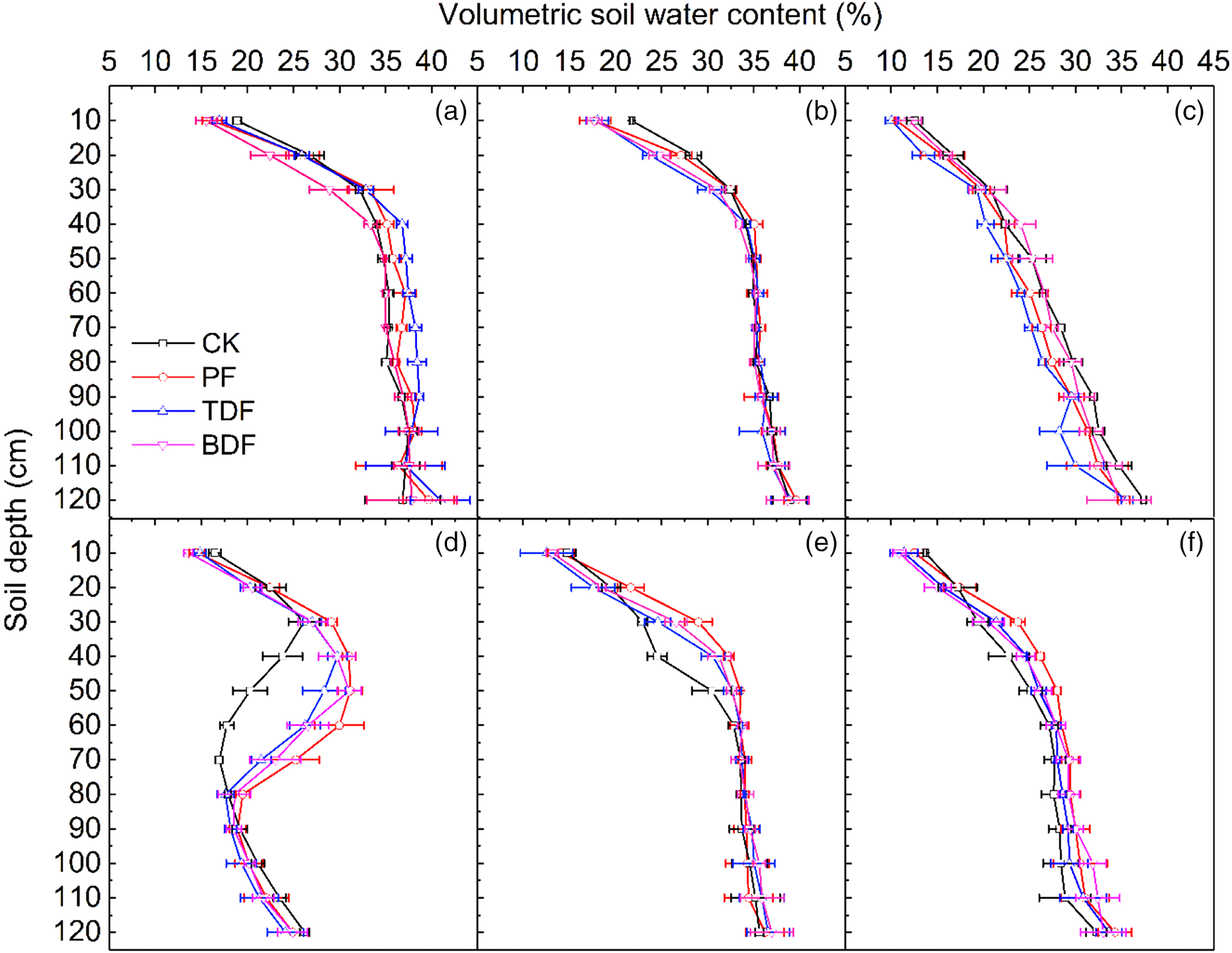
Soil moisture in the mulching treatments was higher than in no mulching at 20–120 cm soil layer (Figure 1). However, soil moisture was greater in no mulching treatment than in the mulching treatments at the topsoil layer (0–20 cm). In 2017, the soil moisture content first increased and then decreased with increasing soil depth at V6 (Figure 1d). Rainfall extended into deeper soil layers owing to infiltration, while the shallow soil moisture was dissipated through field evaporation. Additionally, the soil water content was significantly greater in the three mulching treatments at 40–70 cm soil profile than that in no mulching treatment. The highest soil moisture contents were observed at 30–80 cm soil layers in PF treatment. No marked differences were detected among TDF and BDF treatments (Figure 1d). The soil moisture was the highest at VT because of high precipitation and it increased slowly with increasing soil depth at this stage, with no significant differences among treatments at soil layers below 50 cm (Figure 1e). At R2, the deeper the soil layer, the higher the soil moisture. In fact, soil moisture was always higher at 40–120 cm soil profile under mulching conditions than under no mulching (Figure 1f). The soil moisture was highest under PF, followed by BDF and TDF, while the lowest soil moisture values were recorded under CK (Figure 1f). The distribution of soil moisture differed between 2016 and 2017, especially at VT and R2 (Figure 1a, b, c). Soil water content was higher in CK in the deeper soil layer in 2016 (Figure 1c), primarily because bare soil promoted more rainfall replenishment into soil compared to mulching treatments.
Distribution of soil water content during jointing (V6) (a, d), tasseling (VT) (b, e), and filling (R2) (c, f) growth stages in 2016 (a–c) and 2017(d–f). CK means no mulching, PF means plastic film mulching, TDF means transparent degradable plastic film mulching, and BDF means black degradable plastic film mulching. Horizontal bars are standard errors (n = 3).

Interestingly, soil moisture at 0–20 cm soil profile was higher under no mulching than under film mulching (Figure 1). This difference might be due to the planting pattern. It was flat planting in no mulching treatment, a traditional method used in summer maize cultivation. The planting pattern used in the mulching treatments was ridge planting, which is convenient for mulching film and is widely adopted locally when PF is applied. The ridge soil is dried more easily because soil water is easily shed from the rising ridges and is accumulated in the furrow (Yang, et al., Reference Yang, Blackwell and Nicholson1996). For example, Saglam et al. (Reference Saglam, Sintim, Bary, Miles, Ghimire and Lnglis2017) simulated the response of soil water movement to rainfall, and found that film mulched on ridges did not permit infiltration of rainwater into the soil. Therefore, traditional non-mulching cultivation showed higher soil moisture at the topsoil than did the mulching treatments tested here.
The redistribution of soil water was significantly influenced by different covering treatments (Figure 1). Our results were consistent with Saglam et al. (Reference Saglam, Sintim, Bary, Miles, Ghimire and Lnglis2017), who reported that soil water content under biodegradable polyethylene mulching varied between values found under polythene mulching and no mulching treatments. The water vapor barrier caused by degradable mulching was much less effective than that caused by plastic mulching because of the materials used. Therefore, the loss of water vapor from the soil was greater under degradable film covering. Another reason may be related to crop water consumption. Herein, maize development in PF plots was slow, and consequently, water consumption was lower under PF treatment than under the degradable film mulching treatments. Meanwhile, the difference between mulching and no mulching treatments was greater in the early than later growth stages (Figure 1d, f). Nevertheless, the PF effectively restrained the water–heat transfer between soil and atmosphere, decreasing field evaporation (Li et al., Reference Li, Hou, Jia and Han2016). Although the water retention under degradable films was poorer than that under PF, the use of degradable films might effectively avoid the problem of residual plastic pollution, which is highly beneficial toward the development of a more sustainable agriculture.
Soil water storage
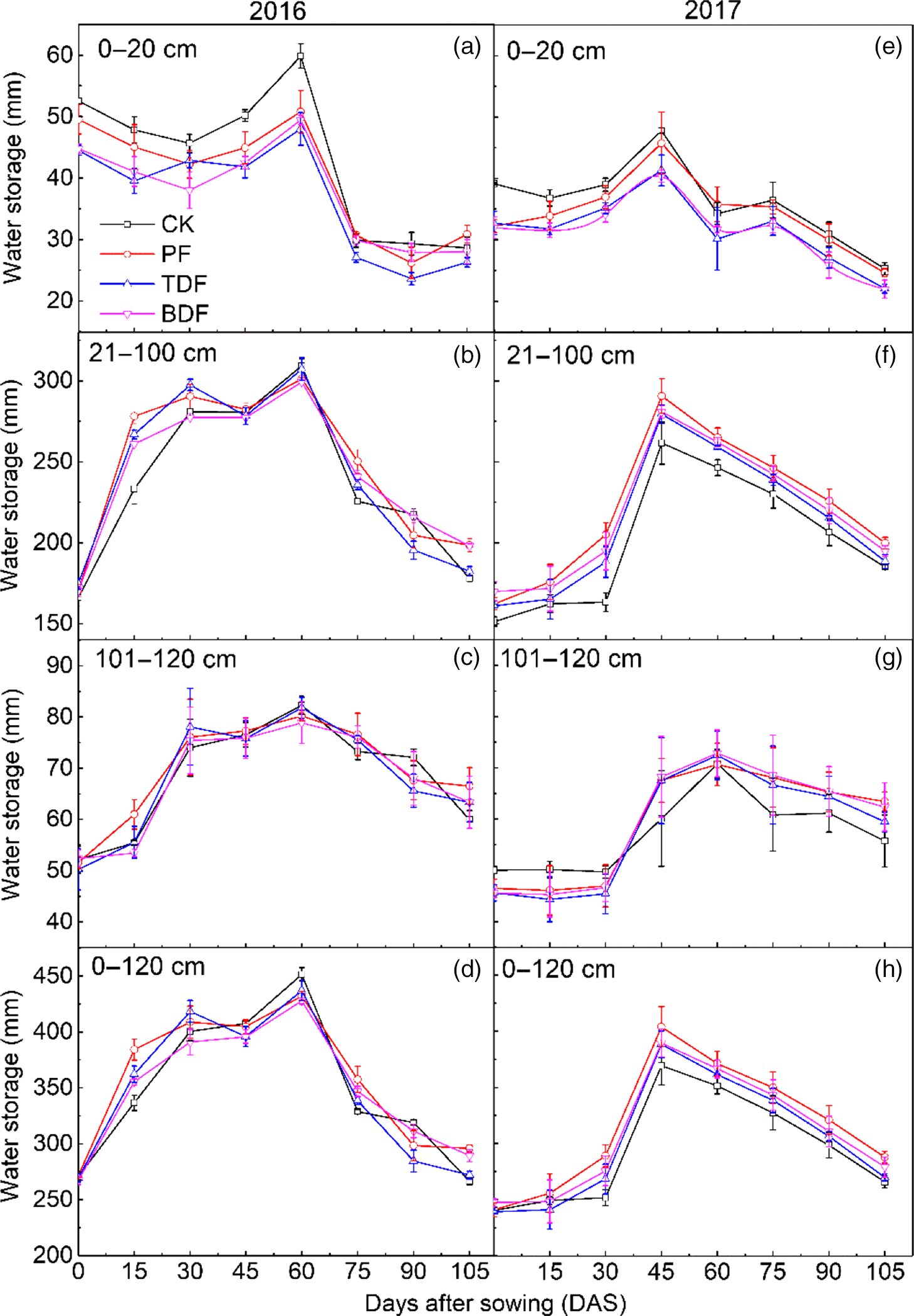
The soil water storage at the top 20 cm soil depth was lower at the harvest stage compared to at the sowing stage across 2 years (Figure 2a, e). The fluctuation of soil water storage increased due to the precipitation, infiltration, evaporation, and crop root uptake. In general, the soil water storage under no mulching was the highest until 60 days after planting (2016), followed by conventional PF covering and degradable film covering, and no significant differences were found between the two types of degradable film mulching treatments (Figure 2d). At 60–90 days after planting, the soil water storage in the no mulching treatment was lower than that in PF treatment, but still higher than those in TDF and BDF treatments (Figure 2d). At the intermediate soil layer (21–100 cm), the highest soil water storage was found in PF treatment, followed by BDF, TDF, and CK treatments (Figure 2b, f). Furthermore, conservation PF had a greater wetting effect on soil than did degradable films, with TDF and BDF treatments showing similar water conservation. In the deep soil layer (101–120 cm), the soil water storage increased from sowing until the middle of July, and then decreased until maturity (Figure 2c, g). The soil water storage was greater at harvest than at sowing and soil water depletion during the entire growth seasons was the largest in no mulching, followed by TDF, BDF, and PF (Figure 2d, h).
Soil water storage at 0–20 (a, e), 21–100 (b, f), 101–120 (c, g), and 0–120 (d, h) cm soil layer in the 2016 (a–d) and 2017 (e–h) summer maize-growing seasons. CK means no mulching, PF means plastic film mulching, TDF means transparent degradable plastic film mulching, and BDF means black degradable plastic film mulching. Vertical bars are standard errors (n = 3).

Soil water storage is a key factor affecting maize growth and yield, which is closely related to crop water consumption. The soil water storage in the upper soil layer is critical to maize development. Gao et al. (Reference Gao, Xie, Jiang, Wu and Niu2014) found that superficial maize roots and root volume had a negative correlation with soil depth, and Zhao et al. (Reference Zhao, Li, Ai, Li and Gu2018) reported that the roots of summer maize absorbed water mainly from the upper 20 cm soil depth (77.8–48.6% of water uptake for maize was from this layer) until V6. The main soil layer of water absorption gradually deepened, reaching 40–120 cm soil depth at the milking stage. In this study, soil water storage decreased in the top 20 cm soil layer during the early growing stages likely due to root uptake. Then, a greater soil water storage was observed because of heavy precipitation at 30–60 days after planting (Figure 2). The variation in soil water storage at later periods was mainly influenced by the precipitation distribution (Ji and Unger, Reference Ji and Unger2001). In the shallow soil layer, the soil water storage in CK conditions was larger than those under other mulching treatments (Figure 2a, e). Ali et al. (Reference Ali, Jan, Zhang, Khan, Cai and Wei2016) indicated polyethylene film had a greater water retention capacity compared to the degradable film and our results are consistent with these previous observations, except for the flowering stage in 2016 due to the high precipitation.
Water consumption
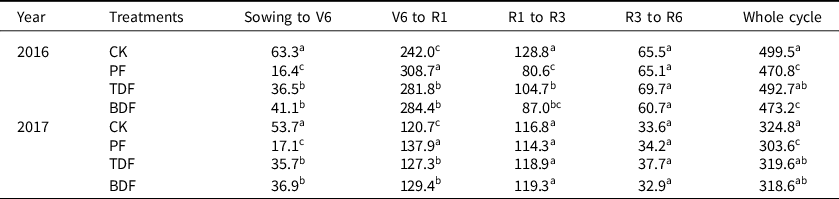
From sowing to V6, ET of summer maize in PF, TDF, and BDF treatments were 74.1, 42.3, and 35.1% lower than that in the CK treatments in 2016, and 68.1, 33.4, and 31.3% lower in 2017 (Table 1). From V6 to R1, the greatest water consumption was observed under PF treatment, followed by BDF, TDF, and CK. During this period, precipitation was frequent and heavy (Figure S1); the bare soil surface allowed a higher rainwater infiltration rate, and the lower rainfall infiltration rate caused by film mulching accelerated rainwater loss. Therefore, a lower ET rate was observed in CK from V6 to R1 (Table 1). From R1 to R3, the ET rate in PF, TDF, and BDF treatments was significantly decreased by 37.4, 18.7, and 32.5%, respectively, compared to that in no mulching in 2016. ET in 2017 was larger than that in 2016 owing to the high precipitation from R1 to R3 (Table 1; Figure S1). In accordance with Wang et al. (Reference Wang, Wu, Fan, Zheng, Zhang, Li and Guo2019a), the variability of ET was relatively small among film mulching and no mulching from R3 to R6, with no marked differences observed (Table 1). The reason for this may be maize canopy with mulching showed greater development, and the increased soil evaporation under no mulching conditions was offset by the increased ET via crop transpiration under mulching conditions (Wang et al., Reference Wang, Wu, Fan, Zheng, Zhang, Li and Guo2019a). Different mulching technologies significantly affected total ET and the order of ET was CK > TDF > BDF > PF (Table 1). Compared to the CK plot, ET of the whole growing season was decreased by 28.7, 6.8, and 26.3 mm in PF, TDF, and BDF plots in 2016 and by 21.3, 5.2, and 6.3 mm in 2017, respectively (Table 1). Gu et al. (Reference Gu, Li and Du2017) reported that ET for PF mulching was lower than that for degradable film mulching, which was consistent with our results.
Water consumption (mm) for summer maize at different growth stages under different mulching treatments

CK means no mulching, PF means plastic film mulching, TDF means transparent degradable plastic film mulching, and BDF means black degradable plastic film mulching. V6, VT, R2, and R6 are jointing, tasseling, filling, and maturity stages, respectively. In each growing season and for each phenological stage, different letters indicate significant differences (p < 0.05, HSD test) among treatments.
Grain yield
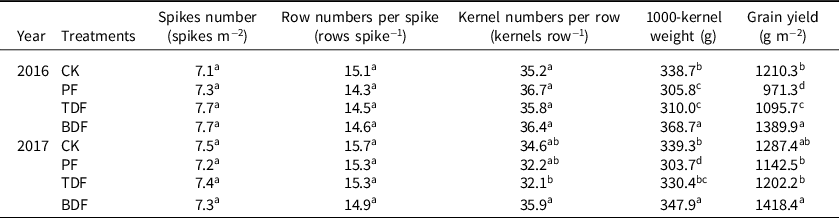
The grain yield was similar between the two experimental years and the highest yield occurred in BDF treatment while the lowest one was observed in PF treatment (Table 2). In 2016, the grain yield in BDF was significantly higher 14.9% than that in CK treatment. However, grain yields in PF and TDF plots were significantly lower by 19.7 and 9.5% than that in CK plots, respectively (Table 2). In 2017, the grain yield of maize increased by 10.2% under BDF conditions when compared to that under CK, but decreased by 11.3 and 6.8% under PF and TDF conditions, respectively. The variation in grain yield was mainly derived from changes in the 1000-kernel weight. Compared to that in CK, the 1000-kernel weight in BDF treatment was significantly increased by 8.6% in 2016 and 2.5% in 2017. Conversely, the 1000-kernel weights were lower in PF and TDF treatments by 9.7 and 8.5% in 2016 and 10.5 and 2.6% in 2017, respectively, when compared to that in CK treatment. Differences in spikes numbers, row numbers per spike, and kernel numbers per row were not significant among mulching treatments (Table 2). Nonetheless, the value of kernel numbers per row was highest in BDF treatment.
Grain yield and yield components of summer maize in 2016 and 2017

CK means no mulching, PF means plastic film mulching, TDF means transparent degradable plastic film mulching, and BDF means black degradable plastic film mulching. In each growing season, different letters indicate significant differences (p<0.05, HSD test) among treatments.
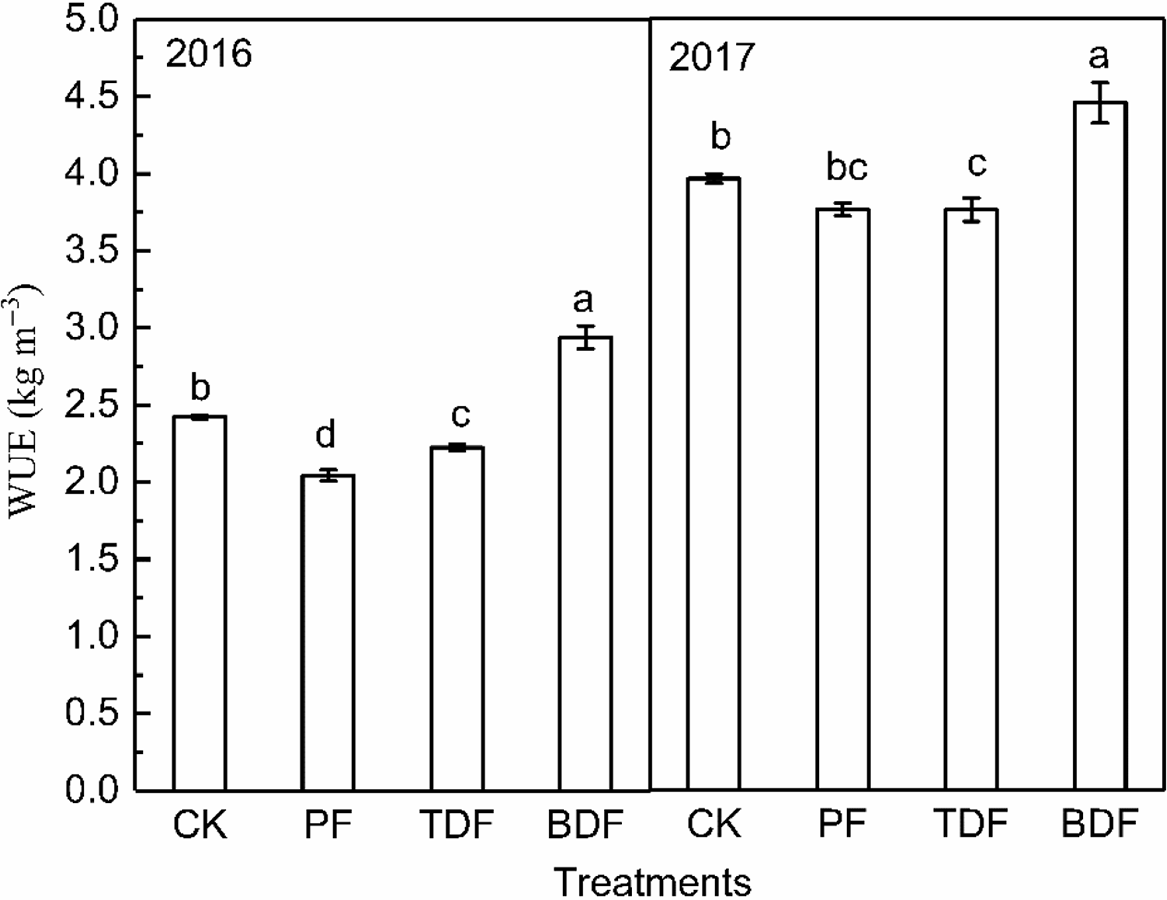
WUE was also the highest in the BDF treatment, being 21.5% in 2016 and 12.4% in 2017 higher than WUE in CK treatment (Figure 3). Compared to no mulching, past studies have shown film mulching significantly decreased field evaporation (Gu et al., Reference Gu, Li and Du2017). Wu et al. (Reference Wu, Du, Ding, Yuan, Li and Tong2017) detailed the processes of evaporation and condensation of soil water under film cover, and concluded that only 2.3% of soil water in 0–20 cm layer evaporated to the outside. The ET under degradable film mulching was higher than under PF mulching, as found earlier by Ali et al. (Reference Ali, Jan, Zhang, Khan, Cai and Wei2016), Li et al. (Reference Li, Hou, Jia and Han2016), and Saglam et al. (Reference Saglam, Sintim, Bary, Miles, Ghimire and Lnglis2017). Grain yield of summer maize was greater under BDF covering than under transparent film covering (Table 2), and similar results were found by Gu et al. (Reference Gu, Cai, Fang, Li, Chen and Li2020), who indicated via a meta-analysis that the maize yield was 2.1% higher under black film mulching than under white film mulching.
Water-use efficiency (WUE) of summer maize in 2016 and 2017. CK means no mulching, PF means plastic film mulching, TDF means transparent degradable plastic film mulching, and BDF means black degradable plastic film mulching. Different letters indicate significant differences (p < 0.05, HSD test) among treatments.

Optimizing the soil climate (soil water content and temperature) is vital for summer maize germination and seedling growth during the hot summer in the NCP. Many studies have demonstrated that the effects of transparent film mulching on increasing soil temperature were greater than those of black film mulching (Gu et al., Reference Gu, Cai, Fang, Li, Chen and Li2020; Locher et al., Reference Locher, Ombódi, Kassai and Dimény2005) because transparent film allows more solar radiation to be transmitted and the topsoil can absorb more energy (Lan et al., Reference Lan, Shen and Li2013; Liu et al., Reference Liu, Chen, Liu, Wen and Liao2016). However, higher soil temperatures can accelerate leaf senescence and Fdecrease the crop photosynthetic rate, resulting in a lower 1000-kernel weight and lower kernel numbers of maize (Bu et al., Reference Bu, Zhu, Liu, Luo, Chen and Li2013b). Covering with a transparent film not only increased the crop growth rate, but also accelerated the consumption of soil nutrients (Cuello et al., Reference Cuello, Hwang, Gutierrez, Sang and Kim2015; Liu et al., Reference Liu, Li, Zhou, Feng, Li and Pan2013; Li et al., Reference Li, Wu, Zhao, Lu, Fan and Zhang2007), which resulted in low nutrient availability at the late growth stage. By using the same treatments of this study, Li et al. (Reference Li, Kuang, Gou, Ma and Li2020) found significant variation in soil temperature, following the order of TDF > PF > BDF > CK. In fact, the application of BDF increased the efficiency of dry matter translocation to the grain because of relatively lower soil temperature, when compared to transparent films (Niu et al., Reference Niu, Gan, Zhang and Yang1998; Tan et al., Reference Tan, Guo, Liu and Fan2020).
Uncertainty in the climate change poses challenges to the performance of mulches in enhancing agricultural productivity (Wienhold et al., Reference Wienhold, Vigil, Hendrickson and Derner2018). While higher grain yield was found under lower ET (2017), lower yield was observed under higher ET (2016), as shown in Table 2. Seasonal rainfall is a critical factor that determines ET and grain yield, and a large amount of water loss in the field is – in general – unproductive and discouraged. The total precipitation during the summer maize-growing seasons were 494.3 mm in 2016 and 350.3 mm in 2017, and changes in soil water storage were only 10.2 mm in 2016 and 33.6 mm in 2017. It has been found that the precipitation has substantial effects on the ET. Gao et al. (Reference Gao, Feng, Liang, Zhan, Lin, Zhao, Shen, Zhou and Zhou2018) reported that the rainy and overcast weather around silking of summer maize was the main limitation that severely affected the assimilation availability, pollination, and kernel number per ear. The silking stage occurred at around August 11 in the NCP, and the precipitation during this period in 2016 was higher than in 2017, which caused a lower kernel number per row. Additionally, from August 26 to harvest in 2016, the precipitation was only 6.1 mm. Moisture shortage at this time might be another factor that restrains the longitudinal growth of summer maize (Song et al., Reference Song, Jin and He2019). Overall, compared to that in 2017, the grain yield in 2016 was lower because of the uncontrollable spatiotemporal distribution of precipitation.
Conclusions
Film mulching effectively increased soil water content and reduced soil water consumption, with the conventional PF being the best choice for soil water conservation. Compared to no mulching, transparent film (nondegradable and degradable) mulching significantly reduced both the summer maize grain yield and WUE across 2 years. The reduction in grain yield may be related to the increased hydrothermal environment under transparent film mulching, which likely accelerated crop senescence. Because soil cumulative temperature was modified, the grain yield and WUE of summer maize under BDF mulching were significantly higher than those under no mulching. Based on our results, the BDF mulching may be considered an effective field management mode to improve the summer maize yield, WUE, and soil health in the NCP.
Supplementary material
For supplementary material for this article, please visit https://doi.org/10.1017/S001447972100003X.
Acknowledgements
This work was supported in part by the National Key Research and Development Plan (2016YFB0302402), by the Key Research and Development Plan of Shandong Province, China (2019GSF109054), and by the Funds of Shandong ‘Double Tops’ Program (SYL2017YSTD02).
Conflict of interest
The authors declare no conflict of interest.
Financial support
The National Key Research and Development Plan (2016YFB0302402); the Key Research and Development Plan of Shandong Province, China (2019GSF109054); and the Funds of Shandong ‘Double Tops’ Program (SYL2017YSTD02).