


Introduction
Social phobia in children and adolescents is a complex and pervasive problem. It follows a chronic course and is thought to significantly impair academic, occupational and social functioning (Beidel, Turner and Morris, Reference Beidel, Turner and Morris1999). Prevalence rates for the disorder are reported at around 1.6% of all adolescents (Essau, Conradt and Petermann, Reference Essau, Conradt and Petermann1999) although rates vary somewhat between studies.
To date, evidence-based treatments for social phobia in children and adolescents remain limited. Children experiencing social anxiety have generally been given generic treatment for anxiety. Where they have received specialized treatment for their social anxiety, this has usually been social skills and exposure based, and whilst effective for some participants, a substantial minority are unremitted by end of treatment (e.g. Hayward et al., Reference Hayward, Varady, Albano, Thienemann, Henderson and Schatzberg2000; Spence, Donovan and Brechman-Toussaint, Reference Spence, Donovan and Brechman-Toussaint2000). In part, this lack of specialized, effective interventions for social anxiety in children is due to the lack of specific models of social anxiety for this age group. The social skills deficit model has historically been the most widely used, in both the child and adult specialties. This model suggests that an individual experiences anxiety in social situations as a result of a lack of social skills (Marks, Reference Marks1985). This deficit is thought to engender the avoidance of social interactions. This avoidance then reduces the opportunity for development of appropriate skills, which precipitates a negative maintenance cycle (Spence, Donovan and Brechman-Toussaint, Reference Spence, Donovan and Brechman-Toussaint1999). This model has been supported by studies that have reported deficits in social skills in socially anxious individuals (Beidel et al., Reference Beidel, Turner and Morris1999; Spence et al., Reference Spence, Donovan and Brechman-Toussaint1999).
In comparison to the social-skills deficit model, Clark and Wells’ (Reference Clark, Wells, Heimberg and Liebowitz1995) model of social phobia in adults suggests that it is individuals’ distorted negative beliefs about their social skills that cause their social anxiety, rather than a social skill deficit. Many studies that have demonstrated social skills deficits in socially anxious people have done this by asking them to self-report on their social skills. If this newer understanding of social anxiety is correct (e.g. Clark and Wells, Reference Clark, Wells, Heimberg and Liebowitz1995; Rapee and Heimberg, Reference Rapee and Heimberg1997) it is likely that these self-report measures have elicited a bias in the individuals’ reporting of their social skills.
On the basis of the social skills deficit model of social anxiety, social skills training has usually been provided as the first line of treatment for socially anxious children. However, recent evidence from the child and adolescent literature has not supported a social skill deficit model. Cartwright-Hatton, Hodges and Porter (Reference Cartwright-Hatton, Hodges and Porter2003) and Cartwright-Hatton, Tschernitz and Gomersall (Reference Cartwright-Hatton, Tschernitz and Gomersall2005) reported little association between objective ratings of children's social skills and self-report social anxiety scores. They concluded that social skill deficits may not be present in all socially anxious children.
Where social skills based interventions have not been employed to treat socially anxious children and adolescents, generic CBT based interventions have often been used instead. These have usually been based on a simple, generic, cognitive-behavioural model of anxiety, such as the “Coping Cat” Programme (e.g. Kendall, Reference Kendall1994; Kendall et al., Reference Kendall, Flannery-Schroeder, Panichelli-Mindel, Southam-Gerow, Henin and Warman1997). Generic approaches such as these, however, often do not directly address the specific features of social phobia that are probably necessary for successful treatment.
The recent development of disorder-specific models of anxiety within the adult literature has led to advances in the treatment of social phobia in adults (e.g. Clark and Wells, Reference Clark, Wells, Heimberg and Liebowitz1995). Clark and Wells’ Model of Social Phobia suggests that it is an individual's beliefs/assumptions about the self, others and performance that precipitate the disorder. According to this model, when an individual enters a social situation, they appraise it as being unsafe. This “danger” appraisal activates the individual's assumptions and subsequent negative automatic thoughts about behaving in a socially undesirable way, which they feel will lead to their feared social catastrophe (e.g. rejection from others or social embarrassment). Unpleasant cognitive and physiological reactions are then experienced (e.g. trembling and feeling hot) (Zinbarg and Barlow, Reference Zinbarg and Barlow1996), which heighten and maintain the individual's perception of threat, and form a self-perpetuating cycle.
A central component of the Clark and Wells’ (Reference Clark, Wells, Heimberg and Liebowitz1995) model is the self-processing element of the cycle. The model suggests that when an individual enters a social situation, their attention becomes focused upon the self, and they process information about their performance as if from an “observer perspective”. During this process, the individual sees an image of themselves, as if generated from another's perspective. This perspective employs unpleasant interoceptive information (e.g. feeling hot, dry mouth) to infer that the performance is not going well (e.g. that they appear flushed and are not speaking clearly). The social phobic believes this image to be a true reflection of their audience's perception of them. When appraising the self from an observer's perspective, the individual has limited disconfirmatory information at their disposal (e.g. evidence that the audience are smiling or appear interested), meaning that their distorted beliefs about social performance remain unchallenged. By contrast, this model suggests that less anxious people, when in social situations, process their performance from a “field perspective”. Using the field perspective, the individual views their performance more objectively, using information that is derived externally (i.e. through their own ears and eyes), for example, they will see that people are interested in them and enjoying their company. Assuming that the social performance is adequate, using the field perspective ensures that the individual receives undistorted, largely positive information about their performance. With the benefit of this input, there is little need to resort to using interoceptive information. Even if, therefore, the individual is hot, or slightly shaky, they will not attend to this information, and anxiety will be maintained at a low level.
A number of studies now provide support for the anxiogenic role of the observer perspective in social phobia in adults. Wells, Clark and Ahmad (Reference Wells, Clark and Ahmad1998) found that socially anxious individuals adopted more of an observer perspective, whilst controls adopted more of a field perspective, when reporting memories of an “anxiety-provoking social encounter”. However, when reporting a memory of a non-social situation, the groups adopted a similar field perspective. Coles, Turk, Heimberg and Fresco (Reference Coles, Turk, Heimberg and Fresco2001) successfully replicated this study and reported that as social anxiety increased, socially phobic participants were more likely to recall a memory from an observer perspective. Furthermore, Spurr and Stopa (Reference Spurr and Stopa2003) found that when participants generate an observer perspective image, regardless of level of social anxiety, it was “associated with more negative thoughts and more safety behaviours”. They further reported that whilst taking an observer perspective, the belief in these negative thoughts was stronger.
Rapee and Heimberg (Reference Rapee and Heimberg1997), in their cognitive-behavioural model of social phobia, propose a concept similar in nature to that of the observer perspective. They suggest that social phobics generate a mental image of themselves, incorporating aspects of their appearance and behaviour. This representation is generated from numerous sources of information, including long-term memory and somatic symptoms.
As a result of these more refined models of social anxiety in adulthood, adult treatments have become more focused and sophisticated. There are now cognitive-behaviour treatments that are specific to social phobia. A central component of the cognitive treatment of adult social phobia is video-feedback of social performance. This technique is employed to address the problematic observer perspective that is thought to be pivotal in any social phobia formulation (see Harvey, Clark, Ehlers and Rapee (Reference Harvey, Clark, Ehlers and Rapee2000) and Hi-Young, Lars-Gunnar and Allison (Reference Hi-Young, Lars-Gunnar and Allison2002)). The main aim of video feedback is to modify the images produced by the social phobics’ observer perspective, as these are often unrealistic representations, generated from interoceptive information. The video feedback method provides exposure to the social phobic's true self during social situations, in order to directly challenge their beliefs. In employing video feedback, patients are video recorded during a social encounter. They are then asked to generate an image of themselves in the encounter, and to recall the situation in detail, describing how they think they appeared. The recording of the encounter is then reviewed with the clinician, to explore the accuracy of these representations and, in many cases, to disconfirm the distorted beliefs that the individual holds about their social skills. Further specific guidance for the use of this technique is provided by Wells (Reference Wells1997).
Despite consistent evidence showing the successful use of video feedback within the adult literature, there is limited evidence for its use within a child and adolescent population. The lack of empirical evidence for this technique, however, may be unrepresentative of its increased clinical use within child and adolescent services. Since the presence of an observer perspective is the principal rationale for the employment of video feedback, a sensible first step would appear to investigate this phenomenon in adolescence. To the authors’ knowledge, no studies have investigated the occurrence of an observer perspective within this population, nor any relationship that it might have with social anxiety. We hypothesized that if observer perspective was present at all during childhood, it would be most likely to develop between the ages of 12 and 18 years. The average age of onset is considered to be mid-adolescence (American-Psychiatric-Association, 1994). Therefore, it was hypothesized that there will be a relationship between social anxiety and perspective-taking, such that more anxious children will report a more observer perspective. This will interact with age, such that the effect will be apparent for older, but not younger adolescents.
Method
Ethical approval for the research was obtained from the University of Manchester, School of Psychological Sciences Research Ethics Committee.
Participants
Assuming a significance level of 0.05, and a standard deviation (SD) of 1.84 in the population (Gomersall, Reference Gomersall2004), we would have power of 86% to detect a difference of one scale point on the 7-point Perspective-Taking Rating Scale [PTRS] (Cohen's degree of freedom 0.54) with a two-tailed test, with 62 participants in each group.
Participants were recruited from schools and colleges within the Greater Manchester (UK) area. The most appropriate age range for this study was thought to be between 12 and 18 years. It was predicted that any development of observer perspective would most likely occur within this age range. Therefore, school students within two specific age bands were approached: 1) 12 to 14 years, and 2) 16 to 18 years.
In total, 124 participants participated in this study. In the 12 to 14 age band, 62 participants participated, of whom 31 were male (mean age = 12.1 years, SD = 0.25), and 31 were female (mean age = 12.1 years, SD = 0.34). In the 16 to 18 years age band, a further 62 participants participated, of whom 31 were male (mean age = 16.7 years, SD = 0.68) and 31 were female (mean age = 16.6 years, SD = 0.56).
Materials: self-report measures
Social Phobia and Anxiety Inventory for Children (SPAI-C: Beidel, Turner and Morris, Reference Beidel, Turner and Morris1998). The SPAI-C is a 26-item self-report inventory designed to assess the frequency and range of social fears in childhood and early adolescence (8–14 years). It assesses the three main aspects of social phobia (somatic, cognitive and behavioural) across multiple social settings and situations. The inventory uses a 3-point Likert-type scale to assess symptom frequency (never/hardly ever; sometimes; most of the time/always). It has good internal consistency (alpha = 0.95), and test-retest reliability (r = .86, p < .001 at two weeks; r = .63, p < .01 at 10 months). The SPAI-C manual recommends administering the adult SPAI to participants aged over 14 years (Turner, Beidel and Dancu, Reference Turner, Beidel and Dancu1996). However, Inderbitzen-Nolan, Davies and McKeon (Reference Inderbitzen-Nolan, Davies and McKeon2004) successfully used the SPAI-C with an adolescent population (13–17 years) reporting adequate sensitivity (61.5%) and specificity (82.7%). Since participants in the present study spanned the age range of 12–18 years, the SPAI-C was employed throughout.
Fear of Negative Evaluation Scale (FNE: Watson and Friend, Reference Watson and Friend1969). The FNE is a 30-item self report inventory, measuring expectation of and distress related to negative evaluation from others. The scale uses a ‘yes/no’ answer format for each statement. The mean score reported by Watson and Friend (Reference Watson and Friend1969) was 13.97 for males and 16.1 for females. It has good internal consistency (alpha = 0.94 to 0.96) and test-retest reliability (one month reliability = 0.78 to 0.94). Although initially designed for use with adults, Warren, Good and Velten, (Reference Warren, Good and Velten1984) provide normative and validity data on the FNE for students aged 12–14 years. The mean for this age group was 14.13 (SD = 6.90) for males and 15.88 (SD = 7.18) for females. Garcia-Lopez, Olivares, Hidalgo, Beidel and Turner (Reference Garcia-Lopez, Olivares, Hidalgo, Beidel and Turner2001) supported the construct validity and test re-test reliability (r = .75) of the FNE for students aged 14–17 years.
Anxiety Rating Likert Scale (ARLS). Participant anxiety during the 3-minute speech task (see below) was measured using a single-item, situation-specific Likert-type scale. This scale was administered immediately following the speech task. Scores on the ARLS range from 0 (no worries or not nervous at all) to 6 (very much worried or very much nervous).
Perspective-Taking Rating Scale (PTRS: Wells et al., Reference Wells, Clark and Ahmad1998). The PTRS is a single-item, 7-point bipolar scale (range of −3 to +3) that is designed to assess a participant's perspective when asked to recall a social situation. An extreme “field” perspective (the image/situation is recalled as if looking out through ones’ own eyes) is represented by −3 on the scale. An extreme “observer” perspective (the image/situation is recalled as if viewed through someone else's eyes) is represented by +3 on the scale. In this study, participants were given the following instructions:
“I would like you now to close your eyes and try to get a picture in your mind about what you felt you were like whilst you were in front of the camera. It doesn't matter what the picture looks like as I'm not going to ask you to describe it, I just want you to keep the picture in your mind and, keeping your eyes closed, let me know when you have it, as I'm going to ask you a question about it.”
Once the participant indicated that they had an image in mind, they were asked:
“In that picture (participant name) are you looking at yourself as if it is through someone else's eyes or are you looking out through your own eyes?”
Upon giving a response, participants were asked to look at the PTRS and rate the image accordingly. This measure has been successfully used in research investigating social phobia in adults (Wells et al., Reference Wells, Clark and Ahmad1998; Wells and Papageorgiou, Reference Wells and Papageorgiou1999). It has also been adapted and utilised successfully for use with children and adolescents in two unpublished theses (Doubleday, Reference Doubleday2004; Gomersall, Reference Gomersall2004).
Pilot group
Five 12-year-old students were employed, in order to determine whether the questionnaires, rating scales and procedure were appropriate for the youngest participants in the study. These participants were asked to complete the proposed study in full, as outlined in this section. All participants were able to complete the study, including all questionnaires, without difficulty. Therefore, no amendments to the protocol were made, and the data collected from the pilot group were included in the main data set.
Procedure
Upon return of appropriate consents, participants were invited to join the researcher in a quiet room on school premises. After an introduction to the research, they were asked to complete the two questionnaires (SPAI-C and FNE). Each participant was then asked to stand in front of a video camera and speak for three minutes on any topic. They were told that a sample of the presentations would later be viewed and rated by other adolescents not known to them. Following protocols used in similar research (Cartwright-Hatton et al., Reference Cartwright-Hatton, Hodges and Porter2003; Cartwright-Hatton et al., Reference Cartwright-Hatton, Tschernitz and Gomersall2005) participants were given visual notification 30 seconds before the end the three-minute time period; no prompts were offered until the participant was silent for 15 seconds and on these occasions, the researcher prompted them with one of the following questions: “Do you have any brothers or sisters?; Do you have any plans for the weekend?; What do you like best at school?; Do you have any pets?; Who is your best friend?; What was the last film you watched at the cinema?” The protocol dictated that videoing be terminated if a participant was unresponsive for more than 30 seconds or became distressed. However, this was not necessary for any participant.
Participants were then asked to complete the Anxiety Rating Likert Scale and then the Perspective-Taking Rating Scale. The participants were then fully debriefed.
Results
Missing data and data distribution
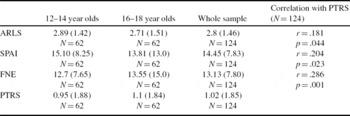
There were no instances of missing data. Tests of normality of data-distribution were conducted. These indicated that some variables were non-normally distributed. Attempted transformations of these data were unsuccessful so, where possible, non-parametric statistics were employed. However, where this was not possible, the parametric analyses were considered robust enough to manage a data set that was not normally distributed. Descriptive statistics for the data are presented in Table 1.
Means (standard deviations) of dependent and independent variables and correlations with PTRS

Notes: ARLS = Anxiety rating scale.
SPAI = Social Phobia and Anxiety Inventory.
FNE = Fear of Negative Evaluation.
PTRS = Perspective Taking Rating Scale.
Hypothesis testing
“There will be a relationship between social anxiety and perspective-taking, such that more anxious adolescents will have a more observer perspective. This will interact with age, such that the effect will be apparent for older, but not younger adolescents.” In order to test this hypothesis, a series of three ANCOVAs were computed. Data from the Perspective-Taking Rating scale (PTRS) were the dependent variable. The three social anxiety measures (SPAI-C/FNE/ARLS), were used, in turn, as the covariates. The group factor was participant age, for which there were two equal-sized groups (12–14 years, and 16–18 years). The outcomes of Spearman's Correlations between each of the dependent variables and perspective taking are reported in Table 1.
ANCOVA – using SPAI-C as covariate
Age was not found to be significantly related to perspective-taking (PTRS) F(1,120) = 0.73, p = .40, adjusted R2 = 0.05. There was a significant effect of social anxiety (SPAI-C) on perspective-taking, F (1,120) = 7.97, p = .01. This indicates that as the amount of social anxiety increased, perspective moved towards that of an observer. There was no interaction between SPAI-C, perspective-taking and participants’ age, F (1,120) = 0.36, p = .55.
To confirm the direction of the observed relationship, a Spearman's Correlation was conducted. A significant positive relationship was found, r = .20, p = .02.
ANCOVA using FNE as covariate
Age was not found to be significantly related to perspective-taking (PTRS), F (1,120) = 0.24, p = .63, adjusted R2 = 0.06. There was a significant effect of social anxiety (FNE) on perspective-taking (PTRS), F (1,120) = 9.39, p < .001. This indicates that as the amount of social anxiety increased, perspective moved towards that of an observer. There was no interaction between FNE, perspective-taking and participants’ age F (1,120) = 0.53, p = .47.
To confirm the direction of the observed relationship, a Spearman's Correlation was conducted. A significant positive relationship was found r = .29, p < .001.
ANCOVA using ARLS as covariate
Age was not significantly related to perspective-taking (PTRS), F (1,120) = 0.15, p = .70, adjusted R2 = 0.03. There was a significant effect of social anxiety (ARLS) on perspective-taking (PTRS), F (1,120) = 5.27, p = .02. This indicates that as the amount of social anxiety increased, perspective moved towards that of an observer. There was no interaction between ARLS, perspective-taking and participants’ age F (1,120) = 0.54, p = .46.
To confirm the direction of the observed relationship, a Spearman's Correlation was conducted. A significant positive relationship was found r = .18, p = .04.
These analyses suggest an association between level of social anxiety and perspective-taking. Specifically, as social anxiety increased in these adolescents, they reported a more observer perspective. This relationship was apparent for both the younger and older group.
Discussion
The results of this study showed that adolescents aged 12 to 18 years were able to report the perspective that they took in recalling a recent social encounter. Participants reported a range of perspective styles, from highly “field” to highly “observer”. Moreover, as predicted, a modest but statistically significant relationship between social anxiety and perspective-taking (as measured by the Perspective-Taking Rating Scale – PTRS) was found in this sample of adolescents. This effect was present for each of the three measures of social anxiety that were employed: the Social Phobia and Anxiety Inventory for Children – SPAI-C; the Fear of Negative Evaluation Scale – FNE; and a situation-specific measure of state social anxiety – Anxiety Rating Likert Scale – ARLS. In each case, although the level of association was modest, as social anxiety increased, participants’ perspective moved towards that of an observer. Therefore, the initial part of the study's hypothesis, regarding the relationship between social anxiety and perspective-taking, was supported.
To the authors’ knowledge, there have been no published studies that have directly investigated observer perspective within a youth population. Blackmore and Wooffitt (Reference Blackmore and Wooffitt1990), in their study of 5–12 year-old participants, reported that, when asked to describe a recalled social situation, many described seeing themselves from a perspective that was akin to the observer perspective studied here. However, Blackmore and Wooffitt (Reference Blackmore and Wooffitt1990) were unable to cast any light on the putative relationship between such images and social anxiety. The current study, therefore, confirms and extends these indirect findings, indicating that adolescents often report an observer perspective, and that this perspective is associated with increased social anxiety.
The current study also examined the effect of age on perspective-taking. Studies that have investigated the development of social anxiety suggest a mean age of onset in mid-adolescence (American Psychiatric Association, 1994). It seemed likely, therefore, that observer perspective and/or its relationship with social anxiety would be more likely to occur in the older than the younger participants in this study. The results, however, indicated that age (within the range that this study examined) does not appear to influence perspective-taking or its relationship with social anxiety.
Discovering an association between social anxiety and perspective-taking in a sample of adolescents has potential implications for mental health services. Child and adolescent psychology services currently employ a number of treatment approaches for social anxiety and social phobia, e.g. Social Skills Training: (Beidel and Turner, Reference Beidel and Turner1998) and Cognitive Behaviour Therapy: (Albano, Marten, Holt and Heimberg, Reference Albano, Marten, Holt and Heimberg1995). However, in recent years it has become increasingly fashionable to adopt video feedback techniques, as developed for use with socially anxious adults. This strategy is recommended in the clinical treatment of socially anxious adults, as it provides strong disconfirmatory evidence of many of the beliefs that are thought to maintain social phobia. As outlined above, these beliefs are themselves derived and maintained by the individual's employment of an observer perspective when engaged in stressful social situations (Clark and Wells, Reference Clark, Wells, Heimberg and Liebowitz1995). However, there have been no previous published studies, to the authors’ knowledge, that have investigated the occurrence of an observer perspective within a child and adolescent population. By providing evidence for the occurrence of observer perspective within this age range, and indicating a relationship with social anxiety, this study has provided indirect evidence to support the use of video feedback strategies with an adolescent population.
This study also indicates that clinical levels of social anxiety are not necessary in order to generate an observer perspective in a younger population. In the adult literature (Wells, Reference Wells1997; Wells and Papageorgiou, Reference Wells and Papageorgiou1999) it has been suggested that the observer perspective might only be apparent when pathological levels of socio-evaluative fears are present. In the current research, non-clinical levels of social anxiety were sufficient to elicit an observer perspective. Therefore, it is possible that “normal” socio-evaluative concern is sufficient to elicit this phenomenon in adolescence. Additional research is now needed, to explore this finding and to examine the effectiveness of video feedback on images produced by non-clinical levels of social anxiety, within an adolescent population. This finding has potential theoretical implications; if adolescents have a tendency to adopt the observer perspective in mildly anxiety provoking situations, is this a potential explanatory factor for the very high rates of onset of social anxiety in this age group?
This study was not without its limitations. Generalizations concerning perspective-taking and its association with social anxiety with children less than 12 years of age, for example, are not possible. Moreover, to further increase the generalizability of the current results, it would also be helpful for the study to be replicated with a clinical sample, and drawing from a wider demographic population. Furthermore, because of the limited extant research into perspective-taking in an adolescent population, it was difficult to provide an accurate estimate of the sample size required to power the interaction effect in the current study. Therefore, an approximation was proposed on the basis of an unpublished study with similar themes (Doubleday, Reference Doubleday2004). Consequently, the current study was estimated to have only 57% power to detect any interaction between social anxiety and age, on perspective-taking. Clearly then, this aspect of the study may have been underpowered, raising the possibility of a type II error. It is noted, however, that the estimates used to power the present research were conservative ones, based upon an ANCOVA using median splits for age and social anxiety. The actual analyses employed continuous scores (age and social anxiety) rather than a median split, so in practice, the power was probably higher. Finally, it is clear that speaking in front of a camera and an unknown adult does not reflect the full range of social fears experienced by adolescents. It would have been useful to have examined the hypotheses in a range of social situations, particularly those involving peers. However, we feel that the comparatively mild social situation that we chose to employ (for ethical and practical reasons) was conservative to our hypothesis, and that any results from more ecologically valid scenarios would have been similar to those reported here.



Comments
No Comments have been published for this article.