




Crossref Citations

This article has been cited by the following publications. This list is generated based on data provided by Crossref.
Walgrave, Stefaan
Van Camp, Kirsten
Lefevere, Jonas
and
Tresch, Anke
2016.
Measuring issue ownership with survey questions. A question wording experiment.
Electoral Studies,
Vol. 42,
Issue. ,
p.
290.
Lefevere, Jonas
Walgrave, Stefaan
Stubager, Rune
and
Tresch, Anke
2017.
Measuring Issue Ownership: A Comparative Question Wording Experiment.
Scandinavian Political Studies,
Vol. 40,
Issue. 1,
p.
120.
Goggin, Stephen N.
and
Theodoridis, Alexander G.
2017.
Disputed Ownership: Parties, Issues, and Traits in the Minds of Voters.
Political Behavior,
Vol. 39,
Issue. 3,
p.
675.
Craig, Stephen C.
and
Cossette, Paulina S.
2017.
WHOSE ISSUE IS IT ANYWAY… AND DOES IT REALLY MATTER? Issue Ownership and Negative Campaigning.
World Affairs,
Vol. 180,
Issue. 3,
p.
72.
Seeberg, Henrik Bech
2017.
How Stable Is Political Parties’ Issue Ownership? A Cross-Time, Cross-National Analysis.
Political Studies,
Vol. 65,
Issue. 2,
p.
475.
Stubager, Rune
2018.
What is Issue Ownership and How Should We Measure It?.
Political Behavior,
Vol. 40,
Issue. 2,
p.
345.
Tresch, Anke
and
Feddersen, Alexandra
2019.
The (In)stability of Voters’ Perceptions of Competence and Associative Issue Ownership: The Role of Media Campaign Coverage.
Political Communication,
Vol. 36,
Issue. 3,
p.
394.
Seeberg, Henrik Bech
2020.
How political parties’ issue ownerships reduce to spatial proximity.
West European Politics,
Vol. 43,
Issue. 6,
p.
1238.
Craig, Stephen C.
and
Cossette, Paulina S.
2020.
Who Owns What, and Why? The Origins of Issue Ownership Beliefs.
Politics & Policy,
Vol. 48,
Issue. 1,
p.
107.
Downes, James Floyd
Loveless, Matthew
and
Lam, Andrew
2021.
The Looming Refugee Crisis in the EU: Right‐Wing Party Competition and Strategic Positioning.
JCMS: Journal of Common Market Studies,
Vol. 59,
Issue. 5,
p.
1103.
Clifford, Scott
2022.
How Moral Motives Link Party Stereotypes.
Political Behavior,
Vol. 44,
Issue. 2,
p.
705.
Enders, Adam M.
Gainous, Jason
and
Wagner, Kevin M.
2022.
Say it again with feeling: Issue ownership and candidate communication using Twitter.
Social Science Quarterly,
Vol. 103,
Issue. 4,
p.
959.
McLaughlin, Peter T.
Geras, Matthew J.
and
Rhinehart, Sarina
2024.
Supporting Veterans: Source Cues, Issue Ownership,and the Electoral Benefits of Military Service.
Political Behavior,
Vol. 46,
Issue. 1,
p.
307.
Leiva, Andrés
Lisbona, Francisca
Navia, Patricio
and
Cabezas, José Miguel
2025.
Issue convergence and issue divergence in the content of television campaign messages in two-round presidential systems: Chile, 2005–2017.
Frontiers in Political Science,
Vol. 7,
Issue. ,
Nyhuis, Dominic
Baumert, Jona-Frederik
Choi, Jeongho
Block, Sebastian
and
Harmening, Morten
2025.
Modeling issue competence over time: a Bayesian framework for estimating dynamic issue ownership.
Political Science Research and Methods,
p.
1.
Christensen, Love
and
Fernandez-Vazquez, Pablo
2026.
When Can Political Parties Credibly Change Their Policies?.
Comparative Political Studies,
Fernandes, Jorge M.
Meguid, Bonnie M.
and
Weeks, Ana Catalano
2026.
Thinly Veiled: The Use of Femonationalist Speech in European Parliaments.
British Journal of Political Science,
Vol. 56,
Issue. ,
Hamzawi, Jordan
Kato, Gento
and
Endo, Masahisa
2026.
What brings you to the party? Voter preferences on parties through policy and valence dynamics.
Party Politics,
Vol. 32,
Issue. 4,
p.
486.
‘Which party do you think would do a better job of handling this issue?’
Versions of this question have been common in political surveys going back to the 1950s. And yet the empirical construct which motivates these questions, often called issue ownership, has only been studied directly in the past two decades. Petrocik coined the term and defined issue ownership as a product of the parties’ reputations for competence on an issue, and theorized that issue ownership is the primary driver of campaign issue emphasis.Footnote 1 Subsequent researchers, particularly those working outside the US context, have suggested their own definitions of issue ownership.Footnote 2 These alternative views propose different sources and implications for issue ownership, and so the question of how best to interpret voters’ evaluations of parties on issues remains quite open.
Yet whether respondents’ answers to the traditional issue ownership survey question actually reflect any particular definition of the concept has rarely been tested, despite a wealth of research in recent years.Footnote 3 Not only is this oversight troublesome in terms of understanding the data we collect, but the question of whether issue ownership stems from the parties’ reputations for competence, their histories of attention to issues, their policy positions, or something else is also critical to understanding the implications of the opinions being measured.
In this Research Note, my aim is to help clear up this uncertainty by way of a survey experiment, conducted as part of the 2008 Cooperative Congressional Election Study (CCES), testing three distinct wordings of the issue ownership survey question. The control group is presented with a traditional wording, while two treatment groups are asked to respond to alternative wordings giving specific criteria: the first cues respondents to evaluate the parties in terms of positions, while the second asks respondents to assess the parties’ competence explicitly. These criteria are based upon the classic dichotomy of looking at issues in terms of either positions or valence, and though these two alternatives do not directly map onto all of the proposed explanations for issue ownership, they do address the two most prominent views and serve to connect the issue ownership literature to the broader work on spatial models and issue voting.Footnote 4
This analysis concerns not only how the results from each group differ, but also how the relationships between responses and factors such as partisanship and ideology vary across wordings. I find that responses to the traditional question are driven by the parties’ positions as well as their reputations, contrary to Petrocik’s original definition of issue ownership, and that policy considerations may actually be a stronger influence than parties’ reputations. I also show that the traditional question’s ambiguity as to how respondents should evaluate parties leads to measurement error and potential bias, as respondents more often default to their partisan predispositions than when given more specific criteria. The article concludes with suggestions of best practices for survey researchers and a discussion of the theoretical implications of these findings, along with recommendations for future research in this area.
Issue Ownership in Theory and Practice
After work by Repass, by Budge and Farlie, and by others established the relevance of individual issues to parties’ success, Petrocik built on these findings by asserting that the value of an issue to a candidate is based on his party’s reputation for competently handling the issue.Footnote 5 A party that enjoys a significant reputational advantage over its opponents is, therefore, said to ‘own’ that issue, and stands to benefit when that issue is made salient during a campaign.Footnote 6
There is little consensus about the exact sources of these reputations, however. Petrocik cited parties’ histories of performance and attention on particular issues, as well as their links to specific interested constituencies, as the main sources of these reputations, while downplaying the role of the parties’ positions.Footnote 7 As such, voters see candidates mainly as potential administrators who, because of party affiliation, offer differing levels of expected performance across a range of issues. This framework is the basis for the one employed by Walgrave, who added an ‘associative dimension’ of issue ownership to reflect more spontaneous linkages between parties and issues, which becomes especially relevant in a many-party context such as Belgium.Footnote 8
Sellers, Holian, Sigelman, and even Petrocik himself all suggest elsewhere a role for positions in understanding views of candidates and parties, either as an alternative source of advantages on issues or as a way of reframing how voters see issues and assign ownership.Footnote 9 Simon, meanwhile, derives a model of issue ownership that entirely substitutes positional advantages for party reputations. Yet the coexistence of issue ownership with positional theories of issue voting has always been uneasy.Footnote 10 While van der Brug and Meguid both try to directly juxtapose issue ownership with parties’ positions, the majority of researchers have simply avoided taking any strict view of the sources of issue ownership, preferring instead to focus on the empirical manifestation of issue ownership reflected in survey responses.Footnote 11 Given that most of these studies have focused on the discussion of issues in campaigns, rather than the concept of issue ownership itself, this approach spares researchers from having to take sides in much larger and less settled debates over how voters evaluate parties generally.
In practice, though, there seems to be a greater level of agreement on how to measure issue ownership: with a simple question, routine in political surveys, asking respondents which party would do a better job at ‘handling’ a particular issue. Though the question’s wording has varied somewhat when used outside the United States (see for example Belanger, Belanger and Meguid, and Walgrave and De Swert), these surveys more often than not refrain from telling respondents how they should compare the parties on each issue, and this vagueness has largely obviated any pressing need for an exact definition.Footnote 12 Though we may not be able to specify exactly what causes issue ownership, the thinking goes, we can measure issue ownership itself as a manifest aspect of public opinion.
But where issue ownership comes from – whether from parties’ reputations, their issue positions, or a combination of these and other factors – has both theoretical and empirical importance. For theories of campaign strategy, understanding issue ownership is crucial to deciphering the incentives for candidates and parties in choosing whether and how to discuss particular issues. Clarifying issue ownership also matters for public opinion research more broadly, both for the interpretation of existing data and the design of future surveys of voters’ opinions of parties with respect to specific issues.
To serve both of these goals, I designed a survey experiment to offer insight into how voters evaluate parties on issues. As the framework for this test, I return to the classic conceptualization by Stokes which conceives of issues in positional and valence terms.Footnote 13 In this view, voters think about the utility of each party in terms of their ability to produce either an objective good (such as a lower crime or unemployment rate) or a subjective good (such as universal healthcare or a decrease in income taxes). The objective (valence) benefits a party can offer are universally desired, so the relative difference between parties is in their ability to deliver, while the subjective (positional) benefits depend upon each voter’s own policy preferences. This schema corresponds well to the competence-based and position-based views of issue ownership described above, and offers a way to compare these alternative explanations of issue ownership directly.
Experimental Design
To find out what the traditional issue ownership question really measures, I conducted a survey experiment as part of the NYU/UC Berkeley module of the 2008 Cooperative Congressional Election Study.Footnote 14 This experiment tested whether a change in the wording of the traditional party evaluation question, cueing respondents to base their responses on either positional or competence considerations, would affect the resulting responses.
Each respondent was randomly assigned to one of three groups and asked to evaluate parties on nine issues. A different wording of the question was presented to each group, with the ordering of issues and parties randomized:
1. Traditional wording: ‘For each of the following issues, please tell us whether you think the Republicans or the Democrats would do a better job of dealing with that issue’.
2. Position cue wording: ‘For each of the following issues, please tell us whether you think the Republicans or the Democrats have better ideas and policies regarding that issue’.
3. Competence cue wording: ‘For each of the following issues, please tell us whether you think the Republicans or the Democrats are better qualified to handle that issue’.
I investigate how respondents generate their answers to the traditional question by comparing the results from each wording, first through a simple comparison of aggregate responses and then through modeling individual responses.Footnote 15
Findings
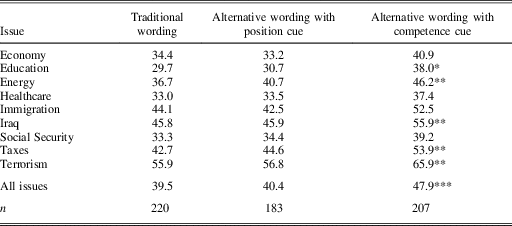
Table 1 shows the percentage of respondents who reported a preference for the Republicans on each issue, out of those who expressed a preference for either party, across all three wordings. The traditional question’s results echo the patterns of issue ownership found in Petrocik and myriad other studies: Democrats are rated highest on education, healthcare, and Social Security, while Republicans’ best issues are taxes, terrorism, and the Iraq war.Footnote 16 But interestingly, only on the issue of terrorism are the Republicans preferred by a majority of respondents: it appears that, in the 2008 election, Democrats were preferred by voters (or at least, those participating in the CCES) across a broad range of issues.
Alternative Question Wordings and Party Preferences: Percentage of Respondents Preferring Republicans on Each Issue
Notes: ***=Result is significantly different from traditional wording’s result at >0.01 level, **=at >0.05 level, *=at >0.1 level (difference-of-means tests). Percentages do not include respondents who gave ‘no difference’ or ‘not sure’ responses. Number of respondents presented is the mean for a given question wording across all issues. Traditional wording varies from 188 to 239 respondents, position cue from 134 to 207, competence cue from 179 to 229; significance tests are calculated using the actual number of respondents for each individual issue, and the total number of responses across all issues for the pooled sample.
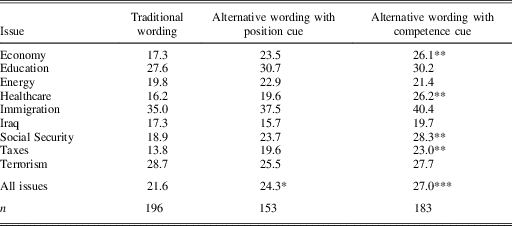
Table 2 shows the frequency with which partisan respondents (those self-identifying as either Republicans or Democrats) defect from their parties, either giving a preference for the opposing party or declining to choose between them.Footnote 17 Party identification could serve as a default response for partisans – rather than investing the effort to decide between parties, they simply name their own – and thus greater partisan defection would signal that respondents are more carefully considering their answers. In these results, both cues are shown to produce significantly higher rates of defection than the traditional wording, with the larger difference coming from the competence cue (a 27.0 percent defection rate on average, compared to 21.6 percent), again suggesting that the traditional question is not equivalent to one that asks about competence explicitly.
Alternative Question Wordings and Party Defections: Percentage of Partisans Not Preferring Their Own Party on Each Issue
Notes: ***=Result is significantly different from traditional wording’s result at >0.01 level, **=at >0.05 level, *=at >0.1 level (difference-of-means tests). Percentages reflect the proportion of self-identified partisans (i.e., independents and leaners are not included) who either prefer the opposing party on that issue, say that there is no difference between the parties, or that they are not sure. Number of respondents presented is the modal number for a given question wording across all issues; sample sizes only vary across issues by one to two respondents at most within each question wording. Significance tests are calculated using the actual number of respondents for each individual issue, and the total number of responses across all issues for the pooled sample.
The implication here is that the traditional wording is at best an inefficient tool for measuring issue ownership: if respondents are less apt to give serious consideration to the questions asked of them, then more responses are needed in order to observe differences.Footnote 18 But perhaps more importantly, this wording could also introduce bias if the cognitive demands on respondents vary across issues. If respondents are more likely to use their default choice on some issues than others, then the variation in resulting bias (toward the sample’s partisan distribution) could lead to a false ordering of best and worst issues for each party.Footnote 19
For both of these reasons, the use of more specific evaluation criteria (in the form of cues) for questions about party preferences on issues would seem to be the prudent choice for accurately measuring views of parties on issues. Yet in practice, we are often interested in measuring issue ownership as an overall evaluation of parties on issues – letting the respondents choose for themselves how to make those evaluations. So the question still remains: where do responses to the traditional issue ownership question come from?
For a more careful look at respondents’ evaluations, I employ binary logit models to distinguish the effects of three considerations – partisanship (as a default choice), policy positions, and reputations for competence – on responses to each question wording.Footnote 20 In analyzing the results, I have inspected the relationship between each of these considerations and responses to each wording. While compiling data on party identification is straightforward, estimates of respondents’ opinions of the parties’ positions and competence are much harder to come by. Though we would ideally be able to control for positions on each issue separately, by assuming that individuals’ reactions to the parties’ positions are correlated within and across issues, we can use self-reported ideology as a proxy for policy preferences on individual issues.Footnote 21 Because competence is presumed not to be dependent upon respondent characteristics, however, it should not vary across respondents – only across issues.Footnote 22 As such, these reputations can be accounted for by employing fixed effects for each issue, because their impacts on party-issue preferences should effectively be uniform across individuals.
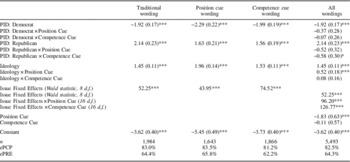
I first look at the magnitude and significance of each relationship in models predicting party preferences on all nine issues, for each of the three question wordings. The results shown in Table 3 first run these models separately for each wording and then present a single model which pools all three groups, with interactions used to evaluate the differences in coefficients across wordings.
Modeling Party Preferences across Issues DV: Preference for Republicans on an Issue (Binary Logit Model)
Notes: Table entries are binary logit coefficients with standard errors (SEs) in parentheses, except for the results under ‘Issue Fixed Effects’, which are Wald statistics for the joint significance of fixed effects (FEs) under each wording. (The tests of issue FEs for specific wordings in the ‘All Wordings’ model have sixteen degrees of freedom because they include a base set of FEs as well as a separate set for each of the alternative wordings.) ***=Result is significant at >0.01 level, **=at >0.05 level, *=at >0.1 level (two-tailed). DV is coded 0 for Democratic preference, 1 for Republican preference. Model does not include respondents who gave ‘no difference’ or ‘not sure’ responses, but alternative specifications which do produce similar results. Measures of ePCP and ePRE are defined in Herron (1999) and are developed from traditional measures of percentage correctly predicted (PCP) and proportional reduction in error (PRE) achieved over a null model. All issues are pooled, so individual respondents appear up to nine times. I choose not to use clustered SEs in this table because the outcomes being modeled are distinct across issues, and as such, clustering would likely overestimate the errors involved. For those interested in how clustering affects these errors, however, an alternative set of results which cluster by individual is presented in an online appendix.
In the unpooled models, party identification, ideology, and fixed effects are all significant for each question wording. For each group, Democratic identifiers were least likely to prefer the Republican party on these issues, while Republican identifiers were most likely. As respondents grew more conservative, they also became more likely to prefer Republicans. Finally, for all three wordings, the joint impact of fixed effects for each issue is highly significant. The relative magnitudes of these effects are hard to compare across models, but the patterns appear promising: the total impact of PID (that is, the difference between the Democratic and Republican coefficients) is greatest for the traditional wording, ideology’s effect is greatest for the position cue wording, and issue fixed effects are most significant with the competence cue. But to compare these directly, the ‘All Wordings’ model offers the clearest tests.
From the pooled results, the differences between wordings are more apparent. We see that while the effects of Democratic affiliation do not differ significantly across wordings, Republican affiliation has a substantially larger positive effect under the traditional wording (the base category) than for either the position or competence cue wordings (a significant difference for the competence cue, and just slightly under that threshold for the position cue). Overall, partisans answering the traditional question were more likely to give responses consistent with their party identification than those given either cue, which is consistent with the findings about defection rates shown in Table 2. The effects of ideology under the position cue, meanwhile, are significantly larger than under the other two wordings; conservative respondents became more likely to prefer Republicans, and liberals less likely, with the position cue than without it. And the significance of fixed effects for issues is highest with the competence cue: the Wald statistic for that wording’s fixed effects is more than 30 percent higher than that seen for the position cue wording, echoing the result seen in the unpooled models.Footnote 23
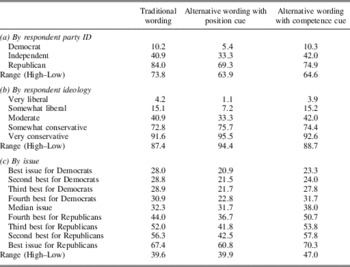
To give a sense of the magnitudes of these relationships and their differences across wordings, Table 4 offers estimates of how likely respondents with various characteristics are to prefer the Republicans under each wording, based on marginal effect estimates from the unpooled results in Table 3. In Table 4(a), these estimates are averaged across issues, for a respondent who identifies as a moderate. In each case, partisanship is a very strong predictor of responses, holding the other variables (ideology and issue) constant. But this relationship is strongest for respondents given the traditional wording, with a difference in the frequency of pro-Republican responses of nearly 74 percent between Democratic and Republican identifiers, approximately 10 percentage points higher than with either alternative wording. This is consistent with Table 2’s suggestion that partisanship serves as a default choice most often with the traditional wording.
Predictive Margins by Party ID, Ideology, and Issue: Estimated Percentage of Respondents Preferring Republicans in Each Category
Notes: Estimates are derived from the unpooled models shown in Table 3, and reflect the percentage of respondents in each category who would prefer the Republicans over the Democrats on an issue for each set of conditions. Predictions by party identification are for a respondent who describes herself as a moderate, on average across all issues. Predictions by ideology are for a respondent who identifies as an independent, again on average across all issues. Predictions by issue are for a moderate independent. As these explanatory variables are all made up of ordered categories, ranges are provided as a simple way to summarize the magnitudes of their relationships to the dependent variable, in order to demonstrate which question wording leads to the strongest such relationship for each variable. In (c), the ordering of ‘best’ issues is done separately for each wording, but the rankings are highly similar across wordings (see Table 1).
In Table 4(b), similar estimates are calculated for independents of varying ideologies. We see that ideology is an even stronger predictor of responses than partisanship, with the position cue wording leading to differences between the most liberal and most conservative respondents of greater than 94 percent; the other two wordings also show a strong relationship, their ranges just 6–7 percentage points lower. Respondents’ policy preferences play an important role in party preferences in all cases, but especially when they are specifically cued.
Table 4(c) shows the differences in predicted preferences across issues while holding constant both partisanship and ideology. There is significant variation across issues in all cases, but these differences are particularly pronounced for the competence cue: Republicans get 47 percent more support on their most favorable issue compared to the issue most favorable to Democrats. As we would expect, asking specifically about the parties’ competence provides the best reflection of differences in voters’ party preferences across issues which are unconnected to the respondents’ individual predispositions – that is, the original construct of objective party qualities defined by Petrocik as ‘issue ownership’.
There are ultimately three main conclusions to be drawn from these results. First, the overall results of the survey experiment show that the traditional issue ownership question is not a direct measure of opinions on the parties’ issue-handling competence, as Petrocik originally claimed. Second, when we provide respondents with specific criteria by which to make their evaluations, they are more likely to give answers which are distinct from their partisan predispositions. And finally, we see from looking at individual responses that while the traditional wording appears to tap into both positional and competence considerations, it is not the best reflection of either type and is most susceptible to partisan bias.
Discussion
What, then, do these findings imply for our understanding of issue ownership? On the most basic level, my results provide strong evidence that the construct measured by the issue ownership survey question is not the same as that which Petrocik originally claimed for issue ownership. Whether that finding suggests a need to revise the theory of issue ownership, or rather to develop a better way of measuring it as defined, is largely a semantic debate that is best left to future researchers. The essential implication of my results is that the traditional issue ownership survey question should not be interpreted as a measurement of any one specific consideration, but instead is a reflection of various factors weighed by respondents.
This conclusion echoes another set of recent findings, those in Stubager and Slothuus.Footnote 24 In the context of Danish elections, the authors similarly find a role for policy positions, competence, and party identification in determining issue ownership. They also find a fourth factor (constituency links, which we have not tested here) to be relevant as well. Taken together, these two studies are quite different in terms of both context and methods, yet reach the same general conclusions: that issue ownership is comprised of multiple distinct dimensions of public opinion, and cannot be reduced to a single concept independent of other political concerns.
In addition to guiding the interpretation of existing surveys, my results also imply a need for survey practitioners to reconsider how they design questions related to issue ownership. For researchers wishing to capture a particular type of party comparison – for example, voters’ beliefs about issue-handling competence – the alternative wordings used herein show the value of using more precise question wordings. When given specific criteria for evaluating parties, respondents are indeed more likely to use them in their replies. And yet, even if one takes a broad view of issue ownership and is more interested in voters’ overall evaluations of parties than the specific components thereof, the need for careful approaches to question wording remains. The use of party identification as a default choice not only leads to measurement error, but can also generate bias if that error is heterogeneous across individuals or issues, so practitioners should explore how best to ascertain respondents’ party preferences on issues independent of their overall predispositions.
Though a detailed treatment of the theoretical aspects of issue ownership is beyond the scope of this Research Note, the results we have described here suggest a need for the discipline to reexamine how party preferences on issues may change over time and as a function of campaigns. At the simplest level, it suggests further uses for survey tests (such as the one presented in this study) to determine how voters evaluate parties, to bring in other proposed sources of issue ownership such as party priorities that were not tested here. With larger samples to work with, researchers could also begin to look in greater detail at how the weighting of positions, competence, and other factors varies across individuals, issues, countries, and time. The results in this article were derived from a test of one particular context, and given changes in issue salience, party positions, campaign platforms, and so forth, we might find very different results elsewhere.
Finally, on a more conceptual level, the finding that voters evaluate parties in terms of both positions and competence implies a variety of ways in which those evaluations can be changed. Issues may be reframed, shifting focus toward one component or another, and evaluations on those individual components may themselves be affected – for example, if voters learn about the parties’ positions or change their own. And it follows that candidates may distinguish themselves from their parties based upon their own policy positions or qualifications, while views of the parties themselves on issues may even vary across electoral contexts. All of these possibilities stand in contrast to existing theories of campaign issue emphasis, and highlight the need for richer views which embrace complexity rather than deny it. The theory of issue ownership was never intended to serve as a singular explanation of issue voting and campaign strategy, and the results in this article reinforce the need to incorporate its concepts into a more sophisticated framework for understanding the role of issues in modern elections.