

Introduction
Domesticated plants and animals were introduced to the Carpathian Basin c. 6000 cal BC. This set the stage for farming cultures that built large nucleated villages and tells, produced diverse forms of pottery and figurines, developed innovative techniques for producing ornaments and weapons of copper and gold, and maintained complex trade networks. Some have suggested that the Neolithic groups of south-east Europe (here defined as the Balkans and the Carpathian Basin) reached a ‘peak of creativity’ between 5000 and 3500 cal BC, followed by a ‘crisis’ or ‘collapse’ during the Copper Age when settlement patterns became more dispersed, and shrines and symbols less common (Anthony Reference Anthony, Anthony and Chi2010). Scholars of south-east Europe have explored a range of models to explain the large-scale (although regionally variable) dispersal pattern that occurred at the end of the Neolithic. These include migration, changes in climate, reorganisation of agricultural systems, conflict and internal changes in the organisation of social groups (e.g. Gimbutas Reference Gimbutas1982; Sherratt Reference Sherratt1984; Bánffy Reference Bánffy1994; Whittle Reference Whittle1996; Chapman Reference Chapman, Carman and Harding1999; Halstead Reference Halstead and Halstead1999; Tringham Reference Tringham, Joyce and Gillespie2000; Parkinson Reference Parkinson2006; Keeley et al. Reference Keeley, Fontana and Quick2007; Anthony Reference Anthony, Anthony and Chi2010).
Identifying the processes that contributed to this decrease in social complexity is key to understanding the long-term consequences of the Neolithic transition in European prehistory. In this paper, we use the rich archaeological record in eastern Hungary, and the analytical tool of stable isotope analysis, to evaluate whether diet significantly changed during the ‘florescence’ of the Late Neolithic and the ‘collapse’ of the Copper Age in eastern Hungary. We acknowledge that diet is only one component of this complex ecological, economic and sociocultural transformation, yet we argue that these data shed new light on aspects of life that changed at the onset of the Copper Age, and, perhaps more importantly, those that stayed the same.
Archaeological context
In eastern Hungary, the Copper Age transition occurred at the end of the Late Neolithic period (c. 4500 cal BC), when most of the nucleated tells and villages of the Tisza-Herpály-Csőszhalom complexes were gradually abandoned and groups of the Early Copper Age Tiszapolgár culture established smaller dispersed hamlets in new locations on the Great Hungarian Plain. Other changes include the re-orientation of trade networks, the homogenisation of pottery styles and the appearance of communal cemeteries located outside of settlements (Bánffy Reference Bánffy1994; Sherratt Reference Sherratt1997; Parkinson Reference Parkinson2006; Gyucha Reference Gyucha2009; Parkinson et al. Reference Parkinson, Yerkes, Gyucha, Sarris, Morris and Salisbury2010). It is currently thought that these changes were due to internal processes (rather than migration) as there is continuity in some aspects of material culture such as settlement structure and burial treatment (Bognár-Kutzián Reference Bognár-Kutzián1972; Ecsedy Reference Ecsedy1981; Kalicz Reference Kalicz1988; Bánffy Reference Bánffy1994, Reference Bánffy and Szőke1995; Whittle Reference Whittle1996; Gyucha et al. Reference Gyucha, Parkinson, Yerkes, Thurston and Salisbury2009; Parkinson et al. Reference Parkinson, Yerkes, Gyucha, Sarris, Morris and Salisbury2010).
Both domesticated and wild plants and animals were used, but their relative importance changed from the Late Neolithic to the Early Copper Age. For example, at Late Neolithic Tisza culture sites (n = 12), domesticated mammals accounted for 58% of faunal assemblages, with high contributions from wild mammals (42%; calculated from the number of identified specimens: Bartosiewicz Reference Bartosiewicz, Bailey, Whittle and Cummings2005). In the Early Copper Age, the percentage of wild animals drops to 10% or less at some sites (calculated from the number of identified specimens: Nicodemus Reference Nicodemus2003). This increased emphasis on domesticated animals, combined with the dispersed settlement pattern mentioned above, has led some scholars to suggest that Early Copper Age groups became agropastoralists (Bökönyi Reference Bökönyi1988; Bánffy Reference Bánffy1994, Reference Bánffy and Szőke1995; Molnár & Sümegi Reference Molnár, Sümegi and Whittle2007).
Scholars working in this region have also looked for evidence which shows that climatic and environmental factors triggered cultural changes during the Neolithic and Copper Age. Climate, hydrology and vegetation patterns appear to be relatively stable across both time periods. There is some evidence, however, of human impact on the landscape through woodland management/clearance and fertilisation (intentionally or unintentionally) from human and animal waste. Starting in the Neolithic and continuing throughout the Copper Age, this may have opened and transformed the landscape in ways that could have had both positive and negative implications for these farming communities (Willis et al. Reference Willis, Sumegi, Braun, Bennett and Toth1998; Nagy-Bodor et al. Reference Nagy-Bodor, Jarai-Komlodi and Medve2000; Gardner Reference Gardner2002; Sümegi et al. Reference Sümegi, Kertész, Hertelendi, Jerem and Biró2002; Gábris & Nádor Reference Gábris and Nádor2007; Willis Reference Willis and Whittle2007; Gyucha et al. Reference Gyucha, Duffy and Frolking2011; Duffy Reference Duffy2014).
A more dispersed settlement pattern, an increased emphasis on domesticated as opposed to wild animals, and environmental evidence for an opening of the landscape during the Copper Age point to a possible shift in the subsistence strategy of these populations. Did the Late Neolithic farmers eventually exhaust their soil and timber resources, resulting in the ‘collapse’ of tell-based villages? Did animal husbandry increase in importance during the Copper Age? Or, did an emerging open environment and potentially more productive agricultural systems allow smaller social units, such as households and extended families, to establish autonomous and economically viable hamlets? An understanding of the diet of Late Neolithic and Copper Age cultures is central to evaluating these questions and, at a larger scale, models for culture change and social organisation in south-east Europe. Stable isotope biochemistry provides a key tool for the analysis of diachronic change in dietary practices, as well as correlations between diet and demographic variables such as sex and status. Detailed studies of changes in the diet of Late Neolithic and Copper Age populations may help us understand whether subsistence practices played a role in the ‘collapse’ of Late Neolithic societies in south-east Europe and whether certain members of these societies were affected more than others.
Stable isotope patterns in south-east Europe
Variation in the light, stable isotopes of carbon (13C/12C) and nitrogen (15N/14N), expressed as δ13C and δ15N, in human skeletal tissue can reflect the type and relative proportions of dietary protein due to fractionation. Fractionation occurs due to the preferential uptake of lighter isotopes (e.g. 12C over 13C) in biological systems to conserve energy (Hoefs Reference Hoefs2004). This process results in relatively predictable changes in isotopic ratios within food webs, and is commonly used in archaeological studies for palaeodietary reconstructions.
In temperate Europe, stable carbon and nitrogen isotopes have been used to identify the types of terrestrial plants used (i.e. domesticated cereals such as wheat and barley that synthesise CO2 via the C3 pathway vs millet, which synthesises CO2 via the C4 pathway) and the relative contribution of animal protein in the diet. The carbon isotope values for human diets based mostly on terrestrial plants and animals in Europe tend to have a δ13C range of -21‰ to -19‰ (Richards & Hedges Reference Richards and Hedges1999: 892), and this was also the case for Early and Middle Neolithic populations in Serbia and Hungary analysed in previous studies (Whittle et al. Reference Whittle, Bartosiewicz, Borić, Pettitt and Richards2002, Reference Whittle, Anders, Bentley, Bickle, Cramp, Domboróczki, Fibiger, Hamilton, Hedges, Kalicz, Kovcás, Marton, Oross, Pap, Raczky, Bickle and Whittle2013; Pearson & Hedges Reference Pearson, Hedges and Whittle2007). Changes in this range have been attributed to two possible dietary sources: freshwater fish and the C4 plant millet. Freshwater fish in Europe generally exhibit isotopically depleted δ13C values in the range of -23‰ to -21‰, which can lead to depleted values in humans if fish made a significant contribution to the diet (Dufour et al. Reference Dufour, Bocherens and Mariotti1999; Katzenberg & Weber Reference Katzenberg and Weber1999; Lillie & Richards Reference Lillie and Richards2000; Lillie et al. Reference Lillie, Richards and Jacobs2003). Conversely, consumption of millet can lead to the enrichment of carbon isotopes in humans. While most domesticated plants used by the prehistoric populations in Europe were C3 plants such as barley and wheat, which exhibit depleted δ13C values, there is some evidence from isotope analysis and archaeobotanical assemblages that human consumption of the C4 plant Broomcorn millet (Panicum miliaceum), which exhibits enriched δ13C values, did increase in some regions, including eastern Hungary, around the fifth millennium BC (Murray & Schoeninger Reference Murray, Schoeninger, Gibson and Geselowitz1988; Le Huray & Schutkowski Reference Le Huray and Schutkowski2005; Honch et al. Reference Honch, Higham, Chapman, Gaydarska and Hedges2006; Pearson & Hedges Reference Pearson, Hedges and Whittle2007). It is important to note that direct radiocarbon dating of millet seeds from Neolithic contexts in south-east and Central Europe has resulted in dates of the Bronze Age or later, potentially challenging the idea that millet was even cultivated during the Neolithic in this region (see Motuzaite-Matuzeviciute et al. Reference Motuzaite-Matuzeviciute, Staff, Hunt, Liu and Jones2013).
Nitrogen isotopes are used in European reconstructions of palaeodiet to determine the contribution of freshwater vs terrestrial foods and the relative amount of animal protein in the diet. Depleted δ15N values in humans, close to that for terrestrial herbivores (6‰ to 9‰), are generally assumed to indicate a diet based mostly on terrestrial plants (Hedges & Reynard Reference Hedges and Reynard2007). Enriched δ15N values have been attributed to diets with high contributions from aquatic resources (≈14‰ to 16‰; Bonsall et al. Reference Bonsall, Cook, Heaton, Higham, Pickard and Radovanovic2004), or terrestrial animal protein (8‰ to 12‰; Dürrwächter et al. Reference Dürrwächter, Craig, Collins, Burger and Alt2006; Honch et al. Reference Honch, Higham, Chapman, Gaydarska and Hedges2006), and, more recently, mixed diets of animal protein and crops fertilised with manure (>9‰; Bogaard et al. Reference Bogaard, Heaton, Poulton and Merbach2007, Reference Bogaard, Fraser, Heaton, Wallace, Vaiglova, Charles, Jones, Evershed, Styring, Andersen, Arbogast, Bartosiewicz, Gardeisen, Kanstrup, Maier, Marinova, Ninov, Schäfer and Stephan2013; Fraser et al. Reference Fraser, Bogaard, Heaton, Charles, Jones, Christensen, Halstead, Merbach, Poulton, Sparkes and Styring2011).
Methodology
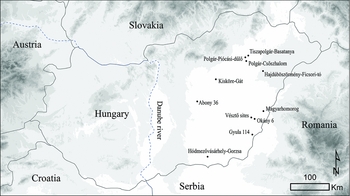
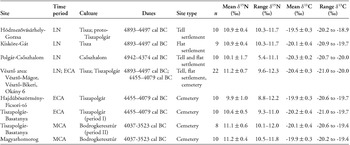
In this study, carbon and nitrogen isotope ratios (δ13C and δ15N) from 89 human bone collagen samples from 9 Late Neolithic and Copper Age settlements and cemeteries were analysed along with 44 animal bone samples from 3 settlements (Figure 1 & Table 1; see also online supplementary material). (Detailed site information is available in Giblin Reference Giblin2011.) These data were collected to address the central hypothesis that dietary practices changed from the Late Neolithic to the Copper Age. Correlation between stable isotope values and indicators of social differentiation (via type and quantity of grave goods) was also evaluated.
Map of Hungary showing archaeological sites sampled in this study.

Site information and summarised isotope data for Neolithic and Copper Age humans (LN = Late Neolithic; ECA = Early Copper Age; MCA = Middle Copper Age).

Human and animal bone samples were prepared for isotope analysis in the David M. Yerkes and Timothy L. Johnson Memorial Laboratory and in the Human Biology Laboratory at the Ohio State University (OSU) according to revised procedures described in Ambrose (Reference Ambrose1990). (For a detailed explanation of the preparation protocol and assessment of diagenetic contamination, see Giblin Reference Giblin2011.) Collagen samples were analysed on a Costech Elemental Analyzer coupled to a Finnigan Delta IV Plus stable isotope ratio mass spectrometer under continuous flow using a CONFLO III interface at the Stable Isotope Biogeochemistry Laboratory at OSU. Stable carbon (δ13C = per mil deviation of the ratio of 13C:12C relative to the Vienna Peedee Belemnite Limestone standard) and stable nitrogen (δ15N = per mil deviation of 15N:14N relative to air) measurements were made where the average standard deviation of repeated measurements of the USGS24 and IAEA-N1 standards was 0.04‰ for δ13C and 0.09‰ for δ15N.
Diet, dispersal and differentiation—the isotope results
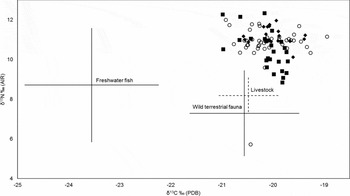
Figure 2 shows the δ13C and δ15N data for all the Late Neolithic and Copper Age human bones analysed (Table 1). The samples are shown relative to summarised ranges for domesticated and wild animal species analysed from Neolithic and Copper Age contexts (data available in online supplementary material).
Human and animal bone collagen stable isotope data from the Great Hungarian Plain: circles = Late Neolithic humans; squares = Early Copper Age humans; diamonds = Middle Copper Age humans; animal values are shown as the mean ± 1σ.

The δ13C values for human bone (mean: -20.1‰) fall within the observed range of carbon isotope values (-21‰ to -19‰) for diets based on terrestrial C3 plants and animals from Europe (Richards & Hedges Reference Richards and Hedges1999: 892). There is no evidence that carbon-enriched C4 plants such as millet contributed significantly to the diet of any individual, perhaps lending support to recent scepticism about its cultivation in Europe at this time (see Motuzaite-Matuzeviciute et al. Reference Motuzaite-Matuzeviciute, Staff, Hunt, Liu and Jones2013).
It does not appear that aquatic resources made a major contribution to the Late Neolithic or Copper Age diets from this sample, although they were available and used to a certain extent. Fish (especially carp and catfish) and several species of freshwater mussels were available in eastern Hungary and are found at Neolithic and Copper Age sites (Bartosiewicz Reference Bartosiewicz and Whittle2007; Gulyás et al. Reference Gulyás, Tóth, Sümegi and Whittle2007; Gulyás & Sümegi Reference Gulyás and Sümegi2011). It is difficult to quantify the dietary importance of aquatic resources (relative to terrestrial sources) from currently excavated material due to regional variability in collection strategies of small faunal remains (see Bartosiewicz Reference Bartosiewicz and Whittle2007). An additional complication is the wide range of isotope values associated with freshwater fish species in Eurasia (δ15N: 8 to 16‰; δ13C: -35 to -23‰) due to differences in local freshwater ecosystems and their trophic structures (Dufour et al. Reference Dufour, Bocherens and Mariotti1999). Hedges and Reynard (Reference Hedges and Reynard2007: 1244) calculate that even with contributions of fish protein forming up to 20% of the total ingested animal protein for humans (assuming that fish have nitrogen isotope values enriched by 6‰ over meat and dairy protein), human nitrogen isotope values would only increase by 0.7‰. In the case of eastern Hungary, δ15N values in freshwater fish are not consistently enriched from terrestrial animal protein, which would make any isotopic enrichment in humans resulting from freshwater consumption even less apparent than that calculated by Hedges and Reynard. Even though aquatic resources were used in both periods, the isotope data do not help to clarify their relative dietary contribution.
The average nitrogen isotope value from the Neolithic and Copper Age human bones included in this study is 10.8‰. In comparison to the domesticated livestock nitrogen values, the humans are +3‰ to 4‰ enriched. Based on the generally applied model of trophic level enrichment, this would indicate a human diet mainly composed of terrestrial meat and/or dairy protein. Several other studies have found similar ranges in nitrogen isotope values at Neolithic and Copper Age sites in Europe and have attributed these values to the primary consumption of proteins from meat and secondary products such as milk and cheese (e.g. Richards et al. Reference Richards, Price and Koch2003; Dürrwächter et al. Reference Dürrwächter, Craig, Collins, Burger and Alt2006; Honch et al. Reference Honch, Higham, Chapman, Gaydarska and Hedges2006).
Recently, scholars have questioned the above interpretation that early farming societies in Europe subsisted on a diet based primarily on meat and dairy products (Bogaard et al. Reference Bogaard, Heaton, Poulton and Merbach2007, Reference Bogaard, Fraser, Heaton, Wallace, Vaiglova, Charles, Jones, Evershed, Styring, Andersen, Arbogast, Bartosiewicz, Gardeisen, Kanstrup, Maier, Marinova, Ninov, Schäfer and Stephan2013; Bonsall et al. Reference Bonsall, Horvat, McSweeney, Masson, Higham, Pickard and Cook2007). In comparison to contemporary populations, a prehistoric diet that includes 60% (or greater) animal protein is twice as high as estimates for developing countries (30%), but is close to estimates for developed countries (57%) (comparative data from the Food and Agriculture Organization from 2006, see Hedges & Reynard Reference Hedges and Reynard2007: 1244). In contemporary societies, agrarian subsistence economies do not include a 60% or greater contribution from animal protein, rather, it is pastoral systems such as the Maasai—where milk provides the majority of their protein—that include such high percentages of animal protein (Hedges & Reynard Reference Hedges and Reynard2007: 1248). Although a high level of protein in Neolithic and Copper Age diets is not impossible, it most resembles the protein-intake expectations for groups with a pastoral economy rather than an agrarian economy.
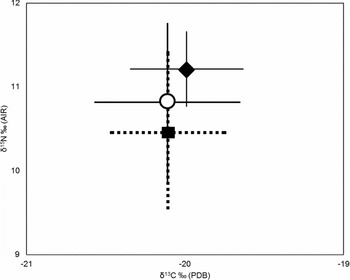
When we look at the isotope data over time (Figure 3), it appears that both carbon and nitrogen values are relatively similar throughout the Late Neolithic and Copper Age. If animal husbandry increased in importance during the transition, we might expect to see an enrichment of δ15N values over time, but there is no isotopic evidence to support this.
Stable isotope data for humans from the Great Hungarian Plain grouped by time period: circle = Late Neolithic humans; square = Early Copper Age humans; diamond = Middle Copper Age humans; values expressed as the mean ± 1σ.

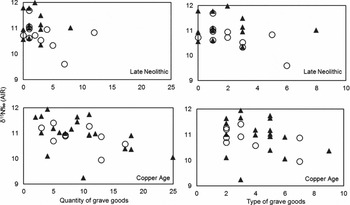
To evaluate whether dietary patterns in the Neolithic and Copper Age samples were influenced by sex or social differentiation (attributed though funerary treatment), the linear relationship between the δ15N values (i.e. protein consumption) and the type and quantity of grave goods was evaluated using Pearson's correlation coefficient (Figure 4; see too the online supplementary material). If social status during the Late Neolithic and Copper Age was related to access to higher trophic-level protein sources, we would expect to see a positive correlation between δ15N and grave goods.
The relationship between δ15N and the quantity and type of grave goods recorded for males (triangles) and females (open circles) during the Late Neolithic and Copper Age.

In fact, there is a statistically significant negative correlation between δ15N and both quantity and type of grave goods in half of the groups. Although this is a very preliminary assessment of social differentiation and diet, these results seem to indicate that individuals (especially females) buried with more elaborate grave goods during the Late Neolithic, and particularly the Copper Age (when there is an increase in the number and types of grave goods included in burials), were actually eating less protein-rich resources such as meat and dairy than individuals buried with fewer grave goods. It is interesting to note that isotopic results from the contemporary Varna I cemetery in Bulgaria do not show significant correlations with the quantity or type of grave goods, despite clear evidence for social inequality in burial treatment (Honch et al. Reference Honch, Higham, Chapman, Gaydarska and Hedges2006). Despite evidence that social differentiation was emerging in some parts of south-east Europe at this time, it may not have been related to differential access to key dietary resources.
Discussion
Reconstructing dietary patterns is crucial to understanding why changes in material culture, and consequently social organisation, took place during transitional periods. In this study, the δ13C and δ15N values indicate that dietary patterns were relatively stable between the Late Neolithic and Copper Age in eastern Hungary. The δ15N values for all of the human bones analysed indicate a relatively high trophic position in the food web. It does not seem probable that meat alone made such a large contribution to the diet (see Hedges & Reynard Reference Hedges and Reynard2007). Dairy is a possible dietary source that could lead to enriched bone collagen values, and dairy fats have indeed been identified in residues from Neolithic pottery in Hungary (Craig et al. Reference Craig, Chapman, Heron, Willis, Bartosiewicz, Taylor, Whittle and Collins2005, Reference Craig, Heron, Willis, Yusof, Taylor and Whittle2007). A larger sample size of Neolithic and Copper Age pottery from eastern Hungary analysed by Hoekman-Sites and Giblin (Reference Hoekman-Sites and Giblin2012) identified only one sherd (2.5% of the sample) that contained dairy fat compared to 51% of sherds that contained animal fat. This, combined with a lack of other archaeological correlates for an agro-pastoral economy (recently summarised by Giblin Reference Giblin and Greenfield2014; also, see Greenfield Reference Greenfield2010), led us to the conclusion that dairy probably made a minor contribution to Late Neolithic and Copper Age diets in this region.
While the authors are not aware of direct evidence for the use of manure as fertiliser in this region during the Neolithic and Copper Age, data from a long-term experimental study of the effects of manuring on wheat crops indicates that manure leads to bulk grain δ15N values of 3‰ to 8‰. Therefore, a mixed diet of manure-enriched cereals and animal products would result in human δ15N values of 9‰ to 11‰ (similar to predicted diets based primarily on meat protein) (see Bogaard et al. Reference Bogaard, Heaton, Poulton and Merbach2007, Reference Bogaard, Fraser, Heaton, Wallace, Vaiglova, Charles, Jones, Evershed, Styring, Andersen, Arbogast, Bartosiewicz, Gardeisen, Kanstrup, Maier, Marinova, Ninov, Schäfer and Stephan2013; Fraser et al. Reference Fraser, Bogaard, Heaton, Charles, Jones, Christensen, Halstead, Merbach, Poulton, Sparkes and Styring2011). Amy Bogaard and colleagues (Reference Bogaard, Heaton, Poulton and Merbach2007: 336) argue that it was precisely this integration of plant and animal by-products that allowed Neolithic and Copper Age farmers to enhance crop yields and spread into new environments. Even though we hypothesise that a manuring effect may have contributed to the elevated δ15N values of Late Neolithic and Copper Age bone collagen from eastern Hungary, this needs to be evaluated by other lines of data in future studies (e.g. soil chemistry, stable isotope analysis of palaeobotanical remains).
Finally, there is no evidence for ‘elite’ and ‘commoner’ diets during these periods. Individuals buried with more elaborate grave goods had the same (and in some cases lower) nitrogen isotope values as people buried in simpler graves (Honch et al. Reference Honch, Higham, Chapman, Gaydarska and Hedges2006; Giblin Reference Giblin2011). This does not discount the possibility that changes in social organisation played an important role in the Late Neolithic–Copper Age transition, but it does indicate that the more elaborate burial treatments that started to emerge in the Copper Age, in eastern Hungary and elsewhere, did not necessarily reflect differential access to food resources.
Several scholars have proposed that smaller, less integrated and independent units of social and economic reproduction—e.g. households—became the primary unit of social organisation following the florescence of the ‘mature’, nucleated Late Neolithic societies of south-east Europe (e.g. Sherratt Reference Sherratt1984; Tringham & Krstić Reference Tringham, Krstić, Tringham and Krstić1990; Bogucki Reference Bogucki1993; Halstead Reference Halstead and Halstead1999; Flannery Reference Flannery, Peregrine, Ember and Ember2002; Parkinson Reference Parkinson2006; Yerkes et al. Reference Yerkes, Gyucha and Parkinson2009; Parkinson et al. Reference Parkinson, Yerkes, Gyucha, Sarris, Morris and Salisbury2010). In the various iterations of this model, multiple pushes (environmental degradation, resource stress, internal conflict and population growth) and pulls (technological innovations, incentives to intensify production and a more fertile anthropogenic landscape) played a role in the gradual abandonment of large, nucleated tell villages and the emergence of more dispersed, independent hamlets. Far from a ‘collapse’, this process may reflect the benefits of the sustainable system of farming and livestock management that was established at the end of the Late Neolithic period and which opened new frontiers for autonomous villages during the Copper Age.
Conclusion
The isotope results from this paper provide support for the gradual emergence of smaller independent, but integrated, societies by the end of the Late Neolithic that became fully independent during the Copper Age. This occurred without the emergence of ‘chiefs’ with enhanced authority or social ranking. Palaeoenvironmental evidence for an opening of the landscape on the plains of eastern Hungary, in conjunction with elevated nitrogen isotope values from humans, may lend support to the idea that early farming societies of south-east Europe were causing environmental changes that actually increased the biodiversity and productive potential for farming and small-scale animal husbandry, which in turn allowed extended families to spread out and subsist on their own.
Acknowledgements
This research was financially supported by the National Science Foundation (award 0929110). For access and help with the sample collection process, thanks go to Zsolt Bereczki, Erika Molnár, György Pálfi, Antonia Marcsik, Ildikó Pap, Szabolcs Makra, Béla Zilahy, Ildikó Szikossy, Tamás Hajdu, Pál Raczky, Alexandra Anders, László Bartosiewicz, Márta Daróczi-Szabó, Anna Biller and Zsófia Kovács. For assistance with sample preparation and stable isotope analysis, thanks are due to Laurie Reitsema, Stanley H. Ambrose, Megan Luthern, Shane Whitacre, Sandy Jones, Andréa Grottoli and Yohei Matsui. Thank you also to William Parkinson and Attila Gyucha for guidance and support related to this research. Finally, many thanks for the insightful suggestions of the two anonymous reviewers.
Supplementary material
To view supplementary material for this article, please visit http://dx.doi.org/10.15184/aqy.2016.3