INTRODUCTION
The Lumbrineridae Schmarda, Reference Schmarda1861 (Annelida: Polychaeta: Eunicida) are distinguished from other members of Eunicida by the absence of antennae and palps, and by the presence of symmetrical maxillae (Rouse & Pleijel, Reference Rouse and Pleijel2000). This family has over 200 described species recognized in 19 genera (Carrera-Parra, Reference Carrera-Parra2006a). They are among the most common polychaetes in the Portuguese continental shelf (Fauchald, Reference Fauchald1977) and they have a worldwide distribution from shallow waters to abyssal depths living as burrowers in mud and sand, on rocky bottoms or algal substrates (Rouse & Pleijel, Reference Rouse and Pleijel2000).
Lumbrinerids are characterized by a prostomium without appendages, sometimes with one to three antennae emerging from a dorsal pocket between the prostomium and peristomium. The peristomium is composed of two rings, without appendages. Parapodia are subbiramous, with notopodia represented by reduced knobs and small aciculae. Notochaetae are absent. Neuropodia are well developed with aciculae, and composed of a pre- and a postchetal lobe. Neurochaetae include limbate chaetae, capillaries, bi- or multidentate hooded or unhooded hooks, both simple and compound, and also compound spinigers. The pharynx consists of a ventral tubular proboscis with a complex maxillary apparatus of subpriognath to labidognath structure (Orensanz, Reference Orensanz1990). The jaws comprise a ventral pair of less or more fused mandibles, and a dorsal series of maxillae. The maxillae are composed of four or five pairs of chitinous plates mineralized with calcite (Colbath, Reference Colbath1986) and a short pair of carriers.
Essential features for the identification of the family Lumbrineridae are the structure of the anterior chaetigers, the structure of the maxillary apparatus and the detailed structure of the hooks. Also length and shape of the parapodial lobes are valuable characters, noting the exact location of the parapodium examined in relation to the total length of the animal (Fauchald, Reference Fauchald1977).
In Italian seas 22 valid species are currently recorded (Castelli et al., Reference Castelli, Bianchi, Cantone, Cinar, Gambi, Giangrande, Iraci Sareri, Lanera, Licciano, Musco, Sanfilippo, Simonini and Relini2008) which belong to 6 genera: Lumbricalus Frame, Reference Frame1992; Lumbrinerides Orensanz, Reference Orensanz1973; Lumbrineriopsis Orensanz, Reference Orensanz1973; Lumbrineris Blainville, Reference Blainville and Blainville1828; Ninoe Kinberg, Reference Kinberg1865; and Scoletoma Blainville, Reference Blainville and Blainville1828. A seventh genus is probably present after the reassignment of the widely reported species Lumbrineris gracilis to the genus Hilbigneris Carrera-Parra, Reference Carrera-Parra2006a.
Several of the species in the Italian seas are not certainly recognizable using the existing taxonomic keys. In some cases, current descriptions in common identification literature may seem to mix characters from several similar species making species identification problematic. In addition, specimens with characters that do not fit with the current species descriptions are regularly found. Whether such specimens represent intraspecific variants or separate species is often not known (Oug, Reference Oug2011).
During sampling activities for a monitoring project carried out by ISPRA (Institute for Environmental Protection and Research) in the North Adriatic Sea, several specimens of the genus Gallardoneris were collected from benthos samples. The genus Gallardoneris, erected by Carrera-Parra (Reference Carrera-Parra2006a), is composed of three species: Gallardoneris iberica Martins et al., Reference Martins, Carrera-Parra, Quintino and Rodrigues2012; G. shinoii Carrera-Parra, Reference Carrera-Parra2006a; and G. thailandensis Carrera-Parra, Reference Carrera-Parra2006a. The specimens collected in the Adriatic Sea appeared morphologically close to G. iberica, the species recently described from the north-western Atlantic (Martins et al., Reference Martins, Carrera-Parra, Quintino and Rodrigues2012), but nonetheless, showed some characters that did not fit completely with the description of G. iberica. In particular, we observed some differences in (i) the number of acicuale in first chaetigers and (ii) the chaetiger where the prechaetal lobe exceeds in length the postchaetal one. Therefore, we compared our specimens with type material of G. iberica borrowed from the Museu Nacional de História Natural e da Ciência, Lisbon (MUHNAC). The analyses evidenced that seemingly new characters observed in specimens from the North Adriatic Sea were also present in type material of G. iberica from the Portuguese shelf, resulting in the positive confirmation of the species. Accordingly, we re-described some morphological details of G. iberica and provided new iconographic material. Results from this work allow extending the geographical distribution of G. iberica to Italian marine waters and to the Mediterranean Sea.
MATERIALS AND METHODS
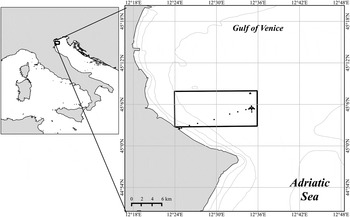
The study is based on a total of 120 soft-bottom sediment samples, collected in the North Adriatic basin, at about 15 km from Porto Levante (Rovigo, Italy) (Figure 1), in the course of three field campaigns carried out in October 2008, September 2010 and July 2012. These surveys were conducted by ISPRA as a part of the prescribed activities for monitoring the potential impact connected to the installation and production of the Adriatic Liquefied Natural Gas (LNG) Terminal.
Sampling area. Black dots represent sampling sites.

Sediment samples were collected with a 0.1 m2 Van Veen grab, washed through a 1 mm mesh sieve and the retained fraction preserved in 4% buffered formaldehyde buffered with CaCO3. All organisms collected were sorted and identified at the lowest possible taxonomic level (i.e. species) under a stereomicroscope and then preserved in 70% ethanol for long-term storage. Grain-size and total organic matter (TOM) content in sediments were analysed according to the Reference Analytical Methodologies (Dean, Reference Dean1974; ICRAM, Reference Cicero and Di Girolamo2001).
The specimens were examined for diagnostic characters following the format of Carrera-Parra (Reference Carrera-Parra2006a) and Martins et al. (Reference Martins, Carrera-Parra, Quintino and Rodrigues2012). The maxillary apparatus of each individual was extracted after an anterodorsal incision and mounted dorsally and ventrally on a slide to study the details of both the maxillae (M) and the mandible under an optical microscope. For each specimen the length and width of the prostomium (respectively, PrL and PrW), the length through chaetiger 10 (TL10), the width at chaetiger 10 (W10) excluding parapodia were taken by image analysis. Digital camera Zeiss Axiocam ERc5s was used for digital photographs and UTHSCSA ImageTool 3.0 software was used for morphometric measures. The terminology of the maxillary apparatus, the blade size of composite multidentate hooded hooks (CMHH) and the size of simple multidentate hooded hooks (SMHH) followed Carrera-Parra (Reference Carrera-Parra2006a). Photographs of relevant morphological features were taken and drawings were realized to illustrate the descriptions.
Specimens collected from the Adriatic Sea were compared with type material of Gallardoneris iberica from the MUHNAC. Specimens of G. iberica from the Adriatic Sea are conserved in the Laboratory of Benthos Ecology at ISPRA (Rome, Italy).
RESULTS
MATERIAL EXAMINED
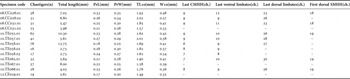
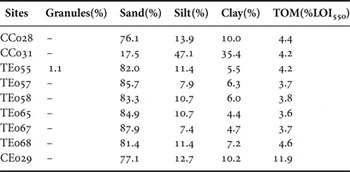
Out of 891 lumbrinerids collected, 13 specimens were identified as Gallardoneris iberica. All specimens came from the North Adriatic Sea (Figure 1). Cruise 25 October 2008: 2 specimens, site CC028, 45°04.570′N 12°31.932′E, 28.0 m depth; 2 specimens, site CC031, 45°05.249′N 12°34.250′E, 28.5 m depth; Cruise 12 September 2010: 1 specimen, site TE055, 45°05.546′N 12°34.863′E, 29.3 m depth; 1 specimen, site TE057, 45°05.438′N 12°35.211′E, 28 m depth; 3 specimens, site TE058, 45°05.417′N 12°35.282′E, 28.2 m depth; 1 specimen site, TE065, 45°05.614′N, 12°35.067′E, 28.5 m depth; 1 specimen, site TE067, 45°05.404′N 12°35.075′E, 28.3 m depth; 1 specimen, site TE068, 45°05.350′N 12°35078′E, 28.1 m depth; Cruise 7 July 2012: 1 specimen, site CE029, 45°04.929′N 12°33.080′E, 28 m depth. Given coordinates are in WGS84/NAD83 system. Main morphological measurements for all collected specimens are reported in Table 1. Sedimentary grain-size composition and TOM content in the sampling sites are reported in Table 2.
Main morphological characteristics for 13 specimens of Gallardoneris iberica analysed. –, data not available.

Characterization of sampling sites where specimens of Gallardoneris iberica were collected in the North Adriatic basin.

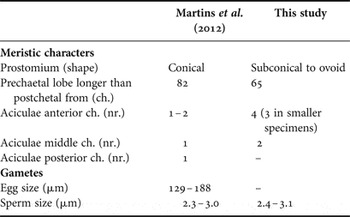
Comparison of main differences found in meristic characters and gametes measures (minimum–maximum) of Gallardoneris iberica between original description (Martins et al., Reference Martins, Carrera-Parra, Quintino and Rodrigues2012) and 13 specimens from this study. –, data not available.

COMPARATIVE MATERIAL EXAMINED
Type material from the MUHNAC). Paratypes: MB29-000226 (female), 1 incomplete specimen (44 chaetigers), north-western Portuguese continental shelf, site MESH 3B, 39°48.584′N 9°13.773′W, June 2010, in fine sand, 100.5 m; MB29-000227 (male), 1 incomplete specimen (40 chaetigers), site MESH 2E, 39°46.680′N 9°28.770′W, June 2010, in very fine sand, 139.7 m; MB29-000228, 2 incomplete specimens (57 and 59 chaetigers, respectively), site MESH 7E, 40°00.542′N 9°19.765′W, June 2010, in fine sand, 125.6 m.
DESCRIPTION
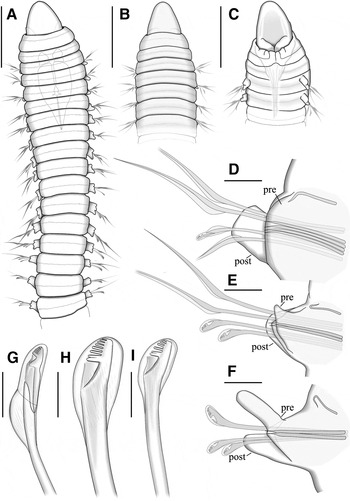
The prostomium shape is variable between ovoid and subconical with rounded tip (Figure 2A–C), slightly larger at base than longer, with a pair of nuchal organs, two faint longitudinal ridges on ventral side projecting onward from buccal lips for 2/3 of prostomium length. No eyes, no antennae, buccal lips present. Peristomium about equal to the prostomium length, with two rings, the first slightly longer than the second. First six chaetigers are dorsally inflated and larger than the following. A thin granular transverse row is visible both on dorsal and ventral side on each segment (Figure 2A–C).
All parapodia well-developed, first six shorter than following ones. Prechaetal lobe in parapodia 1–5 inconspicuous, in parapodia 7–14 ovoid, from parapodium 15 digitiform; smaller than postchaetal lobe in anterior parapodia, of similar size in median parapodia, longer than postchaetal lobe from parapodium 65 (Figure 2D–F).
Postchaetal lobe in parapodia 1–18 auricular, from parapodium 19 digitiform. CMHH from chaetiger 1 to 6–9, in number of 1 per chaetiger, occasionally 2 in largest individuals, with short blade, with up to 7 teeth, proximal tooth often partially fused with subsequent tooth (Figure 2G).
Gallardoneris iberica: (A) anterior part of the body, dorsal view; (B) mature male, anterior part of the body, dorsal view; (C) ventral view; (D–F) chaetigers 4, 11 and 65, front view (pre, prechaetal lobe; post, postchaetal lobe); (G) composite multidentate hooded hooks; (H) preacicular simple multidentate hooded hooks; (I) postacicular simple multidentate hooded hooks. Scale bars: A–C, 500 µm; D–F, 50 µm; G–I, 20 µm.

SMHH from chaetiger 7–10, with short hood, with up to 7 teeth, proximal tooth largest, partially fused with subsequent tooth (Figure 2H, I). Preacicular hook larger than postacicular hook, present from chaetiger 18–19. Dorsal limbate chaetae from chaetigers 1 to 23–30, becoming thinner after chaetiger 15, almost capillaries in their last appearance. Ventral limbates in chaetigers from 1 to 8–12.
Curved notopodial aciculae are present in all parapodia. Neuropodial aciculae pale yellow, thin, translucent, aristate, 3–4 in anterior parapodia, 2 stouter in median parapodia. Pygidium not available for examination.
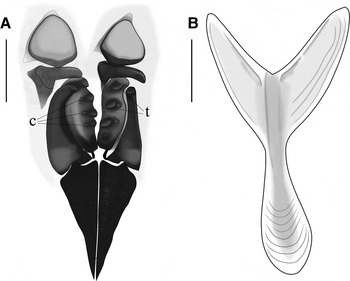
Maxillary apparatus with four pairs of maxillae; maxillary carriers are black, joined along base of MI, where a triangular process on the anterior edge inserts in an incision of the MI base (Figure 3A). MI forceps-like with wide recurved base, as long as carrier, one distal tooth, without attachment lamella. MII stout, as long as MI, with ligament, without attachment lamella. MII with three smoothed teeth, a fourth less distinct tooth is sometimes present on the left maxillae; the posterior-most teeth are flanked by small cusps in dorsal position (Figure 3A).
Gallardoneris iberica: (A) maxillae (c, cusps; t, main teeth); (B) mandible. Scale bars: A, B, 200 µm.

MIII edentate, with wide attachment lamella (Figure 3A). MIV edentate plate, with whitish central area and darker posterior edge (Figure 3A). Mandible completely fused, Y shaped, translucent, opalescent (Figure 3B).
The surface of the body appears smooth. The body colour in alcohol varies from white to pale pink salmon.
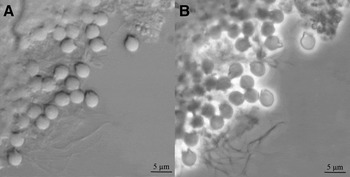
One incomplete mature male specimen was found in September 2010 at site TE058. Male gametes are present after 20th chaetiger, collected in large white pads visible under the skin at the base of parapodia after 42nd chaetiger. The diameter of gametes range from 2.4 to 3.1 µm (Figure 4A, B).
Male gametes of Gallardoneris iberica: (A) under differential interference contrast; (B) under phase contrast illumination. Scale bars: A, B, 5 µm.

Table 1 reports the meristic and morphometric data for the specimens of G. iberica under consideration. The length of the individuals ranged from 2.7 to 15.7 mm.
DISCUSSION
To our knowledge, the records described in this study represent the first report of the species Gallardoneris iberica for Italian sea waters, as well as for the Mediterranean Sea. Up to date the species is not reported in other checklists of the Mediterranean Sea area. The World Register of Marine Species (WoRMS; Carrera-Parra, Reference Carrera-Parra, Read and Fauchald2014) reported the distribution of G. iberica in the north-east Atlantic along the Portuguese shelf.
Before being discovered in Atlantic waters by Martins et al. (Reference Martins, Carrera-Parra, Quintino and Rodrigues2012), the distribution of the genus Gallardoneris was formerly limited to the West Pacific continental shelf (South Vietnam for G. shinoii, and Thailand for G. thailandensis) (Carrera-Parra, Reference Carrera-Parra2006a).
Gallardoneris iberica was recently found and described along the Portuguese continental shelf at depths ranging from 18 to 180 m. The species is reported to inhabit mainly sediments with high content of fines, biogenic fraction and TOM (Martins et al., Reference Martins, Carrera-Parra, Quintino and Rodrigues2012). The depth range, the grain-size composition and the TOM content measured for samples from North Adriatic Sea are in good agreement with the habitat characteristics formerly reported for this species.
The number of neuropodial aciculae varies across the body. Most of the individuals have 4 aristate aciculae in anterior chaetigers, but less frequently 3 aciculae were observed in smaller specimens. Aciculae in first chaetigers are thin, with tips slightly curved backward when emerging from parapodium, therefore they can be hardly seen in intact animals. To observe them clearly it is necessary to dissect the parapodium. Martins et al. (Reference Martins, Carrera-Parra, Quintino and Rodrigues2012) reported the presence of only one aristate acicula in the anterior chaetigers of G. iberica. Nonetheless, the examination of type material from Portuguese continental shelf permitted to observe the presence of 4 aristate aciculae in anterior chaetigers, and 2 aciculae in the median parapodia, as detected in the material from the Adriatic Sea. We found that staining with Methyl Blue provided better visibility for some characters (Dnestrovskaya & Jirkov, Reference Dnestrovskaya and Jirkov2012), including aciculae and chetae allowing to detect them also in small specimens without dissecting the polychaete. Therefore, we can define here this character as general for the species G. iberica.
In most sizeable individuals we observed in MII the presence of small cusps flanking the posterior teeth (Figure 3A). According to Carrera-Parra (Reference Carrera-Parra2006b) a true tooth is a ‘structure provided with pulp cavity’. This is not the case for these structures which appear as simple outgrowths of the inner surface of MII, close to the true tooth. These cusps are negligible or absent in smaller individuals.
Martins et al. (Reference Martins, Carrera-Parra, Quintino and Rodrigues2012) reported that prechaetal lobe is longer than postchaetal from chaetiger 82. In our specimens it was not possible to compare the length of parapodial lobes after chaetiger 76, but with the exception of two specimens that allowed verifying that prechaetal lobes are longer than postchaetal ones after the chaetiger 65. It is possible that this difference may account for geographical variability or, more probably, may be related to size of individuals.
Besides minor differences (Table 3), the morphological analysis of our material and comparative material showed that the specimens from the Portuguese continental shelf and from the Adriatic Sea were very similar and appeared to be the same species.
It is premature, at this stage, to give an opinion about the origin of the species or its possible dynamics of colonization/expansion. Owing to the recent description of G. iberica in the Portuguese continental shelf, it is probable that in the Adriatic Sea this species could have been previously recorded as Lumbrineris spp. Among the lumbrinerid species recorded in the Mediterranean area, Gallardoneris iberica may have been recognized as Lumbrineris nonatoi Ramos, Reference Ramos1976. According to the original description (Ramos, Reference Ramos1976) the two species have in common the shape of the prostomium, the arrangement of CMHH (present up to chaetiger 9), the prechaetal lobe longer than postchaetal one in posterior chaetigers and the overall shape and teeth arrangement of the MI, MII and MIII. Nonetheless, the two species differ in the shape of the postchetal lobe in anterior chaetigers (digitiform in L. nonatoi, auricular in G. iberica), in the number of aciculae in posterior chaetigers (one in L. nonatoi, instead of two in G. iberica) and in the shape of the mandible, that is partially divided in L. nonatoi, as reported in Carrera-Parra (Reference Carrera-Parra2006b), while it is completely fused and Y-shaped in G. iberica. Moreover, MIV has one tooth in L. nonatoi, while in G. iberica MIV is an edentate plate with whitish central area, and MV is present in L. nonatoi while it is completely lacking in G. iberica.
We have verified the presence of G. iberica in the North Adriatic Sea at least since 2008 gathering specimens from archived samples. Additional records of other specimens from different areas of the Mediterranean Sea, and particularly from the re-analysis of archive collections, may enable to clarify the geographical distribution of G. iberica. Additional detailed studies, supported by molecular identification methods, could allow testing phylogeography hypotheses about the origin and the colonization pattern of this species.
ACKNOWLEDGEMENTS
This work was founded by Adriatic LNG S.r.l. as a part of the prescribed monitoring programme for the potential impact of the offshore gravity-based structure for unloading, storing and regasifying Liquefied Natural Gas (LNG). We thank Dr Diana Carvalho from Museu Nacional de História Natural e da Ciência, Lisbon (MUHNAC) for loan of type material. We are grateful to Dr Barbara La Porta and Dr Monica Landi for the critical reading of the manuscript. We thank Dr Veronica Marusso, Dr Laura Grossi and Dr Tiziano Bacci from the ISPRA laboratory who helped in the sampling and sample sorting. We are also grateful to two anonymous referees for valuable comments and suggestions to improve the quality of the paper.