Introduction
Peak oxygen consumption is an important prognostic indicator and a major determinant of quality of life in total cavopulmonary connection patients. A subset of patients with superior exercise tolerance is referred to as “Super-Fontan” in recent literature. Excellent functional outcomes of these individuals have been associated with optimal weight, body composition, non-altered ventilation, and higher levels of physical activity in childhood and adolescence. Reference Tran, Celermajer and Ayer1,Reference Ohuchi, Mori, Kurosaki, Shiraishi and Nakai2
Patients and methods
Study group consisted of 354 consecutive patients after single-chamber palliation by total cavopulmonary connection (surgery between 1992 and 2016) identified in the single-centre nationwide institutional database. Of these, 288 (73.9%) patients underwent cardiopulmonary exercise testing during follow-up. Perioperative data, clinical profile, and exercise test results were retrospectively analysed in this study. The study was approved by the Institutional Ethics Committee (EK-1167-23).
Sixty-six patients (18.6%) had no cardiopulmonary exercise testing data available, of whom 19 (28.7%) patients had insufficient height for bicycle ergometry (<120 cm), 16 patients (24.2%) had neurological comorbidity with limiting psychomotor impairment, 6 (9.1%) patients died less than 30 days after total cavopulmonary connection surgery, 2 (3.0%) patients were unwilling to undergo exercise testing, and the remaining 23 (34.8%) patients were lost to follow-up.
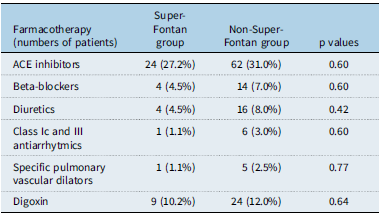
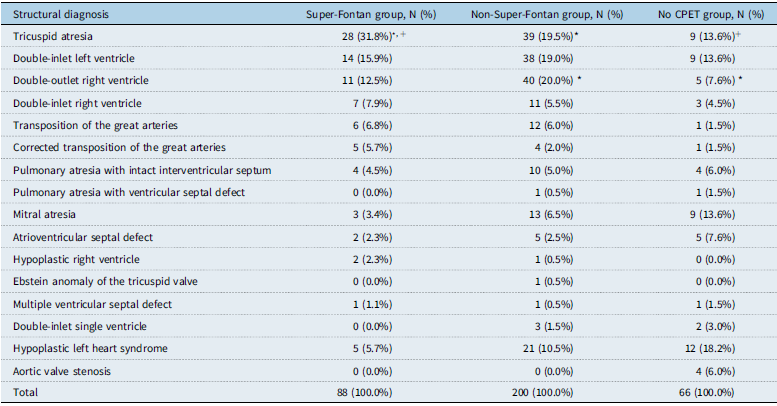
A subgroup of 88 (30.6%) patients (45 women; 51.1%) at median age 13.0 [11.0; 18.0] years met the definition criterion of the so-called Super-Fontan phenotype (achieving ≥80% of predicted VO2peak value). A list of patient characteristics is presented in Table 1 and Table 2 and frequencies of the respective diagnoses in Table 3. Results of cardiac magnetic resonance imaging were available in a subset of 84 (29.2%) patients with cardiopulmonary exercise testing data. Ejection fraction of the systemic ventricle was 53.3 ± 6.4% in the Super-Fontan group and 49.7 ± 10.2% in the rest of the cardiopulmonary exercise testing cohort (p = 0.64). The regurgitant fraction at the atrioventricular valve was 9.0 [5.0; 14.5]% in the Super-Fontan group versus 17.0 [9.0; 21.0]% in the rest of the cardiopulmonary exercise testing cohort (p = 0.004).
Patient characteristics in the Super-Fontan group compared with the non-SF and non-CPET groups

CPET = cardiopulmonary exercise testing; N = number; NA = not applicable; SF = Super-Fontan; TCPC = total cavopulmonary connection; #, p value only for right versus left morphology; *, +, p < 0.05.
List of the farmacotherapies in the patient groups

Frequency of diagnoses between the subgroups

N = number of patients; *, +, p ≤ 0.05.
Cardiopulmonary exercise testing
Cardiopulmonary exercise stress testing on an electromechanically braked bicycle ergometer (Ergoline Ergoselect 150 or 200, Bitz, Germany) with analysis of ventilation and exhaled O2 and CO2 concentration by the “breath-by-breath” method (Oxycon Pro with electrochemical oxygen sensor, Jaeger, Germany) was performed until patient exhaustion using an incremental protocol of + 0.5 W/kg of body weight every 3 minutes. Criteria for maximal effort were respiratory exchange ratio at peak exercise >1.05 and a perceived exertion ≥16 on the Borg scale. Best test result was used for fullfillment of Super-Fontan group inclusion criterion in patients, where multiple test results were available during follow-up. National reference values for healthy peers were used for calculating percent predicted VO2peak values3.
Statistical analysis
The test of data distribution was performed using the Shapiro–Wilk test, and data are appropriately presented as mean ± standard deviation or median [quartile range]. Statistica software (Statistica for Windows v12.0, StatSoft Inc., USA) was used for statistical analysis. The relationship of continuous variables was tested by Pearson correlation, and the relationship of categorical and continuous variables was tested by two-sample t-test, Mann–Whitney U test, Kruskal–Wallis test, or analysis of variance, followed by post hoc Tukey HSD test. The relationship of categorical variables was tested using the Yates Chi-square test between groups of ≥5 patients. The survival analysis was plotted using the Kaplan–Meier method, and the cumulative proportion of survivors in each subgroup was calculated. Six early deaths (defined as ≤30 days after total cavopulmonary connection surgery) were excluded from the survival analysis. Cox proportional hazard model and Gehan–Breslow–Wilcoxon test was used for between group survival analysis. A level of p < 0.05 was considered statistically significant.
Results
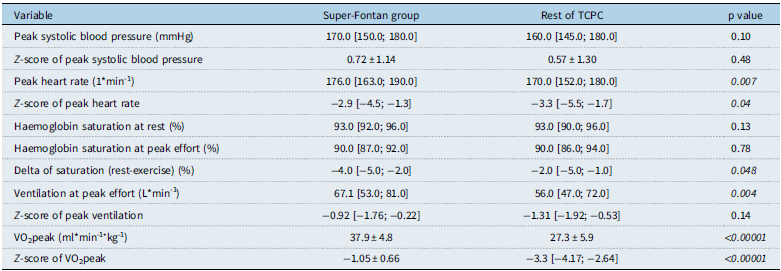
In addition to superior peak oxygen consumption, Super-Fontan patients exhibited a higher peak heart rate and greater desaturation during exercise in comparison to the rest of the cohort (Table 4).
Cardiopulmonary exercise test results

TCPC = total cavopulmonary connection; VO2peak = peak oxygen consumption; data presented according to distribution as mean ± standard deviation or median [interquartile range].
The follow-up period from stage III of single-chamber palliation by total cavopulmonary connection to the end of the study was 18.8 [13.2; 23.9] years. The composite endpoint (death or heart transplantation) was achieved in 18 patients. Survival analysis showed a significant difference between all patient groups (p = 0.004) and also higher survival rates in Super-Fontan patients compared to non-Super-Fontan patients (p = 0.04). There was excellent mid-term (10 years) event-free survival in both cardiopulmonary exercise testing groups, 100.0% in the Super-Fontan patients and 99.3% in the non-Super-Fontan group, compared to 90.3% survival in the non-cardiopulmonary exercise testing group. Freedom from the endpoint 20 years after surgery was 100.0% in the Super-Fontan group compared to 94.0% in the non-Super-Fontan group and 85.5% in the non-cardiopulmonary exercise testing group (Figure 1).
Kaplan–Meier survival probability until composite endpoint in Super-Fontan group (blue), non-Super-Fontan group (red), and non-CPET group (green). CPET = cardiopulmonary exercise testing; SF = Super-Fontan.

Discussion
The prevalence of patients with excellent functional outcomes 30.6% (88/288) in our cohort is similar to the study by Weinreb, who reported proportions of 33.9% (90/265) patients. Reference Weinreb, Dodds and Burstein4 On the other hand, Cordina Reference Cordina, du Plessis, Tran and d’Udekem5 and Ponder Reference Ponder, Chez and Rosenthal6 in their studies reported lower Super-Fontan prevalence rates of 11.5% (14/133 patients) and 13.8% (27/195 patients), respectively. A plausible explanation is the lower Super-Fontan patient age in Weinreb´s and our cohort: 12.8 (9.5–16.4) and 13 [11–18] years, respectively, versus 24 ± 5 years in the Cordina´s and 32 ± 8 years in Ponder´s study. In a newly published Japanese study, Ohuchi Reference Ohuchi, Mori, Kurosaki, Shiraishi and Nakai2 reported a Super-Fontan prevalence of 19.1% (77/404), but cardiopulmonary exercise testing was done using treadmill and non-age-dependent VO2 prediction equations were used for predicted VO2 calculation.
Powell Reference Powell, Chin and Alsaied7 identified 22 patients meeting criterion for excellent functional outcome (VO2peak ≥80% of predicted values). Compared to the rest of the cohort (n = 90 patients), these individuals were characterised by fewer postoperative complications (8% versus 36%) and a 4-day shorter hospital stay after completion of total cavopulmonary connection. Unfortunately, these data are not available in our database for comparison.
Similar to the study by Tran et al. Reference Tran, Celermajer and Ayer1 and Weinreb et al. Reference Weinreb, Dodds and Burstein4 , we demonstrated a significant effect of body mass index on VO2peak in total cavopulmonary connection patients. In our study group, patients with the Super-Fontan phenotype had a body mass index 0.80 z-score lower than the rest of the total cavopulmonary connection cohort. Similar results were also reported in the studies of Ponder et al. Reference Ponder, Chez and Rosenthal6 and Ohuchi et al. Reference Ohuchi, Mori, Kurosaki, Shiraishi and Nakai2 . This is consistent with the results of studies on longitudinal follow-up of total cavopulmonary connection patients where the increase in body mass index over the course of follow-up inversely correlated with VO2peak. Reference Lambert, McCrindle and Pemberton8
Peak heart rate during cardiopulmonary exercise testing was higher, and exercise-induced drop in oxygen saturation was more profound in Super-Fontan group. Exercise responses of blood pressure and ventilation did not differ in Super-Fontan patients from the rest of our cohort. Similar values of z-scores of maximal ventilation, but significantly higher peak oxygen consumption may indicate better respiratory efficiency in patients with the Super-Fontan phenotype.
In our previous longitudinal study Reference Illinger, Materna and Slabý9 , we demonstrated a steeper deterioration of VO2peak over time in women with total cavopulmonary connection than in men. However, in cross-sectional studies, female gender is associated with lower absolute but higher relative oxygen consumption Reference Goldberg, Zak and McCrindle10 . This is due to lower absolute normative values for VO2peak in women in the 2nd to 3rd decade of life, which may also explain the significantly higher proportion of women in the Super-Fontan group than in the rest of the cohort.
Bossers et al. Reference Bossers, Helbing and Duppen11 reported worse functional outcomes in intracardiac tunnel patients in their cross-sectional study. However, our Super-Fontan cohort had the same proportion of patients with an intracardiac tunnel as the rest of the cardiopulmonary exercise testing cohort, corresponding to a comparable chance of excellent functional outcome using both approaches of the latest surgical era, regardless of the average outcome of the surgical strategy. There was even a higher proportion of patients with intracardiac tunnel in the Super-Fontan group than in the non-cardiopulmonary exercise testing group. In the study of Tran et al. Reference Tran, Celermajer and Ayer1 , lower age at total cavopulmonary connection completion was found in a small group of 10 Super-Fontan patients compared to the rest of the cohort (N = 45) (4.0 ± 2.9 versus 7.2 ± 5.3years). In our cohort, we did not observe any difference in age at total cavopulmonary connection completion between Super-Fontan group and rest of total cavopulmonary connection patients.
The relative frequency of patients with morphologically right systemic ventricle was similar in the Super-Fontan subcohort and the rest of the total cavopulmonary connection patients. This is in agreement with the results of recent studies that found no differences in VO2peak in patients with morphologically left versus right systemic ventricle. Reference Goldberg, Zak and McCrindle10,Reference Dhauna, Aboulhosn and Lluri12 A surprise was that VO2peak of patients with hypoplastic left heart syndrome did not differ from other nosological units, moreover 4/38 hypoplastic left heart syndrome patients from the study group achieved Super-Fontan phenotype. Also, tricuspid atresia patients were more prevalent in Super-Fontan group. There was no difference in systemic ventricular ejection fraction between Super-Fontan patients and the rest of the cohort, but Super-Fontan patients had lower regurgitant fraction on atrioventricular valve measured by MRI. This is in contrary to the findings of Ohuchi et al. Reference Ohuchi, Mori, Kurosaki, Shiraishi and Nakai2 , but their results are based on cine-ventriculography.
The protective effect of higher fitness on mortality was reported before by Ohuchi et al. Reference Ohuchi, Negishi and Noritake13 , who found a lower mortality risk (hazard ratio 0.88) in their study in patients with VO2peak >21ml*min-1*kg-1. In their recent study Reference Ohuchi, Mori, Kurosaki, Shiraishi and Nakai2 , they reported 0% mortality in 77 Super-Fontan patients for 12 years after cardiopulmonary exercise testing. In our patient group, one Super-Fontan patient aged 32 years died of eclampsia and cardiogenic shock shortly after labour. Thus, excellent fitness may not completely protect child-bearing total cavopulmonary connection women from peripartal complications. Reference Garcia Ropero, Baskar and Roos Hesselink14 Statistically, the Super-Fontan group had lower risk of achieving the combined endpoint (death/heart transplantation) than the rest of the cohort. We attribute the lower survival rates in the non-cardiopulmonary exercise testing group to the inherent bias of not surviving to the age of the stress test and to the high prevalence of neurological comorbidities, which may alter their prognosis.
We previously described differences in VO2peak between primary non-fenestrated patients and patients in whom fenestration was created and subsequently closed by intervention.15 In the present study, there was no difference in proportion of patients with patent fenestration during cardiopulmonary exercise testing between the groups.
Limitations
Magnetic resonance imaging results were available only in a subset of patients, introducing possible selection bias. Also, whole cardiopulmonary exercise testing group is preselected by being able to undergo exercise testing. In a subset of non-cardiopulmonary exercise testing patients, the reason for not completing the stress test was not known due to loss to follow-up. We did not find significant differences in the pharmacological treatment in Super-Fontan patients versus the rest of the cohort. This may be related to the low power of the statistical test with a small number of observations. There was no data available regarding unscheduled hospitalisations and hospital length of stay.
Conclusions
Subgroup of Super-Fontan patients has unique clinical characteristics, when compared to the rest of the total cavopulmonary connection nationwide cohort. Besides superior VO2peak results, patients tend to have lower long-term mortality, body mass index, lower degree of atrioventricular valve regurgitation, and greater preoperative pulmonary dimensions. Also, there is higher prevalence of females in the Super-Fontan subgroup. There was no variance in morphology of the systemic ventricle or presence of fenestration.
Funding statement
This work was supported by Ministry of Health of the Czech Republic—Conceptual Development of Research Organization, Motol University Hospital, Prague (00064203).
Competing interests
None declared.