INTRODUCTION
Neospora caninum is a recently described intracellular apicomplexan protozoa, closely related to Toxoplasma gondii. N. caninum is recognised as an important cause of bovine abortion world wide; it is the most frequently diagnosed cause of bovine abortion in the UK where it has been estimated that about 13% of all bovine abortions are attributable to it (Davison et al. Reference Davison, Otter and Trees1999a). In the USA it is estimated that 20% of all abortions are associated with N. caninum, representing a major cost to the dairy industry (Dubey, Reference Dubey2003). A N. caninum-infected cow is 3 to 7 times more likely to abort than an uninfected cow. There are no licensed drugs to control neosporosis in cattle and although a vaccine has been marketed in the USA and New Zealand, its efficacy is equivocal.
LIFE CYCLE
N. caninum has a typical coccidian facultative heteroxenous life cycle involving a definitive canid host and a range of intermediate hosts. Dogs and coyotes have been shown to be definitive hosts and produce oocysts in faeces following ingestion of tissues from infected intermediate hosts (McAllister et al. Reference McAllister, Dubey, Lindsay, Jolley, Wills and McGuire1998; Gondim et al. Reference Gondim, McAllister, Pitt and Zemlicka2004a). It is presumed, although it has not been shown, that sexual reproduction occurs in the intestinal epithelial cells of the definitive host, resulting in gametogeny, syngamy and the production and excretion of oocysts. Oocysts, 10–12 μm in diameter, are unsporulated when they are shed from the gut of the definitive host; sporulation occurs outside the host to produce oocysts containing two sporocysts each of which contains four sporozoites. A variety of domestic and wild animals have been shown to be intermediate hosts for N. caninum but the most common and economically important species is cattle. Asexual multiplication occurs in the intermediate host. A rapidly dividing tachyzoite stage can be found in a variety of host cells. Tachyzoites differentiate into bradyzoites which are usually found contained within thick walled cysts. Bradyzoites replicate slowly and are thought to be a quiescent stage and persist within the tissues of the intermediate host. During pregnancy bradyzoites reactivate, differentiate into tachyzoites and spread to other tissues including the uterus where they cross the placenta and infect the foetus.
TRANSPLACENTAL TRANSMISSION
Two forms of transplacental transmission have been described in cattle (Trees and Williams, Reference Trees and Williams2005). If naïve cattle are infected during pregnancy by ingesting oocysts, the sporozoites differentiate to tachyzoites which spread, probably via the circulation in cells of the mononuclear phagocytic system, to the uterus and ultimately cross the placenta and infect the foetus. This type of transmission is described as ‘exogenous transplacental transmission’. ‘Endogenous transplacental transmission’ occurs as the result of reactivation of an existing persistent infection within a cow during pregnancy. In this case, bradyzoites are thought to differentiate into tachyzoites which spread across the placenta and into the foetus. Whether the foetus is infected by endogenous or exogenous transplacental transmission the potential outcomes are the same: the foetus may be killed or it may survive and be born persistently infected. Persistently infected female calves will pass the infection to their offspring once they start to breed. One of the key unknowns in the biology of N. caninum is the relative frequency with which cattle are infected post-natally compared to those infected by transplacental transmission.
POST-NATAL TRANSMISSION
The only proven route of post-natal transmission of infection to cattle is via ingestion of sporulated oocysts. The maximum number of oocysts an infected dog may excrete has been estimated to be around 500 000 after feeding on tissues from an infected intermediate host (Gondim et al. Reference Gondim, McAllister and Gao2005). The incidence of oocyst shedding in dogs appears to be low – a study in Germany identified N. caninum oocysts in only seven out of 24 000 samples of faeces examined (Schares et al. Reference Schares, Pantchev, Barutzki, Heydorn, Bauer and Conraths2005). In contrast, cats infected with tissue cysts of T. gondii may shed up to a billion oocysts (Dubey and Frenkel, Reference Dubey and Frenkel1972) and a dose of only 2000 T. gondii oocysts can infect and cause abortion in a pregnant sheep (Owen et al. Reference Owen, Clarkson and Trees1998).
There is a limited number of studies in which cattle have been infected with oocysts. De Marez et al. (Reference De Marez, Liddell, Dubey, Jenkins and Gasbarre1999) showed that calves developed antibody and cellular immune responses following infection with 104 to 105 oocysts. Three pregnant cattle infected with 600 oocysts in early gestation showed evidence of infection but none aborted (Trees et al. Reference Trees, McAllister, Guy, McGarry, Smith and Williams2002); Gondim et al. (Reference Gondim, McAllister, Pitt and Zemlicka2004b) showed that when 1500 to 115 000 oocysts were given to 19 pregnant cattle, 17 seroconverted and one abortion occurred at mid-gestation. Finally, in a study where the number of viable oocysts was estimated using a bioassay in gerbils, a dose of at least 137 oocysts resulted in infection (measured by an antibody, interferon-γ or cell proliferation response) in all 18 cattle infected; one N. caninum-positive foetus was aborted and in four animals, transplacental transmission occurred and infected, but clinically normal calves were born at term (McCann et al. Reference McCann, McAllister, Gondim, Smith, Cripps, Kipar, Williams and Trees2007). These data – that dogs excrete low numbers of oocysts and that there is a low incidence of abortion in cattle fed oocysts – add to the uncertainty surrounding the role of dogs in the aetiology of bovine neosporosis. It is possible that as yet unknown factors might be involved in triggering abortions, such as differences in virulence between isolates of N. caninum and increased susceptibility to infection, particularly in milking cattle that are under extreme metabolic and nutritional stress.
Abortion storms are the most dramatic manifestation of neosporosis. It is assumed that abortion storms result from exposure of at-risk (i.e. pregnant) cattle to oocysts shortly before the abortion storm occurs. There is some circumstantial evidence to support this view (McAllister et al. Reference McAllister, Björkman, Anderson-Sprecher and Rogers2000; Dijkstra et al. Reference Dijkstra, Barkema, Hesselink and Wouda2002; Björkman et al. Reference Björkman, McAllister, Frössling, Näslund, Leung and Uggla2003) but it is not clear how often post-natal transmission occurs and how frequently it results in abortion.
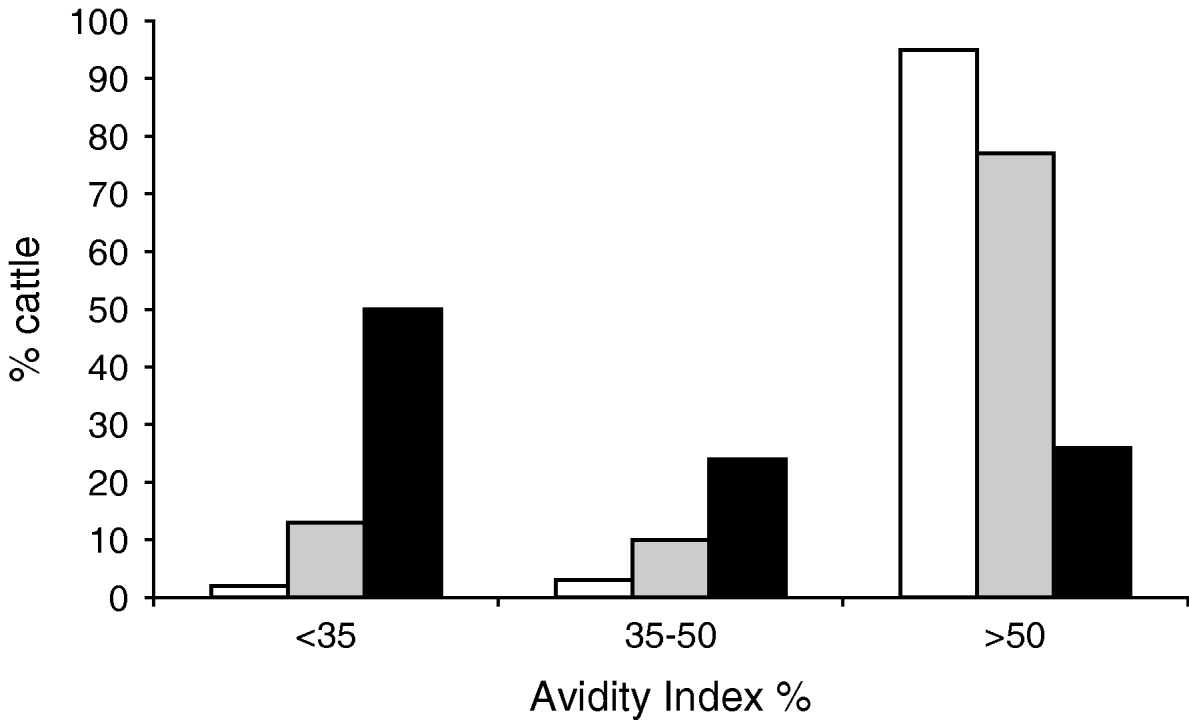
To address this question we measured the avidity of N. caninum specific antibodies in sera of three groups of infected cattle – those that had recently calved normally (n=100), those that had recently aborted, but where the aetiology was not known (n=98) and thirdly those that had aborted (n=50) on five farms, each of which had recently experienced a N. caninum associated abortion storm – defined as more than 10% of the at risk cows aborting within a 12 week period (Davison et al. Reference Davison, French and Trees1999b). All the sera were collected within two weeks of abortion or four weeks of calving. The avidity ELISA described by Björkman et al. (Reference Björkman, Näslund, Stenlund, Maley, Buxton and Uggla1999) was used and an avidity index (AI) for each sample calculated. An AI <35 is indicative of recent infection whereas an AI >50 is usually seen in animals that have been infected longer than six weeks (Björkman et al. Reference Björkman, Näslund, Stenlund, Maley, Buxton and Uggla1999). Ninety-five percent of normally calving cattle had AIs >50 (Fig. 1), similarly 79% of aborting cattle had high AIs indicating that the majority of these cattle had persistent infections. In contrast 50% of cattle that had aborted during an abortion storm had AIs <35; only 25% of these cattle had evidence of a chronic infection.
The percentage of Neospora caninum-positive cows with low (<35), inconclusive (35–50) and high (>50) avidity indices, measured by an avidity ELISA. Group 1 (open columns) were normally calving cows (n=100), sampled within four weeks of calving and were from farms with no history of N. caninum associated abortions (n=74) or from farms where no history was available (n=26). Group 2 (grey columns) were cattle (n=98) which had aborted and sera were collected within one week of abortion. No farm history was available for these cattle. Group 3 (black columns) were from cattle (n=50) from farms that had reported an N. caninum associated abortion storm, defined as more than 10% of the at risk cattle aborting within a 12 week period. All samples were taken within two weeks of the time of abortion.

These data support the view that epidemic abortion storms are associated with recent exposure to N. caninum oocysts. However, in a population of cattle where the aetiology of abortion was not known, and in a population of normally calving cows, the majority showed evidence of chronic infection. It is well established that persistently infected cattle transmit the infection to their foetuses very efficiently and this may occur in up to 95% of pregnancies (Paré et al. Reference Paré, Thurmond and Hietala1996; Davison et al. Reference Davison, Otter and Trees1999c) implying that endogenous transplacental transmission is the principle natural route of infection and maintaining the parasite within the population (Dubey et al. Reference Dubey, Schares and Ortega-Mora2007).
ROLE OF WILD CANIDS IN TRANSMISSION OF N. CANINUM
The role of wild canids in the transmission of N. caninum has been considered (reviewed by Gondim, Reference Gondim2006). It has been established that coyotes (Canis latrans) are a definitive host for N. caninum and can shed oocysts following ingestion of infected tissue (Gondim et al. Reference Gondim, McAllister, Pitt and Zemlicka2004a). There is epidemiological evidence in the USA that beef herds grazed in proximity to coyotes and gray foxes have a higher risk of exposure to infection (Barling et al. Reference Barling, Sherman, Peterson, Thompson, McNeill, Craig and Adams2000). In feeding studies, European red foxes (Vulpes vulpes) did not excrete N. caninum oocysts after being fed tissue from infected sheep and goats although dogs fed the same material did produce oocysts (Schares et al. Reference Schares, Heydorn, Cuppers, Mehlhorn, Geue, Peters and Conraths2002). There is serological evidence that red foxes may be infected with N. caninum (Buxton et al. Reference Buxton, Maley, Pastoret, Brochier and Innes1997; Barber et al. Reference Barber, Gasser, Ellis, Reichel, McMillan and Trees1997; Hamilton et al. Reference Hamilton, Gray, Wright, Gangadharan, Laurenson and Innes2005), suggesting that they may be intermediate hosts rather than definitive hosts, but recently one study has shown that oocysts were detected in faeces of two red foxes on Prince Edward Island, Canada (Wapenaar et al. Reference Wapenaar, Jenkins, O'Handley and Barkema2006). The fact that dogs (Canis familiaris), coyotes (Canis latrans) and wolves (Canis lupus) are so closely related phylogenetically suggests that wolves might also be a definitive host for N. caninum but it is not clear from the limited data currently available if canids other than those within the Canis spp family are true definitive hosts for the parasite (reviewed by Gondim, Reference Gondim2006).
IMMUNOLOGY
The most striking feature of the immune response to N. caninum in cattle is the massive amount of interferon (IFN)-γ that is produced by mononuclear cells in the peripheral blood, spleen and lymph nodes (Marks et al. Reference Marks, Lunden, Harkins and Innes1998; Williams et al. Reference Williams, Guy, McGarry, Guy, Tasker, Smith, MacEachern, Cripps, Kelly and Trees2000; Andrianarivo et al. Reference Andrianarivo, Barr, Anderson, Rowe, Packham, Sverlow and Conrad2001; Lunden et al. Reference Lunden, Wright, Allen and Buxton2002). CD4+ T cells are major producers of IFN-γ ex vivo (Marks et al. Reference Marks, Lunden, Harkins and Innes1998; Klevar et al. Reference Klevar, Kulberg, Boysen, Storset, Moldal, Björkman and Olsen2007) and other cell types such as NK cells are likely to be important sources of IFN-γ (Boysen et al. Reference Boysen, Klevar, Olsen and Storset2006; Klevar et al. Reference Klevar, Kulberg, Boysen, Storset, Moldal, Björkman and Olsen2007), particularly early in infection and in certain sites within the body, such as in the caruncular tissue of the placentome (Rosbottom et al. Reference Rosbottom, Gibney, Guy, Kipar, Smith, Kaiser, Trees and Williams2008). Strong proliferation responses are detectable in antigen stimulated peripheral blood mononuclear cell cultures and antibody responses are often biased towards the IgG2 isotype (Williams et al. Reference Williams, Guy, McGarry, Guy, Tasker, Smith, MacEachern, Cripps, Kelly and Trees2000; Andrianarivo et al. Reference Andrianarivo, Barr, Anderson, Rowe, Packham, Sverlow and Conrad2001). Parasite-specific CD4+ cytotoxic T cells have been shown to mediate the direct lysis of autologous infected cells through a perforin-granzyme dependent pathway (Staska et al. Reference Staska, McGuire, Davies, Lewin and Baszler2003). IFN-γ inhibits parasite growth (Innes et al. Reference Innes, Panton, Marks, Trees, Holmdahl and Buxton1995) and also activates macrophages and other mononuclear cells. This type 1, pro-inflammatory response, which is induced rapidly following a primary infection, is thought to control parasite growth, induce differentiation from tachyzoites to bradyzoites and the formation and maintenance of tissue cysts. In mice, the immune responses are consistent with those described in cattle. The neutralisation of IFN-γ with monoclonal antibodies resulted in uncontrolled parasitaemia and death of N. caninum infected mice (Khan et al. Reference Khan, Schwartzman, Fonseka and Kasper1997; Baszler et al. Reference Baszler, Long, McElwain and Mathison1999; Tanaka et al. Reference Tanaka, Hamada, Inoue, Nagasawa, Fujisaki, Suzuki and Mikami2000) and infections in IFN-γ knockout mice are lethal (Ritter et al. Reference Ritter, Kerlin, Sibert and Brake2002; Nishikawa et al. Reference Nishikawa, Inoue, Makala and Nagasawa2003). Depletion and adoptive transfer studies have shown that CD4+ T cells are also of paramount importance in protection (Tanaka et al. Reference Tanaka, Hamada, Inoue, Nagasawa, Fujisaki, Suzuki and Mikami2000).
There is some evidence that cattle develop protective immunity following N. caninum infection (reviewed by Williams and Trees, Reference Williams and Trees2006). Cattle experimentally infected before pregnancy develop a protective immune response and are able to prevent both transplacental transmission and abortion if challenged during pregnancy (Innes et al. Reference Innes, Wright, Maley, Rae, Schock, Kirvar, Bartley, Hamilton, Carey and Buxton2001; Williams et al. Reference Williams, Guy, Ellis, Smith, Björkman and Trees2007). During an outbreak of Neospora-associated abortion in a beef herd, cows with evidence of previous exposure to the parasite were less likely to abort than cows with primary infections suggesting that protective immunity had developed in the cattle previously exposed to the parasite (McAllister et al. Reference McAllister, Björkman, Anderson-Sprecher and Rogers2000). However, the situation in persistently infected cattle appears more complex. In a persistently infected cow, recrudescence can occur potentially in every, although not necessarily all, pregnancies during her lifetime. This may result either in the birth of a persistently infected calf or an abortion and a persistently infected cow can abort more than once. This suggests that a persistently infected cow does not develop sufficient immunity to her endogenous infection to prevent repeated foetal infection but is immune to exogenous challenge. We confirmed this experimentally by challenging five naturally, persistently infected cows in the first trimester of pregnancy with an exogenous foetopathic infection (Williams et al. Reference Williams, Guy, Smith, McKay, Guy, McGarry and Trees2003). All five cows were solidly immune to the exogenous infection and unlike the challenge control group, none aborted; but in three of these animals, in the second and third trimester of pregnancy, there was evidence of recrudescence of their persistent, endogenous infection and their calves were born infected. Thus the relationship between N. caninum and the bovine immune system appears complex and may be affected by the route and timing of the animal's first exposure to the parasite.
Our recent results highlight the differences between an N. caninum infection acquired before birth compared to an infection acquired post-natally. We have shown that in cattle infected with tachyzoites 10 weeks before pregnancy, there was no evidence of endogenous transplacental transmission during the subsequent gestation and all the calves were born uninfected (Williams et al. Reference Williams, Guy, McGarry, Guy, Tasker, Smith, MacEachern, Cripps, Kelly and Trees2000). Significantly, infection of naïve cows with oocysts during pregnancy resulted in exogenous transplacental transmission in the first pregnancy, but in the next pregnancy there was no evidence of endogenous transplacental transmission (McCann et al. Reference McCann, McAllister, Gondim, Smith, Cripps, Kipar, Williams and Trees2007). These results suggest that persistent infections were not established in cattle infected post-natally, despite the fact that both routes of infection (oocysts or a bolus of tachyzoites administered intravenously) are either identical or analogous to natural routes of transmission. There is very little data available on what happens in adult cattle in pregnancies subsequent to that during which they were exposed to oocysts. In one study where there was good evidence that a herd had been exposed to oocysts (Dijkstra et al. Reference Dijkstra, Barkema, Hesselink and Wouda2002) an analysis of the subsequent offspring (i.e. those conceived after exposure to oocysts) suggested that endogenous transplacental transmission had occurred. However, only nine offspring from a total of 244 cows in the herd were seropositive (five from a first gestation and four from a second), providing evidence of endogenous transplacental transmission. These results suggest that persistent infections were established in only a small proportion of the animals exposed to post-natal infection (Dijkstra et al. Reference Dijkstra, Lam, Bartels, Eysker and Wouda2008). Clearly more research is required to ascertain if post-natal infection does establish truly persistent infections. This is an important issue as it will have a significant effect on the advice given to farmers about controlling infection in their herds. Cows that have been exposed to oocysts as adults may have acquired effective immunity to the parasite which will protect them from abortion in the future and may also not pose a risk of transmitting infection on to their calves. Therefore these animals are valuable and should be retained within the herd. In contrast, there is a risk that offspring of these cattle, which were infected by exogenous transplacental transmission, will themselves transmit the parasite to future generations. Moreover, they have the potential to be a source of infection to dogs on the farm. In view of these risks the advice may be that these calves should be culled.
Taken as a whole, what these results do suggest is that the nature and effectiveness of the immune response to N. caninum may well be determined by when an animal first encounters the parasite. There are analogies with other infectious agents such as Bovine Viral Diarrhoea virus in cattle and malaria, T. gondii and Hepatitis B virus in humans (Petersen, Reference Petersen2007). Much more research is necessary to truly understand how the parasite persists within the cow and to identify the events leading to recrudescence during pregnancy. It is tempting to speculate since we know that the age of the foetus at the time of infection is critical in determining whether the foetus survives or is killed (Williams et al. Reference Williams, Guy, McGarry, Guy, Tasker, Smith, MacEachern, Cripps, Kelly and Trees2000), that the outcome is affected by the stage of development of the foetal immune response. The foetal immune response must be sufficiently mature to control parasite replication and to drive differentiation to the quiescent bradyzoite stage, which prevents foetal death (Gibney et al. Reference Gibney, Kipar, Rosbottom, Guy, Smith, Hetzel, Trees and Williams2008), but when the persistently infected calf reaches adulthood and herself becomes pregnant, her immune response must be sufficiently modulated by the pregnant state to allow the parasite to reactivate and differentiate back to tachyzoites which can then migrate to the foetus, thus allowing the parasite to transmit down several generations of the same family. The efficiency of transplacental transmission is less than 1, therefore some post-natal transmission is essential in maintaining the parasite (French et al. Reference French, Clancy, Davison and Trees1999). But whilst a cow infected by oocysts may not necessarily develop a persistent infection, her foetus infected by exogenous transplacental transmission will be born persistently infected and will transmit the parasite to subsequent generations when she reaches maturity. This demonstrates how finely tuned N. caninum is to its host and by understanding this interaction we can learn about ontogeny of the immune system and the immunology of mammalian pregnancy. Wow, what a parasite!
ACKNOWLEDGEMENTS
We are grateful to Dr Arthur Otter, Veterinary Laboratories Agency for providing sera from aborting cattle and to the Department for the Environment, Farming and Rural Affairs, the Wellcome Trust (Grant no: GR066695MA) and the Milk Development Council for funding.