Though the portion of societal violence attributable to people diagnosed with schizophrenia is no more than 10% (Walsh, Buchanan, & Fahy, Reference Walsh, Buchanan and Fahy2002), violence is among the features most easily associated with mental illness, especially a diagnosis of schizophrenia. That is, without a doubt, a major obstacle in the recovery process of people with severe mental illness, and one cause of the stigma they face (Pérez-Garín, Molero, & Bos, Reference Pérez-Garín, Molero and Bos2015), because it is a challenge to their integration in the community. Until the 90s, most of the research found no association between a diagnosis of schizophrenia and violence. Yet in recent decades, prospective as well as retrospective studies have found significant risk of violent crime perpetration in community samples of people diagnosed with schizophrenia (Shaw, Senior, Stevenson, Lennox, & Short, Reference Shaw, Senior, Stevenson, Lennox and Short2012).
Different studies (Fazel, Gulati, Linsell, Geddes, & Grann, Reference Fazel, Gulati, Linsell, Geddes and Grann2009; Wallace, Mullen, & Burgess, Reference Wallace, Mullen and Burgess2004) have reported odds ratios in subjects with schizophrenia consistently above 1, and up to 7 in men. Yet the risk of committing violent acts was no higher in people with concurrent diagnoses of schizophrenia and substance abuse than with substance abuse alone. In other words, this heightened risk of committing acts of violence is not only the result of the diagnosis and positive symptoms, but of a complex interaction of psychological and social factors (Wallace et al., Reference Wallace, Mullen and Burgess2004).
In summary, most studies suggest a consistent association between schizophrenia diagnosis and acts of violence, but the effect size is small and it is modulated by other variables, such as toxin consumption. There is continued debate about the impact of this and other modulating variables – like positive symptoms and personality disorders – in the relation between schizophrenia and violence.
For instance, many studies have found a significant mediating effect of positive symptoms called “threat/control override delusions” (Link, Stueve, & Phelan, Reference Link, Stueve and Phelan1998; Swanson et al., Reference Swanson, Swartz, van Dorn, Elbogen, Wagner, Rosenheck and Lieberman2006). However, other authors (Appelbaum, Robbins, & Monaham, Reference Appelbaum, Robbins and Monahan2000) used a prospective research design with 1,200 subjects, and found that patients admitted to hospitals for severe psychiatric crises who exhibited the aforementioned symptoms were less likely to commit acts of violence 10 weeks after discharge.
Douglas, Guy, and Hart (2009) were able to shed some light on the heterogeneity of results, concluding in their exhaustive meta-analysis of 224 studies that several aspects of research design can produce variation in the effect size of the violence-schizophrenia relationship, and in the importance of other moderating variables. In community samples for instance, as opposed to samples from correctional institutions, the effect size of the psychosis-violence association is higher. Meanwhile, that association has a smaller effect size in control groups with a high prevalence of mental disorders. Furthermore, the authors caution there may be bias to publish papers that find a positive association between psychosis, symptomatology, and violence.
The vast majority of research analyzing the relation between psychosis and violence has utilized samples from psychiatric facilities, the community at large, or forensic psychiatric institutions. Meanwhile, samples from the general prison population have scarcely been studied. One of the latest prison studies, conducted in Brazil (Pondé, Caron, Mendonça, Freire, & Moreau, Reference Pondé, Caron, Mendonça, Freire and Moreau2014), found no association between psychosis and the most serious crimes. That non-association is contrary to what another study found in a prison psychiatric ward, also in Brazil (Teixeira & Dalgalarrondo, Reference Teixeira and Dalgalarrondo2006). In a prospective, longitudinal study of prison inmates in the United Kingdom, Keers, Ullrich, DeStavola, and Coid (2014) concluded that only an untreated schizophrenia diagnosis was significantly associated with violence. They also argue that lack of treatment is strongly associated with the emergence of persecutory delusions.
The literature leads us to believe the association between psychosis and violence needs to be explored in new populations. Given the special characteristics of the prison population – with a high prevalence of psychological disorders and traumatic experiences, and well-defined demographics including low level of education and high rates of immigration – we expect important variations in the association between violence, and psychopathological and demographic variables. In this study, we want to contribute to the analysis of the relation between psychosis and violence in this population: male inmates in the general prison population. It will be the first study to that effect in Spain to date.
Method
Participants
Inclusion criteria included male sex, serving a prison term (that is, not awaiting trial), absence of neurological disease, and having enough mastery of the Spanish language to communicate. A total of 472 people, men with prison sentences, participated in this study.
Inmates were randomly selected according to unit from two Andalusian prisons, Morón amd Albolote, one in western Andalusia and one in eastern Andalusia.
Of the 500 inmates initially sampled, 5.6% declined to participate. The final sample was representative of the Andalusian prison population in the year 2010, with a 95% level of confidence and .02% precision. Almost 50% had no education at all or had not completed primary school. Meanwhile, 34% had completed primary school, and 10% mandatory secondary school. Just 6.7% had some vocational education or non-obligatory secondary schooling. 81% of inmates were Spanish and 19% foreign, the wide majority coming from North Africa, 42.8%, and European communities, 22.8%. A total of 68 inmates had committed murder, homicide, attempted murder, or injury, making up 14.2% of the total sample.
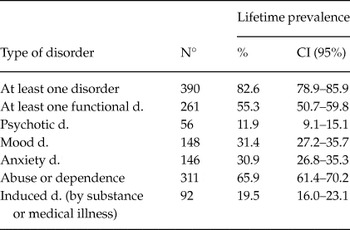
According to Table 1, the prevalence of psychological disorders was high in this population. 82.6% of inmates displayed an Axis I psychological disorder, and the prevalence rates of substance dependence and anxiety disorders were especially high. With regard to personality disorders, the lifetime prevalence of suffering at least one was 79.9% (López, Saavedra, López, & Laviana, Reference López, Saavedra, López and Laviana2016).
Lifetime Prevalence of Axis I DSM IV Mental Disorders Identified by the SCID I (n = 472)

d. = disorder
Design
A correlational, retrospective study was conducted, and the data generated were analyzed using a logistic regression technique. The predicted variable was having committed a violent crime or not; that category included murder, homicide, attempted murder, and injury. We decided not to include crimes that could be clearly tied to certain outcomes (armed robbery, sexual abuse) or could include acts without physical violence (gender violence).
Instruments
The clinical version of the Structured Clinical Interview for Diagnostic and Statistical Manual of Mental Disorders – Fourth Edition (DSM-IV) was used to diagnose Axis I disorders (First, Spitzer, Gibbon, & Williams, Reference First, Spitzer, Gibbon and Williams2002). To evaluate personality disorders, we used the self-report International Personality Disorders Examination (IPDE) World Health Organization (WHO), (1996). Clinical, sociodemographic, and offending data were collected during a sociodemographic interview. Interview data were then verified and added to with information from prison records.
Procedure
Eight psychologists participated in the study, first completing a training program about the research procedure; they all had clinical experience in forensic settings. Interviewers were trained in the assessment tools, and before beginning the project, we organized a visit to show interviewers the prisons and conduct meetings with prison staff. In coordination with the prisons, interviewers set up meetings with the inmates, provided them with information, and got their written consent before proceeding to interview them. The wardens of participating prisons and the General Bureau of Prisons approved and supervised the investigative process. The Andalusian Foundation for Social Integration of the Mentally Ill (FAISEM from the acronym in Spanish) was chosen to coordinate the study. The University of Seville consulted with FAISEM through a collaboration agreement.
The first interview collected sociodemographic information; it was followed by the SCID-I diagnostic interview and the IPDE-I. Inmates who needed help were accompanied and advised in completing the IPDE-I questionnaire. A clinical seminar was held once a month with each of the two groups of interviewers (East and West). The seminars were designed to clear up any doubts, and to analyze the most complex cases together. The groups in group analysis were at all times supervised by the project coordinator. Two psychologists trained in the tools transferred test results into a data table. The data-table creation process was used to test diagnoses and detect possible errors.
Statistical Analysis
Bivariate correlations were computed between each categorical, potential predictor variable and violent crime perpetration using Pearson’s chi-squared test, unless the observed frequency was under 10, in which case Yates’s correction for continuity was substituted. In addition, Fisher’s exact test was applied in cases where at least 20% of boxes had expected frequencies under 5. Along with the corresponding significance tests, contingency coefficients (r ϕ) were computed to measure effect size; they were evaluated according to Cohen’s (1988) standards regarding correlation indexes: small (.10), medium (.30), and large (.50). These calculations were made by analyzing the relative risk of committing violent crimes for two cohorts of participants, criminal offenders and non-offenders, and the odds ratio comparing their relative risk. To analyze the only quantitative predictor in the study, participant age, we opted for a one-way ANOVA model, and R 2 to measure effect size, which was interpreted according to Cohen’s (1988) standards concerning the coefficient of determination: small (.01), medium (.06), and large (.14). Finally, the relations among violent crime perpetration and various predictors altogether – categorical as well as quantitative variables – were analyzed using binary logistic regression models, along with their corresponding adjusted odds ratios, and Cox and Snell’s R 2 indexes and Nagelkerke’s R 2 to measure the model’s effect size, tested as coefficients of determination. We tested for possible issues of multicollinearity in the different logistic regression models based on tolerance indices provided by multiple linear regression. Version 18.0 of the SPSS Statistics package was utilized over the course of data analysis.
Four major sets of potential predictor variables were considered. The first included Axis I psychological disorder diagnoses (always lifetime prevalence): a functional psychotic disorder (schizophrenia, schizophreniform, schizoaffective, or delusional disorder), mood disorders (depressive or bipolar disorders), anxiety disorders, dependence, substance-induced. This block included having experienced a positive psychotic symptom (hallucination or delusion) due to their relevance to theory.
The second major variable set included having experienced a toxin-abuse episode: alcohol, cannabis, stimulants, opioids, cocaine, or hallucinogens.
The third set was made up of three major categories of personality disorders: A (schizoid, paranoid, schizotypal), B (histrionic, borderline, narcissistic, and antisocial), and C (avoidant, dependent, and obsessive-compulsive).
Fourth and last, we considered a breadth of sociodemographic variables: level of education, with three categories (no education; primary and/or mandatory secondary school; non-obligatory secondary school or higher education); past criminal record (yes/no); family psychiatric history (yes/no); prior incarceration for violence (yes/no); use of a mental health facility in the year prior to incarceration (yes/no); has a romantic partner (yes/no); suicide attempt (yes/no); living situation (irregular, or regular with Spanish or European Union nationality); place of birth (Spain/abroad); employment situation at the time of incarceration (employed/unemployed); traumatic experience before 16 years of age (yes/no); psychopharmacological treatment in the year before incarceration (yes/no); and age at the time of interview.
Results
Separate analyses for each group of variables appear below: type of (Axis I) disorder diagnosed, substance abuse, personality disorders, and sociodemographic variables.
(Axis I) Disorder Type
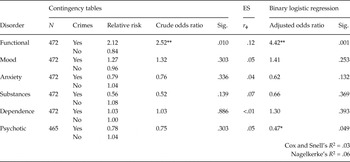
In our analysis of bivariate correlations between violent crime perpetration and each diagnosis, including the presence of psychotic symptoms, only the relation between functional psychotic disorder and violent crimes was found to be statistically significant (see Table 2), and its effect size was small. Analysis of standardized residuals revealed that the statistical significance was primarily because more people than expected had had a functional psychotic disorder and also committed a violent crime. Accordingly, among people with that diagnosis, 26.7% had committed violent crimes, while that percentage was only 12.6% in people without a functional psychotic disorder.
Results of Violent Crime Analyses According to Diagnosed Disorders, with Chi-squared and Binary Logistic Regression

ES = effect size
* p ≤ .05 **p ≤ .01
Binary logistic regression analysis of violent crime perpetration as a function of all the diagnoses together (see Table 2) demonstrated that the functional disorder’s adjusted odds ratio continued to be statistically greater than 1, whereas all the other disorders’ adjusted odds ratios were still not statistically significant, except for presence of psychotic symptoms. The adjustment made based on the remaining disorders produced an increase in the functional disorder’s odds ratio from an initial 2.52 (Li = 1.22; Ls = 5.16) up to 4.42 (Li = 1.77; Ls = 11.01), and a decrease in the probability of occurrence through random chance. Therefore, the risk of committing violent crimes was more than four times higher in people with a functional psychotic disorder than in those without such a disorder. Meanwhile, the adjusted odds ratio of psychotic symptoms turned out to be less than 1, .47 (Li = .22; Ls = .99), indicating higher risk of committing violent crimes in people who did not exhibit psychotic symptoms. However, the statistical significance of that result was borderline. We first determined that the tolerance indices of each diagnosis were over .67, far from the .20 that would indicate issues of multicollinearity. Meanwhile, Nagelkerke’s R 2 was medium in size. To create a new model with the four types of predictors, dependence and substance-induced disorders were ruled out because they had the highest significance levels.
Substance Abuse
Next, we analyzed bivariate correlations between violent crime perpetration and the presence or absence of abuse of different substances. While the relation between violent crimes and stimulant abuse turned out to be statistically significant according to the χ2 test (1, N = 472) = 4.93, p = .026, its significance disappeared after Yates’s correction for continuity was applied. Logistic regression analysis likewise indicated that relation is not statistically significant, but in both cases it would have been significant if the test had been one-tailed. Descriptively speaking, the only substances with odds ratios over 1 – which would indicate a higher probability of committing violent crimes when they are abused – were alcohol, stimulants, and hallucinogens. First, we computed collinearity indices for that set of predictors and found they were all .84 or higher. With an eye to creating a model to include the four types of predictors, two substances with odds ratios over 1 and small significance levels were selected: stimulants and alcohol.
Personality Disorders
Third, we analyzed the relation between violent crimes and personality disorders A, B, and C. None of the crude or adjusted odds ratios we found were statistically different from 1. Personality type B obtained the lowest significance level, so that was the only predictor selected for the final model. Tolerance indices for the three variables were over .87.
Sociodemographic Variables
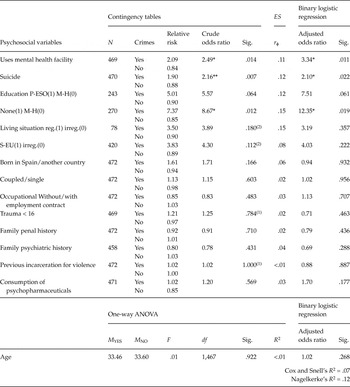
Last, we analyzed the relationship between the large set of sociodemographic variables, described in the Method section, and violent crime perpetration (Table 3). The tests developed for level of education gave us the corresponding odds ratios when passing from mid-level or higher education (code 0) to each of the others (codes 1). In the case of living situation, we compared the relative risk of committing crimes when going from an irregular residence (code 0) to each of the others (code 1).
Results of Violent Crime Analyses According to Psychosocial Variables, with Chi-squared and Binary Logistic Regression

None = no education, P = primary school, ESO = mandatory secondary school, M = post-mandatory portion of secondary school, H = higher education. Reg. = regular residence in Spain; Irreg. = irregular residence; S-EU = Spanish or European Union nationality.
In an isolated analysis of each variable, we confirmed that four of the relations we examined with committing crimes were statistically significant: using a mental health facility in the past 12 months, suicide attempts, and the two extreme levels of education – none, and non-mandatory secondary or higher education. Accordingly, having gone to a mental health facility in the past 12 months increased one’s risk of committing violent crimes by a factor of 2.49 (Li = 1.72; Ls = 3.62); having attempted suicide increased that risk by a factor of 2.16 (Li = 2.16; Ls = 3.79); and receiving no education, compared to non-mandatory secondary or higher education, increased it by a factor of 8.67 (Li = 1.33; Ls = 57.30). Those statistical significances were maintained in the logistic regression equation; the remaining variables adjust, according to adjusted odds ratios of 3.34 (Li = 1.32; Ls = 8.42), 2.10 (Li = 1.11; Ls = 3.96), and 12.35 (Li = 1.52; Ls = 100.16), respectively. Tolerance indices were lower on the variables place of birth, .32, and living situation, .34, while all the others were greater than or equal to .83. In a subsequent analysis of the four groups of predictors, only variables with significance levels less than .400 were selected.
Logistic Regression Model
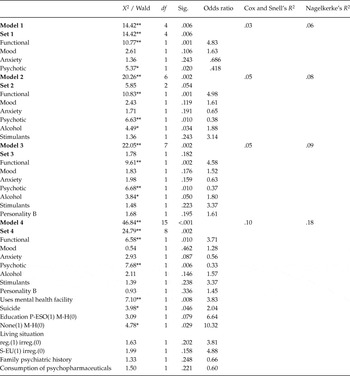
Table 4 presents results from the hierarchical logistic regression model, with different variables selected for each group: the model’s first set of variables included psychotic functional disorder, mood disorders, and psychotic symptomatology; the second included stimulant and alcohol abuse; the third was personality type B; and the fourth covered psychosocial variables – mental health facility use, suicide attempts, level of education, living situation in Spain, family psychiatric history, and consumption of psychopharmaceuticals in the past 12 months. Tolerance indices for the complete model were all above .73, so there were no particular issues of multicollinearity among predictors.
Results of Hierarchical Binary Logistic Regression with each Type of Variable in a Set: Disorders, Substance Abuse, Personality, and Psychosocial Variables

χ2 for the model and set; Wald’s statistic for each predictor.
* p ≤ .05 **p ≤ .01
With regard to the first set within the model, it was noteworthy that psychotic symptoms showed a statistically significant correlation with violent crimes after eliminating substance and dependence disorders, which were present in the first analysis. However, the direction of correlation did not change, so psychotic symptoms constituted a preventive factor in committing violent crimes, odds ratio = 0.42 (Li = 0.20; Ls = 0.87). The results about functional psychotic disorder were maintained, continuing to be statistically significantly related to violent crime perpetration, with almost 5 times higher risk of committing such crimes if the individual has a functional disorder, odds ratio = 4.83 (Li = 1.88; Ls = 12.36). It is also noteworthy that both disorders continued to correlate significantly with violent crime in the model’s fourth variable set, after making the adjustment for the remaining predictor variables considered.
Regarding the second model, we should mention that alcohol was statistically significantly related to violent crimes after making the correction for the type of disorder the inmate was diagnosed with. Conversely, analyzing abuse of different substances showed no relation to violent crimes, odds ratio = 1.88 (Li = 1.05; Ls = 3.38). The aforementioned significance disappears again, however, in the fourth model, with all types of predictor variables included. In the third model, the relations observed in the second were maintained; that is, personality type B did not add predictive power to the model.
Finally, in the fourth model, the statistical significance of alcohol abuse disappeared, and three variables appeared – in addition to functional disorders and positive psychotic symptomatology – that had statistically significant correlations with violent crime perpetration: mental health facility use in the past 12 months, suicide attempts, and lowest versus highest level of education. Thus we found a higher relative risk of committing this type of crime when one had gone to a mental health facility, previously attempted suicide, or had the lowest level of education – participants who were illiterate or had not completed primary school, compared to those who had non-mandatory secondary schooling or higher education. In the first case, the relative risk of committing violent crimes was multiplied by 3.83 (Li = 1.43; Ls = 10.29), it was multiplied by 2.04 (Li = 1.01; Ls = 4.13) if a participant had made suicide attempts, and was multiplied by 10.32 (Li = 1.27; Ls = 83.62) if his or her level of education went from mid-level or higher education, to no formal education. Effect size indices for the complete model rose to medium in the case of Cox and Snell’s index, and large based on Nagelkerke’s index.
Classifying cases with probabilities over .15 as possible violent crimes, 72.6% would be correctly classified. Moreover, the model would yield a rate of just 26.3% false positives, therefore having a specificity of 73.7%. Meanwhile, it would produce a rate of 34.4% false negatives, therefore having a sensitivity of 65.6%.
To evaluate the model’s predictive ability, we also created a ROC curve relating the model’s sensitivity and specificity for the different probabilities it predicts. The model’s predictive power, then, was computed as the difference between the ROC curve and an absolute lack of specificity and sensitivity. In our case, the area between the two lines was statistically significant, area = .76, p < .001.
Discussion
The high prevalence of psychological disorders in the prisons we studied warrants consideration. This study found a higher prevalence than is reported in the only official research on prison mental health, conducted by the General Bureau of Prisons (Dirección General de Instituciones Penitenciarias, 2007). For instance, in that study, which was not without its methodological shortcomings, only 2.6% of the sample had a documented history of psychotic disorders, whereas our study found a lifetime prevalence rate of 11.9%.
Our results are consistent with other studies (Vicens et al., Reference Vicens, Tort, Dueñas, Muro, Pérez-Arnau, Arroyo and Sarda2011) that found a higher prevalence of psychological disorders in the prison population than in the population at large. This is especially true of anxiety, mood, dependence, substance abuse, and personality disorders. With regard to psychotic disorders, we observed a higher prevalence in the prison context, but the difference was less pronounced. We found a higher lifetime prevalence of psychotic disorders than Fazel and Seewald (Reference Fazel and Seewald2012) reported in their meta-analysis of 33,588 inmates. However, those authors remark that the prevalence of that diagnosis differs from country to country. Vicens et al. (Reference Vicens, Tort, Dueñas, Muro, Pérez-Arnau, Arroyo and Sarda2011), in a prison study in Northern Spain with a very similar methodology to the one used here, reported quite similar results, 10.7%. Those authors’ findings endorse the reliability of the prevalence of psychotic disorders found in this study.
Functional Psychosis Diagnosis as a Risk Factor
The high prevalence of psychological disorders in inmates differentiates our study from others that used a control group from the community at large with very low prevalence rates. According to Douglas et al. (Reference Douglas, Guy and Hart2009), using samples with high-prevalence control groups would reduce the effect size in the relation between psychotic disorders and violence. Yet despite that warning, our study observed a high risk of committing acts of violence – with an adjusted odds ratio of 3.71 in the final regression analysis – for such individuals, compared to people not diagnosed with a functional psychosis. Some studies have found significant risks associated with other Axis I diagnoses, especially mood disorders, though with lower odds ratios (Oakley, Hynes, & Clark, Reference Oakley, Hynes and Clark2009), but in the present study, no other Axis I disorder behaved like a risk factor.
In relation to the prison population, Pondé et al. (Reference Pondé, Caron, Mendonça, Freire and Moreau2014) found no association between psychotic disorders and violent crimes in Brazilian prisons in Salvador de Bahia, but Teixeira and Dalgalarrondo (Reference Teixeira and Dalgalarrondo2006) did in Sao Paulo. Keep in mind, however, differences in the penitentiary systems of Spain and Brazil, and in the methodology these studies employed. The prevalence of psychiatric disorders in prisons in Pondé et al.’s (2014) study was very small, just 1.4%, which could make it hard to obtain significant risks. This figure is far from the one obtained in the European context, which could indicate bias based on assessment type or inmate typology.
In a social and political context closer to our own, a recent prospective study of former inmates in British prisons by Keers et al. (Reference Keers, Ullrich, DeStavola and Coid2014) found an odds ratio of committing acts of violence of 3.76, practically identical to ours, in people diagnosed with schizophrenia. However, the effect only applied to untreated schizophrenia. The present study was unable to ascertain the specific type or quality of treatment inmates received before entering prison. We only determined if inmates had gone to a mental health facility or received psychopharmacological medication in the year before entering prison. The result was contrary to expectations: inmates who went to at least one mental health facility in the year before incarceration had a higher risk of committing violent crimes. Please note that the large majority of people we diagnosed with a functional psychosis, 73.3%, did not go to a mental health facility the year before entering prison. That percentage increases if we look at the year following prison entry, by which point 97.2% of people diagnosed did not receive assistance from a mental health facility in the year since they were incarcerated, and 68.9% had not seen a psychologist or psychiatrist. Therefore, it is very likely only the most severe patients with the most disruptive behaviors would have gone voluntarily, or would have been pressured to get help at a mental health facility the year before their incarceration. That could explain the association between mental health facility visits, and violent offenses. Some findings in the literature support the plausibility of that hypothesis. In their meta-analysis of 110 studies, Witt, van Dorn, and Fazel (Reference Witt, van Dorn and Fazel2013) found that having received treatment under mandate or pressure, even receiving depot antipsychotics, is associated with an increased risk of committing acts of violence. These data demand a review of the psychiatric care inmates receive in prison, as well as improved coordination between the corrections and healthcare systems.
While it is reasonable to think of a sort of causal relationship between psychotic disorder and later committing a violent crime, we must point out that this study’s design does not allow for statements about causation. One might also hypothesize that the experience of committing an especially serious crimes, and the stress that generates, could bring on a psychotic break, at least in especially vulnerable subjects (Douglas et al., Reference Douglas, Guy and Hart2009). In fact, when in prospective studies, the diagnosis of psychosis was assigned before violent acts were committed, the strength of the association between psychosis and violence decreased dramatically, yielding odds ratios of scarcely 1.30 (Douglas et al., Reference Douglas, Guy and Hart2009). Furthermore, the psychosis some inmates suffer in our prisons may not be related to violent acts on their part, but instead with unusual variables like toxin consumption or certain sociodemographic variables. With that in mind, it is meaningful that people with schizophrenia actually have a higher risk of being victimized than of committing violent acts themselves (Hiday, Swartz, Swanson, Borum, & Wagner, Reference Hiday, Swartz, Swanson, Borum and Wagner1999). This may reinforce the cycle of violence, in which the victimization people with schizophrenia experience, and the risks that diagnosis entails, make them more likely to commit acts of violence. Such acts then increase their risk of being victimized. This is especially important to keep in mind in order to confront the stigma associated with suffering from psychosis.
Positive Psychotic Symptoms and Personality Disorders
In line with the findings of Appelbaum et al. (Reference Appelbaum, Robbins and Monahan2000), our results indicate that positive symptoms act as a protective factor in violent crime perpetration. Nevertheless, one must treat that result with caution, not only because of the numerous data contradicting those findings (e.g., Link et al., Reference Link, Stueve and Phelan1998; Link et al., Reference Link, Monahan, Stueve and Cullen1999; Swanson et al., Reference Swanson, Swartz, van Dorn, Elbogen, Wagner, Rosenheck and Lieberman2006), but for reasons to do with methodology and the organization of the penal system. First of all, in the Spanish judicial system, people convicted of murders or homicides that are the direct result of psychotic symptoms serve their sentences in a special prison psychiatric ward. We observed that the prevalence of schizophrenia in normal prisons was very high, and we cannot rule out the possibility that some members of the general prison population committed their crimes under the influence of positive symptoms. However, the vast majority of such patients serve their sentences in other wards or institutions.
Next, we utilized a broader category of positive symptoms than the classic threat/control-override symptoms, including visual hallucinations and delusions that, on their own, could indicate another diagnosis.
Last, if we analyze in depth the relationship between positive symptoms, the psychosis variable, and violent crimes, the association between positive symptoms and violent crimes is only significant in people not diagnosed with a functional psychosis. In other words, positive symptoms do not have a significant crude odds ratio, and only achieve statistical significance when all Axis I diagnoses are input.
All those facts in conjunction indicate that positive symptoms only function as a protective factor for people not diagnosed with functional psychosis. Hence, people not diagnosed with psychosis but exhibiting positive symptoms might have neurological disorders or cognitive deficits less compatible with murder, for instance.
Group B personality disorders presented a crude odds ratio of 1.76. However, contrary to the large majority of the literature, no personality disorder type presented significant odds ratios. It is possible the high comorbidity and prevalence of these disorders, almost every inmate (80% of inmates exhibited a personality disorder), prevented the variability needed to yield significant associations. Another possible explanation for this result is the method of personality disorder assessment, the IPDE-II self-report questionnaire. Though inmates completed the questionnaires with assistance from interviewers, it is possible we obtained a lot of false positives.
Toxin Consumption
Though there are exceptions (Link et al., Reference Link, Monahan, Stueve and Cullen1999), many studies have concluded that substance abuse is a risk factor for violent crime perpetration in people with schizophrenia. Some have suggested this variable can mask the impact of the psychosis diagnosis and itself become the most important variable in explaining violent behavior (Fazel et al., Reference Fazel, Gulati, Linsell, Geddes and Grann2009). In the present study, abuse of different substances did not act as a determining variable, and dependence disorders were in no case significant. Stimulant consumption was, however, found to be significant in a one-tailed test. However, it did not produce a significant association with violence when two-tailed tests were analyzed together with all types of abuse. In the case of stimulant abuse, we were obliged to apply a statistical correction due to its low prevalence; this made its previous significance disappear.
Some studies have reported significant associations between alcohol abuse, low level of education, and violent crimes in patients with schizophrenia (Jones, Lichtenstein, Grann, Langström, & Fazel, Reference Jones, Lichtenstein, Grann, Langström and Fazel2011). In the present study, alcohol abuse behaved like a risk factor when Axis I diagnoses were entered into the regression with an odds ratio of 1.88. Yet unlike functional psychosis, alcohol abuse did not hold up when all sociodemographic variables (e.g., level of education) were entered in the last stage of regression analysis.
This pattern of results suggests toxin consumption is an important actor in explaining violent behavior, but adjusting its effect by introducing sociodemographic variables moderated or even nullified its strength. The low importance of substance abuse in the present study could be explained by difficulty finding the correct prevalence of different types of abuse. Agreeing to an interview about substance abuse, especially cocaine, heroin, or stimulants, in a prison context where they are prohibited is not easy, and may be subject to social desirability.
Suicide Attempts and Level of Education as Risk Factors
Few studies have found significant associations between suicide and violent behavior. One by Witt et al. (Reference Witt, van Dorn and Fazel2013) found an odds ratio of committing acts of violence very similar to ours in adults diagnosed with schizophrenia and a history of suicide attempts, 1.6. Another study, by Witt, Hawton, and Fazel (Reference Witt, Hawton and Fazel2014), reported an odds ratio of 2.8 for committing acts of violence in patients diagnosed with schizophrenia who had threatened to commit suicide at some time. Conner et al. (Reference Conner, Cox, Duberstein, Tian, Nisbet and Conwell2001) found that violent behaviors in the past year of one’s life were a significant predictor of suicide. That association was especially strong in people without a history of alcohol consumption. The association is not unusual considering that both behaviors, suicide and violence against others, can be regulated by the same lack of impulse control. In light of that reality, we must always make suicidal ideation and suicide attempts a priority in prison treatment and health programs.
One result we consider important is the strong association between low level of education and violent crimes. In fact, level of education produced a higher adjusted odds ratio than any other significant variable in the final regression analysis, and therefore predicts violence better than functional psychotic disorders do. Some studies have reported bias in favor of psychopathological variables to the detriment of sociodemographic or psychosocial variables, even when those have shown more ability to predict violence, both in samples of patients with psychological disorders and in samples of healthy participants (Bonta, Law, & Hanson, Reference Bonta, Law and Hanson1998). For years, different studies have consistently found a strong association between low level of education, and risk of incarceration as well as committing murder, in healthy populations and populations with mental disorders. These studies, coming in part from the field of criminology, have advocated for investing in education as a preventive factor in violence and reducing social costs (Lochner, Reference Lochner2004; Lochner & Moretti, Reference Lochner and Moretti2004). Despite that fact, a recent meta-analysis of 110 samples exclusively made up of patients diagnosed with psychosis found no association between level of education and violence (Witt et al., Reference Witt, van Dorn and Fazel2013). As those authors argue, sociodemographic variables need to be more rigorously analyzed to clear up these inconsistencies. In particular, psychosocial variables need to be analyzed across studies in a clinical setting to rule out potential biases, as Bonta et al. (Reference Bonta, Law and Hanson1998) suggest.
This study confirmed the association between diagnosis with functional psychoses and violent crimes based on significant adjusted odds ratios in a sample of prison inmates. The final regression model, made up of psychopathological and sociodemographic variables, had a medium effect size according to Cox and Snell’s index, and large based on Nagelkerke’s index. The risk of committing violent crimes for people with diagnoses was not as high as in other studies, probably due to the high rates of prevalence and comorbidity in this context. That high prevalence, certain characteristics of the penitentiary system, and research limitations could explain why variables like personality disorders and positive symptoms did not behave like risk factors. Suicide attempts and especially low level of education appeared as risk factors for committing violent crimes. The odds ratios for psychosis diagnoses were less than or equal to other violence predictors, like level of education in the present case (Link et al., Reference Link, Monahan, Stueve and Cullen1999). That finding should help reduce the stigma associated with psychosis. Furthermore, this result suggests that aside from factors specifically associated with psychopathology, social failure in the context of marginalization is what best explains the risk of committing violent crimes.