Reward–punishment models of voting have been extremely influential in the study of voting behaviour. Responding to suggestions that voters knew too little about politics to make coherent decisions about who should govern them, V. O. Key argued that voters knew quite enough to judge whether things they cared about were getting better or getting worse: elections let voters play the ‘rational god of vengeance and reward’.Footnote 1 Bad governments were rejected, and not so bad ones allowed another term in office. There is now an extensive body of academic research into the link between voting behaviour and government performance, particularly in economic affairs. Initial findings stressed the link between economic indicators and the vote and sought to demonstrate that the electorate operated a system of reward and punishment in which governments who presided over good times were returned and those who did not were ejected.Footnote 2 While there is undoubtedly a general link between election results and economics, the strength and nature of this relationship seems to vary. Electors respond to different economic indicators at different times, unemployment at one time, for instance, and inflation at another, and the link is apparently stronger in some countries than others.Footnote 3
Arguably, one reason for this lies in the differences between political systems that make it easier to identify responsibility and thus apportion credit or blame. A very influential piece of research by Powell and Whitten demonstrated that elections in countries where responsibility is most easily focused on a single party will be more likely to follow the reward–punishment model.Footnote 4 Where responsibility is divided, because of a minority government, strong parliamentary committees or a decentralized federal structure, it is harder for voters to identify who is responsible. Coalition governments mean voters must decide whether responsibility should be distributed equally.Footnote 5 The length of time a government has been in office is another factor; as are institutional and country differences, such as how open an economy is to outside influence,Footnote 6 whether multi-level governance undermines responsibility,Footnote 7 the presence of a dual executive,Footnote 8 and divided government at state level in the United States.Footnote 9 The key point here, though, is that a reward–punishment model requires that voters do not simply evaluate the performance of the economy, but also apportion credit and blame as appropriate.
A critical variation that remains largely unexplored is how and why individual voters attribute responsibility to the government. Although aggregate evidence suggests that the ability to attribute responsibility, due to the type of government and so forth, is important, in many ways this fails to get to the heart of the voting decision. While work by Lewis-Beck does ask voters more specifically whether government policies had made things better or worse (though this of course conflates the attribution and the evaluation),Footnote 10 in general the literature on economic voting has tended to ignore the issue of attribution at the individual level. Recent work in the United States by Rudolph and Grant has attempted to fill this gap.Footnote 11 Using the 2000 and 1998 US National Election Studies, respectively, and a question that asks respondents to pick who they think is most responsible for economic conditions (for 2000: the president, Congress, the Federal Reserve or business people; for 1998: the president, Congress, business people or working people), they argue that at the individual level attribution matters. In particular, they show that presidential approval in 1998 is much more strongly related to economic evaluations if the president is thought responsible, and in 2000 vote intention for Gore is only related to economic evaluations if the president is seen as responsible for economic conditions.
Rudolph also follows up on related work by Sigelman and Knight by looking at where attributions actually come from.Footnote 12 He finds that both ideology and, more importantly, the interaction between partisanship and economic perceptions are crucial predictors of whether people think that the president is responsible for economic performance.Footnote 13 This relates to other evidence that partisanship affects responsibility attributions at the State level in the United States,Footnote 14 and also to earlier work that argues that partisans disproportionately blame economic problems on presidents from the opposite party.Footnote 15
Yet these tests of the determinants of individual level attribution are limited. First, Rudolph’s work is confined to the US case, which is peculiar among most modern democracies in having a single party, yet often divided, government. How are attributions determined in systems where it is clearer which body of government is responsible for decisions, but maybe not which party? And how well does the concept of partisanship travel in this context? In this article, we examine two parliamentary democracies, Britain between 1997 and 2001 and the Republic of Ireland between 2002 and 2007. In the first case, we have a clear change of government from one single-party government to another (Conservative to Labour), which provides for possible variation in the partisan distribution of attributions (and evaluations). In the latter, we have a coalition government (Fianna Fáil and the Progressive Democrats) re-elected, but we also have a sharp decline in the economy after the election, which again provides for potential variation in terms of evaluation and attribution with changing circumstances.
Secondly, although discussion until now has focused mainly on economic changes, there is in fact no reason to limit policy change to economic change. Anderson points out that the arguments about the ease with which voters can attribute credit or blame for public policy performance apply beyond the economic sphere to a more general set of issues.Footnote 16 It is not unreasonable to expect that evaluations of performance in providing public services such as education and health care, dealing with social problems such as crime and competently managing the taxation and welfare system could all be important for voters’ choices. A recent analysis by Cutler, using questions similar to those employed here, explored the conditioning effect of attribution of responsibility for each of a number of policy areas to a particular level of government on the translation of policy evaluations into vote choices in Canadian federal and provincial elections.Footnote 17 Key argued that the economic reward–punishment model was an easy one for voters to use when deciding how to cast their votes as they required little special information to know when times were good and when they were bad. This is true, but for most people there is at least limited information from the media and personal experience of other areas of performance. We focus particularly on a number of other policy areas here, including health care, crime, education and taxation. The health issue, in particular, was one of the two or three most important issues, according to voters, in both countries over this period. Media stories concerning the health services featured heavily in terms of policy debate (which, of course, many voters do not follow) and also more general stories of waiting lists, local hospitals closing and so forth. Moreover, most people, even if they have had no need of the service themselves, will have family members or friends with more direct experience. This is not to say that all such evaluation is necessarily ‘objective’, and of course not all voters share the same viewpoint on the health service. But it is reasonable to suggest that if we ask voters to tell us whether things have been getting better or worse in relation to health care, or for that matter education or crime, they will have a basis on which to make an evaluation. In this article, we therefore move beyond economic issues when looking at attribution of responsibility to compare how attribution affects the impact of other policy areas on vote choice, and examine whether the factors that predict attribution are similar for all issues. This is not to say we expect all policy areas to have equal effects. We do not: some are simply more salient than others, and party competition may well highlight some more than others. What we do expect is that evaluations of policy areas attributed to the government will always be more important than evaluations where no credit or blame is accorded to the government.
Thirdly, when thinking about what causes evaluations and attributions, one obvious, and far from ‘objective’, basis on which these judgements are likely to be made is partisanship. The possible importance of partisanship in both evaluation and attribution, and in the relationship between them, is well known to be problematic. Our approach avoids some of these modelling problems by using panel data. Broadly speaking, there are three different versions given in the literature about the relationship between evaluations and partisanship. First, there is the classic view, popularized in The American Voter by Campbell et al., which sees partisanship as providing a perceptual screen through which events are seen.Footnote 18 Government partisans may thus have a rosier view of ‘their’ government’s achievements than opposition partisans might have. Indeed, there is a growing literature providing evidence of this idea of selective evaluation.Footnote 19 A contrary view, initially advocated by Fiorina,Footnote 20 is that evaluations are more likely to influence partisanship, which is best seen as merely a ‘running tally’ of past evaluations of the performance of all parties. A middle position, associated uniquely with Green et al.Footnote 21 is that the two have no more than a spurious relationship. They argue that evaluation and partisanship are independent: that partisanship is neither a running tally nor a filter. If partisans have a rosier view of ‘their’ government, and most studies do find this to be so, there is an objective foundation to it, perhaps because policies and priorities are more in accord with what such partisans want. One of the difficulties in exploring any of these theories is that obviously all of them allow for an association between evaluations and partisanship. The difference between them is over what accounts for that relationship.
Each of these have implications for the argument advanced in this article about attribution, and it is worth spelling these out clearly. The traditional view of party identification allows for partisans to filter out evidence of poor performance. If this is so, then there might be no room for attribution to exert a separate influence by ‘excusing’ a poor performance or discounting a good one. Only to the extent that the filter is not perfect is there room for attribution to matter, but that is precisely what the traditional account maintains: the filter, or perceptual screen, is by no means absolute. The ‘running tally’ perspective discounts partisanship altogether as an independent force, and so leaves room for attribution to matter. Perceptions of performance are assumed to be objective. The same is true for the account proffered by Green et al. To some extent, then, there is space for attribution to play a direct role in determining behaviour under each of the various accounts of partisanship. What these different accounts point to, however, is the need for measures of partisanship that are somehow separated from the other variables. To mitigate the problem of attribution and evaluation simply acting as proxies for partisanship, work by Rudolph predicting US vote choice and presidential approval includes a control for party identification.Footnote 22 Since this work uses cross-sectional data, party identification is of course still being measured contemporaneously with evaluation, attribution and vote choice/ presidential approval. Following Bartels, we use panel data here to avoid some of these problems, measuring partisanship, and indeed previous vote choice, at a separate and earlier time point to our other independent variables.Footnote 23 In this way, we have a better handle on the causality of the relationship between attribution and partisanship than previous accounts.
So, to summarize, what we aim to investigate in this article are two related questions. First, how far do attributions appear to reflect reality and how far are they merely a function of partisanship? Secondly, to what extent is attribution important for changing people’s votes? Do evaluations of performance affect voters much more strongly if they attribute those changes to the government? In order to answer these questions, we aim to move both beyond the US case and beyond simply economic performance. We also avoid some of the problems with previously used cross-sectional data by the use of panel data that covers both economic and non-economic issues from two countries, first Britain in the period between 1997 and 2001, and secondly Ireland between 2002 and 2007.
Measuring evaluations and attribution
Attributions are measured in both contexts using questions that follow performance evaluations. Both the British and Irish electorates were asked how they perceived the changes in a number of key policy areas over the 1997–2001 period in Britain and the 2002–07 period in Ireland. Respondents to the 1997–2001 British Election Panel Survey were asked in 1997:Footnote 24
Since the last general election in 19xx would you say that unemployment has increased or fallen?
What about taxes?
The standard of the health and social services?
Crime?
The quality of education?
The general standard of living?
Your own standard of living?
These questions were then repeated in some of the following waves. The general standard of living question was asked again in 1998, 1999, the spring of 2000, the autumn of 2000 and in 2001; questions about taxation, education and the National Health Service (NHS) were asked again in 1999, the spring of 2000, the autumn of 2000 and in 2001; a question about crime was asked again only in 1998 and 1999. The Irish questions are almost identical.Footnote 25 For the 2002 wave, the question was:
Thinking back over the last five years – the lifetime of the 1997 to 2002 Fianna Fáil/Progressive Democrat government – would you say that the ECONOMY in Ireland over that period of time got a lot better; a little better; stayed the same; got a little worse; or got a lot worse?
The same question was then subsequently asked with respect to the health service, housing, crime, unemployment, taxation and transport. The questions on the economy and the health service were then asked again in 2003, 2004, 2006 and 2007; the crime question was asked again in 2004, 2006 and 2007.Footnote 26
In addition to the evaluation questions, respondents in both the 1997–2001 British panel and the 2002–07 Irish panel were also asked who was responsible for each change:
‘And do you think this [change] is mainly the result of the X government’s policies, or for some other reason’? (Britain 1997–2001)
‘Do you think this [change] was MAINLY due to the policies of that government or NOT MAINLY DUE to the policies of that government?’ (Ireland 2002–07)
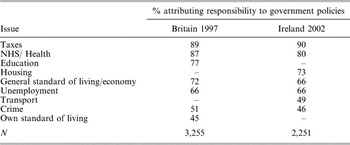
This question is asked subsequent to, but nonetheless separately from, the question on evaluations. In this respect, these questions differ and, we would argue, improve on the approach taken by Lewis-Beck’s earlier research on attributed evaluations in the European context, in which the format was to ask whether government policies had made things better or worse.Footnote 27 Table 1 shows the degree to which voters attribute credit or blame to the outgoing Conservative government in Britain in 1997 and the returned Fianna Fáil/Progressive Democrat coalition in Ireland in 2002.
Attribution of Responsibility to Government Policies in Britain and Ireland

Source: British Election Survey 1997 and Irish National Election Survey 2002.
There is a notable degree of similarity between Ireland and Britain here. Around half of the electorate hold the government responsible for crime and transport and, not unfairly, in Britain only 45 per cent hold the government responsible for their own standard of living. At the other extreme, a clear majority of respondents hold the government responsible for taxation, education and health care. The economy falls somewhere between these two extremes, with around two-thirds of both the Irish and British electorate thinking the general standard of living/the economy, prices and unemployment are the government’s responsibility.
Evaluation, partisanship and attribution
But what of partisanship? The suspicion must be that for some voters partisanship has an influence on whether they point the finger of blame at the government, or clap their hands in applause. In fact, we have suggested that attribution in any policy area will vary with partisanship and evaluation. Essentially, government partisans who have a positive evaluation will give the government credit, and opposition partisans with a negative evaluation will blame the government. Conversely, government partisans with negative evaluations will not blame the government, and nor will opposition partisans with positive evaluations give the government credit. If this pattern holds true, we can see that attribution can play the function of resolving incongruity between partisanship and evaluation. When evaluations are negative, government partisans can blame circumstances, as may opposition partisans when evaluations are positive.
The most effective way to assess the reason why some people think the government is responsible for change is to model attribution using partisanship and evaluations, as well as other likely causes of credit and blame. Since we have panel data with attribution and evaluation measured at multiple waves, and a binary dependent variable (one attributes responsibility or one does not), we use a random effects logistic regression model. Here, we present models that look at how people attribute responsibility for the economy, the health service, crime, and in Britain at least also education and taxation. These are the only issues that are consistently measured over the two panels. All evaluations are measured from −2 (got much worse) to +2 (got much better).
Of course, we also wish to look at partisanship, and in particular the interplay between partisanship and evaluation, so we include partisanship measured at the first time point of the panel.Footnote 28 This means that we are only using the panel data after the first wave. This allows us to use a measure of partisanship which is at least one step removed from attribution and evaluation, and party identification here is thus a fixed characteristic of the individuals within the panel.Footnote 29 We then include an interaction term between party identification and evaluation, as we expect positive and negative evaluations to have different effects on partisans of the incumbent party than on partisans of opposition parties.
We also have other fixed characteristics that we wish to include here. Rudolph, when looking at attributions for economic success/failure, finds that political ideology is important, with economically right-wing voters less willing to credit/blame any branch of the government with changes to the economy.Footnote 30 Given this, we also include a fixed measure of economic left–right position. This is based on the standard five-item battery used in Britain that Evans and Heath devised in the early 1990s,Footnote 31 and a very similar version for the Irish data,Footnote 32 scaled to a five-point measure with high scores indicating more laissez-faire attitudes, and low scores more socialist attitudes. We also include measures of information and sophistication; namely education, political knowledge and attention paid to the news. The first is a series of dummies measuring highest qualification, the second is in Britain a 0–6 scale that uses six factual questions to assess ‘civics’ knowledge and in Ireland a 0–5 scale based on a similar quiz of factual questions.Footnote 33 Finally, we include a measure of attention paid to the media in both countries.Footnote 34 All these measures come from the first wave of the panel and are therefore fixed for any individual.Footnote 35
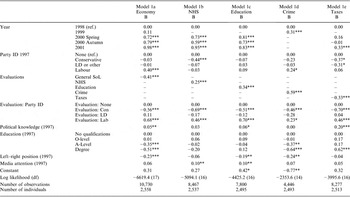
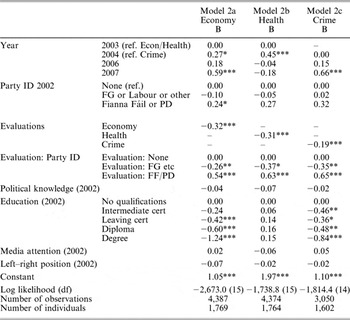
Tables 2 and 3 show these models for Britain and Ireland, respectively. First, it is clear that time does matter, but not always in a consistent manner. As the year dummies indicate, the incoming Labour government in 1997 is quite sensibly perceived as less responsible on all policy areas at the beginning of its term than at the end. There is no such consistent pattern in Ireland, although the government did seem to get the benefit of some doubt in 2003 on the economy. Secondly, education, media usage and knowledge have some effect, but these are not great and in the case of knowledge and media attention were limited to the British electorate. Moreover, apart from taxation, these effects tend to act in opposite directions in Britain: higher education tends to reduce people’s willingness to credit or blame the government; yet political knowledge and media attention tend to marginally increase attribution. To speculate, it could be that the latter two effects are more to do with political engagement, people who pay attention to politics think that it matters, whereas the education effect maybe reflects a more informed attitude on the short-term impact that the government can have on levels of crime or the economy. In Ireland, education has quite a strong negative effect on economic and crime attribution, but no effect on health. Left–right position has a statistically significant effect on some attributions in Britain, and, as we would expect and fitting with the US literature, in all cases in Britain and Ireland it is the most left-wing respondents who are likely to attribute responsibility.
Logistic Regression Random Effects Panel Models of Attributions of Responsibility to the Government in Britain, 1998–2001

* p < 0.05 ** p < 0.01 *** p < 0.001.
Source: British Election Panel Survey 1997–2001.
Logistic Regression Random Effects Panel Models of Attributions of Responsibility to the Government in Ireland, 2002–07

* p < 0.05, ** p < 0.01, *** p < 0.001.
Source: Irish National Election Panel Survey, 2002–07.
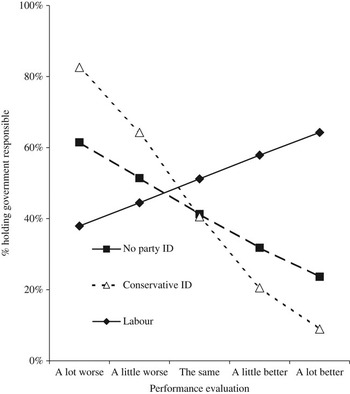
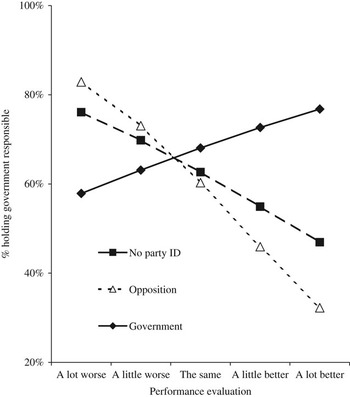
We are most interested, however, in the impact of partisanship and evaluations. What is quite clear is that the pattern of difference in both Ireland and Britain is very strong once evaluations and partisanship are taken into account, with, as expected, government partisans giving credit when evaluations are positive, and opposition partisans according blame when evaluations are more negative. Figure 1 shows the predicted probabilities in Britain of attributing responsibility to the government by economic evaluations for partisans of different parties. We graph only economic evaluations for reasons of space, but, as the tables show, a similar pattern is seen across all policy areas. These predicted probabilities are for a respondent in 1998 with up to A-level education, a mean score on the political knowledge quiz (4.07), a mean score on the left–right scale (2.55) and a mean score on the media attention measure (1.17).
Predicted probability of attributing responsibility to the government for change in the economy from Model 1a by partisanship: Britain

For Labour partisans with favourable evaluations, the government generally receives the credit (64 per cent with the best evaluation), whereas less than two in five of Labour partisans with poor evaluations blame the government (38 per cent with the worst evaluation). Conversely, Conservative partisans are very keen to blame the government (83 per cent with the worst evaluation) and very reluctant to credit the government (9 per cent with the best evaluation). These results are very similar for the other policy areas in Britain, and are mirrored in Ireland. Figure 2 shows the model of attribution for the economy in Ireland. The predicted probabilities here refer to a respondent in 2003 with a leaving certificate, a mean score on the political knowledge quiz (3.53), a mean score on the left–right scale (0.02) and a mean score on the media attention measure (0.48). Although the results are slightly weaker than for the British case, we again see that opposition partisans are much more likely to blame the government for problems (83 per cent with the worst evaluation) than to credit the government with success when things have gone well (32 per cent with the best evaluation).
Predicted probability of attributing responsibility to the government for change in the economy from Model 1b by partisanship: Ireland

Vote choice and attribution
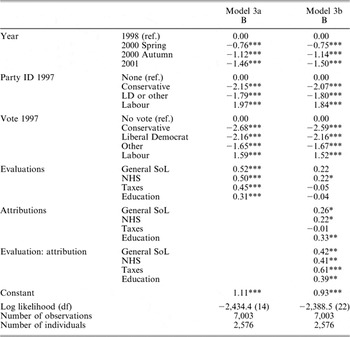
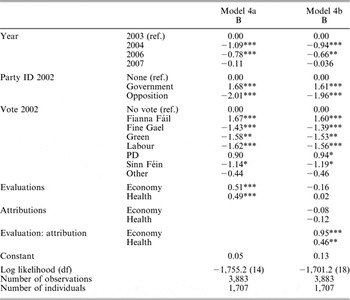
So if attributions seem driven by a combination of partisanship and evaluations, to what extent can they really be important for explaining electoral defeat and success? In this final section of the article, we model vote intention following a similar logic to that employed by Rudolph and Grant,Footnote 36 by using evaluations and attributions combined. Of course, unlike Rudolph and Grant, we have panel data and so again we fit random effects logistic regression models to the panel data, with vote intention as the dependent variable, or vote choice in the 2001 election for Britain and 2007 in Ireland, coded as 1 for the incumbent party(ies) and 0 for an opposition party.Footnote 37 We have year as an independent variable, allowing for the fact that Labour became somewhat less popular and Fianna Fáil became considerably less popular over the electoral cycle. Again, we are concerned with endogeneity. We include party identification in these models as previously, measured at the start of the panel.Footnote 38 Lewis-Beck cautions against the use of lagged partisanship since it may ‘act as an overcontrol’.Footnote 39 Our strategy is thus a conservative one, as we make the discovery of effects a more difficult task. We also include vote choice in the election at the start of the cycle; thus, we are essentially modelling vote switching, in so far as vote intention deviating from previous vote is a switch.Footnote 40 Of main interest, though, are the independent variables of evaluation, attribution and the interaction between them. Here, we only include policy areas that were asked consistently in the same waves of each of the two panels. In the British case, this means the economy, health, education and taxation; in the Irish case, this means just the economy and health. Again, evaluations run from −2 (got much worse) to +2 (got much better), and attribution is coded 1 for government responsibility and 0 when the government is not held responsible. This means that the effects of evaluations on people who do not hold the government responsible are simply the main effects of evaluations, and the effects of evaluations for those who do attribute responsibility are the combined coefficients for the main effects and the relevant interaction terms. In Models 3a and 3b, we include just evaluations of these two areas of performance, and in Models 4a and 4b evaluations, attributions and the interaction between them.
Tables 4 and 5 show these models for Britain and Ireland, respectively. As we would expect, the effects of previous vote choice and partisanship are extremely large, although as Models 3a and 4a demonstrate, they do not eliminate, either in Britain or in Ireland, the effect of evaluations completely. Better evaluations lead to respondents being more likely to give an incumbent support, even when controlling for both previous vote choice and partisanship. Models 3b and 4b introduce attributions and an interaction between attribution and evaluation. In Britain, the main effects of evaluations, i.e. the effect for people who do not attribute responsibility to the government, drop dramatically with only the NHS evaluation remaining statistically significant (and that at just the 5 per cent level). In Ireland, both main effects are no longer statistically significant. The interaction effects, i.e. the difference between those who attribute responsibility and those who do not, in both Britain and Ireland are all substantively and statistically significant.Footnote 41 To put it bluntly, the vote choices of people who attribute responsibility to the government are affected by their performance evaluations, but the vote choices of those who do not attribute responsibility are largely unaffected by their performance evaluations, regardless of country context and policy area.
Logistic Regression Random Effects Panel Models of Vote Choice Predicting Government Vote Intention/Choice Relative to Opposition Vote Intention/ Choice in Britain, 1998–2001

* p < 0.05, ** p < 0.01, *** p < 0.001. SoL = Standard of living.
Source: British Election Panel Survey, 1997–2001.
Logistic Regression Random Effects Panel Models of Vote Choice Predicting Government Vote Intention/Choice Relative to Opposition Vote Intention/ Choice in Ireland, 2003–07

* p < 0.05, ** p < 0.01, *** p < 0.001.
Source: Irish National Election Panel Survey, 2002–07.
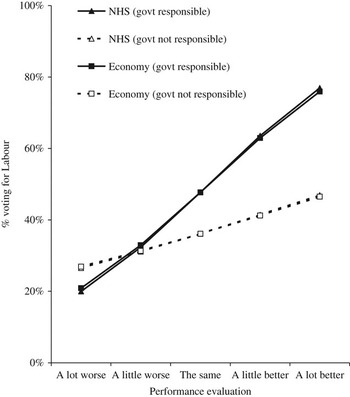
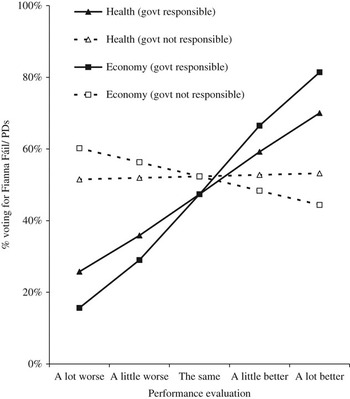
To illustrate the magnitude of these effects, Figures 3 and 4 contain predicted probabilities from Models 3b and 4b, showing the difference that evaluations make to vote intention with and without attribution for the two common policy areas in Britain and Ireland, that is health and the economy. The predicted probabilities for the British data are for a respondent in 2001 who did not vote in 1997, has no party identification, and who thought that performance in other areas had not changed over the previous year. Similarly, in Ireland, the predictions are for a respondent in 2007 who did not vote in 2002, had no party identification, and who thought that performance in other areas had not changed. As can be seen, the predicted proportion of people voting for the incumbent does change somewhat as unattributed evaluations of either outcome change. If we take Britain first, where the effects of evaluations and attributions for health care and the economy are almost identical, we see that around 25 per cent of people who thought things had got much worse indicate a Labour vote intention, whereas about 45 per cent of those who thought that things had got much better gave a Labour vote intention. These effects are not trivial, but they are much smaller than the gap shown for people who do think the government is responsible for either policy area. Less than 20 per cent of people who blame the incumbent for the economy getting much worse would vote Labour, whereas 77 per cent of those who credit the incumbent with the economy getting much better would do so. We see almost identical figures for health care in Britain.
Predicted probability of voting for Labour from Model 4a by evaluation of performance and attribution of responsibility for that performance: Britain

Predicted probability of voting for Fianna Fáil/PDs from Model 4b by evaluation of performance and attribution of responsibility for that performance: Ireland

Moreover, similarly large effects can be seen in Ireland in Figure 4. To take the economy, there is effectively no impact of evaluation on vote intention if not accompanied by attribution to the government, yet there is a huge impact of economic evaluations on the replies of those respondents who do attribute responsibility, with only 16 per cent of those who thought things had got much worse giving a government vote intention, but 81 per cent of those who thought things had got much better saying they would vote for a government party.
Discussion
We have sought to generalize results obtained in the two-party US system on the importance of attributed responsibility for economic policy to a wider set of countries, including coalition and single-party governments, and to a wider set of policies. We have used a set of similar questions asked in Ireland and in Britain. By using panel data, gathered across five and six post-election waves, respectively, we have also tried to get a better grip on the problems of endogeneity inherent in this sort of analysis. We argue that our evidence is supportive of Rudolph’s claims regarding the sources of attribution, and the large impact attribution can have on vote choice when combined with evaluation. We found that attributions varied in a reasonable manner across policy areas, giving support to the argument that asking people who are responsible taps something meaningful about government influence in that policy area. However, individual judgements of attribution were also strongly linked to partisanship; in particular, the evaluations and attributions of government and opposition partisans are clearly linked. Multivariate analysis confirmed this link between attribution, evaluation and partisanship, with respect not only to economic policy, but also to all the other issues we examine, be they crime, health, education or taxation. We have discussed the diversity of views on how far voters resolve incongruities between performance and partisanship by selective evaluation. Whatever be the truth of that argument about selective evaluation, it does appear that voters resolve some incongruities between partisanship and policy evaluation through selective attribution. In this way, favoured parties are not always blamed for policy failures, and less favoured ones are not always credited with policy successes. Moreover, we find that attribution appears to have a large impact on the voting decision. While we find a clear relationship between evaluations and vote choice, this is only when those evaluations are combined with the attribution of credit or blame to the government. Evaluations not associated with attribution have almost no effect either in Britain or in Ireland. It is not enough to think that performance has been poor on an issue; sensibly, the voter has to think that the government is responsible for the undesired outcome.
There are several implications of these findings. The first is that we have been able to identify at the level of individuals direct evidence for the importance of attributions, which has largely been assumed to drive aggregate-level findings. Attribution matters, and although evaluations without attribution may tell us about the direction of economic growth or the pressures on health services, they will tell us little about the impact of these on the fortunes of the government. In a comparative perspective, the implications are that attribution levels will vary according to institutional constraints on policy making. We should find that fewer people in complex coalition systems, for instance, hold governments responsible for economic policy than in single-party governments, and that those in relatively closed economies with control over their exchange rates should blame governments more than citizens living in open economies where exchange rates are fixed by others. We would argue that the questions used here would be useful measures for such a purpose.
A second implication is that we should not be so surprised when ‘economic voting’ models do not work, and neither should we simply take that to indicate the irrationality of the voters, but rather we should consider the circumstances and the sort of electoral campaign that took place. Concluding a book on European electoral behaviour over six countries and almost half a century, Thomassen argues that how people vote depends on the nature of the political competition.Footnote 42 The 1997 elections in Ireland and Britain were both exceptions to the pattern in which governments presiding over an improving economy are rewarded, as both the Conservative government of 1997 and the Rainbow coalition in Ireland later that same year were both defeated. In each case, though this is supposition in the Irish case, it seems that not enough voters credited the parties in government with responsibility for the improvement. In Britain, the Conservative party lost economic credibility after the events of ‘Black Wednesday’, when sterling broke with the European Exchange Rate Mechanism, while in Ireland the government almost certainly had to share credit with the previous government, which it replaced in late 1994 without an election.
Thirdly, these results demonstrate not only that the evaluation of the economy has an important effect, which is enhanced greatly when responsibility is attributed, but also that credit and blame are not merely relevant to economic issues, rather that the concept can be generalized to a number of other issue areas, including health, education and taxation. Moreover, the size of the effects that we show here suggests, at least in Britain and Ireland, that the interplay between evaluation and attribution in these policy areas is as important in deciding voters’ minds as that same interplay for the economy. Voters do not simply evaluate the economy and therefore the government, but also evaluate the government’s performance across a range of policy areas. It should be emphasized that these results are obtained using a model in which every effort was made to control for the influence of partisanship, by including both past vote and previously measured party identification. Even so, attributed evaluations, both economic and non-economic, exhibited significant effects in all areas where they could be measured.
Finally, these results also underline the importance of partisanship. While there are chronic difficulties in finding a suitable measure, and the ones used here suffer from many of the usual problems, the importance of partisan filters for the perceptions of current events is clear. In this sense, we would want to echo Bartels’s recent findings that ‘partisan loyalties have pervasive effects on perceptions of the political world’.Footnote 43 What we show here is that regardless of the impact of partisanship on the evaluations themselves, partisanship does affect the attribution of responsibility for those outcomes, and it is this combination of attribution and evaluation that in turn impacts on political behaviour. It may well be the case that political competition will centre more on the politics of credit and blame as valence politics becomes increasingly important, but we should remember that parties do not compete before an entirely neutral audience.