Introduction
Although the literature on social assistance (also referred to as welfare or income assistance) has proliferated over the years, in Canada as elsewhere, there is a dearth of scholarship on the Learning, Earning and Parenting (LEAP) program for teenage parents (Smith-Carrier, Reference Smith-Carrier2010). Similar to the Ohio Works’ LEAP program where this program first originated, the LEAP program in Ontario, Canada’s most populated province, centres on three areas (as mirrored in its title): (a) efforts to promote secondary school graduation; (b) attention to employment and job readiness; and (c) a focus on the development of positive parenting skills. To be eligible for social assistance, participants must be enrolled and attending secondary school (with the goal of earning a secondary school diploma), participate in mandatory parenting classes (a minimum of thirty-five hours) and engage in employment or employment activities (Government of Ontario, 2015). While both teen mothers and fathers who fit the prescribed eligibility criteria are able to participate in LEAP, the program is vastly overrepresented by mothers (Smith-Carrier, Reference Smith-Carrier2010). The purpose of this study is to examine the trajectories of two cohorts on LEAP over a five-year window (the first cohort from 2003 to 2008, and the second from 2009 to 2014) as a means to explore the effectiveness of the LEAP program in offering the supports necessary to improve the future prospects of teen parents and their children.
Ontario’s LEAP program
In 1996, Canada, following the steps of its American counterparts, restructured its welfare system, jettisoning its entitlement system based on need, to one characterised by minimal benefits and significant conditionality (Herd et al., Reference Herd, Mitchell and Lightman2005). Similar to changes adopted through the American Personal Responsibility and Work Opportunity Reconciliation Act (PRWORA), Ontario introduced a workfare system, dubbed Ontario Works (OW), that would ensure that participants work for their benefits. A parallel program, the Ontario Disability Support Program (ODSP), was set up to run alongside OW capturing people diagnosed with ‘a substantial mental or physical impairment that is continuous or recurrent, and is expected to last one year or more’ (Government of Ontario, 1997: Part 1, 4(1)).
Teen parents between the ages of sixteen to seventeen wishing to access social assistance (via OW) are mandated to participate in LEAP to be eligible for financial assistance. Parents between the ages of eighteen to twenty-five are also eligible to participate in the program voluntarily if they are in the process of completing their secondary school education (Government of Ontario, 2015). The Government of Ontario (2015: 1) indicates that ‘in order to remain eligible for assistance, all LEAP participants must be on the path to completing their high school diploma or equivalent…and will continue to be eligible for assistance, regardless of age, as long as they continue to participate, make satisfactory progress in LEAP requirements and continue to meet eligibility requirements.’ LEAP participants within the mandatory category (parents aged sixteen to seventeen who have not completed high school) may be deferred from LEAP requirements during the period of maternity leave following the birth of their child, albeit ‘should be encouraged to participate in LEAP as soon as possible following childbirth’ (Government of Ontario, 2015: 2).
The learning element of LEAP requires participants to regularly attend an educational program leading to a secondary school diploma or equivalent (or attend a post-secondary institution as a mature student). The earning component focuses on equipping participants with the ‘full range of employment supports to develop employment skills and become job-ready’ (Government of Ontario, 2015: 3). Such supports include co-op or community placements, job shadowing, part-time work or jobs training programs. Finally, the parenting element is intended to ‘enhance parenting skills; develop parents as teachers and role models for their children; foster healthy child development; improve parental self-esteem and coping skills; and alleviate parental depression’ (Government of Ontario, 2015: 4). To do so, the program requires a minimum of thirty-five hours of participation in an approved parenting program (for further details on the many rules and regulations pertaining to the LEAP program, see Government of Ontario, 2015).
A brief history
Teen pregnancy did not feature prominently as a ‘problem’ in the American literature until the 1970s, and not until much later (perhaps as late as the early 1990s) in the UK. From World War II until this time, attention was primarily directed toward what might be pejoratively referred to as ‘illegitimate’ births, far too frequently subjecting women conceiving ‘out-of-wedlock’, and their ‘bastard’ children, to moral censure and contempt. During this period, it was marital status (the absence of a husband), not age, which incited widespread consternation (Brown, Reference Brown2016). However, as the average age at first birth has steadily risen, largely to facilitate women’s education and training and ensure their subsequent move into employment, teen pregnancy became a growing concern. Specifically, early conception obfuscated the preferred neoliberal trajectory of women: education, employment, then motherhood (see UNICEF, 2001). Mayson (Reference Mayson1999) and Gazso (Reference Gazso2012) have (as have many others) described the reclassification of mother as carer to mother as earner, from the 1980s to the present, as being one of the most fundamental shifts to contemporary social relations. The neoliberal turn, prioritising economic achievement above all other markers of wellbeing, also manifestly influenced Ontario’s social assistance regime in the 1990s, reinforcing women’s double shift (Hochschild and Machung, Reference Hochschild and Machung2012) and requisite demand for self-sufficiency; the directive that women engage in paid labour, while maintaining responsibility for child and household, without reliance on government assistance. To do so would invariably signal their own failure to demonstrate ‘personal responsibility’ (as per the title of the American PRWORA legislation) (see Breitkreuz and Williamson, Reference Breitkreuz and Williamson2012).
LEAP was first launched in the United States, modelled after the LEAP program in Ohio, which was instituted in 1989. Other interventions for teen parents were introduced in the 1990s in various American states, including Learnfare in Wisconsin, the Teenage Parents Demonstration Project in Illinois, the Cal-Learn program in California and the New Chance program, the latter operating in several different sites around the country. Evaluations of these programs (see Duffy and Levin-Epstein, Reference Duffy and Levin-Epstein2002) have shown somewhat equivocal results. For instance, participation in Learnfare did not appear to engender significant improvements in school attendance for participants. Meanwhile, evaluations of the LEAP program found some improvement in participants’ school enrolment and attendance, and an increased likelihood of a high school graduation, albeit not with teen parents who had dropped out of school. Moreover, at the four-year follow-up, no significant earnings or employment effects appeared to result for the overall sample. Cal-Learn, in contrast, showed its most positive impact on participants who had dropped out of school and had not been held back a grade. Although participants had a significantly higher graduation rate than non-participants, roughly half did not complete their secondary school education (Duffy and Levin-Epstein, Reference Duffy and Levin-Epstein2002).
While the rate of teenage births has been in steady decline over the past thirty years in Canada, as in other Western countries (Kamp, Reference Kamp, McLeod and Allard2007), the Government of Ontario (2009: para. 8) has continued to characterise teen pregnancy as an area ‘of significant concern in specific populations including socio-economically disadvantaged teens.’ In justification, the Government of Ontario (2009: para. 2) cites research that shows that teen pregnancy, relative to births from older mothers, ‘poses increased health risks to both the mother and the child,’ including a greater risk of the mother developing health conditions (i.e. anaemia, eclampsia, depressive disorders, hypertension) or her child having a low birth weight, preterm birth or having a greater risk of mortality or developmental issues, learning difficulties, respiratory problems or hearing and visual impairments in childhood (Government of Ontario, 2009). Despite the momentous attention drawn to teen mothers, the effects of programs directed to this ‘at-risk’ population show mixed results (Brown, Reference Brown2016). Many of these studies employ quantitative methods, leaving a significant void of qualitative research on teen mothers accessing social assistance programming. The qualitative research that is currently available documents a more balanced frame than the primarily negative policy picture tends to obscure. Although many studies confirm that teen parenthood may indeed have its challenges, it can also be associated with significant benefits to both mother and child (see Arai, Reference Arai2009; Brown, Reference Brown2016; Clarke, Reference Clarke2015).
Portrayed as a ‘problem’ of ‘epidemic’ proportion (Kamp and Kelly, Reference Kamp and Kelly2014: 887), teen mothers are acutely aware of the stigma associated with their status. Yet, despite the enacted stigma (experienced discrimination or labelling) and experience of felt stigma (the anticipation or expectation of discrimination and negative treatment by others; Boyle, Reference Boyle2018) mothers routinely face (Fulford and Ford-Gilboe, Reference Fulford and Ford-Gilboe2004), many seek to dispel the ‘irresponsible’, ‘feckless’ labels attached to young parenthood, offering instead a positive portrait of themselves as being good mothers, striving to make a better life for them and their children (Brown, Reference Brown2016). In fact, many young women in Brown’s (Reference Brown2016) study discussed how having a child was a crucial turning point in their life, one that helped them re-write their life script and forge a new identity as mother. Often, this meant furthering their educational and work objectives in order to adequately provide for herself and her child(ren). This is consistent with the finding that the education and employment outcomes of women who have children in their younger years do not appear to be significantly stymied compared to women conceiving in later life (see Bradbury, Reference Bradbury2006).
Method
In this study, we examined the trajectories of two cohorts of LEAP participants and followed them over a five-year period. The first cohort (Cohort One) includes participants, both mandatory and voluntary, on the LEAP program from January 2003 to January 2008, and the second cohort (Cohort Two) includes participants from January 2009 to January 2014. The research questions posed in our study include: (a) where were LEAP participants after five years of the start of the observation period? How many remained on LEAP, shifted to another program (OW or ODSP) or left social assistance entirely? (b) for the first cohort only (as these data were available for this cohort only): where were LEAP participants after ten years from the commencement of the observation period (from 2003 to 2013)? How many remained on LEAP, shifted to another program or left social assistance entirely? Data for these analyses were accessed through the university-based Research Data Centre. The dataset, including administrative data collected by the Ontario Ministry of Community and Social Services (‘the Ministry’), was made available to researchers (including the members of our team) with an approved proposal, vetted by analysts at the Ministry and Statistics Canada, through a Research Data Centre pilot program (Statistics Canada, 2019). Descriptive statistics were calculated using Stata v. 15. This is the first research study, of which we are aware, that explores the outcomes of LEAP participants in Ontario over time.
Results
Status of cohorts after five years
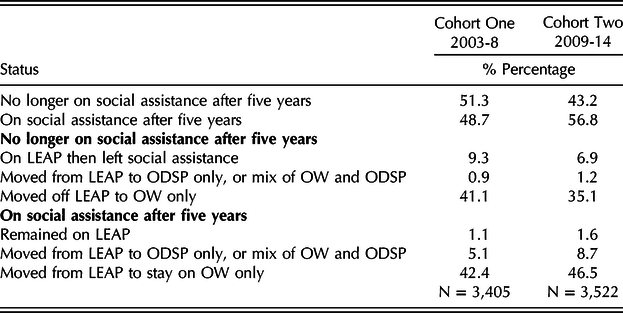
Table 1 documents the status of each cohort after a five-year observation window (Cohort One: January 2003 to January 2008; Cohort Two: January 2009 to January 2014). The number of participants on LEAP remained similar across the two cohorts, albeit was slightly higher in the latter cohort (Cohort Two: N=3,522 > Cohort One: N=3,405). At the end of the five years, the number of individuals that remained on LEAP (without shifting to another program or exiting social assistance) was slightly higher for Cohort Two (1.6 per cent) relative to Cohort One (1.1 per cent). Moreover, the number that had shifted to ODSP (or had a mixed OW and ODSP shifting patternFootnote 1) had increased for Cohort Two (8.7 per cent) relative to Cohort One (5.1 per cent). The number of participants that moved directly onto OW from LEAP was also slightly higher for Cohort Two (46.5 per cent) relative to Cohort One (42.4 per cent). Following this trend, the number of participants able to leave social assistance entirely after five years was greater for Cohort One (51.3 per cent; N=1,747) compared to Cohort Two (43.2 per cent; N=1,520). Thus, after five years, 48.7 per cent of Cohort One (N=1,658) were still in receipt of benefits compared to 56.8 per cent of Cohort Two (N=2,002) (Statistics Canada, 2019).
Social Assistance Use for Cohort One and Cohort Two After Five Years

Notes: LEAP - Learning, Earning and Parenting program; OW – Ontario Works; ODSP – Ontario Disability Support Program.
When examining the trajectory of the social assistance caseload in its entirety in both 2003 and 2009, we see somewhat higher exit rates relative to those shown by the two LEAP cohorts. At the end of five years, roughly 60 per cent of the 2003 caseload (all applicants) had left the system, and similar to Cohort Two on LEAP, the percentage of those who had left social assistance from the 2009 caseload had declined. After five years, about 50 per cent of the overall 2009 caseload had exited the system (Kerr et al., Reference Kerr, Smith-Carrier and Wang2019).
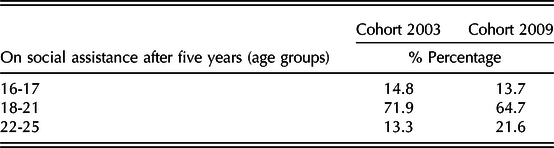
Table 2 outlines the age distribution of both cohorts. In Cohort One, among those remaining on social assistance after the five-year observation period, 71.9 per cent were in the eighteen to twenty-one age categoryFootnote 2, 13.3 per cent were in the twenty-two to twenty-five age range (voluntary participants accounted for 85.2 per cent of the overall caseload) and 14.8 per cent of the caseload were in the sixteen to seventeen age category, the latter inclusive of all mandatory participants. Likewise, for Cohort Two, the lion’s share of participants remaining on social assistance after five years were voluntary participants, 64.7 per cent in the eighteen to twenty-one age category, 21.6 per cent in the twenty-two to twenty-five age range and 13.7 per cent in the mandatory grouping (sixteen to seventeen years of age) (Statistics Canada, 2019).
Social Assistance Use for Cohort One and Cohort Two After Five Years

Duration on social assistance
For both cohorts, we calculated the durationFootnote 3 of months LEAP participants had accessed benefits (including those that had left social assistance within the five-year span and those that remained). The presence of a record for an individual in a given month indicates that said person received social assistance in that month; the absence of record in the administrative dataset indicates an exit off the system. The mean duration (calculated as the sum of all social assistance spells per individual) for those continuing to receive benefits in Cohort One after five-years was 4.3 years (51.3 months; SD=11.6 months), while Cohort Two had a mean duration of 4.4 years (53.3 months; SD=9.7 months).
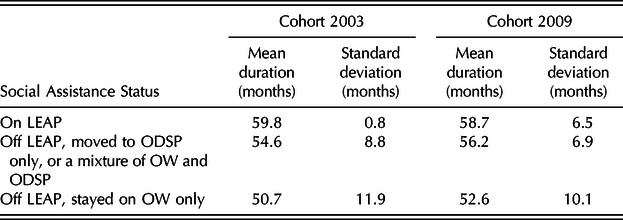
In addition, we calculated duration by program experience type (see Table 3). Among those who remained on social assistance after five-years, the mean duration for those that had remained on LEAP (in other words, they had not shifted to another social assistance program) was 4.98 years (59.8 months; SD= 0.8), while those who had shifted to ODSP or experienced a mixed OW and ODSP shifting pattern (moving from OW to ODSP or from ODSP to OW) had a cumulative mean duration of 4.55 years (54.6 months; SD=8.8) and those who had left LEAP for OW had a cumulative mean duration of 4.23 years (50.7 months; SD=11.9). For Cohort Two, those who had stayed on LEAP had a mean duration of 4.89 years (58.7 months; SD=6.5); those who had moved to ODSP or had a mixed shifting pattern on OW and ODSP had a cumulative mean duration of 4.68 years (56.2 months; SD=6.9) and those who left LEAP for OW only had a cumulative mean duration of 4.38 years (52.6 months; SD=10.1) (Statistics Canada, 2019).
Duration for Two LEAP Cohorts by Social Assistance Status After 5 Years

Notes: LEAP – Learning, Earning and Parenting program; OW – Ontario Works; ODSP – Ontario Disability Support Program.
Status of cohort one after ten years
In response to our second research question tracking the outcomes of Cohort One over ten years (from January 2003 to January 2013), we observed that 41.8 per cent of the LEAP participants that were on the program in 2003 continued to receive benefits after ten years, while 58.2 per cent of this cohort had left social assistance entirely. For the 41.8 per cent of participants that remained on social assistance after the ten-year observation period, 2.3 per cent had participated in LEAP and/or had shifted onto ODSP, 26.2 per cent had left LEAP and had a mix of OW and ODSP participation and 71.5 per cent moved off LEAP and remained on OW only. As above, we calculated the duration of months LEAP participants in Cohort One had remained on social assistance after the ten-year window (mean duration=8 years or 96.0 months; SD=25.5 months). For those that had participated in LEAP and moved to ODSP the mean duration was 9.74 years (116.9 months; SD=10.9), those that had left LEAP and had a mixed shifting pattern on OW and ODSP had a mean duration of 8.57 years (102.8 months; SD=21.0), while those who had left LEAP and remained on OW only had a mean duration of 7.73 years (92.8 months; SD=26.5) (Statistics Canada, 2019).
Discussion
Inadequate LEAP outcomes
In Cohort One, roughly half (51.3 per cent) of the population had exited social assistance by the end of five years, the other half remained. Cohort Two was even more challenged in their quest to exit social assistance; after five years, 43.2 per cent had left relative to 56.8 per cent who stayed. LEAP exit rates are thus almost 10 per cent lower than those of the general OW caseload, in 2003 (about 60 per cent left after five years relative to 51.3 per cent of those in LEAP) and 2009 (roughly 50 per cent had exited compared to 43.2 per cent on LEAP; see Kerr et al., Reference Kerr, Smith-Carrier and Wang2019). Compared to the OW caseload in its entirety, LEAP participants were more likely to remain in receipt of benefits over time. Taking a longer view, the ten-year analysis of Cohort One shows that over the ten-year span roughly 58 per cent of LEAP participants left social assistance, while 42 per cent continued to receive benefits, either through OW or ODSP. Consequently, the LEAP program does not appear to vastly improve the employment prospects of a large proportion of its participants. Although we have few Canadian data on the outcomes of LEAP participants who leave, it is likely that many who do join the ranks of the precarious work force of low-waged labour with few, if any, benefits; a trend identified in qualitative research by Lightman et al. (Reference Lightman, Herd and Mitchell2008) documenting the experiences of OW participants one year after leaving social assistance. These findings are consistent with those of Smith-Carrier (Reference Smith-Carrier2010) in Canada, and Lansdale and Brooks-Gunn (2014) in the US, who note that the LEAP program has not delivered the improvements in the educational attainment and long-term employment intended of its participants.
In January 2009, LEAP participants numbered 3,522 (Statistics Canada, 2019), equating to roughly 0.74 per cent of the overall Ontario social assistance caseload (N = 474,500 applicants, 221,100 on OW and 253,400 on ODSP as of March 31, 2009; Federal-Provincial-Territorial Directors of Income Support, 2016). As LEAP does not appear to be effective in making significant improvements in the financial and employment outcomes of its participants over the long-term, the resources marshalled to offer the LEAP program, directed to only a small fraction of the overall caseload, could also be questioned.
‘Problematisation’ of teen mother population
Notwithstanding a persistent decline in teen pregnancies across industrialised countries, including Canada and the US, the teen mother population has garnered the rapt attention of policy-makers (Smith et al., Reference Smith, Strohschein and Crosnoe2018). Often branded an ‘at-risk’ population (Kamp and Kelly, Reference Kamp and Kelly2014), teen parent, and teen mom specifically, remains a highly stigmatised identity (SmithBattle, Reference SmithBattle2013; Brown, Reference Brown2016). Despite a plethora of evidence to discredit the damaging discourses of the ‘underclass’, ‘welfare dependency’ (Hartley and Taylor-Gooby, Reference Hartley and Taylor-Gooby1992; Garrett, Reference Garrett2017) and ‘at risk’ populations (Kelly, Reference Kelly2000), these notions linger, becoming entrenched in mainstream parlance to describe the teen mother population (Smith-Carrier, Reference Smith-Carrier2011). Hamilton et al.’s (Reference Hamilton, Lawson, Gaudet, Chisholm, Kaur and Abercromby2018) qualitative study in London, Ontario points to the construction of the ideal neoliberal girl, a subject that concomitantly embodies, and contests, the ‘can do’ and ‘at risk’ girl narratives. Straddling all at once the worlds of motherhood and teen girl, teen mothers have been shown to demonstrate a keen desire to be seen as ‘good mothers’ (see Smith-Carrier, Reference Smith-Carrier2010), exemplifying the ‘can do’ spirit expected of them, while also resisting the negative stereotypes that construct them as ‘bad’, ‘irresponsible’ parents (see also Kelly, Reference Kelly1996; Ellis-Sloan, Reference Ellis-Sloan2014).
Yet, under a neoliberal backdrop of economic austerity and increased employment vulnerability (Evans, Reference Evans2007), teen mothers must unremittingly navigate a multiplicity of roles (student, employee, mother, girl, woman, care provider, etc.), without the resources that would adequately support them to achieve the ‘self-sufficiency’ expected of them. Policy attention has centred on the individual behaviours that ostensibly lead to mothers’ need for assistance, rather than the systemic factors that engender their poor circumstances (Smith-Carrier, Reference Smith-Carrier2017). However, literature increasingly casts a dubious light on interventions intended to modify individual behaviour toward ‘independence’. SmithBattle et al. (Reference SmithBattle, Loman, Chantamit-o-pas and Schneider2017) find that such interventions offer too few resources and do little to assuage the educational and social disadvantage teen mothers typically experience prior to pregnancy. This disadvantage is worse now than for earlier cohorts of teen mothers in the US (Driscoll, Reference Driscoll2014) and Canada (Bielski, Reference Bielski2013). Consequently, as SmithBattle et al. (Reference SmithBattle, Loman, Chantamit-o-pas and Schneider2017: 108) argue, the ‘effects of programs (such as LEAP) may be increasingly blunted by teen mothers’ higher level of disadvantage, psychological distress and childhood adversities.’
Teen mothers are often exposed to higher levels of stress derived from financial hardship, family instability and exposure to violence and trauma; experiences that predispose them to mental health conditions and poor outcomes in later life (SmithBattle, Reference SmithBattle2007; Smith et al., Reference Smith, Strohschein and Crosnoe2018). Rather than offering additional resources and supports to mitigate the impacts of these adverse experiences, welfare programming, and LEAP specifically, has adopted a tough love approach (Smith-Carrier, Reference Smith-Carrier2011), through a blend of carrots and sticks, typically directed to participants at the discretion of caseworkers. Yet, as Hamilton (Reference Hamilton2016) notes, the dis/incentive structure embedded in the American Temporary Assistance of Needy Families (TANF) program has not been shown to be particularly effective in helping participants meet the three-pronged objectives of the PRWORA: ‘job preparation, work and marriage’ (Office of Family Assistance, 2017).
Lack of evidence supporting LEAP’s objectives
Contrary to the assumed gains derived from the application of punitive sanctions and more restrictive eligibility criteria, Hamilton (Reference Hamilton2016) found that states in the US with more generous work requirements (i.e. fewer required work hours, lower financial sanctions) were more likely to experience higher rates of long-term success (i.e. more exits to jobs with higher wages) among TANF participants. The author suggests that the intended incentives of PRWORA ‘may have been based in a whole or partial misunderstanding of personal decision making in regard to work, family, and independence’ (Hamilton, Reference Hamilton2016: 146). Family caps (laws that deny additional benefits for mothers that have children while in receipt of welfare), for example, have not been shown to alter women’s decision-making related to having children (Wallace, Reference Wallace2009). Moreover, contrary to what decision-makers might have expected through the marriage-promotion objectives of PRWORA, the move from welfare-to-work has not translated into a higher likelihood of marriage for TANF participants. Indeed, moving into employment has been shown to increase women’s choices with regards to marriage, lowering their probability of transitioning into marriage, and increasing their chances of exiting from it (Cherlin and Fomby, Reference Cherlin and Fomby2005).
Chase-Lansdale and Brooks-Gunn (Reference Chase-Lansdale and Brooks-Gunn2014) argue that many American welfare programs have now shifted away from welfare programming, dubbed ‘1.0’, to the next generation ‘2.0’, which favours a human capital approach over the labour force attachment slant that marked erstwhile welfare reform programs in the US and Canada. The former approach emphasises the importance of higher education, advanced skills, apprenticeships and real training, as opposed to the latter’s focus, through Active Labour Market Policies (ALMPs), on immediate job readiness (including résumé writing workshops, interview coaching, etc.), under the faulty logic that ‘any job is a good job’ (Lightman et al., Reference Lightman, Mitchell and Herd2005: 6). Employment services attached to the 2.0 welfare programming variant also recognise that higher education and skills training must be accessible to individuals with young children, underscoring the need for enriched early education programs and affordable child care. It is only within the context of having theirs and their children’s needs met that mothers can seize the opportunity to obtain the education and skills that will enable them to leave social assistance for jobs that can provide for a family (Chase-Lansdale and Brooks-Gunn, Reference Chase-Lansdale and Brooks-Gunn2014).
Although the importance of jettisoning ALMPs and moving to a human capital approach has been confirmed in the welfare/workfare literature (Theodore and Peck, Reference Theodore and Peck2001; Hotz et al., Reference Hotz, Imbens and Klerman2006), the political will to orient Ontario’s workfare system in this direction remains lacking. While some in the US are proposing a significant shift in programming for teen mothers towards a two-generation approach, pairing early childhood education with parent human capital development (Sommer et al., Reference Sommer, Sabol, Chor, Schneider, Chase-Lansdale, Brooks-Gunn, Small, King and Yoshikawa2018), Ontario – who imported the LEAP program from its American counterparts from the beginning – should follow suit.