

Introduction
As we face the prospect of an unprecedented anthropogenic mass extinction, with species being lost at rates that are two or three orders of magnitude greater than the background rates from the geological record (Pimm et al. Reference Pimm, Jenkins, Abell, Brooks, Gittleman, Joppa, Raven, Roberts and Sexton2014, Ceballos et al. Reference Ceballos, Ehrlich, Barnosky, García, Pringle and Palmer2015), understanding and predicting the consequences of species extinction have become urgent tasks for conservation scientists and practitioners (Vieira & Almeida-Neto Reference Vieira and Almeida‐Neto2014, Ceballos et al. Reference Ceballos, Ehrlich, Barnosky, García, Pringle and Palmer2015). Most empirical studies examining the magnitude of biodiversity loss have usually ignored coextinction scenarios (Dunn et al. Reference Dunn, Harris, Colwell, Koh and Sodhi2009, Vieira & Almeida-Neto Reference Vieira and Almeida‐Neto2014), where the loss of one or more species may unleash a cascade of secondary extinctions, which may cause entire communities and ecosystems to collapse (Jackson et al. Reference Jackson, Kirby, Berger, Bjorndal, Botsford, Bourque and Bradbury2001, Fowler Reference Fowler2010, Colwell et al. Reference Colwell, Dunn and Harris2012, Säterberg et al. Reference Säterberg, Sellman and Ebenman2013, Brodie et al. Reference Brodie, Aslan, Rogers, Redford, Maron, Bronstein and Groves2014, Donoso et al. Reference Donoso, Schleuning, García and Fründ2017). Although the magnitude of coextinction is still virtually unknown, given the difficulties of documenting it in natural systems (Dunn et al. Reference Dunn, Harris, Colwell, Koh and Sodhi2009, Moir et al. Reference Moir, Vesk, Brennan, Keith, Hughes and McCarthy2010), it has been suggested that these cascading effects should be more pervasive in some types of ecological interactions, such as parasitism and mutualism (Dunn et al. Reference Dunn, Harris, Colwell, Koh and Sodhi2009, Kiers et al. Reference Kiers, Palmer, Ives, Bruno and Bronstein2010). The recent and rapid rise of network ecology (i.e., research on the function, structure and evolution of ecological systems using network models and analyses; Borrett et al. Reference Borrett, Moody and Edelmann2014) has proved to be a powerful tool to describe the complexity of species interactions and their interdependence (Proulx et al. Reference Proulx, Promislow and Phillips2005, Pascual & Dunne Reference Pascual and Dunne2006, Borrett et al. Reference Borrett, Moody and Edelmann2014), including their response to disturbance and cascading effects. Understanding what determines the robustness of mutualistic networks (i.e., the system’s tolerance to secondary extinctions) is currently one of the main challenges faced by network ecologists (Solé & Montoya Reference Solé and Montoya2001, Dunne et al. Reference Dunne, Williams and Martinez2002, Memmott et al. Reference Memmott, Waser and Price2004, Burgos et al. Reference Burgos, Ceva, Perazzo, Devoto, Medan, Zimmermann and Delbue2007, Rezende et al. Reference Rezende, Lavabre, Guimarães, Jordano and Bascompte2007, Mello et al. Reference Mello, Marquitti, Guimarães, Kalko, Jordano and de Aguiar2011a, Reference Mello, Marquitti, Guimarães, Kalko, Jordano and de Aguiar2011b, Pocock et al. Reference Pocock, Evans and Memmott2012, Eklöf et al. Reference Eklöf, Tang and Allesina2013, Vieira et al. Reference Vieira, Cianciaruso and Almeida-Neto2013, Astegiano et al. Reference Astegiano, Massol, Vidal, Cheptou and Guimarães2015). However, despite their importance, most studies trying to estimate the robustness of ecological networks have been traditionally based on scenarios that ignore other important ecological and evolutionary factors, such as species traits, associated with the likelihood of a species becoming extinct (e.g., Dunne et al. Reference Dunne, Williams and Martinez2002, Memmott et al. Reference Memmott, Waser and Price2004, Burgos et al. Reference Burgos, Ceva, Perazzo, Devoto, Medan, Zimmermann and Delbue2007, Pocock et al. Reference Pocock, Evans and Memmott2012, but see Curtsdotter et al. Reference Curtsdotter, Binzer, Brose, de Castro, Ebenman, Eklöf, Riede, Thierry and Rall2011, Srinivasan et al. Reference Srinivasan, Dunne, Harte and Martinez2007, Vieira et al. Reference Vieira, Cianciaruso and Almeida-Neto2013, Astegiano et al. Reference Astegiano, Massol, Vidal, Cheptou and Guimarães2015). In these studies, primary species extinctions are assumed to occur at random or as a consequence of species specialization (Solé & Montoya Reference Solé and Montoya2001, Dunne et al. Reference Dunne, Williams and Martinez2002, Memmott et al. Reference Memmott, Waser and Price2004, Burgos et al. Reference Burgos, Ceva, Perazzo, Devoto, Medan, Zimmermann and Delbue2007, Rezende et al. Reference Rezende, Lavabre, Guimarães, Jordano and Bascompte2007, Mello et al. Reference Mello, Marquitti, Guimarães, Kalko, Jordano and de Aguiar2011a, Reference Mello, Marquitti, Guimarães, Kalko, Jordano and de Aguiar2011b, Pocock et al. Reference Pocock, Evans and Memmott2012).
Species traits also play an important role in determining the structure and stability of ecological networks, as traits constrain the likelihood of interactions among species (Santamaría & Rodríguez-Gironés Reference Santamaría and Rodríguez-Gironés2007, Vizentin-Bugoni et al. Reference Vizentin-Bugoni, Maruyama and Sazima2014, Bastazini et al. Reference Bastazini, Ferreira, Azambuja, Casas, Debastiani, Guimaraes and Pillar2017). Species traits imply that species may differ in their ecological requirements and their effects on ecosystems. However, they are not equally different (Lefcheck et al. Reference Lefcheck, Bastazini and Griffin2015), for some species may be similar or ‘redundant’ in their traits (Rosenfeld Reference Rosenfeld2002, Pillar et al. Reference Pillar, Blanco, Müller, Sosinski, Joner and Duarte2013, Kang et al. Reference Kang, Ma, Li, Zhang, Niu, Ding and Han2015), conferring higher resistance and resilience to the system (Pillar et al. Reference Pillar, Blanco, Müller, Sosinski, Joner and Duarte2013, Kang et al. Reference Kang, Ma, Li, Zhang, Niu, Ding and Han2015). Thus, one might expect that the loss of more ‘distinct’ and less redundant species in terms of their traits might have a greater effect on how ecological networks respond to disturbances, as their role in the network cannot be compensated by other species.
Plant–animal seed disperser interactions are an important mutualism that shapes both ecological and evolutionary dynamics (Snow Reference Snow1971, Morton Reference Morton1973, Herrera Reference Herrera1985, Jordano Reference Jordano2000, Correa et al. Reference Correa, Costa‐Pereira, Fleming, Goulding and Anderson2015). That these interactions are key drivers of biodiversity is supported by the fact that, in the tropics, up to 90% of all plant species rely on animals to disperse their seeds (Jordano Reference Jordano2000). Given their significance to maintaining biodiversity and supporting ecosystem functioning, plant–disperser interactions are considered a crucial component in conservation policies (Wunderle Jr et al. Reference Wheelwright1997, Trakhtenbrot et al. Reference Trakhtenbrot, Nathan, Perry and Richardson2005). Yet, few studies have evaluated the robustness of seed dispersal systems (but see Mello et al. Reference Mello, Marquitti, Guimarães, Kalko, Jordano and de Aguiar2011a, Reference Mello, Marquitti, Guimarães, Kalko, Jordano and de Aguiar2011b, Timóteo et al. Reference Timóteo, Ramos, Vaughan and Memmott2016, Costa et al. Reference Costa, Ramos, Silva, Timóteo, Andrade, Araújo, Carneiro, Correia, Cortez, Felgueiras, Godinho, Lopes, Matos, Norte, Pereira, Rosa and Heleno2018).
Seed dispersal networks also play a critical role in terrestrial ecotone zones, such as in grassland–forest ecotones, as animal seed dispersers may help plant species to expand their distribution across phytophysiognomy boundaries, ultimately transforming the landscape (Jensen et al. Reference Jensen and Nielsen1986, Bossuyt et al. Reference Bossuyt, Hermy and Deckers1999, Carlucci et al. Reference Carlucci, Duarte and Pillar2011, Müller et al. Reference Müller, Overbeck, Pfadenhauer and Pillar2012, Myster Reference Myster2012). Grasslands are a major biome of the planet, occupying an area equivalent to 31–43% of the land surface (Coupland Reference Coupland1979, White et al. Reference White, Murray and Rohweder2000). Grasslands support high levels of biological diversity and endemism (White et al. Reference White, Murray and Rohweder2000, Bond & Parr Reference Bond and Parr2010, Iganci et al. Reference Iganci, Heiden, Miotto and Pennington2011, Parr et al. Reference Parr, Lehmann, Bond, Hoffmann and Andersen2014) and are responsible for maintaining important ecosystem processes and economic activities, such as acting as carbon sinks and supporting livestock production (Coupland Reference Coupland1979, Breymeyer & Van Dyne Reference Breymeyer and van Dyne1980, White et al. Reference White, Murray and Rohweder2000, Hu et al. Reference Hu, Chapin, Firestone, Field and Chiariello2001, Overbeck et al. Reference Overbeck, Müller, Fidelis, Pfadenhauer, Pillar, Blanco, Boldrini, Both and Forneck2007, Curtin & Western Reference Curtin and Western2008, Parr et al. Reference Parr, Lehmann, Bond, Hoffmann and Andersen2014). Nonetheless, their conservation has been historically neglected by environmental policies (Overbeck et al. Reference Overbeck, Müller, Fidelis, Pfadenhauer, Pillar, Blanco, Boldrini, Both and Forneck2007, Bond & Parr Reference Bond and Parr2010, Parr et al. Reference Parr, Lehmann, Bond, Hoffmann and Andersen2014), and despite their large area and economic and environmental value, grasslands are among the most altered and threatened ecosystems of the planet (White et al. Reference White, Murray and Rohweder2000, Bond & Parr Reference Bond and Parr2010, Henwood et al. Reference Henwood2010, Parr et al. Reference Parr, Lehmann, Bond, Hoffmann and Andersen2014). In addition to anthropogenic threats, such as overgrazing, farm intensification and afforestation, grasslands suffer from a natural process of forest expansion (Schwartz et al. Reference Schwartz, Foresta, Mariotti, Balesdent, Massimba and Girardin1996, Bowman et al. Reference Bowman, Walsh and Milne2001, Overbeck et al. Reference Overbeck, Müller, Fidelis, Pfadenhauer, Pillar, Blanco, Boldrini, Both and Forneck2007, Bond & Parr Reference Bond and Parr2010, Müller et al. Reference Müller, Overbeck, Pfadenhauer and Pillar2012). Although forest expansion is considered a threat to grassland conservation, this process creates a unique and useful scenario for ecological studies, as grassland–forest ecotones encompass a ‘mosaic of lifeforms’ that share very distinct evolutionary origins and life histories (Luza et al. Reference Luza, Gonçalves and Hartz2015) that compete for space and other resources. Seed dispersal networks, formed by woody plants and frugivores, are likely to be an important driver of spatial and temporal dynamics in grassland–forest mosaics, as seed dispersal of woody plants may accelerate the expansion of forest ecosystems (Carlucci et al. Reference Carlucci, Duarte and Pillar2011, Müller et al. Reference Müller, Overbeck, Pfadenhauer and Pillar2012, Myster Reference Myster2012). Thus, grassland–forest ecotones constitute a pertinent case for studying simulated coextinctions, with important consequences for the development of conservation policies. For instance, if the goal of conservation efforts is to protect grasslands, these analyses can help us to identify species that should be managed in order to maintain grasslands. Also, if conservation efforts are aimed at maintaining forest expansion or forest species, this sort of analysis can help us to identify species that should be of higher priority in conservation.
Here, we estimated the robustness of a seed dispersal network formed by woody plants and birds from a grassland–forest mosaic from southern Brazil. We simulated five distinct scenarios of woody plant species extinction, including scenarios where species are eliminated based on their evolutionary and functional distinctiveness. Our main hypothesis is that the loss of more functionally distinct, and consequently less redundant species should have a large effect on network robustness, as their role in the network cannot be compensated for by the remaining species. Given the lack of phylogenetic signal in traits in this network (Bastazini et al. Reference Bastazini, Ferreira, Azambuja, Casas, Debastiani, Guimaraes and Pillar2017), we also expect that loss of phylogenetically distinct species will be less important. Although the role of bottom-up and top-down ecosystem regulation has been much debated (Hanley & La Pierre Reference Hanley and La Pierre2015), theoretical and empirical evidence suggests that bottom-up dynamics are more prominent in shaping community dynamics in multitrophic scenarios (Goudard & Loreau Reference Goudard and Loreau2008, Scherber et al. Reference Scherber, Eisenhauer, Weisser, Schmid, Voigt, Fischer and Schulze2010). Moreover, plant extinctions may be more likely to trigger animal coextinctions than vice versa (Schleuning et al. Reference Schleuning, Fründ, Schweiger, Welk, Albrecht, Albrecht and Beil2016). Thus, we assumed a bottom-up regulation and simulated scenarios of primary woody plant extinction and their effects on bird coextinctions.
Material and Methods
Study System and Seed Dispersal Network
Our study system comprises a seed dispersal network from a forest–grassland mosaic located in southern Brazil (Azambuja Reference Azambuja2009, Bastazini et al. Reference Bastazini, Ferreira, Azambuja, Casas, Debastiani, Guimaraes and Pillar2017). The site (between 30°25’03”S 52°21’37”W and 30°25’54”S 52°22’40”W) is characterized by gently rolling terrains, with altitudes ranging from 100 to 210 m. The grassland matrix is mainly used for cattle ranching (Azambuja Reference Azambuja2009). Large forest patches occupy hill slopes and riparian areas, and smaller shrubby and forest patches are sparsely distributed across the grassy landscape (Azambuja Reference Azambuja2009, Bastazini et al. Reference Bastazini, Ferreira, Azambuja, Casas, Debastiani, Guimaraes and Pillar2017). The average annual temperature is 16.5°C and the mean annual precipitation is 1504 mm (Instituto de Pesquisas Agronômicas 1989, Azambuja Reference Azambuja2009).
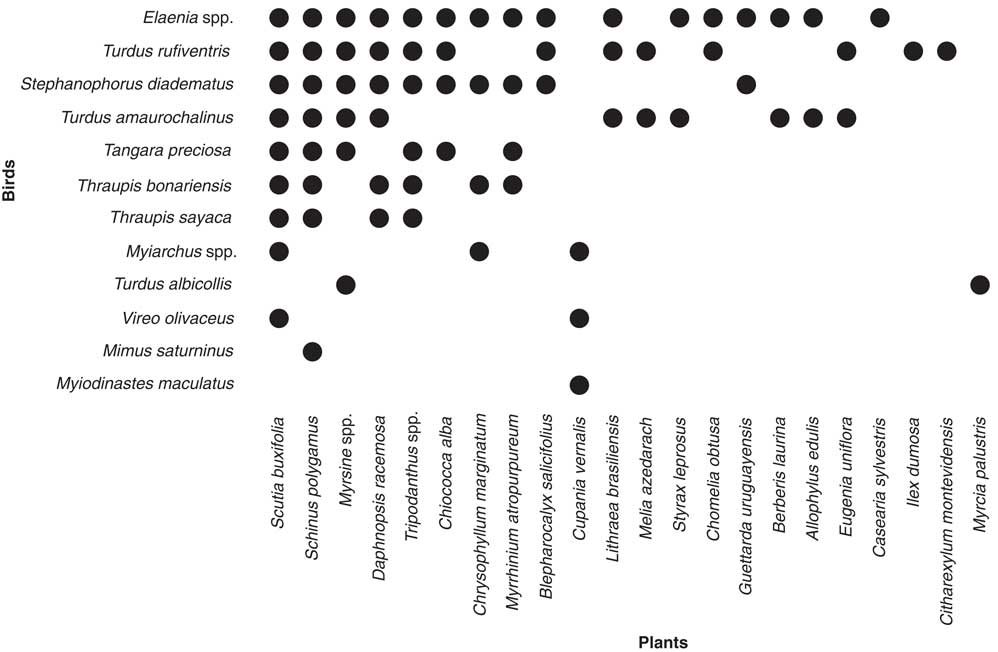
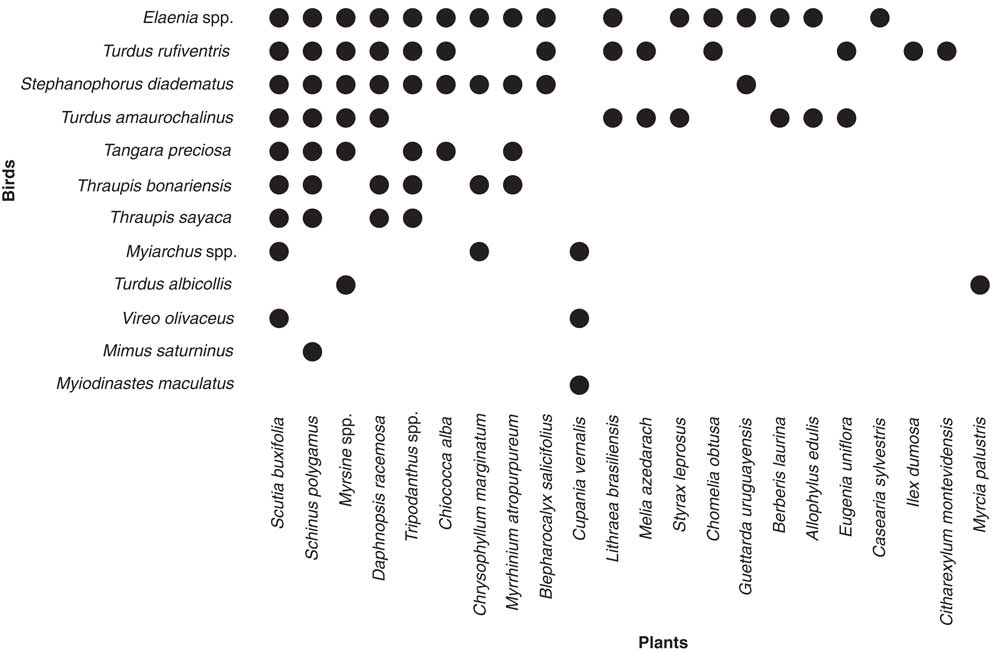
We used data collected during a bird trapping study between July 2007 and June 2008 (Azambuja Reference Azambuja2009, Bastazini et al. Reference Bastazini, Ferreira, Azambuja, Casas, Debastiani, Guimaraes and Pillar2017). Birds were captured in mist nets, which were set up for eight consecutive days every month in grasslands, c. 1 m away from the border of forest patches, in order to optimize bird capture success. Captured birds were placed into fabric bags for 20 minutes, so their faeces could be collected (Azambuja Reference Azambuja2009, Bastazini et al. Reference Bastazini, Ferreira, Azambuja, Casas, Debastiani, Guimaraes and Pillar2017). The seeds found in faecal samples were identified to the finest taxonomic resolution possible. Based on this information, we built a qualitative interaction matrix comprising 22 woody plant species and 12 frugivorous bird species (Fig. 1). Bastazini et al. (Reference Bastazini, Ferreira, Azambuja, Casas, Debastiani, Guimaraes and Pillar2017) demonstrated that trait coupling between birds and plants is an important driver of the structure of this network. We used the phylogeny of Bastazini et al. (Reference Bastazini, Ferreira, Azambuja, Casas, Debastiani, Guimaraes and Pillar2017) based on the APG III megatree (R20100701.new; Angiosperm Phylogeny Group 2009) and the traits used in their analyses (diaspore diameter, maximum plant height, aril presence, diaspore shape and colour; Bastazini et al. Reference Bastazini, Ferreira, Azambuja, Casas, Debastiani, Guimaraes and Pillar2017) to estimate the phylogenetic and functional distinctiveness indices explained in detail below.
Bi-adjacency matrix representing the seed dispersal network from a forest–grassland mosaic in southern Brazil.
Numerical Analyses
We estimated the phylogenetic distinctiveness of each plant species (i.e., how isolated a species is on the phylogenetic tree) using the fair proportion metric, which is defined as the sum of all edge lengths between the species and the root of the phylogenetic tree, with each edge length being divided by the number of species in the cluster it subtends (Redding et al. Reference Redding, Hartmann, Mimoto, Bokal, DeVos and Mooers2008). We repeated the same procedure in order to estimate the functional distinctiveness of each species (i.e., how distinct a species is in terms of its functional traits) based on a functional dendrogram using plant traits. The functional dendrogram was built using Ward’s sum of squares clustering procedure based on a Euclidean distance matrix calculated from species trait values (Legendre & Legendre Reference Legendre and Legendre2012).
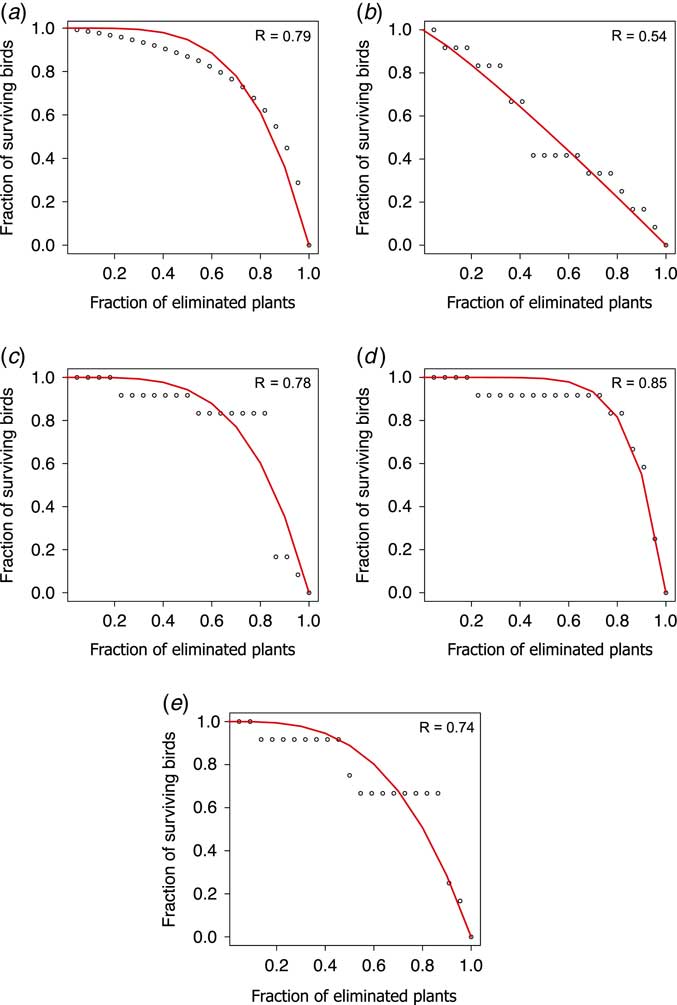
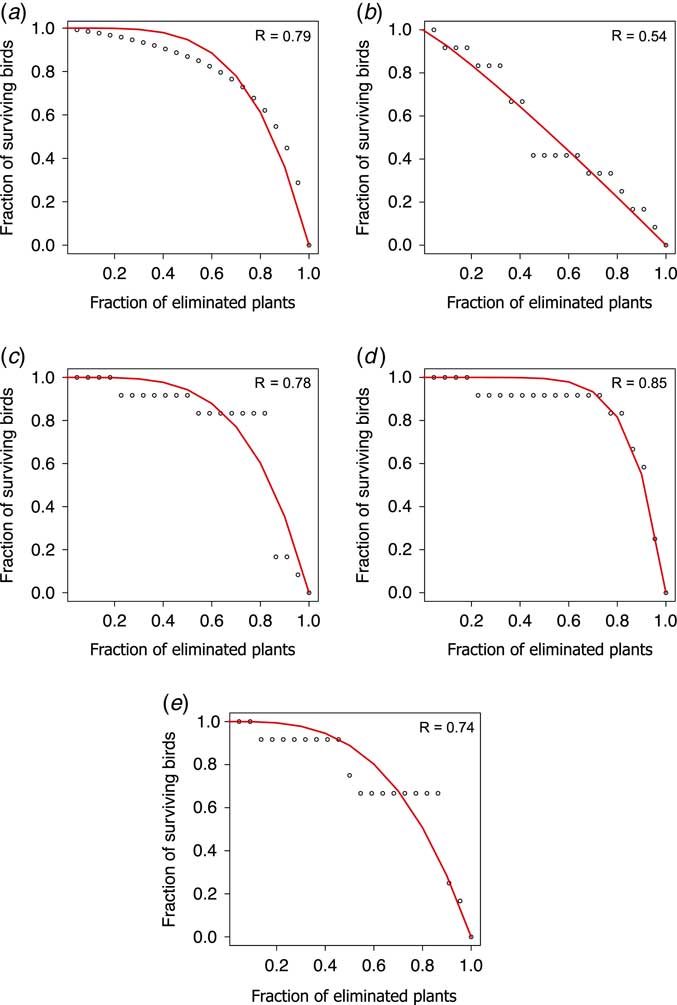
Secondary extinctions of woody plants were simulated by five distinct elimination schemes. The first was based on (a) random extinctions (using 1000 simulations) and provided a baseline scenario to compare the effects of the other scenarios (Dunne et al. Reference Dunne, Williams and Martinez2002, Memmott et al. Reference Memmott, Waser and Price2004, Astegiano et al. Reference Astegiano, Massol, Vidal, Cheptou and Guimarães2015). The other scenarios considered species specialization in the seed dispersal network, either with (b) the most generalist (most connected plants) or (c) the most specialist (poorly connected plants) species disappearing first; (d) species eliminated based on their evolutionary distinctiveness; and (e) based on species’ functional distinctiveness. In both (d) and (e), most distinct species, either in terms of their traits or phylogenetic position, were eliminated first. For each scenario, we calculated network robustness (R) defined as the area below the attack tolerance curve (ATC; Albert & Barabási Reference Albert and Barabási2002, Burgos et al. Reference Burgos, Ceva, Perazzo, Devoto, Medan, Zimmermann and Delbue2007), which represents the curve of the fraction of surviving bird species as a function of the eliminated plant species. R values vary between 0 and 1, where values closer to 1 indicate higher network robustness (Burgos et al. Reference Burgos, Ceva, Perazzo, Devoto, Medan, Zimmermann and Delbue2007).
All numerical simulations and analyses were performed in the R environment (R Core Team 2012) and the code is available on Github (https://github.com/bastazini/Networks).
Results
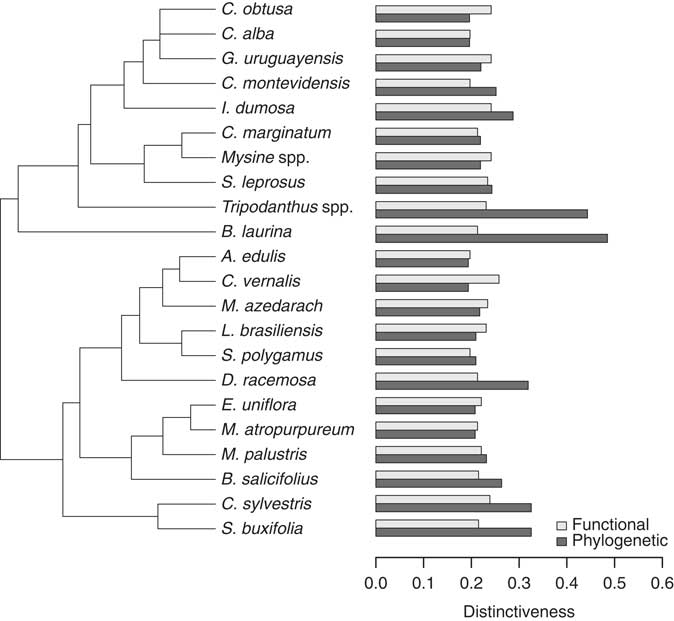
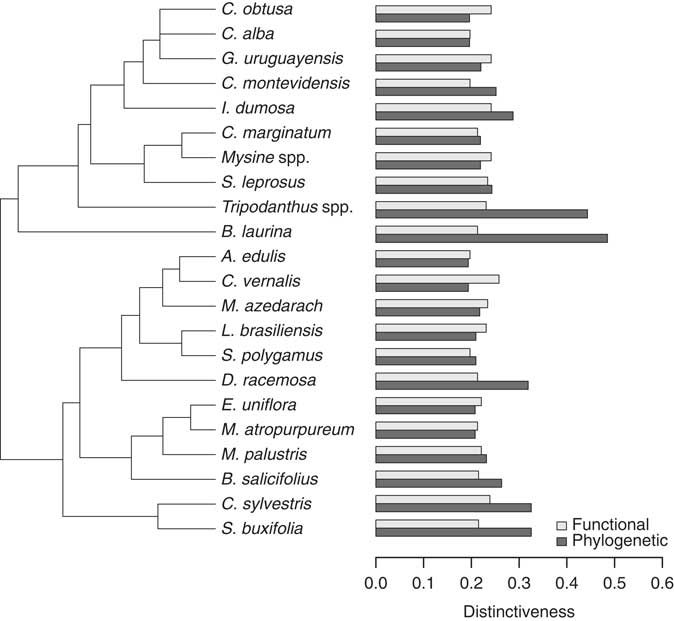
Species were more variable in terms of their phylogenetic distinctiveness (range: 0.19–0.48) than their functional distinctiveness (range: 0.19–0.25; Fig. 2). There was no correlation between both measures of distinctiveness (Pearson’s r=–0.015; p=0.94), which indicates that most unique species in the phylogenetic tree are not the most unique species in terms of their functional traits (Fig. 2).
Functional and phylogenetic distinctiveness of plant species, with the phylogeny plotted alongside, in a seed dispersal network from southern Brazil.
Considering all five scenarios, our seed dispersal network was likely to be very robust to the loss of woody plant species (average robustness considering all five simulated scenarios=0.74±SD=0.12). However, our simulations showed that distinct extinction scenarios have distinct effects on network robustness (Fig. 3). The loss of generalist species was more detrimental to network robustness, as the ATC of this scenario exhibited an abrupt initial decline (Fig. 3b). The other scenarios showed a less steep initial response to the loss of plant species. Network robustness was higher when species were eliminated based on their evolutionary uniqueness, followed by random extinctions, the extinction of the most specialist species and functional distinctiveness (Fig. 3).
Attack tolerance curves under different plant extinction sequences: (a) random; extinctions based on species specialization either with (b) the most generalist (most connected plants) or (c) the most specialist (poorly connected plants) species disappearing first; (d) species evolutionary distinctiveness; and (e) species functional distinctiveness.
Discussion
Empirical evaluations based on scenarios where primary extinctions occur as a function of species specialization or as random events (Solé & Montoya Reference Solé and Montoya2001, Dunne et al. Reference Dunne, Williams and Martinez2002, Memmott et al. Reference Memmott, Waser and Price2004, Burgos et al. Reference Burgos, Ceva, Perazzo, Devoto, Medan, Zimmermann and Delbue2007, Pocock et al. Reference Pocock, Evans and Memmott2012, Vieira et al. Reference Vieira, Cianciaruso and Almeida-Neto2013) may be unrealistic or offer a partial understanding of coextinction processes, as other ecological and evolutionary factors, such as body size and geographical range, influence the probability of a species becoming extinct (Purvis et al. Reference Purvis, Gittleman, Cowlishaw and Mace2000, Cardillo et al. Reference Cardillo, Mace, Jones, Bielby, Bininda-Emonds, Sechrest, Orme and Purvis2005, Reference Cardillo, Mace, Gittleman, Jones, Bielby and Purvis2008, Reynolds et al. Reference Reynolds, Dulvy, Goodwin and Hutchings2005). Here, we combine functional and phylogenetic information and show that extinction scenarios with loss of plant species that are more generalist or more distinct functionally are more detrimental to network robustness than the other extinction scenarios. Vieira et al. (Reference Vieira, Cianciaruso and Almeida-Neto2013) investigated the functional and phylogenetic consequences of random pollinator extinction in several pollination networks using a different metric to quantify functional and phylogenetic uniqueness. Their results suggest that there is an uncoupled response between functional and phylogenetic loss in mutualistic systems. Our study corroborates their findings, since our extinction scenarios based on functional and phylogenetic distinctiveness show very different responses in terms of network robustness. As we predicted, given the lack of phylogenetic signal in plant traits in this seed dispersal network (Bastazini et al. Reference Bastazini, Ferreira, Azambuja, Casas, Debastiani, Guimaraes and Pillar2017), plant functional and phylogenetic effects on bird species extinction were uncoupled, with the loss of phylogenetically distinct plant species having a lower impact on network robustness.
Despite this growing interest in coextinction and robustness analyses, studies focusing on seed dispersal networks are still scarce. Mello et al. (Reference Mello, Marquitti, Guimarães, Kalko, Jordano and de Aguiar2011b) analysed the robustness of 21 seed dispersal networks by simulating random extinctions of plants and frugivores (bats and birds). For plant–bird networks, they found that networks should be very robust to the loss of plant species, with a mean value of robustness (R=0.75) similar to the average of our five scenarios. Future studies are necessary to demonstrate whether seed dispersal networks are as robust as demonstrated by Mello et al. (Reference Mello, Marquitti, Guimarães, Kalko, Jordano and de Aguiar2011b) and our own analyses. But as plant–seed disperser interactions are a system of low specialization (Herrera Reference Herrera1995, Muller-Landau & Hardesty Reference Muller-Landau and Hardesty2005, Donoso et al. Reference Donoso, Schleuning, García and Fründ2017), high network robustness is expected. The sensitivity of dispersal networks to the primary extinction of plants or seed dispersers is still unclear. Mello et al. (Reference Mello, Marquitti, Guimarães, Kalko, Jordano and de Aguiar2011b) suggested that networks should be less robust when animal species are lost, and Schleuning et al. (Reference Schleuning, Fründ, Schweiger, Welk, Albrecht, Albrecht and Beil2016) argued that plant extinctions are more detrimental than animal extinctions in mutualistic networks. An important further step is to investigate the ability of species to replace their lost mutualistic partners. Experimental studies have suggested that rewiring (i.e., the rearrangement of species interactions through time) is likely to promote higher resistance in seed dispersal networks (Timóteo et al. Reference Timóteo, Ramos, Vaughan and Memmott2016, Costa et al. Reference Costa, Ramos, Silva, Timóteo, Andrade, Araújo, Carneiro, Correia, Cortez, Felgueiras, Godinho, Lopes, Matos, Norte, Pereira, Rosa and Heleno2018). Nonetheless, we still lack a deep understanding of the underlying mechanisms driving rewiring in mutualistic networks, as different factors such as spatial–temporal co-occurrence, environmental gradients and species traits and abundances may determine the probability of species interactions (Danielson Reference Danielson1991, Jordano Reference Jordano2000, Vizentin-Bugoni et al. Reference Vizentin-Bugoni, Maruyama and Sazima2014, Bastazini et al. Reference Bastazini, Ferreira, Azambuja, Casas, Debastiani, Guimaraes and Pillar2017). Although network rewiring models are likely to lead to more accurate predictions (Timóteo et al. Reference Timóteo, Ramos, Vaughan and Memmott2016, Costa et al. Reference Costa, Ramos, Silva, Timóteo, Andrade, Araújo, Carneiro, Correia, Cortez, Felgueiras, Godinho, Lopes, Matos, Norte, Pereira, Rosa and Heleno2018), not being able to correctly account for the mechanisms that determine the rearrangement of species interactions or simulate unconstrained rewiring might lead to an overestimation of network robustness to secondary extinctions (Costa et al. Reference Costa, Ramos, Silva, Timóteo, Andrade, Araújo, Carneiro, Correia, Cortez, Felgueiras, Godinho, Lopes, Matos, Norte, Pereira, Rosa and Heleno2018), which is undesirable from a conservation stand point. Nonetheless, we stress that although understanding the role of network rewiring is a critical question yet to be answered, our static and conservative approach provides valuable insights into the effects of eco-evolutionary mechanisms on network disassembly.
It is well recognized that generalist species play an important role in ecosystem functioning and stability (Memmott et al. Reference Memmott, Waser and Price2004, Richmond et al. Reference Richmond, Breitburg and Rose2005, Gaston & Fuller Reference Gaston and Fuller2008, Poisot et al. Reference Poisot, Mouquet and Gravel2013, Valiente‐Banuet et al. Reference Valiente‐Banuet, Aizen, Alcántara, Arroyo, Cocucci, Galetti and García2015). González et al. (Reference González, Dalsgaard and Olesen2010) suggested that generalist species have at least two important roles in pollination networks: generalists are able to interact with more species than specialist species; and they have the ability to connect otherwise unconnected sub-networks. Thus, generalist species may be responsible for creating a more cohesive network. This cohesive pattern is likely to augment the ability of the system to respond to perturbations, and consequently increase its stability (Bascompte et al. Reference Bascompte, Jordano, Melián and Olesen2003). Generalist species should receive special attention in conservation, as even small declines in their populations may result in significant disruption of ecosystems (Gaston & Fuller Reference Gaston and Fuller2008). Our seed dispersal network comprises a very heterogeneous set of plant species in terms of phylogenetic history (15 taxonomic families), life history and functional groups, including trees (e.g., Scutia buxifolia, Cupania vernalis and Styrax leprosus), shrubs (Berberis laurina, Chomelia obtusa and Daphnopsis racemosa), vines (Chiococca alba) and hemiparasite species (Tripodanthus spp.). Among this diverse set of taxa, five are responsible for c. 50% of all pairwise interactions, showing a larger number of connections: S. buxifolia, Schinus polygamus, Myrsine spp., D. racemosa and Tripodanthus spp. Overall, these five taxa are characterized by functional distinctiveness values lower than the median (except for Tripodanthus spp. and Myrsine spp.) and, except for S. polygamus, high phylogenetic distinctiveness. A common trait shared by these species is the size of their fruits, which is relatively small compared to the other species. As in other trophic interactions where predators have to swallow whole food items, fruit size is an important constraint in seed dispersal networks, and as a general rule, plants with large seeds and fruits tend to attract fewer animal species than plants with small fruits (Wheelwright Reference Wheelwright1985, Jordano Reference Jordano2000, Dehling et al. Reference Dehling, Jordano, Schaefer, Böhning-Gaese and Schleuning2016, Donoso et al. Reference Donoso, Schleuning, García and Fründ2017). Temporal availability and co-occurrence with its seed dispersers are also important factors enhancing the chance of a plant being consumed and dispersed by an animal (Jordano Reference Jordano2000). These well-connected plants are among the taxa with larger temporal co-occurrences with the most bird species in the network (Azambuja Reference Azambuja2009, Bastazini et al. Reference Bastazini, Ferreira, Azambuja, Casas, Debastiani, Guimaraes and Pillar2017). Thus, small fruits and phenological patterns seemed to be a possible explanation for some of the structural patterns and the robustness of this seed dispersal network.
We underline the implications of our study for conservation policies, especially in southern Brazil. The conservation of grassland–forest mosaics here has been the focus of much debate (Overbeck et al., Reference Overbeck, Müller, Fidelis, Pfadenhauer, Pillar, Blanco, Boldrini, Both and Forneck2007, Reference Overbeck, Hermann, Andrade, Boldrini, Kiehl, Kirmer and Koch2013, Luza et al. Reference Luza, Carlucci, Hartz and Duarte2014). As in other grassland ecosystems around the world, the grasslands of southern Brazil have experienced an increase in density of woody species that is drastically changing their physiognomy (Overbeck et al. Reference Overbeck, Müller, Fidelis, Pfadenhauer, Pillar, Blanco, Boldrini, Both and Forneck2007, Müller et al. Reference Müller, Overbeck, Pfadenhauer and Pillar2012). Forest expansion seems to be driven by nucleation processes influenced by the presence of facilitating structures, such as rocky outcrops or isolated trees established in the grassland matrix, which act as perches for vertebrate dispersers and as safe sites for woody plants (Carlucci et al., Reference Carlucci, Duarte and Pillar2011, Müller et al. Reference Müller, Overbeck, Pfadenhauer and Pillar2012). Most of the generalist tree species that we found in our study are important species for woody plant encroachment onto the grasslands of southern Brazil (Carlucci et al. Reference Carlucci, Duarte and Pillar2011, Müller et al. Reference Müller, Overbeck, Pfadenhauer and Pillar2012). These results could help to develop sounder strategies in species management and the restoration of grassland–forest mosaics in southern Brazil, as they suggest that the loss of generalist species and functional uniqueness is more detrimental to the robustness of seed dispersal networks.
Our findings provide important information for forest and grassland management in southern Brazil, as they indicated that the sequential extinction of generalist woody plant species and functional plant diversity made the system more likely to collapse, whereas the loss of evolutionary uniqueness and specialist species had a smaller effect on network robustness. Despite its simplicity, our framework stresses the importance of considering distinct extinction scenarios and can help ecologists to understand and predict cascading effects in ecological systems.
Acknowledgements
We thank Andreas Kindel, André Luza, Danis Kiziridis, Kirsten Henderson, Paulo Prado, Rodrigo Bergamin, Sandra C. Muller, Nicholas Polunin and two anonymous reviewers for providing valuable suggestions that greatly improved this manuscript.
Financial Support
VAG Bastazini received support from CAPES (grant #1002302), the TULIP Laboratory of Excellence (ANR-10-LABX-41 and 394 ANR-11-IDEX-002-02) and from a Region Midi-Pyrenees project (CNRS 121090), VD Pillar from CNPq (grant #307689/2014-0), PR Guimarães Jr from CNPq and FAPESP (grant #2017/08406-7) and VJ Debastiani from CNPq (grant #150417/2017-9).
Conflict of Interest
None.
Ethical Standards
None.