Introduction
The genus Opegrapha comprises at least 40 species in Brazil (Redinger Reference Redinger1940). It is a genus in the lichen family Roccellaceae, recognized by the usually elongate to branched ascomata with at least a partly carbonized excipulum, anastomosing paraphyses, thick-walled clavate asci which are amyloid or hemi-amyloid, and hyaline, transversely septate ascospores with thick walls and rounded lumina. The ascospores are often surrounded by a gel layer and sometimes become ornamented and pale brown when overmature.
The genus Dictyographa has been characterized by the same characters, except that the ascospores are also longitudinally septate and thus muriform. The species described in Dictyographa were revised by Ertz & Diederich (Reference Ertz and Diederich2007), who included the two species finally accepted in the group in the genus Opegrapha, as the longitudinal septation seemed the only character joining these two species. Ertz & Tehler (Reference Ertz and Tehler2011) reinstated the genus Dictyographa for the same two muriform Opegrapha species.
Both Opegrapha species with muriform ascospores (or Dictyographa species) are reported only from the palaeotropics, including Pacific islands (Ertz & Diederich Reference Ertz and Diederich2007). In the course of an inventory and ecological study of the corticolous lichen flora of the Vale do Catimbau National Park in Pernambuco, north-eastern Brazil, an undescribed Opegrapha with submuriform ascospores was found to be locally common. It is the first species of Opegrapha with muriform ascospores known from the neotropics.
The new species differs from all species known so far in the genus (or in related genera) by the combination of the following characters: submuriform ascospores and a brown pruina on the apothecium disc. It is therefore described below as new to science.
Material and Methods
Identification and descriptive work was carried out in Itabaiana, Universidade Federal de Sergipe, using a Leica EZ4 stereomicroscope and a Leica DM500 compound microscope, and also in Soest using an Olympus SZX7 stereomicroscope and an Olympus BX50 compound microscope with interference contrast, connected to a Nikon Coolpix digital camera. Sections were mounted in tap water, in which all measurements were also taken. The specimens from this study are preserved in ISE. The chemistry of the type specimen was investigated by thin-layer chromatography (TLC) using solvent A (Orange et al. Reference Orange, James and White2001).
The Species
Opegrapha subdictyospora M. Cáceres & Aptroot sp. nov.
MycoBank No.: MB 801105
Corticolous Opegrapha with submuriform ascospores and a brown pruinose disc.
Type: Brazil, Pernambuco, Buíque, Vale do Catimbau National Park, at Morro do Cachorro trail, on bark of tree, c. 900 m alt., 19 September 2007, M. E. S. Cáceres 4231 (ISE—holotype).
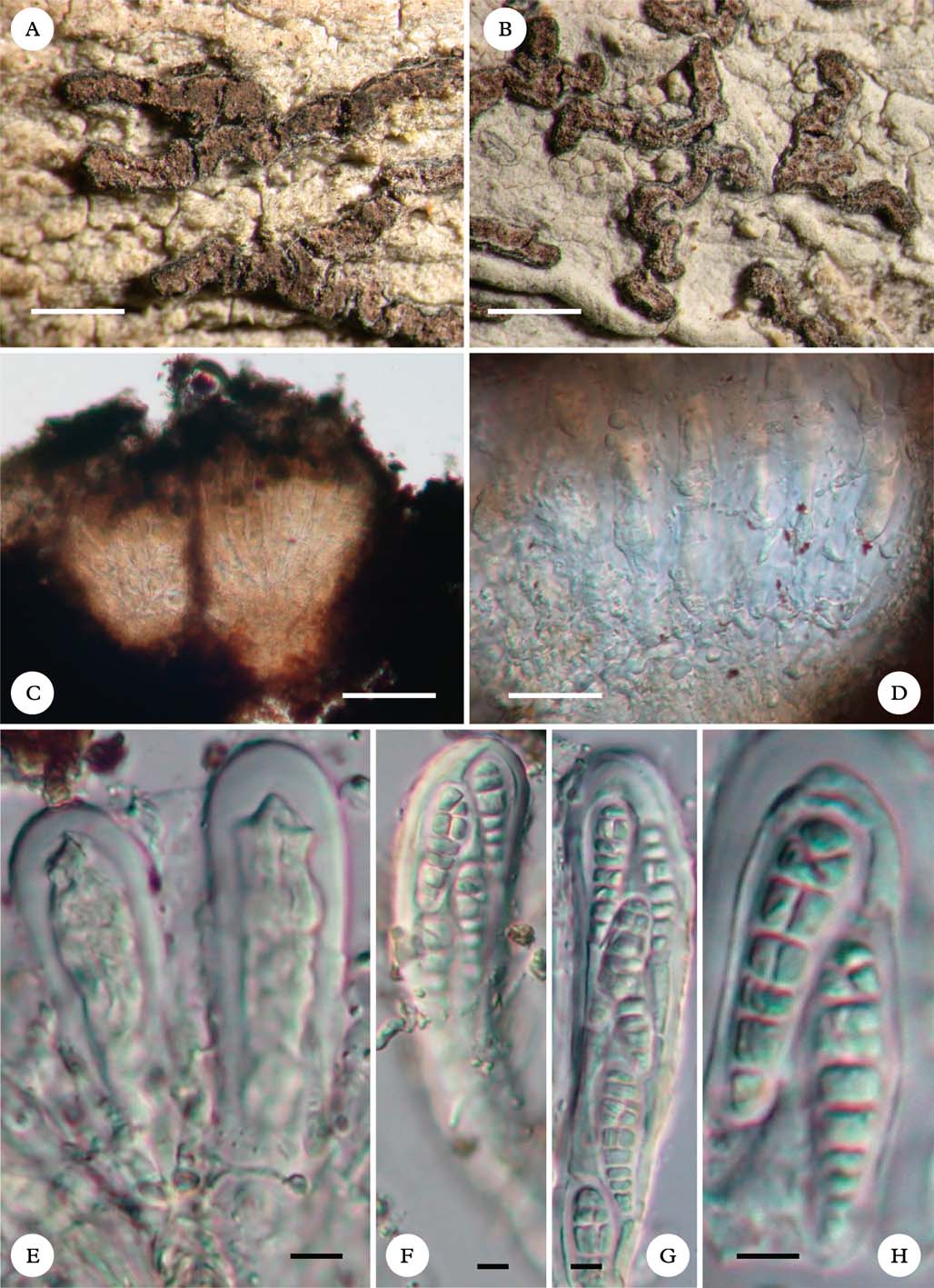
(Fig. 1)
Opegrapha subdictyospora. A, habitus (Cáceres 4238); B, habitus (Cáceres 4243); C, section through ascomata (Cáceres 4243); D, hymenium (Cáceres 4243); E, immature asci (Cáceres 4243); F–H, asci with ascospores (holotype). Scales: A & B=1 mm; C=0·2 mm; D=50 µm; E–H=5 µm. In colour online.
Thallus crustose, cracked, not corticate, dull, pale ochraceous to nearly white, very thin and closely following the bark surface, surrounded by a brown prothallus line. Thallus pruina not present.
Apothecia numerous, dispersed, sessile, elongate to furcate, partly simple but mostly branched, up to 5 mm long, outline shape irregularly zigzag-like; disc flat, chocolate brown, dull, partly whitish pruinose (especially towards the margin), 0·2–0·4 mm wide, margin black, c. 0·1 mm wide. Excipulum carbonaceous, continuous below the hymenium, c. 100 µm thick. Hymenium not inspersed, IKI+ reddish, after KOH IKI+ blue; paraphysoids anastomosing, c. 1 µm wide, apices not swollen. Asci cylindrico-clavate, 23–27×23–27 µm, wall c. 3–5 µm thick, tip IKI+ blue. Ascospores 8 per ascus, hyaline, submuriform, 7–9×0–2-septate, IKI−, clavate, 23–27×6–7 µm, wall c. 1·5 µm thick, surrounded by a c. 1 µm thick gelatinous layer. Young ascospores transversely (1–)5(–7)-septate, many 5-septate and then with largest lumen just above the central septum (Fig. 1F), suggesting that they stay 5-septate for a relatively long time during their development, not macrocephalic.
Pycnidia brown, punctiform, along the prothallus. Conidia not observed.
Chemistry
UV+ whitish, C−, P−, K+ dirty yellow. TLC: no substances, only terpenoids from the host bark.
Ecology and distribution
On smooth bark of trees in Caatinga forest. Known only from Brazil.
Discussion
There are only two species of Opegrapha known with muriform ascospores (Ertz & Diederich Reference Ertz and Diederich2007), from which the new species differs by, for example, the brown disc and the submuriform rather than densely muriform mature ascospores. Opegrapha arabica (Müll. Arg.) Vain. (Dictyographa arabica Müll. Arg.) lacks a dark hypothecium and has densely muriform ascospores that seem to remain 3-septate for a relatively long time during their development (Ertz & Diederich Reference Ertz and Diederich2007). Opegrapha varians (Müll. Arg.) Vain. (Dictyographa varians (Müll. Arg.) Müll. Arg.) has a dark hypothecium but in addition has densely muriform ascospores that also seem to remain 3-septate for a relatively long time during their development (Ertz & Diederich Reference Ertz and Diederich2007). The new species is the first species of Opegrapha with (sub)muriform ascospores known from the neotropics; the other two are reported only from the palaeotropics, including Pacific islands.
The terpenoid found on the TLC plate of the type specimen originates from the host bark, which was demonstrated by performing TLC of the bark without lichen, which gave the same result.
The structures described as pycnidia did not contain any conidia. Their orientation on the thallus (along the prothallus) is reminiscent of pycnidia in many other crustose Arthoniales.
The generic placement of this species, though clearly undescribed, poses some challenges. The genus Dictyographa, originally thought to differ from Opegrapha only by the muriform ascospores, was synonymized with it by Ertz & Diederich (Reference Ertz and Diederich2007). With the splitting of Opegrapha into several unrelated genera as a result of phylogenetic studies (Ertz & Tehler Reference Ertz and Tehler2011), it recently became reinstated. The new species has not been sequenced and it does not seem very close to the two Dictyographa species. Finally, the new species shows similarities with species of the genus Lecanographa (Egea & Torrente Reference Egea and Torrente1994), which generally have pruinose discs, but often rounded ascomata and/or symmetrical (not clavate) ascospores, and of which no species are known with a tendency to muriform ascospore septation. Given that the phylogenetic position of the new species is unknown, it is preferred here to describe it in the genus Opegrapha, which contains many species of unknown affinities, rather than in the isolated small genus Dictyographa.
Additional specimens seen. Brazil: Pernambuco: Buíque, Vale do Catimbau National Park, Morro do Cachorro trail, 2007, M. E. S. Cáceres 4243, 4238 & 4241 (all ISE); Serra Branca, 2011, E. L. Lima 141 (ISE); Breu de Jovane, 2012, E. L. Lima 403 & 407 (URM); Serrinha, 2012, E. L. Lima 653, 726, 732, 810 (all URM).
The CNPq (Conselho Nacional de Desenvolvimento Científico e Tecnológico) is thanked for a research grant to MESC (Processo 501633/2009-0) and for financial support for the collecting trips (CNPq-Protax Processo 562.330/2010-0 and INCT-Herbário Virtual Processo 573.883/2008-4). The Fundação de Amparo à Ciência e Tecnologia do Estado de Pernambuco (FACEPE) is also thanked for a Master's scholarship to ELL. We are grateful to Leo Spier for performing thin-layer chromatography. AA thanks the Stichting Hugo de Vries-Fonds for a travel grant.