



LEARNING OBJECTIVES
After reading this article you will be able to:
-
understand the risk and management of clozapine-induced myocarditis and cardiomyopathy
-
manage clozapine-associated tachycardia and conduction deficits
-
understand the limitations of diagnosing and monitoring clozapine-induced myocarditis in psychiatric practice.
Clozapine is the only evidence-based treatment option for treatment-resistant schizophrenia. Most national and international guidelines, including those by the UK’s National Institute for Health and Care Excellence (NICE), support its use for this indication (NICE 2014). However, clozapine is associated with a range of adverse effects, from mild and transient to severe and potentially fatal conditions such as agranulocytosis and myocarditis. Concerns about these adverse effects, coupled with the need for regular monitoring, are frequently cited as reasons for its underutilisation (Meyer Reference Meyer and Stahl2020). Even when prescribed, its adverse effects are often poorly managed, leading to unnecessary discontinuation (Nielsen Reference Nielsen, Damkier and Lublin2011).
Clozapine affects multiple organ systems, including the gastrointestinal, urinary, haematological and cardiovascular systems. Cardiac adverse effects include myocarditis, cardiomyopathy, tachycardia and conduction deficits. This review focuses specifically on these adverse cardiac effects. Although clozapine is also associated with an increased risk of metabolic syndrome, studies have shown it results in lower all-cause mortality, including deaths from ischaemic heart disease, compared with other commonly used antipsychotic drugs (Tiihonen Reference Tiihonen, Lönnqvist and Wahlbeck2009).
The British National Formulary (BNF) and clozapine’s summary of product characteristics indicate that its use is contraindicated in severe cardiac disorders, with myocarditis cited as an example. However, the term ‘severe cardiac disorders’ is not clearly defined. NICE guidelines recommend physical health monitoring for antipsychotic drugs, including monitoring pulse and blood pressure during titration and dose changes and annual electrocardiograms (ECGs) (NICE 2014). Despite this, the UK lacks formal guidelines specifically addressing the monitoring or management of myocarditis or other cardiac adverse effects associated with clozapine. Consequently, monitoring practices still vary significantly across the country, as they did 5 years ago (Barnes Reference Barnes, MacCabe and Kane2020).
Clozapine-induced myocarditis (CIM)
Definition and incidence
Myocarditis refers to inflammation of the myocardium, the muscular middle layer of the heart. It is characterised by infiltration of inflammatory cells into the myocardium and non-ischaemic necrosis. Although outcomes are generally favourable if myocarditis is identified and treated early, complications can include cardiogenic shock, sudden death and long-term dilated cardiomyopathy.
Myocarditis is relatively uncommon and its actual incidence is difficult to ascertain, as many cases are mild and remain undiagnosed. Common causes of myocarditis are summarised in Box 1. Numerous medications, including psychotropic ones such as olanzapine, quetiapine and aripiprazole, have been implicated in its development. However, clozapine is the most strongly associated with myocarditis so far (Daniel Reference Daniel, Rajaree and Rudy2023).
Common causes of myocarditis
Infectious
-
Viral: coxsackievirus, parvovirus, cytomegalovirus, Epstein–Barr virus, HIV, coronavirus, etc.
-
Bacterial: diphtheria, salmonella, tuberculosis, salmonella, etc.
-
Spirochaetal: syphilis, leptospirosis, etc.
-
Myocytic: candidiasis, histoplasmosis, etc.
-
Rickettsial: typhus, Q fever, etc.
-
Helminthic: trichinosis, echinococcosis, etc.
-
Protozoal: malaria, toxoplasmosis, etc.
Non-infectious
-
Cardiotoxins: catecholamines, cocaine, alcohol, carbon monoxide
-
Medications:• Antibiotics: Penicillin, Cephalosporin • Diuretics: Thiazide, Loop diuretics • Psychotropic medication: Clozapine, Quetiapine, Olanzapine, Aripiprazole, Risperidone, Haloperidol, Fluphenazine
-
Systemic disorder: collagen vascular disease, sarcoidosis, coeliac disease, etc.
-
Radiation
Clozapine-induced myocarditis (CIM) was first identified in a fatal overdose case in 1980 (Vesterby Reference Vesterby, Pedersen and Kaempe1980). In 1993, the UK reported four CIM cases, including three fatalities, with awareness increasing after a study by Kilian et al (Reference Kilian, Kerr and Lawrence1999), which highlighted a 2000-fold increased myocarditis risk within the first month of clozapine therapy. These findings led Novartis, one of the manufacturers of clozapine, to introduce cardiac monitoring guidelines in Australia, recommending the monitoring of troponin and creatine kinase-MB (CK-MB) for the first 14 days. However, these guidelines were criticised for their limited scope, lacking specific thresholds for discontinuing clozapine.
Ronaldson et al proposed a detailed case definition (Reference Ronaldson, Taylor and Fitzgerald2010) and a monitoring protocol, initially adopted in Australia and later in other countries. In the UK, NICE guidelines (2014) do not specify monitoring parameters for myocarditis. The Maudsley Prescribing Guidelines recommend monitoring using troponin, beta-natriuretic peptide (BNP) and C-reactive protein (CRP) levels (Taylor Reference Taylor2021).
Common symptoms of myocarditis
Cardiac
-
Chest discomfort
-
Tachycardia
-
Palpitation
-
Chest pain
-
Hypotension
-
Exercise intolerance
-
Peripheral oedema
-
Arrythmia
-
Syncope
-
Sudden cardiac death
Generalised
-
Fever
-
Fatigue
-
Rashes
-
Myalgia
-
Arthralgia
-
Dizziness
Respiratory
-
Sore throat
-
Cough
-
Shortness of breath
-
Rhinorrhoea
-
Orthopnoea
Gastrointestinal
-
Gastrointestinal discomfort
-
Abdominal pain
-
Nausea
-
Vomiting
-
Diarrhoea
The incidence of CIM varies widely worldwide, with significantly higher rates reported in Australia. Reported incidence rates range from as high as 8.5% in Australia (Ronaldson Reference Ronaldson, Fitzgerald and McNeil2015) to 0.03% in a Danish registry study (Rohde Reference Rohde, Polcwiartek and Kragholm2017). A systematic review by Curto et al (Reference Curto, Girardi and Lionetto2016) found that most countries reported incidences below 0.1%, whereas Australia reported rates between 1 and 3%. These variations may result from differing definitions of myocarditis and variations in monitoring practices. Routine monitoring may identify milder, subclinical cases, explaining Australia’s higher incidence rates and lower mortality. Several hypotheses have been proposed to explain these differences, including genetic predispositions, rapid clozapine titration and environmental factors such as high ozone exposure in Australia, which can cause cholinergic dysfunction (Daniel Reference Daniel, Rajaree and Rudy2023; Kanniah Reference Kanniah and Kumar2020). However, these theories remain debated. Ronaldson et al (Reference Ronaldson, Fitzgerald and McNeil2015) suggested that countries without routine monitoring may miss myocarditis cases, and the universal risk of myocarditis may be approximately 3%.
As noted above, CIM can be fatal if not detected early. A systematic review reported a 21% fatality rate in documented cases (Bellissima Reference Bellissima, Tingle and Cicović2018). A more recent meta-analysis of 18 studies found that clozapine exposure was associated with an absolute death rate from myocarditis of 4 per 10 000 people (an event rate of 0.0004, 95% CI 0.0002–0.0009) with moderate heterogeneity (Siskind Reference Shivakumar, Thomas and Sollychin2020). The fatality rate due to myocarditis exceeds that of agranulocytosis, which is estimated at 1.3 per 10 000 people (Taylor Reference Taylor2021).
Pathophysiology
Clozapine-induced myocarditis is believed to result from an acute hypersensitivity reaction to the drug. This hypothesis is supported by the presence of eosinophilic infiltrates in myocardial biopsy samples and the acute onset of symptoms following the initiation of clozapine. Alternative mechanisms include toxic clozapine accumulation due to cytochrome P450 1A2/1A3 deficiency or elevated plasma levels of noradrenaline and inflammatory cytokines (Patel Reference Patel, Moore and Piper2019; Daniel Reference Daniel, Rajaree and Rudy2023).
Risk factors for CIM include rapid titration of clozapine dosage and the co-prescription of other psychotropic drugs, such as sodium valproate. Although some studies have suggested potential associations with increased age, male gender and the co-prescription of selective serotonin reuptake inhibitors (SSRIs), a recent meta-analysis did not find these associations to be statistically significant (Vickers Reference Vickers, Ramineni and Malacova2022).
Signs and symptoms
Clozapine-induced myocarditis is an acute adverse reaction that may present with a wide range of symptoms, from non-specific flu-like manifestations to more specific cardiac ones (Box 2). There are also reports of asymptomatic cases in which the diagnosis was only made post-mortem (Ronaldson Reference Ronaldson, Fitzgerald and Taylor2011). On physical examination, findings may range from normal to more concerning signs, including low blood pressure, raised jugular venous pressure (JVP), chest congestion or a pericardial friction rub. CIM typically occurs early in treatment, with over 85% of cases manifesting within the first 2 months and up to 75% within the first 3 weeks (Kanniah Reference Kanniah and Kumar2020). Ronaldson et al (Reference Ronaldson, Fitzgerald and Taylor2011) have described the typical course of myocarditis in a cohort of 75 cases.
Symptoms of CIM typically appear 10–19 days after initiation, accompanied by elevated CRP levels (>50 mg/dL). Troponin levels rise, with clinical signs such as postural hypotension, ECG changes and left ventricular dysfunction emerging during this period, highlighting the need for early detection. Prompt discontinuation of clozapine early in the course of CIM often results in symptom remission (Ronaldson Reference Ronaldson, Fitzgerald and Taylor2011). However, continued clozapine use can lead to severe complications, including fulminant myocarditis, heart failure, high-grade atrioventricular block, sustained ventricular arrhythmias and cardiogenic shock, significantly increasing the risk of death. Despite this, there are documented cases of myocarditis resolving without long-term sequelae, even when clozapine was not discontinued (Ronaldson Reference Ronaldson, Fitzgerald and Taylor2012a).
Given this variability, predicting the prognosis for individual patients is difficult. Therefore, close monitoring of symptoms and cardiac function is essential, especially during the initial weeks of clozapine therapy.
Diagnosis
The diagnostic workup for myocarditis involves a combination of clinical examination and investigations. Various laboratory and radiological tests have been proposed to aid in the diagnosis. In the psychiatric literature, many Australian studies have used Ronaldson et al’s case definition and monitoring protocol to define and monitor cases of CIM (Ronaldson Reference Ronaldson, Taylor and Fitzgerald2010, Reference Ronaldson, Fitzgerald and Taylor2011). These criteria, including thresholds for discontinuing clozapine, are based primarily on expert opinion rather than robust validation.
In cardiology practice, criteria proposed by the European Society of Cardiology (ESC) Working Group on Myocardial and Pericardial Diseases are commonly used for suspected myocarditis (Caforio Reference Caforio, Pankuweit and Arbustini2013: Table 4). Under those criteria, Ronaldson et al’s case definition pertains to suspected rather than confirmed cases of CIM. Furthermore, the thresholds recommended by their protocol have not been validated and are not standard in cardiology. This discrepancy has led to suggestions that reliance on Ronaldson et al’s criteria may overestimate the incidence of CIM and contribute to the premature discontinuation of clozapine (Sweeney Reference Sweeney, Whiskey and Patel2020).
The following investigations are commonly proposed for the diagnosis of CIM.
Electrocardiogram (ECG)
Electrocardiogram (ECG) findings in myocarditis are typically abnormal but are neither sufficiently sensitive nor specific for the diagnosis (Caforio Reference Caforio, Pankuweit and Arbustini2013). In this context, the primary role of ECG is to exclude other major cardiac emergencies, such as myocardial infarction or arrhythmias, which can present with similar symptoms. Common ECG findings in myocarditis include sinus tachycardia, atrial or ventricular arrhythmias, prolonged QT interval, T-wave inversion and saddle-shaped ST elevation (we return to these symptoms in the section ‘Clozapine-induced cardiomyopathy (CCM)’ below).
To ensure an accurate interpretation of ECG changes during treatment, it is essential to obtain a baseline ECG before initiating clozapine therapy. This allows clinicians to attribute any subsequent ECG abnormalities to clozapine use or other emerging cardiac conditions.
Eosinophilia
Clozapine-induced myocarditis is most likely an acute allergic phenomenon. Peripheral eosinophilia may be present in some patients; however, it is not universally observed and can be a delayed feature, appearing up to 8 days after troponin levels peak (Ronaldson Reference Ronaldson, Fitzgerald and Taylor2011; Bellissima Reference Bellissima, Tingle and Cicović2018). Additionally, peripheral eosinophilia is a non-specific marker for CIM and should not be relied on as a primary tool for monitoring or diagnosing myocarditis.
NT-proBNP and CK-MB
Use of NT-proBNP (see the CCM section below) and CK-MB levels is not recommended for diagnosis or monitoring in CIM (Caforio Reference Caforio, Pankuweit and Arbustini2013).
CRP
C-reactive protein is a liver-produced protein that rises in response to any inflammation. It is a non-specific marker for CIM and can also be elevated in conditions such as clozapine-induced fever, serositis, and chest or urinary tract infections. However, elevated CRP alongside elevated troponin levels may be an early indicator of CIM. Ronaldson et al (Reference Ronaldson, Fitzgerald and Taylor2011) suggested that a rise in CRP >50 mg/dL typically precedes increased troponin levels, warranting more frequent troponin monitoring. They also reported five cases where CRP levels exceeded 100 mg/dL, with left ventricular abnormalities despite normal troponin levels. Based on these findings, their recommendation was to discontinue clozapine if CRP exceeds 100 mg/dL. However, it is crucial to remember that an elevated CRP level alone does not confirm CIM without other supporting findings (Caforio Reference Caforio, Pankuweit and Arbustini2013; Sweeney Reference Sweeney, Whiskey and Patel2020).
Troponin
Conventional and high-sensitivity troponin assays measure one of two proteins in a blood sample – troponin T or I. These proteins are released into the bloodstream when cardiac muscle is injured, as seen in conditions such as myocardial ischaemia/infarction, myocarditis and pulmonary embolism. The troponin T and I levels increase in proportion to the severity of cardiac muscle injury. High-sensitivity troponin tests are more accurate at detecting myocarditis than conventional tests. An elevation of troponin I/T levels to more than twice the upper normal limit (UNL) is observed in 90% of cases diagnosed using Ronaldson et al’s criteria (Ronaldson Reference Ronaldson, Fitzgerald and Taylor2011). A normal troponin level does not exclude myocarditis (Caforio Reference Caforio, Pankuweit and Arbustini2013), although this would be highly atypical.
Troponin is a marker of myocardial injury; hence, in mild or early cases, there might not be a significant increase. Therefore, sequential troponin testing should be done in suspected cases. Additionally, the cut-off of troponin I/T >2 times the UNL has not been validated against cardiac biopsy (the gold standard for diagnosing myocarditis) or other more specific diagnostic tools, such as echocardiography or cardiac magnetic resonance imaging (MRI). Therefore, there is a risk of over-diagnosing myocarditis in the absence of other supportive findings (Sweeney Reference Sweeney, Whiskey and Patel2020).
Echocardiogram
Transthoracic echocardiography (TTE) is the most commonly used investigation for suspected CIM. In cases of myocarditis, typical findings include biventricular or left ventricular dysfunction, regional wall motion abnormalities and diastolic dysfunction. TTE can also help rule out non-inflammatory cardiac conditions such as valvular diseases. However, it is important to note that a normal echocardiogram does not exclude the possibility of myocarditis.
Cardiac MRI (CMR)
Cardiac magnetic resonance imaging (CMR) has become the preferred investigation for diagnosing myocarditis. It can assess the localisation of myocardial fibrosis, necrosis, oedema and hyperaemia. The updated Lake Louise Consensus Criteria (2018) for myocarditis are commonly used to diagnose the condition, and this approach has largely replaced the need for cardiac biopsy in most cases. CMR is more sensitive and specific for diagnosing acute myocarditis, with a reported sensitivity of 81% and specificity of 71%, compared with endomyocardial biopsy as the reference standard (Lurz Reference Lurz, Eitel and Adam2012). However, obtaining a cardiac MRI can present challenges, particularly in people with acute psychosis.
Cardiac biopsy
Cardiac biopsy is considered the gold standard for investigating inflammatory heart diseases, including myocarditis. However, in clinical practice, this procedure is rarely performed owing to its invasiveness and associated risks, such as tamponade and perforation. An endomyocardial biopsy typically reveals inflammatory cellular infiltrates within the cardiac tissue, with or without concomitant myocyte necrosis and eosinophilic inclusions. It is crucial to carefully select the biopsy site to minimise the risk of false-negative results.
Monitoring and management
The use of regular blood tests (for CRP and troponin) to monitor for CIM remains contentious. Proponents argue that CIM is a severe and potentially fatal adverse effect, often presenting with non-specific symptoms, and early identification can lead to timely and effective intervention. However, the opposing view suggests that CIM is a relatively rare or uncommon side-effect, and routine monitoring without specialist input may result in false positives, leading to unnecessary discontinuation of an effective drug. Moreover, such monitoring may not be cost-effective, particularly in countries with low reported incidence of CIM. There are concerns that increasing monitoring requirements could discourage clinicians from prescribing clozapine (Dawson Reference Dawson, Clark and Sluggett2018; Sweeney Reference Sweeney, Whiskey and Patel2020; Segev 2021). Wagner et al (Reference Wagner, Siskind and Falkai2023) failed to achieve international consensus on monitoring, with barriers including the low incidence of CIM and the high monitoring cost in most countries.
Given that the risk of CIM is primarily confined to the first 8 weeks of treatment, it is prudent to maintain a high index of suspicion. There are a few monitoring options that have been suggested in the literature.
The first is to monitor the patient for symptoms such as fatigue, dyspnoea, chest discomfort, palpitations, fever, flu-like illness and peripheral oedema. Any emergent signs and symptoms should prompt immediate investigation, including ECG and CRP and troponin levels. For example, clozapine-induced fever typically occurs within the first 4 weeks of treatment and resolves in 2–5 days, with tachycardia also starting early. If the patient’s symptoms subside and troponin levels remain normal, the risk of myocarditis is low.
An alternative approach is to add tests for inflammatory markers (CRP) and cardiac enzymes (troponin) to the baseline weekly blood tests for the first 4–8 weeks (Curto Reference Curto, Girardi and Lionetto2016; Kanniah Reference Kanniah and Kumar2020; de Leon Reference de Leon, Schoretsanitis and Smith2022). Another suggestion is to monitor only high-risk patients, such as those with pre-existing cardiac disorders (Sweeney Reference Sweeney, Whiskey and Patel2020).
In clinical practice, clozapine is prematurely discontinued in many patients with suspected myocarditis. Goodison et al (Reference Goodison, Siskind and Harcourt-Rigg2015) noted that 65% of patients reported with CIM did not meet Ronaldson et al’s case definition (Ronaldson Reference Ronaldson, Taylor and Fitzgerald2010). A similar retrospective review at South London and Maudsley NHS Foundation Trust found that 80% of 228 people with suspected CIM did not actually have CIM confirmed. This study used stricter criteria than Ronaldson et al’s, requiring either a positive echocardiogram or MRI, alongside other supportive findings (Segev 2021). Therefore, it has been suggested that clozapine should be withheld in suspected CIM cases with elevated troponin levels, and a cardiology consultation should be arranged as soon as possible before permanently discontinuing clozapine (Segev 2021).
We recommend conducting baseline ECG and CRP and troponin tests and carefully monitoring patients for any signs or symptoms suggestive of CIM. CRP and troponin levels should be reassessed on days 7, 14, 21 and 28, or earlier if symptoms develop, along with an ECG.
CRP levels can indicate the severity of inflammation, and some evidence suggests that slowing the titration of clozapine based on CRP levels might prevent dose-related adverse effects, including myocarditis (de Leon Reference de Leon, Schoretsanitis and Smith2022). Conversely, elevated or rising troponin levels should raise suspicion for CIM, warranting an urgent referral to cardiology for further investigation. If CIM is not confirmed after examination and investigations, clozapine may be resumed, closely monitoring symptoms and troponin and CRP levels.
Rest and regular observation are essential during the early stages of myocarditis, as acute forms can have an uncertain course. Hospital admission is recommended, and patients should be treated under specialist care owing to the risk of deterioration and associated complications, including reduced left ventricular ejection fraction (LVEF), overt heart failure, advanced atrioventricular block, sustained ventricular arrhythmias, cardiogenic shock and even death. In mild cases, discontinuing clozapine should improve symptoms and left ventricular function within a few days. In more severe cases, the withdrawal of clozapine and corticosteroids is the mainstay of treatment. Heart failure should be managed with diuretics, beta-blockers, angiotensin converting enzyme (ACE) inhibitors, mineralocorticoid receptor antagonists, and sodium–glucose co-transporter 2 (SGLT2) inhibitors (Bellissima Reference Bellissima, Tingle and Cicović2018). Close collaboration with local cardiologists and service-level agreements is essential for early and timely access to specialist opinions.
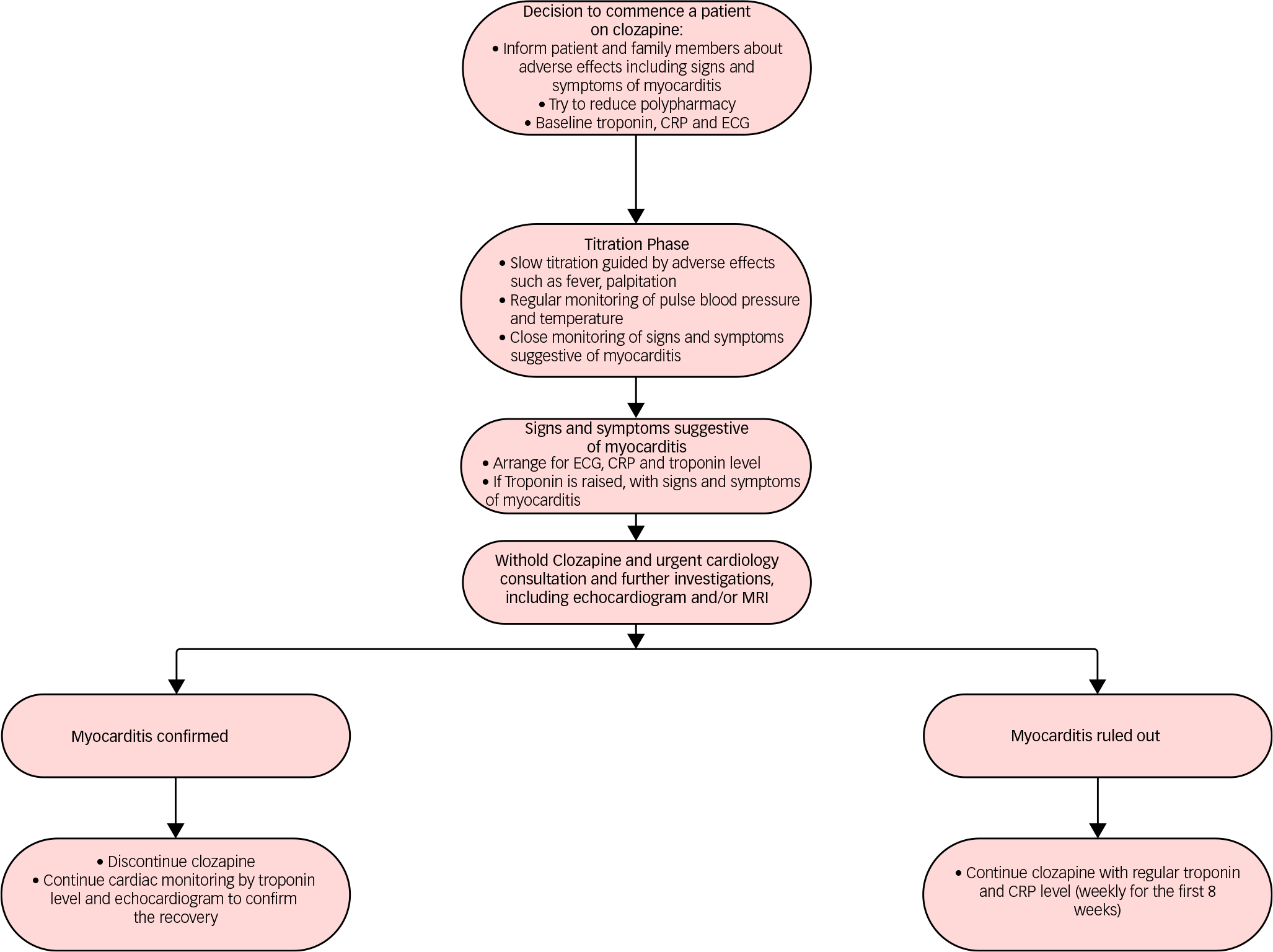
A monitoring and management protocol for CIM is show in Fig. 1.
Recommended monitoring and management for clozapine-induced myocarditis. CRP, C-reactive protein; ECG, echocardiogram; MRI, magnetic resonance imaging.

Clozapine rechallenge
Clozapine is typically contraindicated after an episode of CIM. However, it may be reconsidered after a careful risk–benefit analysis involving both the patient and a cardiologist. Currently, evidence supporting the rechallenge of clozapine after CIM is based on case reports, which are subject to reporting bias.
Ronaldson et al (Reference Ronaldson, Fitzgerald and Taylor2012b) reported eight cases of clozapine rechallenge following CIM. Four patients had successful outcomes, one developed myocarditis again and three discontinued clozapine for other reasons. Although they could not draw firm conclusions, they suggested that the severity of the initial myocarditis episode – primarily based on left ventricular dysfunction and CRP levels – along with the speed of titration might be key factors. Notably, 75% of patients who had successful outcomes did not exhibit abnormal echocardiograms.
Bellissima et al (Reference Bellissima, Tingle and Cicović2018) reviewed the literature and found 12 successful rechallenge cases out of 19, yielding a success rate of 63%. Similarly, Shivakumar et al (2020) reported a successful rechallenge and proposed a protocol that includes very slow titration of clozapine, closely monitoring CRP levels. Although no specific cut-off for CRP was established, their recommendation was to withhold titration if CRP levels were elevated. If CRP levels return to normal, titration could continue; however, if they remain elevated, further investigations into other causes of inflammation would be required. If troponin levels increase at any point, clozapine should be discontinued and a cardiologist should assess the patient to manage any adverse effects.
Halawa et al (Reference Halawa, Armstrong and Fancy2023) reported a case where clozapine was rechallenged twice. Their suggested protocol included very slow titration, monitoring CRP and troponin I levels twice weekly, and increasing daily monitoring if these levels were raised. If CRP levels were between 100 and 150 mg/dL and troponin I was less than twice the UNL, they recommended reducing the clozapine dose and arranging for an echocardiogram. However, they recommended that clozapine should be discontinued if the CRP level exceeded 150 mg/dL or if the troponin I level was more than twice the UNL.
Clozapine-induced cardiomyopathy (CCM)
Definition and incidence
The World Health Organization (WHO) defines cardiomyopathies as diseases of the myocardium that lead to cardiac dysfunction. The WHO classification of cardiomyopathies includes hypertrophic, dilated, restrictive and arrhythmogenic right ventricular cardiomyopathies (Richardson Reference Richardson, McKenna and Bristow1996). These conditions weaken the heart’s ability to pump blood, potentially leading to complications such as heart failure, arrhythmias (irregular heartbeat, ventricular tachycardia), blood clots and even sudden cardiac arrest.
Certain medications, such as anthracyclines, monoclonal antibodies (e.g. trastuzumab), alkylating agents (e.g. cyclophosphamide), tyrosine kinase inhibitors (e.g. sunitinib and imatinib) and antipsychotic drugs (e.g. phenothiazines and clozapine) are reported to cause cardiomyopathy. Most reported cases suggest that clozapine causes dilated cardiomyopathy (Alawami Reference Alawami, Wasywich and Cicovi2014). Dilated cardiomyopathy is characterised by enlarged heart chambers, causing the muscle wall to become thin and weak, affecting the ability of the heart to pump blood efficiently.
Kilian et al (Reference Kilian, Kerr and Lawrence1999) first reported cases of clozapine-induced cardiomyopathy (CCM). Since then, owing to increased awareness of cardiac adverse effects, many more cases have been documented. Unlike myocarditis, CCM is a long-term adverse effect with a gradual onset. Most patients are diagnosed approximately 6–9 months after the initiation of clozapine, although the reported onset ranges from 1 month to 6 years (Curto Reference Curto, Girardi and Lionetto2016). The gradual onset and the high prevalence of other risk factors, such as diabetes, hypertension and alcohol misuse, make it difficult in some cases to attribute the condition solely to clozapine.
A recent meta-analysis of 16 studies reported 6 cases of cardiomyopathy per 1000 patients exposed to clozapine (Siskind Reference Shivakumar, Thomas and Sollychin2020). The same meta-analysis also found an absolute risk of death due to cardiomyopathy of 3 deaths per 10 000 patients. This suggests that CCM is a relatively rare adverse effect. Owing to its gradual onset and non-specific symptoms, CCM is likely under-reported, and many people in the latent or developed stages of the illness may remain undiagnosed and untreated.
Pathophysiology
The pathophysiological mechanisms of clozapine CCM are not fully understood owing to the limited number of prospective studies evaluating cardiac function in people on clozapine therapy. One Italian study followed 38 individuals receiving clozapine and conducted clinical evaluations along with echocardiography at baseline, 3 months and 12 months. They reported that in one-third of their sample, the left ventricular ejection fraction decreased by more than 5% (Rostagno Reference Rostagno, Domenichetti and Franco Gensini2012).
Initially, CCM was thought to be a consequence of subclinical myocarditis. However, current understanding suggests that it encompasses a diverse set of pathways, including immune modulation (IgE-mediated hypersensitivity), catecholaminergic activation, free radicals and oxidative stress, among others (Rabkin Reference Rabkin and Tang2023). It can also result from strong association with other risk factors, such as diabetes and hypertension. It should be noted that if other possible aetiological factors are present, their influence as contributing causes cannot be discounted.
Signs and symptoms
The New York Heart Association (NYHA) classification based on symptoms and exercise capacity is widely used for the assessment of people with heart failure (Yancy Reference Yancy, Jessup and Bozkurt2013). Within this, classes I and II (reflecting the first and second phases of the condition) characterise asymptomatic patients or those presenting with non-specific symptoms (such as fatigue, shortness of breath and tachycardia). During these phases, tests may reveal non-specific ECG abnormalities. The next phase is class III, where symptoms of heart failure are more apparent. These include weakness, fatigue and exertional dyspnoea with moderate physical activity. In the final phase (class IV), heart failure symptoms become more pronounced. These may include dyspnoea at rest or during exertion, orthopnoea and peripheral oedema. The ECG during this phase might show a prolonged QTc interval, bundle branch block and signs of right heart overload.
Diagnosis
As patients can be asymptomatic or present with non-specific symptoms, the diagnosis of CCM often relies on echocardiographic evidence of reduced left ventricular systolic function with an ejection fraction below 50%. This should be in the absence of conditions that would typically increase cardiac overload, such as hypertension, valvular abnormalities or coronary artery disease. The NT-proBNP test is increasingly used to screen suspected cases of heart failure.
Echocardiogram
Echocardiography plays a crucial role in diagnosing CCM. It comprehensively assesses diastolic and systolic function, wall thickness and the size of the left and right heart chambers. In cases of CCM, the typical finding is a dilated left ventricle with a reduced ejection fraction. Echocardiography is also vital for managing and monitoring patients with CCM, allowing for regular follow-up to assess changes in cardiac function.
N-terminal pro-B-type natriuretic peptide (NT-proBNP)
NT-proBNP is an inactive fragment of B-type natriuretic peptide (BNP), which is a protein released from cardiac ventricular cells, particularly in response to ventricular distention. Over the years, literature has supported its utility as a potential biomarker for assessing the presence and severity of heart failure. It is a simple blood test; a standard average value typically indicates that heart failure is less likely. The NT-proBNP test is more sensitive than the BNP test but can be elevated in conditions such as renal failure. However, no current evidence suggests the role of NT-proBNP in the early detection of CCM (Alawami Reference Alawami, Wasywich and Cicovi2014).
Monitoring and management
Owing to the rarity of CCM and the associated costs, routine echocardiographic monitoring is not necessary for all patients on clozapine. However, in Australia, guidelines suggest annual echocardiogram monitoring for baseline and long-term follow-up, although this is not considered cost-effective (Murch Reference Murch, Tran and Liew2013). If cardiomyopathy is suspected, the patient should be referred to a cardiologist for further assessment, including evaluation of other potential aetiological factors.
Management typically involves discontinuing clozapine. Evidence suggests that stopping clozapine can improve ejection fraction or delay further deterioration, with more significant improvements observed in patients with higher initial ejection fraction (Alawami Reference Alawami, Wasywich and Cicovi2014). Disease-modifying heart failure medications are the mainstay of treatment under specialist care. These include diuretics, beta-blockers, ACE inhibitors, mineralocorticoid receptor antagonists (MRAs) and, more recently, SGLT2 inhibitors. Rechallenging with clozapine is generally contraindicated, given the limited evidence available. However, there have been a few case reports of successful and unsuccessful rechallenges, including instances where clozapine was continued despite cardiomyopathy, after careful risk assessment (Alawami Reference Alawami, Wasywich and Cicovi2014).
Sinus tachycardia
Definition and incidence
Sinus tachycardia, defined as a resting heart rate exceeding 100 beats per minute (bpm), is a common side-effect of clozapine. It affects 25–35% of patients, with reported rates varying widely. A recent audit found that the heart rates of people taking clozapine averaged 20 bpm higher than normal, with 52% experiencing palpitations, often emerging early and resolving within 6 weeks (Gurrera Reference Gurrera, Gearin and Love2022; Brennan Reference Brennan, Lal and Hugo2024). However, some cases persist long-term, even after 10 years of therapy. Tachycardia is frequently overlooked in clinical practice, as patients rarely report it, which highlights the need for proactive monitoring and management.
Pathophysiology
The tachycardia associated with clozapine is primarily mediated by its anticholinergic effects and its antagonistic action on alpha-2 receptors, leading to beta-adrenoreceptor activation. During the titration phase, tachycardia may also be related to orthostasis. Clozapine-induced tachycardia is dose-related and correlates with clozapine plasma levels (Meyer Reference Meyer and Stahl2020).
Signs and symptoms
Most patients do not complain of palpitations, and tachycardia is often noticed during routine physical check-ups.
Management
Although most psychiatric guidelines (Meyer Reference Meyer and Stahl2020; Taylor Reference Taylor2021) suggest that an increased heart rate becomes clinically significant if it exceeds 100 bpm, because of increased risk of cardiomyopathy, there is also evidence that an elevated heart rate, even below 100 bpm, is associated with negative outcomes such as coronary heart disease, stroke and sudden cardiac death (Patel Reference Patel, Moore and Piper2019).
The decision to treat tachycardia should be based on persistent tachycardia in the absence of significant anxiety symptoms, rather than on a single measurement. We have used smart watches with good effect to confirm persistent tachycardia. In most cases, tachycardia during the titration phase is usually benign. However, further investigations are warranted if it is associated with other cardiac symptoms or signs suggestive of myocarditis. In benign cases, withholding or slowing the titration may help. If the tachycardia persists, reducing the dose of clozapine could be considered, if feasible. Persistent tachycardia could also be due to other prescribed medications, such as anticholinergics like hyoscine, which is used to treat hypersalivation, or antidepressant drugs. If tachycardia persists, treatment is needed to prevent long-term complications, but it should not lead to clozapine discontinuation in the absence of other complications. A dose reduction should be considered for long-term clozapine users presenting with tachycardia.
Beta-blockers such as atenolol or bisoprolol are commonly used to manage clozapine-induced tachycardia. Studies report mixed outcomes, with reported reductions in heart rate averaging 16.45 bpm (Stryjer 2009) and 6.3 bpm (Brennan Reference Brennan, Lal and Hugo2024), although rates often remain above pretreatment levels. Evidence supporting their long-term effectiveness in preventing complications is limited. Specialist consultation is recommended if tachycardia persists. Alternatives like ivabradine and verapamil have been reported in case studies but should be used only under specialist guidance.
Conduction deficits
Definition and incidence
Patients on clozapine can present with non-specific cardiac rhythm problems, especially during the initial stages of treatment. Most abnormalities are of little clinical significance (Kang Reference Kang, Kwon and Ahn2000).
The corrected QT interval (QTc) is a measure used in electrocardiography to assess the time it takes for the heart’s ventricles to depolarise and repolarise. This is an important parameter, as abnormalities in the QTc interval can increase the risk of ventricular tachycardia, particularly a life-threatening condition called torsades de pointes (a specific type of polymorphic ventricular tachycardia). The QTc interval represents the heart’s electrical recovery time, corrected for heart rate with a formula.
The most commonly encountered problem is QTc prolongation. Antipsychotic medications, including clozapine, have been associated with QTc prolongation and sudden cardiac death, although the risk varies between different antipsychotics (Taylor Reference Taylor2021). Haloperidol and pimozide carry the highest risk, whereas clozapine is generally classified as low-risk in this regard. However, recent studies suggest this may be inaccurate (Taylor Reference Taylor2021). For example, Sankaranarayanan et al (2024) studied a cohort of 104 patients treated with clozapine and found that 36.5% had a prolonged QTc interval. They also observed non-statistically significant trends linked to male gender, serum clozapine levels and heart rate. Prolonged QTc intervals may also be influenced by other factors, such as co-prescribed medications (e.g. other antipsychotics or anticholinergic drugs), electrolyte imbalances or underlying cardiac disorders. Typical average values for QTc intervals are <450 ms in males and <470 ms in females. The risk of serious arrhythmias, including torsades de pointes, increases when the QTc interval exceeds 500 ms (Taylor Reference Taylor2021).
Pathophysiology
QT prolongation, often caused by antipsychotic medications, including clozapine, occurs owing to their effects on ion channels, especially delayed-rectifier potassium channel (IKr) blockade, which slows repolarisation, thus prolonging the QT interval.
Signs and symptoms
Most patients with QTc prolongation are asymptomatic. However, dizziness and syncopal episodes are commonly reported in symptomatic patients. Therefore, monitoring QTc intervals by conducting baseline and regular ECGs is crucial, especially if the baseline ECG shows any abnormalities.
Monitoring and management
All patients starting clozapine require a cardiovascular assessment, including an ECG, with attention to factors that can affect the QTc interval, such as comorbidities and other medications. Annual ECGs are advised, with more frequent monitoring if symptoms arise. Interventions for QTc prolongation (<500 ms) include clozapine dose reduction, medication review and electrolyte checks. If the QTc exceeds 500 ms or symptoms occur, cardiology consultation is essential to ensure safe and effective management.
Conclusions
Clozapine is the only evidence-based treatment for treatment-resistant schizophrenia, but its use requires careful management of potential adverse effects, particularly life-threatening cardiac complications like myocarditis. Psychiatrists should remain informed about recent developments and collaborate with cardiologists to ensure timely access to specialist care when needed. Although research on myocarditis, especially in Australia, has provided insights, gaps remain in understanding its pathophysiology and identifying high-risk factors. More studies are required to refine monitoring protocols and improve the management of clozapine’s cardiac side-effects to ensure its safe and effective use.
MCQs
Select the single best option for each question stem
-
1 In terms of presentation of clozapine-induced myocarditis (CIM), which of the following is false?
-
a CIM can present with non-specific symptoms
-
b there have been reports of asymptomatic cases of CIM where diagnosis was only made post-mortem
-
c CIM typically occurs at least a year after treatment
-
d physical examination can reveal low blood pressure, raised jugular venous pressure (JVP), chest congestion or a pericardial friction rub
-
e CIM can lead to fulminant myocarditis, heart failure, high-grade atrioventricular block, sustained ventricular arrhythmias and cardiogenic shock.
-
-
2 Regarding the clozapine-induced myocarditis investigation:
-
a peripheral eosinophilia is a very early feature
-
b ECG is a sensitive but not specific test
-
c a C-reactive protein (CRP) level >100 mg/dL confirms CIM
-
d a high troponin level confirms the diagnosis of myocarditis
-
e transthoracic echocardiography (TTE) is the ‘gold standard’ diagnostic test.
-
-
3 The majority of patients who develop CCM are diagnosed:
-
a between 1 and 3 months after clozapine initiation
-
b between 3 and 6 months after clozapine initiation
-
c between 6 and 9 months after clozapine initiation
-
d between 9 and 12 months after clozapine initiation
-
e more than 1 year after clozapine initiation.
-
-
4 Which of the following is a crucial investigation to diagnose CCM?
-
a ECG
-
b troponin levels
-
c echocardiography
-
d X-ray
-
e C-reactive protein (CRP) levels.
-
-
5 Regarding clozapine-induced tachycardia, which of the following is false?
-
a tachycardia during the clozapine titration phase is usually benign
-
b in most cases, withholding or slowing the titration of clozapine may help
-
c for persistent tachycardia, treatment is required to prevent long-term complications
-
d for persistent tachycardia, clozapine is contraindicated and should be discontinued routinely
-
e beta-blockers such as atenolol or bisoprolol are commonly used to manage clozapine-induced tachycardia.
-
MCQ answers
-
1 c
-
2 d
-
3 c
-
4 c
-
5 d
Data availability
Data availability is not applicable to this article as no new data were created or analysed in this study.
Author contributions
S.Gu. and A.S. concieved the idea and wrote the initial draft. S.Go. and R.S. revised the draft.
Funding
This research received no specific grant from any funding agency, commercial or not-for-profit sectors.
Declaration of interest
S.Gu. has received honoraria for lectures from Viatris, one of the manufacturers of clozapine.



eLetters
No eLetters have been published for this article.