Implications
The regulations for the organic productions suggest the use of chickens of indigenous breeds or strains that have medium-growing (MG) or slow-growing (SG) profile instead of fast-growing (FG) ones. In practice, due to economic reasons, the latter are often adopted even if they are less resistant to diseases as well as less adapted to outdoor farming conditions. Considering the large market availability of males from egg-type chicken strains that are usually suppressed at hatching, the use of these SG birds may represent a potential way either to exploit this unused resource or to reduce the cost for their disposal, representing thus a valuable alternative for the organic chicken market. This study aims to investigate the meat characteristics of these birds in comparison with the FG and MG ones.
Introduction
Worldwide, most broiler chicken production is obtained by using selected fast-growing (FG) genotypes housed indoors under intensive conditions and fed balanced diets. These factors have represented the successful key for the development of the poultry sector from a rural activity to an industrial one. Meanwhile, in the last decade, to bring back poultry production to its origins while satisfying the consumer’s perception of improved welfare of animals along with a ‘more natural’ approach to production, alternative rearing systems have been proposed and ruled by the EU Regulations 1538/91 (European Commission, 1991), 1804/99 (European Commission, 1999) and 834/2007 (European Commission, 2007). In particular, the organic system regulation suggests using indigenous breeds or strains, which have a slow-growing (SG) or medium-growing (MG) profile, taking into account the vitality and the resistance to the diseases of birds as well as their adaptability to outdoor local conditions. However, FG birds fed with specific low-density diets are often used for organic production. These commercial hybrids are usually slaughtered at young age (from 37 to 55 days) and do not have a growth profile suited to 81-day production, which is the minimum mandatory slaughtering age for organic chickens. SG birds, even though less efficient than FG ones, appear more suitable for organic systems (Gordon and Charles, Reference Gordon and Charles2002). In addition, the genotype and age at slaughtering affect the meat quality attributes. Fanatico et al. (Reference Fanatico, Cavitt, Pillai, Emmert and Owens2005a), feeding the same diet to SG, MG and FG birds for 81, 67 and 53 days, respectively, observed that SG birds had the highest drip and cook losses and tougher meat. Higher breast drip loss in SG strains was also found by Berri et al. (Reference Berri, Le Bihan-Duval, Baeza, Chartrin, Picgirard, Jehal, Quentin, Picard and Duclos2005) who compared SG, MG and FG chicken crosses. Meat colour is also affected by the genotype: breast meat of SG chickens exhibited lower lightness (L*) as well as higher yellowness (b*) and redness (a*) than MG and FG birds (Quentin et al., Reference Quentin, Bouvarel, Berri, Le Bihan-Duval, Baeza, Jego and Picard2003). Castellini et al. (Reference Castellini, Mugnai and Dal Bosco2002), rearing FG chickens slaughtered at 56 and 81 days, also found important modifications in meat quality due to either the slaughtering age or to the rearing system. Increasing the slaughter age, the content of muscle protein of breast and thigh increases, but data for the lipid fraction are controversial. According to Touraille et al. (Reference Touraille, Ricard, Kopp, Valin and Leclerq1981) breast lipid content decreases while the phospholipid fraction increases from 8 to 16 weeks of age. On the contrary, Grey et al. (Reference Grey, Robinson, Jones, Stock and Thomas1983) showed a lipid increase from 6 to 22 weeks of age. Similarly, Baeza et al. (Reference Baeza, Salichon, Marché, Wacrenier, Dominguez and Culioli2000) found a significant lipid increase in breast muscle of ducks between 8 and 12 weeks. The effect of ageing on the amount of total collagen is unclear while tenderness generally decreases as chickens become older (Touraille et al., Reference Touraille, Ricard, Kopp, Valin and Leclerq1981). In Muscovy and mule ducks breast tenderness decreases with advancing ageing, however in the latter the tenderness is not related to collagen content which decreases with ageing or to its solubility which is unaffected by ages (Baeza et al., Reference Baeza, Salichon, Marché, Wacrenier, Dominguez and Culioli2000). Darker breast meat were observed in older broiler chickens compared to younger ones (Delpech et al., Reference Delpech, Dumont and Nefzaoui1983). Similar results were obtained by Baeza et al. (Reference Baeza, Dessay, Wacreinier, Marché and Listrata2002) in breast meat of ducks.
In France, there is a long tradition in the production of Label Rouge chickens with a 30% of market share (Magdelaine et al., Reference Magdelaine, Spiess and Valceschini2008), and many SG genotypes have been selected and studied for this particular production (Berri, Reference Berri2004). In general, the main quality aspects that characterise the meat from Label Rouge are higher firmness, darker colour, more intensive odour and flavour (Laszczyk-Legendre, Reference Laszczyk-Legendre1999). In the majority of European countries, there is no such type of production but only an increasing interest of consumers in organic products.
The low availability of indigenous breeds has led to adopt selected MG meat-type birds for organic production even if producers often prefer to rear FG commercial hybrids due to their obvious productive advantages. However, due to the considerable market availability of males from egg-type chicken strains that are usually suppressed at hatching, the use of these SG birds may represent a way to exploit this unused resource, currently disposed as a waste, and on the contrary might represent a valuable alternative for such a market.
This study was conducted to compare and characterise meat quality traits, as well as chemical and fatty acid composition, from FG and MG meat-type chickens and SG egg-type ones, reared under organic conditions.
Material and methods
Animals and treatment
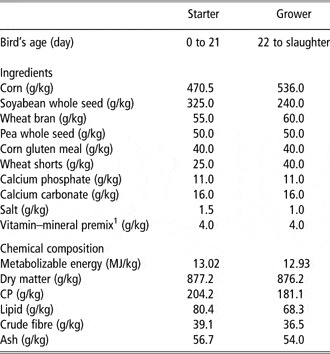
The experiment was carried out in the spring of 2008 at the Research Centre of the University of Perugia located in the centre of Italy, 500 m above sea level. A total of 360 1-day-old male chicks, equally divided into three experimental groups represented by strains selected for meat production (meat-type) FG (Cobb 700) and MG strains (Naked neck Kabir) and one strain selected for egg production (egg-type) SG strain (Brown Classic Lohman) were used. The chicks were housed in three indoor pens (20 birds/m2) in the same environmental controlled poultry house till 21 days of age. Afterwards, birds were transferred into three poultry houses with outdoor run availability of 10 m2/bird. The outdoor runs were seeded with the same herbal species to obtain the same pasture composition. All the birds were fed ad libitum the same diets formulated according to the European Union (EU) Regulation (European Commission, 1999) and Italian legislation in force (Ministero Politiche Agricole e Forestali, 2001) by using organic raw materials (Tables 1 and 2). Birds from the FG and MG groups were raised until 81 days old, the minimum slaughter age required by the regulation 1804/99 (European Commission, 1999), whereas birds from the SG group were raised until 96 days old in order to achieve an acceptable market live weight. To avoid variations in meat quality due to slaughtering conditions, the start of raising of SG chicks was anticipated of 15 days in respect of MG and FG ones and all the birds were processed in the same session. Feeds and representative samples of grass were collected for proximate analysis and fatty acid composition determination.
Ingredients and compositions of the diets

1Provided the following per kg of diet: vitamin A (retinyl acetate), 13 000 IU; vitamin D3 (cholecalciferol), 4000 IU; vitamin E (DL-α_tocopheryl acetate), 80 IU; vitamin K (menadione sodium bisulfite), 3 mg; riboflavin, 6.0 mg; pantothenic acid, 6.0 mg; niacin, 20 mg; pyridoxine, 2 mg; folic acid, 0.5 mg; biotin, 0.10 mg; thiamine, 2.5 mg; vitamin B12 20 μg; Mn, 120 mg; Zn, 90 mg; Fe, 30 mg; Cu, 10 mg; I, 1.5 mg; Se, 0.2 mg; ethoxyquin, 100 mg.
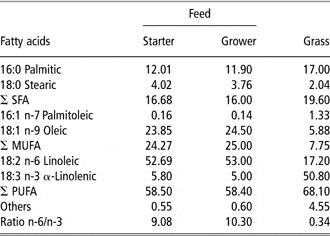
Fatty acid composition (% TFA) of chicken feeds and grass of outdoor pens

TFA = total fatty acids; SFA = saturated fatty acids; MUFA = monounsaturated fatty acids; PUFA = polyunsaturated fatty acids.
Before slaughter, birds were subjected to a total feed withdrawal of 12 h, including the lairage time at the processing plant of 2 h. The birds of each group were individually weighed and 15 birds were randomly selected, labelled and subsequently processed under commercial conditions using electrical stunning (120 V, 200 Hz). After chilling, carcasses were stored at 4°C for 24 h and used for subsequent meat quality evaluation. Carcasses were obtained by removing head, neck, shanks and abdominal fat from bled, plucked and eviscerated birds. Slaughter yields were determined according to the method described by the Working group 5 of the World’s Poultry Science Association (1984) in order to obtain the main commercial parts: breast, thigh + drumstick and wing. All these parts were weighed and the values were expressed as a percentage of body live weight.
Colour attributes, pH, drip loss, cook loss, collagen content and Allo-Kramer shear values after cooking were determined on breast fillets (Pectoralis major muscles). Moisture, protein, total lipid, ash and fatty acid composition were determined on Pectoralis minor and on Biceps femoris muscles.
Colour measurements
The International Commission on Illumination (CIE, 1978) system colour profile of lightness (L*), redness (a*) and yellowness (b*) was performed by a reflectance colorimeter (Minolta Chroma Meter CR-400, Minolta Italia S.p.A., Milano, Italy) using illuminant source C. Breast meat colour was evaluated averaging three measurements taken on the medial surface of the fillet (bone side) in an area free of obvious colour defects (bruises, discolorations, haemorrhages, full blood vessels or any other condition that may have affected uniform colour reading).
pH measurement
Breast meat pH was measured using a modification of the iodoacetate method initially described by Jeacocke (Reference Jeacocke1977) as reported hereunder. Approximately 2.5 g of meat were removed from the cranial end of each Pectoralis major muscle, minced by hand and homogenized for 30 s in 25 ml of a 5 mM iodoacetate solution with 150 mM of potassium chloride. The pH of the homogenate was determined using a pH meter (Crison Basic 20+, Crison Strumenti S.p.A, Carpi, Italy) calibrated at pH 4.0 and 7.0.
Drip and cook loss determination
Drip loss was measured on intact fillets (Pectoralis major muscle) kept suspended in a sealed glass box for 48 h at 2°C to 4°C and calculated as percentage of weight loss during storage. Cook loss was also measured by cooking intact muscles on aluminium trays in a convection oven at 180°C until 80°C at core sample. The samples were then allowed to equilibrate to room temperature, re-weighed and cook loss was determined as percentage of weight loss.
Shear value determination
Shear values were determined using a TA.HDi Heavy Duty texture analyzer (Stable Micro Systems Ltd, Godalming, Surrey GU7 1YL, UK) equipped with an Allo-Kramer shear cell. Cooked meat samples (2 × 4 × 1 cm) were cut parallel with the muscle fibre direction from each fillet (Pectoralis major muscle: cranial position) and sheared with the blades at a right angle to the fibres using a 250 kg load cell and cross head speed of 500 mm/min (Papinaho and Fletcher, Reference Papinaho and Fletcher1996). Allo-Kramer shear values were reported as kilograms shear per gram of sample.
Chemical analysis
Proximate analysis (moisture, protein, lipid and ash content) was carried out on feed as well as on both breast (Pectoralis minor) and thigh (Biceps femoris) meat. Moisture and ash were determined in duplicate according to the Association of Official Analytical Chemists procedure (AOAC, 1990). Proteins were determined using the standard Kjeldahl copper catalyst method (AOAC, 1990). Total lipids were measured using a modification of the chloroform : methanol procedure described by Folch et al. (Reference Folch, Lees and Sloane-Stanley1957). Finally, collagen was determined on breast meat following the modified colorimetric method of Kolar (Reference Kolar1990) and total collagen content was calculated by multiplying the amount of hydroxyproline by 7.5.
Fatty acid analysis
After the extraction of total lipids, fatty acids of feed, grass and both breast and thigh meat were converted to methyl esters following the method described by Christopherson and Glass (Reference Christopherson and Glass1969). The separation of fatty acids was carried out by using a Shimadzu GC17A gas chromatograph (Shimadzu Corporation, Tokyo, Japan) with a WP-4 Shimadzu integration system, equipped with a Varian CP-SIL88 (Varian Inc., Walnut Creek, CA, USA) capillary column (100 m length; 0.25 mm i.d.; 0.20 μm film thickness) and a flame ionization detector. The operating conditions of the gas chromatograph were as follows: oven temperature was maintained at 170°C for 15 min, increased to 190°C at a rate of 1°C/min, then increased to 220°C at a rate of 5°C/min and maintained at this temperature for 17 min. The temperature of the injector was 270°C and of the detector 300°C. Helium was used as a carrier gas at a constant flow of 1.7 ml/min. The identification of individual fatty acids was carried out by using polyunsaturated fatty acids (PUFA)-2 fatty acid methyl ester standards (Matreya Inc., Pleasant Gap, PA, USA).
Statistical analysis
The influence of genotype (FG, MG and SG) on meat quality traits was evaluated by using one-way ANOVA and means were separated by Student Newman Keuls test. Pearson’s correlation coefficients and probability were calculated to evaluate the relationships between breast meat collagen content and Allo-Kramer shear value (SAS, 1988).
Results and discussion
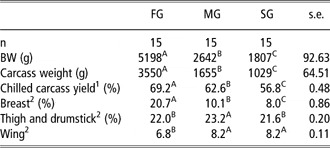
Both FG and MG chickens were slaughtered at 81 days to comply with the Regulation 1804/99 (European Commission, 1999), whereas the SG birds were slaughtered at 96 days in order to achieve an acceptable market live weight. At these ages FG birds exhibited a BW of about two and three times higher, respectively, than MG and SG birds (5198 v. 2642 and 1807 g; P < 0.01; Table 3). Although productive performance comparison of the different genotypes was not the aim of this study, we report these information for clarity: feed conversion ratio, calculated on feed consumption with the exclusion of pasture intake resulted of 3.29 v. 3.39 and 4.42, respectively, for FG, MG and SG. Carcass yields accounted for 69.2%, 62.6% and 56.8% in FG, MG and SG, respectively (P < 0.01; Table 3). These data are consistent with Rizzi et al. (Reference Rizzi, Marangon and Chiericato2007) who found chilled carcass yields of 55.9% in egg-type strains and 66.3% in dual-purpose breeds slaughtered at 1726 and 3147 g live weight, respectively. Fanatico et al. (Reference Fanatico, Pillai, Cavitt, Owens and Emmert2005b), comparing SG and FG genotypes reared outdoor and slaughtered at 81 days (2250 g) and 53 days (2458 g), also found higher carcass yields in FG birds (71.9% v. 70.1%). Taking into account the carcass weights, in this study, FG group produced a very heavy carcass (3550 g), which is not properly suitable for the organic poultry market that is strongly oriented towards light whole carcasses.
Slaughtering performance of broiler chickens according to genotype

FG = fast-growing; MG = medium-growing; SG = slow-growing.
1Ready to cook carcass/BW.
2Calculated on body live weight.
A–CMeans within a row followed by different superscript letters differ significantly (P < 0.01).
Concerning the cut-up yields, as expected, the breast meat yield decreased from FG to MG and SG birds (20.7% v. 10.1% v. 8.0%; P < 0.01), thigh and drumstick were significantly higher in MG, whereas wing percentages were lower in FG (P < 0.01; Table 3). These differences in cut-up proportions are attributable to genetic selection which has dramatically improved, in modern commercial hybrids, the breast proportion while reducing the other cut up yields (Havenstein et al., Reference Havenstein, Ferket and Qureshi2003).
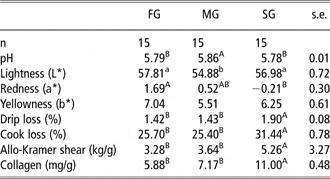
MG birds exhibited a higher breast meat pH (5.86 v. 5.79 and 5.78, P < 0.01) and a lower lightness in comparison with FG and SG birds (54.88 v. 57.81 and 56.98, respectively; P < 0.05). Furthermore, FG and SG birds showed, respectively, the highest (P < 0.01) and the lowest values of redness with respect to MG birds, which presented intermediate values (Table 4).
Meat quality traits of breast meat (Pectoralis major) according to genotype

FG = fast-growing; MG = medium-growing; SG = slow-growing.
a,bMeans within a row followed by different superscript letters differ significantly (P < 0.05).
A,BMeans within a row followed by different superscript letters differ significantly (P < 0.01).
The darker and lighter colour found, respectively, in MG as well as in FG and SG birds are consistent with the results of Berri et al. (Reference Berri, Wacrenier, Millet and Le Bihan-Duval2001), who compared commercial lines selected for increased body weight with unselected control lines but are in contrast with the results of Fanatico et al. (Reference Fanatico, Cavitt, Pillai, Emmert and Owens2005a). Since, darker and redder breast meat were observed in older broiler chickens and ducks compared to younger ones (Delpech et al., Reference Delpech, Dumont and Nefzaoui1983; Baeza et al. Reference Baeza, Dessay, Wacreinier, Marché and Listrata2002) the differences in lightness and redness observed in this study can be attributed to the genotype.
The differences in lightness can be related to the pH values, confirming the well-known relationship between these parameters (Fletcher, Reference Fletcher2002). Moreover, when estimating genetic correlations for meat quality and body traits in meat-type chickens, Le Bihan-Duval et al. (Reference Le Bihan-Duval, Berri, Baeza, Millet and Beaumont2001) observed a very strong, negative genetic correlation between ultimate pH and L* value of the meat.
The genetic origin dramatically affected meat water holding capacity and texture. SG birds exhibited significantly (P < 0.01) higher drip and cook losses in comparison with FG and MG ones. These data agree with those of Lonergan et al. (Reference Lonergan, Deeb, Fedlet and Lamont2003) who found a higher cook loss in SG compared with FG broilers. Debut et al. (Reference Debut, Berri, Baéza, Sellier, Arnould, Guémené, Jehal, Boutten, Jego, Beaumont and Le Bihan-Duval2003) and Fanatico et al. (Reference Fanatico, Pillai, Cavitt, Owens and Emmert2005b) also found higher drip and cook losses in breast meat of SG birds reared outdoors than in FG broilers. The latter authors attributed this outcome to the size of the breast muscles that was lower in SG birds. Our data are consistent also with those of An et al. (Reference An, Zheng, Li, Zeng, Qu, Xu and Yang2010) who, comparing FG hybrids and egg-type breed (White Leghorn) slaughtered at 6 and 18 weeks found higher water holding capacity in hybrids and attributed this to the thicker endomysium and perymisium collagen layers.
As regards to texture, SG breast meat showed significantly higher Allo-Kramer shear values in comparison with both FG and MG birds (5.26 v. 3.28 and 3.64 kg/g, respectively; P < 0.01). These differences were observed in breast muscles boned at 24-h post mortem so that any toughening effect caused by early deboning (i.e. 8-h post mortem) was avoided. A significantly higher content of collagen was also found in the SG group compared to MG and FG birds (11.0 v. 7.17 and 5.88 mg/g; P < 0.01). As a consequence, the collagen content and shear values of breast-cooked meat were significantly correlated (r 2 = 0.40; P < 0.01; data not shown). The collagen content along with other basic components of connective tissues does not explain itself the meat tenderness, but the muscle structure, in particular the fibre diameter and type, as well as the number of collagen cross-linked chains and the thickness of endomysium and perymisium layers of muscle can also affect this attribute (Lepetit, Reference Lepetit2008; An et al., Reference An, Zheng, Li, Zeng, Qu, Xu and Yang2010). Furthermore, the higher age at slaughtering of SG birds with respect to MG and FG birds may have further contributed to increase the difference in meat tenderness and collagen content. Touraille et al. (Reference Touraille, Ricard, Kopp, Valin and Leclerq1981) reported that tenderness generally decreases as chickens become older.
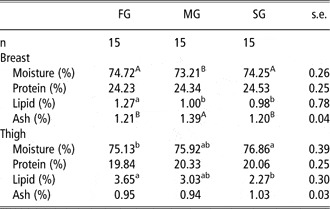
The chemical composition of breast and thigh meat is given in Table 5. Genotype influenced moisture, lipid and ash contents of breast meat. FG and SG meat had higher moisture and lower ash contents than MG birds (P < 0.01). FG group exhibited higher lipid content than MG and SG birds (1.27% v. 1.00% and 0.98%, respectively; P < 0.05). As for thigh meat, SG birds showed higher moisture than FG ones with intermediate values for MG birds (76.86%, 75.13% and 75.92%, respectively; P < 0.05). Moreover, the lipid content of thigh meat gradually decreases from FG to MG and SG birds (3.65%, 3.03% and 2.27%, respectively; P < 0.05).
Chemical composition of breast (Pectoralis minor) and thigh (Biceps femoris) meat according to genotype

FG = fast-growing; MG = medium-growing; SG = slow-growing.
a–bMeans within a row followed by different superscript letters differ significantly (P < 0.05).
A–CMeans within a row followed by different superscript letters differ significantly (P < 0.01).
The higher content of lipids observed both in breast and thigh meat of FG birds may be related to the genotype. These birds were selected to reach their market live weight at the maximum age of 56 to 60 days and when the slaughter age is prolonged to 81 days, as required for organic production, they increase their fatness.
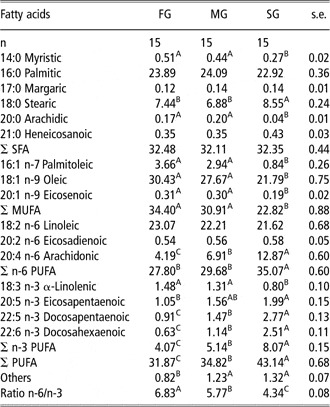
The fatty acid composition of breast meat is given in Table 6. Genotype dramatically affected the fatty acid composition. SG meat exhibited lower proportions of monounsaturated fatty acids (MUFA) than FG and MG birds (22.82% v. 34.40% and 30.91% TFA; P < 0.01) due to the lower contents of palmitoleic, oleic and eicosaenoic acids. On the contrary, SG meat showed higher proportions of n-6 PUFA than FG and MG birds (35.07% v. 27.80% and 29.68% TFA; P < 0.01) due to the arachidonic acid content, which was three and two times higher (P < 0.01) than FG and MG meat, respectively. The total n-3 PUFA of SG meat was double that of FG meat and higher than that of MG birds (8.07% v. 4.07% v. 5.14% TFA; P < 0.01). SG meat contained the highest values (P < 0.01) of all the n-3 PUFA with the exception of α-linolenic acid (LNA). Total saturated fatty acids were not affected by the genotype.
Fatty acid composition (% TFA) of breast meat (Pectoralis minor) according to genotype

TFA = total fatty acids; FG = fast-growing; MG = medium-growing; SG = slow-growing; SFA = saturated fatty acids; MUFA = monounsaturated fatty acids; PUFA = polyunsaturated fatty acids.
A–CMeans within a row followed by different superscript letters differ significantly (P < 0.01).
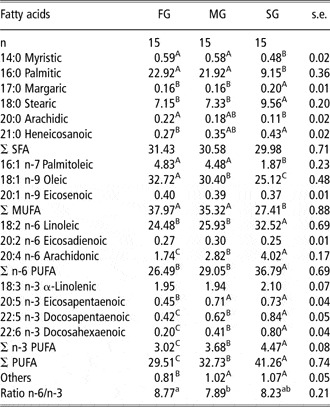
The fatty acid composition of thigh meat is shown in Table 7. The results agreed with those previously described for breast meat, but the differences among groups were less pronounced. MUFA content was significantly (P < 0.01) lower in SG birds than both FG and MG birds, whereas total PUFA, n-6 PUFA and n-3 PUFA were significantly higher (P < 0.01).
Fatty acid composition (% TFA) of thigh meat (Biceps femoris) according to genotype

TFA = total fatty acids; FG = fast-growing; MG = medium-growing; SG = slow-growing; SFA = saturated fatty acids; MUFA = monounsaturated fatty acids; PUFA = polyunsaturated fatty acids.
a,bMeans within a row followed by different superscript letters differ significantly (P < 0.05).
A–CMeans within a row followed by different superscript letters differ significantly (P < 0.01).
Several factors may affect the fatty acids composition of meat. Rymer and Givens (Reference Rymer and Givens2006) did not find significant differences in the efficiency of incorporation of n-3 PUFA into edible tissues using the two FG broiler genotypes Cobb 500 and Ross 308. In our trial, the large differences in the fatty acid composition of the meat among breeds may be attributed mainly to the genotype rather than feeding, since all the birds received the same diets. A possible effect of the dietary regimen could be related to the different pasture utilization by the three genotypes as reported by Castellini et al. (Reference Castellini, Berri, Le Bihan-Duval and Martino2008). Indeed FG birds had lower locomotory activities and therefore had a more limited access to the outdoor area than SG birds and this may have presumably affected their pasture intake. However, Ponte et al. (Reference Ponte, Alves, Bessa, Ferriera, Gama, Brás, Fontes and Prates2008) reported that pasture consumption has little effect on the fatty acid profile of broiler meat since grass biomass intake represented between 2.5% and 4.5% on a dry matter basis of the total feed intake. The fatty acid composition of pasture (Table 2) did not clearly show any relationship with the fatty acid composition of meat since the LNA of both breast and thigh meat of SG birds appeared similar to or lower than that of FG and MG birds even if the LNA proportion of pasture was about 50% of the total fatty acids. In addition, the intramuscular fat content may be responsible for the different fatty acid profile among genotypes. Barton et al. (Reference Barton, Marounek, Kudrna, Bures and Zahradkova2008) demonstrated that lean animals have higher proportions of muscle PUFA due to the higher incidence of membrane phospholipids (high in PUFA). However, the breast lipid content, along with the PUFA proportion of MG birds, do not clearly confirm the findings of Barton et al. (Reference Barton, Marounek, Kudrna, Bures and Zahradkova2008). Another hypothesis to explain these differences in the PUFA profile is that SG birds may have a higher Δ-6 desaturase activity, the enzyme involved in the conversion of LA to ARA as well as of LNA to EPA and DHA, being these long chain PUFA quite higher in their meat and absent both in feed and grass (Table 2). These data appear interesting since in literature there is no evidence regarding the fatty acid profile of different chicken genotypes submitted to the same feeding regimen as well as concerning their Δ-6 desaturase activity. The lipid content of breast and thigh meat is also affected by bird age, but the data are contradictory: Touraille et al. (Reference Touraille, Ricard, Kopp, Valin and Leclerq1981) found in broiler a lipid decrease after 8 weeks of age, whereas Baeza et al. (Reference Baeza, Salichon, Marché, Wacrenier, Dominguez and Culioli2000) reported a lipid increase in breast muscle of Muscovy and mule ducks between 8 and 12 weeks.
However, other factors can be involved in the fatty acid metabolism and therefore deeper investigation are needed to confirm the effect of chicken genotype and age on lipid metabolism with particular regard to the enzymes involved in the long-chain PUFA pathway.
Conclusions
The choice of different chicken genotypes in organic farming plays a key role in determining carcass yields, chemical composition and final meat quality traits. The use of egg-type SG birds affected the colour as well as water-holding capacitiy and texture of the meat. Moreover, SG birds produced meat with a lower lipid content and higher proportions of PUFA, particularly the n-3 ones, making this genotype attractive from a nutritional point of view. When reared until 81-day-old, as ruled by the European organic farming regulation, FG birds yield very heavy carcasses which do not appear suitable for the organic poultry market that is mainly focused on the whole carcass. In practice, when FG birds are used for organic market, only breast meat is sold as organic meat while the other parts of the carcass are sold as regular meat.
Overall, from this study, it emerged that meat functional properties as well as nutritional characteristics are strongly influenced by the bird genotype. The former appears much more attractive both for industrial and consumer use in FG and MG strains, whereas from a nutritional point of view, meat from SG appears healthier (less fat and higher content of n-3 PUFA) and thus might better fit with the consumer’s expectations of organic products. Moreover, the organic poultry production, although being a niche production, may represent a valuable way for the exploitation of the SG egg-type males that otherwise are suppressed at hatch.
Acknowledgements
This study was supported by the E.QU.I.ZOO.BIO project (Efficiency, Quality and Innovation in Organic Livestock). The Authors acknowledge Stefano Pignata for his precious technical assistance.