1. Introduction
“Counternomics” are counterfactuals whose antecedents run contrary to the laws of nature.Footnote 1 Counternomics appear in many areas of scientific discourse. Explaining why we know some theory in the history of science to be false frequently requires making counternomic claims. For example, we know classical electromagnetic theory to be false because if it had been true, then a sample of metal’s rate of photoelectron emission would have varied as the wavelengths of light shining on it were altered, and photoelectron emission is unchanged under that intervention. That counterfactual statement—‘If classical electromagnetic theory had been true …’—is a counternomic.Footnote 2 Additionally, counternomics often appear in scientific explanations, especially those that invoke laws or law-like regularities to do explanatory work. For instance, a diamond’s lack of free electrons explains why it is an exceptionally poor electrical conductor. Accordingly, one is inclined to affirm the following counterfactual: “If a diamond’s chemical structure had been such that it had more free electrons, then it would have been a better conductor.” But because it is at least a matter of nomological necessity that a diamond has its actual chemical structure, that too is a counternomic.
Despite how common counternomics are in scientific discourse, surprisingly little philosophical attention has been paid to them.Footnote 3 This lack of attention is surprising because counternomics straightforwardly raise a number of interesting epistemological and metaphysical questions. For example, what counts as evidence regarding what would have happened in some nomologically impossible circumstances, and why? Which counterfactual semantics best models how scientists reason counternomically? Relatedly, since some counternomic antecedents seem to be logically or metaphysically impossible—for example, the logically impossible, ‘Had Bohr’s theory of the atom been true, …’Footnote 4—do our theories of modality and modal language somehow need to accommodate impossible worlds and counterpossible conditionals?
My aim in this article is to get started answering some of these questions. I want to address a question concerning our knowledge of counternomics—in particular, about how observations of actual physical systems might support counternomic hypotheses. Again, counternomics describe circumstances in which the laws of nature are different from what they actually are. So we have limited epistemic access (to start, we have no empirical access) to any of the circumstances they describe. Yet in some cases, real-world observations seem to support our beliefs about what would have happened under those different laws. The question I am concerned with is: How? How can the way things behave under the actual laws support claims about how they would have behaved under nonactual laws?
I begin by narrowing the scope of the question to a particular kind of interesting experimental case and provide two representative examples (sec. 2). Because these are cases of experimental manipulation, you might think that how we reason counternomically using them is a kind of intervention-based counterfactual inference. I show that this characterization faces serious difficulties (sec. 3) and suggest another characterization (sec. 4).
2. Narrowing the Question
This article concerns the following question: How can facts about how things behave under the actual laws support claims about how they would have behaved under a different set of laws? I can put the question a more precise way. When we have some actual evidence E and some counternomic conditional C, what inference or evidential relationship moves us from E to C? I think it is still important to narrow the scope of this question since at least some counternomic circumstances are such that our reasoning about them is fairly transparent. I will now distinguish between these “easy” cases and those that I will focus on.
Here is one example of our reasoning about a counternomic circumstance in which the structure and content of our reasoning using “real-world” data is easy to understand. It is widely known that certain mathematical models of motion in classical mechanics represent concrete objects as moving across frictionless planes. This is obviously an idealization. But this idealization relies in part on a counternomic: it is nomologically impossible that there could have been frictionless planes. Now, there is a whole range of nomologically possible planes ranging from very frictional (e.g., rubber) to not very frictional at all (e.g., wet ice). And it is easy to graph how the acceleration of some object differs between more frictional and less frictional surfaces and as the coefficient of friction approaches zero. So how do we know how objects would have moved across a frictionless plane? Simply extend the observed curve to the point where the coefficient of friction is zero. However an object’s acceleration is characterized there, that is how it would have behaved if there had been frictionless planes.
A second, similar kind of case in which the content and structure of our counternomic reasoning is transparent involves objects whose behavior is governed by well-known mathematical laws. For example, while Newton’s law of gravitation is an inverse-square law, it is possible to construct simulations of how planetary interactions would have looked if gravitation had been an inverse-cube law. One need only formulate the nonactual law mathematically and make the behavior of the simulated objects fit it. Thus, it is easy to know how things would have behaved in that counternomic circumstance. The reasoning that leads us to these bits of counternomic knowledge is, as above, quite transparent.
The two types of cases I have just mentioned share the following feature: they involve an extrapolation of mathematical descriptions of physical systems. The sort of cases I am concerned with are those in which our counternomic reasoning is based not on mathematical descriptions but instead on observations of experimental systems. These cases are puzzling for a number of reasons. Let me briefly describe their puzzling features before providing examples. These cases comprise observations of experimental settings in which an ordinarily law-governed phenomenon is “absent.” Accordingly, those observations can and do support counternomic claims about what the world would have been like, if some law had not obtained or if some kind of entity had not been excluded by the laws. But in each of these experimental settings, the state of the experimental system is significantly distorted from the sorts of conditions described in the targeted counternomic circumstances. The presence of the distortion in these cases makes it puzzling exactly how these experimental observations manage to provide evidence for the counternomic claims of interest.
2.1. Water and Hydrogen Bonding
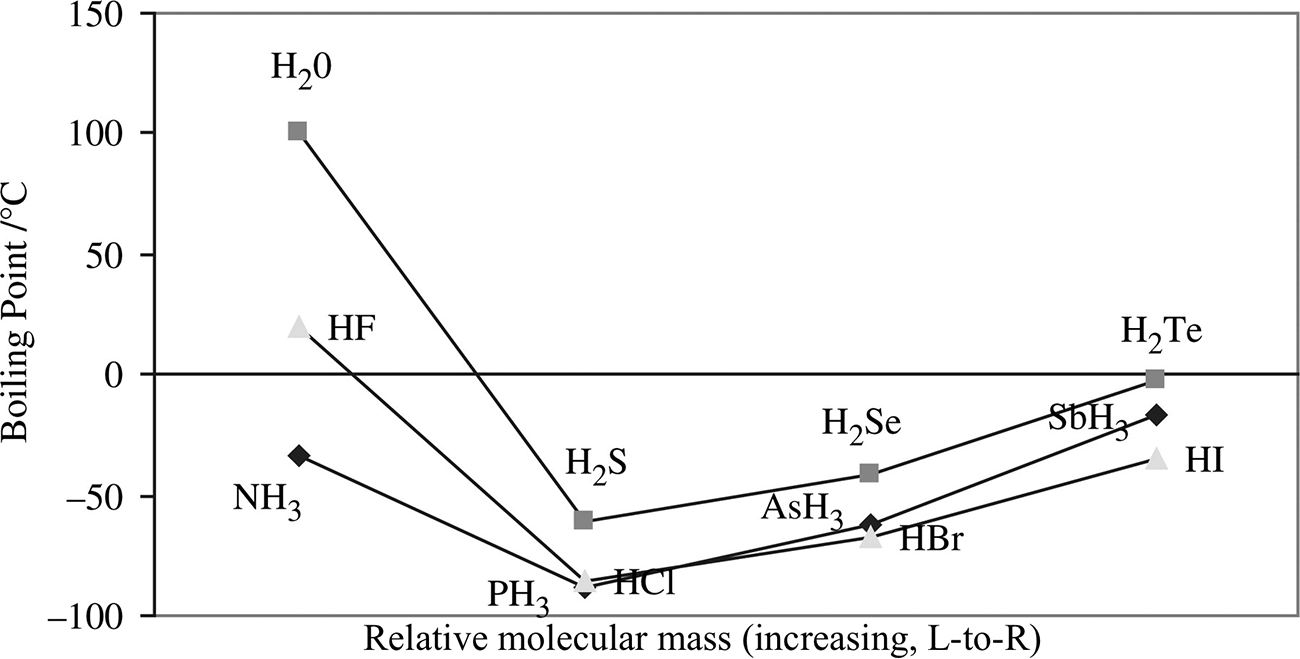
To understand my first example, some background will help. Water has an abnormally high boiling point for a molecule of its mass. Other molecules of water’s approximate mass are gaseous at the temperature ranges at which water is a liquid. Considering only its mass, one expects that water would be a gas at room temperature. The boiling points of other group 16 hydrides (e.g., H2S, H2Se) obey a nearly linear relationship with regard to their molecular mass (see fig. 1).
Boiling points of various hydrides (Hendry and Rowbottom Reference Hendry and Rowbottom2009).

Extrapolating from this relationship, one expects that water’s boiling point will be at about −70°C.Footnote 5 Obviously, it is not. What explains water’s abnormally high boiling point is its tendency to form intermolecular hydrogen bond networks.Footnote 6 Hydrogen bonds are much stronger than the weaker van der Waal bonds the other group 16 hydrides form; as a result, water’s boiling point is much higher than expected. Because of hydrogen bonding’s role in explaining why water’s boiling point is so high, one is inclined to affirm the following counternomic:
H-Bonds If there had been no intermolecular hydrogen bonding, then water would have been a gas at room temperature.
This theoretical background provides ample evidence for H-Bonds. And there is no mystery as to how this evidential relationship works; indeed, finding H-Bonds by extending the almost-linear relationship between molecular mass and boiling point mirrors the sort of case I set aside as “easy.” Thus consider, as promised, additional, experiment-based evidence for H-Bonds.
When one introduces a large amount of energy into a sample of liquid water (e.g., by heating it), one can observe its intermolecular hydrogen bonds breaking.Footnote 7 Mass in the liquid sample is lost as the bonds break and portions of liquid evaporate. Suppose that one observes all this and, quite reasonably, says, “Here is a situation in which we know that the water’s hydrogen bonds are not there. And look, it is a gas! Should this not count as some evidence for what would happen if there had been no hydrogen bonding?” Indeed, this observation does allow us to reason veridically about what water would have been like, had hydrogen bonding not occurred. It is an additional evidential basis for H-Bonds.
The puzzle I am interested in is understanding how this observation serves in that evidential capacity. This case is puzzling for two reasons. First, even though water’s hydrogen bonds break when it is boiled, it is nevertheless still a law that intermolecular hydrogen bonding occurs. All you have done is break some hydrogen bonds by boiling the water; surely even that bond breaking is governed by the laws. So, to say that observations of boiling water show us what things would have been like if there had been no hydrogen bonds seems to mischaracterize what the observation actually is.
The fact that observing this situation in which—here is an infelicitous description—hydrogen bonding “does not occur” requires us to first boil the water we are observing poses a second, more worrying, problem. For the thing that we took ourselves to be reasoning about is what water would have been like at room temperature in the absence of hydrogen bonding. Of course, heating some water means it is no longer at room temperature. So, on the face of things, that observation should not allow us to reason about the very thing that we wanted to reason about.
2.2. Magnetic Monopoles
Here is my second example. Maxwell’s second equation—a law—ensures that there cannot be any magnetic monopoles (i.e., a magnet with only a south pole or a north pole). Nevertheless, the following counternomic seems true:
Monopole If there had been magnetic monopoles (i.e., had Maxwell’s second equation not held), then they would still have obeyed Maxwell’s first and fourth equations.
Maxwell’s first and fourth equations are Gauss’s law and Ampère’s circuital law; together they govern the fact that electric charge, flux, current strength, and the magnitude of fields always stand in particular proportions to each other. So, qualitatively, Monopole says that if there had been more kinds of magnetic objects (e.g., monopoles), they would have behaved in basically the same ways that magnetic objects already behave. Put this way, this should seem plausible. Quantitatively, the only change to Maxwell’s equations (i.e., other than the second equation itself; from  to
 ) would be to the Maxwell-Faraday equation (from
 to
 ). This change adds a variable jm for the contribution of the monopole’s magnetic charge density, so that magnetic and electric monopoles end up being analogous.
Some recent experimental results confirm that if monopoles had existed, they would have behaved in this way. In other words, these results confirm Monopole. Now, there are no genuine, naturally occurring magnetic monopoles. Any genuine monopoles would be elementary particles that carry a net magnetic charge; there are none. But in experimental settings, materials known as “spin ices” behave, when supercooled (<1K), as if they contained magnetic monopoles. In these low-energy systems, coordinated groups of particles will jointly (i.e., as “quasiparticles”) carry a net magnetic charge. And while the magnetic charge in these cases is not attached to a single particle, it behaves mathematically as one would expect the magnetic charge of genuine monopoles to behave (Castelnovo, Moessner, and Sondhi Reference Castelnovo, Moessner and Sondhi2008; Bramwell et al. Reference Bramwell, Giblin, Calder, Aldus, Prabhakaran and Fennell2009).
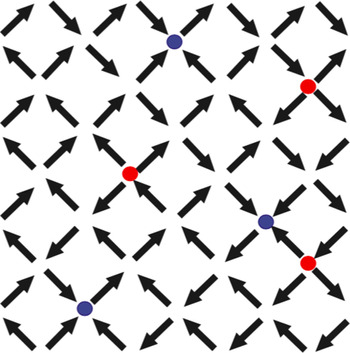
Spin ices are solids composed of tetrahedra arranged in a “corner-touching” lattice (tetrahedron vertices touching other tetrahedron vertices), with electrons sitting at the vertices of each tetrahedron. Each electron’s spin is constrained to point either directly into or out of its tetrahedron. When supercooled, the spins tend to align one spin in for every one spin out; this is the system’s lowest-energy configuration. However, because of thermal fluctuations, some individual spins flip, so that some regions end up containing a net magnetic charge. A simplified model for understanding this is presented in figure 2. In this figure, each arrow represents a spin; dots are the centers of sites of magnetic monopole quasiparticle behavior. Notice that at each normal site (without a dot), the spins are aligned “two in, two out,” but at the monopole sites, one spin is flipped so as to induce a region of net magnetic charge.
Two-dimensional representation of monopoles in spin ice (Aldus et al. Reference Aldus, Fennell, Deen, Ressouche, Lau, Cava and Bramwell2013).

What I am interested in is how these results support Monopole. To restate it as before: What inference or evidential relationship moves us from these experimental observations to Monopole (‘Had there been magnetic monopoles, then …’)? In this example, just like the first example, the values of other variables in the experimental system are distorted from normal conditions in important ways. The extremely low energy of these condensed matter systems is a distorted variable, together with the fact that the “monopoles” in question are not genuine monopoles. They are quasiparticles. Yet Monopole presumably describes circumstances in which there are genuine, fundamental-particle monopoles. How, then, do these experimental observations manage to provide evidence for it?
3. Intervention-Based Counterfactual Reasoning?
Both of these examples involve experimental manipulation of some sort or another and an observation of what happens under that manipulation. Accordingly, you might suspect that the most straightforward characterization of how these cases support some counternomic conditional is as a kind of counterfactual reasoning from intervention.
Interventions on the variables in a physical system often help us differentiate between various causal structures we might think the system has.Footnote 8 If you manipulate whether some event A occurs in a system, and nothing whatsoever happens to B, then you ought not to think that A causes B. But if you manipulate A, and B changes the same way every time you manipulate A, then you ought to conclude that A causes B. What is relevant for current purposes is that interventions support counterfactual reasoning in the same way they can support causal reasoning. If one observes the occurrence of both A and B in some physical system, then interventions can help you reason counterfactually about what would happen if either one had been absent. Suppose you know that A causes B because of interventions on A. Then, you should infer on the basis of those interventions that if A had been absent, B would also have been.
The current suggestion is that the structure of the counternomic reasoning in my problem cases is the same kind of counterfactual reasoning that interventions normally facilitate. The thought seems simple enough: one observes that net magnetic charge is always zero in unmanipulated electromagnetic systems and that Gauss’s and Ampère’s laws hold. Then, thanks to an intervention that results in some net magnetic charge in an electromagnetic system, one learns that the monopole charge makes no difference to whether either of those laws hold. So you reason counterfactually and conclude that Monopole is true.
This suggestion is clearly quite tempting. But I do not think it succeeds. The reason stems from something I have already mentioned. It is not possible to intervene on the variables whose absence comprises the counternomic circumstances of interest without distorting other important variables: one cannot manipulate whether hydrogen bonding occurs, or whether there is net magnetic charge in a region, without interfering with some other behavior in the experimental system. Our counternomic reasoning in the cases I am interested in cannot be characterized as intervention-based counterfactual reasoning simply because their manipulations do not qualify as the sorts of manipulations that can properly facilitate counterfactual reasoning.
To see why I say this, notice that when one uses interventions to reason counterfactually, it is important that all features of a system other than those that are manipulated (and those that the manipulated variables cause) be kept intact. Indeed, the basic idea behind an intervention is that one manipulates only the variable whose causal and counterfactual relationships are being investigated. Otherwise, interventions would be of little use in causal and counterfactual reasoning. Suppose you are evaluating whether raising the voltage of a circuit causes a lightbulb plugged into it to burn out faster. In order to properly reason about that counterfactual circumstance, you need to hold fixed everything except for the voltage of the circuit. You especially do not want to change anything else that might affect the bulb’s burn rate (e.g., filament thickness, gas pressure). The reason is simply that if the relationship you are investigating is actually there, you want the intervention to help you isolate it. Thus, in order for a manipulation of a target system to properly qualify as an intervention, it had better isolate only the variables of interest (Woodward Reference Woodward2003, 46–48).
With this in mind, consider the following case. Consider some ecosystem in which a species R is subject to predation by species D, and suppose that R has very few natural predators of its own. Imagine you are interested in evaluating the following counterfactual: ‘If D’s rate of predation were lower, then R’s reproduction rate would increase by n individuals/year’. Now suppose it is possible to manipulate this ecosystem by introducing a species H that preys only on D but not R. However, even though H does not prey on R, H competes for the same resources that R does, peaking during R’s mating period. Now, even though introducing H is a manipulation of that system that lowers D’s rate of predation, I do not think it allows you to properly evaluate that counterfactual. The reason should be pretty clear. Bringing in H distorts the very features of the ecosystem required for evaluating whether that counterfactual is true, since bringing in H interferes with R independently of how it affects D. Accordingly, that “intervention” (so-called) cannot be an appropriate basis for evaluating that counterfactual.
The same problem affects the experimental-to-counternomic cases. The targeted circumstances in H-Bonds and Monopole implicitly or explicitly require specific background conditions. H-Bonds describes temperatures as normal; Monopole describes genuine monopoles. However, the only manipulations available to us directly affect the experimental systems in exactly those required respects. That is, those manipulations distort the very background conditions required to evaluate those counterfactuals. So, just as introducing H cannot be a basis for intervention-based counterfactual reasoning about R’s reproduction rate, neither can the experimental observations of interest by themselves provide evidence for their counternomic conditionals. They do not properly qualify as interventions (in the technical sense; Woodward Reference Woodward2003, 46–48). So our reasoning about H-Bonds and Monopole, from the experimental results I have mentioned, cannot be characterized as intervention-based counterfactual reasoning.
4. Counterfactuals and Inductive Inferences
Putting aside the obstacles faced by the interventionist characterization, the central philosophical issue raised by these examples remains the same as before. How can observations of how things behave under the actual laws serve as evidence for claims about how things would have behaved under a different set of laws incompatible with the actual ones?
One of the cases I described as “easy” will prove to be helpful here. Remember that one can use a graph that tracks an object’s deceleration on smoother and smoother surfaces as evidence for a counternomic claim about how it would behave if it had been sliding on a frictionless plane: simply extend the relationship to the point of frictionlessness. We can easily suppose that such a graph is based on data observed in actual cases (e.g., take a piece of plastic, slide it on some wet ice; sand it down a little smoother; do it again and again) and hence taken from physically realizable systems. But frictionless planes are not physically realizable. Friction arises in part from electromagnetic attraction and Pauli exclusion at the microscopic level, so the familiar idealization of objects and planes as frictionless is counternomic with respect to at least those law-governed phenomena. So, despite how easy it is to understand the structure of our counternomic reasoning in this case, it resembles the experimental cases in this respect: the evidence used to support a claim about the counternomic is based in observations of actual, physically realizable systems. Then, we can ask the same question of this case that is asked of the experimental cases: How can observations of physically realizable systems, governed by the actual laws, support claims about the behavior of systems governed by nonactual laws?
The question is, of course, relatively easy to answer with this case. But a careful look at how things work here can shed some light on how the evidential relation in the experimental cases works. If analogous features are present in the experimental cases, then there will be a way of understanding how they work, too.
The evidential relationship in the case of the frictionless planes is an inductive inference from observed cases to counterfactual frictionless cases. In that case, it is an extrapolation of a mathematically described relationship, so the induction is quite transparent. Yet it is important to note that inductive inferences of that variety sometimes do not work. For example, one cannot indefinitely extend the relationship that tracks the amount of energy needed to accelerate an object to some speed since the speed of light imposes a hard threshold on reachable speeds. Nevertheless, the induction regarding frictionlessness is easy to accept because nothing suggests that there is a similar hard threshold. Nothing suggests that the otherwise smooth mathematical curve would spike or drop very suddenly after some point, and nothing in our physical theory suggests that things would behave unpredictably if they were to become smoother and smoother. In other words, there is no reason to doubt that the unobserved, counterfactual frictionless planes would have resembled the actual, even though that counterfactual turns out to be counternomic. I take it that is why an induction from the observed relationship to the counternomic frictionless cases seems unproblematic, despite its using behaviors governed by the actual laws as evidence for a claim about behaviors under nonactual laws. This point is important. It means that if you are using some observations of actual physical systems to help support a counternomic, the fact that the target describes a counternomic situation does not by itself provide a defeater for the inference or evidential relationship.
I take it that the problematic experimental cases also involve an inductive inference. They, too, use observations as evidence for claims about some unobserved (i.e., counterfactual) cases. To be sure, their inductive evidence is of a different sort from the induction regarding frictionless planes; there is no mathematical relationship that they can extrapolate from. Nevertheless, it seems just as before that there are no defeaters for thinking that the counterfactual would have resembled the actual. So prima facie those experimental observations can support inductive inferences about their counternomic analogues.
Let us begin by considering the monopole quasiparticles. They carry a net magnetic charge, which still obeys Gauss’s and Ampère’s laws and which behaves as if it had been carried by a single object. Those observations are used to support a claim about how a genuine monopole (i.e., a fundamental particle) would have behaved. What would be a defeater against using this observed behavior as evidence for a counterfactual about the behavior of genuine monopoles? The most straightforward defeater would be an indication that electromagnetism at nonfundamental scales (including quasiparticles) fails to resemble the electromagnetic behavior of fundamental particles. As far as I am aware, we have no such defeater. In fact, electromagnetic behavior does scale above the fundamental, and we antecedently take macroscopic electromagnetic behavior to resemble the microscopic. So in fact there is some (undefeated) reason to take the electromagnetic behavior of a quasiparticle as inductive evidence for what a fundamental particle with analogous properties would have looked like.
Now, you might note here that the resemblance to the fundamental particles is exactly what is at issue: the fundamental particle analogues of the quasiparticles would have been genuine monopoles, which are incompatible with the actual laws. But it is unclear that this is a defeater all by itself. Nothing in electromagnetic theory predicts that if monopoles had existed, they would have behaved unusually or unpredictably in ways that cannot be approximated by what is actually physically realizable, that is, ways unusual beyond simply being monopoles. (Compare: special relativity predicts that if there had been light-speed exceeders, they would have behaved in radically different ways from what is physically realizable, e.g., they would have infinite mass.) If so, then the known fact that monopoles are incompatible with the laws does not by itself provide a defeater against the inductive inference. Thus, the presumption that the counterfactual would have resembled the actual seems to be undefeated, even though in this case the counterfactual is also counternomic. In other words, an inductive inference that the behavior of genuine monopoles would resemble the behavior of observed monopole quasiparticles seems undefeated, even if one knows that genuine monopoles are not physically realizable.
So there is a prima facie admissible inductive inference from the observations of monopole quasiparticles to Monopole. I think a similar story can be told for H-Bonds. We observe that water’s hydrogen bond networks break when it is boiled and simultaneously observe that it is a gas. Is there a defeater for believing that things would have resembled the actual (e.g., actual water without hydrogen bonds is gaseous) in the counterfactual absence of hydrogen bonding? Nothing that I am aware of suggests that other kinds of intermolecular bonding would have behaved radically differently. And nothing suggests that, for example, how gases react to temperature would have been different either. The judgment that the counterfactual would resemble the actual again seems to face no defeaters, even though the counterfactual supposition here—“Had there been no hydrogen bonding …”—is also counternomic. If so, there is a prima facie undefeated inductive inference that uses those observations, governed by the actual laws, to support H-Bonds, a counterfactual about nonactual laws.
Tentatively, then, it seems plausible to characterize our counternomic reasoning in my two experimental cases as a certain kind of defeasible inductive inference from the observed to the counterfactual. I have just briefly argued that in these two cases, there is no reason to doubt that such an induction is justified.
In at least the quasiparticle case, there may be additional, positive reasons for believing that the counterfactual would have resembled the actual. I can introduce the idea by calling on the “easy” case again. Idealizations like frictionlessness are frequently indispensable because they make calculations computationally tractable. That familiar idealization obviously produces results within close approximations of objects’ observed behaviors. It seems like its success can support an inductive inference that those counternomic objects (i.e., frictionless planes) would have appropriately resembled actual objects. For the fact that that idealization yields approximately the right results seems to suggest that if frictionless things really had existed, their behavior would not have diverged significantly from the patterns established by the frictional stuff we actually observe.Footnote 9 If so, then given the success of the idealization, we have some reason to believe: if there had been frictionless planes, they would have behaved as expected, that is, approximately similarly to the objects we actually have. In other words, the success of the idealization seems to prima facie justify using actual observations as an approximation of, or as inductive evidence for, the behavior described in the counternomic.
Quasiparticles also feature in a frequent idealization. In condensed matter physics, treating coordinated groups of particles (“quasiparticles”) as if they were unitary makes tractable many calculations that would otherwise be near impossible. Now, following my preceding remarks, it seems like the success of an idealization can support an evidential relationship between observed cases and claims about the ideal or counternomic. So consider how the observations of magnetic monopole quasiparticles seem to support Monopole: How does it work there? Well, idealizations of quasiparticles as single objects are highly successful in various computational contexts. We might reasonably infer, then, that if those objects had existed, their behavior would have resembled or approximated the behavior of the quasiparticles. The same principle should apply when it comes to experimentally observed quasiparticles, even though they are not being idealized for computational purposes. When one observes a quasiparticle, one can infer that if that quasiparticle had genuinely been a single object, then that object’s behavior would have closely resembled the observed quasiparticle’s behavior. And if so, the observed behavior of the experimentally observed objects (i.e., the monopole quasiparticles) can serve as prima facie evidence for a claim about how genuine monopoles would have behaved. So the observations of monopole quasiparticles can serve as prima facie evidence for Monopole.
To conclude, reasoning about the counternomic using behaviors governed by the actual laws seem justifiable if there are no defeaters for thinking that the counterfactual would have resembled the actual. I have argued that the fact that the counterfactual happens to be counternomic does not by itself provide a defeater for such an inference. At any rate, these experimental cases are only two isolated examples of counternomic reasoning in scientific practice. I am sure that many other examples of counternomics in science can equally benefit from careful philosophical discussion.