Introduction
Crowding is the assemblage of animals into a space smaller than what is normally required for better fitness (Stienhaus, Reference Stienhaus1958), and carries with it both costs and benefits. In predaceous groups, it results in cannibalism and/or intraguild predation (e.g. Michaud and Grant, Reference Michaud and Grant2004). However, in herbivorous insects, it reduces access to food and increases competition as an immediate cost (Muller and Godfray, Reference Muller and Godfray1999; Amarasekare, Reference Amarasekare2000). On the other hand, it provides more mating opportunities with suitable mates bearing superior genetic composition (Thornhill and Alcock, Reference Thornhill and Alcock1983).
The adverse effects of crowding across the animal kingdom are well defined as slowing down of the rate of growth and development of dwarfed individuals with decreased rate of reproduction (Dixon, Reference Dixon and Watson1970; Suleman, Reference Suleman1982; Hawley, Reference Hawley1985; Prout and McChesney, Reference Prout and McChesney1985; Scott, Reference Scott1990). Crowding in phytophagous insects is particularly well researched and has been found to negatively influence population growth and fitness parameters of the individuals (McClure and Price, Reference McClure and Price1975; Karban, Reference Karban1986; Valle et al., Reference Valle, Kuno and Nakasuji1989). Crowding increases competition among the individuals, thereby increasing the development time of insects (Applebaum and Heifetz, Reference Applebaum and Heifetz1999; Fantinou et al., Reference Fantinou, Perdikis and Stamogiannis2008), which is disadvantageous since this lengthens the larva's exposure time to predators and parasitoids (Price et al., Reference Price, Bouton, Gross, McPheron, Thompson and Weis1980; Rhoades, Reference Rhoades, Denno and McClure1983; Klok and Chown, Reference Klok and Chown1999). The increased intraspecific competition due to larval crowding is also known to lead to numerous behavioural changes, which are considered the first characteristic to change in response to variation in population density (Ellis, Reference Ellis1963; Roessingh and Simpson, Reference Roessingh and Simpson1994). Deleterious effects of competition lead to increased development time, and decreased pupal mass, fecundity, longevity and male mating success (Debouzie, Reference Debouzie1977; Tsiropoulos and Manoukas, Reference Tsiropoulos and Manoukas1977; McNeil and Southwood, Reference McNeil, Southwood and Harbore1978; Mattson, Reference Mattson1980; Kawai, Reference Kawai1981). Juliano (Reference Juliano1988) found that the probability of a larva maturing on a leaf declines as the number of larvae per leaf increases, indicating density-dependent loss of larvae. The wide reporting of costs of crowding from a wide range of the animal kingdom leaves no doubt of their general significance (Stienhaus, Reference Stienhaus1958).
Apart from the costs, crowding, under many conditions, may also exhibit some benefits. The resulting longer development may result in an increase in body mass (Wiklund and Forsberg, Reference Wiklund and Forsberg1991) because of the increased consumption of food (Rahman, Reference Rahman1969). Aggregation can also help to overcome the hostility of their environment, engage in co-operative social feeding, mate and reduce predation risk (Allee, Reference Allee1931; Ghent, Reference Ghent1960; Stamp, Reference Stamp1980; Pulliam and Caraco, Reference Pulliam, Caraco, Krebs and Davies1984; Nahrung et al., Reference Nahrung, Dunstan and Allen2001).
Thus previous studies clearly indicate that crowding results in a number of costs and benefits. However, this aspect is totally untouched in Zygogramma bicolorata Pallister (Coleoptera: Chrysomelidae), an efficient biocontrol agent of congress weed, Parthenium hysterophorus L. (Asteraceae). Despite a body of work on the life-history traits of this beetle (Jayanth and Bali, Reference Jayanth and Bali1994; Dhileepan and McFadyen, Reference Dhileepan, McFadyen, Mahadeveppa and Patil1997; Dhileepan et al., Reference Dhileepan, Setter and McFadyen2000; Bhoopathi and Gautam, Reference Bhoopathi and Gautam2006; Omkar et al., Reference Omkar, Rastogi and Pandey2008, Reference Omkar, Pandey and Rastogi2009), no systematic laboratory study on crowding and its effects in this beetle has so far been conducted. Field studies on the biocontrol efficacy of Z. bicolorata in relation to its density have revealed that a density of at least one adult per plant resulted in skeletonization of the leaves, with low initial population densities prolonging the time to cause defoliation and preventing regeneration of the weed by eating up fresh buds in addition to suppressing winter generation plants (Jayanth and Bali, Reference Jayanth and Bali1994). In view of the above information, the experiments were designed with the hypothesis that crowding during larval rearing will not only affect the developmental duration, survival and weight of adults, but will also affect the reproductive performance of emerging adults earlier reared under crowding conditions.
Materials and methods
Study organism
Adults of Z. bicolorata measure 5–6 mm in length, and both adults and larvae feed on Parthenium spp. leaves (McFadyen and McClay, Reference McFadyen, McClay, Wilson and Swarbick1981), making this Mexican beetle an effective biocontrol agent of congress weed. In 1980, Z. bicolorata was first introduced to Australia from Mexico (McFadyen and McClay, Reference McFadyen, McClay, Wilson and Swarbick1981) and in India, biological control efforts were initiated in 1983 (Jayanth and Nagarkatti, Reference Jayanth and Nagarkatti1987). Feeding by the beetle has a negative effect on P. hysterophorus under field conditions (Dhileepan et al., Reference Dhileepan, Setter and McFadyen2000), and has attracted great interest in the use of this beetle for biological control of congress weed.
Stock culture
Adult Z. bicolorata, collected from the campus of the University of Lucknow, India (26°50′N, 80°54′E), were brought to the laboratory for establishment of a stock culture. The beetles were paired in plastic Petri dishes of an area 63.6 cm2, fed excised leaves of P. hysterophorus and kept under controlled abiotic conditions in an environmental test chamber (ETC) at 27 ± 2°C; 65 ± 5% relative humidity; and 14 h light/10 h dark. Eggs laid were collected every 24 h and observed for hatching. Newly hatched larvae were used in the experiment.
Experiment protocol
Effect of crowding on growth, development and survival of immature stages
One-hundred newly hatched 1st instar larvae ( < 12 h) were randomly selected from the stock culture and kept singly under the above-mentioned conditions in an ETC (CH-6S, Remi Instruments, Mumbai, India) in Petri dishes of area 63.6 cm2. The larvae were fed on a sufficient amount of excised P. hysterophorus leaves (40 mg/individual), so that the effects recorded could be attributed to crowding only and not to the combined effects of crowding and scarcity of food. Leftover wilted leaves were replaced daily with fresh ones. The cast exuviae were noted and removed to record the number of moults. The time between moults and number of larvae surviving each moult were recorded. Late 4th instar larvae were transferred to sand-filled Petri dishes to allow for pupation. Sand was kept moist by adding sufficient quantities of water. The duration from this event until adult emergence was recorded as the pupal period. The numbers of pupae formed were also recorded. The same observations were made in set-ups with larval densities of 4, 8, 12, 16, 20 and 24 per Petri dish and sufficient amount of excised P. hysterophorus leaves. Each experiment consisted of 10 replicates per larval density. During the course of the experiments, dead larvae were removed and not replaced by live ones to gather an insight into the immediate and relatively long-term effects of crowding on the remaining larvae, i.e. the progressive effects and events in an initially over- or under-crowded population. Under conditions of field releases, it is difficult to assess day-to-day changes in field population of a biocontrol agent, and thus, having an assessment of the ideal initial release density along with the trends of intraspecific interactions post-release would be helpful.
The total larval period (duration from 1st instar to start of soil incubation), partial developmental period (duration from 1st instar to adult emergence), weights of adults and sex ratio were also recorded. Percentage of immature survival (number of pupae/number of 1st instars × 100), percentage of adult emergence (number of adults emerged/number of pupae × 100), developmental rate (1/partial development period), generation survival (number of females × number of 1st instars) and Howe's growth index (HGI) were calculated:

where N is the percentage of adult emergence and AV is the partial developmental period.
Effect of larval crowding on reproductive attributes
Five-day-old adults of both sexes from each larval density tested above were drawn out for studying the long-term consequences of larval crowding on the reproductive performance. For this, a pair of similar size was kept in an ETC under controlled conditions (same as above) in Petri dishes (same as above) with freshly excised P. hysterophorus leaves (200 mg/pair), which were replaced daily with fresh ones. Each experiment consisted of 10 replicates per larval density. Daily oviposition was recorded for the entire lifetime and the eggs were further observed for hatching. Pre-oviposition, oviposition and post-oviposition periods, fecundity and percentage of egg viability were recorded. The reproductive rate was calculated taking into account the ratio of fecundity and oviposition period.
Fitness measures (r) were calculated as a performance measure (McGraw and Caswell, Reference McGraw and Caswell1996):

where m is the survival (1 or 0), D is the partial development time and V is the potential fecundity.
Data analysis
The data obtained on the growth, developmental, survival and adult reproductive parameters were analysed using one-way ANOVA and in case of significant F-values, means were compared using Tukey's honest significance test at 5%. Data of developmental rate against number of larvae were fitted to different regression curves and the best-fit equation was selected by comparison of the regression coefficients. Experimental data were then fitted to the best-fit equation and backward and forward predictions of the developmental rate were done at intervals of 24 h for obtaining the maximum theoretical development rate at 95 and 50% levels. The forecast of maximum theoretical developmental rate at 95 and 50% levels was done graphically by drawing drop lines from the line graph.
Results
Effect of larval crowding on growth, development and survival of immature stages of Zygogramma bicolorata
There was a significant effect of different levels of larval crowding (1, 4, 8, 12, 16, 20 and 24) on growth and development of immature stages of Z. bicolorata. Larval crowding significantly affected the development periods of the different immature stages, viz. 1st (F = 3.47; P < 0.001; df = 6, 153), 2nd (F = 3.72; P < 0.001; df = 6, 153) and 3rd (F = 3.77; P < 0.001; df = 6, 153) instars. However, there was no significant effect on the duration of development in 4th instar larvae (F = 0.86; P>0.05; df = 6, 153). Individual comparison of means revealed that the 1st instar duration was the highest at larval density of 4 and differed significantly from the other densities. However, the development time of 2nd, 3rd and 4th instars was not significantly affected by the simulated crowding.
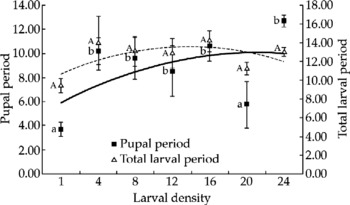
The total larval period (F = 2.26; P < 0.01; df = 6, 153; Fig. 1) was not significantly influenced by the different larval densities. By contrast, the pupal period significantly varied with larval densities (F = 7.88; P < 0.001; df = 6, 153; Fig. 1).
Influence of different larval densities on pupal period and total larval period (in days) of Zygogramma bicolorata.

The partial developmental period, which was inclusive of durations of all immature stages except the incubation period, differed significantly among the tested larval densities (F = 5.39; P < 0.001; df = 6, 153) and were significantly the highest at larval densities of 4 and 8.
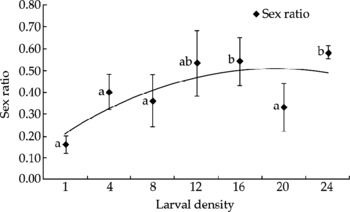
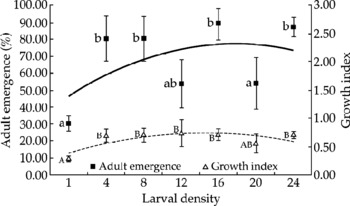
The sex ratio (F = 4.94; P < 0.001; df = 6, 153; Fig. 2), percentage of adult emergence (F = 7.44; P < 0.001; df = 6, 153) and the HGI (F = 5.19; P < 0.01; df = 6, 153; Fig. 3) were also significantly affected by the larval crowding. For mean adult emergence and the HGI, a larval density of 1 differed significantly from the other densities.
Influence of different larval densities on sex ratio of Zygogramma bicolorata.

Influence of different larval densities on percentage of adult emergence and growth index of Zygogramma bicolorata.

Percentage of immature survival (F = 0.50; P>0.05; df = 6, 153), generation survival (F = 0.55; P>0.05; df = 6, 153) and weights of male (F = 0.93; P>0.05; df = 6, 89) and female (F = 0.78; P>0.05; df = 6, 116) did not differ significantly.
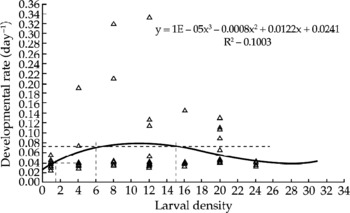
Backward and forward extension of the binomial regression equation of developmental rate against larval densities revealed ideal density for 95% (6 or 15 larvae/Petri dish) and 50% (1.75 larvae/Petri dish; Fig. 4).
Regression curve describing the effect of different larval densities on developmental rate of Zygogramma bicolorata and the identification of optimal larval density required for 95 and 50% maximum theoretical developmental rate. Thin dashed lines and thick continuous line indicate 95 and 50% maximum theoretical developmental rate, respectively.

Effect of larval crowding on reproductive attributes
Larval crowding did not significantly affect reproduction. Regardless of the larval density during rearing, the reproductive attributes of the emerging Z. bicolorata adults did not differ significantly in terms of pre-oviposition (F = 1.49; P>0.05; df = 6, 64), oviposition (F = 1.62; P>0.05; df = 6, 64) and post-oviposition (F = 0.67; P>0.05; df = 6, 64) periods. Similarly, fecundity (F = 1.67; P>0.05; df = 6, 64), percentage of egg viability (F = 0.56; P>0.05; df = 6, 64), fitness (F = 0.77; P>0.05; df = 6, 64) and the reproductive rate (F = 0.72; P>0.05; df = 6, 64) of adults emerging from different larval crowding conditions were not significantly affected by the different larval densities.
Discussion
The results of the study revealed that most developmental parameters, viz. partial developmental period, percentage of immature survival, growth index, generation survival and sex ratio, were good at larval densities of 4 and 8 in comparison with other larval densities. However, high adult emergence and growth indexes were also observed at the higher larval densities of 16 and 24, though partial developmental period was found to be reduced in comparison with that at lower densities.
Increased rearing densities beyond larval densities of 4 and 8 slowed down the development of immature stages in Z. bicolorata. This can be attributed to: (a) reduced space for movement and (b) reduced consumption of food owing to intraspecific competition. Previous study in the chrysomelid Pyrrhalta nymphaeae L. reported that the probability of a larva maturing on a leaf declines as the number of larvae per leaf increases (Juliano, Reference Juliano1988). Our finding of delayed development of Z. bicolorata due to larval crowding corroborates earlier findings on other phytophagous insects (e.g. Kisimoto, Reference Kisimoto1965; Drosopoulos, Reference Drosopoulos1977; Denno et al., Reference Denno, Douglass and Jacobs1986; Gibbs et al., Reference Gibbs, Lace, Jones and Moore2004).
The negative effect of increased larval density in a limited arena may be the result of physical interference due to frequent contact among individuals causing intensified competition for resources. Strong et al. (Reference Strong, Lawton and Southwood1984) discussed mechanism of competition among herbivorous insects, emphasizing interference, differential resource consumption and inducible defences. Communities in which several consumers converge or specialize on the same resources are characterized by competition among them (Muller and Godfray, Reference Muller and Godfray1999; Amarasekare, Reference Amarasekare2000). Other workers have also reported competition for food among individuals at high population densities (Helgen, Reference Helgen1987; Dixon, Reference Dixon and Watson1970; Putman, Reference Putman1977). The reduced feeding rates as a result of competition are likely to be the major cause for the reduced growth and development of the larvae (Lawton et al., Reference Lawton, Thompson and Thompson1980; Pickup and Thompson, Reference Pickup and Thompson1984; Crowley et al., Reference Crowley, Nisbet, Gurney and Lawton1987). Though the amount of food provided was kept constant in the present study and that consumed by the larvae was not quantified, the reduction in food consumption per individual due to crowding has been suggested as a probable reason for the reduced larval growth (Applebaum and Heifetz, Reference Applebaum and Heifetz1999; Fantinou et al., Reference Fantinou, Perdikis and Stamogiannis2008). Increased physical or chemical interference could also be a cause of reduction in food consumption (Muller and Godfray, Reference Muller and Godfray1999; Amarasekare, Reference Amarasekare2000). However, the constant amount of food provided per individual in the present study indicates that the prolonged development time in Z. bicolorata was due to crowding alone and not due to any kind of experimental shortage in food availability.
Though reduced food consumption and increased competition for food resources at higher larval densities explain the decreased rate of development at these densities, it does not explain the lower developmental rate at the lowest larval density. This could be due to the probable presence of (a) social feeding, (b) lack of some other fitness increasing social behaviours and/or (c) presence or absence of some feeding eliciting chemicals. The role of such social influences in stimulation of feeding (Stamp, Reference Stamp1980; Hemptinne et al., Reference Hemptinne, Gaudin, Dixon and Loganay2000; Nahrung et al., Reference Nahrung, Dunstan and Allen2001) and faster development under the influence of pheromones has been suggested by a number of workers.
Theoretical prediction based on the fitting of the experimental data revealed larval densities of 8–10 to be ideally suited for maximum developmental rate, which closely coincides with those of our study. A 95% maximum developmental rate was obtained at larval densities of 6 and 15. Noteworthy is the presence of a constant minimum developmental rate beyond a larval density of 24, which indicates the negative effect of crowding to be no longer influential. This could be because of the higher mortality at these larval densities, which would allow the survival of only the maximum sustainable number of larvae. The initial higher mortality at the higher larval densities is likely to ease the crowding pressure at the later stages. This will allow the surviving individuals to develop better with lesser competition and risk of mortality, thereby resulting in a high percentage of adult emergence and growth index.
Low immature survival and adult emergence under most of the crowded conditions may be attributed to (a) easy transmittance of many diseases (Stienhaus, Reference Stienhaus1958) due to increased amount of wastes and faecal material and frequent contact and interaction, and/or (b) the increased window of vulnerability to predation due to the slowing down of the development. Crowding is known to result in the accumulation of increased amount of urea in the fruit fly Drosophila melanogaster Meigen, which has been implicated in its slower development and reduced survivorship (Botella et al., Reference Botella, Moya, Gonzalez and Mensua1985). The higher contact rate under crowded conditions may also facilitate the transmission of pathogens as has been observed in the larvae of Junonia coenia Hubner (Lepidoptera: Nymphalidae) and Colias philodice Godart and Colias eurytheme Boisduval (Lepidoptera: Pieridae; Stienhaus, Reference Stienhaus1958). Under field conditions, natural enemies may also play a role in reducing survival.
Larval density had no effect on the development of the 4th instar in Z. bicolorata, probably because of the cessation of feeding in this stage prior to pupation, thus resulting in an absence of competition for food. However, the overall relatively lower levels of immature survival and adult emergence are probably due to local population effects as the ambient conditions were favourable.
Surprisingly, no major effect of larval density on the weight of the emerging adults and on the reproductive potential of the females was recorded. The reasons for this are currently unclear and merit further studies on efficiency of food conversion and metabolism in Z. bicolorata. The lack of effect of larval crowding on the reproductive output, however, is explained by the well-known correlation between weight and fecundity. Heavier and larger sized adults are known to have higher fecundity (Evans, Reference Evans1982; Thornhill and Alcock, Reference Thornhill and Alcock1983; Gilbert, Reference Gilbert1984; Johnson, Reference Johnson1990). Since, in this study, no effect on weight of adults was recorded, the lack of influence on reproductive output becomes a direct conclusion. Similar effects have been observed in the bird-cherry ermine moth Yponomeuta evonymellus L. (Javois et al., Reference Javois, Tammaru and Kaar2004) and in the cabbage moth Mamestra brassicae L. (Kazimirova, Reference Kazimirova1996).
The effect of crowding on larval stages and not adults indicates the vulnerability of the former. This is supported by several other studies that state that juvenile survival was generally lower and more variable than adult survival and tends to be more sensitive to resource availability and changes in weather (Fisher, Reference Fisher1961, Reference Fisher1963).
Thus the results of our study on larval crowding in Z. bicolorata reveal that crowding: (1) causes delayed larval growth and development, (2) creates intraspecific competition among individuals, but (3) has no effect on the weight and reproduction of adults. Our findings will help in identifying the optimum density of Z. bicolorata for effective weed management in the field without causing too much competition for food resources in the larvae and is also likely to provide guidelines for improved laboratory rearing of the beetle.
Acknowledgements
The authors are thankful to the Head, Department of Zoology, University of Lucknow, for laboratory facilities.