Implications
The relevant negative impact in livestock production due to seasonal dry periods within tropical and arid climate regions highlights the need to understand genetic and metabolic adaptation mechanisms to periodical feed restriction. Our results concerning changes in BW and genomic expressions of intermediary metabolism regulatory enzymes of ram lambs of Dorper and Australian Merino breeds subjected to ad libitum and to 85% maintenance energy requirements show that Dorper have a better adaptation to feed restriction than the Merino sheep. Our findings can contribute to future research guidelines leading to improved genetic selection toward livestock adaptation to harsh environments.
Introduction
Several studies have been performed in order to characterize the effects of caloric restriction on gene expression of enzymes involved in energy metabolism (Dhahbi et al., Reference Dhahbi, Mote, Wingo, Tillman, Walford and Spindler1999; Hagopian et al., Reference Hagopian, Ramsey and Weindruch2003; van Harten and Cardoso, Reference van Harten and Cardoso2010). These studies showed differences in enzyme levels during periods of weight loss, suggesting that these changes can be maintained or increased in animals adapted to restrictive feeding conditions.
The purpose of this experiment was to study the effect of dietary restriction on gene expression of some regulatory enzymes of the intermediary metabolism (phosphofructokinase (PFK), pyruvate kinase (PK), phosphoenolpyruvate carboxykinase (PEPCK), fructose 1,6-bisphosphatase (FBPase), glucose-6-phosphatase (G6Pase), glycogen synthase (GS), fatty acid synthase (FAS), glutamate dehydrogenase (GDH) and carbamoyl phosphate synthase (CPS)) in two different sheep breeds, assuming that these enzymes are related to physiological responses to feed restriction. This study is a consequence of our earlier work (van Harten et al., Reference van Harten, Almeida, Morais, Schwalbach, Greyling, de Waal and Cardoso2003; Almeida et al., Reference Almeida, Schwalbach, deWaal, Greyling and Cardoso2004 and Reference Almeida, Campos, Francisco, van Harten, Cardoso and Coelho2010) showing metabolic effects of seasonal feed restriction in both laboratory and farm animals. The animals used here were the Dorper and the Australian Merino. The Dorper is a composite breed developed in South Africa from a cross between the Blackhead Persian and the Dorset Horn (Cloete et al., Reference Cloete, Snyman and Herselman2000). The breed was introduced in Australia from South Africa 1996 (Almeida, Reference Almeida2011) in order to increase meat production from the more arid regions as the Dorper is a hair breed that is able to survive in a harsh environment and under poor nutrition (Cloete et al., Reference Cloete, Snyman and Herselman2000). The Australian Merino is a highly productive wool breed that is considered well adapted to extensive production systems, and has been the basis of sheep production in Australia over the last 200 years.
To obtain a better profile of the glucose significance in homeostasis, hepatic glucose levels were also determined in both breeds. Hepatic glucose is the major determinant of plasma glucose concentration (Féry, Reference Féry1994) regardless of the nutritional state. The effects of insulin and glucose in ruminants (hypoglycemia) are similar to those observed in monogastric animals, although much less severe (Faverdin, Reference Faverdin1999). Gluconeogenesis in ruminants occurs mainly in the liver with the kidneys accounting for a maximum of about 15%. Although not absorbed in large quantities, glucose is of equal importance as a metabolite in ruminants as in non-ruminants. It is a major source of energy for nervous tissues and is essential in the synthesis of structural polysaccharides, glycoproteins and glycolipids of cell membranes, cartilage and mucopolysaccharides, as well as for the mammary gland metabolism (Cerrilla and Martínez, Reference Cerrilla and Martínez2002).
Material and methods
Animals and experimental design
The trial was conducted at Merredin Research Station in Western Australia (31° 29.585 S, 118° 13.575 E). Ram lambs of Dorper and Australian Merino (Peppin) breeds, aged 4 to 6 months were used and each breed was randomly divided into two groups: Merino control (MC) and restricted (MR), Dorper control (DC) and restricted (DR) were compared across two nutritional treatments: growth and restricted diets for 42 days. Animals were kept together in a paddock chemically fallowed with the broad-spectrum herbicide (Monsanto, Melbourne, Victoria, Australia; 540 g/l glyphosate, Roundup Powermax®, applied at 1 l/ha) following manufacturer's instructions (Monsanto, Melbourne, VC, Australia) to destroy all vegetative dry matter before the onset of the pasture growth season. The paddock was adjacent to the sheep yards where the weighing and trial feeding pens were located. Animals were allowed 10 days to adapt to these paddocks and experimental conditions. To adapt the sheep further to the trial conditions, a period of 6 days was allowed for the sheep to eat an individual maintenance ration while in individual feeding pens, purposely designed and build for the trial. All pens had a height of 1 m and had an area of 0.75 m2 (50 cm × 150 cm). During these periods, animals were fed ad libitum on commercial pellets (see composition and details in the following section) and had free access to drinking water.
Nutritional treatments
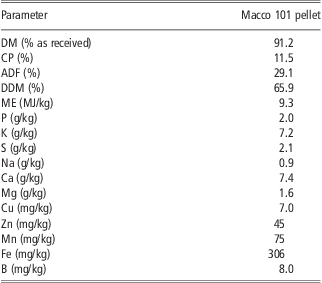
Animals were exclusively fed on the commercial feed pellet (Table 1; Macco 101, Macco Feeds, Williams, WA, Australia).
The composition of feed pellets fed to animals for the period of the trial and adaptation periods
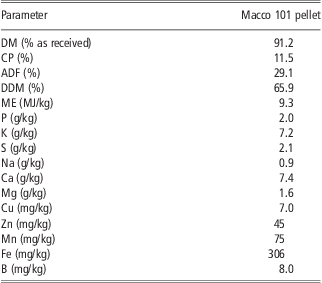
DM = dry matter; DDM = digestible DM; ME = metabolizable energy; P = phosphorus; K = potassium; S = sulphur; Na = sodium; Ca = calcium; Mg = magnesium; Cu = copper; Zn = zinc; Mn = manganese; Fe = iron; B = boron.
All parameters, except DM expressed in DM basis.
During the adaptation period to the individual feeding pens, a maintenance ration of feed for each individual was calculated using the Freer equation (Freer et al., Reference Freer, Dove and Nolan2007).
Sheep were confined to individual pens for an hour to eat. In between feeding sessions, all animals were run as a single group and had continuous access to water in the bare paddock.
Upon allocation to the experimental groups, individual rations were calculated. At day 0, average weights were 34.1 kg (s.e.m. 3) and 32.3 kg (s.e.m. 2.8), respectively, for MC and MR groups and 38.8 kg (s.e.m. 5) and 33.8 kg (s.e.m. 3.1) for DC and DR groups, respectively. Five animals per breed were allocated to a diet that was calculated based upon live weight. The maintenance ration (i.e. zero growth rate) was used from day 6 was calculated using the Freer equation (Freer et al., Reference Freer, Dove and Nolan2007). From day 0, rations were calculated to provide a growth rate of 100 g/day for the growing diet and a restricted diet growth rate of −100 g/day (∼85% of maintenance).
Animals were weighted twice a week in order to record growth performance. The first weighing of the week (every Tuesday) was used to adjust for the individual rations and the second (Friday) to determine the changes in BW. From day 10, animals were weighed at least twice at each weighing to obtain an average weight. If an individual varied more than 1 kg between the two weightings, it was weighed immediately again until a consistent representative weight was assigned.
Experimental animal weight change presented in this paper was calculated as a percentage over day 0 weight.
Sacrifice and sampling
At the trial completion of day 42, animals were transported to a licensed commercial Abattoir (Tammin abattoir, Tammin, WA, Australia) for sacrifice. After a 24-h fasting, animals were stunned and sacrificed following standard commercial practices in Australia.
Carcasses were decapitated, skinned and eviscerated. Liver was sampled (100 to 200 mg) and snap-frozen in liquid Nitrogen until further analysis.
RNA extraction and cDNA synthesis
Total RNA was isolated from liver tissue samples (30 mg) using RNAspin Mini kit (GE Healthcare UK limited, Buckinghamshire, England, UK) following the protocols provided by the manufacturer. Concentration and purity of the RNA were determined spectrophotometrically (Beckman DU68 spectrophotometer, Brea, CA, USA) at 260 and 280 nm. RNA integrity was assessed by 28S and 18S rRNA band visualization after gel (agarose 1.5%) electrophoresis and ethidium bromide staining. First strand cDNA synthesis was carried out by reverse transcription using the Moloney murine leukemia virus (M-MLV) reverse transcriptase (RT) enzyme (Promega Corporation, Madison, Wisconsin, USA). cDNA was obtained by mixing 1 μg of total RNA with oligodT primers (500 ng/μl), random hexamers (500 ng/μl) and deoxynucleotide triphosphates (dNTPs; 10 mM). The mixture was incubated for 5 min at 70°C and the rest of the components were added (M-MLV 5× reaction buffer, dNTPs 10 mM, Recombinant RNasin Ribonuclease Inhibitor and M-MLV RT), according to the manufacturers’ instructions, to a final reaction volume of 25 μl. This step was followed by incubation of 60 min at 37°C, 15 min at 42°C and 5 min at 94°C. cDNA samples were stored at −20°C until real-time PCR amplification.
Quantification of regulatory enzymes mRNA by real-time PCR
Degenerate primers for FBPase, GS and CPS were designed based on other species sequences deposited on Genebank (http://www.ncbi.nlm.nih.gov). In brief, using CLC Free Workbench 3.2.3 software (CLC bio, Aarhus, Denmark), conserved regions among species were identified after sequence alignment, and degenerated primers designed using different internet-based interfaces, such as Primer3 and Primer Premier software (Premier Biosoft International, Palo Alto, CA, USA). The primers (Supplementary Table 1) were synthesized by STABVIDA (Caparica, Portugal). Several conventional PCR reactions, using FideliTaq DNA polymerase master mix (USB, Cleveland, USA), were carried out on a GeneAmp PCR System 9700 (Applied Biosystems, Inc., Foster City, CA, USA) with the following conditions: 92°C for 2 min; 35 cycles of 94°C for 30 s, 50°C for 30 s (for FBPase), 55°C for 30 s (for GS and CPS), 68°C for 1 min and a final extension at 68°C for 5 min. Reaction products were analyzed by electrophoresis on 1.5% agarose gel stained with ethidium bromide, purified with NZYGelpure kit (Nzytech Lda, Lisbon, Portugal) and sequencing was performed by STABVIDA. Specific primers were then chosen for these target genes and housekeeping gene (Supplementary Table 2).
Real-time PCR oligonucleotide primers were first chosen with Primer3 Software and confirmed with Primer Express® Software (Applied Biosystems, Inc.; Supplementary Table 2). To avoid genomic DNA amplification, primers were designed to be located in two different exons. In order to select the most stable internal control gene under our experimental conditions, four potential housekeeping genes (β-actin, β-2 microglobulin, ribosomal protein L1 (RPL) 19 and 18S RNA) were tested. RPL 19 gene transcription was unaffected by our experimental conditions (P > 0.05) and therefore, chosen as the housekeeping gene.
Real-time reactions were performed in a total 25 μl reaction volume containing 12.5 μl of Power SYBR®Green PCR Master Mix (Applied Biosystems, Inc.), 2 μl of cDNA and 100 nM of each primer. All samples were run in duplicate on a 96-well optical reaction plate (Applied Biosystems, Inc.) on ABI Prism® 7300 SDS (Applied Biosystems, Inc.). The reaction was initially heated during 10 min of pre-incubation at 95°C, followed by 40 two-temperature cycles (15 s at 95°C and 1 min at 60°C). After PCR, melting curves were acquired (15 s at 95°C, 30 s at 60°C and 15 s at 95°C) to ensure that a single product was amplified in the reaction. For the housekeeping quantification we used diluted (1 : 10) cDNA. Primer concentrations were previously optimized to determine the minimum primer concentrations giving the lowest cycle threshold, assuring non-specific amplification. After analyzing the melting curves, the PCR products were run through a 2.0% agarose gel to confirm specificity, followed by sequencing (STABVIDA).
Relative mRNA quantification data were then analyzed with the real-time PCR Miner algorithm (Zhao and Fernald, Reference Zhao and Fernald2005). Primer concentration was previously optimized to the ratio minimum concentration/lowest cycle threshold.
Glucose determination
Glucose was determined in liver as described by Dhahbi et al. (Reference Dhahbi, Mote, Wingo, Tillman, Walford and Spindler1999). After extraction, glucose levels were obtained in the supernatant using an enzymatic–colorimetric kit (Sigma-Aldrich, St Louis, MO, USA) following protocols provided by the manufacturers.
Statistics
Statistical differences among groups were analyzed by two-factorial repetitive ANOVA for weight changes analysis and ANOVA of a 2 × 2 factorial experiment design with effects of breed, diet condition and breed by diet interaction in the model for the other studied parameters. The level of significance was set at P < 0.05. Whenever a significant difference was detected a post-hoc comparison test (least significant difference test) was performed. Whenever only one condition was reunited, a one-way ANOVA was performed, comparing the results separately (STATISTICA, StatSoft, Inc., 2004, version 7, Tulsa, OK, USA).
Animal welfare disclaimer
Both Australian (State and Commonwealth) and European Union guidelines and legislation on care, use and handling of experimental animal were followed. All aspects of the experiment were monitored and approved by competent veterinary authorities of the State of Western Australia (Perth, WA, Australia). Authors A. M Almeida, Sofia van Harten and L. A. Cardoso hold a FELASA (Federation of European Laboratory Animal Science Associations) grade C certificate, which enables designing and conducting animal experimentation under European Union standards.
Results
Live weight evolution
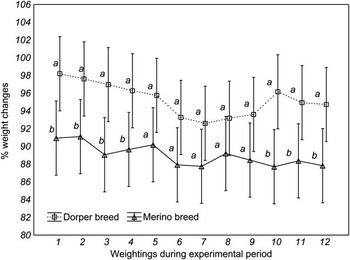
Animals were subjected to 12 weight measurements during the experimental period. Concerning control animals, weight changes in both experimental breeds showed a significant difference (P < 0.0001) between the average weight gain of Merino and Dorper animals, 8.8% (+3 kg) and 15% (+5.4 kg), respectively, during the experimental period. Weight changes between the same breed animals were significant (P < 0.001). Interaction between breed and weights were not significant (P = 0.999). Results show a consistent greater weight gain of Dorper over Merino sheep.
Regarding feed restricted groups, our results show that by the end of the experimental period, Merino and Dorper animals showed a loss of, respectively, 12.6% and 5.3% over their initial weights and that both breeds’ weight changes over their respective controls were significant (P < 0.001).
In Figure 1, repetitive ANOVA result graphic shows significant differences (P < 0.001) between average weights changes of Merino and Dorper feed restricted groups. It also shows the weight loss significance during the experimental period between both breeds with a more accentuated decrease of weight of Merino sheep during the first 9 to 10 days of the experiment. Approximately between day 18 (fifth weight) and day 24 (seventh weight) of the experimental period, both breeds show a greater and equivalent weight loss (no significant differences between breeds), followed by a significant weight recovery of Dorper sheep until the end of the experiment.
% Weight changes over day 0 of Merino and Dorper restricted-fed groups. Results were analyzed by two-factorial repetitive ANOVA. Vertical bars represent standard deviations of % weight changes. Points of the graphic without a common superscript within the same weighting period differ (P < 0.05).

The MR and DR groups weighted, relatively to day 0 of the experiment, respectively, 87.4% (−4 kg) and 94.7% (−1.79 kg). The weight changes within the same restricted breed animals (P = 0.54) are not significant.
Relative gene transcription
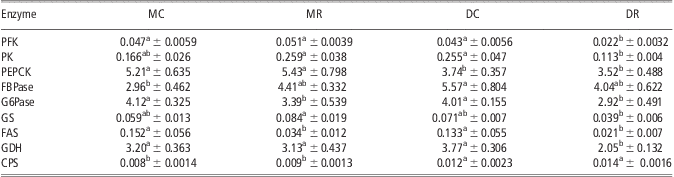
Diet restriction decreased FAS and G6Pase expression relative to control feed animals regardless of breed (Table 2). Our results show breed-related differences in PEPCK in which the Merino group presented a 32% higher mRNA expression relatively to the Dorper sheep and in CPS, in which gene expression was 35% higher in the Dorper than in the Merino animals (Table 2). The DR group revealed a decrease over DCs in the transcription of PFK (48.84%), PK (55.69%) and GDH (45.62%; Table 2). DC sheep showed higher gene levels of FBPase (88.18%) over MC group and GS revealed that the interaction of breed and diet restriction led to a decrease of 53.57% in the MR group over DR animals (Table 2).
Quantification of mRNA transcription by real-time PCR, relative mRNA level of each enzyme
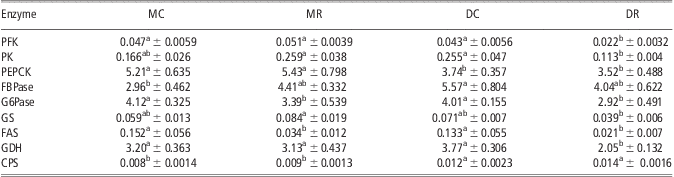
MC = Merino control; MR = Merino restricted; DC = Dorper control; DR = Dorper restricted; PFK = phosphofructokinase; PK = pyruvate kinase; PEPCK = phosphoenolpyruvate carboxykinase; FBPase = fructose 1,6-biphosphatase; G6Pase = glucose 6-phosphatase; GS = glycogen synthase; FAS = fatty acid synthase; GDH = glutamate dehydrogenase; CPS = carbamoyl phosphate synthase.
Values are means ± s.e.m.
Within a row, means without a common superscript differ (P < 0.05).
Glucose levels
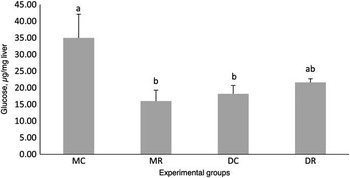
The MR group revealed a decrease of 45.7% in liver glucose levels relative to its control and the Dorper breed groups showed no significant result between them (Figure 2).
Glucose levels in liver. MC = Merino control; MR = Merino restricted; DC = Dorper control; DR = Dorper restricted. Values are expressed as mean ± s.e.m. Bars with different letters differ significantly (P < 0.05).

Discussion and conclusion
The study of the physiological response to weight loss is of capital importance to establishment of novel selection tools in order to increase and sustain animal production. Within this context, post-genomics era disciplines such as proteomics, metabolomics or transcriptomics are therefore of utmost importance. In this article, we conduct a study on the gene expression of regulatory enzymes of the intermediate metabolism in a production animal, the sheep. Our results provided us a relevant insight into this subject. We are discussing them in terms of changes within the experimental groups concerning live weight, glycolysis, gluconeogenesis, glucogenesis, lipolysis and protein catabolism.
Live weights
As shown by our results, a feed restriction level of 85% of their daily maintenance needs, revealed that the Dorper animals managed the restriction imposed better than the Merino breed, having lost only 42% of initial weight over the same ratio concerning the latter breed. Regarding the control groups, Dorper sheep group gains were 49% greater than Merino group gains.
Glycolysis
PFK and PK mRNA levels showed no significant differences in the restricted-fed Australian Merino sheep. Regarding the Dorper breed, these enzymes revealed significant differences in the feed restricted group when compared with its control. PFK and PK genes showed a decrease in their expression, in line with the maintenance of glucose levels in the restricted-fed Dorper animals. Similar results were obtained in rats by Dhahbi et al. (Reference Dhahbi, Mote, Wingo, Tillman, Walford and Spindler1999), who reported a significant decrease in PFK and PK mRNA in their underfed animals. These results are coherent with the ones obtained by Feuers et al. (Reference Feuers, Duffy, Leakey, Turturro, Mittelstaedt and Hart1989); Hagopian et al. (Reference Hagopian, Ramsey and Weindruch2003) and Ugochukwu and Figgers (Reference Ugochukwu and Figgers2006) concerning PK and PFK activities in fed restricted rats.
In a situation of feed restriction, animals tend to modify their physiological functions in order to reduce glycolytic activity and stimulate the activity of regulatory gluconeogenic enzymes of intermediary metabolism. Thus, the significant decrease of glycolytic mRNA level in Dorper animals observed in our work may indicate that this breed demonstrated a better adaptation in a feed restriction situation, presenting a facilitated glucose homeostasis, as showed by the hepatic glucose levels. These results are consistent with the variations found in BWs, leading to a better nutritional performance of the Dorper breed animals.
Gluconeogenesis
PEPCK results only showed breed-related differences. As in our study, Velez and Donkin (Reference Velez and Donkin2005) found no significant differences in gene expression of PEPCK during a study in dairy cows with a dietary restriction of 50% of ad libitum feeding. Our results show that the increased PEPCK mRNA concentrations in the Merino breed have no consequences on gluconeogenesis, suggesting an apparent downgrading concerning the activity on this enzyme in this breed. FBPase showed the influence of the interaction of feed restriction and breed on its mRNA expression, revealing significant differences between both control breeds with the Dorper animals showing higher gene levels. van Harten and Cardoso (Reference van Harten and Cardoso2010), also found no significant differences in gene expression of this enzyme in New Zealand restricted rabbits subjected to feed restriction (30% of ad libitum feeding) during 30 days.
G6Pase, an enzyme that plays an important role in glucose supply during periods of feed restriction, showed in our work a decrease in gene expression in both Dorper and Australian MR groups. In this case, the results obtained differed from Dhahbi et al. (Reference Dhahbi, Mote, Wingo, Tillman, Walford and Spindler1999) which presented in their work higher values of these enzymes in the restricted groups over control, confirming a stimulation of the gluconeogenic pathway in situations of feed restriction in rats subjected to feed restriction (50% of ad libitum feeding). The difference between these authors’ results and ours can be induced by a much higher restricted diet in their experiment and by rat sensitivity to glucose homeostasis.
Gluconeogenesis enzymes did not present any significant difference between the experimental groups, revealing only breed effect on PEPCK mRNA levels and nutrition effect on G6Pase expression levels. These results can show the need for further research on a putative upregulation of PEPCK enzyme receptors in Dorper sheep.
Glycogenesis
GS, a key enzyme limiting the formation of glycogen, showed influence of the interaction of dietary restriction and breed on gene expression in Dorper and Merino animals. Our results revealed that this parameter in the DR group was significantly lower than the MR group, whereas no differences were found between the DC and MC. Our results are consistent with Nur et al. (Reference Nur, Sela, Webster and Madar1995), in a study involving rats, in which they evaluated the effect of dietary restriction on GS gene expression. No significant difference on GS mRNA level was found among the 72-h restricted rats. Feed restriction leads to glycogen degradation with the production of glucose. It would therefore be expected that the GS gene expression was decreased in restricted diets, as obtained by van Harten and Cardoso (Reference van Harten and Cardoso2010), where results supported a decreased glycogenesis in situations of restricted feeding. In their study, a decrease in the level of GS mRNA in restricted wild rabbits was found (16 times lower over control). Our work shows that contrary to these results, DR feed sheep maintained glucose levels not because of gluconeogenesis effects.
Restricted feeding did not induce a GS expression change in Merino and Dorper animals, revealing only a lower value in this parameter in the latter group compared with the MR sheep, contributing to the verified glycemia homeostasis in the Dorper animals.
Lipolysis
Regarding lipid metabolism, FAS, which represents one of the regulatory enzymes involved in fatty acid synthesis, showed only feed restriction effect on its mRNA level in the restricted animals over control (4.47 times lower for Australian Merino and 6.33 times lower for the Dorper sheep). These results indicate an inactive or decreased lipogenesis in adipose tissue within restricted-fed animals (Kozloski, Reference Kozloski2002; Paulino et al., Reference Paulino, Sartori and Nishida2006). Our work showed similar results to those presented by Kim and Freake (Reference Kim and Freake1996). These authors found decreased mRNA levels of FAS and acetyl-coenzyme A carboxylase dietary restriction mice. Our results are thus coherent with the diet restriction imposed to the experimental animals.
Protein catabolism
GDH showed different levels in the two breeds, as a result of the imposition of feed restriction. The Australian Merino sheep showed no significant differences between experimental groups of control and restriction. Dorper animals presented a lower GDH gene expression (1.84-fold) in restricted animals over controls. In situations of feed shortage, amino acids constitute a source of carbon for the synthesis of glucose (Kozloski, Reference Kozloski2002; Paulino et al., Reference Paulino, Sartori and Nishida2006).
Our work obtained different results from those presented in several experimental studies. van Harten and Cardoso (Reference van Harten and Cardoso2010) found an increase in the GDH mRNA of restricted wild rabbits (2.28-fold) compared with the control group. Hagopian et al. (Reference Hagopian, Ramsey and Weindruch2003) verified increased activity of this enzyme. In both experiments, the restriction level was much higher than in the present work (85% of daily maintenance requirements against 60% and 75%, respectively), which can justify protein catabolism due to the GDH increased genomic and activity levels. The significant decrease in GDH mRNA in DR animals highlights a decrease in protein catabolism in these animals, showing muscle structure preservation in this experimental group, which did not occur in the Merino homologous group.
CPS showed no significant differences in the animals subjected to feed restriction compared with ad libitum animals of both breeds, revealing only a breed difference in the experimental animals with higher values in the Dorper sheep, indicating a facilitated urea synthesis in this breed.
The gene expression results of various regulatory enzymes of intermediary metabolism obtained in this work in Merino and Dorper sheep under the effect of feed restriction indicate a better adaptation of the latter animals to a homeostasis of carbohydrate and protein metabolisms.
The differences found in gene expression of several regulatory enzymes of the intermediary metabolism can provide useful tools, leading to improved genetic selection toward livestock adaptation to harsh environments and reflect the need to develop, in the future, new studies including aspects on volatile fatty acids and regulatory enzymes kinetics.
Acknowledgments
Authors acknowledge funding from FCT – Fundação para a Ciência e a Tecnologia (Lisboa, Portugal), in the form of project POCI/CVT/57820/2004 – studies on genetic and physiological characterization of sheep adaptation to feed restriction; grant SFRH/BPD/34751/2007 (Sofia van Harten) and Ciência 2007 research contract (André Almeida). Authors also acknowledge funding from the Department of Agriculture and Food (Perth, WA, Australia) in the form of the project: A comparison of Damara, Dorper and Merino sheep breeds to nutritional stress. The support of CIISA (Centro Interdisciplinar de Investigação em Sanidade Animal) and the Faculty of Veterinary Medicine of Lisbon is also acknowledged. Authors thank finally, the most valuable contribution by DAFWA staff: A. Harrod, L. Young, N. Stanwyck, E. Kidsonand and R. Butler (DVM) from the Merredin Research station and M. Young (Geraldton office) for contribution on field and abattoir work. The donation of animals used in this trial by the Western Australian farming community, and all facilities kindly provided by Tammin abattoir and Spearwood Meat Processing Plant are also appreciated.
Supplementary materials
For supplementary materials referred to in this article, please visit http://dx.doi.org/doi:10.1017/S1751731112001589