The conference Crosstown Traffic: Popular Music Theory and Practice took place in Huddersfield, UK, on 3–5 September 2018. ‘Crosstown Traffic’ was certainly an appropriate name for the event. The conference stood at the intersection of four different organisations for popular music studies: the International Association for the Study of Popular Music (IASPM) in its UK and Ireland branch, the Association for the Study of the Art of Record Production (ASARP), the International Society for Metal Music Studies (ISMMS) and the Electronic Dance Music Culture Research Network (Dancecult). Spanning 3 days, the event hosted over 200 delegates and attendees from all over the world, and its joint organisation allowed for a diversity of themes and approaches.
The place – Huddersfield – situated in the north of England, was a good pick for the conference for its small dimensions and compactness, which facilitated moving around between the town centre and the university. The rooms designated for the conference spread over four floors in the newly opened Oestler building, home to the local music department and flagship of the University of Huddersfield. The rooms were all reachable within seconds, which allowed attendees to switch easily between presentations. Eight panel sessions ran simultaneously, and there were so many interesting contributions I wished to see. Unfortunately, I could only be in one place at any one time; therefore this review will only cover the presentations I attended.
A couple of initiatives complemented and enriched the conference programme. First, the Huddersfield Immersive Sound System 3D concert, which took place on Tuesday evening, constituted a nice way to rest the mind after a day's work. The gig was structured in this fashion: large dark room, audience in the centre, performer's desk at the front and a multitude of speakers surrounding the audience in a circle. The sound was panned dynamically so that, while sitting in the middle, the spectators could have a fully absorbing experience of the performance.
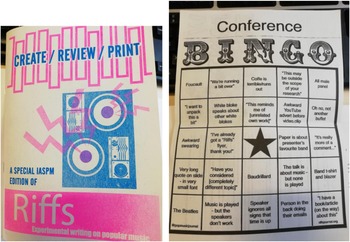
Second was the special issue of Riffs. Riffs is a journal/zine of experimental writing on popular music, featuring articles by academics and beyond. Its creators and editors are based in the Birmingham Centre for Media and Cultural Research, and their DIY philosophy is to ‘push the boundaries of academic research, communication and publishing in the area of popular music’. At Crosstown Traffic the editorial board set themselves the task of gathering contributions from attendees on the first day of the conference (Monday) in order to publish them on the following day, together with a few previously prepared articles. The ambitious mission was successfully accomplished, and not only is the issue a witty and entertaining read, but it should be set as a model for academic publishing on popular music (judging by the speed in which contributions were published). I hereby include the cover and my favourite page of the issue (Figure 1).
The cover and my favourite page of Riffs.

And now, we come to the papers. The conference was opened by a keynote from Franco Fabbri (University of Pavia), who investigated plagiarism, providing examples from international cases such as the Italian singer Albano vs Michael Jackson. The talk posed significant questions: how can we distinguish copying from imitation, and how can we identify plagiarism if sometimes a pop song is the result of the application of a formula that, perhaps, is already contained in the works of Bach and Beethoven? Such inquiries remain open, but Fabbri's contribution constitutes a step forward in the analysis of the so-called ‘anxiety of influence’ (Bloom Reference Bloom1973) and its repercussions in popular music.
The first panel I attended was entitled ‘Critical Approaches to Production’, in which the speakers examined the collaborative and collective aspect of record production. Eliot Bates (City University, New York) theorized record production as the complex intersection of aesthetic, economic, managerial and technical domains. Bates is definitely onto developing a new framework, and his paper was very technical and densely packed with information, but at times not so easy to follow.
Tom Western (University of Edinburgh) fascinatingly unravelled issues of nationalism, citizenship and migration in relation to music creation and production, based on his fieldwork in Athens, Greece. The topic of Western's presentation is timely to say the least, and the author convincingly advocates for a more ‘unfixed’ understanding of national musics through the integration of refugees voices and the study of the interaction these voices have with host communities. Lastly, Samantha Bennett (Australian National University) examined record production in connection to the (new) relationship between musicians and audiences. Bennett calls ‘intermixtuality’ the nexus between musicians, fans and production embodied by processes of online ‘stem-sharing’, in which several artists (Bennett chose Deadmau5, REM, and Bon Iver as case studies) engage with fans by letting them remix their tracks. By taking up the role of the remixer, the listener becomes an even more active participant in the process of cultural production. While remix contests are sometimes set up by the artists, such phenomena of ‘prosumption’ (production + consumption) are also complicated, often, because fans are not really able (or allowed) to release their own remixes.
After lunch I joined fellow panellists at my own session. Rob Ahlers (University of Groningen, The Netherlands), spoke about the ‘Eurosonic Noorderslag’, a festival showcasing European musicians that takes place in Groningen each year since 1986. The aim of the festival is to connect people from the industry while showcasing talents from various European countries. The ethos of the festival – centred upon an idea of European music that should counteract the Anglo-American dominance – is problematised by Ahlers: first of all, what exactly is ‘Europeanness’ in popular music? Secondly, how does this Europeanness manifest itself in times of rising nationalism? Thirdly, why do most bands perform in English anyway?
Such questions are important if we, as fans and scholars, wish to understand popular music in a broader, international context. I have noticed that the conference hosted only a few papers discussing musics from other parts of the world, especially outside Europe. The large majority of contributions focused on the UK and American contexts and artists. If this, on the one hand, makes sense, since the conference is set in the UK and one of the organising body is the UK and Ireland branch of IASPM, on the other hand it reinforces the idea that the study of popular music is an Anglo-American prerogative. I suppose the organisers themselves also would have welcomed a more international approach (they probably did not receive so many papers examining musics outside Europe and North America), but perhaps this approach should have been encouraged in the call for papers. In any case, a more international breadth of views might be something to think about in the future.
After Ahlers, Patrycja Rozbicka (Aston University, UK) talked about how Brexit may potentially impact the UK music industry. The future, apparently, is not quite rosy, as Rozbicka relentlessly provided a large set of data referring to the UK music export and the live sector of bands touring in and out of the UK. Rozbicka also analysed the cases of other EEA countries such as Norway and Switzerland, unveiling how they have been handling their live music business. Rozbicka's presentation, supported by detailed statistics, was a remarkable one because it offered a different angle – political and economic – that nonetheless complemented popular musicology and should be of great avail to scholars studying the topic.
The last afternoon session offered the most technical talk I attended. Kirsten Hermes presented on vocal tone clarity and the methods to achieve this in the mix. The talk was certainly interesting and Hermes had a considerable amount of slides showing examples of female and male frequency ranges she had gathered, which were supposed to highlight how to obtain clarity. At the same time, though, it left me thinking that vocal tone clarity cannot be understood unless it is placed in context (e.g. other instruments, the arrangement), and also largely depends on microphone choices. Can clarity be achieved with a £20 microphone? Correspondingly, what if other instruments in the arrangement insist on the same frequencies as the ones supposed to shape clarity for the vocals?
The drinks reception that closed the first day of Crosstown Traffic was a good occasion to meet new people and network. Wine and other refreshments were plentiful, and they were served together with a cold dinner of sandwiches. After a few glasses in the Oestler building I joined a group of other early-career academics on a walk through Huddersfield, discovering the various little pubs the town had to offer along the way. A very nice experience overall, which confirmed that popular music scholars are still largely bon viveurs.
I started the second day by listening to a fascinating talk by Simon Zagorski-Thomas (London College of Music), who spoke about the associations between the voice – specifically the vocal timbre – and the (im)materiality of the body in popular music. Because every timbre is subject to interpretation, when listening to a certain singer we imagine a certain type of body, linking the voice to race, size, age and gender (sometimes we are also ‘deceived’ by what we have presupposed at first). The same can be applied to the emotions that the timbre conveys – anger, sadness, intimacy, detachment and so on. Zagorski-Thomas gave examples of how such emotions can be delivered through the manipulation of the voice in the studio (EQ or additional instruments). The deliberate exaggeration of a characteristic of the recorded and disembodied voice eventually influences the listener's interpretation of that very voice to a significant extent.
At 11 o'clock the participants gathered in the main hall for the second keynote of the conference. Anne Danielsen (Oslo University) illustrated the rhythmic changes in Afro-American music in chronological order: from the tidy, clear beats of James Brown (1971) and Michael Jackson (1979) to the muddy, irregular beats of Tyler the Creator (2015) through Prince, Snoop Dogg, Brandy and Rihanna. With the aid of slides evidencing the waveforms of the beats studied, Danielsen explored cluster beats, internal (to the bar) tempo shifts and, generally, the mutation of percussive and rhythmic styles in black music over time. Since this research is a work in progress, it would be interesting to know how she intends to interpret this change in rhythm creation on a broader, sociological level.
After lunch Kai Arne Hansen (Oslo University) problematised the notion of pop. What is pop? A genre, a style? And what is the difference between genre and style, since the OED defines ‘genre’ as ‘style’? The presentation raised many points, evidencing how the (supposed) inauthenticity of pop is as constructed as the authenticity of other genres. This talk was part of a panel on the theorisation of genre categorisation in contemporary music analysis. Lewis Kennedy (University of Hull, UK) spoke about metal, and Claire Bannister (Kingston University, UK) about goth music. Although the papers were all stimulating, a quick examination of other genres such as rock or indie would have probably given a more complete picture of the topic of the panel. Moreover, if pop has been losing its derogatory connotation, which genre has in turn acquired it?
After the coffee break, Mimi Haddon (University of Sussex, UK) presented on the disjuncture between the so-called ‘vanguard’ of post-punk (Reynolds Reference Reyonlds2005) and the less radical, more ‘pop’, successors. In practical terms, Haddon focused on the differences (and contiguities) between the first wave of post-punk of bands such as Joy Division and Scritti Politti, and their inheritors like U2 and Echo & The Bunnymen, highlighting the loose and problematic character of the term post-punk in traditional definitions.
Dawn Hazle (University of Nottingham) analysed Soviet Russian metal. Taking the band Aria as her main case study, Hazle deconstructed the too frequent assumption of ‘music against the State’ in socialist countries, demonstrating how Aria and other metal (and rock) bands in the USSR were not opposed to official ideology, but rather lived outside the system and in parallel to it, through a principle of ‘non-involvement’. Such new framework is vital in order to understand the capacity and impact of music phenomena in past (and perhaps contemporary) highly ideological political structures, moving beyond rigid schemata of ‘resistance’.
The tasty conference dinner provided another good opportunity to socialise. The atmosphere was very informal and laid-back, unlike some other conferences (sorry, Russian Studies folks) and people were often switching tables. However, being very tired and having other food for thought to chew on, I left early for the hotel. It is a shame I could not explore more of Huddersfield, but perhaps this review would have ended here if I had.
On the last day of Crosstown Traffic I attended the presentation of Antti-Ville Karja (Music Archive Finland) on the ‘reconceptualisation of the popular through the sacred’. Karja investigated the connections between religion, popular culture, youth and subcultures. Because religions are popular movements in themselves, and because subcultures are at times systems of belief, Karja conceptualised the ‘multiple forms of the sacred’ in relation to the role that music plays in such forms. It was all very theoretically stimulating, yet it was not clear how narratives of transgression – often present in subcultures – would fit in this picture.
The best, however, came last. Steven Malliet (University of Antwerp) presented his latest research on neo-tribalism and ritualism in dance music in Belgium and the Netherlands. Malliet interviewed 339 electronic and dance music (EDM) enthusiasts via an online questionnaire, and found that taste, gender and age in the local EDM scene are more relevant parameters than drug and alcohol use. Moreover, younger people are more attached to the concept of subculture and their attachment tends to transcend race and social class. Apart from these exciting findings, what made Malliet's contribution stand out was the amount of data he collected and the sociological rigour with which he analysed them. Malliet's approach as a psycho-sociologist should be set as an example for many popular music scholars (including myself), who wish to integrate some numbers into their arguments, and who too often deduct conclusions based on scant or uncorroborated figures.
Sound engineer and producer Andrew Scheps closed the conference with his articulated and broad keynote paper centred upon the idea that the listener's experience is more important than the author's intention. Starting from the principle that ‘the only thing that matters is what comes out of the speakers’, Scheps told the audience about his recent reconsiderations in terms of approach to musical endeavours, from being based on the artist's meaning to focusing on the listener's interpretation of the artist's music. Scheps's entertaining speech was a great way to end the conference on a ‘light’ note.
Overall, the three days of Crosstown Traffic presented a great array of topics, not all graspable at once, but all stimulating and thought-provoking. The event asked crucial questions and put attendees face to face with urgent issues, some new, some recurrent. At the same time, it represented a step forward in popular music research and a precious occasion to exchange ideas. We are all in the process of crossing town, and we all hope to reach the other side, but it takes time and we should enjoy the ride: sometimes it is good to get stuck in the traffic.