Although changes to the Eucharist have tended to overshadow how other rites and rituals of the English church were recast during the Reformation, there were also marked changes in the performance of the sacrament of baptism. More generally, the Reformation spawned an extensive and long-lasting controversy concerning the necessity of baptism, how it should be performed and who should do so. The sixteenth and seventeenth centuries witnessed three major developments regarding baptism within the Church of England. First, the reformers stressed that baptism ought to be performed publicly in the presence of the congregation whenever possible. Secondly, there was a wide-ranging controversy relating to the rubrics stressing a highly ritualized ceremony, most notably concerning the making of the sign of the cross at baptism. Thirdly, a greater emphasis was placed on the clerical performance of the sacrament. The evidence garnered to document these changes has usually been drawn from ecclesiastical legislation, visitation articles, and contemporary comment.Footnote 1 Although the odd event from a parish register has occasionally been used to elucidate a particular point, there is a general historiographical tendency to rely upon instances where expectations of how the rite should be performed broke down, on the part of parishioners, the local clergy, or the ecclesiastical hierarchy.
The developments noted above, however, also had a profound impact upon the precise timing of baptism. The institution of a clerical monopoly on the administration of the sacrament implied a restriction in the capacity to perform prompt baptism. At the same time, an emphasis on publicity encouraged the observance of the rite during times of divine service within church. Both these reforms weakened the imperative to baptize promptly, and ensured greater latitude for choosing when the rite was administered. This suggests that the systematic examination of dates when baptisms were performed can tell us something about the administration of this rite in early modern England. As we shall see, this is indeed the case, and the ritual aspects of the timing of baptism varied markedly between different parts of England. Moreover, variations in the distribution of christenings over the course of the week and the year can be used as an indirect measure of conformity to the established church. This article will also suggest that evidence generated by a close study of the timing of baptism can be used to examine the recasting of the ritual year over the course of the two centuries before 1750. Before this, it is important to review the ecclesiastical and theological factors relating to the impact of the Reformation upon the timing of baptism, as well as outlining the source material used as the basis for this article.
I
The early Christian church regarded baptism as a ritual of initiation, signifying the washing away of original sin. It was originally reserved for performance at just two feasts during the ecclesiastical calendar, Easter and Whitsun (Pentecost), and formed part of a unified initiation rite consisting of baptism, confirmation, and first communion in the presence of a bishop. As the church assumed a more established position within state and society, attention passed to the issue of whether it was correct for children below the age of discretion to be confirmed and receive communion. Eventually, the passage from John 3:5 stating that ‘none shall be saved except those that are baptized by water and the Spirit’, in combination with the Augustinian doctrine of original sin, led the church to adopt a position that baptism should take place as soon as possible after birth due to the risk of sudden death. The original links between baptism, bishops, and the feasts of Easter and Whitsun were weakened, as the unified rite of initiation became fractured.Footnote 2
The process of change was slow. Anglo-Saxon law codes indicate a desire to ensure prompt baptism as early as 693. The fourth Lateran Council in 1215 linked communion to the age of discretion, but a thirteenth-century Sarum missal expected baptism to take place on Easter Eve. It was only with the constitutions of Archbishop Peckham, issued in 1279, that the dispute over when baptism ought to be performed was formally ended. Only births taking place in the week before Easter Day and Whitsun were to be reserved for initiation at the times observed by the patristic church. Owing to the risk of sudden death, all infants ought to be baptized within a week of birth.Footnote 3 A series of church councils and synods over the course of the fifteenth century had recommended rapid baptism after birth to prevent the death of unbaptized infants. In the absence of any reliable registration recording both the birth and baptism of infants, it is impossible to know for certain whether such regulations were being observed in England immediately before the Reformation, but the liturgical evidence suggests that infants were typically no more than a few days old when they were presented at the font. For example, the Sarum manual, in force for most of England until 1549, indicates a preference for the swift performance of the rite. Its rubrics on baptism stated that:
Solemn baptism is customarily celebrated on the Saturday before Easter and at the vigil of Pentecost: and therefore children born within eight days of Easter or within eight days of Pentecost must be reserved baptism on Easter Eve or on the vigil of Pentecost, if conveniently and without risk they can be reserved … Others however who happen to be born at other times of the year, when they have been born weak, on account of mortal peril which often hangs over children unforeseen, should be baptized.Footnote 4
The implication here is that baptism should only be delayed for children born eight days before Easter and Whitsun. At all other times of the year, it ought to take place promptly after birth.
Other evidence indicates that, by the early sixteenth century, parishioners and ecclesiastical authorities both expected and made provision for the prompt performance of baptism. Complaints made by parishioners of Wembury in Devon against the priory of Plympton in 1535 included an instance where a priest had been summoned to baptize a sick child, but had taken eight hours to arrive by which time the child had died.Footnote 5 It was not canonical for any layman or woman to perform baptism except in the case of necessity, but the Sarum rite made it clear that the priest was expected to ensure that the laity knew how to baptize infants in such instances. The parish priest was expected ‘frequently on Sundays [to] explain to his parishioners the form of baptizing in pure, natural and fresh water, and … know how to baptize infants according to the form of the Church’.Footnote 6 Thus, the laity would possess the knowledge to perform baptism immediately, rather than wait for a priest to perform the ceremony. John Mirk's Instructions for parish priests, written in the early fifteenth century, directed curates to ensure that midwives had clean water ready for the performance of baptism, and that if the child was ‘bote halfe be bore/Hed and necke and no more’, the midwife should perform baptism immediately.Footnote 7 The various campaigns waged by the ecclesiastical authorities against midwives baptizing infants during the sixteenth and seventeenth centuries suggests that this had become a fairly common practice by the early sixteenth century.Footnote 8
All this evidence suggests that the interval between birth and baptism ought to have been short by the start of the sixteenth century. Events were, however, afoot that were to recast the ritual timing of this rite. The attention of the continental reformers only began to focus upon the baptism rite after the challenge of the Anabaptists from the mid-1520s. The radical movements associated with the German Reformation argued that infant baptism was an error since it was not found in the New Testament, and that it was a sign of profession, rather than a channel of grace. Moderate reformers responded by stressing that scriptual authority and the teachings of the earliest Church fathers permitted infant baptism. They also argued that one was washed, and did not wash oneself; baptism was thus an act of God and was a powerful demonstration that salvation rested not upon any work, experience, or decision by the individual, but entirely on God's grace.Footnote 9
As a consequence of this challenge, the reformers attempted to remould baptism as a reminder of the promises made on the behalf of every member of the congregation at their own baptism, and as a means to incorporate a child into the church as a new member. This involved arresting the privatization of the rite that liberal attitudes towards its performance by the laity had produced. The baptism liturgy included within the Strasbourg Psalter of 1530 stressed the need for the rite to be performed upon Sundays, as part of a desire to show that the faithful were joined to Christ through this ritual by his death and resurrection, and to remind them of these promises on a weekly basis. The Augsburg rite of 1537 also stressed the use of fonts in church to reinforce the ritualistic aspects of the ceremony.Footnote 10
However, this emphasis on the didactic and public aspects of baptism had no immediate impact in England as the pre-Reformation liturgies remained in force until 1549. Additionally, the two most important doctrinal statements of the Henrician church, the Bishops' book (1537), and the King's book (1543), suggest a fundamental continuity in the expected ritual timing of baptism.Footnote 11 There were some subtle differences in emphasis between these two texts: the Bishops' book stressed the doctrine of original sin and the role of baptism in salvation ‘inasmuch as infants and children dying in their infancy shall undoubtedly be saved thereby, and else not’. Similar sentiments were omitted from the more conservative King's book, suggesting that unbaptized children could be saved.Footnote 12 Nonetheless, radical changes in the baptism rite would not take place until the issue of the first Book of common prayer.
The new prayer book followed the continental reformers in placing a strong emphasis on the public performance of baptism, both to mark the initiation of the infant into Christian community, and to serve as a reminder to the congregation of the promises made on their behalf at baptism. The rubrics on public baptism noted that although it was the custom of the early church to baptize at Easter and Whitsun, this practice had fallen out of use and it was not thought worthwhile to restore it. However, it was ‘thought good to follow the same as near as convenient may be’.Footnote 13 The rubrics on baptism in private houses stated:
The pastors and curates shall oft admonish the people that they defer not the baptism of infants any longer than the Sunday or other holy day next after the child be born, unless upon a great and reasonable cause declared to the curate, and by him approved. And also they shall warn them, that without great cause and necessity they baptize not children at home in their houses.Footnote 14
The rubrics advised parents to notify the curate the previous evening, or in the morning, if they had a child they wished to baptize. The actual ceremony would take place after the last lesson in Morning Prayer or Evening Prayer on such days.Footnote 15
This new emphasis, as the prayer book rebels of 1549 understood it, was unpopular. Their demands included the retention of baptism on weekdays as well as Sundays, asserting that ‘the gates of heaven be not opened without this blessed sacrament of baptism’.Footnote 16 This was based upon a misunderstanding: the prayer book allowed for baptism on weekdays or in private houses if the child was considered likely to die. The prayer book included an order of service to receive the child into the church ‘as one of the flock of the true Christian people’ following a valid baptism.Footnote 17 The preference for the performance of baptism on feast days in the font in church met with the approbation of Martin Bucer, and was kept for the revised version of the baptism rite contained in the 1552 edition of the Book of common prayer.Footnote 18 Mary's accession to the throne, however, led to a return to the pre-Reformation manual, and thus one would expect a move away from the performance of baptisms on Sundays and other holy days during her reign.Footnote 19
The religious settlement of 1559 ushered a return to the 1552 version of the prayer book, and the emphasis again was placed on baptism on feast days. Both the Interrogatories of 1560 and the records of ecclesiastical courts suggest that the authorities were keen to enforce these rubrics.Footnote 20 Articles inquiring whether baptism was performed whenever possible on the specified days, whether it was unduly delayed by either the minister or the parents, and whether the parish church possessed a proper font for the performance of the rite, were a regular feature of visitation articles issued by bishops and archdeacons during the reigns of Elizabeth, James VI and I, and Charles I.Footnote 21
At the same time, there was a greater unwillingness to countenance lay baptism, especially baptism by midwives. A position statement written by the clergy in preparation for the Convocation of 1563 demanded that ‘no private baptism be administered hereafter, but only by those that be ministers of the church’.Footnote 22 This was partly driven by a fear that recusants and independents would take advantage of private baptism for their own ends, as well as a desire by the clerical profession to possess a monopoly on the administration of the sacraments.Footnote 23 Lay baptism was prohibited by instructions issued by diocesans to their clergy, even though they lacked canonical basis.Footnote 24 An end to baptism by women was demanded by the Millenary Petition to James VI and I in 1603 and was agreed at the Hampton Court conference of January 1604. The resulting emendation of the prayer book ensured that private baptism was only to be performed by Anglican ministers.Footnote 25
This, in essence, remained the official position of the Church of England concerning the timing of baptism for around the following two and a half centuries. The turmoil of the mid-seventeenth century and the suspension of the episcopal hierarchy in 1642 did nevertheless have an impact. The Directory of publique worship (1644) declared that baptism was only to be performed by the minister in public, and that it was not to be unnecessarily delayed.Footnote 26 The parliamentary ordinance of 1645 that authorized the replacement of the prayer book with the Directory also required dates of birth and baptism to be recorded in the parish register, although relatively few parishes appear to have done so.Footnote 27 The institution of civil registration in England from 1653 removed the need for baptisms to be registered.Footnote 28 In all probability, this period witnessed a move away from the performance of baptism in facie ecclesiae. It might be expected that the restoration of episcopacy in 1662 would have seen a reversion to the guidance in place before 1640. The revised prayer book of 1662 changed matters slightly; the curates of every parish were to ‘admonish the People, that they defer not the Baptism of their Children longer than the first or second Sunday next after their Birth, or other Holy-Day falling between, unless upon a great and reasonable cause, to be approved by the Curate’.
Evidence relating to the performance of baptism during the eighteenth century suggests that there was a widespread move away from the public performance of the rite, as well as a profound degree of variation between different communities. Parish registers record intervals between birth and baptism in increasing numbers after the Marriage Duty Act of 1695.Footnote 29 Registers that record dates of birth and baptism indicate that the median interval between birth and baptism around 1700 was eight days, but this had increased to a month by the early nineteenth century.Footnote 30 There was also a large degree of variation between parishes and chapelries, even between those that lay within the same county.Footnote 31 By the early nineteenth century, the Bedfordshire parish of Blunham with Mogerhanger had reverted to the practice of the early church, and most children were baptized at Easter or Whitsuntide. A variant of this practice was observed in the Cambridgeshire parish of Melbourn: the performance of baptism was being postponed for the parochial ‘feast week’ held in July during the late eighteenth and early nineteenth centuries. In some parishes, midwives continued to baptize infants who were imperilled by death.Footnote 32 In addition, the campaigns by later Stuart bishops against the growing popularity of private baptism were generally unsuccessful, and it became the normal manner in which the rite was administered in many parts of the country.Footnote 33 For instance, the registers of the Sussex parish of Ardingly and the parish of St James in the town of Bury St Edmunds repeatedly give dates at which infants were privately baptized and subsequently received into the church by the eighteenth century.Footnote 34 Indeed, by 1750, the private performance of the rite was also becoming common within the dissenting churches that practised infant baptism.Footnote 35 In early nineteenth-century Lincolnshire, the requirement to perform baptism on Sunday was ignored in a large number of Anglican places of worship, and private baptism was used in ways that were more convenient to the requirements of the parents.Footnote 36 Many of these practices did not conform to the requirements of the Book of common prayer, and again serve to highlight the variability of practice within the established church. In many ways, these developments parallel those that were taking place in the performance of marriage. The proliferation of clandestine marriage as well as the growth in the market for marriage licences to dispense with aspects of the canonical preliminaries before the exchange of vows resulted in a privatization of the ceremony.Footnote 37
The cumulative weight of evidence suggests that the timing of baptism was a contested matter during the early modern period, and that a wide range of variation in local practice existed by the end of the eighteenth century. Moreover, the extent to which parishes adhered to the relevant rubrics upon baptism could serve as an indicator of conformity to the church's official liturgy. The tumult of religious change during the sixteenth century should ensure dramatic changes in the timing of baptism. The period before the introduction of the Book of common prayer in 1549 should be typified by an equal distribution of baptisms across the days of the week, and few, if any, feast days recognized by the church should be attracting more than their fair share of events. On the other hand, the period after 1549 should see an increasing proportion of baptisms being performed on Sundays and holy days. The extent of conformity with the new requirements can also be examined; the absence of Sunday as a popular day for baptism could well suggest a lack of enthusiasm, or downright hostility, towards changes brought about by the Reformation. The extent to which such requirements continue to be observed until 1750 can also tell us much about contemporary baptism rituals. The next section examines how the timing of baptism changed over the two centuries or so before 1750; as a preliminary, it describes the sources utilized to study these developments.
II
As is well known, Thomas Cromwell instituted parish registers in 1538 to record all baptisms, marriages, and burials taking place within each parish.Footnote 38 These records have been used by historical demographers to furnish considerable detail about the demographic experience of the English population. Their utilization for the study of the rituals that they record, on the other hand, has been remarkably sparse.Footnote 39 In essence, a baptism record in a parish register is composed of the following elements: a date, the name of the baptized, the parents of the baptized child, and any other notes appended to the record. There are well-documented problems in the use of parish register material, most notably relating to the reliability and completeness of registration. However, the sole assumption underlying any analysis of the timing of baptism is that the date of performance of baptism is accurately recorded. It is then straightforward to identify the day of the week, or the day of the moveable Easter calendar that a particular event fell upon. It is also possible to calculate which days of the year attracted more baptisms than they ought to have done if they had been evenly distributed across the year.
Roger Schofield has provided an overview of changes to the distribution of baptisms across days of the week, using the twenty-six parishes in the Cambridge Group for the History of Population and Social Structure's family reconstitution database.Footnote 40 The coverage of this particular sample is not, however, particularly strong for the early years of parochial registration; indeed, only a handful of parishes cover the first two decades following 1538, while the geographical coverage of the parishes is necessarily rather limited, given the small number of parishes. Additionally, no attempt was made to analyse whether particular days of the year were particularly popular for baptism.
To explore these issues further, two separate databases of baptismal dates are used here to analyse how the distribution of events across the days of the week and the year changed between the onset of parochial registration and 1750. The first database takes advantage of the decade or so that intervened between the introduction of parochial registration in October 1538 and the formal introduction of the Book of common prayer on Whit Sunday in 1549. Baptisms that are recorded in the extant parish registers from this period will have been performed under the requirements of the pre-Reformation liturgies of Sarum, York, and Hereford, as the triumph of the more conservative elements in Henry VIII's court after 1540 curtailed further religious reform.Footnote 41 The study of these events performed during this period can tell us much about the situation before the later changes. Comparatively few surviving registers commence in 1538, as a requirement issued in 1604 to transcribe surviving paper registers on to parchment added the proviso ‘especially since the beginning of the reign of the late queen’.Footnote 42 Nevertheless, enough survive for 39,534 baptisms to be collected from 310 parish registers, and the resulting database will be referred to from this point on as the type ‘A’ parish register database.Footnote 43
To bridge the chronological span from around 1558 through to 1750, a smaller group of parish registers was selected, and the dates of baptism from their registers collected into another database, named the type ‘B’ parish register database. The choice of the starting year reflects the problem of record survival mentioned above. However, some parishes in this sample possess registers that commence during the late 1530s and in the 1540s, allowing a certain degree of overlap between the two databases. The parishes in this group were selected to cover a wide range of English communities, and so to obtain some indication of the variety in the timing of baptism to be found between different regions. A total of fifty parishes, and 234,113 baptisms, constitute this database.Footnote 44
For both parish register databases, a series of steps had to be taken to ensure that the data was of sufficient quality. Parish registers are subject to periods of poor registration caused by negligence, non-registration induced by religious nonconformity, or by the loss of some years through damage to the register. Including years with poor registration could distort seasonal patterns and so a computer programme was written that could identify periods with suspicious patterns of registration.Footnote 45 This was undertaken so that years with poor registration could be excluded to prevent the distortion of observed patterns. Only the baptisms of infants were included for analytical purposes, and all dates were checked to ensure compatibility with the Julian calendar.Footnote 46
The liturgical evidence presented earlier suggested that the number of baptisms performed upon a Sunday ought to fluctuate markedly over the course of the two centuries or so under observation, and the large amount of data stored within the type ‘A’ and ‘B’ parish register databases are ideal for studying these changes over time. Fortunately, the identification of the day of the week upon which a baptism took place using just the date of the event is a straightforward matter.Footnote 47 Baptism upon the feast days observed by the church as well as upon Sundays was also enjoined by both the Book of common prayer and its antecedents. Before 1549, the only religious festivals where the reservation of baptism for performance on these days was encouraged were Whitsun and Easter Eve. After this date, there was an expectation to reserve baptism wherever possible for the principal saints' and feast days kept by the church.
To study changes in the numbers of baptisms performed these days, a schedule of the holy days listed in the prayer book was prepared. Days for which the Book of common prayer provided collects of the day were selected for this purpose, with the exception of Holy Week. Counting the number of baptisms performed on fixed holy days, such as the Feast of St Michael the Archangel (29 September), is simple, but moveable feasts such as Ascension Day are harder to identify from year to year. Fortunately, the relative position of this day to Easter Sunday within a given year is always constant, and so it is possible to identify whether an event fell upon a moveable feast by first finding the date of Easter Sunday in that year, and by calculating the interval between that day and the date upon which the baptism was performed.Footnote 48
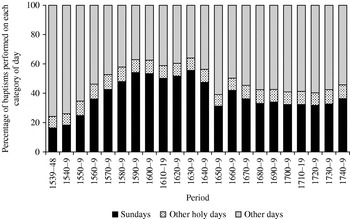
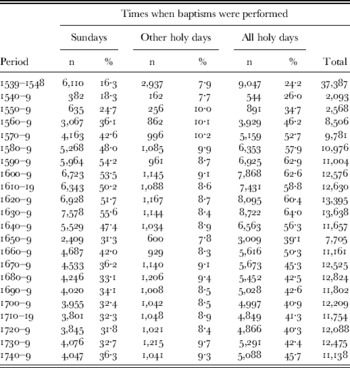
Both Table 1 and Figure 1 above show how the proportion of baptisms that were performed on these days changed over time. The first row of Table 1 summarizes the data for the type ‘A’ database, and shows that 16·3 per cent of all baptisms were performed on Sundays – greater than any other day of the week. If there had been an equal distribution of events over the days of the week, then this value would have been 14·3 per cent, but this figure is sufficiently close to suggest that the weekly distribution of events was very even. Additionally, around 8 per cent of all baptisms were performed upon holy days. The contrast with the following decades is noteworthy, as the proportion of events performed upon a Sunday increases to a first peak of 54·2 per cent between 1590 and 1599, and thence to a second peak of 55·6 per cent during the 1630s. The share claimed by holy days manages to reach a peak of over 10 per cent from the 1550s through to the 1570s, but fails to reach such values again. Overall, the proportion of baptisms performed on the days specified by the Book of common prayer increases from just less than one quarter of all events under study between 1539 and 1548, to nearly two-thirds of all baptisms during the 1630s.
Proportions of baptisms being performed on Sundays and other holy days by decade, 1539–1749.

Proportions of baptisms being performed on Sundays and other holy days, 1539–1749

Notes: Holy days are reckoned to be those for which the Book of common prayer provides a collect of the day.
Source: Types ‘A’ and ‘B’ parish register databases.
As Figure 1 shows, there is a marked contrast between the years up to 1640, and the remainder of the period under study. A marked decline in the 1650s is followed by a recovery for the following decade. However, from 1670 onwards, no decade witnesses the performance of more than two-fifths of baptisms on Sundays. Additionally, baptism administered on other holy days does not reach the popularity achieved during the sixteenth century, though it is always higher than the proportion performed upon these days before the point when the reservation of the rite for performance on these days had been encouraged in 1549.
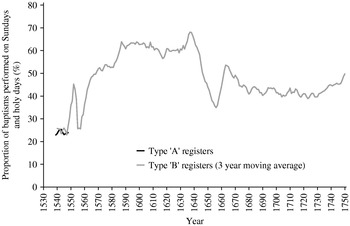
The presentation of these data as a series of decadal indices hides some intriguing patterns, and Figure 2 above reproduces this information as a time series with a three-year moving average to smooth year-to-year fluctuations for the data from the type ‘B’ parishes. This figure immediately highlights the rapid growth in the number of baptisms performed on Sundays and holy days with the issue of the prayer book for the first time under Edward VI, as well as an equally rapid fall following its withdrawal by Mary in 1553. The subsequent increase during the reign of Elizabeth through to the 1590s, the relative lack of change followed by slight decline until the 1630s, and the rapid disappearance of this regime after 1642, are all neatly illustrated. The return to the pre-war regime after 1662 is also highlighted. Indeed, Figure 2 provides a remarkably concise visual parallel to key events in English ecclesiastical history between 1538 and 1662.
Changes in the annual proportionate share of all baptisms performed upon Sundays and holy days, 1539–1750.

The situation for the ninety years or so before 1750 also merits comment. Following the short increase in the proportion of events performed on the specified days after 1662, which reaches a peak of just over 53 per cent in 1663, it falls to a level of around 40 per cent, which it sustains until 1730. After this point, the number of events performed upon these days does start to rise again. This suggests that the short-lived drive for conformity conducted by the re-established Anglican hierarchy during the 1660s was followed by the adoption in many communities of a rather lukewarm compliance with the rubrics concerning baptism. In the absence of any effective means of enforcing conformity following the various attempts at religious toleration finally embodied by the Toleration Act of 1689, the variation between individual parishes would ensure that the levels of compliance with the liturgical requirements that the pre-Civil War church had accomplished would never be achieved again. Indeed, the stage was now set for the florid variations in baptismal practices between different parishes that become so evident during the eighteenth century.
III
With the sheer number of baptism events available for analysis, it is also possible to investigate which particular days of the year attracted more baptisms than might be expected had there been an equal distribution of events across the entire year. However, the distribution of baptisms across the course of the year will bear some resemblance to the underlying seasonality of birth, especially if the interval between birth and baptism was relatively short.Footnote 49 Accordingly, the number of baptisms being performed upon a particular day will be a function of both the broad seasonal fluctuations in the number of baptisms, as well as the propensity to reserve the ritual for performance on that day. Any comparison between the days of the year that might be attracting more or fewer baptisms therefore requires this seasonal trend to be removed using a process called ‘de-trending’, so that all days can be compared using a common scale.Footnote 50
For both the type ‘A’ and ‘B’ databases, the distribution of events across the course of the year were analysed in two ways. The first method sought to identify days of the year that attract significantly more or fewer events than they ought to. This was done by removing the underlying seasonal distribution of baptism from the day-to-day fluctuations, and then calculating a statistical measure known as a Z-score for each individual day of the year. This particular measure is commonly used in statistical analysis, and provides a yardstick to judge whether a particular day is attracting significantly more or less baptisms for a particular day of the year than might be expected if there was an even distribution of events across the days of the year.Footnote 51 If it exceeds a particular value, we can infer that the day in question is a popular one for baptism. Conversely, if it is less than another threshold, we can determine that this day is an unpopular one for the performance of the rite.Footnote 52
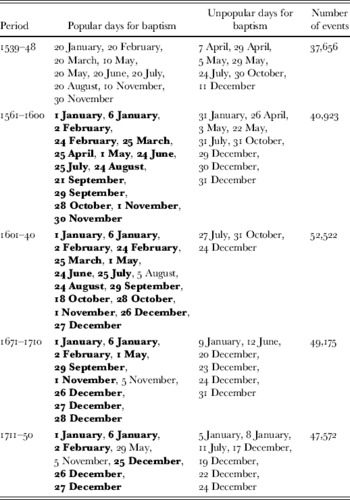
Table 2 shows the results of this analysis for both the type ‘A’ and type ‘B’ registers. For the years between 1539 and 1548, ten days attracted more events than they ought, while seven attracted fewer. None of the popular days for baptism appear to match any of the major feast days observed by the medieval church.Footnote 53 However, a cause for concern is the tendency for the tenth, twentieth and thirtieth days of individual months to attract more baptisms than they ought, as it is likely that this pattern is a product of transcription errors. Almost all the registers used in the type ‘A’ database are printed or typed transcripts of the surviving registers. Moreover, following the requirement to transcribe paper registers to parchment in 1597, most of the surviving registers are copies of the original register. Accordingly, these sources are copies of copies, and it is plausible that errors in the transcription of roman numerals to Arabic numbers underlie this pattern.
Popular and unpopular days for baptism over the course of the calendar year, 1539–1750

Notes: Holy days for which the Book of common prayer provides a collect of the day are printed in bold. For method of calculation, see text.
Source: Types ‘A’ and ‘B’ parish register databases.
For the following four periods for the type ‘B’ database, holy days listed by the Book of common prayer consistently attract baptisms at the 5 per cent level of statistical significance. There is some variation between each of the different periods, and there are some days that are popular for christening that do not appear to be connected to any religious feast. Circumcision of Christ (1 January) and Candlemas (2 February) appear in all five. Additionally, Epiphany (6 January), May Day (1 May – more properly referred to in this context as St Philip and St James's Day), All Saints' Day (1 November) and St Stephen's Day (26 December) all make several appearances. It is also noteworthy that many of the days just before Christmas, especially Christmas Eve, were very unpopular for baptism. This indicates that events that would have usually been performed on these days were being reserved for Christmas and St Stephen's Day.
However, both the periods covering the years 1671 to 1710, and 1711 through to 1750, differ from the earlier periods. The number of holy days that are popular for baptism decline, with none of the festivals that fell between June and September attracting significantly more baptisms than one would expect given the overall seasonality of baptism. Additionally, both 5 November and 29 May become popular days for baptism following 1671. Special orders of service were included for both these days, as well as 30 January, as appendices to the prayer book from various points during the seventeenth century, and the rubrics for all of them stated that ‘The Service shall be the same with the usual Office for Holidays’.Footnote 54 All these days possessed considerable resonance in the history of seventeenth-century England, and they were widely observed in the late seventeenth century.Footnote 55 The first of these days has obvious connotations as Gunpowder Plot Day, commemorating the attempt to blow up parliament in 1605, and it was also the date of William of Orange's landing in 1688.Footnote 56 The former was Royal Oak Day or Oak Apple Day: it was Charles II's birthday, the anniversary of the day he escaped capture following the battle of Worcester in 1649 by hiding in an oak tree, and the anniversary of his formal accession in 1660. The evidence in Table 2 suggests that this continued well into the eighteenth century, despite the association of 29 May with the exiled Stuart dynasty.Footnote 57 Its lasting popularity may well have had more to do with its association with the return of Charles II as ‘thereby restoring to us the publick and free profession of thy true Religion and worship’.Footnote 58 Interestingly, 30 January – the day set aside for the remembrance of Charles, King and Martyr – does not attract baptisms in the same way as the other days, though it probably suffered from its proximity to Candlemas (2 February). As Table 2 shows, the latter day remained a very popular one for christenings through the first half of the eighteenth century.
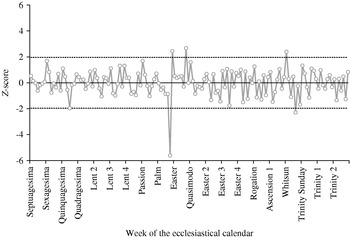
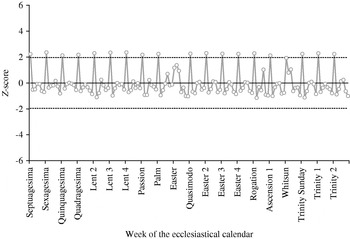
The second statistical procedure was used to identify the days of the ecclesiastical calendar that attracted disproportionately more or fewer baptisms, and it functioned upon broadly similar lines to the one used for analysing fixed holy days. The main difference, of course, was that the days of the ecclesiastical calendar running from just before the onset of Lent to after Trinity Sunday were the units of analysis, rather than the days of the calendar year.Footnote 59Figure 3 illustrates the result of applying this method to detect days in the weeks of the ecclesiastical calendar surrounding Easter and Whitsun that were popular and unpopular days for baptism. The two ‘tram lines’ on either side of the horizontal axis represent the thresholds for the conventional definition of statistical significance.Footnote 60 If a point moves outside these lines, then the day in question is attracting significantly more or less baptisms than it ought to if there had been an equal distribution of baptisms over this part of the ecclesiastical calendar.
De-trended Z-scores for the daily distribution of baptisms over the weeks of the ecclesiastical calendar between Septuagesima and the second Sunday after Trinity, 1539–1548.

Between 1539 and 1548 the Saturday immediately before Easter, the first Friday after Easter, and Whit Sunday all attracted significantly more baptisms than if there had been an equal distribution of events across these weeks. Moreover, Ash Wednesday, Good Friday, and the first Thursday after Whitsun are all unpopular days. While the last of these days does not appear to have any particular importance, the other two are significant days within the ecclesiastical calendar. Ash Wednesday marked the start of Lent; and it appears parishioners, or clergy, or both, were reluctant to baptize on this day. Additionally, reluctance to baptize on Good Friday suggests that events that would have been performed on this day were being reserved for the following day, in line with the rubrics within the Sarum manual. The popularity of Whit Sunday also reflects such stipulations. Given the complexity of the Easter calendar and the long interval of time between the creation of the original register and the compilation of any copy, it is difficult to believe that these patterns were produced by systematic errors in the transcription of the earliest registers. Indeed, the strength of this pattern provides some startling evidence over the extent to which the medieval church's teachings concerning the timing of baptism had been internalized, as well as the strength of conformity during the 1530s.
To demonstrate the effects of adherence to the Book of common prayer, the data for the individual days in the weeks under study for the type ‘B’ registers between 1601 and 1640 is depicted in Figure 4. The general similarity in patterns for all the periods covered by the type ‘B’ database indicated by Table 3 makes the presentation of figures for all five periods unnecessary. In this figure, the dominance of Sunday as a popular day for baptism becomes clear. Moreover, the absence of Easter Sunday, Ascension Day, and Whitsun as popular days for baptism is due to the close proximity of other days that were also relatively popular. For instance, there is a prolonged peak in the series covering the days from Easter Sunday to Easter Tuesday, and from Whit Sunday to Whit Tuesday. As noted earlier in this article, several eighteenth- and nineteenth-century communities started reserving significant numbers of baptisms for performance at both Eastertide and Whitsuntide, and so this feature of Figure 4 is perhaps the first indication of these later developments. Ascension Day, on the other hand, suffers from its proximity to other Sundays. Clearly, the desire to baptize on this day was weaker than for Sundays in general.
De-trended Z-scores for the daily distribution of baptisms over the weeks of the ecclesiastical calendar between Septuagesima and the second Sunday after Trinity, 1601–1640.

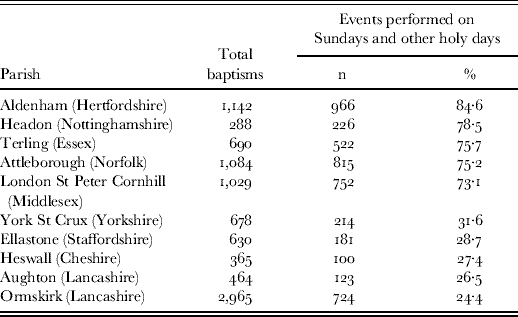
Variations in the proportion of baptisms performed on Sundays and other holy days in ten selected parishes, 1561–1600
Notes: Holy days are reckoned to be those for which the Book of common prayer provides a collect of the day.
Source: Type ‘B’ parish register database.
This evidence relating to the observance of holy days has implications for our understanding of religious observance in early modern England. Following the liturgical changes of the Reformation, it is clear that the feast days of saints were being fully recognized up until the start of the English Civil War in 1642. After this point, they seemingly become less important features of the ritual year. By the eighteenth century, Candlemas remained as the only religious festival outside the Christmas and New Year period that remained popular for baptism. The appearance of 5 November and 29 May might reinforce David Cressy's contention that the seventeenth century witnessed a greater secularization of festive observance.Footnote 61 However, both these days possessed some confessional signification as a means of remembering Catholic plots and the re-establishment of the Church of England. Moreover, the indication that these feast days remained important until after the mid-seventeenth century also has important implications for our understanding of changes in the length of the working year. Jan De Vries has argued that it was only after the 1650s that the number of days worked each year increased, as many traditional observances had survived the Protestant Reformation. The evidence presented here is consistent with this hypothesis; if these days were ceasing to be important religious observances, then it is not implausible to believe that reluctance to work upon these days was also in decline.Footnote 62
IV
The evidence from individual parish registers can also be used to identify variations between different communities. However, the situation for the years between 1539 and 1548 is one of remarkable homogeneity. Of the 310 parishes that are included in the type ‘A’ database, only two parishes – Knightwick in Worcestershire, and Morland in Westmorland – baptized over one third of infants on Sunday; and the sample size for the former is very small. After this period, the general impression is one of considerable variation between different parishes.
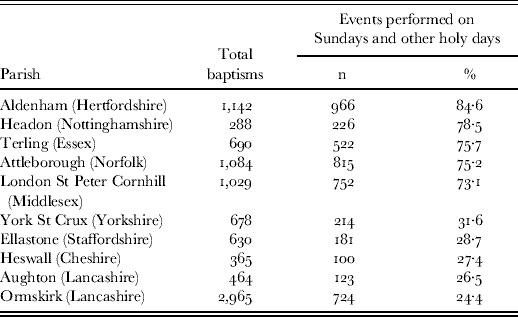
The patterns for the parishes that constitute the type ‘B’ database are far more variable. Table 3 shows the proportion of events performed on Sundays and other holy days for ten of the fifty parishes in the samples between 1561 and 1600. At the top of the table is Aldenham, where nearly 85 per cent of events were performed on the days enjoined by the Book of common prayer. In several other parishes, around three-quarters of all baptisms were performed on these days during these years. This suggests a general conformity with the rubrics, even in urban environments such as London where higher rates of infant mortality could be expected, and where there would be a greater incentive to ensure prompt baptism.
By contrast, only one quarter to one third of all baptisms were performed on the specified days in the final five parishes listed in Table 3. At this point it should be noted that the equivalent figure from the type ‘A’ database, noted in Table 1, was 24·2 per cent. This value serves as a benchmark for the proportion of events that would occur on these days in the absence of an encouragement to baptize on such days. The figures for Aughton, Heswall, and Ormskirk are all very close to this value, suggesting that the particular rubrics on baptism relating to the timing of baptism were not being enforced. It should also be noted that these parishes were all situated in Lancashire and Cheshire, counties noted for their lack of enthusiasm, or downright hostility, to the Elizabethan religious settlement. Indeed, in 1574 the privy council wrote to the earl of Derby, as lord lieutenant, to complain that Lancashire was the ‘very sink of Popery, where more unlawful acts have been committed and more unlawful persons holden secret than in any other part of the realm’.Footnote 63 Both Aughton and Ormskirk were situated in the hundred of West Derby, a part of the county where allegiance to Catholicism remained strong throughout the early modern period.Footnote 64
Two other parishes also show low levels of compliance with the new requirements. Ellastone is situated in northern Staffordshire, itself a county with a relatively high concentration of Catholic gentry.Footnote 65 Meanwhile, York St Crux was an urban parish in a city with a reputation for religious conservatism during the sixteenth century.Footnote 66 With the exception of Ormskirk, the share of events that were registered upon the days specified by the Book of common prayer in the five communities are all higher than the figure before the promulgation of the new liturgy in 1549. Nonetheless, these values are all very close to this baseline, indicating a very weak degree of compliance with the new regime. They also stand in marked contrast to the high proportions found elsewhere at the same time.
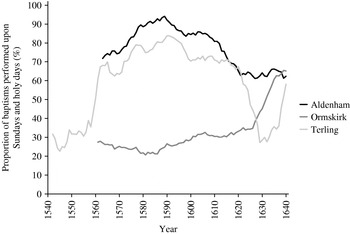
Figure 5 shows how the proportions of baptisms performed on Sundays and other holy days changed for the parishes of Aldenham, Ormskirk, and Terling, and between the start of parochial registration until 1640. The extent of conformity in the first parish is striking; around 1590, nearly 95 per cent of baptisms were performed on the days specified in the rubrics on baptism. In contrast, the situation in Ormskirk suggests that little changed until the 1620s.Footnote 67 Thereafter, the number of baptisms performed on Sundays and other holy days increased dramatically to over 60 per cent of all events by 1640. Previously, the proportion was around 30 per cent, indicating a very weak compliance with the reformed liturgy. This, in turn, suggests that the pre-Reformation imperative to baptize infants as soon as possible after birth remained in force until well into the seventeenth century, as well as indicating a general climate of religious conservatism in this particular parish.
Proportions of all baptisms performed upon Sundays and holy days in the parish registers of Aldenham (Hertfordshire), Ormskirk (Lancashire), and Terling (Essex), 1541–1642: nine-year moving averages.

The situation in Terling varies in yet another way. The increasing proportion of events taking place on the specified days around the time of the Elizabethan religious settlement is clear, though it never quite manages to reach the same degree that Aldenham achieves. There is, however, a sudden dip in the 1620s, with only a quarter of baptisms being performed on Sundays and holy days, followed by a return to the original level by 1640. The suddenness of the change is obscured by the use of nine-year moving averages to smooth the series. Closer examination of the data suggests that there was a sudden move away from baptizing on the days recommended by the Book of common prayer in 1625, followed by a return to the preceding state of affairs after 1631. This corresponds to the ministry of Thomas Weld, who served as vicar of the parish during these years. He was first suspended, and in 1632 deprived of his living by William Laud for failing to conform to the prayer book.Footnote 68 During this eight-year period, only 29 per cent of all baptisms were performed on Sundays and holy days; the equivalent figure for the ten years from 1615 to 1624 was 67 per cent, and 42 per cent between 1633 and 1642.Footnote 69 This suggests that studying the timing of baptism may be used to identify periods when parishes failed to conform to the prayer book. It also sheds interesting light on nonconformist attitudes to the reformed baptismal rite. The ceremonial and didactic performance of the sacrament upon the feast days of the church, as intended by those who drafted the prayer book, appears to have been viewed with disapprobation by this particular clergyman.
Two aspects of the exemplar parishes highlighted above are particularly noteworthy. First, the Edwardian Reformation shattered the striking patterns of uniformity in the timing of baptism. By the early seventeenth century, many parishes were reserving baptisms almost exclusively for performance on the days recommended by the Book of common prayer. Others, however, disregarded its requirements, either on the grounds of religious conservatism, or on the basis that the church was insufficiently reformed. As noted earlier, historians of eighteenth-century baptismal customs have taken care to point out how neighbouring parishes could vary enormously; the evidence presented here suggests that while the range of variation was not as pronounced before 1640, considerable disparities between communities clearly existed.
The other corollary worth stressing is that the proportion of baptisms being performed on a Sunday or other feast days recognized by the reformed church can be used as a measure of conformity. The collection of large volumes of such data could be used to study the geography of religious conservatism during the sixteenth and early seventeenth centuries; there may well be other parts of England and indeed Wales that failed to conform until the seventeenth century. Moreover, it could also be used to identify particular times when parishes and chapelries that were not in conformity to the established church. This suggests that quantifying the timing of baptism provides a novel and powerful means to investigate the spatial and temporal aspects of conformity in the first hundred years or so of parochial registration.
The evidence presented in this article indicates that there were several shifts in the ritual timing of baptism over the first two centuries of parochial registration. First, there is a clear correlation between religious change and changing conformity with the requirements of the Book of common prayer rubrics relating to the timing of baptism. For example, it is clear that increases in the proportion of baptisms being performed on Sundays and other holy days increased markedly with the successive introduction and re-introduction of the prayer book, drives for conformity in the 1580s and 1630s, and the restoration of the pre-Civil War ecclesiastical settlement after 1662. The analysis of days on which baptisms were performed indicated that there was a fundamental shift in the nature of religious observance after the strife of the mid-seventeenth century. After this point, the feast days that had survived the Reformation were no longer particularly popular occasions for baptism. Indeed, the only ones that remained in common use were those that were associated with Christmas, and with the commemoration of politically significant events from the seventeenth century, namely the Gunpowder Plot and the Restoration.
This relationship with broader religious change at the national level should not detract from the capacity of this form of analysis to tell us much about both religious change and conformity at the level of the individual community. In the absence of registers of both dates of baptism and birth, there is no direct evidence on the adherence of the laity to the requirements of the teachings of the Catholic Church. However, the surviving data from parish registers for the years between 1539 and 1548 is commensurate with strong conformity to the liturgy of late medieval England. From this point onwards, the evidence from registers of baptism ironically suggests that Reformation and the prayer book resulted in greater variations between communities. Many conformed to the requirements of the prayer book rubrics on the timing of baptism to a quite remarkable degree, while others failed to, either on the basis of religious conservatism or radicalism. While patterns for different parishes are most homogenous before 1642, even during this period uniformity was a pious hope rather than a realized goal; the broadening range of parochial practice by the eighteenth century shows that thereafter this variation became stronger. Although these sources have been generally exploited for the purposes of historical demography, the research presented here suggests parish registers have an intriguing tale to tell regarding the performance of the rituals that they record.
APPENDIX
The identification of both fixed and moveable holy days that attracted unusual numbers of baptisms required some straightforward, if fairly involved, statistical analysis, and it is convenient to describe this in detail here. This process was broadly similar for both types of feast days, and so the procedure for fixed holy days will be explained first, before progressing to discuss the analysis of moveable holy days. Put simply, the number of baptisms on any day is the sum of the broad seasonal fluctuations in the number of baptisms, plus any special inclination (or disinclination) to baptize on that day. This serves to complicate matters since it is not possible to compare all the days of the year without performing some necessary preliminaries. For instance, a holy day in August may attract considerably more baptisms than any other day in that month for a particular period, but the actual number of events recorded on that particular day may be smaller than another day in April that was not a religious festival. To make a direct comparison between these two days, the seasonal fluctuations need to be removed from the data, and this was done through a process known as ‘de-trending’.
The first step was to count the number of events taking place on each day of the year for each selected period. Events taking place upon 29 February in leap years were discounted to simplify matters. The annual series was then de-trended by dividing the number of baptisms upon each day by the twenty-nine day moving average centred upon that day to remove the underlying variations in the seasonality of baptism. Experimentation suggested that a moving average of twenty-nine days was most satisfactory for this purpose, since smaller periods were insufficient to remove seasonal fluctuations. The distribution of values that results from this calculation will violate a key expectation of a normal statistical distribution, since while the values for each day will not necessarily possess an upper limit, they cannot be less than zero. To correct for this, the logarithm of each of these values was taken to ‘re-scale’ the values so that they approximate to a normal distribution.
Finally, Z-scores for each day were calculated by subtracting from this value the mean or average of the de-trended and re-scaled values for all the days of the year, and by then dividing this by the standard deviation of all the values. The Z-score represents how many units of standard deviation a value is above or below the average, or mean, value. The standard deviation in turn provides a measure of how the data is distributed around the average value for the entire sample. The Z-scores can then be used to identify days that attracted anomalous numbers of baptisms. If the value for a particular day was greater than 1·96, then the day in question was attracting more baptisms than one would expect if there was an even distribution of baptisms across the days of the year once any seasonal pattern had been removed. Conversely, if the Z-score for any day was less than −1·96, then that day was attracting significantly fewer baptisms that would be the case if there had been an even distribution of events. These threshold values represent the conventional 5 per cent level of statistical significance for a two-tailed distribution. In other words, only five out of every hundred observations ought to exceed these two thresholds.
The procedure to identify moveable holy days functioned on broadly similar lines, except that there is no need here to exclude baptisms taking place on 29 February. The relative position of an event to the Easter calendar within a given year was calculated by first finding the date of Easter Sunday in that year. By comparing the number of days from 1 January to Easter Sunday with the number of days from 1 January to the date of that event, it is then possible to place the event within a week of the ecclesiastical calendar. The number of events taking place for each of the 140 days in the ecclesiastical calendar between Septuagesima Sunday through to the Saturday in the second week after Trinity Sunday was then counted. A twenty-nine day moving average was once again used to smooth out any seasonal fluctuations in the distribution of events. Z-scores for each of these 140 days were then calculated, and days attracting significantly more or less baptisms were then identified using the same thresholds for statistical significance that were used for the identification of fixed holy days.