INTRODUCTION: MAKING PLACE THROUGH RACE
Black people have a long-contested history with public transportation in the United States. The 1896 Plessy v. Ferguson decision relegated Blacks away from Whites in public places, thus separating the groups socially and physically. The impact on public transportation not only moved Blacks and other people of color to the “back of the bus,”Footnote 1 but equal access and fair treatment on public transportation was also litigated. Blacks’ contentious relationship with transit agencies and experiences with transportation racism is well documented in the literature (Bullard Reference Bullard, Bullard, Johnson and Torres2004; Marcantonio and Mayer, Reference Marcantonio and Mayer2010; Stolz 2005/Reference Stolz2006). Robert Bullard et al. (Reference Bullard, Johnson and Torres2004) note that, “transportation remains a civil-rights and quality-of-life issue” (p. 66). Yet this contested terrain can also serve as a site for positive and enjoyable social interactions among Blacks, even as they ride through a segregated and unequal metropolis.
To be sure, the United States has a history of more than a century of transportation racism, where Blacks have been restricted, formally and legally, from fully utilizing public transportation (Bullard Reference Bullard, Bullard, Johnson and Torres2004; see Stewart v. The Steamer Sue 1885). Subpar transit options and access have existed in Black communities compared to the quality and access Whites have in the same city (Farmer Reference Farmer2011; Golub et al., Reference Golub, Marcantonio and Sanchez2013; Purifoye Reference Purifoye2017). In response, Blacks waged massive campaigns for free movement, both locally and nationally, through resistance, freedom marches, boycotts and other protest measures (for example, bus boycotts in Baton Rouge, LA, Montgomery, AL, and Jackson, TN as well as the Freedom Rides of the mid-twentieth century, to name a few efforts). One of our respondents (Black female) recalled this history in noting that in growing up in the South she witnessed how transportation laws impacted ridership; in particular, she noted that as Blacks gained greater liberty to sit anywhere on the bus, Whites started moving off and taking cabs. This liberation brought some level of power into transit spaces for Blacks. Thus, public transportation systems are places and spaces of Black liberation as well. However, Blacks continue to fight for unrestricted mobility through and across urban landscapes, especially on public transportation.
Race studies support the idea of observably different social interactions among oppressed groups such as Blacks (Jones Reference Jones2017; Sigelman et al., Reference Sigelman, Bledsoe, Welch and Combs1996; Wright Austin et al., Reference Austin, Sharon, Middleton and Yon2012) and demonstrate how linked fate (Simien Reference Simien2005) among Blacks is played out in public spaces. As these studies show, the sharing of a history of oppression and restrictions on public freedoms, along with the belief that Blacks’ futures are intricately bound, has shaped histories of pleasantries among Blacks in public places (Anderson Reference Anderson1990; Jones Reference Jones2017). Compared to Whites, Blacks are more likely to greet strangers and express social cohesion through interactions with each other (Anderson Reference Anderson1990; Jones Reference Jones2017; Raudenbush Reference Raudenbush2012). For instance, Elijah Anderson (Reference Anderson1990) shows that friendly and brotherly interactions between Blacks are of cultural importance while “greetings of whites toward blacks are usually ambiguous or have limited effectiveness” (p. 179). Yet Anderson does not give attention to interactions on mobile systems, but rather, static city spaces.
Danielle Raudenbush’s (Reference Raudenbush2012) study demonstrates how social cohesion plays out on the Green Line train in Chicago. Yet the interplay between race, the materiality of the transit vehicle, and the places through which the vehicles travel are not attended to. To address these gaps in Black solidarity and social cohesion research, we move beyond a one-dimensional social cohesion and a linked fate narrative, and bring the intersection of race, mobility, materiality, and place to the fore. Specifically, we focus on mobility, the materiality of the trains and buses, race, place, and the direction of travel and how these dynamics influence these specific types of interactions that we call Black transit affinities, which are a type of actively developed, temporal, meaningful interaction that takes place on mobile systems. Transit affinities have four distinctive qualities: they are 1) personal; 2) mutually engaged; 3) actively maintained although interrupted by stops on the bus or train; and, 4) particular to majority-minority areas of the city, noted especially within predominantly Black spaces. Investigating Black social interactions on public transportation can help us to better understand how Black people connect while navigating racially disparate urban public spaces, in this case, public transit systems.
THEORETICAL FRAMEWORK: MAKING PLACE USING RACE AND MOBILITY
September 10, 2012. Two Black female passengers (BFP) were seated next to each other on a northbound #3 King Drive bus. They began discussing the state of working conditions for the schools and a possible looming strike. These women did not know each other as indicated by their conversation. They quickly moved to a discussion of (former) Mayor Rahm Emanuel. One of the women stated, “He left Washington to come to Chicago and got a raise, but he wants people to work for free.” The other woman agreed with her assessment of Emanuel. The first woman then explained that she was headed over to the west side for a union meeting. The other woman noted the distance, and she stated that she had a ride home. She also said she was attending the meeting regarding the teachers’ strike because she was a crossing guard. This conversation continued until the bus approached McCormick Place (a large convention center in Chicago).
Around 30 IMTS Conference attendees boarded at McCormick. One of them, a White Male Passenger, sat next to a Black male and repeatedly looked over at him, but said nothing. Eventually, the two Black women who were conversing noticed the slow boarding time. They appeared annoyed that the group held up the bus with fare issues and other questions. One of the BFP yelled, “just get on the d**n bus already.” Afterwards, they shared their annoyance and wrapped up their conversation.
In mobile spaces, interactions among strangers are usually hot, i.e. touched upon quickly, and often end after the first stop or when other riders interrupt the space. However, as we show, something different happens on buses and trains as they travel through and into the predominately Black spaces of Chicago’s south side communities that we did not observe in the more integrated spaces of downtown or the north side.Footnote 2 Here we show how these mobilized interactions operate as a form of relationship and community building, which we identify as transit affinities. As shown in the vignette at the beginning of this section, Black strangers who engage in these mobilized interactions move beyond fleeting conversations or generic ones about the weather, directions, or wait times. Instead, they often engage in more personable interactions that continue through bus and train stops and interruptions which, in some ways, shows their investment in the conversation. As also demonstrated in the vignette, and as we show later, these transit affinities do not continue after the transit vehicle is integrated or moves into more integrated spaces and direction. This is one of the distinctive components of these interactions and why we argue for including them in the scholarship on Black urban experiences and interactions in public places. And although they may occur among other racial minority groups, here we focus on how we became aware of them among Black passengers on the south side of Chicago. Importantly, patterns of these affinities were not present on the north side routes, or among White passengers on the routes in the study.
Transit affinities are formed in often tight and restricted mobile spaces while travelling through socially and economically isolated majority-minority areas of the city. We show how sameness (i.e. racial solidarity, mobility, and place) is used in their formation to not only help Black passengers pass the time, but also provide them with helpful information, an outlet for voicing their frustrations with racism, freedom to express their own racially insensitive ideals, and the space to voice political discontent. These affinities give meaning to the spaces of the trains and buses and this has not been well attended to in prior research on intraracial and relational interactions on public transportation. Further, transit affinities are not as much protections from hostilities or aggressions, at least in the moment, as they are participatory arrangements that are actively maintained, even after repeated interruptions.
Like other types of interactions, the meanings of these affinities shape experiences with place. But we purposefully do not situate this paper within a traditional symbolic interactionist frame. Additionally, symbolic interaction theory doesn’t allow for a holistic analysis of how linked fate, social cohesion, or the experiences of people of color shapes social interactions from Black transit affinities to the “Black nod” (Jones Reference Jones2017; Ngũgĩ Reference Ngũgĩ2013). This paper thus examines these distinctive mobile interactions among Black passengers as they travel through Black spaces, noting that the temporality and restrictions of mobility are not only distinguishing qualities of these affinities, but that they have a noteworthy meaning that is situated at the intersection of race, place, and mobility.
In everyday public spaces, interactions among strangers do not tend to be engaging, let alone intimate and continuous after various interruptions. Further, therapeutic and intimate interactions with strangers outside of third places like clubs and hair salons are rare (Oldenburg Reference Oldenburg1999). Yet, here we show how Black passengers on these south side routes in particular, use each other for support, sharing of intimate details, and in some instances, in therapeutic ways. Thus, we move beyond a restrictive distant bond or interactionist frame to interrogate the remarkable interactions and patterns of intimacy that we observed on these buses and trains.
But space, race, and materiality are not the only important variables here, direction of travel seemed to matter as well for these types of transit affinities. Previous studies on mobile interactions do not give attention to the direction of travel and how it might shape interactions (for instance, see Raudenbush Reference Raudenbush2012). In this study, we show how transit affinities reflect a rule of order that is guided not only by the demographics of the passengers, but also the direction of travel and where the vehicle is located in the city, further highlighting the role of mobility and place. Additionally, we show how Blackness is not enough in the space but rules of collegiality and affording freedoms to a group, Blacks, who are usually denied freedoms in public spaces (as we have seen in the exponential growth of news reports and videos of Whites calling the police on Blacks who are looking, sitting, or sleeping in public places), is present as well. In doing so, this study opens the door wider to more sophisticated understandings of how Blacks navigate urban spaces that are fraught with inequities.
We draw on Georg Simmel’s ([1905] Reference Simmel and Levine1971) concept of sociabilities, the joy experienced from social interactions, to understand these social relationships. These sociabilities are occurring in spaces and among a group, Black Americans, who everyday navigate a social world with a double-consciousness (Du Bois [1903] Reference Du Bois2005) thus showing their social import. They show that even in the midst of racist material systems (Farmer Reference Farmer2011; Purifoye Reference Purifoye2017), Black passengers have robust affinities and ties that are often personal and joyful. This suggests they are more than superficial, but are pleasurable, meaningful, and oftentimes amusing (Simmel [1905] Reference Simmel and Levine1971). This may be best understood through further interrogation of how double-consciousness links Blacks, thereby solidifying their linked fate and enhancing their instances of intraracial sociabilities. That is, the White gaze often restricts, surveils, and polices Black presence and movement in White spaces and, as a result, Blacks use a variety of strategies to navigate public spaces that can and do look fundamentally different depending on locale. Thus, studying transit affinities is an important arena of research that can provide valuable micro-level insights into how people experience the dynamics of mobility (movement, materiality, and direction) and sociability. Further, it suggests that in urban spaces, interactions with strangers can actually be pure social exchanges (see Simmel [1905] Reference Simmel and Levine1971). Additionally, these interactions can help reveal how passengers use mobile transportation as a site for community. We build on Marcus Anthony Hunter and colleagues′ (Reference Hunter, Pattillo, Robinson and Taylor2016) work, which reminds us that “all-black spaces are not [all] abandoned, overgrown, unruly, destructive spaces that necessitate pruning” and encourage more investigations into “the agency, intent, and even spontaneity of urban black residents… in creating places that are sustaining, affirming, and pleasurable” (p. 51).
Interactions Among Strangers: Transit Affinities Reduce Strangeness
As Lyn Lofland (Reference Lofland1973) notes, public places are filled with strangeness and strangers. Even when in familiar places, the stranger may be ever present. Some of the uneasiness of this can be eased through rules of social order, cultural rules, and cues that allow for some level of expectation (Goffman Reference Goffman1959; Lofland Reference Lofland1998; Tuan Reference Tuan1977). In the confined and mobile spaces of public transit, a different level of uneasiness occurs as passengers are trapped in confined spaces that are also mobile (Purifoye Reference Purifoye2015). This can highlight patterns of raced social interactions in spaces where different race groups are unable to escape until the bus or train stops, and where each stop can add more strangeness as new passengers board (Purifoye Reference Purifoye2015). These conditions also shape interactive patterns where attempts are made to keep the stranger at arm’s length. Unlike static spaces, public transportation moves the social actor in and out of places, thus providing a tenuous experience with place and the people in it.
Other urban place studies do not give attention to how this same mobility can also move passengers into spaces where interactions can be safe and engaging (Kim Reference Kim2012; Lucas Reference Lucas, Grieco and Urry2012). Specifically, mobility exposes passengers to both strangeness in interracial spaces, and to familiarity in intraracial places. Urban research barely addresses this, if at all. In showing how transit affinities are developed, we reveal how Blacks use spaces that have been historically contentious for them, to create joyful and warm interactions. As we discuss later, our observations revealed patterns of collegiality as the buses and trains moved into and through the majority Black spaces of the south side of Chicago. Thus, we move beyond a hyper-focus and fixation on urban disorder (Sampson Reference Sampson2012), to focus research on the more positive experiences and narratives of Blacks in urban spaces.
People do not just travel but they engage in a variety of activities while riding the rails and buses, including reading, sleeping, listening to music, engaging in handheld devices, standing, and talking. Some talk to strangers to ask for directions while others engage through fleeting pleasantries. Previous studies of public transit interactions and behaviors have primarily focused on technologies, materiality, and sociality (Bissell Reference Bissell2009) or social networks produced in transit in relation to time (Jain and Lyons, Reference Jain and Lyons2008) and even social disengagement (Kim Reference Kim2012). Richard Ocejo and Stéphane Tonnelat (Reference Ocejo and Tonnelat2014) note that people on public transportation engage each other for longer periods than they do in wide-open and static place. People on public transportation are bound together by mobility (they cannot just jump off a moving vehicle), but commuting patterns can also reduce strangeness and shape some level of communality, forging future relationships (Elliott and Urry, Reference Elliott and Urry2010). However, transit affinities stand outside of this latter pattern as they are temporal.
The material limits of mobile spaces also shape particular types of activities and behaviors, part and parcel because of transit culture, class, gender, and race (Hodgson Reference Hodgson, Grieco and Urry2012; Kim Reference Kim2012; Ocejo and Tonnelat, Reference Ocejo and Tonnelat2014; Purifoye Reference Purifoye2015; Raudenbush Reference Raudenbush2012). We do not dismiss these prior studies but instead build on these works while targeting mobility, place, race, and direction of travel. We examine how, when negotiating public mobile spaces, Blacks “receive and display a wide range of behavioral cues and signs that make up the vocabulary of public interaction” (Anderson Reference Anderson1990, pp. 166–167) thus, allowing them to actively shape transit affinities. In doing so, we address mobility, but also direction of travel, sociability (through solidarity), and place.
We also add that transit affinities are not just everyday conversations but are often prosocial—intended to be beneficial to others (Padilla-Walker and Carlo, Reference Padilla-Walker and Carlo2014)—and therefore warrant further examination. By giving attention to mobility, materiality, race, and directionality in the forming of transit affinities (although they may not have longevity), we can better understand the social connections among Blacks in public spaces. Additionally, transit affinities show that mobile spaces add a new layer of analysis for majority-minority spaces that have so often been characterized by social disorganization, violence, and chaos because they demonstrate that personableness, cooperation, and order are present.
RESEARCH SETTING AND METHODOLOGY
Chicago and its Public Transportation Systems
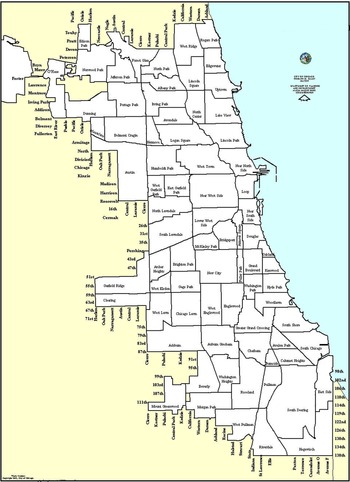
Chicago, Illinois is a city of Community Areas (CA) and neighborhoods, as well as wards and parishes. To understand Chicago, one must appreciate the role, history, and politics of its CAs and segregated residential landscape. The development and growth of Chicago reflects an “uneven distribution of power and resources,” which highlights differences across “race, ethnicity, gender, sexuality, and other social groupings” that are distinctive by CA and/or neighborhoods (Connolly and Steil, Reference Connolly, Steil, Marcuse, Connolly, Johannes, Olivo, Potter and Steil2009, p. 5). The CAs on the north side of the city are more likely to be racially integrated whereas the CAs on the west and south sides tend to be majority-minority (CMAP, 2020). We focus primarily on transit rides through the mostly poor and majority-minority CAs of the south side of the city (Figure 1).
City of Chicago Community Areas Map. Source: City of Chicago.

The Chicago Transit Authority
The Chicago Transit Authority (CTA), the city’s transit agency, operates under the Regional Transportation Authority (RTA). At the time of this writing, the CTA operated over 120 bus routes and eight train (colloquially called the “El” or “L” trains) routes. This article focuses on data collected through field observations on the CTA’s Red Line train and six bus routes, but primarily focuses on the distinctive interaction patterns observed on the south side of Chicago—in particular, the # 3 King Drive bus and the Red Line South (the portion of the Red line route that travels from Cermak/Chinatown to 95th Street/Dan Ryan stations). The King Drive bus travels from Chicago State University—which is on the south side of the city and located in the Roseland community area—through Roseland, Chatham, Greater Grand Crossing, Washington Park, Grand Boulevard, Near South Side, and the Bronzeville neighborhood, through the redeveloped South Loop and into the Loop and down Chicago’s Magnificent Mile. The Red Line train travels south and north from 95th Street and the Dan Ryan, which is on Chicago’s south side, to Howard Street, which is at the northern boundary of the city (encompassing about twenty-five miles).
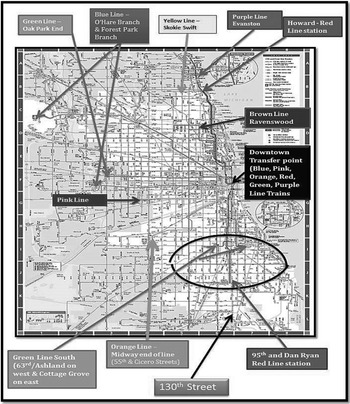
The Red Line train route is a space where the demographic reality of the city is in clear view when riding it from end to end. The Red Line is just one of the eight ‘L’ routes. It is a twenty-four hour line, does not travel to any of the area airports, and yet, it is the CTA’s busiest train route (CTA 2012, 2016, 2018). The Red Line carries passengers into and through the busy downtown shopping and tourist corridors and to the stadiums of the Chicago White Sox and Chicago Cubs baseball teams. The ridership boarding at 95th/Dan Ryan are majority-minority passengers. At Howard Street, there are three train routes (Red, Purple, and Yellow). The ridership at this stop is very diverse but majority White. Transferring trains is not afforded at any station on the city’s south side but train transferring is available at various stations downtown and in the predominately White north side communities of Lincoln Park (Fullerton stop), Lakeview (Belmont station), and Rogers Park (Howard station) (see Figure 2).
CTA System map with ‘L’ routes highlighted (Map: CTA)

A Quick Snapshot of the South Side
Chicagoans often refer to the city by geographical regions or “sides” such as South, North, or West Side. Further, news reports, realty companies, and those familiar with the city do the same while also often including the neighborhood or one of the Community Areas in the discourse as a geographic point of reference. Many of Chicago’s south side CAs and neighborhoods have been majority-minority spaces for a long time, beyond the Black Metropolis (Drake and Cayton, [1945] Reference Drake, Claire and Cayton1993), especially after 1968. Although Blacks were living close to Whites at the turn of the twentieth century and after the First World War, integrating their children in schools set off a flurry of racial conflict, violence, and hyper-segregation. Whites were tolerant of living near Blacks, but attempts at integrating schools led to movements of ‘White flight’ out of the city and into the suburbs (in part because accessibility to the automobile made this more feasible) and increased segregation in the city (Pacyga Reference Pacyga2009; Wilson and Taub, Reference Wilson and Taub2006). The White flight that occurred during the first half of the twentieth century and the continual White flight in areas that are now dominated by Latinx or Black populations continues to demarcate the south side of Chicago as a predominately minority space.
Participant Observations
The ethnographic data included in this paper were collected over a two-year time span.Footnote 3 To engage in participatory observations, we rode the CTA trains and buses. Our observations, which we conducted independently of each other, occurred during various times of day. Our goal was to be wholly present during our observations—which included greeting other passengers when we deemed it appropriate, engaging in brief conversations or responding to passengers, and affirming their presence (through body gestures such as a hand wave or a head nod). In placing ourselves inside these mobile spaces as commuters, errand runners, shoppers, museum visitors, and the like, we were able to experience public transportation in as natural a setting as possible (Lofland et al., Reference Lofland, Snow, Anderson and Lofland2006). Most often, we remained in our original seat once we boarded the bus or train with the exception of moving to make accommodation for the elderly, disabled, or pregnant women.
Rides were often used to also run errands, visit various venues, go shopping, meet friends, grab food, or for sightseeing, which is in line with our regular uses of the transit system. For each ‘run’ we spent at least two hours of round-trip travel time conducting our observations on each route. We intentionally chose to travel at various times of day so that we could cast a wide net for our observations. This included riding the same buses and trains in different directions—for instance, riding the Red Line train north in the morning and south in the late afternoon. We also traveled on different modes of transport to travel similar paths; that is, in some instances, we rode the bus into the downtown area in the morning and rode the train later in the day on our return trip.
We were cautious in taking notes so that we did not attract attention from other passengers. We recorded our observations as “graphically” (Lofland et al., Reference Lofland, Snow, Anderson and Lofland2006, p. 113) as possible, noting matters such as passengers’ seated positions, clothing, perceived race and gender, and weather conditions. We also provided rich descriptions (Geertz Reference Geertz and Geertz1973) of how people boarded and moved through the space, gave attention to community/neighborhood spaces and demographics at the stops, and were also cognizant of our own position in the space as researchers, passengers, and as people of color. We discussed our observations and field notes as we began to weave through our analysis by coding for race and place (along with gender and class). We coded these factors and worked together to unpack what we saw and heard.
FINDINGS: TRANSIT AFFINITY FORMATIONS AND QUALITIES
Riding the trains and buses as passengers and errand runners can be interesting in and of itself. Riding public transit as researchers illuminated patterns often unnoticeable to everyday riders. It is important to note that we did not enter this project looking for transit affinities, or any affinities, but were instead interested in observing the behaviors of transit riders. It was not until several months into being in the field and sharing stories, many of which were funny, that transit affinities came to the fore. As Black passengers, we were drawn into some conversations, laughed with passengers who were ‘entertaining’ the masses, and engaged passengers when they wanted to discuss things such as our opinion of Garrett’s popcorn or PI 1’s “good hair.” We sat as everyday passengers attempting to observe our actors and the space in as natural a way as possible (Anderson Reference Anderson2004).
Conducting participant observations over long periods of times affords a researcher the opportunity to observe and experience various conditions, behaviors, and conversations. As long-time transit riders, we knew that transit rides are often noisy and crowded, but they could also be equally quiet and spacious depending on location, time of day, and whether on a bus or train. During this study, we observed different patterns of noise, movements, and material spaces. On north side routes passengers were more often disengaged with their surroundings, through the use of technologies, reading, sleeping, or staring out the window. Passengers on the south side routes were not as engaged with mobile devices but instead engaged each other. Many who had phones were using flip phones, especially older passengers, but most were not on the phone nor did they have ear buds in at the same rate as those in other areas of the city. This pattern could be informed by the cost of technologies, wanting to be aware of the surroundings, the desire to be connected with those physically present, or the unique transportation culture that we witnessed, which involved engaging actively with those in the space more often than with those not physically in the space (i.e. through phone conversations). This was an observational distinction from the north side rides.
Personable Interactions in Confined Moving Spaces
In a city like Chicago, public transportation is a recognizable part of the landscape with buses and trains that travel through the city and into the suburbs. Trains travel below ground, on elevated tracks, and through the middle of some of the metropolitan area’s busiest expressways. Buses travel through traditional residential neighborhoods, the downtown business district, and downtown residential and tourism spaces. During these rides passengers often took part in non-engagement activities such as reading, listening to things on their phones and other mobile devices, and sleeping and often avoided making eye contact with those boarding. Others talked to their travel partners or just stared out the window (even at night and when the trains were underground).
On the south side, transit affinities transformed these spaces. That these transformations also occurred within racially and economically segregated spaces is also remarkable, as these spaces are often characterized in news reports as socially disorganized, violent, chaotic, and hostile. On the buses and trains in these Black spaces however, passengers engaged in conversations where they shared personal information. This provides the opportunity to better understand why people are often “far more willing to confide in individuals they are not close to than common sense suggests” (Small Reference Small2017, p. 7). The temporality of mobile spaces and interactions afforded grounds for these conversations, even as the crowdedness shaped a particular type of vulnerability. Specifically, we observed how conversations among strangers on the south side were often very personal and revealed patterns of care, advice, and empathy. We observed passengers discussing topics ranging from how to access services for seniors to how to sign a new lease that required the lessee to exclude their child if they had a felony conviction.
Passengers engaged in these transit affinities did not appear to focus on the strangeness of those around them, but instead used the homogeneity of the interior space and the characteristics of the exterior space—such as segregation and racial demographics—to create an environment for expressed affinities. This was illustrated in an interaction between two older Black female strangers on the King Drive bus:
During a southbound trip on the King Drive bus after we passed 79th Street (Chatham CA), two Black female passengers discussed their children and how kids don’t take care of their responsibilities, such as taking care of their own children. BFP #1 informed the other that she wanted to move but wasn’t sure what she should do about moving because if she moved, her grown son may not have a place to live. She also noted that she pays $87/month in rent (due to disability) and wanted to move somewhere where her visitors didn’t have to sign in and out of her building. She saw requiring visitors to sign in as controlling and just wanted to have her family and friends freely visit. The conversation then moved to a discussion of the Chicago Housing Authority (CHA). They discussed how complex the system is and how the CHA was planning to move folks out of apartments. BFP #1 noted that she also didn’t want others on her lease because the rent would then go up to $400/month. BFP #2 noted that her friend had put her kids out because they all had criminal records and she was living in Section 8 housing. (July 2012)
These women were not just engaged in a fleeting pleasantry (Haddington et al., Reference Haddington, Mondada, Nevile, Haddington, Mondada and Nevile2013), or discussing joy or disappointment with transit services, but instead shared personal information with each other; one of the distinctive features of transit affinities. They did not restrict the conversation to their ‘mom-ness’ but discussed housing, family disruptions, and the dilemmas of disappointments. The one passenger told the other, a stranger, that her son had a felony conviction and that is why she was concerned not only about her rent, but about his housing options. The women did not know each other, as discovered by their exiting comment of “nice to meet you.” Mario Small (Reference Small2017) notes that “many of our private worries would damage our social relations if they suddenly became public knowledge” (p. 4). Yet through this transit affinity, the private worry was not only shared between two strangers, but also with others in the space who heard the conversation. The strangeness of place afforded the opportunity to share, even though this affinity was not within a “core network” (Small Reference Small2017, p. 5).
The transit affinities created a sense of personableness, which suggested that the space was safe for particular discussions that one may normally reserve for private settings or more intimate public places (like a restaurant). In forming these affinities, passengers not only shared personal information with complete strangers, but they also openly expressed fears and critiques of other Blacks within earshot of others, such as during a February 2013 trip on the Red Line South train.
A Black male passenger (BMP) boarded a northbound Red Line train at 87th and looked hard at another BMP who was already on the train. He eventually began a conversation with the seated BMP, which revealed that they knew each other. They discussed some people being locked up, but how they avoided the same experience. They then shifted to a conversation about how rules on the streets had changed. But “the shorties now, they’ll do anything,” one remarked. “Times changed. Motherf***ers will shoot anybody. It’s why I’m trying to get out of town.” The other BMP shared, “They tried to kill Boomie, man. Shot him six times.” They also noted that Boomie left town and hadn’t returned.
When the train pulled into the 55th Garfield station, the gentlemen, and several others on the train, looked around at who boarded, which was a typical pattern on northbound Red Line trains at this stop. After taking notice of who had boarded (all of whom were Black passengers), the men continued discussing a few other mutual acquaintances and their desire to leave Chicago until the train stopped at 47th Street where Whites were among new passengers who boarded the train. This behavioral pattern of monitoring who boarded the train and adjusting conversations accordingly was repeated during many northbound rides as passengers were more likely to focus on boarding passengers than when the train was heading southbound past 55th/Garfield. We discuss this later.
Transit affinities highlight the distinguishableness of Black social solidarity. These Black men shared their fears with each other, and with those within earshot. Black men discussing their fears in public settings is not distinguished in prior urban literature, yet these men were acquiesced to do so on the train and where PI 1, a Black woman, was close enough to hear them. Their interaction was much different than what we tend to see in urban sociology literature in general or, more specifically, what generally is associated with Black men’s interactions in public spaces like street corners (see Anderson Reference Anderson1990; Young Reference Young2018). This was not a display of bravado or hyper-masculinity, but rather one of vulnerability and an expression of some of the realities of Black men’s lives, from hyper-arrests to being victimized by street violence.
As these observations show, Black passengers engaged in a number of interactions that helped create and develop meaning during their travels through the city’s south side. These personable interactions allowed passengers to engage in discussions about local governance and express their personal grievances. Additionally, they engaged in layered conversations that touched on the criminal justice system and local challenges, such as violence in the city, which also had potential negative implications for their families, friends, and even themselves. In presenting these affinities, we highlight Black interactions that are pleasant, in opposition to narratives and reports that have instead overly emphasized aggression in Black communities. As Derrick R. Brooms and Armon R. Perry (Reference Brooms and Perry2016) show, this negative and exaggerated Blackness has wrongfully and obstinately situated Blacks as hostile and violent, as if joy and sociality are not present in Black spaces. Additionally, these affinities also speak to joy, celebration, play, and poetry of Black placemaking, which Hunter and colleagues contend “refers to the ways that urban black Americans create sites of endurance, belonging, and resistance through social interaction” (Reference Brooms and Perry2016, p. 32).
Mutually Engaged Interactions: Social Order and Transit Affinities
Black spaces (areas where the population is all or overwhelmingly Black) are not “free for all” spaces, meaning that just because you are Black and in a Black space, there are expectations for how individuals might engage and interact with each other (i.e. no taking advantage of the Blackness if it will annoy and disrupt others). Rules of social order were made evident in these temporal spaces. Transit affinities also had rules, meaning that they needed to be mutually agreed upon to some extent. Further, Black passengers were expected by other Black passengers to recognize these rules and those of directionality (the direction of travel mattered as we discuss later). Indeed, it was fascinating to be made aware of these “rules” after just a few observational trips on the Red Line and the #3 King Drive bus. Were these rules known by south siders most of their transit using lives, or were they learned from infractions? We discovered the answer may have been a little bit of both. It is important to reiterate here that we did not look for these affinities, thus we learned the rules as we were discovering them, unbeknownst to us originally.
Public places are locations of negotiations for space and efforts to maintain rules of social order (Anderson Reference Anderson2004; Goffman Reference Goffman1971). The rules of social order in mobile spaces, especially as they travel through Black spaces, should not be confined within a ‘code of the streets’ frame either, as transit moves us beyond static places and prior research also shows that mobility matters in social interactions and behaviors (Purifoye Reference Purifoye2015). Black passengers were not allowed to just board and bother others just because they were in a Black space but were expected to behave ‘as if they got some sense.’ This was important. These rules not only suggested a level of mutual respect, but mutual awareness of the space and exercising both liberties and control as appropriate.
The rules are part of the ordered space and help highlight the impact of transit affinities. Transit affinities were not chance conversations that seemed to just happen, nor were they focused on what one may typically expect to hear among strangers engaged in conversations in confined public mobile spaces, such as ‘where are you going?’, ‘is this the right bus?’, or ‘how old is your child?’. Instead we observed that many Black passengers seemed to be engaging each other purposefully in meaningful interactions as the train or bus moved into poor Black spaces and during the beginning of trips that were moving away from them, thus also highlighting how directionality matters. When we were spotted looking around or listening, we too were drawn into conversations, even if just to provide an occasional nod (Anderson Reference Anderson1990; Jones Reference Jones2017; Ngũgĩ Reference Ngũgĩ2013) or smile of ‘understanding’ as individuals expressed frustration with the city’s racist politics, or sadness about their mother not being able to attend a sibling’s eighth grade graduation. If our observations appeared involving, then we were involved in the transit affinities. But we kept our responses minimal to not disrupt the setting too much since we were there as observers first. The rules of transit affinities allowed us to take as minimal a role as we wanted.
As noted, transit affinities require mutual engagement. Being Black was not enough, as seen in this observation on a southbound King Drive bus. A Black female passenger told an older Black male passenger to stop talking to her while she was on the phone; he had been relentlessly flirting with her. She had added that she was trying to be respectful because of his age (he was at least sixty), but he was pushing it. The BMP’s age had superseded the stranger harassment that the BFP was experiencing. He had violated the rules of the transit affinities because the engagement was not mutual. This also showed that being Black was not the only precursor to the affinities. This same man had also tried to engage other Black males in the space, but not through acceptable pleasantries. They, like the BFP, simply smiled or laughed when he said something funny but did not engage him in conversations because he was disrupting the space with random rantings and outbursts. Responses to this passenger highlight that affinities not only have order but help to shape order in mobile spaces. These interactions also show the distinctiveness of transit affinities; that they aren’t just passively formed generically or every time Black passengers have some sort of interaction.
On another southbound ride on the #3 King bus, a Black female passenger expressed displeasure with another BFP whom she felt offended her senses. A Black male passenger then engaged her and asked how she knew the woman was the source of the foul smell. She then went on to explain that she’s ridden the bus with her before, but also noted that she felt it was her family’s responsibility to help the woman so that she did not come out into public with this odor issue. The two then continued discussing why this was problematic on a small bus where seating options were minimal. The BMP and BFP engaged in a transit affinity, although the topic was regarding the unpleasantness of another Black passenger. It was not only mutually agreed upon, but further highlighted the distinctive of these affinities, as they were not limited to everyday pleasantries, but also involved discussing present issues beyond the lateness of the bus or the weather.
Disrupted and Interrupted: How Transit Affinities Continued Through Stops
The King Drive bus has one of the highest weekday ridership among the CTA bus routes (RTAMS). During the study, this route also used some of the smallest buses in the CTA fleet, with articulated buses only appearing (in the smallest instances) after January 2014. This meant that the spaces on the bus were not only usually crowded, given the high ridership, but passengers tended to board at every stop along the route. However, the constant stopping and shifting of passengers did not serve as a deterrent for starting and continuing transit affinities as demonstrated here:
During a southbound ride on the King Drive bus, a Black female passenger boarded the bus at the Roosevelt Road stop. She sat in one of the inward facing seats. As people boarded and sat down, she handed them a tract (as she referred to it. Others may call it a palm card). She was promoting an event that was happening somewhere on the south side. She quietly passed out the tracts to Black passengers but passed them out in earnest after we were south of 39th Street. After a few more stops, at which point the bus and the exterior were Black spaces, another BFP asked her for more information. After she informed her about the event, the other BFP offered to help her pass out the tracts. She said she could pass them out to co-workers at her Walgreens job and to family. (July 2012)
These two women did not know each other as evidenced in their introductions at the conclusion of the conversation. These women sometimes had to stop talking as someone moved close to them to pass by (the aisle on the buses that were used on this route are very narrow), yet they continued the conversation after each disruption. With an average weekday ridership of sixteen to twenty-two thousand, depending on the month (www.rtams.org), conversations were often disrupted by boarding and disembarking passengers. Yet for these two women, they continued to converse until the Walgreens worker exited at 63rd Street.
During another southbound trip on the King Drive bus, two Black male passengers engaged in a conversation on politics shortly after the bus pulled away from 35th Street and King Drive. They loudly (meaning they didn’t lower their voices as people often do when discussing topics such as politics or religion in public) expressed their displeasure with Rahm Emanuel, Chicago’s mayor at the time, and what they saw as arrogance because of his ties with Washington, D.C. No one else verbally contributed to the conversation or seemed to give them any attention, as they themselves were either talking to someone else, looking around, or engaged in some other activity. The men were sitting in two separate sets of seats (one behind the other), so one of them had to turn a little bit to talk to the other. Their conversation included discussing how they felt personally affected by decisions coming out of City Hall and how they knew others who were also struggling because of reduced services. One of the men was very vocal in expressing his indignation at struggling given his age, time in the city, and his veteran status. The conversation then turned to what they perceived as racial inequity and limited access to opportunities. As they discussed who owned some of the corner stores (a colloquial name for small convenience stores) in their neighborhood, one of the men stated, “Those Arabs kill me. They come over here trippin’.” This statement was shortly followed by the other BMP responding, “Yep, they can barely speak English, but they get everything.” Their conversation was often disrupted as people boarded, which was at every stop, and as the noise levels increased. They also paused to speak to other passengers who sat down next to them during their ride. They ended their conversations with a ‘nice talking to you,’ and ‘take care’ as the one sitting in the back seat got up to leave.
The conversation between these two men revolved around disgruntled attitudes toward politics and what they supposed was racial inequity—they spoke in general terms regarding race and ethnicity (using the two terms interchangeably). This mutual agreement, through continued discourse in the discussion of race and politics, and the active maintenance of the conversation, highlights one of the features that distinguish transit affinities from other transit interactions. During our observation period, race and politics were rarely topics of open conversation among passengers outside of this south side zone (roughly 35th (north)–Stony Island/Lake Park (east)–Dan Ryan (west)–95th Street (south)). In fact, during a ride on a northbound Outer Drive express bus, a BMP tried to engage the people around him in a discussion on China only to have them look away. After a few tries to get someone to engage, he started talking about the Boston Marathon bombings and presidential campaign financing. He eventually, after repeatedly talking directly to him, was able to get the White male passenger (WMP) sitting next to him to reply occasionally, especially after he directly turned or lightly touched him to gain his attention. Others in the space looked out the window while also engaged with their phones and mp3 players. When the BMP exited, the WMP said to a young Asian male passenger (AMP) sitting nearby, “No choice.” He then continued by saying, “Lots of characters in the city. I have that face that people want to talk to. On the Red Line, people like to talk.” (pause) “Sometimes when I talk to a guy like that, I wish I had a recording. He might be the next Nelson (inaudible). But I think it’s illegal” (referring to recording people without their permission). Unlike previous stranger interactions that were mutually agreed upon on the south side, this WMP seemed to engage because he had “no choice” while also complaining to the young AMP, and those of us within earshot, that this was not his preference.
Directionality, Majority-Minority Spaces, and Black Social Solidarity
While several studies have analyzed Black social affinities on transit (Fleetwood Reference Fleetwood2004; Raudenbush Reference Raudenbush2012), they have not examined other important issues such as the direction of travel. It is not only being in an enclosed, racially homogeneous space that produces solidarities—the spaces through which the trains and buses move have an important impact on Black solidarity and linked fate. Solidarities are intensified in these confined mobile spaces (i.e. the bus and train) as they move people back to neighborhoods that are isolated from the rest of the city and its wealth opportunities. Further, the direction of travel creates liberatory spaces where freedom of expression and bodily positioning is more available, and where space to discuss socially taboo topics is also afforded.
In analyzing our data, we recognized that these discoverable and observable transit affinities were not just restricted to actual conversations but also included an allowance of liberatory actions and movements, but with some rules. Permitting space for other Black passengers to freely express themselves was important, as the two older BMPs passengers did on the King Drive bus when complaining about then-Mayor Rahm Emanuel. But the critique the Black woman provided in her expression of being offended by poignant smells was also of import, as she noted that the smell disrupted passenger experiences.
As buses and trains moved into Black spaces, patterns of liberatory actions and behaviors were also observed. That these liberties were not expressed by Black passengers in integrated spaces is telling. It was clear from the data that passengers were indeed behaving in very particular ways traveling southbound and in other ways while traveling northbound. Importantly, transit affinities also meant not disrupting another’s liberality when the interior and exterior space was a Black space, but instead ‘letting freedom reign’ in these places, as shown here:
A lip-syncing young Black female passenger boarded a southbound train at Harrison. She had her earbuds in and her eyes were closed while she waited along with about twenty other passengers on the platform. When the train pulled away from the Roosevelt stop, she opened her eyes and sang, aloud, five or six seconds of her song: “You got to know that I’m here, you’ve got to know that I’m here!” As she sang, four passengers—a Black female passenger, two Black male passengers, and an Asian male passenger—looked her way. As the four passengers gazed in her direction, she did not make eye contact with any, instead she swayed her shoulders, closed her eyes, and returned to her lip-sync. She continued this behavior until after the train prepared to pull away from 22nd Street and Chinatown, where she again sang aloud. This time she sang her note even longer. A few of the Black passengers looked at each other after this. As the train moved further south, the singing passenger sang aloud for extended periods of time until 55th street, where she extended her time and increased her volume. (February 2013)
The southbound Red Line was transformed into a karaoke space, as the singing Black female passenger felt no boundaries on her vocal public behavior by the time the train reached 55th Street. This freedom of expression was witnessed inside Black spaces only; in observations outside of this homogeneous zone, humming, singing out loud, and other such types of expressions typically were met with stares and looks of annoyance. Although other passengers looked at her while in the integrated spaces (as she was violating a rule), once the train moved into Black spaces, frequent stares ended.
Why might it have been important to just let the young BFP sing as loudly as she wanted? Because as the trains and buses moved northbound out of these spaces, bodily and vocal freedoms were not afforded to Blacks and the need for self-policing of behaviors and movements were understood (Brooms and Perry, Reference Brooms and Perry2016; Rollock et al., Reference Rollock, Gillborn, Vincent and Ball2011). So, although the singing BFP received some gazing within the integrated space (as she was in violation of the directional rules) she was free to sing without the gazing once the interior and exterior spaces were homogeneous. The mobile community that afforded transit affinities, also afforded these types of liberatory expressions.
On southbound train and bus rides, Black passengers engaged freely in expressing themselves even when the behavior may have been considered rude, annoying, or bigoted by the same person engaging in the behavior or those around them. The bus or train car being all Black and within or moving into a Black space mattered. For instance, during a northbound ride on the Red Line train two passengers, a BFP and BMP, loudly talked about Korea and Koreans. The BMP stated, “Koreans are trying to blow us up and stupid Dennis Rodman took his a** over there.” They were discussing the Boston Marathon bombings article that was in the Red Eye newspaper and discussing acts of terrorism and this moved them to a conversation about nations and people they considered to be hostile to the United States. They made other remarks about how Koreans in the United States may be trying to harm U.S. citizens. The conversation ceased as we moved northbound and away from the 47th Street station, and where the chances of the train becoming integrated increased (35th Street/Sox Park was the next stop). They did not tell each other to stop the conversation but signaled that it was time to end it by their silence. The rest of the car also became quieter.
The conditions that shaped the mobile community for transit affinities were important. Personal perspectives, as shown earlier, and policing of the self and others in the space were important. Further, what some may assign as aggressive actions and fearful responses, are often interpreted differently by those within the space. Our finding here aligns with previous research to show that urban Black residents transform and shift denigrating (and oppressive) geographies within a city “to provide sites of play, pleasure, celebration, and politics” (Hunter et al., Reference Hunter, Pattillo, Robinson and Taylor2016, p. 34). Although much of the research on urban Black communities has focused on dismaying patterns of violence and chaos (Rose and McClain, Reference Rose and McClain1990; Sampson Reference Sampson2012; St. Jean Reference St. Jean2008), we observed that order was important to those who lived and traveled into and through these spaces, and consideration for others was also important.
For south side and southbound Black passengers, the material spaces on the buses were not as pleasant as on the north side, yet they engaged in community activities such as transit affinities and the expression of personal fears. Further, these passengers could use the space for various other freedoms not afforded to them in integrated spaces where Blacks are usually surveilled and treated as dangerous. Importantly, our observations showed that Black passengers were not oblivious to the exterior spaces. Patterns of interactions shifted as passengers moved toward or away from Black spaces.
DISCUSSION: TRANSIT AFFINITIES PAINT A NEW URBAN ORDER
Anthony Elliott and John Urry (Reference Elliott and Urry2010) note that mobilities are intertwined in various relationships from commuter marriages (couples who maintain separate residences usually due to work but may live together at various points of time) to distant couples, thus highlighting how mobility can be used to nurture intimacy and closeness. They show how mobility is not just about getting from one place to another, for work, or for leisure destinations but how individuals’ personal lives intersect with public transportation. As we highlighted, Black transit affinities are far beyond networks and interactions that are often formed through the familiarity of seeing the same faces during one’s traditional commute time and route. Black passengers on the south side formed and engaged in these transit affinities often during off-peak hours (i.e. non-rush hour times). As the buses and trains moved through the majority-minority areas of the city, Black passengers brought in the past and the future and subjects beyond the realm of the mobile space. Further, we demonstrated that passengers were attentive to the direction of travel and the communities they were traveling through in forming these affinities and recognizing the mobile community. The liberality of engagement and behaviors was poignant and used evidentially as the buses and trains traveled southbound into parts of the city that have a higher predominance of Black residents. Most mobilities and urban studies do not consider these dynamics.
Prior studies on social interactions on public transportation suggest that mobility, distance of travel, and who is on the vehicle are the primary variables shaping interactions in mobile spaces (Elliot and Urry, Reference Elliott and Urry2010; Jain and Lyons, Reference Jain and Lyons2008; Kim Reference Kim2012; Raudenbush Reference Raudenbush2012). These studies focus on the ‘ride’ and not on the stops and the materiality of the transit vehicle. But as we have shown, the material and physical spaces, travel interruptions, and exterior spaces are important in understanding social interactions on public transit systems. We also brought to the fore an often-attenuated area of mobility and race studies showing how the mobile ‘linked fate’ among Black passengers riding on smaller and older buses and crowdedness is of import.
We know that Black lives are never neutral palettes, but shaped by history, materiality, politics, religion, and other identities and phenomena that they bring to public interactions. Additionally, networks and communities are important for Black families (Hofferth Reference Hofferth1984; Pattillo Reference Pattillo2013; Stack Reference Stack1974). Family and community groups are open systems that help buffer and establish boundaries against the potentially hostile outside world. Perhaps surprisingly, mobility allows for the nurturing of temporal intimate relationships where personal needs are met among strangers who are Black and who are traveling through segregated Black spaces.
Appreciating the Affinities
Transit affinities are not just pleasantries that give recognition to others, but they have other purposes as well. Our observations suggest that there is familiarity with sharing and developing temporal bonds while in these mobile spaces on the south side. Through these short and intimate interactions people exchanged personal information such as housing crises, helped with promotional materials, talked politics and religion, discussed race and racism, and showed support to the stranger(s) with whom they were speaking. These extemporaneous interactions helped to transform the mobile places into a quasi-community, albeit temporarily.
Transit affinities are not only relationships that are socially created, but they are maintained through disruptions of the train and bus stops and are developed among groups that are simultaneously experiencing solidarity and social cohesion. These affinities are given to disruptions but are often maintained until disrupted by the exit of one of the participating passengers. Closely examining the interactions among Black passengers on the buses and trains as they traveled through the south side moves us away from a simple linked fate frame and instead suggests that social actors were actively engaging in transit affinities. These particular interactions were framed through crowdedness, through noise, and although they may have seemed inconvenient at times, such as when the train was close to the next stop, they were meaningful and concluded with pleasantries.
The interactions and behaviors suggested that the south side (roughly 35th-Stony Island, 95th Street, and the Dan Ryan Expressway)—which is also a space where the Community Areas are predominately Black and poor—is a space where transit affinities flourished in ways not seen in racially diverse CAs. These interactions can shift, end, or form with every stop of the bus or train. The confinement of the space also shapes these social interactions. Transit affinities were framed beyond a shared experience, and also revealed intentional interactions. Interracial interactions in downtown areas and on the north side were often unfriendly and revealed patterns of active disengagement, avoidance techniques, and oneness (solitude)—where passengers tried to avoid sitting too close to others or used technology to create a personal space within the public space.
Although public transportation has been a historical space of contestation and a “site for discrimination” for Blacks (Feagin Reference Feagin1991, p. 114), transit affinities disrupt these patterns with acts of civility, cohesion, and order. Transit affinities transformed mobile spaces into ordered interactive spaces, where strangers openly engaged in conversations which were often sensitive, about children, social services, politics, oppression, and fears. On our rides through Chicago we observed many types of interactions. Transit affinities are a compelling finding, but also they are unique to particular spaces in the study. We did not set out expecting to find variables in social interactions based on where the bus or train was in the city, or even who was on the bus or train, yet these affinities emerged. Identifying more intimate transit interactions, such as transit affinities, allows us to further examine how social interactions are shaped through mobility, place, and race. Examining their replication in other majority-minority areas and routes of the city is beyond the scope of this paper. Future research can look at other racialized spaces and other integrated spaces.
Our work suggests there is a distinctive social space on public transportation on the south side of Chicago. These riders, while in the midst of an economic and socially isolated urban space form a community of support. They are equipped with information to help with personal troubles and issues. They also have a community affinity that most urban researchers have not previously recognized.
CONCLUSION
In seeking to understand social interactions, intraracial and interracial interactions, and the consequences of a segregated landscape, we should continue to give attention to public mobile spaces. Mobile public spaces highlight segregation while also integrating social actors in ways not possible in wide-open or static spaces.
Black passengers do not enjoy the freedom of expression that their racial counterparts do on public transportation. Blacks are often silenced in many transit spaces by glares, responses of fear, reprimands by bus drivers, and passenger comments (Rollock et al., Reference Rollock, Gillborn, Vincent and Ball2011). These reactions remind Black passengers that their behaviors are monitored and limited. As the buses and trains move in and out of racially diverse places and spaces, the mainstream rules are enacted and enforced. These rules are embedded in interactive codes that are reaffirmed as passengers move through various White and integrated spaces. That these encounters happen in mobile transit spaces matters because people are confined, trapped in space, and cannot readily disembark once the train and bus are in motion. The very limited physical spaces on public transportation restrict people’s ability to use many of the strategies that they might use in open spaces, such as crossing the street to avoid interactions. Yet, within these spaces, groups have possibilities for producing solidarity, exchanging pleasantries, news and information, and for making friends. Thus, our work stresses that these are not the same spaces all the time.
Mobility not only allows us to get to where we have to go, but mobility also grants us the opportunity to interact with others, often strangers, and to “establish and maintain social relationships” (Haddington et al., Reference Haddington, Mondada, Nevile, Haddington, Mondada and Nevile2013, p. 3). Commuters improve familiarity with strangers in repeated patterns of errand running, walking, and commuting to and from work (see Hodgson Reference Hodgson, Grieco and Urry2012). In this paper, we examined how Black passengers who are strangers fast-track this familiarity in mobile public spaces that are traveling through racially and economically homogeneous and segregated spaces. We examined how Black strangers interact and create transit affinities and rules that were created by openly discussing personal and/or taboo topics in these mobile public spaces. The current study aimed to contribute to the burgeoning body of literature on social solidarity by examining the intersection of mobility, place, materiality, direction of travel, and race thus contributing to the interdisciplinary study of transportation, geography, and race. Additionally, the findings in this paper can be used to further examine the social and cultural processes (see Merriman Reference Merriman2012) that shape mobile social interactions, especially those produced during travel through spaces labeled by many urban scholars as disorganized and blighted. Future research also could incorporate qualitative interviews to interrogate further how people make sense of their experiences on public transportation in general and, more specifically, how they make meaning from some of the interactions and events during their travels.