Introduction
Person-centered care is considered integral in providing high-quality care for people with dementia. Central to this principle is engagement in meaningful activity, which is associated with increases in quality of life, reductions in behavioral and psychological symptoms, improvements in independence, and reductions in carer depression and stress (e.g. Wood et al., Reference Wood, Womack and Hooper2009). However, studies with people with dementia in residential care have shown scarce opportunities for meaningful activities outside the delivery of daily care activities (Chung, Reference Chung2004; Qian et al., Reference Qian, Yu, Hailey, Zheng, Davy and Nelson2014), and people with dementia can spend an estimated 70–90% of their time unoccupied (e.g. Wood et al., Reference Wood, Womack and Hooper2009; Morgan-Brown et al., Reference Morgan-Brown, Ormerod, Newton and Manley2011).
Technology can be used to enhance independence and support quality of life and person-centered care in residential aged care facilities (RACFs). Although technologies, such as computers, mobile phones, smart phones, and alarm gadgets, are used in care settings, this report focuses on touchscreen technology (TT). TT such as tablets provide access to a range of ‘apps’ that tap into a person's past or present interests, and have the potential to provide an accessible and easy-to-use medium for facilitating engagement with minimal investment and demand on RACF staff. Research relating to TT in dementia care is limited but has found that people with dementia are able to use, enjoy, and benefit from using tablet devices (in the early-stages in Lim et al., Reference Lim, Wallace, Luszcz and Reynolds2013; Imbeault et al., Reference Imbeault, Langlois, Bocti, Gagnon and Bier2016). Use of TT by people with dementia is associated with increased socialization, enjoyment, quality of life, and reduced anxiety and depression (e.g. Ekstrom et al., Reference Ekström, Ferm and Samuelsson2015), and can make a substantial contribution to helping people to live well with dementia (Upton et al., Reference Upton, Bray, Jones and Upton2013). The use of TT in dementia care has been found to have a number of advantages, including ease of use compared to traditional computers, supporting reminiscence, aiding recall, increasing and improving interpersonal interactions (with other residents, staff members, and family), and improvement in quality of life via increased interaction and learning opportunities (Upton et al., Reference Upton, Upton, Jones, Jutlla and Brooker2011), and is suitable for use for people with moderate dementia (Astell et al., Reference Astell2016).
Despite this emerging evidence, recent reviews found little evidence of widespread applications of technology for people with dementia and carers (Lorenz et al., Reference Lorenz, Freddolino, Comas-Herrera, Knapp and Damant2017) and a clear need for further research into its use in dementia aged care (Pinto-Bruno et al., Reference Pinto-Bruno, García-Casal, Csipke, JenaroRío and Franco-Martín2017), including investigation into its benefits in different stages of dementia. Barriers to technology used by people with dementia and their carers include perceptions about high cost, dilemmas about when to use them (time of day and also dementia stage), and a lack of information and support about their use (Gibson et al., Reference Gibson, Dickinson, Brittain and Robinson2015). Although staff at RACFs are crucial in engaging residents in meaningful activities, and in utilizing TT, there is currently limited access to practical, evidence-based education for staff regarding using TT with people with dementia. Indeed, a major barrier for staff using technology in dementia care is confidence, with concerns that their own limited skills could negatively impact the resident's experience (Upton et al., Reference Upton, Upton, Jones, Jutlla and Brooker2011; Reference Upton, Bray, Jones and Upton2013). Recommendations for the introduction of TT in dementia care include staff training to address confidence and competence in using TT (Upton et al., Reference Upton, Bray, Jones and Upton2013). This project developed an educational workshop on TT use in dementia care and aimed to evaluate its impact on RACF staff knowledge of and confidence in using TT with residents with dementia.
Methods
Participants were staff from three state-funded RACFs in Melbourne already involved in a study investigating use of TT. The staff had identified that they needed training/education as these tablets were rarely being used (anecdotally, mostly due to staff time limitations and lack of confidence). Two facilities were psychogeriatric nursing homes (PGNHs) and one was a mainstream low care RACF. The PGNHs accommodate older people with mental illnesses and dementia, who display persistent behavioral and/or psychological symptoms. The mainstream RACF accommodates older people who require support due to impairment as a consequence of mental illness and/or dementia. The PGNHs are high care facilities and thus, the residents with dementia tend to be at moderate-to-severe stages of dementia, while residents with dementia in the low care RACF tended to be at the milder to moderate stages, which is typical for the RACFs in Australia. Staff participants were recruited using convenience sampling, based on being rostered to work on the dates of the education session.
Interactive educational session. Based on the staff's self-nominated training methods to support them (as specified in previous research from this group, Loi et al., Reference Loi, Westphal and Lautenschlager2017), one education session/in-service was provided at each RACF between July to August 2015. Each session ran for a maximum of 40 min and was presented by first author AG, with either SL or AW facilitating. The education session was designed in the context of adult learning theory principles that have been assessed for programs for public health practice (Bryan et al., Reference Bryan, Kreuter and Brownson2009), integrating the following principles that adults: (1) need to know why they are learning, (2) are motivated to learn by the need to solve problems, (3) previous experience must be respected and built upon, (4) need learning approaches that match their background and diversity, and (5) need to be actively involved in the learning process. The workshop aimed to educate staff and increase their confidence and skill in the use of TT (in the form of Apple iPad™ and Android tablets), in the care of residents with dementia. Topics included:
-
1. The evidence behind using TT in the care of people with dementia.
-
2. The practical day-to-day logistics of using and engaging a resident with TT (such as when and how to use TT, specific apps to use, damage and breakage risk, TT storage, how to end a session). Examples of engagement (for different stages of cognitive impairment, including severe impairment) were given.
-
3. Practical use of the tablet. Participants were encouraged to operate the tablets and try out different applications on the two TT devices available during the workshop.
Measures
Participants completed a questionnaire before and after the education session, which were designed for this study by the first author. Each questionnaire had the same 13 questions and took approximately 5 min to complete. Four questions related to demographics (gender, age, occupation, and work experience), two questions on experience with TT (tick boxes), five Likert scale questions on confidence, interest, and usefulness of TT with residents and residents with dementia (with lower numbers indicating low confidence/interest/usefulness, and higher numbers indicating high confidence/interest/usefulness), one true/false question on whether people diagnosed with dementia are unable to learn new things, and one question that required the respondent to tick all boxes that apply to what they think TT can be helpful for (11 available choices, Box 1).
Question 13 on the questionnaires
TT can help (please check all that apply):
-
□ improve motor skills
-
□ provide memory stimulation
-
□ improve cognitive function
-
□ increase communication and interaction
-
□ reduce anxiety and depression
-
□ maintain/improve quality of life
-
□ reduce BPSD
-
□ provide person-centered care
-
□ increase engagement
-
□ help residents feel more confident/empowered
-
□ provide a new and novel way for staff to actively engage with residents
Data were analyzed using IBM SPSS Statistics 22. Fisher's exact test (FET, due to small cell sizes) or independent sample t-tests were used to compare pre- and post-questionnaire data. Ethical approval was granted by the local hospital ethics committee.
Results
17 RACF staff attended the educational sessions. There was a 100% response rate for the pre-education session questionnaires (n = 17) and a 71% response rate for the post-education questionnaires (n = 12). Questionnaires were anonymous so results were unable to be paired.
Characteristics of respondents
Analysis of the pre-education questionnaires revealed 35% were personal care attendants, 29% were registered nurses, 24% were enrolled nurses, 6% were allied health, and 6% were domestic staff (cook). The majority of the respondents were female (76%) and aged over 40 years old (76%). 94% of respondents had worked in residential-aged care for over one year.
Staff perceptions of people with dementia and the use of TT
There was no difference between pre- and post-session on whether respondents thought that “People diagnosed with dementia are unable to learn new things.” Pre-session 93% of people said this was false, post-session 90% said that this was false (p = 1.00, FET). Pre-education session, respondents selected a mean of seven items (SD = 4.33) from Question 13 (see Box 1) that they thought TT could help with. Post-education session they selected a mean of nine issues (SD = 4.24). This was not statistically significant (t = −1.49, df = 27, p = 0.15). χ 2 tests on each item also found no significant difference between each item between time points.
Staff confidence in using TT
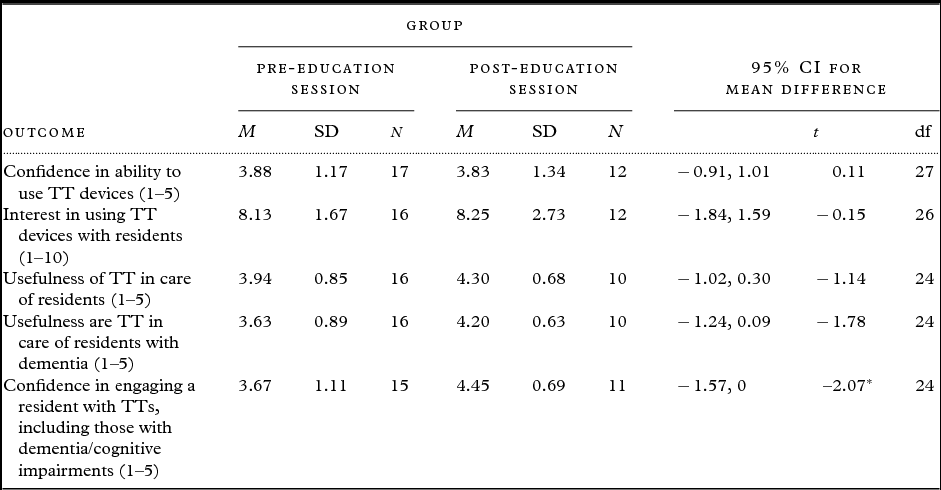
There was no difference between pre- and post-education session on staff confidence in their own ability to use TT devices, their interest in using TT devices with residents, how useful they thought the TT was in the care of residents and for those with dementia in particular. However, there was a significant difference between pre- and post-education session in how confident they felt in engaging a resident with TT, including those with dementia/cognitive impairment, t (24) = −2.07, p < 0.05. Pre-education session the mean confidence rating was 3.67 (scale 1–5, SD = 1.11) and post-education session the mean confidence rating was 4.45 (SD = 0.69). See Table 1.
Results of independent sample t-tests and descriptive statistics by pre- or post-education session

*p < 0.05.
Discussion
This pilot project addresses the issue highlighted in the previous literature (Upton et al., Reference Upton, Upton, Jones, Jutlla and Brooker2011; Reference Upton, Bray, Jones and Upton2013), which reported self-reported low confidence in staff ability to utilize TT with dementia residents. As a result of an education session, staff, who were mostly female, middle-aged, and either personal care attendants or nurses, reported significantly more self-confidence in their ability to use TT devices with residents (including those with cognitive impairment and dementia).
The generalizability of the study was limited by the small sample size and the sample of convenience. In addition, the questionnaire used was not validated, and there was no control group or follow up. As the study aimed to report on staff education, literacy, and confidence, other relevant issues in the effective use of technology were not addressed (such as any problems faced by participants trying to learn the technology). Lastly, although the session included information on using TT in all stages of dementia, the questionnaire did not specifically ask respondents about TT's usefulness and confidence in the context of severity of dementia, thus limiting our understanding of the effectiveness and potential of using TT in dementia care. Future research should investigate the effectiveness of TT training in a larger cohort and assess feasibility of training sessions becoming an integrated part of RACF staff training.
Using technology in dementia aged care is an important and under-researched topic in today's technologically advanced landscape, despite the clear benefits of the clinical application of technology. Despite the limitations, the findings from this study are important, as results lend support for the upskilling of RACF staff in using technology to improve the care of people with dementia. Evidence-based education and training can increase staff confidence in using TT, and will likely result in more successful uptake and implementation of technology in RACFs, helping these facilities to offer an improved consumer experience for residents living with dementia.
Conflict of interest
None
Description of authors’ roles
AG designed and delivered the education session, conducted data collection, carried out statistical analysis, and wrote the paper. SL and AW helped to design the study and together with NL assisted with access to the RACFs and assisted with writing the article.
Acknowledgments
The authors would like to acknowledge the RACF staff for their time and for completing the questionnaires. This project was supported by the Dementia Training Study Centre National Fellowship Program.